Human Being, Not Human Doing

Who looks outside, dreams; who looks inside, awakes.

Carl Gustav Jung (1875-1961; Swiss psychiatrist and psychoanalyst; father of analytical psychology.)

The rain was steady and heavy all night. I say “all night,” but I’m not really certain when it started. It’s not as if it awakened me, and I looked at the clock and whispered to my sleeping self, “Ah, it’s raining.” But I could hear it, even as it lulled me into a deeper and more restful slumber.

When I awakened, the raindrops were pearling their way down the window panes. As I lay in bed–looking and listening–I knew that Plan B would govern my day.

Plan A had been to continue my yard work. This year, my focus is more on “taking out” than on “putting in.” I have lots and lots of shrubs–especially rhododendrons–that have outgrown the spaces where I planted them. For some, a heavy pruning will restore their vitality and their appearance. For others, pruning will neither restore their vitality nor their beauty. They have to be removed. So that’s what I’ve been doing. Pruning. Removing. Hauling truckload after truckload to the landfill. That was my Plan A.

But I had checked the weather forecast before going to bed and knew the strong likelihood of rain.

That was when I came up with Plan B. I could spend the day doing some extra indoor biking. Then, I could start rearranging the artwork in my office–a task that I have needed to tackle for months, but one that I have managed to avoid doing with full success. And betwixt and between, I could make Ukrainian Sauerkraut Soup–perfect for a chilly, rainy-day dinner–and I could bake Jumbo Sourdough Banana Nut Muffins–a perfect way to use up this week’s sourdough discard. 

It was settled. Plan B, it would be.

But before I started to execute that plan, I perused my smartphone news. As I did, I was ever aware of the rain, still falling hypnotically. For a second, I considered stopping the pendulum on my grandfather clock so that the only sound would be the rhythm of the falling rain. Then, in the next second, I looked out the window onto my deck. I could see the raindrops dropping one by one off the scalloped edges of my Asian patio umbrella–all wet with green bamboo, red sun, pink blossoms, and blue happiness. And for another second, I considered trying to count the drops as they fell, starting at the 6:30 position on the umbrella, proceeding clockwise, counting every sliding raindrop, working my way back home, and then beginning anew.

As I considered those thoughts, I glanced down at the next news flash to discover an article from Open Culture: “Stephen King Recommends 96 Books that Aspiring Writers Should Read.” I knew immediately that it was not newsy at all. I had read that same article nearly a decade ago. I perused the list anyway, discovering that I could not claim to have read any more of those books now than I could claim to have read them then. As I reached the end of the article, I found that King had updated his list: “Stephen King Creates a List of 82 Books for Aspiring Writers (to Supplement an Earlier List of 96 Books.)” I scanned that list quickly.

Somehow, I was brought back to the reality of my grandfather clock still ticking. I had not stopped the clock as I had considered doing. I was brought back to the reality of the raindrops still falling off the scalloped edges of my Asian patio umbrella. I had not counted the raindrops as I had considered doing.

I was brought back to the haunting reality that my day was wasting away.

I still needed to meditate so that I could get started with my Plan B. Meditation does not come easy for me, even after years of daily practice. I’m finding, though, that I can sit with myself for longer and longer periods of time without my mind being pulled in the direction of all the other things that I could be doing.

But on this day, when the “all” of the day seemed to be wrapped up in the “all” of the rain, I decided to sit for a shorter-than-usual spell. Ten minutes. No more. I had things to do on my Plan B.

I was drawn to an 11-minute mindfulness session. Surely, I could spare an extra minute, especially since the title tugged at me: “Human Being, Not Human Doing.”

“If you’re like most people, you probably feel like you have to be constantly doing something.”

I was stunned. How on earth did acclaimed meditation coach Lynne Goldberg know so perfectly how I was feeling? How I feel so often?

In her meditation session, she explores the roots of our obsession with doing, tracing the origins all the way back to our childhoods when others praised us for doing things that we were good at doing. Art. Dance. Music. Sports. Wordplay.  She continues her exploration–even into relationships–noting that the praise we receive for the things that we do begins to validate us and our self-worth.

And then she drives home her point. Validation through doing is external, controlled by others. It leaves us with the feeling that we have to continue to do–to perform–in order to get those accolades. To feel loved. To maintain that sense of self-worth. Interestingly enough, we’re not even aware that it’s happening.

“At your essence, you are a human being, not a human doing. You are loved and worthy and enough exactly as you are. The only approval that you need is that of your own.”

“Well, of course,” I say to myself. The notion of loving yourself–of approving yourself–goes all the way back to the ancient Greeks even if it did not enter mainstream psyche and pop culture until the Beat Generation of the 1950s and the Hippies of the 1960s.

More, I’m not quite certain that I agree with Goldberg’s tack of tracing our emphasis on doing to the praise that we received from doing things well as long ago as our infancy. It seems to me that we need to consider other possibilities. The joy and love of work. The joy and love of doing. The joy and love of creating. The internal, self-validation that doing things well brings us even when others are totally unaware that we’re doing them.

But I’m not going to quibble over any of those possible disagreements right now.

For now, I’m just glad that I stumbled upon Goldberg’s meditation.

For now, I think that I will revisit King’s recommended reading lists and start to read–or reread–one of the books that I find there.

For now, I think that I will count the raindrops as they fall off the scalloped edges of my Asian patio umbrella.

For now, I think that I will stop the pendulum on my grandfather clock.

For now, I think that I will continue lounging in my azure blue linen bathrobe as noon approaches and as rain continues.

For now, I think that scrambled eggs on toast might be perfect for dinner.

For now, I think that I’m really enjoying doing nothing more than just being.
More Mishaps & Memories

“I’ve learned so much from my mistakes … I’m thinking of making some more.”

Cheryl Cole (b. 1983; English singer and television personality.)

Well, I don’t know about you, but this past week has been quite a week for me. I daresay that it would have been for you, too, if you had disclosed as much about yourself–for the whole world to see–as I did last week in my “M & M’s: Mishaps and Memories.”

I mean, it wasn’t too bad that I fessed up to not remembering the mishap that prompted the post in the first place, and it wasn’t too bad that I shared two foot-in-mouth mishaps. But what on earth possessed me–at the end of the post–to mention my IQ test.

Without a doubt, I did not need to bring up my IQ. Even now, after considerable reflection, I don’t know why I did. It’s not as if I don’t have an IQ. I do. But–brace yourself–I had to take my IQ test twice to find out my score.

Right now, the foot in my mouth is getting harder and harder to swallow, so I had just as well tell you all about my IQ test mishap so that I can gulp–and you can gasp–and we can all be done with it.

I was in the third grade. Maybe I wasn’t paying attention to the test directions. I don’t remember. I just thought that it was one more fun thing to do on one more fun-filled school day. And everything was going along just fine until I got to the third test question. It was a math question, and it must have been a real challenge. I kept working away on it, and just when I figured out the answer, the exam time was up.

I flunked my IQ test.

“What do you mean? Of course, Brentford Lee has an IQ.”

“But it can’t be determined because he only answered three questions. He didn’t finish the test.”

“Well, give it to him again and make sure he knows that he has to answer all the questions.”

The whole mishap was more embarrassing for my parents than it was for me. It didn’t bother me too much because, in my mind, I blamed them. After all, they were the ones who had taught me:

If a job is once begun

Never leave until it’s done.

Be it’s labor great or small,

Do it well or not at all.

Naturally, when I was challenged by that math question, it became my job. I kept working on it all the way to the end of the exam time. In my mind, that question became my great labor. I was fiercely determined to figure it out. Until I did–and I did, eventually–I couldn’t begin to think about all those other questions. In my mind, they didn’t even exist.

Well, like I said, I had to take the test again to establish for someone’s benefit that I had an IQ. I guess I showed them a thing or two because I didn’t have to take it a third time.

But don’t ask me to tell you my IQ score. I can no more remember it than I can remember my Myers-Briggs personality type. I always have to have Jenni remind me. (Dear Readers, you do remember Jenni, right? She’s my dear colleague, who set me up for this mishaps-and-memories nonsense in the first place.) Anyway, I’m 75% certain that I’m an ENFJ. It’s the 25% J part that always causes me to ask Jenny. Unlike me, she remembers everything.

Here. I’ll prove it. I just sent her a text message:

What is my Myers Briggs type?

If I recall correctly, aren’t you ENFP?

P?

I know the E and P for sure. The other two I think are right…

See. I told you. Jenni remembered. I am ENFP, and I’m sticking with it for now.

Wow! I’m glad that I told you all about my IQ mishap.

Now I can move on.

I mentioned last week that the mishap that sparked last week’s post might have had something to do with cooking or baking.

Now, however, I don’t think that it had anything to do with baking. I have shared my one memorable baking mishap already in my “Baking Up My Past.” Remember? In my first childhood baking adventure, I measured the baking powder incorrectly. Neither I nor my mother knew until batter oozed out the door of our South Bend, woodburning-cookstove, onto the kitchen floor.

Obviously, I have had other baking mishaps down through the years. But I have my reputation to protect–in my own mind, at least, even if nowhere else–so I’ll keep those to myself.

As for cooking mishaps, I do have one that always makes me laugh. It proves, once again, how naive and innocent and unschooled I am in the ways of the world.

I’m not certain, however, that it can be considered cooking. Is popping popcorn cooking? And it involves a microwave. I’m fairly certain that preparing anything in a microwave can not be considered cooking.

Nonetheless, here’s the laughable mishap that might have been related to cooking, depending on your culinary views.

For years, I would have nothing to do with microwaves. But the time came when my oldest sister Audrey talked me into letting her gift me with a microwave. As near as I can remember, it would have been around 1994 when my now full-time home in the Shenandoah Valley was then just a weekend getaway. She thought that I could use the microwave, if for nothing else, for popping popcorn. I mean, who doesn’t like popcorn? So I accepted her gift, not realizing how big the microwave was nor how much it weighed. It was, after all, 1994, and by then microwaves had advanced a lot, and they were much smaller than the commercial refrigerator-sized RadarRanges that Raytheon brought out in the 1940s. I assumed that my gift would be modern and small, too.

Small? Not. It was huge. It took up nearly all of the island counter space in what was then my super-small, weekend kitchen.

But, hey. I’m always up for a popping good time. So I bought a box of Jolly Time popcorn packets.

I put a pack in my clunker microwave and stood there in full anticipation.

Nothing. No popping sounds. No popcorn aromas.

Nothing.

I tried again. Nothing. As my IQ test mishap demonstrates, I don’t give up. I went through the entire damn box and my entire damn evening. Nothing.

The next day, I took the box and all of the unpopped packets back to the store.

“I want to get my Jolly Time money back. This popcorn must be old. None of it would pop.”

I walked away with a refund.

A few weeks later, my sister called to see how I was enjoying the microwave.

I told her about my disappointing popcorn experience.

“What cooking mode did you have it on?”

“Say whaat? Cooking mode?”

She explained the controls and the various options.

“Run into the kitchen and check. I’ll stay on the line.”

I was back in a sec.

“It’s on … Defrost.”

Dang. Defrost. Needless to say, I felt like an idiot. For some reason, I never did like that microwave after that memorable mishap.

At last, I remember the mishap that started all of these confessions. It was decidedly a technological mishap, even more embarrassing than the microwave one.

This mishap happened in the late 1980s or early 1990s when Chesapeake and Potomac Telephone introduced Caller ID to its subscribers in Washington, DC. I had just launched my own side gig–Potomac Research Organization (PRO)–and I felt a compelling need to monitor my incoming calls.

Instanter I went downtown and bought myself new phones so that I would know who was calling me.

As soon as I installed them, I called my sister in Richmond:

“Hey. I just bought these new Caller ID phones. Call me so I can see who’s calling.”

She did. Her name and number did not show up on my phone.

I did the same thing with my oldest sister in West Virginia.

She called me. Again, her name and number did not show up on my phone.

I unplugged my phones, boxed them up, and on Monday, I marched in the store, asking that my defective phones be replaced.

What do you mean by defective?

I explained in detail my two “test” experiments with my two sisters.

The salesperson looked at me with a smirky smile that still makes me cringe:

“Have you enrolled in Caller ID with Chesapeake and Potomac?”

“Say whaaaaat? Do you mean to tell me that I have to buy new phones AND enroll in Caller ID? Well, I have never.”

I got my money back, and I was perfectly happy living my life exactly as I had been living it: answering my phone without knowing who was calling. Or not answering it at all.

Yes, indeed! Caller ID was the mishap that sparked the idea for last week’s post and for this one, too.

I wish that I could say that I have learned a lot from my mishaps. I haven’t. And I wish that I could say that I won’t have any more mishaps. But I will. And I will keep right on laughing through all the memories.

M & M’s: Mishaps & Memories

“To make mistakes is human; to stumble is commonplace; to be able to laugh at yourself is maturity.”

William Arthur Ward (1921-1994; American motivational writer.)

Memory of an elephant. Yep. That’s exactly what I’ve got, and you–My Dear Readers–can vouch for me. As you know, I can drone on and on about many things, especially about my elephant memory. I did so just week before last in “Dating after Twenty-Three.” Remember? Of course, you do.

But here’s the thing. For this week’s post, I’m in a bit of a pickle. I’m having a memory lapse.

Don’t worry. I’m sure that it’s minor, and I’m sure that it’s momentary. But for the life of me, I can’t remember what the hell this post is supposed to be about. I don’t mean in the broadest sense of its content. Of course, I know that fully well: mishaps and memories.

The idea sparked as miraculously as spontaneous combustion one day last fall when a dear colleague and I were exchanging lighthearted banter, and I ended up fessing up to one of the many mishaps that I’ve suffered down through the years that ended up as memories.

As soon as I shared it with her, she quipped:

“That would be an excellent angle for one of your blog posts.”

I agreed. Almost immediately, I started a draft and made it as far as the preliminary title: “Mishaps and Memories.” In an instant, the two M’s seemed sweet enough to melt in my mouth, so the working title became the final title of today’s delectable treat: “M & M’s: Mishaps & Memories.”

Immediately, I loved the quadruple alliteration as well as the double ampersand. I still love them. Plus, in high school, I learned that every good title has a main title and a subtitle, separated with a colon. Can you believe that I remembered that little rule after all these years and used it here with a full measure of success?

But I sure wish that I could remember the memorable mishap that sparked this idea the day that my colleague and I were having such frivolous merriment on paid college time. (Oops! Did I just say that? Well, so be it. It’s not a problem for me anyway because I’m no longer on the college’s payroll. I’m reinventing myself at my own expense. It’s no problem for my colleague either because I have not disclosed her identity.)

Let’s see. What can I do to jog my memory? I know. I’ll use my alphabet technique for remembering things. Starting with the letter A, I’ll slowly work my way through the alphabet, lingering on each letter for a bit. When I get to the letter of whatever it is that I’m trying to remember, the entire word will flash apocalyptically across my mind.

Well, I’ve been from A to Z and back. Not once. Not twice. But three times. No apocalypse.

Well, duh. Why don’t I just text Jenny? I’m sure that she would remember our conversation. On the other hand, doing that would give me a ready answer and spoil all my fun and yours, too.

If I keep at it, I’m sure that I’ll remember. Aside from my foolproof alphabet technique, I have another technique for remembering things. But right now, I can’t remember it either.

So where was I? Oh, yes. I remember. I was trying to remember my memorable mishaps.

Well, let me just start sharing some, and as I share, maybe–just maybe–I’ll remember the one that Jenny thought was so riveting.

The mishap that I am about to share was the result of my naivete and innocence coupled with my polite and courteous outspokenness, for which I am so well known.

When I started my Federal career, I was part of a large editorial team. One of my co-workers was Ed-h B-l-–r. After a year or so, I transferred to another editorial position in the same Federal agency, but in a different building.

On my first day in my new position, I was introduced to one of my fellow editors, H-l-n B-l—r.

Since their last names were the same, I assumed that they were related, and I was so delighted with myself that I had a perfect way to get into a perfect conversation with her.

“It’s an honor to meet you. Are you related to Ed–h B-l—r?”

“Do you mean the bitch who stole my husband?”

What an embarrassing mishap. Now, though, it’s a funny memory.

Okay. Let’s try another mishap confirming that I am naive, innocent, and downright dumb when it comes to being politely and courteously outspoken.

Fast-forward, if you will, a good number of years. Same Federal agency. Different position. Different building.

In that position, I had to review everything that the staff ghostwrote for my boss, the director.

One memo caused me to have some major concerns, and I called them to B-n’s attention.

“Go down there right now and tell N-r- that this is nothing but a piece of sh-t.”

I did as directed.

“Good morning, N-r-.” I flashed my widest smile as I handed her the document. “B-n told me to tell you that this memo is nothing but a piece of sh-t.”

N-r- stormed out, taking the stairs to B-n’s office on the sixth floor. I took the elevator, hoping to warn B-n. Fury must have wings. She beat me to his office where I found her giving him a piece of … her mind.

Sadly, these two foot-in-mouth mishaps haven’t taken me any closer to the mishap that I’m struggling to remember.

Maybe it had something to do with technology?

Maybe it had something to do with cooking or baking?

Maybe it had something to do with both?

Surely, it didn’t have anything to do with my IQ test. I don’t think that I have ever disclosed that mishap to one single solitary living soul. No, not one.

And, please, please, please, Dear Colleague who was with me when the idea combusted originally: do NOT reveal your identity by commenting on this post to tell me the memorable mishap that I can’t remember. You must remember that I have done everything in my power to keep it concealed.

Also, doing so would make me look really dumb. Work with me. Give me a little more time. By next week’s post, I’ll surely remember the memorable mishap that I can’t remember right now.

Wrapping My Arms Around All

“Diversity is a fact, but inclusion is a choice we make every day.”

–Nellie Borrero (Global Inclusion and Diversity Manager, Accenture)

Ask those who know me, and they will tell you that I’m a hugger. Ask those who didn’t know me once upon a time, and they’ll tell you that they weren’t strangers for long: I hugged them, too. I can’t help myself. I was born hugging, and I was born smiling. Seventy-five years later, I’m still smiling and still hugging. Go figure.

It’s fair to say, I suppose, that this hugging-and-smiling-thing that I’ve got going is part of my nature. I was born with that genetic disposition. But it’s equally fair to say, I suppose, that it’s part of my nurture. I grew up in an environment that encouraged everyone to embrace everyone, figuratively and literally.

For me, the nurturing environment was the coalfields of Southern West Virginia, sprinkled with veins of coal that ran out too soon and with rays of hope that would not fade. Hardship has a magical way of bringing people together. Of getting folks to wrap their arms around one another to show acceptance. Of getting folks to wrap their arms around one another to affirm goodness. Of getting folks to wrap their arms around one another to claim better.

Coal-camp kids know the love language of hugs, probably far better than adults, because they hug daily at the flour-sack-apron level and at the  tarnished-belt-buckle level.

They hug weekly at the worn-hymnal level. I remember one song in particular that still reverberates in my ears:

Jesus loves the little children,
All the children of the world;
Red and yellow, black and white,
They are precious in His sight,
Jesus loves the little children of the world.

As I sang, I was convinced that the “little children” in the song were me and my friends, mingling together the many colors of our ethnicities. Blacks. Greeks. Hispanics. Hungarians. Italians. Puerto Ricans. Whites. And I was equally convinced that “the world” in the song had to be my coal-camp world where I stood in church singing “Jesus Loves the Little Children.”

It would be easy for me to say that from that point forward in my life I would hug everyone. Accept everyone. Embrace everyone. Automatically. Without even thinking.

But it’s not that easy. Celebrating diversity and inclusivity is not an autonomic function like breathing. It requires conscious choices. It requires conscious vigilance. It requires conscious mindfulness.

I didn’t realize that it involved choices until I was seven, and my family moved away from our one-road-in, one-road-out coal camp.

My new world was still in Southern West Virginia. It was still in an area where coal mining was an occupation. But it was a middle-class world, one not faced with the same economic challenges that had brought ethnicities together in the coal camp where I lived before. My new friends’ dads weren’t miners like mine. They were grocers and teachers and electricians and car dealers and tire distributors and band directors. More significant, perhaps, the “little children” in this new town were mainly one ethnicity. White. Like me. We had no Black families. We had no Greek families. We had no Hungarian families. We had one Hispanic family. We had one Italian family.

My new circle of friends included White kids, and I wrapped my arms of friendship around them. But I consciously chose to wrap my arms of friendship around the Hispanic and the Italian, both my age, not only because I liked them but also because I was mindful that we faced similar challenges: mine, economic; theirs, ethnicity.

My world changed again when I went to college. There, my classmates’ parents were from all walks of life. There, I had a few classmates from various parts of the world. But, truth be told, it was largely a White-like-me world. I consciously chose to wrap my arms of friendship around other ethnicities whenever I could. My roommate one year was Black. Another year, Hindu. When I joined a fraternity, my Big Brother was Hispanic. One of my Black friends was crowned Homecoming Queen. On chilly evenings, I often draped my fraternity jacket over her shoulders, walking back to her dorm after an evening together in the Student Union.

After college, my world changed again when I moved to the Nation’s Capital and discovered the full depth and breadth of diversity: race and ethnicity, economic status, religion, age, disability, gender identity and expression, and sexual orientation.

At the same time, I continued to be aware that celebrating diversity and inclusivity requires choices and mindfulness. When I started going to church on Capitol Hill, for example, I walked into the nave and was stunned to see one Black man sitting all alone in the middle of an otherwise entirely White congregation. I could have sat anywhere, but I made a conscious and mindful choice to sit next to him. A few months later, I went to Joe’s regular church. I found myself sitting in the middle of an otherwise entirely Black congregation. When Joe came in, he could have sat anywhere, but he made a conscious and mindful choice to sit next to me.

Those examples are just that. Examples. They’re not profound. They’re not extraordinary. They’re simply intended to show that if we are to celebrate and embrace diversity and inclusivity, we must do so through conscious and mindful choices.

I would add as well that we must be vigilant. Let me share something that took me off guard a few weeks ago. My behavior surprised me. Actually, it shocked me.

I was scrolling through options for my morning meditation. Each option had a visual. I was drawn to the image of a tall thin man standing by the ocean’s edge, facing a glorious sun spreading its rays over the waters. It looked inviting.

“Perfect,” I thought.

I hit PLAY AUDIO. The soft background music began. Then, the meditation coach began talking. In an instant, the voice grated on my ears and irritated me. I hit QUIT and selected another meditation.

I did the exact same thing for the next several days.

Then, one morning I realized how judgmental I was being. I was hitting QUIT based on nothing more than voice. I didn’t give the meditation coach a chance. I didn’t give myself the opportunity to listen to the message. I didn’t give the message the opportunity to speak to my heart and uplift my soul.

When I had that realization, I made a conscious choice to listen to the meditation. I made a conscious choice to accept the voice.

It didn’t take long for me to be carried forward as the meditation coach emphasized some key points that can never be emphasized enough:

● Let go of yesterday and the past.

● Be present with yourself and those around you.

● Forgive yourself and others.

● Be aware of the sun rising, spreading its light everywhere and across everyone without any judgment.

Without any judgment.

Those three words stirred in me a profound sense of self-condemnation, for I had judged the meditation initially based on nothing more than the voice.

Fortunately, I had the opportunity to course correct. Fortunately, I made a choice to listen.

I’m awfully glad that I did, for the meditation ended with a powerful message:

Wrap your arms around your body and feel the warmth of your hug and say to yourself, “Have a very good morning, me.”

The meditation made me aware that I need to be ever vigilant so that I don’t let unintentional biases slip in, skew my perspective, and deprive me of the awesome riches that await me when I wrap my arms around all.

Dating after Twenty-Three

MY CURRENT RELATIONSHIP STATUS: I made dinner for two. Ate both.

–Unknown

Trust me. I wish that I could write a blog post that focuses on the ins and outs and ups and downs of dating after the age of twenty-three. Unfortunately, that is so long ago for me that I probably can’t remember. On the other hand, I have the memory of an elephant, and I  remember everything–literally everything–so I am sure that I could conjure it all up. But relax. I will spare you the torrid and sultry details.

But that’s neither here nor there because this post is not about dating after the age of twenty-three. This post is about dating when you haven’t dated for twenty-three years. (Not to worry. The operative word in the preceding sentence is haven’t. Equal to my elephant memory is my vivid imagination. Once again, relax. I will spare you the details of what is yet to happen, but trust me, those imaginings are getting hotter and steamier by the second, and they can’t happen soon enough. I think.)

The operative sentence in the preceding paragraph is “I think.”

Let’s face it, if you haven’t been on the dating circuit–Is that what it’s called these days? Circuit? Market? Game? Scene?–well, whatever it’s called, I haven’t been on it for twenty-three years. That’s a helluva a long time, and believe me: I’ve got plenty to think about before I throw myself into whatever it’s called.

The last time that I threw myself into whatever it was called back then, I was young. All right. I know. I can do my own math just as well as you can do it for me: 75 – 23 = 52. So. Fine. Being young is relative. Let’s try this wording: I was younger then than I am now. So, for Pete’s sake, can we just move on?

In those days, dateables–or whatever you want to call ’em–seemed to be everywhere. In front of me. Behind me. On both sides of me. They were just everywhere. But in the interest of being totally transparent, I will tell you this. It’s not like I was fighting them off,  but I sure had lots of options to think about. After all, a good man is hard to find.

These days, dateables don’t seem to be anywhere. They’re not in front of me. They not behind me. They’re not on either side of me. They are nowhere. Absolutely nowhere. I know because I’ve looked everywhere. I wouldn’t want the world at large to know, but I’ve even looked in the trees all around my house, thinking, wishing, hoping, longing that maybe–just maybe–I would find one there. You know, just hanging out all casual and relaxed and friendly like, waiting for me. Waiting to see if I was looking back to see if… But I haven’t found one–not one–which proves beyond a shadow of a doubt: dateables do NOT grow on trees in the Shenandoah Valley of Virginia.

So that you can check out my assertions for yourself, let me give you the exact location in the Shenandoah Valley of Virginia where I have determined that dateables do not grow on trees. Doubt no longer. Check out the latitude and longitude coordinates and know that I speak truth and kid you not: 31.771959, 35.217018.

For now, this much is obvious to me. If I am to continue this post–and, having made it this far, I have every intention of making it all the way through to the end–I will just have to shift my focus from real dates to imaginary ones. In that sense, then, it would be similar to “My Imaginary Guests.” Actually, I like that comparison so much that I’m tempted to change the title of this post from “Dating after Twenty-Three” to “My Imaginary Dates after Twenty-Three.” Thankfully, that temptation–unlike some others–did not last long. I wouldn’t want a Potentially Dateable Person (PDP) to be turned off by perceived fickleness. I stand by mine just as surely as Tammy Wynette stands by hers.

All right, then, where were we. Don’t you just love my use, just now, of the royal “we.” I do. I’ll bet you’re wondering–just as I much as I am–when we first used we so royally. Let me check.

Be Right Back.

Well, according to the Oxford English Dictionary (OED), the pronoun “we” (used in place of “I” by a monarch or other person in power) goes back to 1801 when Buonaparte appointed his brother-in-law, Leclerc, to St. Domingo.

Isn’t that riveting? I wonder what other words I could look up right quick? Hmmm. If I  didn’t know better, I’d swear that I’m doing everything in my power to avoid getting into all the nitty gritty details of all that’s involved in dating–real or imaginary–after twenty-three years.

I assure you that I am not. This really isn’t a big deal after all. I’ll do what I do best: face it head on.

So work with me while I pretend that I have, in fact, found a real, live, breathing, walking, talking date.

What’s for certain is that I didn’t find one in a tree. Ahhh…now I remember. My imaginary friend lined me up with a Blind Date.

Be Right Back.

Sometimes my imaginary friend is a prankster, so I had to confirm that Blind Date was still used these days to mean “a date with someone whom the datee does not know but which is arranged by a third person.” The OED assures me that the phrase is still used, though mainly colloquially, and that it is still politically correct.

We’re good to go with both, so I suppose that I’m good to go with this phone number of a PDP. My imaginary friend thinks that we might click. Is that what it’s called? Might be in harmony? (Nope. We’re not singing.) Might go hand in hand? (Nope. In public? In the Shenandoah Valley? Come on.) Might harmonize? (Nope. Again, we’re not singing.) Jibe? (Say whaat?) So much for a thesaurus. I’ll stick with click.

Let me get this over with right now. If I don’t, I’m going to look bad, and that might make my imaginary friend look bad. All that I have to do is make the call, pop the question, and hear what happens. Hang on.

Be right back.

Well, dayum. That went better than I thought. Far better. I loved the voice that I heard. Confident but not too assertive. Raspy but not enough to make me suspect a cold. Loud but not enough to make me suspect the use of a hearing aid or, worse, the need for a hearing aid paired with a refusal to admit it or a cheapness to buy it. So far, so good. I got a resounding “Yes” to the question that I popped.

We’re going to meet for coffee at our local Starbucks. Isn’t that a great idea? It was mine. You’re probably thinking that Starbucks is a dumb first-date idea. You’re wrong. Actually, it’s the perfect spot for a first date. Here’s why. Multiple studies–each one referencing the other for validation–have determined beyond any scientific doubt–thereby eliminating any need whatsoever for a third study to validate the first or the second–that we should size up people not on the basis of their shoes, not on the basis of their cars but rather on the basis of the drink they choose at Starbucks.

So my date’s beverage choice will be the first reveal. Is that caffeine in my cup or what?

I don’t mind telling you that I’ll order my usual Latte or Cappuccino. OMG. Here’s how the research sizes me up, based on my preference:

… perfect blend of the drip coffee folks and the chai latte people. Sometimes shy, sometimes outgoing … so balanced, well adjusted, and free of common neurosis you wonder if a magical fairy raised this magical unicorn. … Date this person ASAP. [Emphasis supplied for any PDPs who might be reading. Just saying. You know how to find me.]

I’m hoping that my date might order a Chai Latte. Would I be one lucky dude or what, if what the research has established is true:

The Chai Latte … person is at their core a humble introvert. … they’ve probably traveled to some remote untamed parts of the earth, have a double PHD in astrophysics … Navigating through life with a Buddhist mentality the Chai Tea person is the opposite of an open book. Mysterious like a mythical creature, you watch them trot off to yoga class and feel your heart squeeze. You might be in love.

Say whaat? Might be in love? I haven’t even swallowed the first sip of my Latte or Cappuccino. Slow down. Let’s enjoy this.

But if my date orders a Java Chip Frappuccino, that will pretty much be a deal breaker for me:

Always full of spice and sass … rocket-balls of energy. Do NOT stand in their way. The frappuccino person is the one driving the car with the ridiculously oversized rims and the dude wearing the blinding bright red jewel encrusted Giuseppe Zanotti sneakers.

Those rocket-balls of energy sound intriguing, but if my date orders a Java Chip Frappuccino, I’ll drink my Latte or Cappuccino as rapidly as possible so that I can get out of Starbucks with my “This was so ……” echoing as I wave goodbye.

While Starbucks was my idea, meeting there at 7:30am was not. I mean. Come on. I’m a morning person, but that’s a bit early, it seems to me, for a first date.

But I’ll get over it, and, actually, it might have real advantages. At that time of day, a handshake will do. Maybe a light hug. But it’s certainly too early in the day–and certainly too early in the dating game–to even think about a kiss. After all, meeting a date for the first time is stressful enough without all the worry about morning breath–the kiss of death when it comes to dating. And, therefore, Dear Readers, you can rest assured: if I should sense even the slightest body movement suggesting that my date is leaning in for a kiss, I’ll just bend over right quick to retrieve my napkin that fell mysteriously to the floor.

Well, as I am sure you can tell, I am not the least bit worried about this first date. If all goes well, it might be the first of many dates that get earlier and earlier. Who’s to say when dawn slides back to midnight and midnight slides back to evening and …

But now I’m wondering what’s supposed to happen with that second date that’s sure to come. I just know that it will. After all, no one in the Shenandoah Valley–absolutely no one–wears blinding bright red jewel encrusted Giuseppe Zanotti sneakers, so I am certain that my date will not have ordered a Java Chip Frappuccino at Starbucks.

So let me see. What comes after that first date? Good God. On my last first date, time stopped and the world stood still for twenty-three years.

Be Right Back.

Thanks for your patience. I had to do some quick research to find out the stages of dating. My sources boldly plagiarized one another, so they are pretty much in agreement. I would document my sources, but I can’t tell which one started it all, so I will share the common threads, paraphrased freely to suit the pitter-patter of my amorous heart.

1. INFATUATION AND ROMANCE. CAN’T LIVE WITHOUT YOU. Say whaat? My concern, Dear PDP, is whether I can live with you.

2. ACCOMMODATION. GETTING TO KNOW LIKES AND DISLIKES AND WARTS. Well, that’s fair enough, I guess. However, just because I’m agreeing does not mean that I have warts. I don’t. Not even one. But I do have one or more wrinkles. But don’t worry. They are not problematic whatsoever. They all disappear every time that I take off my glasses.

3. POWER STRUGGLE. OMG. Please say it ain’t so. At this stage of my life, am I arm-wrestling with my father again?

4. COMPLETE TRUST. This stage is really funny. As I was reading about it, I was looking through the wrong part of my trifocals. Instead of seeing Complete Trust, I saw Complete RUST. At my age, probably.

5. SEXUAL EXPLORATION. Well, it’s about time. I’m going back to Stage 4 and redact RUST. For this stage, it’s all about TRUST.

6. YOU’RE MEETING EXPECTATIONS AND DEALING WITH CHALLENGES. Hello. Didn’t we just deal with this in Stages 3, 4, and 5?

7. SURRENDER TO COMMITMENT AND THE RELATIONSHIP. I’m good with commitment, but surrender? Are we about to wage war?

8. MOVING TOGETHER AS A TEAM. Moving? Where the hell to? Nobody said anything to me about moving. Where are we going? Where I go, my gardens go, too. Where I go, my loft goes, too. Where I go, Ruby goes. (Not to worry: she’s my dog.) Maybe this moving together stage isn’t a good idea.

Actually, the more that I write about it–the more that I think about it–maybe this whole dating thing isn’t such a good idea after all, especially after twenty-three.

Be Right …

Taking Time to Make Time

There are two days on my calendar: this day and that day.

Martin Luther (1483-1546; German theologian; seminal figure of the Protestant Reformation)

How many times have you said to yourself or to someone else, “I can’t wait until [this evening? this weekend? this summer? my vacation? my retirement?] so that I will have time to [read? connect with family? do more writing? start blogging? exercise? meditate? finish some projects? have some me time? sleep in? try that new restaurant?].

My “can’t-wait” list might go like this.

● I can’t wait until this evening so that I’ll have time to sit out by the Koi Pond.

● I can’t wait until this weekend so that I’ll have time to start cleaning up the garden beds.

● I can’t wait until this summer so that I will have time to focus more on my Mary E. Wilkins Freeman research.

● I can’t wait until my vacation so that I will have time to bike new Rails-to-Trails.

● I can’t wait to see where reinvention leads me.

Then, this evening arrives. Then, this weekend arrives. Then, this summer arrives. Then, this vacation arrives. And, finally, reinvention arrives.

And, somehow, every time “the time” rolls around that I had waited for, had longed for, had sometimes even wished small measures of my life away for, all of it–every sweet nanosecond of it–seems to fall through my fingers just as quickly and with as much certainty as fine sand falling through the throat of an hourglass.

And then that prized, precious time is up, and I realize that I didn’t have time to get it all done. Sit by the Koi Pond. Clean the garden beds. Do more Mary E. Wilkins Freeman research. Explore new Rails-to-Trails. Reinvent myself.

Can you relate? If you are being honest with yourself, of course you can relate.

Somehow, it seems that we just don’t have enough time.

I could say that it’s a matter of being mortal. And it is.

I could say that it’s a matter of managing time more wisely. And it is.

I could say that it’s a matter of scheduling time better. And it is.

But here’s the thing.

In reality, all that we have is time.

In reality, we all waste an awful lot of time waiting for the right time and dreaming about the right time.

It seems to me that a far better use of our time might be to make the time to do it right then and right there, assuming that we can do it right then and right there.

It seems to me, just as an example, that a far better use of my time might well be to take the time to write my blog post at the very time the idea floats home to me.

That’s exactly what I did on March 12, the Sunday morning when Daylight Savings Time sprang ahead and stripped away an entire hour, and my to-do list was too long to get it done in the time that I had allotted and that I had left.

It was then that this wacky idea softly settled on my brainscape. It was then that I said to myself:

Take time to make time.

And that’s exactly what I did with this post. I took the time that morning to write most of what you’re reading now. Mind you: that was the same day when I had been robbed of an hour.

Writing it–right then, right there–made me feel awfully stoked. Plus, it freed up my bedtime-time to work on other blog post ideas.

I did a couple of other wacky things after I had my Daylight-Savings-Time realization about taking time to make time.

One day, I took time to make time to sit by my Koi Pond not once, not twice, but three times–all in one day.

Another day, I took time to make time to take a long, luxurious tub soak, smackdab in the middle of the day for no reason at all other than I thought that it was time to let the fragrance of Thyme’s Olive Leaf bath salts bathe my memory and let its softness spill over me as I lowered myself lower and lower into the tub, watching my chest disappear beneath the silky smooth waters.

On still another day– and as nothing more than an out-of-the-blue lark–I took time to make time to create from memory–nothing more than scraps of this and that stored away in time’s shapeless storehouse–a calendar of the milestones in Mary E. Wilkins Freeman’s life. 

And here’s the thing.  Every time that I took time to make time, I didn’t run short on time. I still had time to do everything that I had planned to do.

And here’s the really sweet thing about it all. I didn’t have to wait for this evening. I didn’t have to wait for this weekend. I didn’t have to wait for this summer. I didn’t have to wait for my vacation. I didn’t have to wait at all.

It’s as if the far-away stars and the far-away moons of my wishes, my longings, and my can’t-wait-untils fell down all around me, glowed upon me, and gave me joy as soon as I took the time to make time.

The Frog at My Door

The smallest act of kindness is worth more than the grandest of intentions.

Oscar Wilde (1854-1900; Irish poet and playwright)

My mountain home borders the George Washington National Forest, and, as you might expect, my world is filled with frogs.

Tree frogs, especially, are everywhere. I am convinced that millions and millions surround me. Oddly, though, I don’t see them often at all. They are quite small and awesomely masterful at blending into the trees and forest floor where they live. But I hear them everywhere. Once they start singing–usually in late Spring or early Summer and continuing through mid-Fall–I am in the midst of a nightly surround-sound symphony, commencing with a twilight overture, continuing with a high-pitched repertoire throughout the night, and reaching a calming finale around daybreak the following morn.

The principal musician among the tree frogs is the Spring Peeper, camouflaged to look like tree bark–light or dark as needed. Their song is a pure-tone whistle or peep that rises slightly in pitch from beginning to end. Loud. Piercing. Distant choruses sound like the jingling of small sleigh bells.

Joining them, somewhere in the trees or on the forest floor, are wood frogs–brown, tan, or rust-colored–dark-eye mascara. Their rolling call is a soft, ducklike cackling–ca-ha-ha-ac, ca-ha-ha-ac, ca-ha-ha-acnot too unlike a flock of quacking ducks.

And let me not forget the mottled-skinned Gray Tree Frog. It can be black or almost white, and it can change to light green, yellow, or gray. Its call is a melodious trill, lasting about half a second and repeated over and over again.

Aside from tree frogs, I have several Bull Frogs that live in my Koi Pond. Green tops. Cream or yellow bellies. Large eyes with almond-shaped pupils. I’m most fascinated by their tympana (eardrums) right behind their eyes. My bull frogs belt out loud, resonant bass notes: rumm . . . rumm . . . rumm, or, as some folks claim, “br-rum” and “jug-o-rum.” Wishful thinking.

And, of course, I have Toad Frogs. Stocky body.  Clumsy gait. Dry brown skin. Warts. (No. You did not get your warts from a toad frog.) I love to watch them puff up their bodies when threatened–never by me–in an attempt to look bigger. They, too, have a call. It’s a long trill, and each male in the chorus calls at a slightly different pitch, alternating and overlapping their songs.

And, from time to time, I have seen it rain frogs. Yes. Right here in my yard.

Say whaaaat?” someone just croaked.

Yep. It is possible to “rain frogs.” In severe weather, strong wind gusts scoop them up, blow them hither and yon in the sky, and let them fall to earth again.

Obviously, I spend a lot of time listening to frogs and watching them whenever I am blessed enough to catch sight of them. However, of all the frogs in my world, one has super special meaning.

It’s the frog at my door. My kitchen door. It’s the door that I use when I go out. It’s the door that I use when I come back in.

The frog at my door is a big frog. It’s huge. Actually, it’s the biggest frog that I’ve ever seen. Its belly is all white, a dramatic contrast to the rest of its dark green body, all splotchy with light green spots. And it has several remarkably large warts on its back. As it sits there–all puffed up–its thick lips have a wide, welcoming, fly-trap grin, and its eyes seem forever fixed on mine every time that I walk past. Sometimes, I even think that it looks up and winks at me. Whenever that happens, I always return the flirt.

Is it real?” someone just bellowed.

Well, of course, it’s real. But it’s not alive. I put it there when I started reinventing myself and had to relocate treasures from my college office to my treasured mountain home.

Now the frog sits at my kitchen door, forever looking, forever looking.

My placement of the frog at my door was as deliberate as my purchase. The moment that I laid eyes on it–the moment that our eyes locked–it looked as if it wanted–no, needed–a kiss.

In an instant, I was reminded of the Grimm Brothers’ “The Frog Prince.”

No doubt you remember the story. It’s about a young princess who tossed her golden ball–her favorite plaything–into the air and, failing to catch it, it rolled along the ground and fell into the spring.

“Alas! if I could only get my ball again, I would give all my fine clothes and jewels, and everything that I have in the world.”

About that time, a frog popped its head out of the water and started talking. The princess dismissed him as nothing more than a frog, incapable of helping her.

Ironically, he was not interested in her possessions. All that he wanted, in exchange for retrieving her golden ball, was to have her love, to live with her, to eat from her plate, and to sleep upon her bed.

Thinking that the frog could not get out of the spring even if he could manage to retrieve her golden ball, the princess agreed.

The frog retrieved the golden ball. Overjoyed, the princess took the ball and ran home, oblivious of her promise.

The frog followed. When the King discovered what had transpired, he made his daughter honor her promise.

We all remember the rest of the story. The cruel spell was broken, and the frog turned back into a handsome prince. The prince and princess got married, and, of course, they lived happily ever after.

The fairy tale teaches children and all of us several important lessons:

● The importance of not judging people based on their appearances.

● The importance of treating everyone with love regardless of how they look.

● The importance of keeping the promises that we make.

It seems to me, though, that the fairy tale teaches us one more important lesson:

● Magic can happen when we help others meet their needs.

Think about it. The princess needed to get her ball from the bottom of the spring. The prince needed to be freed from the evil spell that had turned him into a frog.

By the end of the fairy tale, each had met the other’s needs. Magic happened.

So there you have it. That’s why I put the frog at my door. As I go out, I want to be reminded of the multitude of needs that I might encounter and the opportunities that I might have to help meet those needs.

Mind you: when I leave, I’m not headed out on a mission to find needs. I’m simply going out to take care of my own affairs, but as I do so, I hope to have a greater awareness of other people’s needs.

Their needs need not be big or earth-shattering. More often than not, they’re small. More often than not, I can’t meet them all every time that I head out. But when I can, I want to be reminded to do what I can.

● I want to be reminded to smile and be friendly to everyone, including strangers.

● I want to be reminded to buy local and to support small businesses.

● I want to be reminded to be on a first-name basis with all the grocery store clerks.

● I want to be reminded to thank the attendant at the sanitation landfill who rarely gets thanked and to remind her of the importance of the work that she does.

● I want to be reminded to see whether I can help the driver who has pulled his car off to the side of the road.

● I want to be reminded to show love to the seemingly unlovable; to make eye contact with the homeless person on the corner; to give generously; to offer to buy a meal.

● I want to be reminded that less can be more and that I can donate to others what I no longer need.

● I want to be reminded to pay it forward: to help someone starting their career; to give someone a word of encouragement; to be the shoulder that a friend can lean on.

● I want to be reminded that I might be the fire that inspires my local postmistress to go back to college.

● I want to be reminded that without even knowing it, my positivity might be the light at the end of someone’s tunnel.

I want to be reminded of all those things and so many, many more.

This much I know. When I get back home, the frog at my door will be there, waiting for me. Our eyes will lock once again, and at that moment, the frog at my door will hold me accountable: Did I do all that I could do? Did I turn my grand intentions into meaningful actions?

Maybe it’s just the frog at my door, but in my mountain world, it’s as magical as any fairy tale.

The Final Cake

Speak your latent conviction, and it shall be the universal sense; for the inmost in due time becomes
the outmost—and our first thought is rendered back to us by the trumpets of
the Last Judgment.

RALPH WALDO EMERSON (1803-1882; AMERICAN ESSAYIST, POET, PHILOSOPHER, AND LEADER OF THE TRANSCENDENTAL MOVEMENT; from his seminal Transcendental essay  SELF-RELIANCE [1841])


Dayum! I just realized that the title of today’s post might lead you to believe that I’ve baked my last cake. Not to worry. I haven’t. I mean, after all, I’ve been stacking cakes for layers on end, and I have cakes to bake before I sleep and cakes to bake before I sleep. (Frost and I have our own thing going.)

Let me count the cakes. (Barrett–Elizabeth, not Robert–and I have our own thing going, too.) I’m thinking something like around the world in 80 cakes. (Well, dayum again. It looks as if movies and I have our own thing going. Maybe I have my own thing going with everything. No doubt. I do.)

But imagine that. Baking 80 cakes from around the world. Well. I have never, not yet at any rate. But I wonder: will I be the first? BRB.

Well, triple dayum. Every time that I have a brilliant idea, someone goes and steals it from me–right here in plain sight for everyone to see–and manages to get away with it years before I even manage to speak up and declare it in my post.

Yep. You read it right. Famed pastry chef Claire Clark has already done it: 80 Cakes from Around the World. 6 continents, 52 countries. What adventures. What delights.

OMG! I just had another brilliant idea! Forget my idea of around the world in 80 cakes. Well, actually, we can’t forget it, can we? It’s published as a book already, enjoying life everlasting to its fullest.

Fine. Since Clark’s book focuses on countries, here’s another idea. I will remove that which defines countries as countries. I’ll take away all the borders. Is that a stroke of genius or what? Then I can bake what I want to bake and not be boxed in. BRB. I have to go Google.

Well. Dayum nearly flew out of my mouth again, but I’m getting tired of saying dayum because I’ve said dayum three times already. So, dammit. I Googled, and, once again, someone stole my idea even before I had a chance to speak up and declare it here in my post.

Yep. You read it right. Jennifer Rao has poured the batter already and is baking it up as eBooks. Cakes without Borders. Volume 1: The Maiden Voyage. And she’s added another layer. Cakes without Borders Volume 2: The Journey Continues.

Fine. No problem. Since the baking borders are gone, let’s call it like it is. One World. How’s that for a simple-syrup solution? I’ll bake up One World Cakes. Forget cakes without borders. BRB. I have to go Google again.

Well, as I live and breathe. I have been duped again. What I found was not a perfect match, but it was close enough in spirit and intent that my conscience would never ever let me move ahead with what I know would become my One World Cakes empire. I can’t because Oksana Greer started her One World Cafe in 2007.

Well, I’ve gotten over the repeated theft of my ideas before I even had the chance to speak up and declare them, but now “one world” is floating around in my head. We are, you know, One World. More and more every day. One world.

But if you had asked me when peopled started talking about one world and the heightened responsibilities that we face as one world, I would have credited Pearl S. Buck, who alluded to one world in her 1950s essay “Roll Away the Stone,” contributed to NPR as part of its “This I Believe” program:

I take heart in a promising fact that the world contains food supplies sufficient for the entire earth population. Our knowledge of medical science is already sufficient to improve the health of the whole human race. Our resources and education, if administered on a world scale, can lift the intelligence of the race. All that remains is to discover how to administer upon a world scale, the benefits which some of us already have. In other words, to return to my simile, the stone must be rolled away.

But I’m glad that you didn’t ask, because I would have been wrong. Buck was not the first. Credit for the first use of one world goes all the way back to 1919:

The English idealists have followed Hegel rather than Fichte … in striving for a one-world theory, for seeing ideal values realized in the actual (Political Science Quarterly, 34: 610).

Gracious me. Have I gotten side stacked or what? If I keep this up, my post might well compete with a Smith Island Cake. Please tell me that you know about this famous cake from Smith Island, Maryland. Say whaaaat? You don’t. Well, let me take just another crumb or two to bring you into the cake know. The Smith Island Cake has been honored a mighty stack of times for the defining role that it has played in American culture. It is a super-sweet confection, consisting of at least seven thin layers with cooked fudge icing between the layers and on top. The side of the cake is often left unfrosted. (I made one once with 15 layers. Talk about a show-stopper.) Give yourself the baking challenge. Here’s Mrs. Kitching’s Original Smith Island Cake. Or, if you prefer, buy one online: Smith Island Baking Company.

Enough of Smith Island Cakes. Enough of one world and one world cakes. Enough of cakes without borders. Enough of around the world in 80 cakes. Enough of my nonsense.

It suits me just fine to let it all go. Enough is enough is enough. Besides, those who know me well know that I have baked the good bake and that I will continue to do so (The Bible and I have our own thing going, too.)

I suppose, then, that the best thing for me to do is stop salivating over the gazillion cakes that I have yet to bake and start putting the frosting on the final cake that I baked, the one that got me going with this post.

Let me tell you all about it. I promise: I’ll make it no more than a three-layer cake.

During my twenty-three years at Laurel Ridge Community College (formerly Lord Fairfax Community College), I always baked cakes for my classes, especially my Creative Writing classes. They were smaller than my other classes. Plus, I usually met with Creative Writing classes on Fridays. Bringing cake seemed perfect for a three-hour class like that.

Baking for my classes became a standard. If it was a Kendrick class, there would be Kendrick cakes. Word traveled fast. Once I walked into class on the first day and discovered that one of my students had written on the board:

We heard there would be cake.

Is that sweet or what?

I continued baking for my students throughout my teaching career, all the way through Fall 2022, my final semester as a full-time professor at Laurel Ridge. However, that semester I treated my students, week by week, to various types of sourdough muffins.

As I prepared for our final class–which turned out to be my final class, too–I had in mind my usual: celebrate my students and their writing successes.

Muffins didn’t do it for me. It just had to be a cake. I had many of my favorites lined up as possibilities, but it seemed to me that my students should get to choose.

So, for our final class, I’m baking a cake to celebrate. And here’s the deal. You get to decide what kind of cake. What would you like? Just name it. You’ll get it.

Silence fell over the very same room that I sometimes thought could never be silent.

But I learned decades ago that the best way of breaking classroom silence is to remain silent.

It always works. After a minute of silence that felt as long as a semester, one student spoke up:

German Chocolate.

Robbie, thank you very much. German Chocolate it shall be.

I was silent for a moment, pondering why Robbie was the only one bold enough to speak up and declare a preference. The others sat there as if they could not speak. The others sat there, as if they had no preferences whatsoever. I knew otherwise and started laughing a little, as I started asking why no one else spoke up. Typical responses followed:

Social anxiety

Didn’t know what others might think.

Fear of being wrong.

(Hello. How can you go wrong with cake?)

Wanted to hear what others had to say.

But here’s the thing, and it’s rather ironic. When I walked into class and asked my students what kind of celebratory cake they would like, I stood there before them ready to honor whatever they wanted.

It could have been my 15-layer Smith Island Cake. It could have been a Lady Fingers Cake–Торт “Дамские Пальчики”–from One World Cake. It could have been a Bolo de Fuba from Cake without Borders. It could have been the scandelicious Carrot Cake from 80 Cakes from Around the World. It could have been whatever their taste buds desired to taste, whatever their minds dreamt to dream.

With greater irony, they could have had more than one cake. I stood there before them ready to honor whatever they wanted.

But only one student spoke up. One lone voice prevailed. German Chocolate.

I didn’t want to turn the situation into a lecture, yet I felt that I had a responsibility to seize this moment and make it a sweet learning one.

In a flash, I thought of Ralph Waldo Emerson’s essay “Self-Reliance.” With greater speed, I found the essay on the Internet, projected it on the screen for my students to see, and read the following passage:

To believe your own thought, to believe that what is true for you in your private heart is true for all men—that is genius. Speak your latent conviction, and it shall be the universal sense; for the inmost in due time becomes the outmost—and our first thought is rendered back to us by the trumpets of the Last Judgment. Familiar as the voice of the mind is to each, the highest merit we ascribe to Moses, Plato, and Milton is that they set at naught books and traditions, and spoke not what men, but what they thought. A man should learn to detect and watch that gleam of light which flashes across his mind from within, more than the lustre of the firmament of bards and sages. Yet he dismisses without notice his thought, because it is his. In every work of genius we recognize our own rejected thoughts: they come back to us with a certain alienated majesty. Great works of art have no more affecting lesson for us than this.

When we met the next week, my students were majorly impressed by my show-stopper German Chocolate Cake. Three 9-inch layers of light chocolate cake. Coconut-pecan frosting slathered between the layers, all around the sides, and on the top. Delightfully sticky. Delightfully sweet. Delightfully decadent

When the final class ended, Robbie left–cake carrier in hand, delighted to be taking home what remained of the final cake, his own sweet indulgence to share as he saw fit.

I like to believe, however, that everyone left class that day with an even sweeter realization that might serve them for a lifetime if they will only listen: the influential power of a lone voice surrounded by silence.

In Praise of Transverse Rumble Strips

“The great benefit of slowing down is reclaiming the time and tranquility to make meaningful connections–with people, with culture, with work, with nature, with our own bodies and minds” 

Carl Honoré (b. 1967; In Praise of Slow: Challenging the Cult of Speed)

Come on. Fess up. Did the title of today’s post give you whiplash? Or did you find yourself asking, “What the hell?” before you virtually ran to your virtual dictionary?

Well, if you won’t fess up, I will. I had to run to my virtual dictionary. Not once. Not twice. But  three times. After all, I grew up in the coal mining region of Southern West Virginia. What the hell could I be expected to know about rumble strips, transverse or otherwise? Thank you for cutting me some (coal) slack.

Back in the late 1940s when I was born, West Virginia coal camps generally had one road going in and the same road going back out. The winding, single lanes were memorably narrow.

Once, when I was about four or five, I was walking up the narrow Cherokee Road to a playmate’s home. I had almost reached my destination when I saw a humongous black snake sunning right smack-dab in front of me, just a few feet away, extending himself all the way across the road. For a moment, my bare feet froze on the tarred surface, softened by the sun. But then the curious little boy in me lifted my feet and set me free. I tip-toed to one side and looked up the bank into the weeds. Then I quieted myself to the other side, leaned in, and stretched my eyes down the rocky drop off to Windmill Gap Branch below. When I realized that I could see neither the snake’s head nor its tail, I knew that it was time for me to hightail it back home and get my mother. And that’s just what I did. By the time the two of us returned to where I had seen the snake, it had crawled off to wherever it was going before I came along. It was nowhere to be seen. Luckily, my mother knew that I would not make up a tall tale like that. As we walked back home, she shared some of her own childhood black snake tales, but that’s copy better left to another day and, perhaps, another post.

The narrow road’s tarred surface was always lots of fun even when black snakes did not impede my childhood journeys. Solitary summer hours found me walking the road, searching for small tar bubbles. I knew just how hard to press my toes so that the surface would slip and slide back and forth above its liquid soul without it spewing forth like a minor Mount Vesuvius, burning my toes.

And then, of course, with any luck it might be a summer when Ashland Coal Company resurfaced the road with a new layer of tar. Word traveled fast through the coal camp when resurfacing was going to happen, and I knew exactly where I could go to get a bird’s eye view.

All that I had to do was walk a short way up the road–past the Caprinis, the Knights, and the Wilcoxes–go up the steps with stone walls on both sides winding along the road, and climb up my favorite bean tree in the Monarchy’s front yard. Bean trees were all over the coal camp, in all the  yards, planted years earlier by the coal company as a tip-of-the-coal-miners’ hard hats to ornamental landscaping. The trees are spectacular with large, heart-shaped leaves–big enough to umbrella a child in a heavy rain–and with showy, trumpet-like white flowers with purple and yellow throats–fragrant enough to take a child’s breath away on a misty morn. After blooming, the trees are covered with inedible beans, growing as long as 18 inches and anywhere from a half inch to an inch in diameter. Some people call them cigars. Either way, the tree–Catalpa bignonioides–is a member of the Catalpa family, and the beans/cigars are part of its prominent appeal.

The Monarchy’s bean tree was especially appealing to me not only because it was an easy climb but also because one of its branches extended halfway or more across the narrow, soon-to-be-resurfaced road. Sitting on that branch centered me right above the soon-to-unfold drama.

I can still see as vividly now as I saw then the truck edging closer and closer. It had a huge tank that stored and heated the tar and a distributor that spray-nozzled the tar onto the road.

Creeping along behind was the paver machine with several rollers that spread the tar across the road. Then came the machine with steel drums that compacted the surface.

But the equipment did not impress me nearly as much as the hissing steam that rose steadily from the surface and the smoky, oily smell that subdued even the fragrance of the bean tree flowers. Everything that I could see, seated there on the branch–skinny legs dangling–seemed coated in wet blackness. The road. The equipment. Even the clothes that the workers wore and even their hands that waved to me were all in stark contrast to their tanned faces, flexing wide smiles at me, the coal camp kid in khaki shorts and starched, spread-collar, white shirt, watching and smiling back from a bean tree branch just above all the men and all the action.

And even in times when the narrow road was not being resurfaced, it was always the perfect time and the perfect place for playing the perfect childhood game: hopscotch. Some chalk. A road. A kid. Some other kids. Some others, kids at heart. That’s all that it took. For joy. For exercise. For math. For putting to good use that one road in, that same road out. And here’s the good thing. Even a child like me could count with ease, using both hands, the cars coming in and going back out. Little wonder that our hopscotch patterns were nearly as permanent as if they had been stamped indelibly onto the road’s surface.

Unlike me, though, you probably weren’t born in a coal camp in the late 1940s. So you probably know all about the transverse rumble strips that I didn’t know about as a child.

But don’t be too hasty to agree, lest your eagerness embarrass you.

I’ll spare you by willingly embarrassing myself. Growing up, I missed out on rumble strips, but as an adult, I’ve heard their songs and felt their vibes.

Yet, until I started writing this post, I was not certain what the dang things were called. I had to virtually run to my virtual dictionary to find out.

Now I know. And, in case you don’t know, let me bring you into the know, too.

Rumble strips. Alert strips. Sleeper lines. They were first used in 1952 on New Jersey’s Garden State Parkway as safety features, alerting drivers who veered outside the lanes. Shoulder rumble strips as well as center line rumble strips cause sounds and vibrations, with intensities in direct proportion to the vehicle’s speed. Reminder: slow down. Reminder: be attentive.

But don’t forget about  transverse rumble strips–the ones that perhaps gave you whiplash at the beginning of this post.

Sometimes, they’re temporary rumble strips, put down across the road to alert drivers to something ahead that may require a full stop, usually road maintenance.

Sometimes, they’re permanent, alerting drivers to an unexpected stop sign or intersection ahead or to a significantly lower driving speed.

Down through the years, I’ve had lots of experiences with shoulder rumbles, center line rumbles, and temporary transverse rumbles.

Truth be told, though, I can only think of one village that uses permanent transverse rumble strips, coming and going.

It’s one of my favorite places to visit. Actually, it might be my most favorite place. Mind you, though, it’s not my favorite because it’s known as the “Nation’s Horse and Hunt Capital” with fox hunting, steeple chases, and multi-million dollar estates. It’s not my favorite because of all the rich and famous people who have ties there, including Jack Kent Cooke, Robert Duvall, John F. Kennedy, Paul Mellon, and Elizabeth Taylor.

It’s my favorite for one reason and one reason only. Getting there requires me to slow down. Getting there requires me to be attentive.

It’s about 62 miles east of my home in the Shenandoah Valley of Virginia. You’re probably thinking that I can get there in an hour. I can’t.  And that’s what I like about going there. Getting there requires me to slow down. Getting there requires me to be attentive.

Oh, I suppose that I could whiz along at 70mph on the interstate and get there faster than I do. But I don’t. I take the state roads: 55mph, slowing down from time to time to 35mph or 25mph, as I drive through some of the Valley’s  blink-and-they’re-gone small towns.

But what I like is when the 55mph slows to 50mph for a long spell. It’s then that the magic begins. It’s then that I start seeing the dry stack stone walls flanking the road, frozen in time, as perfect now as when farmers first stacked stone on top of stone for miles and miles. It’s then that I start seeing gaps in the walls here and there, perhaps the work of animals, though more likely the work of Nature. It’s then that I’m reminded of Robert Frost’s “Mending Wall”:

Something there is that doesn’t love a wall,

That sends the frozen-ground-swell under it,

And spills the upper boulders in the sun;

And makes gaps even two can pass abreast.

And then 50mph eases into 35mph as I approach Aldie, dropping to 25mph as I  continue through the village. Then, the calming speed pattern repeats itself as I come into Upperville.

It’s then that every fiber of my being becomes more relaxed, more alert, more attentive, quivering in my heart and my soul. It’s then that I say out loud–for me and me alone to hear: “How civilized. How incredibly civilized.”

It’s then, continuing a few miles further to my destination, that I drive across successive groupings of transverse rumble strips.

It’s then that I can actually see people and cars and dogs with heads sticking out car windows, unlike the fast-moving blurriness of Ezra Pound’s “In a Station of the Metro”:

The apparition of these faces in the crowd:

Petals on a wet, black bough.

It’s then that I know. I have arrived. I’m in Middleburg, Virginia.

Soon I’ll meet my good friend Frank–from long, long ago, but not from so far, far away–and sometimes his wife Barb. We’ll meet where we always meet for lunch: King Street Oyster Bar.

And if we’re aware that we’re seated in the village’s historic past and present, midst horse country, steeple chases,  fox hunts, and the rich and the famous, we never talk about it. I doubt that we’re even aware. I dare say that we’re not. Some things–like old money–never show, certainly not in Middleburg.

We’ll talk of this and that–of everything and of nothing, but always of the brininess of the oysters on the half-shell, so fresh that the ocean’s saltiness washes over our conversation.

Soon, always too soon even when it lasts for hours as ours always do, it is done. Lunch is over. We hug, then walk our separate ways, always turning around to wave, at least once, sometimes twice.

Then I start my journey home, driving back out the same road that I drove in, crossing over the rumble strips, noting the increasing speed limits. 25mph to 35mph to 50mph. And I say out loud once more–for me and me alone to hear: “How civilized. How incredibly civilized.”

When my journey morphs mysteriously to 55mph, I start to see the misty Blue Ridge Mountains rising up in the western sky. My heart quickens as I push down on the gas pedal, eager to get back to Edinburg and make the slow, bumpy drive up the one-lane-in, same-lane-out graveled road that always brings me back home.

Once again, the transverse rumble strips have worked their calming magic. Once again, I am at peace with myself and the world, as much as I was when I was a coal-camp child.

Just Released: New Scholarly Book on Acclaimed Writer Mary E. Wilkins Freeman

“Dedicated to the Memory of Mary E. Wilkins Freeman
and the Women Writers of America”

Bronze Doors Inscription, American Academy of Arts and Letters, New York.

If the wheels of progress turn exceedingly slow–and they do–then the wheels of scholarly publishing turn even more slowly. Many steps are involved in publishing a book, especially an academic one with multiple contributors: finding a publisher; issuing the call for proposals (CFP); accepting proposals; writing; peer reviewing; revising; copy editing; and, finally, publishing. On average, it takes about two years for a scholarly book to find its way into print.

But the quality of the scholarship and the advances made by the research make the wait worthwhile.

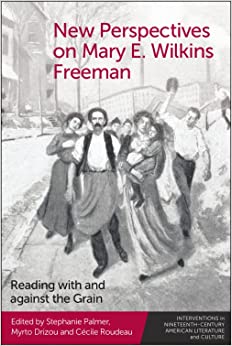
New Perspectives on Mary E. Wilkins Freeman: Reading with and against the Grain is a perfect example. The editors–professors Stephanie Palmer (Nottingham Trent University, United Kingdom); Myrto Drizou (Boğaziçi University, Turkey); and Cécile Roudeau (Université Paris Cité, France) issued the book’s CFP all the way back in April 2019.

As a well-known Freeman scholar, I responded and proposed a chapter. I am sharing my chapter’s abstract below, not to promote myself but rather to provide general background information for my blog readers who may not be familiar with Freeman.

The distinguished accolades enjoyed by Mary E. Wilkins Freeman are numerous and well known. At the start of the Twentieth Century—when her career was at its height—she and Mark Twain were considered America’s most beloved writers. She was the first recipient of the William Dean Howells Gold Medal for Distinguished Work in Fiction (1925). She was among the first women elected to membership in the National Institute of Arts and Letters (1926). And the bronze doors at the American Academy of Arts and Letters in New York (installed at its West 155 Street Administration Building in 1938) bear the inscription, “Dedicated to the Memory of Mary E. Wilkins Freeman and the Women Writers of America.”

What is not well known, however, is Freeman’s financial success as a businesswoman. Freeman started her career in 1883 with $962.09 in cash and with one-half interest in a piece of Brattleboro, Vermont, property. Yet after her death in 1930, the value of her estate at the height of the Great Depression—even after her personal property had been auctioned off at embarrassingly low prices—came to a grand and spectacular finale of $117,285.41. Adjusted for inflation, that would be equivalent to starting out with $24,214.38 in 1883 and ending up with $1,804,925 in 1930 when the market was at its worst.

By any standard, that’s quite a financial success story, especially for a writer who at the start of her career maintained, “I know so little about business and business customs.”

Careful research into the business side of Freeman’s life demonstrates that necessity taught her a lot about business and business customs.

This chapter zooms in on Freeman’s career not only as a successful writer but also as an independent woman. Single for most of her life and without financial backing (unlike her contemporaries Harriet Beecher Stowe, Sarah Orne Jewett, and Kate Chopin), she knew that she had to fend for herself.  Or, as she herself commented in a 1919 letter to American literary scholar Fred Lewis Pattee, “I wrote no more vers de societe. No more Cherries in Blossom. My dear Sir, do you remember I wrote you that I had to earn my living? I did not write this, but I had an Aunt to support. How could I have accomplished these feats on poetry?”

She couldn’t accomplish it by poetry alone, but she could by exploiting multiple genres: 3 plays, 14 novels, 3 volumes of poetry, 22 volumes of short stories, over 50 uncollected short stories and prose essays, and 1 motion picture play.

Over the course of a career that spanned nearly 50 years and through nothing more than the power of her pen and her astute business acumen, she amassed a fortune. Hers is a story of phenomenal magnitude, unparalleled in all of nineteenth century American literature, especially among women writers, and this paper will chronicle her financial success story.

Now, nearly four years later (delayed, no doubt, by the COVID-19 Pandemic), the book was published this month by Edinburgh University Press.

Edinburgh University Press; 1st edition
(February 28, 2023)
Hardcover ‏ : ‎ 328 pages
ISBN-10 ‏ : ‎ 1399504479
ISBN-13 ‏ : ‎ 978-1399504478

My contribution–“Literary Businesswoman Extraordinaire”–appears as Chapter 9 in the section Women’s Work: Capital, Business, Labor.

Kinship Outside of Normative Structures
1. Mary E. Wilkins Freeman’s Neighborly Encounters and the Project of Neighborliness – Jana Tigchelaar
2. “Her Own Creed of Bloom”: The Transcendental Ecofeminism of Mary E. Wilkins Freeman – Susan M. Stone
3. “Preposterous Fancies” or a “Plain, Common World?” Queer World-Making in Mary E. Wilkins Freeman’s “The Prism” (1901) – H.J.E. Champion

Violent, Criminal, and Infanticidal: Freeman’s Odd Women
4. The Reign of the Dolls: Violence and the Nonhuman in Mary E. Wilkins Freeman – Donna M. Campbell
5. Transatlantic Lloronas: Infanticide and Gender in Mary E. Wilkins Freeman and Alexandros Papadiamantis – Myrto Drizou
6. Redefining the New England Nun: A Revisionist Reading in the Context of Pembroke and Irish American Fiction – Aušra Paulauskienė

Women’s Work: Capital, Business, Labor
7. Hunger Strikes:Queer Naturalism and the Gendering of Solidarity in Mary E. Wilkins Freeman’s The Portion of Labor – Justin Rogers-Cooper
8. “It Won’t Be Long Before the Grind-Mill in There Will Get Hold of Him”: The Theft of Childhood in Mary E. Wilkins Freeman’s The Portion of Labor – Laura Dawkins
9. Literary Businesswoman Extraordinaire – Brent L. Kendrick
10. “Deconstructing Upper-Middle-Class Rites and Rituals: Reading Mary E. Wilkins Freeman’s Stories Alongside Mary Louise Booth’s Harper’s Bazar“– Audrey Fogels

Periodization Reconsidered
11. Mobilizing the Great War in Mary E. Wilkins Freeman’s Edgewater People – Daniel Mrozowski
12. A Cacophony of Voices: Freeman’s Modernism – Monika Elbert
13. Underground Influence: Sylvia Townsend Warner’s Pastiche of Mary E. Wilkins Freeman – Stephanie Palmer
14. Untimely Freeman – Cécile Roudeau

Afterword: Why Mary E. Wilkins Freeman? Why Now? Where Next? – Sandra A. Zagarell

New Perspectives on Mary E. Wilkins Freeman is rich and robust, adding new dimensions to earlier book-length studies:

Edward Foster, Mary E. Wilkins Freeman (Hendricks House, 1956). Foster started his Freeman biography right after her death in 1930. At the time, he was a doctoral student at Harvard. One of the book’s many strengths is its inclusion of information gained from interviewing Freeman’s friends and relatives.

Perry Westbrook, Mary Wilkins Freeman (Twayne, 1967; rev. 1988). Westbrook explores some of Freeman’s richest and most significant works, anchoring them to the New England local color tradition as well as to women writers.

Brent L. Kendrick, ed., The Infant Sphinx: Collected Letters of Mary E. Wilkins Freeman (Scarecrow, 1985). Praised by The Journal of Modern Literature as “the most complete record to date of Freeman’s life as writer and woman.” I have a new two-volume update in progress: Dolly: Life and Letters of Mary E. Wilkins Freeman. Vol I: The New England Years (1852-1901). Vol II: The New Jersey Years (1902-1930).

Leah Blatt Glasser, In a Closet Hidden (University of Massachusetts Press, 1996). Glasser’s work is a literary biography that “traces Freeman’s evolution as a writer, showing how her own inner conflicts repeatedly found expression in her art.”

Aside from book publications, Freeman has merited state-wide celebrations, too.

In 1991, Newark Public Library, the New Jersey College English Association, and the English Department of Kean College celebrated Freeman’s life and works in a series of free public programs. Jim Florio, New Jersey’s governor at the time, issued a formal proclamation, declaring “November, 1991 as Mary E. Wilkins Freeman Month.”

Additionally, in October 2019, Freeman was featured as part of the Brattleboro (VT) Literary Festival. Recognizing her connections to Brattleboro and to the Green Mountain State, Vermont Governor Phillip B. Scott proclaimed October 17, 2019, as “MARY E. WILKINS FREEMAN DAY
in Vermont.”

On January 17 the next year, Freeman’s home at 207 Lake Avenue in the Borough of Metuchen in Middlesex County, New Jersey, where she lived and wrote from 1902 to 1907, was added to the National Register of Historic Places.

New Perspectives on Mary E. Wilkins Freeman is a welcome addition to Freeman scholarship. Taken as a whole, the book provides a greater understanding of Freeman’s unequivocal–and sometimes unrivaled–impact on American letters.