
“Past, present, future, all appeared
In harmony united…” (“Yarrow Revisited”)
—William Wordsworth (1770–1850). English Romantic poet who saw profound meaning in ordinary life, memory, nature, and place.
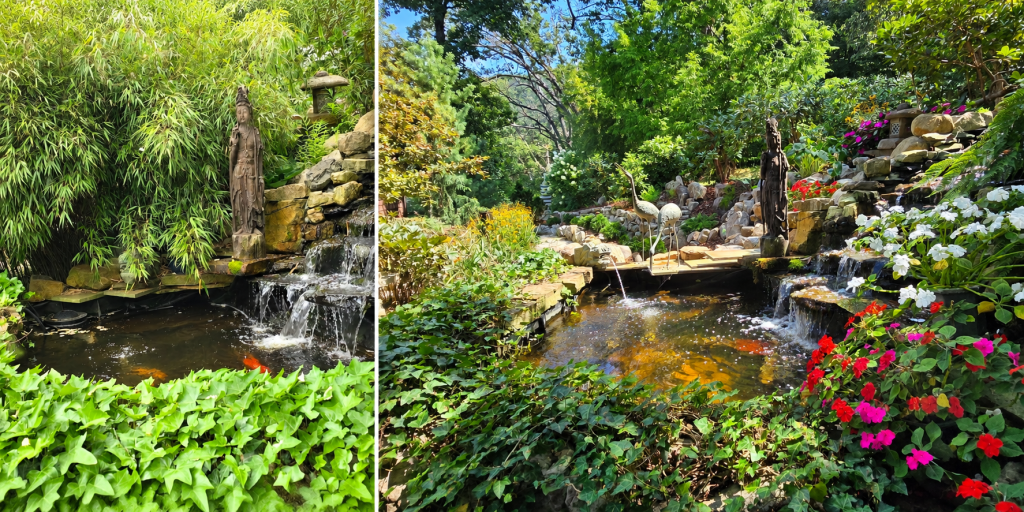
There it stood, heavy with decades of growth. Ten feet or so tall, even when arching gracefully under its own weight. Five feet or so wide, triumphant on the forest edge. Fargesia Jiuzhaigou. A shade-loving, cold-hardy bamboo that could manage ten below zero.
There it stood, sentinel over the koi—swimming the depths of the little pond—whose mirror-surface broke over and over again as water cascaded down the fall’s mossy stones.
There it stood, softening the massive sandstone rocks that gave the waterfall its heft and that teased the dwarfed hand-hewn, lattice-windowed granite lantern at the top.
There it stood, blocking the view from where we sometimes sat on the little patio facing the pond and everything that stood beyond where it stood on the other side.
There it stood, hugging the flagstone pathway beside it, and bringing into question the path itself and any destiny to which it might lead.
It had not always stood thus.
I remember when it arrived, black-bucketed, six scrawny canes spanning six inches.
I remember when I troweled out a hole beside the koi pond and planted it in the hope that over time its greenness would tower and soften the stone-edged waterfall, the bank down from the forest floor, and even the pathway leading to uncertainty.
I remember when it stood there, dwarfed by Quan Yin—the goddess of compassion, mercy, healing, and peace—standing tall on the ledge jutting over the water’s edge.
I remember when it stood there, intimidated by the jade chīshǒu—a Chinese dragon-head–spouting its melody against the pond’s splashings.
I remember it through all the seasons, through all the glorious and trembling growth spurts and even through all my timid prunings.
And I remember it exactly as it stood on the morning of the very day I came to know it could stand there no more.
“Gary, it’s got to go.”
“What?”
“The bamboo standing there.”
He looked at it, then at me, understandably as reluctant to nod agreement as I was hesitant to undo what had been there for so long.
Gary and I both knew what stood beyond the bamboo and beyond the pathway whose inward curve lay hidden by the outward arching clump.
He and I had spent weeks landscaping all that was unseen on the other side of the bamboo. We extended the dry-stacked rock wall. We pruned the rhododendrons. We mulched the sloping bank beneath and the ground behind, curving the edge and weedwhacking all the way to the woods behind.
We knew exactly how all those changes looked–once we walked our way past the bamboo. And we loved its open spaciousness.
But sitting there on the little patio by the koi pond where we sometimes sat, the bamboo seemed to wrap us—cocoon us—in the protective cloak of a well-established past.
What would it feel like, sitting there without the bamboo?
What would it look like sitting there, without the bamboo but with all that lay behind it and beyond it, exposed and in full view?
“Maybe just prune it back a little?”
“I don’t know. I’ll see once I get started.”
My mind was made up, I thought, and early morning proved it. I set about the task with fierce resolve. Before long, my legs could not be seen beneath the cut canes that surrounded me.
Each time I carried a load to the Gladiator, the bamboo lowered itself closer and closer to the ground. Lower. Less. Nothing.
And in the moment of my final return to where it once stood, the landscape opened before me alive with unexpected potential.
I could see the first stone wall I built there, toppled in part from time and winter’s heavings but still secure in its footing.
I could see the pond’s block foundation stretched over with liner.
I could see tubing snaking its way up out of the pond, up the bank, behind boulders, and into the base of the waterfall.
I could see all the inner workings of a past that had served well but that had, at the same time, outgrown the landscape it was built to enhance.
I could see what needed to be done.
I kept what remained strong. The footing. The block foundation. The boulders too massive to yield to whim. I pulled away what had failed, reset what had shifted, and rebuilt the old wall stone by stone.
The work moved quickly now. Four long slabs of flagstone reached out over the pond, parallel to one another but each at its own height. The exposed tubing disappeared behind stone. Two copper cranes stepped onto the lower ledges. Quan Yin and the granite lantern, no longer dwarfed, took their places in the open landscape.
Then the water ran again. It slipped over mossy stones, fell into the pond, and broke the mirror surface just as it always had. The waterfall was not new, but now I could see its sound.
More than that, I could see where a rich and aged past met a shiny and reimagined present.
I was confident that time’s inevitable patina would marry both.
Standing near where the bamboo once stood, Gary and I could see through the garden now, through it all. All the way through. Clearly.


Brent, Thank you for writing these reflections every week. I LOVE reading them, enjoying your way with words, and knowing a little about Gary who moved farther away from Knoxville. I wake up each Monday knowing I’ll have a bit of sunshine, or laughter, or revelation as soon as I open my computer. THANK YOU again for your diligence in writing every week. Donna Wertz
>
LikeLike
Donna,
Your words mean more to me than you may realize. They are a needed reminder of why I write each week: in the hope that something I have to say will somehow reach someone and speak to that person—perhaps bringing, as you so beautifully put it, a little sunshine, laughter, or revelation.
Thank you for reading, for welcoming me and Gary into your Mondays, and especially for taking the time to tell me. You have given a little sunshine back to me. 🌞
Best,
Brent
LikeLike
Thank you for your response, Brent. I would love to meet you in person, but, alas, I no longer drive on freeways; therefore, that is a near impossibility. However, I feel close to you both each Monday as I read your reflections. Your home and gardens must be such a joy to you both.
Donna
>
LikeLike
Thanks so much, Donna!
If you should find yourself up this way, please let us know!
And if we’re in Knoxville, we’ll pay you a visit. Maybe we’ll all go to Church of the Ascension together!
I’d enjoy meeting you, too!
Best,
Brent
LikeLike
a rich and aged past met a shiny and reimagined present. Beautiful!
LikeLike
Thanks so much, Cheryl! That’s one of my favorite lines, too!
LikeLike
I don’t know if I would have had the courage to take down the bamboo. I like the cocoon feel. The outcome is absolutely stunning!!! The cranes are absolute perfection (but I always did like them)!
LikeLike
Wow! Thanks for the before and after and telling us about the process in between. I hear Barbra Streisand singing– “I can see clearly now/ The bamboo’s gone…”
LikeLike
😆 I shall hum that tune every time I walk past where it stood!
LikeLike
Nothing like having a friendly little earworm to accompany you!
LikeLike
Puleez! And muffle the voices? I’ll take the motorcycle! 😂
LikeLike