To Mend or Not to Mend, that Is the Question | Poor Brentford Has His Notions


“Some things serve us best by finishing well.”
— Poor Brentford Lee (b. 1947. Advisor on matters requiring both thread and judgment. Maintains that things well used are best released with gratitude.)


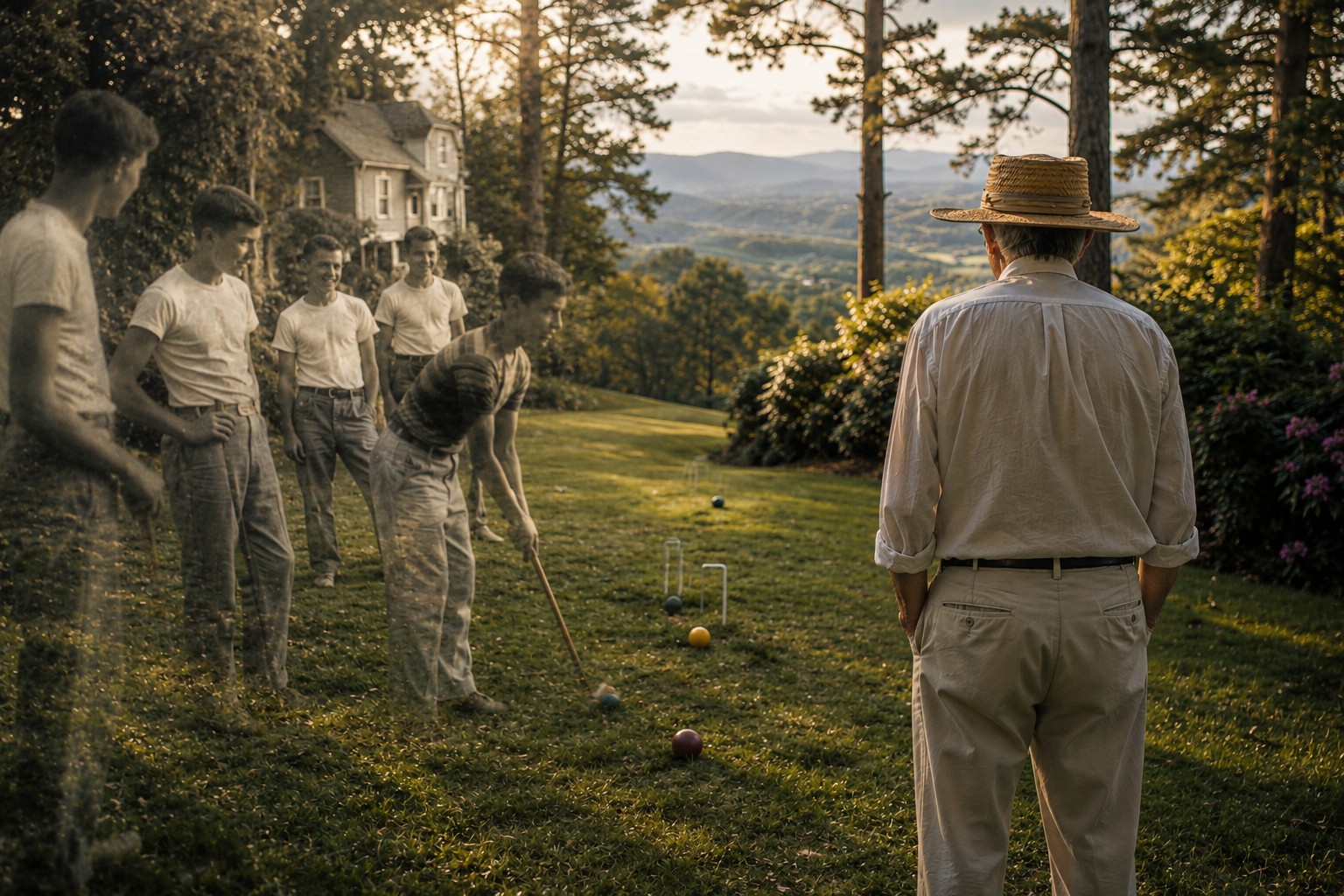
Poor thing. It was just hanging there in the closet.

My favorite purple linen shirt. It was freshly ironed, as it always is, because Gary cares and continues faithfully to press it into presentability even though we both know the collar has grown thin, the threads worn nearly bare, the fabric softened beyond persuasion by years of loyal service at the neckline.

It hangs. Right beside the better ones, right beside the best ones. It still looks handsome at a distance. The color holds its dignity. The linen remembers its authority.

But up close, the collar tells the truth.

There I stood, looking at it, wondering whether I might wear it out in public one more time.

“Dare I?”

I suspected not.

Still, the idea would not entirely leave me. Gary has shown more than once that he knows his way around a needle. I have seen evidence of his skill. A careful stitch here, a thoughtful repair there. Nothing dramatic. Simply competent and reliable.

I couldn’t help but wonder:

“Could Gary save my collar? Could he perform one more act of restoration that would allow me to parade around in public in my old faithful shirt?”

I stood there longer than any sensible person should reasonably devote to a worn piece of linen, quietly debating whether dignity required retirement or reinforcement.

And that was when Poor Brentford arrived.

He did not offer advice immediately. Poor Brentford rarely rushes. He prefers to ask me questions that seem innocent until I attempt to answer them.

“Are you quite certain,” he asked mildly, “that this is a path you wish to explore?”

I did not answer because I knew what direction he was about to take.

Poor Brentford’s memory is longer than I care to admit, even when it comes to fabric.

“Don’t you recall other occasions,” he continued, “when well-intended mending produced unintended outcomes?”

He did not need to specify.

I knew. But I chose to give him that blank stare that always works for me when I feign innocence.

“Remember your sister’s dress?”

Of course, I did. Judy needed something special for an important high school occasion. She had a lovely white dress–a hand-me-down from an older sister. Elegant, well made, perfectly respectable. But what teenage lady wants to wear a dress that has made its public debut already?

“Surely you remember the persuasive talk your resourceful mother gave her?”

“‘Judy,’ she whimpered with soft confidence, “I can transform that dress into something so stunning it will look brand new. A packet of Rit dye is all I need. Pink will be breathtaking on you.'”

Poor Brentford need not have refreshed my memory further. I remembered all.

My mother prepared the dye, immersed the dress, and waited the appointed time.

Judy and I walked out into the back yard with my mother as she hung the dress on the clothesline.

“Oh, Judy. It’s stunning!”

Judy looked, not terribly convinced, even less so when she walked around to inspect the back of the dress.

“Mama! Look! The back doesn’t match. It’s a much deeper pink.”

She was right. The front embraced a gentle pink, while the back pursued a darker vision of the same dream.

Judy was crying. I was laughing. And Poor Brentford? He had the nerve to offer encouragement.

“Listen here, girl. Two shades of pink simply mean twice the fashion. People admire originality.”

They did not. But Poor Brentford was not to be undone. To this day I can still hear him applauding my mother’s sincerity all the while admitting that a new dress was what the day—and Judy’s event—needed.

“Stop pining away over your purple shirt,” he ordered as I continued to stand and stare. “Sometimes, some things are best left alone. Have you forgotten Audrey’s sewing machine?”

How could I not remember. My sister had talked about it often.

As a newlywed, she was proud of her sewing skills but lacked the mechanical companion she believed her talents deserved. Rather than come right out and ask for a sewing machine, she mentioned casually that if she had one, she could mend his tattered garments while frugally extending their wearability.

Poor Brentford understood her plight and reminded her:

“A sewing machine is never an extravagance. It is an investment in continuity.”

And so it was. Repairs followed. Patches appeared. Shirts and trousers acquired energetic embellishments that coworkers described—not entirely unfairly—as reminiscent of a coat of many colors.

But the decisive test came when a funeral required that Audrey shorten Bobby’s dress pants. She took careful measurements and made her sewing machine sing. She was certain that she had completed the alteration with seamstress precision. When her husband tried on the trousers, one side was several inches shorter than the other.

Poor Brentford, never inclined toward alarm, regarded the matter calmly.

“Length,” he observed, “is sometimes a matter of perspective.”

Audrey made every effort to restore balance. She even added fabric at the bottom, but she could not hide the seam that was required to extend the length. Her husband never made it to the funeral, but he never forgot the trousers that he never wore.

By resurrecting these two historical family moments, I knew what Poor Brentford was doing. He was reminding me of the disappointment I would face if I insisted on saving what time had already altered.

“Well-intended mending,” he whispered gently, “does not always restore what we hope it will restore.”

We stood there together, looking at the collar Gary had pressed with such quiet care.

“Surely you’re not thinking that the collar could be reversed?”

It was as if he had read my mind.

“Don’t even go there,” he continued. “Allow the shirt to go down dignified.”

Poor Brentford has always understood something I am still learning. Mending is not always accomplished with needle and thread. The dress was altered beyond harmony. The trousers were improved beyond wearability. The collar had been laundered into truth, its edge now softened to the point of surrender.

“Some things serve us best by finishing well.”

Poor Brentford said nothing more. He did not need to. He has always known that mending takes many forms.

We mend by stitching.
We mend by adapting.
We mend by honoring.
We mend by remembering.

But, sometimes, we mend best by releasing.

Keeping Up with the Evidence


“Language is fossil poetry.”
— Ralph Waldo Emerson (1803–1882). American essayist and philosopher, leading voice of the Transcendentalist movement.


Savannahians have long dubbed their city the Hostess of the South. Many also claim that Jones Street is the most beautiful street in the city. Maybe so. Brick by brick, it unfurls like a quiet benediction: a ribbon of warm red paving stones softened by time, shaded by live oaks whose arms stretch overhead, heavy with Spanish moss filtering the light into a perpetual late-afternoon glow. Federal and Greek Revival townhouses stand shoulder to shoulder, dignified but never aloof, their brick façades punctuated by deep green shutters, wrought-iron balconies, and stoops that rise just enough to suggest ceremony without pretension. Lantern-lit doors—some painted a daring lacquered red—open onto iron urns spilling over with ferns and flowering vines, blurring the line between garden and street. Even the street’s history seems layered into the view, so that walking Jones Street feels less like moving through space than through time, where elegance lingers and beauty is not announced but assumed.

Some Savannahians even maintain that the expression “keeping up with the Joneses” began because of the luxurious homes built along Jones Street. I had never heard that claim until friends visited Savannah and later shared it—along with a stream of photographs—on Facebook. I knew the expression, of course, but I had never heard it tethered to a specific place, much less to a famous street down South.

The claim fueled the researcher in me, leading me to the Oxford English Dictionary (OED). If the phrase is anchored to Jones Street in Savannah, the OED editors are unaware of it. They credit the expression instead to Arthur Ragland “Pop” Momand, who in 1913 launched his New York Globe comic strip, Keeping Up with the Joneses. The strip drew on Momand’s experiences in Nassau County, New York, rather than on any known connection to Savannah’s storied street.

I could have let the matter rest there. OED consulted. Myth gently dispelled. Case closed. But curiosity and further digging—beyond the OED and into archival material, historical accounts, and even the occasionally useful corridors of YouTube—clarified the matter. Since Momand’s comic strip emerged from New York, the Joneses in question were almost certainly New York Joneses. And in the late nineteenth century, that name carried weight. The Livingstons, the Schermerhorns, the Masons, and the Jones family were counted among New York’s old-money elite. Mason and Jones controlled what was then the third-largest bank in the country—Chemical Bank—and their combined wealth ranked among the most formidable in New York’s financial world.

Within that circle, Elizabeth Schermerhorn Jones stood at the center of social gravity. She did not merely inhabit high society; she defined it. Her standards of dress, decorum, and domestic display shaped the expectations of an entire class. Others did not simply admire—they imitated. To be fashionable was to approximate her taste. To be modern was to anticipate it. Her Newport summer residence, constructed in 1853, became a symbol of that authority—an architectural declaration of wealth and refinement that drew attention and, inevitably, comparison.

After her death in 1886, the house passed through multiple owners, declined, and was eventually sold at foreclosure in 1934. Today only the reinforced shell remains, its walls braced in a quiet act of preservation—as if even the structure itself were still attempting, in some small way, to keep up the Joneses.

English is full of such borrowed names, reminders that language often preserves the reputations—and sometimes the accidents—of the people who once carried them.

A few examples may surprise you. Others will feel as familiar as the words themselves.

Did you know that the Earl of Sandwich, pressed by appetite and convenience at the gaming table, is said to have solved his dilemma by placing meat between slices of bread, allowing him to eat without interrupting play. Whether the story is embroidered or not, the word sandwich endured. What began as a practical solution became a culinary staple, and the man himself receded into the background, leaving behind a word now spoken far more often than his title ever was.

Then we have Captain Charles Boycott, an English land agent in nineteenth-century Ireland, who found himself the target of organized social and economic resistance from protesting tenants. Rather than confront him directly, the community withdrew—refusing to work his land, speak his name, or acknowledge his presence. The strategy proved so effective that his surname—boycott—entered the language as a verb, now used globally to describe collective refusal. The man was resisted; the name persisted.

Or what about Étienne de Silhouette? An eighteenth-century French finance minister known for his austerity measures lent his name—somewhat unfairly—to a form of portraiture defined by its simplicity. The inexpensive shadow profiles that became fashionable during his tenure were mockingly associated with his economic policies. Over time, the satire softened, and the word silhouette came to describe not frugality but form itself: an outline, a presence reduced to its essential shape.

The word dunce offers an even stranger reversal. It derives from the medieval philosopher John Duns Scotus, whose followers were once regarded as careful and rigorous thinkers. They wore distinctive pointed caps as a mark of their intellectual tradition. Yet in time, critics of scholasticism turned the name into an insult. The scholar became a fool, and the cap a symbol of ignorance—a reminder that language does not always preserve reputation so much as it repurposes it.

Then we have Amelia Bloomer. She did not invent the garment that bears her name, but she did something perhaps more enduring: she advocated for its adoption. A nineteenth-century reformer, she promoted a style of dress that allowed women greater freedom of movement—looser trousers gathered at the ankle, worn beneath a shortened skirt. The look was practical, even liberating, but it was also controversial. Her name became attached to the style, and with it, to the broader idea that clothing could signal change. What was once a subject of ridicule now reads as an early gesture toward autonomy.

And let’s not forget James Brudenell, the 7th Earl of Cardigan, who is remembered for leading the ill-fated Charge of the Light Brigade during the Crimean War. Less dramatically, though perhaps more enduringly, his name came to be associated with the knitted wool jacket worn by British officers under their uniforms. The cardigan, as it is now known, has long since shed its military associations. It remains, instead, as a quiet example of how even the most turbulent histories can soften into something familiar, worn close, and almost entirely detached from their origins.

So the more I explore borrowed names that have crept into our language, perhaps Savannah can keep its story. Jones Street may not have given us the phrase “keeping up with the Joneses,” but it hardly needs the credit to justify the legend.

Language often works this way. A person’s name slips quietly into common speech, the individual gradually fading while the word remains, carrying only the echo of its origin. And when a story is told often enough—beautifully enough, and in just the right light—its beginning can begin to matter less than its appeal. In the end, what we are really keeping up with may not be the Joneses at all, but the enduring human habit of turning beauty, memory, and rumor into something that feels like truth—and is repeated as if it were true.

Death Watch


“Life is in the transitions.”
—William James (1842–1910). American philosopher, psychologist, and father of American pragmatism.


I was seven, a skinny, average-height boy standing on the neighbor’s porch. The white clapboard house rose tall, its long windows draped in lace curtains. But at one window, the curtain had been pulled back and the green blind raised, as if inviting me to press my face against the glass. Inside, an open casket cradling an old woman. Her dress, light lavender with a large lace collar. Her waist, small. Her figure, tall and slender. Beyond the casket, the room dissolved into shadow.

I had seen a dead person before, so it wasn’t death that lured me across the road that afternoon. But I had never seen anyone laid out in a casket, all dressed up for a wake.

My mother had talked about wakes. People stayed up all night with the body, neighbors carried in food, and children fell asleep in corners. I never went to one. What I knew came from scraps I overheard—the rustle of women’s dresses, the scrape of chairs on pine floors, the low murmur of prayers. Where I grew up in southern West Virginia in the late 1940s and ’50s, a wake was as ordinary as rain.

I’ve thought about my neighbor’s wake now and then for seven decades. Each time, I return to my seven-year-old self, standing barefoot on the porch, looking in the window, mesmerized by death’s pale lilac gown.

All those years, that was as far as my reflections went until recently when I was listening to “Four Days Late.” Eight words grabbed hold of me:

“The death watch was over.
Buried four days.”

I know the Biblical story. Jesus waited four days before calling Lazarus’s name—long enough, it was believed, for the soul to depart and the body to begin its decay. What followed could only be proclaimed a miracle.

What grabbed me wasn’t the miracle. It was the emphatic statement:

“The death watch was over.”

With that line lodged in my mind, I began noticing how often the idea of a death watch appears, even when we don’t call it that.

In Judaism, the dead are not left alone. There is shemirawatching. Someone stays with the body, for hours or longer, reading psalms, keeping vigil. The tradition holds that the soul lingers nearby for a time, not yet ready to depart. What struck me was not the theology, but the instinct: don’t leave yet. Something is still happening.

In Islam, too, death unfolds rather than strikes. The community gathers quickly. The body is washed, prayers spoken, and the dead oriented toward Mecca. Nothing casual or rushed. The living tend to the dead carefully, attentively, as if aware that departure is not abrupt but gradual, and that presence is a form of respect.

Buddhist and Hindu traditions go further, understanding death as a process that may take hours or days, consciousness loosening its hold slowly. Those nearby are encouraged to remain calm and steady—not to cling or hurry, but to remain present while something completes itself.

Even in the folk practices my mother described, the same posture holds. People stayed. They watched. They waited. Death was not treated as an emergency to be cleared away, but as a threshold to be witnessed.

I wonder what, exactly, those watchers believed they were watching for.

Not for proof. Not for reversal. But for something to finish—or something to begin. Across cultures and centuries there is a shared intuition that death is not an erasure, but a passage. A crossing—something that unfolds just beyond our ability to see, but not beyond our need to attend.

So, we stay.

The seven-year-old boy I was could not have named that instinct. He only knew to stand barefoot on a porch and look through a window. He didn’t understand death or wakes or souls lingering nearby. But he understood—without words—that he was standing as witness at the edge of something mysterious.

Perhaps that is what a death watch has always been—not a refusal of death, but an act of faith in continuance: a willingness to be present at the threshold, to witness a crossing we cannot explain.

Maybe the watching is how we admit we don’t believe it’s over.

Looking Back on the Outer Edge of Forever

“The real voyage of discovery consists not in seeking new landscapes, but in having new eyes.”

Marcel Proust (1871–1922). from his The Captive (1923), the fifth volume of his seven-part masterpiece In Search of Lost Time. Proust’s exploration of memory and perception reshaped modern literature.

Somewhere I saw it. Everywhere, maybe. Nowhere? Wherever—it grabbed hold of me and wouldn’t let go.

It was the gripping question:

“What would you tell your 18-year-old self?”

It lingered—since forever. Or yesterday? Either way, one morning not long ago, I tried to get rid of it by tossing it out to others—as if the orphaned question might leave me alone once it found a new home.

The replies were as varied as I expected, and as humorous and matter-of-fact, too:

“Buy stock in Apple and Amazon.”

“Be good at life; cultivate a well-rounded lifestyle.”

“Be patient; trust in God.”

“Serve God better.”

“Stay young; don’t age.”

“Be friends with your mom. Spend more time with family. Don’t let important things slide.”

“Don’t worry about impressing anyone other than yourself.”

Almost always, their offerings included a request to hear what I would have told my 18-year-old self. As a result, the question dug itself more deeply into my being, as I stalled by answering:

“I’m still thinking.”

It was true. But I knew I had to answer the question, too, not for them, but for me.

Several possibilities surfaced.

The first was rather light-hearted:

“You don’t have to have it all figured out. Just stay curious, kind, and honest. Don’t waste your energy chasing approval. Learn to cook, listen more than you talk, and remember: dogs and good people can tell when your heart’s true. Oh, and wear sunscreen.”

I dissed it immediately (though it carried some truths). Then I came up with:

“Don’t rush. The world will still be there when you’re ready to meet it. Pay attention to seemingingly insignificant things. They’re where meaning hides. Keep your humor close and your integrity closer. Fall in love, but don’t lose yourself in the process. And when life hands you a fork in the road, check which one smells like supper.”

I didn’t like that any better, though it, too, spoke truth. I was certain I could nail it with a third attempt:

“You think you know who you are right now, but you’re only meeting the opening act. Be kind. Be curious. And don’t confuse noise for meaning. The world rewards loudness, but grace whispers. Listen to that whisper. It’s you, becoming.”

Then six words sauntered past, not so much tinged with regret as with remembrance. Six words. Six.

“Be a citizen of the world.”

Those words had crossed my path before. In fact, I remember exactly when—not the actual date but instead the general timeframe and the location.

It would have been in the early 1980s, when I was working at the Library of Congress. I was standing in the Main Reading Room of the Jefferson Building, as captivated by its grandeur as I had been when I first started working there in 1969.

Above me, light spilled through the dome like revelation. Gold, marble, and fresco conspired to make the air itself feel sacred, as if thought had taken on architecture. Beyond those arches, knowledge waited in silence, breathing through pages and time.

Even now, I can close my eyes and see it: the way the dome seemed to rise into forever—an invitation, a reminder—that the world was larger than any one life, and I was already standing in the heart of it.

As an editor of the National Union Catalog, Pre-1956 Imprints—the “bibliographic wonder of the world”—I knew every alcove, every corridor, every one of its 532 miles of bookshelves, holding more than 110 million items in nearly every language and format. I had walked those miles over and over again doing my editorial research. I had come to learn that knowledge knows no barrier. I had come to learn that it transcends time and place.

At the same time, I decided that I could transcend place, too. With my experience and credentials, I began to imagine working in the world’s great libraries—first the Library of Congress, then The British Library, then the Bibliothèque Nationale de France, then the Biblioteca Nazionale Centrale di Roma.

I didn’t know where the journey would end, but it gave me a dream, a dream of being a citizen of the world of learning.

More than that, it was a dream untainted by pretense—never by the notion of being uppity. Instead, it was a simple dream. I figured that if I had made it from the coal camps of West Virginia to the hallowed halls of our nation’s library, I could pack up whatever it was that had brought me that far and go throughout the world, savoring knowledge and learning—and perhaps, over time, gaining a smidgen of wisdom.

But here’s the catch. If transcending geography is the measure of my dream’s fulfillment—the wanderlust, the scholar’s yearning for marble floors, old paper, and the hum of languages not my own—then, at first glance, I failed. I never made it to any of the world’s great libraries except the Library of Congress.

However, as I look back through my life-lens of 78 years come November 20, I realize that maybe I went beyond the geographic destinations that I set for myself.

I went from the mountains of West Virginia to the monuments of D.C., from there to the marshlands of South Carolina where I earned my Ph.D., from there back home to the monuments, and, from there, at last, to the Shenandoah Valley and college teaching that took me internationally via Zoom and tapped into Open Educational Resources that did away with the restrictive border of printed books.

In a sense, then, although I didn’t cross country borders, I crossed the borders of ideas, with my voice carrying me farther than my feet ever needed to.

I’ve managed to live generously, teach across generations, write with empathy, research with joy, garden with gratitude, cook with curiosity, and love with intentionality. In all of that, I have been that citizen of the world—not by passport stamps, but by curiosity. By compassion. By connection.

Maybe that’s the truth I’d offer my 18-year-old self:

“You don’t have to travel the world to belong to it.
You only have to live with your eyes open.”

Show Me What You Wrote

“The act of writing is the act of discovering what you believe.”

— David Hare (b. 1947.) British playwright and screenwriter, whose works probe truth, belief, and the human condition.

Sometimes in the hush of evening, when the lamp spills its amber light and the world grows gentle, I watch. His head tilts slightly, caught by the glow, and suddenly, the years loosen their grip. The lines that life has written across his face soften; the jaw loosens, light as breath; the mouth, so often set in quiet thought, curves with the ease of youth. His eyes, clear and steady, seem to brighten from within, carrying a spark that belonged first to a boy and then to a young man. Slowly, the present thins. I see him slipping into his past. Fifty. Thirty. Twenty. And then, for the briefest moment, the man beside me becomes the eighteen-year-old he once was—time erasing each layer, revealing what was always there: the young man, quietly returning.

As I glance elsewhere in the room, I see an artifact from his past—one that has crossed time and threshold to find its place in ours: the grand piano. Massive and unyielding, it took four men to wrestle it off the truck and ease it through the doorway. Yet here it rests, polished wood catching the lamplight, waiting.

At this moment, I still hear the sound as his hands moved across the piano earlier in the day—measured, assured, easy. And I heard “For All We Know” rise into the room, each note carrying a hush that reached backward in time. The melody was not just music; it was memory, and it wrapped itself around him, around me, around the room itself. Ruby retreated to the bed, but not fully at rest. She leaned forward, her body stretched long, her head angled as far as she dared—as though even she knew the swell of sound carried us into places layered and deep. She held herself at the edge, cautious not to tumble into the wandering past, into the chasms of memory, beckoning us toward knowing and truth.

Elsewhere in the room, near the piano, another layer from the past peels back. Hanging on the wall is a sepia-toned etching—Salena Gazebo, number 8 of only 200, signed by the artist Carl Johnson. The lines are delicate, deliberate: the curving path, the quiet trees, the pavilion standing open like an invitation. It feels less like a structure than a memory, as if the paper itself breathed it into being. When I look at it, I sense not just the gazebo, but the moments once lived beneath it—the warmth of gatherings, the hush of twilight, the whispered vows of past lovers who lingered there. Dream and truth blur, as though the etching had captured not a place at all but a pulse of longing and a flicker of knowledge, carrying us softly toward knowing and truth.

In another room, on top of the chest of drawers, rest family photographs. Portraits, a chorus of faces gathered through years, smiling, standing, caught in stillness. They look out across the room with a quiet weight, less about who they are than the collective feel they give: belonging, continuity, the insistence that life moves forward even as it circles back. They do not need names to speak; their presence alone is enough.

Nearby, on a table, sits something smaller, more ordinary yet no less enduring: an iron toast holder. His grandmother’s. On his mother’s side? Or, maybe, his father’s? The lineage matters less than the fact that he kept it, carried it through moves and years, never discarding, never forgetting. The metal holds more than memories of bread he may never have seen toasted. It holds a thread of persistence, a reason to keep even the smallest objects close.

In the dining room, on a side table, another artifact gleams in silver relief: The Last Supper, framed, gifted to his maternal grandparents on their fiftieth wedding anniversary. Sacred and commemorative at once, it shimmers with devotion, not only to faith but also to family. The silver has traveled down through generations, carried into his keeping, held as though letting go would diminish more than memory. It is a marker of continuity, of reverence, of love that lasted long enough to be honored.

And then there is the little boy riding a dog—a keepsake that belonged first to his father when his father was a child, before his life was cut tragically short. A small porcelain figure, a child astride a loyal companion, frozen in time. Yet in that figure is more than innocence; it is a bridge across absence, a way of knowing a father he never met. It survived when the man did not, passed on to him as both wound and inheritance, loss and gift. That little boy on the dog rides still through the years, carrying ache and legacy.

Through these artifacts, I glimpse the man I already know and love, his story unfolding in fragments that matter. In the little boy riding the dog, I see both wound and inheritance, a bridge across absence. In the Last Supper, I see reverence, devotion, love honored and passed along. In the iron toast holder, I see endurance, the instinct to keep and carry even what is small. In the family photographs, I see continuity, lives pressed together across generations. In the drawing of the gazebo, I see invitation and hush—the twilight blur where dreams fade into memory and truth. And in the grand piano, I hear the melody that threads them all together—still rising, still echoing, ever playing in the quiet of his soul.

These artifacts matter to him and, now, to me. I could point to others. But I won’t. Yet one more remains, quiet and insistent, the truest of them all—not carved in silver or pressed into porcelain, but carried in ink and idea. His 1965 high-school graduation essay. He was co-valedictorian. He was eighteen.

It rests inside his high-school yearbook, the Bluejay, its cover deep blue and gilt, its pages a mosaic of faces, cheers, and world events already turning into history. And there, slipped carefully between those pages, lies his speech—typed, carried through six decades of moves and seasons. The paper holds its shape, and the words stand sure, preserved as though waiting for their moment to be read again. In its keeping, I see more than memory; I see devotion—the instinct to preserve not only what he did but who he was becoming. It is an artifact, yes, but it is also a testament, held safe in the place that marked his youth and carried forward into the man he is now.

I smiled and whispered:

“Show me what you wrote.”

He lifted the page, holding it in his hands, just as he held it onstage sixty years ago. Soft at first, his voice grew firmer as he returned to the beliefs that had steadied him even then: that learning gives life its shape, that responsibility gives it weight, that hope gives it breath, and that perseverance gives it endurance. Sixty years have passed, yet as he read, I heard not only the boy addressing his classmates but the man beside me—the same convictions intact, the same spirit enduring.

In those moments, as his voice stretched back and returned to me across the decades, I realized that of all his artifacts, this was the richest. My partner, Gary T. Knutson, wrote those words in youth. They carried him into a future he could not yet imagine. And they anchor him still—steadying him in the present, guiding him toward tomorrow. The piano may sing, the photographs may remember, the silver may gleam, the porcelain boy may still ride—but they can only point, only hint. His own words, fragile on paper yet alive in spirit, opened the door wider. They revealed not just what he kept but who he was becoming, and who he still is.

That is the power of words—not just Gary’s words, but all our words. They outlast objects, outshine heirlooms, outlive even memory. In them can be found who we are when all else has been stripped away—values, beliefs, longings, the essence of self, laid bare. And more than that, words do not simply keep; they move. They persuade and console, ignite and endure. They reveal who we were, and they shape who we might yet become. That is their gift, and their power—becoming, in a way, stronger than stone.

Show me what you wrote, and I’ll see who you are—then, now, and still becoming. For words outlast memory and outshine the heirlooms we keep. They carry the essence. They carry the longing. And they proclaim the truths we’ve always held.

A Reckoning

“Some of us think holding on makes us strong, but sometimes it is letting go.”

Hermann Hesse (1877–1962), German-Swiss novelist and Nobel Prize laureate, best known for Siddhartha, Steppenwolf, and The Glass Bead Game.

Believe it or not, a week or so ago, the past rose up and slapped me across the face. No, it didn’t leave a bruise, but it left behind something I’m still thinking about.

The slap started when I walked into my office. At first glance, it looks impressive. The lamp casts a golden pool across my glass-top computer desk, giving the whole space a glow that almost convinces me I’ve got things under control. The Oriental rug circles wide and bold underfoot, all rich blues and reds that make the room feel grounded, important, and maybe even a little too proud of itself. Books and papers rise in uneven towers, but in that first glance, they seem less like clutter and more like credentials—proof that I’ve been busy living, working, collecting. Even the cows in the painting on the wall keep a calm eye on the scene, as if to say,

“Carry on, Mtn Prof. You’ve got this.”

But as I walk through the door, the illusion collapses. What looked like a tidy study becomes a landscape of leaning towers and stubborn archives. Books crowd tables in uneven stacks, some open, some shut tight, all demanding to be dealt with. Boxes huddle together on the floor, their labels promising order—but their bulging edges betray the lie. Folders spill their contents, paper curling like leaves that refuse to fall from the tree. A shirt slouches over the back of a chair, a plaid witness to resolve slipping into resignation.

Everywhere I turn, something insists on being noticed. Woven baskets perch on top of files, as if even the containers need containers. The desk is less a surface than a staging ground for half-made decisions. Another painting on the back wall gazes out of its pasture, unblinking, as though it’s been watching me circle this mess for years. It has. It’s not chaos exactly—it’s accumulation. Layer upon layer, a sediment of living, each piece waiting for me to finally decide whether it still belongs.

It isn’t permanent chaos. The boxes say as much, their sharp edges and taped seams hinting at better days ahead—days when decisions will be made, order restored, and space reclaimed. For now, it’s not just an office; it’s a staging area where the past collides with the present, where choices will shape the future. Every pile, every stack, every half-forgotten guidebook, and every dog-eared folder is here because I pulled it out of hiding and chose to face it. In that sense, the clutter is not failure but progress. It’s the visible proof that I’m reckoning with the past, one piece at a time.

I’ll continue to reckon, and I’ll keep on making progress. I know I will. But I know, too, that I can’t rid myself of a lifetime of artifacts in one day. Take the CDs, for instance. Three rows deep. Wedged into the lowest shelf of the floor-to-ceiling bookcase at the far end of the office. They’ve been squirreled away there for years. Waiting. Ralph Stanley leans against Sting, Nina Simone keeps company with Mahalia Jackson, and Susan Boyle dreams her dream right next to the Chuck Wagon Gang. It’s less a collection than a timeline—decades of moods, memories, and seasons pressed into plastic cases. But here’s the thing. I don’t have the heart to get rid of them in one fell swoop. And besides, maybe I don’t want to get rid of them all. Maybe I don’t need to get rid of them all. But I can’t hang on just to hang on. Each one becomes a decision. Which will serenade me today? Into the future? Which has already sung its last song?

Other choices are easier. Travel guides, for instance. Like Fodor’s Greece and Frommer’s Greece on $35 a Day. Both hopelessly outdated, their covers promising adventures I never took. They carry missed possibilities but not regret. Into the discard pile they go. Or the box of Library of Congress business cards, embossed with the proud gold seal of my past career. They once carried weight, proof of my role in the world’s premier library. Now? Nothing more than relics of a past identity. They go into the discard pile, too. The work, the years, the meaning, and the memories? They stay.

Other choices are so easy they’re no brainers. My Frost shelf, for instance: concordances, centennial essays, letters, the familiar black-and-green spines that have followed me across decades. They stay. The same goes for my Mary E. Wilkins Freeman books, lined up in their muted blues and browns. They’re not just books; they’re part of my scholarly DNA. No question, no hesitation. They stay.

Then there are some things whose fate I know as soon as my touch awakens forgottenness. My college copy of Hemingway’s The Old Man and the Sea, margins crammed with the notes of an eighteen-year-old who thought he already knew something about struggle. It stays. My copy of Gibran’s The Prophet, inscribed by a fraternity brother—a book I’ve carried long past the days of Greek letters and youthful certainties. It stays.

A three-by-five oil painting of the covered bridge in Philippi, West Virginia? It’s no masterpiece, but it hardly needs to be. I crossed those boards more times than I remember during my years at Alderson-Broaddus College, each passage a kind of bridge between my coal camp past and the life I was building in the present. The brushstrokes may be clumsy, the colors a bit too bright, but none of that matters. It stays.

A small stack of cassettes holds my mother’s voice on magnetic ribbon. One, dated 11/12/81, is labeled I Take a Stroll and Cause Worry among the Worry Warts. The cassettes may be obsolete, but her voice? Never. Alongside them rests the Bible she gave me when I left for college, her handwriting in the front marking it as mine, though I’ve always known it was hers first.

And the kettle bottom resting heavy on my desk—a flat, round stone that once fell from mine roofs where my father worked fifty years. In those seams, a kettle bottom was a miner’s dread, dropping without warning, too often killing the man beneath it. This one didn’t. My father walked away again and again, spared by chance or grace. These pieces stay—not for their weight, but for his, for hers, and for mine.

Tucked nearly into oblivion is a small 4-H patch from fourth grade, meant to be sewn onto a jacket I didn’t have. But I never needed the jacket to know the four H’s—head, heart, hands, health embroidered in me long before I understood mottos or mission statements. They shaped how I worked, how I cared, and how I learned to give myself to something larger. That patch will never leave me. Some things you don’t outgrow; they simply grow with you.

The things in my office are only the visible part of the past. The rest doesn’t sit on shelves—it lives in memory, in relationships, in faith, in regret, in longing. Those pieces weigh just as much, sometimes more. They, too, must be faced, not in sweeping generalizations, but one by one, moment by moment, decision by decision.

Because that’s how the past works. Even though we can’t erase it, we can’t carry all of it forward either. We have to make hard choices, keeping only what steadies us and letting go of the rest. That’s the only way we’ll have room for life to keep unfolding. Room for the present to breathe. Room for the future to arrive. Room to move forward without being smothered by what came before.

I’m glad the past slapped me across the face. It taught me what we all eventually learn: the only way to live fully in the present, and prepare for the future, is to reckon with the past—seen and unseen, tangible and intangible—piece by piece, choice by choice. The past, the present, and the future are never separate. They are one continuum of time. One long sorting. One steady choosing. One true becoming.

Celebrating a Mother, Not My Own

“I do not at all understand the mystery of grace—only that it meets us where we are but does not leave us where it found us.”

Annie Dillard (b. 1945). American essayist whose work reflects the natural world as a mirror for awe and meaning, most memorably in her Pulitzer Prize–winning Pilgrim at Tinker Creek.

What on earth am I doing writing about motherhood in the dog days of summer—the hottest, most humid stretch, when snakes go blind until their molting skin slips over their eyes—especially when I’m celebrating a mother, not my own?

I keep saying to myself:

“This would be perfect for a Mother’s Day post in May.”

But you, my Dear Reader, know that I rarely write to match the calendar—and this post won’t match it, either. That’s not to say I’ve never done it—only that I’ve never done it by design. It’s simply that from time to time an idea collides with an occasion—Mother’s Day or Father’s Day or Thanksgiving or … Hmmmm. Maybe I’ve done it more than I realize.

Anyway, if you browse through my posts, you’ll see the pattern of how I write. When something grabs hold of me and won’t let go, I know I’ve been called to share it—maybe for the greater good, even if it’s just one person who feels the same tug while reading that I felt while writing.

That’s exactly what happened with this post. Memories washed over me from long ago and far away. They had surfaced before, but only as ghostly apparitions drifting in a paused wave. This time, though, I was nearly pulled under by the current.

It began when I uncovered a hand-painted pillow I hadn’t used in years. Bold crimson flowers and curling green leaves still popped against a soft beige background. The piping had faded, and the stuffing had settled into the easy comfort of something well-loved. It was a little worn, and it was a little wistful, but it was still a bright relic from when I was just beginning to find my way.

As soon as I saw the pillow, I started remembering my neighbor who made it. She was an older woman, maybe a few years older than my Mother, but not many. She dressed neatly, always in small-print floral dresses, and, when at home, she always topped her dresses with matching aprons. Ringlets of white hair framed a face that seemed stern at first, but softened the moment she spoke. She had the bearing of someone who kept things in order—herself, her home, her garden, and her place in the community. No one ever doubted that she would follow through on whatever she took on.

Her name was Nell. Nell Barker Harris, but I never called her by her first name. My Mother taught me better. She was always Mrs. Harris to me, though I swear I had the hardest time making Mrs. sound like MIZ-iz. It always rolled off my tongue as MIZ.

My memories of her stretch back to 1958, when my parents bought our home in the subdivision that bore her last name. I had just turned eleven, and I loved exploring the uncharted woods surrounding our home and beyond.

Mrs. Harris and my Mother were good friends, sharing interests in church, cooking and canning, and working the polls on election days.

My Mother thought the world of her, and, looking back, most of what I came to know about her came from my Mother:

MIZ Harris this …” and “MIZ Harris that …” was a constant refrain, especially during summer and fall harvests.

Many were the days my Mother sent me to the Harrises—Nell and her husband Worthy—with fresh vegetables from our garden, or to fetch canning jars—the old timey blue ones with zinc lids—or to swap a recipe.

The Harrises lived close, but their house lay just out of sight from ours. All I had to do was cut across the garden, slip past the barbed-wire fence, run down a slope, and dash up a knoll to reach their faux-stone cottage. It was one of the finer ones in our small town, with more than a hint of upper-middle-class comfort. I’d climb the steps straight to the door, where Mrs. Harris usually met me, fulfilling the errand right there on the stoop.

From those errands and my Mother’s comments, I came to know Mrs. Harris well enough that one December, I went boldly to her house on my own. My sister Judy and I had decided to put up a Christmas tree while our Mother was shopping. I had long had my eyes set on a beautiful white pine—not for Christmas, but for love—growing in the Harris’s woods where I roamed. Off I went to ask if we could cut it down. She agreed, and though the tree seemed to shrink with every drag homeward, Judy and I had it lighted and decorated by the time our Mother returned. She knew exactly how to celebrate the surprise as a tribute to childhood ingenuity.

Another time, my parents sent me over with an idea that I’d dreamt up—again involving white pines. A dead-end dirt road ran between our home and the Harris’s land that we gardened, and we thought it would be beautiful to line its 200-foot stretch with pines. I asked Mrs. Harris if we could dig saplings from her woods. She agreed, though she thought fall would be a wiser planting time.

My parents insisted amongst ourselves that proper planting and deep watering would see them through. They were hardly more than spindly stems with a few scraggly needles, more like Charlie Brown’s Christmas tree than the giants we imagined. Pitiful as they were, they survived the July heat and, in time, grew straight and tall, rising with quiet majesty, as if they had always belonged there.

Later—June 1972, a few years out of college and working at the Library of Congress—I wanted more than the skyward-pointing pines. I wanted the land itself. I found myself in Mrs. Harris’s home, asking if she would sell me the very garden lots my parents and I had tended from pre-teen through early manhood.

I still remember sitting in their parlor that day—dress pants, crisp shirt, and a tie, as if I’d been summoned to defend my undergraduate honor’s thesis. I sat in an overstuffed chair in the corner, its armrests rising up to hold me accountable. The room itself seemed to echo their seriousness and my intent. Mahogany gleamed in the soft light. A large china cabinet dominated one wall, its shelves lined with Blue Willow dishes like the ones my oldest sister Audrey collected. Everything about the space spoke of order and permanence—qualities my Mother had always extolled in Mrs. Harris herself.

Across from me sat Nell and Worthy Harris, steady and composed, firing their questions in quick succession:

Why do you want the land?

Do you plan to build a house there one day?

How will you pay for it?

A bank loan? Do you understand that you’ll need a co-signer?

They had far more questions than I had answers. But a few days later, I rode with the Harrises in their blue-and-white Chevrolet to Raleigh County National Bank, a solemn drive dressed up in chrome and vinyl. I had made the appointment myself, though the banker’s name and face have faded. What remains is the setting: a huge walnut desk topped with thick glass, its surface spread with legal documents that seemed to weigh more than the paper they were printed on.

I signed, and Mrs. Harris co-signed—the literal and the metaphorical deed, both done and dated June 9. She was, after all, the owner of the land. The gleam on my face that day couldn’t have equaled hers, steady and satisfied, as though she had not only sold me a parcel of ground but had also planted me there, rooting me firmly to the very soil where those skyward pines had begun.

But the pillow dragged up one last memory of Mrs. Harris—a dim and shifting one, like an undertow I didn’t see coming.

One year—1965, just a month before graduating from high school—I nominated Mrs. Harris for “Mother of the Year.” She certainly was worthy of the recognition, although she never seemed like my Mother, not even like a mother figure, really. And now, looking back, I wonder whether it was my Mother herself who suggested the nomination. Or maybe it was my oldest sister Audrey. Both of them admired her immensely as one of the pillars of our community and the church that the three of them attended.

Whatever the springboard, I picture myself typing the letter—hunting and pecking as solemnly as if drafting a constitution—and then, with all the earnestness of seventeen, listing her many accomplishments.

I don’t remember a single sentence I wrote in that nomination, only that it won her the recognition we all thought she deserved. What I do remember is the aftermath: her picture in the newspaper, and maybe even a spot on a live radio interview, sharing her reaction:

“I’m just flabbergasted.”

Down through the years, I often found myself wondering how my Mother felt about my nominating Mrs. Harris instead of her. If she carried even a flicker of disappointment, she never showed it. And why would she? For all I know, she may have planted the idea in my head in the first place, speaking of Mrs. Harris with admiration the way she always did.

Years later, my parents came to live with me in DC after my dad suffered a stroke and needed more care than my Mother could manage alone. Audrey and I worked out a plan: summers in their own home, with her nearby to help; winters with me in DC. It was during those ten years that I found myself with a chance to do what I hadn’t done back in high school–nominate my own Mother for recognition as the remarkable woman she was.

The details of my Mother’s nomination are as vague in my memory as Mrs. Harris’s. I am fairly certain it was 1982—the year my parents celebrated their 50th wedding anniversary—and that DC’s “beautiful music station,” WGAY (99.5), sponsored the “Mother-of-the-Month” recognition. I nominated her by focusing on her long marriage to my dad, their six children, and the challenges she faced as an aging woman caring for her invalid husband, ten years her senior. Even though they lived with me, she was the caregiver during the day, and she carried the worry with her to bed at night. That, I believed, made her worthy of being honored.

I had been notified the day before that she had won, and that the radio host would call her live between 7:15 and 7:30 the next morning. I delayed leaving for work until the call came, turning on the radio to listen. The host told her about the award, and she responded in her plain, honest way:

“I am just flabbergasted.”

And here I am, decades later, unsettled by the blur of my memories of the honors given my Mother and Mrs. Harris. I wanted the details to come alive again here, to loom as large now as they did then. So, I went looking for the scoops that might have been reported in the newspapers.

I looked and looked again, but I found no newspaper coverage of my Mother being honored as “Mother of the Month.” That’s fine. My Mother doesn’t need to live in print—she lives on in me. Besides, I know the details by heart. I listened as she heard the radio broadcaster announce her status for all the listening world to hear. The radio station hosted a dinner for her. I pinned their orchid corsage to her dress, drove the two of us to the restaurant, and sat across the table from her.

We dined at The Monocle, seated at one of its linen-draped tables where the Capitol dome seemed near enough to touch. The restaurant buzzed with the voices of staffers and senators, but none of that mattered to me. What mattered was not the food or the setting, but the way she sat taller than usual, radiant with the glow of being truly seen.

I don’t remember the menu. I don’t remember what we ate or drank. What I do remember is my Mother spotlighted there, savoring a moment that was hers alone. She wasn’t the caregiver or the dutiful wife and mother that night. She was the honored radio station guest, my celebrated Mother, and I was lucky enough to be her escort.

I fared better in my search for Mrs. Harris’s recognition. I landed on the newspaper article itself, published in the Beckley Post-Herald on April 15, 1965. I was mistaken about nominating her for Mother of the Year, yet the headline showed I wasn’t far off:

“Shady Spring Woman Is ‘Mrs. Homemaker’”

“Mrs. Homemaker of 1964 and 1965 is the title which was bestowed on Mrs. Worthy Harris of Shady Spring on Saturday afternoon at the annual Home and Sport Show sponsored by Beckley Jaycees.”

It’s a long, long article, taking up nearly a quarter of a page and featuring a full-length photograph of Mrs. Harris holding a silver platter, one of her many gifts, along with a litany of her many talents that left me nodding in remembrance:

“An active member of White Oak Baptist Church, Mrs. Harris teaches crafts such as quilting, copper and leather tooling, refinishing furniture, cooking, canning, silk screening, lamp making, teaches home demonstration club classes, judges community fairs, and does upholstering as a hobby.”

As I continued reading, I realized that I was wrong about something else, too, so wrong that I was beyond flabbergasted:

“In her letter Mrs. [Audrey] Bateman stated, ‘Variety is the spice of life, and truly Mrs. Harris can attribute her zest to living to her many activities which center around her home and community. Her most admirable quality is that she always has time for God, her family, and friends.’”

I read the paragraph three times. Even then, I could only mutter to myself:

“Impossible!”

Surely, I was the one who wrote the nomination—I’d always been the family wordsmith, and the memory still lingers.

It was then that I called Audrey. Surely, she would know. She recalled Mrs. Harris’ recognition, but she was adamant that she had not written that letter, echoing the same sentiment that I had worried about down through the years:

“I wouldn’t dare have written that letter and slighted my own mother.”

Who knows. Maybe I wrote it for her to sign.

The truth lies somewhere in the mix—me, Audrey, and my Mother. All the careful lines blur, all the edges soften, until what’s left is simply presence—fluid, unguarded, and enough.

But now, sixty years after Mrs. Harris’s well-deserved recognition, I suspect it was my Mother herself who lined things up. I’m sure she never dreamt that one day I’d be celebrating her grace—while also celebrating a mother, not my own.


For Mothers Everywhere: Glimpses of My Mother’s Hands

Originally published last year, this remains my most-read—and most-shared—essay. I’m honored to bring it back this Mother’s Day weekend, just as I first wrote it—a quiet tribute to the hands that shaped us all, guiding, giving, and leaving their imprint long after they’re gone.

“Mothers hold their children’s hands for a short while, but their hearts forever.”

–Unknown

On top of my bedroom chest of drawers is a pair of studio portraits of my father and my mother. They’re hand-colored originals, each measuring 3 inches by 4 inches, taken a year or so after my parents’ 1932 marriage. The portraits are in hinged gold frames. My father is on the left. My mother is on the right. A lamp behind illuminates both.

Right now, as I lie in bed, I’m focusing on my mother. Even though her portrait is five feet or so away, she is as clear to my sight as if she were right beside my bed. I’m glimpsing into a distant past, where memories of her linger like whispers.

She’s seated on a bench, wooden, perhaps. The artistic backdrop transports me outdoors. Trees frame the scene, a tall one behind her, their branches reaching skyward, and shorter ones in the background, on the bank of a calm body of water, perhaps a serene river.

She’s wearing a dark dress with short sleeves and a deep-cut neckline, accentuated by a glistening leaf-shaped brooch.

Her finger-waved hair, parted in the middle, falls softly just below her ears. Her eyes are dark and intense, with a gaze that seems to pierce through the image. They are surrounded by her soft, light skin tone, which provides a striking contrast. Their depth and intensity draw me in and make me wonder. What secrets lie hidden behind them? What stories and dreams do they hold? Are they looking into the depths of the world, seeking answers and understanding? Are they inviting me to join in their quest for knowledge?

Her features captivate and mesmerize me, regardless of how often I look at her portrait. Somehow, though, I seem to see my mother’s hands the most. Their contours are soft and graceful, and the fingers curve delicately, one hand gently clasping the other hand.

I see my mother’s hands the most because I know her hands the best.

My mother’s hands are engaging hands. Her hands held mine when I was but a child, and we scurried down the path behind our home where two boulders stood sentinel on either side as colored snow fell down in green and pink and blue flakes, making me believe in magic. Her hands held mine when I was a few years older, and she led me outdoors when our world was covered in snow and showed me how to lie down in stillness, moving arms and legs left and right to create angel wings, making me believe in flight. Her hands held mine a few years later when our world was green with summer and led me to lie down in warm grass, eyes skyward, discovering cloud figures, pointing out the details to one another so vividly that each could see brand new worlds of our own imaginings, making me believe in sharing visions so that others might see.

My mother’s hands are cooking hands. Her hands could transform pinto beans, onions, cornbread, buttermilk, and sweet potato cobbler into a feast, making me want it weekly. Her hands could turn a 25-pound turkey into a bronzed Thanksgiving dinner that rivaled Norman Rockwell’s iconic oil painting Freedom from Want, making art come alive in our own coal camp kitchen. Her hands could measure out with perfection all the ingredients for any dish from any cuisine that she had tasted with no need for recipe and with no need for measurements, teaching me to trust my senses.

My mother’s hands are versatile hands. Her hands could make our clothing without pattern, simply by taking our measure with her hands, making me aware that some things are more felt than seen. Her hands could cut my hair using scissors, comb, and the soft stretch of her fingers, reinforcing in my mind the marriage of expertise and craftsmanship. Her hands could take a pastry brush and turn a greased baking sheet or cake pan into a perfect likeness of Christ, making me see Holiness in the everyday.

My mother’s hands are industrious hands. Her hands could transform a grassy field into a kaleidoscope of gladiolas or dahlias, bursting with vibrant hues, teaching me to see potential in the ordinary. Her hands could hold her side of a wooden pole stretched through handles of a galvanized tub, carrying water to the garden, making me realize that many hands can carry heavy loads. Her hands could hang wallpaper with finesse, demonstrating how effort can elevate even the smallest task to art.

My mother’s hands are inclusive hands. Her hands always opened wide the door, welcoming everyone as guests into our home, making me value open-heartedness and acceptance of others, regardless of differences. Her hands always set a place for them at our modest table, making me understand that meager becomes abundance when shared with others. Her hands always held theirs in loving celebration and thanksgiving, making me a witness to the genuine communion of mankind.

My mother’s hands are nurturing hands. Her hands cared for her father and her mother in times when they could not take care of themselves, impressing on me the importance of helping others. Her hands cared for my dad and me and all my siblings, even when our hands might well have lessened the weight that she carried in hers, showing me that strength comes with sacrifice. Her hands took pine rosin to hold tight and heal the gash in my foot, the scar on my sole still a reminder of what she had learned from her mother’s hands, helping me appreciate generational know-how and wisdom.

My mother’s hands are writing hands. Her hands penned sermons when she pastored a church, making me realize that the intellect can lead the heart to be slain by the Holy Spirit. Her hands sent letters out into the world to those she knew well and to those she hardly knew at all, making me see that the power of words reaches beyond the pulpit. Her hands discovered typewriter keys late in life, determined that hand tremors would not tame her self-expression, making me realize the strength of determination.

My mother’s hands are spiritual hands. Her hands joined the hands of other warriors, praying over me as a child with polio, making me–one of the lucky, uncrippled survivors–a believer in the power of prayer. Her hands walked their way through her Bible and her commentary books–from cover to cover–more than thirty times in her lifetime, making me know the richness to be gained through close readings and research. Her hands clapped, sending thunderous applause into the Heavens to show her thankfulness and gratitude, making me know the joy of praise.

My mother’s hands are clasped hands. As she lay in her casket after her funeral, I removed her rings, took her hands and clasped one gently on top of the other, leaned in for a farewell kiss, and, then, closed the lid.

After her burial, my hands–strong from the strength of hers–released from their cage three white doves, flying upward toward the celestial realm, perhaps at that same mysterious moment when my mother found her way back home and celebrated her arrival with outstretched hands.

The Ghost of Palmyra Church Road

“Memory is the diary that we all carry about with us.”

Oscar Wilde (1854–1900; Irish playwright, poet, and author known for his wit, flamboyant style, and sharp social criticism as well as for his role in the aesthetic movement, which emphasized beauty and art for art’s sake.)

Sometimes, I wonder when a routine in our lives becomes a ritual. They are different, of course. Routines are often performed out of necessity or habit. Rituals carry a sense of purpose, mindfulness, or emotional significance. I suppose a routine can turn into a ritual when its meaning grows beyond its original purpose—when the participants become more conscious of the act itself, savoring it, reflecting on its importance, or incorporating personal values into it.

I’m thinking, for example, of an afternoon drive that my late partner and I used to take daily down a nearby country road meandering along the banks of the Shenandoah River. It started as little more than a way to while away the time between Allen’s arrival home from his 7a.m. to 3p.m. shift at our local hospital until the start of our 5 o’clock cocktail hour and dinner prep.

We always took my Jeep. Allen didn’t like its bumpy ride, but since I was willing to drive, he put up with it. It didn’t take long before we both realized the routine had shifted from its original intent. It became a time when Allen could share the highlights of his day as a surgical technologist, and I could share highlights of mine as an English professor. Then, we savored being with one another, moving along, cocooned in quiet.

Now, heading out for that same drive feels different. I’m alone, but the road is still filled with echoes of those drives with Allen. The gravel crunches beneath the tires, a reminder that I’m traveling at a slower pace—though I still catch myself thinking in we. As I drive down our rutted road, the bumps and jolts are as familiar as ever, almost comforting, as if the past rides along with me into the present. I’m never in too much of a hurry. After all, I know that venturing down means that I’ll have to come back up eventually.

Fall has arrived. The goldenrod along the roadside catches my eye because it often made its way back home into floral arrangements. The landscape changes as I transition from the gravel onto the hard surface of the county road. It meanders along steep banks, the guardrails dented woefully from cars that couldn’t quite manage the turns. The sound of the tires shifts too, now whirring on the pavement as the engine hums along at a modest speed—never more than thirty-five, even though the road stretches out ahead.

Leaving behind the George Washington National Forest, I see the Shenandoah Valley open up into a vast, sweeping view of mountains—beyond them, West Virginia. Mailboxes line the road, clinging to its edge like sentinels. The curves of the road feel like a roller coaster, and I slow down as I near the North Fork of the Shenandoah River. It’s instinct now, my pause to check the depth of the water below, watching as it glides under the bridge.

I pass through Edinburg, a town where unoccupied buildings look as cared for as the rest. I find myself wondering what brought people here in the first place and what keeps them here now. Stony Creek runs by Edinburg Mill, built a decade or so before the Civil War. Just beyond is the cemetery, always a reminder, as if I ever needed one, that a little ways further is where we always used to turn left onto Palmyra Church Road.

I turn there today. This stretch is all too familiar. It’s paved but without markings to show the center of the road, the travel lanes, or the road’s edges. Massanutten Mountain looms straight ahead. I slow down even slower, savoring the ride, stretching out the trip as long as I can. I realize that I have no compelling destination. This trip is about the road itself, the memories, the connection to this place, and the quiet reflection it brings.

The speed limit drops to 25, and the road stretches out ahead. For now, it’s just me and the country road. There’s nothing behind me that I can see and nothing ahead of me but that same winding road.

Soon, I approach a grassy field stretching along the banks of the Shenandoah River. The grass, tall and dry, ready to bow down for a twin-engine plane’s landing. Small cones dot the nearly invisible runway, glowing at night like distant stars, guiding the landing, and then leading to a small, weathered hangar. In times past, we would sometimes glimpse a small plane resting at the far end of the field, its presence quiet and still. We never saw the pilot, if one ever existed. These days, the plane is gone, as if it never was. The field lies empty, waiting.

A little further along, I do a double take to my left as I see Palmyra Church of the Brethren. I’m not sure that Allen and I ever saw it on any of our drives. If we did, neither of us commented. I’m not surprised. It’s a modest church with white wooden siding, a metal roof, and a small steeple that adds a traditional touch. A brick chimney on one side adds to the rural charm. The front entrance is simple, with a door accessed by steps and a metal railing, alongside a wooden ramp. No one is there. The absence of people turns quiet into stark, making the church feel even more secluded if not abandoned.

I pause and cannot help but wonder why a road meandering along the mighty Shenandoah River would bear the name of a church so plain and inconspicuous that it’s easily unseen. Yet, even as I wonder, I know. For the dwindled few, it’s still a house of worship. And then I pause again. Seeing no cemetery. I wonder: where do they bury their dead?

I leave those wonderings behind me as I start looking ahead, hoping to see the small, thin woman that Allen and I used to see as she walked the road, her steps so soft they seemed to barely touch the ground. She was always beneath a large, open black umbrella, shielding her, sometimes from sun or rain or snow, but more often than not, from nothing more than open sky and passersby. Her pace seemed slower than the passage of time itself, as if she were floating rather than walking. Her face leaned down toward a cell phone held delicately in one hand, her eyes locked on its screen. She appeared ethereal, her presence more like a drifting shadow, but there was an undeniable humanity about her—fragile and real.

Allen and I worried about her. We broke our quiet to talk about her. Where was she going? Where had she been? Where was her home? How far away from home was she? Who was waiting there for her return? She seemed so other-worldly that I started calling her The Ghost of Palmyra Church Road. We always wondered whether we would see her on our next drive. We always did, every time, though in a different spot every time, always somewhere further back or somewhere further ahead. Over time, we warmed to her, and we waved softly. It took her longer, but the time came when she warmed back, shyly and slowly, as if to freeze time itself with the lift of her mittened hand.

Something about her presence always felt timeless. Today, she’s not here.

The rumble of tires against the pavement breaks the quiet as I approach a small bridge to my right, spanning this narrow section of the Shenandoah River, connecting to Old Valley Pike. Sometimes, if we were pressed for time, Allen and I would turn here and head back home.

Usually, though, we weren’t in a hurry, and we’d continue down the road where, from this point, it became Red Bank Road. Expansive farmlands open to my right, framed by wooden fences holding on to the Civil War. These fields, too, are dry and dusty.

To my right, I catch glimpses of the Shenandoah River through the sycamore. Rounding the last turn, I’m aware that the speed limit rises to 45 as I approach Mount Jackson. I could easily turn around and retrace the drive as Allen and I used to do as part of our ritual. But I don’t. I know that The Ghost of Palmyra Church Road is no more likely to appear than the plane that’s disappeared from the field. They coexist with the church that has no people and no cemetery–echoes in my memory.

As the landscape shifts and as the signs of the times creep back in, the quiet truth shatters my silence.

This time, I’m driving alone, my right hand resting on the Jeep’s console, no longer holding Allen’s hand in mine.

This time, I realize. Allen is gone.

This time, I realize. The ritual is gone.

This time, I realize. I’m driving home.

This is just another country road.