There It Stood


“Past, present, future, all appeared
In harmony united…”
(“Yarrow Revisited”)

—William Wordsworth (1770–1850). English Romantic poet who saw profound meaning in ordinary life, memory, nature, and place.


There it stood, heavy with decades of growth. Ten feet or so tall, even when arching gracefully under its own weight. Five feet or so wide, triumphant on the forest edge. Fargesia Jiuzhaigou. A shade-loving, cold-hardy bamboo that could manage ten below zero.

There it stood, sentinel over the koi—swimming the depths of the little pond—whose mirror-surface broke over and over again as water cascaded down the fall’s mossy stones.

There it stood, softening the massive sandstone rocks that gave the waterfall its heft and that teased the dwarfed hand-hewn, lattice-windowed granite lantern at the top.

There it stood, blocking the view from where we sometimes sat on the little patio facing the pond and everything that stood beyond where it stood on the other side.

There it stood, hugging the flagstone pathway beside it, and bringing into question the path itself and any destiny to which it might lead.

It had not always stood thus.

I remember when it arrived, black-bucketed, six scrawny canes spanning six inches.

I remember when I troweled out a hole beside the koi pond and planted it in the hope that over time its greenness would tower and soften the stone-edged waterfall, the bank down from the forest floor, and even the pathway leading to uncertainty.

I remember when it stood there, dwarfed by Quan Yin—the goddess of compassion, mercy, healing, and peace—standing tall on the ledge jutting over the water’s edge.

I remember when it stood there, intimidated by the jade chīshǒu—a Chinese dragon-head–spouting its melody against the pond’s splashings.

I remember it through all the seasons, through all the glorious and trembling growth spurts and even through all my timid prunings.

And I remember it exactly as it stood on the morning of the very day I came to know it could stand there no more.

“Gary, it’s got to go.”

“What?”

“The bamboo standing there.”

He looked at it, then at me, understandably as reluctant to nod agreement as I was hesitant to undo what had been there for so long.

Gary and I both knew what stood beyond the bamboo and beyond the pathway whose inward curve lay hidden by the outward arching clump.

He and I had spent weeks landscaping all that was unseen on the other side of the bamboo. We extended the dry-stacked rock wall. We pruned the rhododendrons. We mulched the sloping bank beneath and the ground behind, curving the edge and weedwhacking all the way to the woods behind.

We knew exactly how all those changes looked–once we walked our way past the bamboo. And we loved its open spaciousness.

But sitting there on the little patio by the koi pond where we sometimes sat, the bamboo seemed to wrap us—cocoon us—in the protective cloak of a well-established past.

What would it feel like, sitting there without the bamboo?

What would it look like sitting there, without the bamboo but with all that lay behind it and beyond it, exposed and in full view?

“Maybe just prune it back a little?”

“I don’t know. I’ll see once I get started.”

My mind was made up, I thought, and early morning proved it. I set about the task with fierce resolve. Before long, my legs could not be seen beneath the cut canes that surrounded me.

Each time I carried a load to the Gladiator, the bamboo lowered itself closer and closer to the ground. Lower. Less. Nothing.

And in the moment of my final return to where it once stood, the landscape opened before me alive with unexpected potential.

I could see the first stone wall I built there, toppled in part from time and winter’s heavings but still secure in its footing.

I could see the pond’s block foundation stretched over with liner.

I could see tubing snaking its way up out of the pond, up the bank, behind boulders, and into the base of the waterfall.

I could see all the inner workings of a past that had served well but that had, at the same time, outgrown the landscape it was built to enhance.

I could see what needed to be done.

I kept what remained strong. The footing. The block foundation. The boulders too massive to yield to whim. I pulled away what had failed, reset what had shifted, and rebuilt the old wall stone by stone.

The work moved quickly now. Four long slabs of flagstone reached out over the pond, parallel to one another but each at its own height. The exposed tubing disappeared behind stone. Two copper cranes stepped onto the lower ledges. Quan Yin and the granite lantern, no longer dwarfed, took their places in the open landscape.

Then the water ran again. It slipped over mossy stones, fell into the pond, and broke the mirror surface just as it always had. The waterfall was not new, but now I could see its sound.

More than that, I could see where a rich and aged past met a shiny and reimagined present.

I was confident that time’s inevitable patina would marry both.

Standing near where the bamboo once stood, Gary and I could see through the garden now, through it all. All the way through. Clearly.
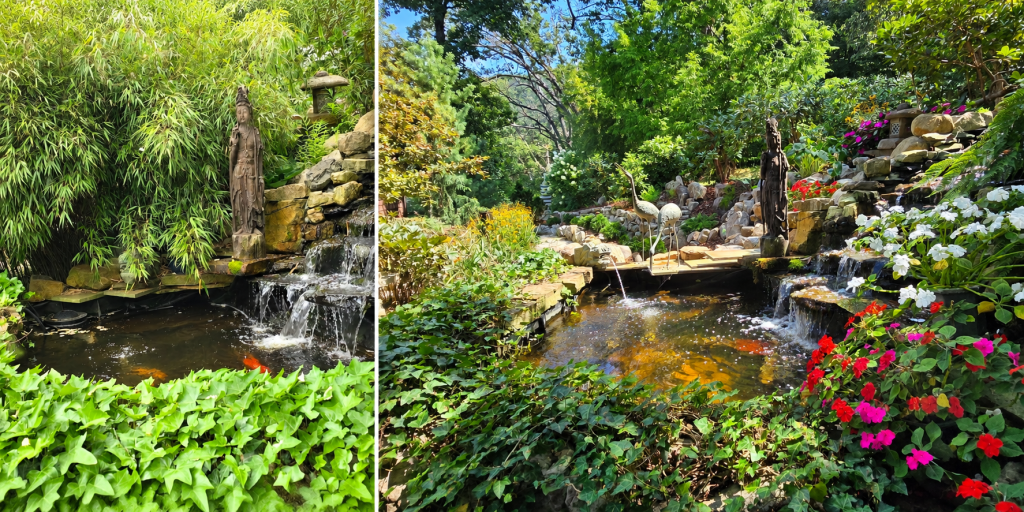

There it stood.

My Kentucky Wonder

“To cherish what remains of the Earth and to foster its renewal is our only legitimate hope of survival.”

–Wendell Berry (b. 1934; American novelist, poet, environmental activist, cultural critic, and farmer.)

My oldest sister, Audrey, keeps everything, and, like her memories, everything is tucked away here and there and everywhere, ready to be brought out and shared with others in a heartbeat.

Not too long ago–Yesterday? The day before? Forever ago?–she sent me a package, securely wrapped and taped, as befits irreplaceable heirlooms sent out into the world, leaving nothing behind to hold on to save precious memories.

When the package arrived, I wondered what was inside. With great care, I managed to unloose family treasures that had been alive decades ago, now destined for a new life decades later.

One by one, I gave Audrey’s relics the loving release that she desired. As I held each, I witnessed the release of my own memories locked away since–Yesterday? The day before? Forever ago? I recognized and remembered everything immediately.

The stainless steel EKCO can opener from my teenage 1960s, perfect for opening cans and bottles with ease, even today. It must have been quite high tech in its day, based on the full directions stamped into the handle:

MIRACLE CAN OPENER. HOLD IN LEFT HAND – HOOK GEAR UNDER RIM OF CAN – SQUEEZE HANDLES – TURN KEY TO RIGHT.

I grin as I hold that vintage kitchen marvel. Squeezing the handles, I wonder why my sister held on to it.

The Belgian tapestry, measuring 18″ high x 56″ long, that once hung above the fireplace mantel in my parents’ bedroom. I recall its presence vividly when I was a toddler. It offers a captivating glimpse into a Venetian court ball beneath a moonlit sky, where graceful dancers swirl elegantly across an outdoor terrace, their movements bathed in the soft glow of the moon. Despite some fraying along the edges, the tapestry remains beautifully preserved, capturing the timeless allure of a bygone era. I wonder when my mother gave the tapestry to my sister.

The Ever-Ready #79 Sterilized Shaving Brush, with its bakelite handle adorned in a nostalgic red and cream hue, its bristles worn ragged by decades of use. As a child, I watched my father dance the brush upon the surface of the soap, coaxing forth creamy lather like an artist delicately crafting a masterpiece. As a teenager, I danced that brush on the surface of my own shaving soap as I journeyed into manhood. Now, as I hold the brush in my hand in a moment of memory and reflection, time stands still, and I wonder when my father held the brush in his hand for the last time.

The Red Velvet Pipe and Cigarette Tobacco tin, with a hinged lid, made by Pinkerton Tobacco Company, Owensboro, Kentucky. It’s still filled to the top. My father smoked cigarettes until he was seventy and had a heart attack. I wonder whether this was his last tin of tobacco when he came to the realization that he had to quit.

The robust pipe, the next item that I gave release. When my father stopped smoking cigarettes, he took up pipe smoking. I hoped that the pipe in my hand was the incredibly expensive Meerschaum that I gifted him. It wasn’t. Instead, what I held in my hand was a Whitehall Jumbos large rustic straight pot pipe. It shows slight signs of age, but the walls of its bowl remain thick with a large flat surface on the rim. The pipe has a robust feel in my hand. I wonder when my dad held it in his weathered hands for the last time, wisps of smoke dancing ’round his head, carrying the rich fragrance of aged tobacco that I so much enjoyed. I wonder what happened to the Meerschaum that I hoped to hold.

Or the infamous knife, the one that nearly cut off my right hand. When but a child—no more than four or five, so small that I had to stand on a kitchen chair to watch as my father butchered a fresh chicken—I reached out to ask, “What’s that?” just as his knife—raised high in air—came thrusting down to sever the chicken breast. The knife could not stop. With equal speed, my father’s hand grasped my nearly severed right hand and held it in place until the doctor arrived. Today, the scar that spans my hand authenticates the strength of his: holding on, not letting go. My mother threw the kitchen knife into the coal bucket, resolving to never use it again. My oldest brother, John, took the knife and hid it away in a brown paper bag. Now, as I hold the knife in my scarred right hand and the crumpled bag in my left, I wonder why he retrieved it. I wonder why he kept it. I wonder when he passed it on to Audrey.

Or what about the Prince Albert Tobacco can, the last heirloom in the box that arrived–Yesterday? The day before? Forever ago? It’s the one that fascinates me the most. It’s 3 inches wide, 4 inches tall, and 3/4 inch thick. It’s vivid red, adorned with elegant gold lettering. On the front is an oval portrait of Edward VII before he was king, when he was known as “Prince Albert.” Since the image appears on the front only, the tin would have been manufactured before 1960. After that year, it was printed on the front and the back. 

As I run my fingers over its surface, I feel the nostalgic echo of my father’s smoking tradition. This pocket tin holds more than just the 1 5/8 ounces of tobacco that it once held. It holds treasured memories of a time that is no more.

Audrey taped a small handwritten note on the front:

Look in can under paper. Try to see if they will grow.

I wonder what’s inside. I take my thumbs and push up on the lid. I remove the paper. Beneath, bean seeds. Dark brown bean seeds.

“Kentucky Wonder!” I exclaim to myself. “Those are Kentucky Wonder seeds, my father’s favorite pole beans.”

I called Audrey to thank her for passing these keepsakes on to me. We shared memories, hers far richer than mine because she lived those treasures through the eyes of an older sibling.

She’s certain that the Prince Albert Tobacco tin is from the 1930s or 1940s, when my family lived in Cherokee (WV). She’s certain that my father collected those seeds from one of his gardens during those years.

Now, I’m not sure when that box of treasures arrived–Yesterday? The day before? Forever ago? But now that spring is here, I vow to do what Audrey bid me do:

“Try to see if they will grow.”

My mind is racing fast and faster with questions. I could ask Audrey who, no doubt, would know the answers.

But my mind is slant toward wonderment.

● I wonder whether those seeds really are from the 1930s and 1940s.

● I wonder when Audrey closeted away that tobacco tin filled with such potential.

● I wonder why she didn’t plant the seeds herself.

● I wonder why she sent the seeds to me, now, as she approaches 90 and as 80 chases me.

● I wonder whether those seeds will germinate and grow after all these years.

● I wonder whether those seeds really are Kentucky Wonder beans.

● I wonder what bean they might be if those seeds are not Kentucky Wonder.

I don’t wonder, however, about what I need to do. I will do exactly as my father and I did when I was but a child, and we started gardening together. As soon as the danger of frost is past and my fingers feel warm when I push them deep into the soil, I’ll put the seeds in a glass of water, and I’ll wait patiently for them to sprout.

Then, I’ll plant them, in threes, next to something tall that they can cling to and hold on to as they climb higher and higher. Then I’ll wait and watch with hope as summer unfolds and fulfills itself, wondering whether my father’s Kentucky Wonder beans, after seven decades or more of hiding away, have run back home to me.

§ § §

John Saunders Kendrick (April 8, 1902–September 21, 1983)