
“We’re all just walking each other home.”
—Ram Dass (1931–2019). American spiritual teacher and author of Be Here Now. His work emphasizes compassion, presence, and our shared human journey.
Early morning. Early breakfast. Just the two of us—three, counting Ruby, who has claimed her customary spot under the kitchen table, waiting for the last crumbs of food or wisdom, whichever falls first. Gary and I are sitting across from one another, easing into our day as we always do.
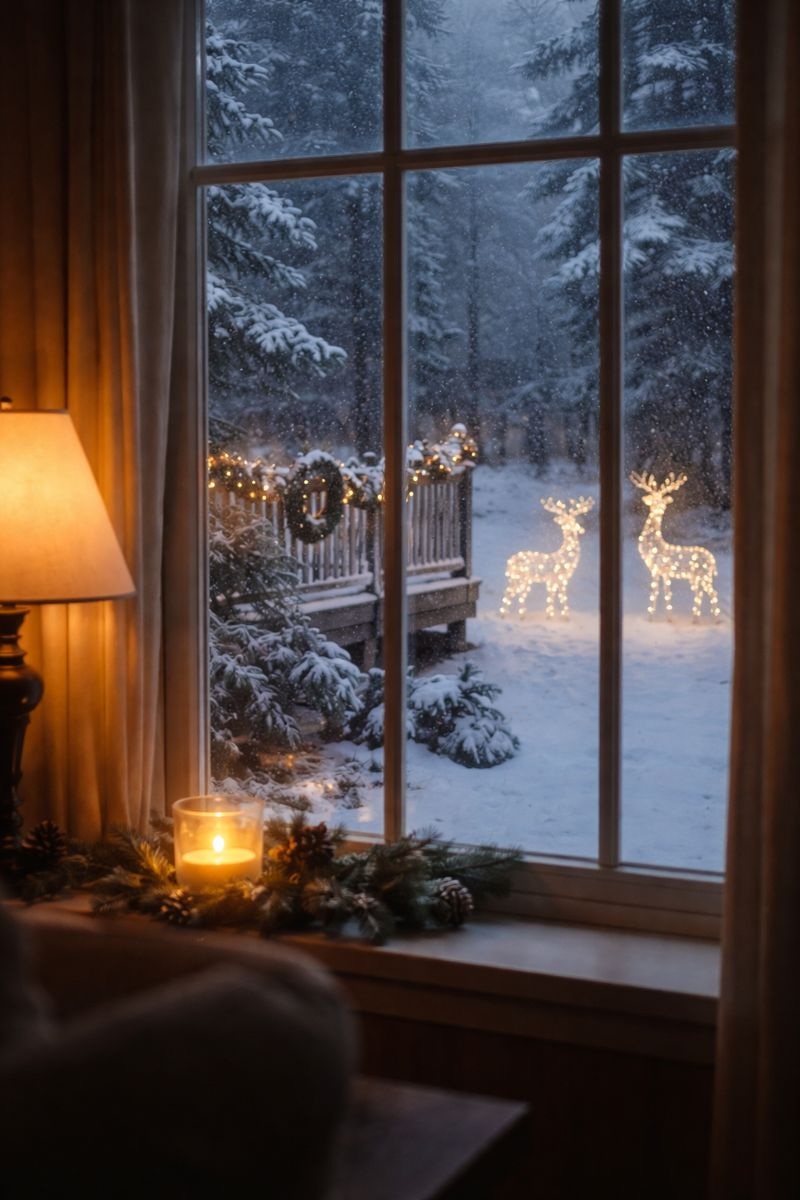
He’s looking out through the French doors toward the deck, where the lighted reindeer we put up together stand frozen in their stately poses of the first snow. I’m facing the working end of the kitchen: stainless steel appliances catching the last of yesterday’s shine, boxwood wreaths hanging in the window, the whole room trimmed and tucked as though company is coming.
Between us is the long view into the living room—garlands draped over the loft railing, trees (plural—cheerfully, unapologetically plural) gleaming in their corners, lamps warming the walls, decorations perched on every surface that would hold still long enough. It looks, frankly, as though Christmas got carried away and stayed for dessert.
Out of nowhere, I say, “She’ll be alone this weekend.”
Gary turns. “Who?”
“My sister. Arlene.” I take a sip of coffee. “I’ve gotten this ridiculous notion in my head that she’s going to round up all the nearby senior citizens and stage their own version of Home Alone.”
We both chuckle, but the idea has already taken hold of me, and the cameras start rolling.
I can see it clearly. The walkers revved up like getaway cars, hearing aids squealing like high-tech booby traps, and the whole troop plotting slapstick with the seriousness of jewel thieves. It’s claptrap nonsense, of course. They’d never really do it. Would they? I doubt it. But how would I know? I don’t know any of them except my sister.
But in my mind, the first scene is already framed and from there the full movie unfolds.
The massive wooden door closes with that soft, familiar thump, and for a moment I can hear the whole house settling around it, almost the way a person exhales after company leaves. Snow blankets the yard like a quilt pulled up by a generous hand. In reality, there is no snow there in North Carolina, except in the photograph from last winter that I’m looking at, the one insisting that I let the house and yard wear a snowfall, too.
It’s a small town, one state away. But it could just as easily be your town or mine or anyone’s. Places like this multiply across the country, each one familiar enough that you can walk through the front door in your imagination without fumbling for the light switch.
Inside stands my sister. She’s eighty-five and determined, leaning into the walker that has become her steady companion. Mind you, she wasn’t left home alone accidentally to fend for herself like Kevin McCallister in Home Alone. She’s simply stepping into a quiet weekend while her daughter and son-in-law are away. She has love, support, and everything she needs.
It’s a beautiful house to behold and to be alone inside. Christmas trees are scattered through the rooms like warm invitations. The largest stands in the front room, glowing with the kind of soft light that makes winter feel kinder. Miss Kitty, the household’s silent monarch, purrs beneath it as if she has been appointed guardian of the glittering tree skirt. If mischief were to break out, she would be responsible, not my sister. My sister is more likely navigating the kitchen with caution, pouring coffee, warming dinner, and keeping an eye on keeping steady.
Still, my mind keeps drifting toward the movie. The parallels surface whether invited or not. A child unexpectedly alone. A golden-ager temporarily on her own. Two people at opposite ends of life who have to face the same truth: they’re the only human heartbeat in the house. His version of that truth was noisy and slapstick. Hers, quiet and measured. Yet both had to answer the same unnerving question:
“What now?“
And that’s where I started to realize that the nonsense of the movie points toward an important truth, one buried deep down inside each of us. The boy did not simply defend his house. He defended himself against the old, universal fear of being alone. He did it in the only way an eight-year-old could: with a heap of claptrap and a wild imagination. He tied paint cans to bannisters. He smeared tar on the steps. He turned cardboard cutouts into party guests. He rigged a toy train so it looked like Michael Jordan was circling the living room. The entire operation was absurd, but it worked. It gave him something to do with his fear, and in doing so, it transformed the fear itself.
I think we all do something similar, no matter our age. We gather what we have at hand and fashion a small defense against the fear of being alone. Children build their courage with noise and make-believe. Adults use busyness, familiar routines, and the jokes that soften the dark edges of a room. Elders rely on rituals, morning light through the same window, and the quiet companionship of animals who seem to understand more than they let on. Whatever the tools, the intention is the same. We are all trying to steady ourselves against the quiet and find a little joy in the process.
This wasn’t theoretical for my sister. She is capable, yet I imagine she felt afraid. She’d never say so, of course. She’s too strong. But, really, who wouldn’t be? When the door closed, when the house settled, when she realized she was the only heartbeat inside, fear must have visited her the way it visits all of us. Human. Ancient. Asking its familiar question:
“Can I do this? Alone?“
Yet even in her fear, I can imagine her shaping the hours with the practical, stubborn spark that has carried her through a lifetime. If she had been the star of her own senior-citizen remake of Home Alone, she wouldn’t have rigged paint cans or tarred the steps, but I can picture her angling her walker like a modest barricade, checking the locks with practiced determination, setting her ears and senses to “alert mode,” and deputizing Miss Kitty as Head of Household Security. She would have done nothing reckless. She would have done nothing theatrical. She would have done the small, knowing gestures that help an old fear settle down and behave.
It’s right here at this quiet, ordinary threshold that I started to be stirred by an even deeper truth. What my sister faced in that moment isn’t unique to someone alone for a weekend. It is the condition every human being inherits the moment we arrive in this world. Being “home alone” is human. I don’t mean in the cute, holiday-movie sense, but in the older, deeper, existential one. From the beginning, every one of us has lived within the small boundaries of our own minds, our private fears, private hopes, and our private rooms. Aloneness is the quiet fact beneath every era, every culture, every age. An eight-year-old with a slingshot in a Chicago suburb. An eighty-five-year-old with a walker in North Carolina. A shepherd in ancient Israel. A monk in a Himalayan monastery. A woman weaving baskets in West Africa. A man tapping away on his smartphone in the Shenandoah Valley. Put them on the same long timeline and the same truth surfaces: each one faces the same inner room, the same echoing questions, and the same silence that asks to be met.
This is meaning-making, and it begins the moment we face our aloneness, not when we avoid it, not when we panic in it. It begins when we turn toward it and say:
“Well, here I am. Now what? What can I shape from this?”
Philosophers have been wrestling with that same question since the dawn of thought. From the Buddha to Kierkegaard, from Lao Tzu to Camus, from the psalmists to the Stoics, every tradition has circled the same enduring question:
● How does a human being rise inside the solitude of their own existence?
● How do we take the raw material of being alone and coax something illuminated out of it?
World religions, in all their variety and beauty, have offered the same response in their own accents. They do not deny the dark. They answer it with light. Literally, symbolically, ritually. Light as remembrance. Light as resistance. Light as meaning. Light as shared humanity. Advent candles. Hanukkah flames. Diwali lamps. Temple lanterns. The kinara burning through the seven days of Kwanzaa. All of them whisper the same ancient encouragement: keep something bright near you. Keep something burning for the ones who come after. If you must face the dark—and everyone must—then face it with a flame.
As I kept circling back to look at the whole scene, I realized that, at some point, each one of us is “home alone.” But it isn’t a tragedy. And it isn’t a failure. It is simply the place where the human spirit begins to show its strength. When we face the aloneness—not outrun it, not dramatize it, but turn toward it—we start gathering whatever light we can find. A lamp switched on at dusk. A familiar chair pulled close to the tree. A loving voice warming the room. A cat curling into our lap with quiet reassurance. These gestures are anything but small. They are how we turn fear into presence, and presence into possibility.
What astonishes me is not that we are afraid, but that we keep meeting our fear with resourcefulness, humor, memory, and hope. We keep rising. We keep lighting dark corners. We keep finding ways to move through our aloneness with a surprising and stubborn grace.
We don’t pretend aloneness away—we meet it together. That is the miracle.
Day by day, weekend by weekend, life by life, we find enough light to find one another and to walk one another home—alone, together.
 The Wired Researcher