Home Alone, Together


“We’re all just walking each other home.”
Ram Dass (1931–2019). American spiritual teacher and author of Be Here Now. His work emphasizes compassion, presence, and our shared human journey.
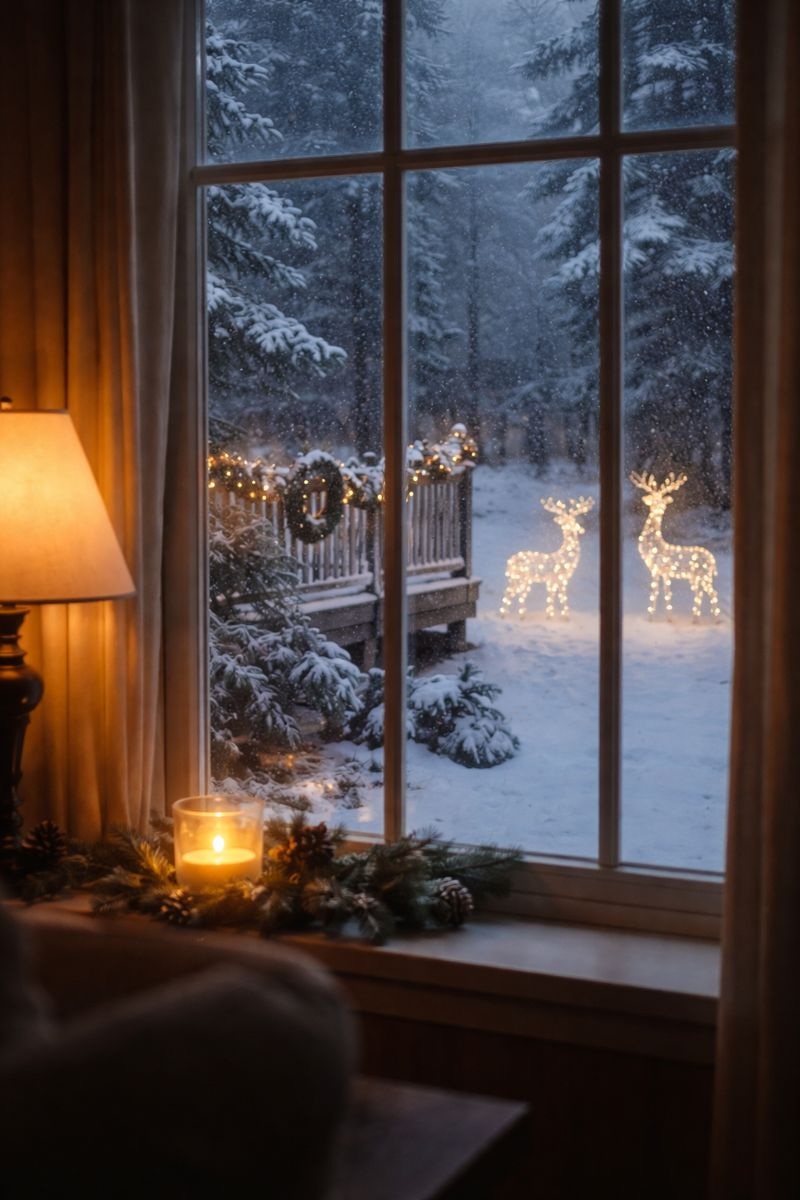

Early morning. Early breakfast. Just the two of us—three, counting Ruby, who has claimed her customary spot under the kitchen table, waiting for the last crumbs of food or wisdom, whichever falls first. Gary and I are sitting across from one another, easing into our day as we always do.

He’s looking out through the French doors toward the deck, where the lighted reindeer we put up together stand frozen in their stately poses of the first snow. I’m facing the working end of the kitchen: stainless steel appliances catching the last of yesterday’s shine, boxwood wreaths hanging in the window, the whole room trimmed and tucked as though company is coming.

Between us is the long view into the living room—garlands draped over the loft railing, trees (plural—cheerfully, unapologetically plural) gleaming in their corners, lamps warming the walls, decorations perched on every surface that would hold still long enough. It looks, frankly, as though Christmas got carried away and stayed for dessert.

Out of nowhere, I say, “She’ll be alone this weekend.”

Gary turns. “Who?”

“My sister. Arlene.” I take a sip of coffee. “I’ve gotten this ridiculous notion in my head that she’s going to round up all the nearby senior citizens and stage their own version of Home Alone.

We both chuckle, but the idea has already taken hold of me, and the cameras start rolling.

I can see it clearly. The walkers revved up like getaway cars, hearing aids squealing like high-tech booby traps, and the whole troop plotting slapstick with the seriousness of jewel thieves. It’s claptrap nonsense, of course. They’d never really do it. Would they? I doubt it. But how would I know? I don’t know any of them except my sister.

But in my mind, the first scene is already framed and from there the full movie unfolds.

The massive wooden door closes with that soft, familiar thump, and for a moment I can hear the whole house settling around it, almost the way a person exhales after company leaves. Snow blankets the yard like a quilt pulled up by a generous hand. In reality, there is no snow there in North Carolina, except in the photograph from last winter that I’m looking at, the one insisting that I let the house and yard wear a snowfall, too.

It’s a small town, one state away. But it could just as easily be your town or mine or anyone’s. Places like this multiply across the country, each one familiar enough that you can walk through the front door in your imagination without fumbling for the light switch.

Inside stands my sister. She’s eighty-five and determined, leaning into the walker that has become her steady companion. Mind you, she wasn’t left home alone accidentally to fend for herself like Kevin McCallister in Home Alone. She’s simply stepping into a quiet weekend while her daughter and son-in-law are away. She has love, support, and everything she needs.

It’s a beautiful house to behold and to be alone inside. Christmas trees are scattered through the rooms like warm invitations. The largest stands in the front room, glowing with the kind of soft light that makes winter feel kinder. Miss Kitty, the household’s silent monarch, purrs beneath it as if she has been appointed guardian of the glittering tree skirt. If mischief were to break out, she would be responsible, not my sister. My sister is more likely navigating the kitchen with caution, pouring coffee, warming dinner, and keeping an eye on keeping steady.

Still, my mind keeps drifting toward the movie. The parallels surface whether invited or not. A child unexpectedly alone. A golden-ager temporarily on her own. Two people at opposite ends of life who have to face the same truth: they’re the only human heartbeat in the house. His version of that truth was noisy and slapstick. Hers, quiet and measured. Yet both had to answer the same unnerving question:

What now?

And that’s where I started to realize that the nonsense of the movie points toward an important truth, one buried deep down inside each of us. The boy did not simply defend his house. He defended himself against the old, universal fear of being alone. He did it in the only way an eight-year-old could: with a heap of claptrap and a wild imagination. He tied paint cans to bannisters. He smeared tar on the steps. He turned cardboard cutouts into party guests. He rigged a toy train so it looked like Michael Jordan was circling the living room. The entire operation was absurd, but it worked. It gave him something to do with his fear, and in doing so, it transformed the fear itself.

I think we all do something similar, no matter our age. We gather what we have at hand and fashion a small defense against the fear of being alone. Children build their courage with noise and make-believe. Adults use busyness, familiar routines, and the jokes that soften the dark edges of a room. Elders rely on rituals, morning light through the same window, and the quiet companionship of animals who seem to understand more than they let on. Whatever the tools, the intention is the same. We are all trying to steady ourselves against the quiet and find a little joy in the process.

This wasn’t theoretical for my sister. She is capable, yet I imagine she felt afraid. She’d never say so, of course. She’s too strong. But, really, who wouldn’t be? When the door closed, when the house settled, when she realized she was the only heartbeat inside, fear must have visited her the way it visits all of us. Human. Ancient. Asking its familiar question:

Can I do this? Alone?

Yet even in her fear, I can imagine her shaping the hours with the practical, stubborn spark that has carried her through a lifetime. If she had been the star of her own senior-citizen remake of Home Alone, she wouldn’t have rigged paint cans or tarred the steps, but I can picture her angling her walker like a modest barricade, checking the locks with practiced determination, setting her ears and senses to “alert mode,” and deputizing Miss Kitty as Head of Household Security. She would have done nothing reckless. She would have done nothing theatrical. She would have done the small, knowing gestures that help an old fear settle down and behave.

It’s right here at this quiet, ordinary threshold that I started to be stirred by an even deeper truth. What my sister faced in that moment isn’t unique to someone alone for a weekend. It is the condition every human being inherits the moment we arrive in this world. Being “home alone” is human. I don’t mean in the cute, holiday-movie sense, but in the older, deeper, existential one. From the beginning, every one of us has lived within the small boundaries of our own minds, our private fears, private hopes, and our private rooms. Aloneness is the quiet fact beneath every era, every culture, every age. An eight-year-old with a slingshot in a Chicago suburb. An eighty-five-year-old with a walker in North Carolina. A shepherd in ancient Israel. A monk in a Himalayan monastery. A woman weaving baskets in West Africa. A man tapping away on his smartphone in the Shenandoah Valley. Put them on the same long timeline and the same truth surfaces: each one faces the same inner room, the same echoing questions, and the same silence that asks to be met.

This is meaning-making, and it begins the moment we face our aloneness, not when we avoid it, not when we panic in it. It begins when we turn toward it and say:

“Well, here I am. Now what? What can I shape from this?”

Philosophers have been wrestling with that same question since the dawn of thought. From the Buddha to Kierkegaard, from Lao Tzu to Camus, from the psalmists to the Stoics, every tradition has circled the same enduring question:

● How does a human being rise inside the solitude of their own existence?

● How do we take the raw material of being alone and coax something illuminated out of it?

World religions, in all their variety and beauty, have offered the same response in their own accents. They do not deny the dark. They answer it with light. Literally, symbolically, ritually. Light as remembrance. Light as resistance. Light as meaning. Light as shared humanity. Advent candles. Hanukkah flames. Diwali lamps. Temple lanterns. The kinara burning through the seven days of Kwanzaa. All of them whisper the same ancient encouragement: keep something bright near you. Keep something burning for the ones who come after. If you must face the dark—and everyone must—then face it with a flame.

As I kept circling back to look at the whole scene, I realized that, at some point, each one of us is “home alone.” But it isn’t a tragedy. And it isn’t a failure. It is simply the place where the human spirit begins to show its strength. When we face the aloneness—not outrun it, not dramatize it, but turn toward it—we start gathering whatever light we can find. A lamp switched on at dusk. A familiar chair pulled close to the tree. A loving voice warming the room. A cat curling into our lap with quiet reassurance. These gestures are anything but small. They are how we turn fear into presence, and presence into possibility.

What astonishes me is not that we are afraid, but that we keep meeting our fear with resourcefulness, humor, memory, and hope. We keep rising. We keep lighting dark corners. We keep finding ways to move through our aloneness with a surprising and stubborn grace.

We don’t pretend aloneness away—we meet it together. That is the miracle.

Day by day, weekend by weekend, life by life, we find enough light to find one another and to walk one another home—alone, together.

Potluck: The Final Course

“To live in this world you must be able to do three things:
to love what is mortal;
to hold it against your bones knowing your own life depends on it;
and, when the time comes to let it go, to let it go.”

Mary Oliver (1935–2019). Pulitzer Prize–winning poet known for her luminous reflections on nature, love, and loss. With clarity and grace, she reminded us to notice what’s beautiful, to cherish what’s mortal, and to let go when the time comes.

It arrived in a box the size of a dorm fridge—bulky, over-taped, and shipped all the way from upstate New York. Inside, cushioned among layers of newspaper and that crinkly brown packing paper that never quite dies, was one of the first gifts Allen–my late partner–ever gave me: a hefty, cream-colored chamber pot. Topped with a crocheted collar that looked like it belonged on a Shaker bonnet, and packed—ironically, perhaps even poetically—with potpourri.

The scent, when I opened the lid, was a clash of lavender and artificial pine, the kind that tries too hard to smell like memory. I laughed, of course. How could I not? A poo jar filled with petals. Humor as a cover. Humor as a calling card. I appreciated the gesture more than the object. Still do. But the truth is, I never liked the pot. Not even a little. It sat in a corner for a quarter century, quietly collecting cobwebs—and stories I never much wanted to dust off.

And now? I’m finally throwing it away. Guilt-free. It did its duty—delivered its laugh, carried its little memory, sparked a story. That’s enough. I’m keeping the crocheted collar as a relic, a threadbare nod to the better parts of our history. The rest can go.

When I made that decision, I actually chuckled. After all, while I like to think that I’ll be around forever, realistically I’m nearing 78. Why not get rid of the stuff now, while I can decide?

I’m not thinking about dying, but this sort of cleanse exists in lots of cultures.

In Sweden, it’s called döstädning—“death cleaning”—a gentle, forward-thinking ritual of clearing out what no longer serves, so your loved ones don’t have to.

In Japan, danshari encourages letting go of clutter—and the emotional baggage that clings to it—in pursuit of a simpler, freer life.

In the Jewish tradition, it’s the ethical will, where elders pass down their values and stories—sometimes alongside their belongings—so nothing meaningful is left unsaid.

Indigenous communities often give things away before the end, weaving stories into every shared object, turning parting into a generous act of connection.

In Tibetan Buddhism, simplicity before death is a form of spiritual preparation—phowa as a practice of unclinging, both to life and the sock drawer.

Even in Iceland, there’s an unspoken elegance to giving things with meaning—fewer objects, deeper stories.

And down here in the South? We just start handing out heirlooms with a twinkle in our eye:

You’ve always liked this gravy boat, haven’t you?”

Trust me. I’m trying that. But guess what? I can’t give it away, try as I will—not even to dear friends and kinsmen.

Who knows. Maybe they’re Zoomers or Millennials who don’t want to clutter their lives like I’ve cluttered mine.

Turns out, a lot of folks under forty don’t want stuff at all. They want experiences—trips, concerts, quiet hikes, a really good latte in a beautiful cup that isn’t part of a 16-piece set. They lean minimalist and value sustainability. Their souvenirs are screenshots, playlists, and the occasional tattoo. Unless my keepsake comes with a story or a strong aesthetic, it’s probably headed for the thrift shop.

A lot of it has found its way there already. More will follow. The initial shock of letting go isn’t as painful as I expected, and I’m discovering that the pain lessens the more I give to Goodwill. I keep reminding myself that the stuff I’m giving away brought me joy for years and years. Now, it can bring others joy at a far lesser price than I paid.

Aside from recycling joy, I have other reasons for embracing what I think I’ll call giving away the Southern-Comfort way.

For starters, the executors of my trust will thank me in advance for doing now what I had no right to ever expect them to do later. Chances are that you’ll need to give that sentence another read or three. Once you do, move on to the next paragraph, where you’ll find a fact that will brighten up your next cocktail party.

Did you know that the average executor spends 100 to 200 hours just sorting through someone’s personal papers and possessions after they die? I’m not talking taxes or legal work—just the business of sifting through the drawers, the boxes, the files, the “I might need this someday” pile in the hall closet. If the estate is disorganized—or, let’s be honest, lovingly chaotic like mine—it can balloon to 300 hours or more. That’s weeks of someone’s life spent decoding your filing system, hunting down life insurance policies, wondering if a particular shoebox full of rubber bands means anything to anyone. And that’s assuming they live nearby. If they don’t? Add plane tickets, time off work, and emotional exhaustion to the tab.

Well. My executors know what I’m doing, and they’re messaging me their effusive thanks already, along with full encouragement to keep right on gifting in my Southern-Comfort way.

It gives me great pleasure, of course, to extend to them a cheerful “You’re welcome” now because by the time they’re empowered, my power will be limited to what I’ve written. The more I think about it, maybe that’s powerful enough.

But I have another reason, too. Doing what I’m doing lets me be in control. I can make sure that my “gravy boats” are repurposed in a way that lets the gravy keep right on flowing the way that I have in mind.

It makes perfectly good sense to me. Let me pause here to say one more thing. Aside from my Southern-Comfort way of gifting, I had the good sense ages ago to get other parts of my house in order: my will and trust.

And here’s another tidbit you can toss around with the olives and maraschino cherries at your next party.

Did you know that nearly 2 out of 3 Americans die without a will? That’s right—despite all the ads for online services and fill-in-the-blank templates, most folks still manage to ghost the Grim Reaper without so much as scribbling a “To whom it may concern.” And when that happens? The Judge Judy drama begins. We’re talking frozen accounts, snarled inheritances, court-appointed strangers making decisions, and families brawling over Grandma’s gravy boat like it’s the last crouton at Sunday brunch. Honestly, dying without a will is the messiest group project you’ll never get any extra credit for.

Guess what? That 2 out of 3 number I gave you includes the rich and famous, too. When I share some of the details with you, you’ll see for yourself that nothing says “let go of your crap now” like the chaos of dying with no will.

But I’m only going to clue you in on a few. After all, you don’t want to be the center of attention at every cocktail party you won’t get invited to if you keep on talking about things everyone needs to do as part of their own death cleanse ritual. Besides, I only had a little time between Goodwill trips to do my research on famous folks without wills.

But here’s three or five you can work to death.

Can you believe that Honest Abe Lincoln himself never got around to writing a will? Try smoking that in your pipe! The man who preserved the Union didn’t preserve a single line of legal instruction. His estate had to be handled by a probate court, and his son Robert had to manage the distribution. It wasn’t exactly messy, but it was embarrassingly ironic.

Or what about the Queen of Soul herself? Aretha Franklin. Well. Yes and no. Initially, she was thought to have no will—until not one but three handwritten wills were found in random places, including under a couch cushion. Say whaaat? Yep. Wedged in a spot where even a remote shouldn’t go. Her family ended up in a nasty legal fight to determine which scribbled version was valid. Talk about a long-winded story. Not here. Not now. Maybe another time.

And while we’re up in the clouds hitting these high notes, let’s not leave out Prince who–you guessed it–had no will. Nope. Zero. Nothing. But he had lots of estate, estimated at over $150 million. It triggered years of court battles among six siblings (some full, some half), and other people claiming to be heirs. His music rights and assets were tied up in legal red tape for six years.

Then, of course, we have the eccentric billionaire Howard Hughes who died with no will that anyone could provewas real. But then again, was Hughes real? He must have been because what happened after his death was like a three-ring circus. Over 600 people filed claims as heirs, including strangers and distant cousins. One “will” was found in a Mormon church—allegedly leaving money to gas station attendants. Fake? Indeed!

Let me share one more example so that you’ll have five in your repertoire.

It’s my very own DollyMary E. Wilkins Freeman, the writer I’ve studied and loved for decades. How on earth could the writer who was, in terms of dollars and cents, America’s most successful nineteenth-century businesswoman not have had the good sense to have her will in place when she died. It’s strange. She had told many people that she had left them money in it, and she referred to a will as late as August 10, 1929, in a letter to Grace Davis Vanamee (American Academy of Arts and Letters):

“I am returning the letters. It will give me much pleasure to have them placed in the museum.

“They naturally would not mean much to my legal heirs, and The Academy honors me by accepting them. I wish there were more.

“Anything else I have of more intrinsic value, is included in my will, for the Academy museum.” (Letter 506. The Infant Sphinx: Collected Letters of Mary E. Wilkins Freeman. Edited with Biographical/Critical Introductions by Brent L. Kendrick, 1985).

Yet when she died in 1930, no will was brought forward. According to one source, she tore it up the day before. At any rate, her two first cousins renounced their rights of administration and requested that Freeman’s attorney handle her estate. He did.

What gets me is this. Freeman wasn’t careless. She was thoughtful and deliberate. Still, her wishes went unrecorded, or at least unhonored. It stays with me, that quiet unraveling of a life so carefully lived.

Maybe that’s part of why I’ve started sorting now—because legacy deserves more than good intentions. I’m not just making lists. I’m making sure the meaning behind the things—and the things themselves—end up where I intend.

Freeman’s didn’t land with intent. Others were writing her final chapter, filled with unexpected characters. The next of kin list grew. Three other first cousins came forward, plus four more relatives with legal rights.

Suddenly, what might’ve been simple became crowded—with claims, questions, and confusion.

Freeman’s personal property was auctioned, with people flocking to the sale and leaving with prized treasures:

● four-poster bed belonging to her grandmother;

● all the books that she had penned and then inscribed, “To My Dear Husband”; and even

● the William Dean Howells Gold Medal for Distinguished Work in Fiction, awarded to her as its first recipient in 1925.

You may be wondering as I have often wondered. What happened to those and other treasures from her estate? Did they survive? Who has them today?

And into that mix of wonderings let me add that I would perhaps gladly sigh my last breath to touch the volume of Rudyard Kipling’s poetry that she held when she lay down on her bed on the evening of March 13 and died at 7:45pm of a heart attack.

What happened to it? Did it survive? Who owns it now?

So there. Now you have it. Five cocktail snippets. Rich and famous folks who bit the dust without a will and left a dusty trail behind.

As for me, I have my will in place. And just as I’m doing my best to give stuff away in my Southern-Comfort way, I’m doing the same with special collections I’ve spent decades curating—Shenandoah Valley pottery, Freeman books, and Freeman letters. My executors know where they belong, but I’m finding unexpected joy in trying to place things myself. Knowing they’re landing where they’re wanted? That will bring a kind of peace no estate plan ever could. Sweeter still, I’ll know they’ll be where I want them to be—and when it’s all said and done, I won’t be lying there wondering.

With any luck, my last course for this potluck called life might be an extra helping of joy for the journey.