The Humourist on Literary Criticism (February 12, 1754)

“… it is a Pity, that the World has not more Humanity and less Spirit, at least, that it is not better tempered; for, tho’ it is a glorious Thing to be possessed of the Strengths of Lions, yet ’tis tyrannous to use it.” — The Humourist

[12 February 1754]

The HUMOURIST.  No. VII.

Majores nusquam Rhonci, Juvenesq; Senesque,

Et Pueri Nasum Rhinocerontis habent.

MARTIAL.1

When Phidias2 had completed the Athenian Minerva, a Critic, of much the same Discernment with these of the present Age, intimated to him, that the Waist was too thick; the silly Crowd, who always put an Implicit Faith in these malevolent Leaders, join’d in the Opinion, and the Statuary, in order to rectify the Blunder, chipp’d it to the Delicacy of their Fancy:  But when another Set of People came to see it, they insisted, that it was too slender; Phidias then threw aside his Tools, informing them, that it was impossible to chip any on again.

In this Manner these Triflers perplex the best Capacities, and sacrifice Excellence to the Attacks of insolent Curiosity:  The most unexceptional Writers, have dearly experienced the Consequences of Envy and Ill-Nature; none are exempt from it who enter the Lists of Authorism, because every weak Mortal (and weak Mortals abound every where) considers himself as the Censor of the Age.  It is a first Principle with these Gentlemen, to decry all Performances, not because they deserve Censure, but as soaring above their Comprehensions, not as void of Matter, but as a Taste for Censure seems to indicate a more refined Judgment and extensive Knowledge than Silence of Decorum can infer; to be pacific now a-Days, is to be tame and senseless; to take Things in the Sense intended, argues a narrow and limited capacity, discovers a Want of Fire and Animation, of Zeal and noble [one word illegible]; it is a Pity, that the World has not more Humanity and less Spirit, at least, that it is not better tempered; for, tho’ it is a glorious Thing to be possessed of the Strengths of Lions, yet ’tis tyrannous to use it.

The Critics may be ranged into Classes, or certain Orders of Distinction, as thus, one seizes upon your Title, another suggests, and by a wonderful Sagacity, hunts out an Author’s Name, some comment, some dissect, and all misconstrue.

This Accusation is principally aim’d at the modern Critics, for the Ancients were, generally speaking, a People of different Inclinations and better Dispositions.

Dyonisius, Longinus, and Quintilian3, were Men of acknowledged Parts, and what Remarks they may have passed against particular Authors, were intended to establish a true Taste, and reform Corruptions that might possibly creep into the Republic of Letters; they had Honesty eno’ to confess the Truth, and Generosity to admire Merit where they found it.,

Our modern Critics arrogate to themselves what does not belong to them:  They are Poets, Philosophers, and Divines; they are Orators, Statesmen and Prime Ministers; they are as knowing in Science as mechanic Operations:  In short, a Critic is an Abstract of every Thing, and is very communicatively inclined, always giving his Opinion, as the true Standard whereby to direct the Judgment and inform the Understanding of Mankind.

I need not add, that they are by Nature cruel, to use an Author with Raillery, whose highest Ambition  is to please, especially when he offers his Sentiments with a becoming Modesty:  I always made it a Rule with me, to read all Authors as Anonymo’s, regarding the Sense, not Names of Books, indifferent, like the Consulters of Oracles, who speaketh, provided what is spoken be sensible and just; true Wisdom being nothing else but an Induction from examined Judgments, making proper Applications to Discourse, and drawing the most natural Conclusions from an Author.

It seems annexed to the Fate of all Writers, from the Oracles, to the puny Ecchoes, of Learning, that they shall live in a State of War:  The Complaint against the Council of Trent4, was, that they condemned not so much Books as Authors, and indeed it is a general  Distemper, supported by the worst Principles, Pride and Envy.  Our Fancies are so bigoted to some particular Notions, that no one can be surprised at the Causes of intellectual Slavery, who takes Time to reflect upon the Perverseness of human Nature, which creates an obstinate Moroseness against any Man’s Light, not lighted at his Candle.

One Satisfaction however attends the Writer, superior to what other Men can boast under a critical  Survey, and that (confining myself only to the Instance of the Statuary) evidently appears; if a Writer errs in Judgment, he can easily correct himself, if he gives a false colouring, he has it in his Power to retouch; but the Statuary has no Resource left, he has the torturing Reflection, that his Work will stand as an eternal Subject for Animadversion and critical Reflection.

The true Nature of Criticism, widely differs from what we usually understand by the Expression; it is not the Art of finding Fault that merits the Appellation, it is the determined Resolution of a Reader neither to depreciate nor dignify by partial Representation, that constitutes the amiable Part of a Critic; the Ancients were regardless of particular Connexions, wholly solicitous to promulgate the Stamp of Truth, and rely on her Determinations, whatever she might dictate.

NOTES

1 Martial (40–c. 102-104 AD), a Latin poet best known for his twelve books of Epigrams. The quote is from Book I, Verse III, which deals with the perils of publication: “Nobody sneers as loud / As a Roman: old or young, even newly-born / He turns his nose up like a rhino horn.”

2 Phidias (c.500-c.432 BC), one of the greatest sculptors of ancient Greece.

3 Longinus, also called Dionysius Longinus or Pseudo-Longinus (flourished 1st century AD), name sometimes assigned to the author of On the Sublime (Greek Peri Hypsous), one of the great seminal works of literary criticism. The earliest surviving manuscript, from the 10th century, first printed in 1554, ascribes it to Dionysius Longinus. Later it was noticed that the index to the manuscript read “Dionysius or Longinus.” (Read more about it at Encyclopedia Britannica.) Quintilian (AD 35-d. after 96), Latin teacher and writer known for his Institutio Oratoria, a major contribution to educational theory and literary criticism.

4 “The first official censorship had come in 1559 with the publication of the Index auctorum et librorum prohibitorum under the direction of Pope Paul IV. The Pauline index, as it became known, was the first in a long succession of papal indexes, forty-two in all. The purpose of these indexes was to guide censors in their decisions of what publications to authorize and which to disallow, for printers were not free to publish books without official permission. In January of 1562 the Council of Trent took up the issue of the Index and was deeply divided. The Pauline index had been seen by many as too controversial and excessively restrictive. After the opening speeches, the council appointed a commission to draft a new index. Although the council closed before the task of the commission was completed, the new Tridentine index was taken up by Pope Pius IV and published in 1564 by Paulus Manutius in Rome. This index constituted the most authoritative guide the church had yet published; its lists formed the basis of all subsequent indexes, while its rules were accepted as the guide for future censors and compilers.” (Read more about it at Modern History Sourcebook: Index Librorum Prohibitorum, 1557-1966.)


The Humourist to the CRITICS (February 12, 1754)

[Numb. 1026]
[12 February 1754]

The HUMOURIST to the CRITICS.

← — Procul O!  Procul este Profani!1

Gentlemen:

I have no Ambition of your Acquaintance, nor will I concern myself with the Sect, abominable Tribe!  Your Name bespeaks Contempt; more it may, less methinks! it cannot.

Preserve a proper and respectable Distance, a reverential Awe to my Authority, or I will assume the Wings of Icaromenippus,2 and fly to my aerial Mansion (now ready for the Reception of its Master) and hurl Confusion on you.

If a People are to fear, it is necessary to know, whom they are to fear; the Brave are ever just.  Know then, that I was born under a Planet not to die in a Lazaretto.  The hot Constellation of Cancer presided at my Nativity.  Mars was then predominant.  Of all the Elements, Fire sways most in me.  I have many Aspirings, many elevated Conceptions, owing, for the most Part, to the peculiar Quality of the Ground wherein I was born, which was the Top of a Hill situated South-East, so that the House must be illustrious, being so obvious to the Sun-Beams.

I have made a Rule, that whoever shall insinuate a Laugh, a distant Joke, or otherwise, on my Writings, and shall not own my Performances to be the best wrote Pieces in the World, the Classics only excepted, shall be look’d upon as a Coxcomb, and —-; and I do hereby give any  Man leave to lay him on his Center of Gravity.

NOTES

1 Virgil’s Aeneid, Book VI, line 257: “keep away, oh keep far away, you profane ones.”

2 Lucian of Samosata ( c. 150 A.D.) a Greek philosopher who wrote Icaromenippus and the True History, the earliest book describing voyages to other worlds.

The Humourist (February 5, 1754)

“Mankind plays the Cheat, and […] Fallacy and Disguise attend the minutest Actions of our Lives.” —The Humourist

[Numb. 1015]
5 February 1754

The HUMOURIST.  No. VI.

He hates Realities and hugs the Cheat,
And still the Pleasure lies in the Deceit.
GARTH.1

The World is compared to the Theatre,2 and the Business of it is generally considered as the grand Drama thereof, both by ancient and modern Writers.  Human Life in some Degree resembles a Masquerade, wherein consists a Medley of incoherent Characters, rudely pressing upon each other, and acting Parts unequal to their several Abilities.  I have taken the Liberty to enlarge the Comparison, and I hope that it is a legal Licence, as it comes nearer to the Purpose of this Essay, and will assist me in proving, that Mankind plays the Cheat, and that Fallacy and Disguise attend the minutest Actions of our Lives.

Flavio (born to make all Mankind happy but himself) is a Gentleman of Birth and Education; he has run thro’ the several Stages with amazing Spirit and Vivacity; all his Possessions now center in his Name, indeed he still enjoys a certain Gaiety, and such a Correctness of Freedom, as adds Dignity to his Deportment and an easy Negligence to his Address.

His chief Happiness has even been to deceive himself:  In the worst Emergency of Affairs, he has never felt much Remorse at the Loss of Company, his fertile Genius always supplying him with Prospects of imaginary Happiness.

This surprising Genius can, by a very peculiar Discernment, find out, that an ideal Estate is preferable to a real one:  He used to apply these two remarkable Lines, after the Misfortune of losing his paternal Estate at Cards:

When House and Land is gone and spent
Then Learning is most excellent;3

From whence he drew these important Inferences, That Brick and Stone are perishable Materials, that they are Tenements of an uncertain Duration, and must necessarily fill the Mind with many anxious Reflections, arising from the precarious Tenure of such Possessions: The Parson and the Parish demand their Tythes and Taxes; the Tenant is perpetually perplexing one with want of Repairs; Casualties of all kinds, Distemper of the Cattle, Briefs at Church (and much is expected from a Lord of the Manor), Lawyers with their confounded Flaws and Doubts, Stewards with their unmerciful Charges, the Impertinence of Servants, Physicians prescribing under the Sanction of Eminence to cut off the Thread of human Life, and the Apothecary’s profuse Viands, are the eternal Incumbrances of Men of Wealth. A Coach, that pleasing Appendage to Independence, is rather an Inconvenience than an Ease; a Man wants Exercise, it promotes an Appetite and helps Digestion; besides, he is under a never ceasing Dread of dislocating his Neck, at least he endangers an Arm or a Leg, and these are Matters that demand our most serious Consideration. To a Man of Gallantry, there still remains an Objection, superior in point of Force to any yet mentioned; it is impossible to go incog. to see and not be seen, or partake of those pretty Divertisements that constitute the Life of a Man of Pleasure; a saucy Coachman, or an impudent Footman, or both, eternally fall in the Way of Gallantry and Love-Intrigues.

This is the Language of Flavio, whose greatest Ambition soars no higher than amusing himself with false and fancied Happiness, with Scenes of Rapture, and Prospects of Illusion and Deceit.

It is so exquisite a Joy to the Mind of Man, to be imposed upon, that if he cannot procure some Jugler to do the Job for him, he thinks himself in a State of never-ending Bliss, when he is imposing upon himself.  Tom Easy, who is a jocose Fellow, protests, that one strong Motive for our Devotion to the softer Sex is, because they are possessed of a most incomparable Method of cheating us, and that with wonderful Dexterity.  Miss Grave-airs cries, Lord! Mr. Sly-boots, I am all Amazement, that a Gentleman of your good natural Endowments, should devote yourself so entirely to the Art of Teazing; there is nothing so hateful to me, as being unmercifully kiss’d, and pull’d, and haul’d:  Who cannot perceive the Imposition, but who does not rejoice in the Perception?

To vary the Scene, and cast our Eyes in a different Point of View, we shall find the same Taste for Deceit, the same Appetite for illusive Schemes, tho’ the Method of their Operations differ.

The Patriot, bellowing with Iron Lungs against Men in Power, hazards his Fame upon a mere Contingency, and forfeits his Reputation by deceiving himself into a Place:  As formerly he sung of Liberty, he now makes Music of his Chains.

In one Place, I can observe an impious great Man, seemingly depressed with the Weight of Office, improving, tho’ not observing, Learning or Religion.

In another Place, a wealthy Monster sacrificing a numerous Family by Donations to Hospitals, thinking to procure a good Name, by Munificence abroad and Poverty at home.

I can observe a wealthy Pluralist, battening in the Sun-shine of Prosperity, and exulting in the Pomp of cathedral Glory, busied in Subscriptions for the Widows of poor deceased Clergymen, when his Abilities point out a quicker Remedy; deceiving at once, Mankind by the Imposition, and himself, by playing with his Conscience.

By such specious Pretences, and other insidious Means, Mankind deceive each other; and if there happens to fall in the Way one honest Man, free from Deceit, free from Imposition, his want of Judgment or Discernment renders him a Victim to the multiplied Attacks of fraudulent Conspiracies;

For neither Man nor Angel can discern

Hypocrisy, the only Evil that walks

Invisible, except to God alone.4

NOTES

1 From Samuel Garth’s The Dispensary: A Poem in Six Cantos (1699). The quote is from Canto III, Lines 23-24,—a satire on apothecaries and physicians.
2 “All the world’s a stage, / And all the men and women merely players” (Shakespeare, As You Like It).
3 “Look well to what you have in hand / For learning is better than house or land / When land is gone and money spent / Then learning is most excellent.”
4 From John Milton’s Paradise Lost (Book III, line 682).

The Humourist (January 29, 1754)

Today the Humourist shows us the personal essay at its best. In response to an earlier post, someone speculated that the Humourist was Benjamin Franklin. Although he is not Ben Franklin, this essay is on a par with Franklin’s essays, and, it is filled with pithy observations that could pass for Franklin aphorisms.

Of equal importance, this essay is chock-full of clues, especially as the Humourist describes his own demeanor!

Enjoy today’s essay!

Many a Man passes in the Crowd of Life for a Philosopher, because he looks one; a Dignity of Carriage demands Respect, and if it have not the Power of bestowing, at least it makes the World believe we have, Sense. —The Humourist

[Numb. 1024]
29 January 1754

The HUMOURIST.  No. V.
Reddere personae scit Convenientia cuique.
HORACE.1

Sir William Temple2 somewhere says, that he knew a Statesman, that had rather have said a smart Thing than done a wise one, and whose Bent of Inclination rather prompted him to set the Company in a Horse-Laugh, than the Nation rejoice.

I believe nothing is more common, than an Affectation of this kind; the World abounds with Men of this Stamp, studious to create Mirth, as well at the Expence of particular Objects, as their own Abilities.

In the small Concerns of Life wherein I have been engaged I always found that a certain Degree of Gravity was the surest Step towards distinguishing Eminence of Station.  I hate Moroseness, yet I detest Levity; I scorn an awful untimed Distance, as much as Wantonness; but it is essentially requisite, that a proper Distinction be made between these several Qualities, otherwise Reverence sinks into Freedom, and Awe becomes Contempt.

Our Actions ought to be suited to the Nature of our Professions, and be so tempered, as that Mankind may have it in their Power to say, that we discover Courtesy at the same Time that we preserve Respect.

We are apt to start at the mere Idea of a merry Judge, or a waggish Divine; at a facetious Statesman, or a ludicrous King; the Characters no way answer to the Nature of Levity, they are inconsistent, and it is impossible to excel in any Part where Ridicule comes unseasonably.

How weak that mortal seems, who aims at distinguishing himself from the Brute Creation, by the unruly Exercise of his risible Faculties, and not by Reason!  More bright Men have fallen victims to a Misapplication of their Talents than to the Sword:  One of this Volatile Turn of Mind labours under a Variety of Disadvantages; if he proves successful in the Pointings of his Repartee, he gains as his Reward Envy, and if unhappy in the marshalling of his Wit, Ridicule; at all Events the World soon discovers his weak Stile, and this habitual Freedom deprives him of the Authority which a Solemnity of Deportment never fails to give him.

I would always have a Man carry [one line of text is illegible] or rather come half-way into the Road of Courtesy, which must denote him affable, than impetuously press to the Threshhold of every Man’s door whose Business it is to wait on him.

It is not enough for a Man to have good Qualities, unless he knows the right Oeconomy of them:  We may be endowed with Excellence superior to the rest of our Fellow Creatures, but it is not sufficient to know that we possess them; Reason informs us, we should use them:  Levity of Carriage and a Distortion of Body and Countenance upon the least Occasion of a Jest, a Jest too dependant upon the Rack of Genius to discover the most distant Approach towards Wit, argues such a Profuseness of Spirits and Misapplication of Capacity, that the general Voice of Mankind must exclaim against it.

It is a good Piece of Marshal Policy, always to keep a Body of Reserve, and to be so prepared for the Worst Emergency, as we have it in our Power to draw for Succour where Necessity requires it:  The same Rule ought to be closely observed by every Individual; give a Pledge of your sprightly Turn, but mortgage not the whole, lest the Mortagee, taking an unfair Advantage, should put you under the Necessity of applying to Equity for Redress.

It is a Matter of the nicest Prudence to please without Satiety:  It is the noblest part of Finesse, not to give Occasion to any one for his laughing at me, when my Endeavours are that he should laugh at my Jest:  Many a Man passes in the Crowd of Life for a Philosopher, because he looks one; a Dignity of Carriage demands Respect, and if it have not the Power of bestowing, at least it makes the World believe we have, Sense.

The Paradox of the wise Man of Mitilene,3 that the half is better than the whole, may bear this Application, that one half of our Abilities properly husbanded, and the other half discovered, is of more real Importance, than the whole profusely squandered.

A Relaxation of Behaviour is not amiss upon some Occasions; where it is call’d in to enliven Conversation, or when so used as neither to discompose the Mind of the Hearer or injure the Speaker; where it neither derogates from Sense or infringes on the Laws of decency; for untim’d Mirth is Ill-Nature, and Humour void of a Moral is an Argument of Weakness.

NOTES

1 “He knows how to give the right part to each person” (Horace, Ars Poetica, 316).

2 Sir William Temple (1628-1699), Restoration diplomat, statesman, and essayist.  A graduate of Emmanuel College (part of the University of Cambridge), Temple wrote in a style, according to Samuel Johnson, worthy of commendation as “the first English prose to pay true attention to rhythmical cadence.”

3 Pittacus (c. 640-568 BC), one of the Seven Sages of Greece, and a native of Mytilene.

The Humourist (January 15, 1754)

In today’s writings, the Humourist is perhaps at his best!  And, joy of all joys, he continues to provide a trail of identity clues:  his knowledge of the ancients, his knowledge of history, his knowledge of literature, his love of painting, and his love of architecture!  The pieces of this “literary whodunit” are falling into place.

 But for now, read what the Humourist writes and enjoy!

15 January 1754

The HUMOURIST.  No. III

So ancient is the Pedigree of Verse,
And so divine a Poet’s function.
ROSCOMMON.1

I have ever been of Opinion that dramatic Performances promote good Purposes:  They purify our Minds and enlarge our Understandings, too, tho’, of the two kinds, Tragedy tends most to our Instruction.

A good Tragedy is a noble Lecture, full fraught with the Precept and the Moral, as we find them so delightfully diffused through the whole System of Philosophy; the Mind is ennobled by the Sentiment, the Passions are rectified by the very Passions themselves, and calm, by their Emotions, the alternate Palpitations of the Heart.

There are two predominant Rulers of the Soul, Pride and Cruelty, that stand in need of Regulation; this particular Branch of the Drama alone, so tempers the Affections, and subdues the unruly Operations of the Mind, that Pride starts at its own Authority, and Cruelty softly graduates into the sweet Path of kind Compassion.

If we turn over the Records of Drama, we shall find, that it is a first Principle to promote Modesty; and there is certainly no Method so effectual, as that of enforcing our Doctrine by Examples, by figuring to Mankind the most splendid Stations of Life, and representing the Heroes of the World humbled, by those very Acts of Heroism which rather distinguished an ambitious than a virtuous Impulse.

It requires no small Experience of Mankind, to be made acquainted with those Occurrences of Life, that are necessary in order to guard against the first risings of Evil.

The tragic Scene represents to us the Necessity of Tenderness on the one Hand, and that kind Compassion which dictates a proper Distinction of Misfortunes on the other, and teaches us to spare our Pity for those only who deserve it.  There is undoubtedly an Injustice, in being moved for that Man whose Behaviour can intitle him only to Disgrace.  Who does not take a secret Pleasure in beholding Clytemnestra sinking into the Arms of Death, after having committed a Murder of an heinous Nature?  When I say that she kill’d her Husband Agamemnon, my Pen denies its Master, my Hand forgets its Function, and every Faculty of the Soul its distinct and separate Operation.2

The Origin of Tragedy was purely a religious Worship, but afterwards it descended from the Temples to the Theatre, ’till it was allayed by secular Direction, and served as just Image and Representation of human Life.

Athens was the fostering Soil for dramatick Poetry; there it blossom’d and pour’d forth its Fruity; and who can wonder at the Veneration Tragedy was held even in those early Days, when we consider that Athens was the Place for more than Wit, solid Learning.

A Tragedy is, or ought to be, interesting; and where it is so, the Judgment furnishes us with those variety of Passions that will not suffer the Mind to lie lull’d supine, or easy.  Whatever may become the Brave, or the Unfortunate; whatever may agree with the Indulgence of a kind Parent, or a faithful Friend, are nobly displayed in Performances of this Nature; nothing discovering that close Connexion between Poets and Painters more graphically than the different Peinture they excel in, the one in the outward Lineaments of the Face and Body, the other in the inward Temperament of the Mind.

The Drama is always new, because it always affects; there is no Argoment of such Weight in favour of Tenderness, as the being moved and excited at the Occurrences of a good Play.

It was always esteemed by the Ancients:  If Lycurgus was a Law-giver and Patron, Solon was a Brother to the Muses; if Alexander made Homer his nocturnal Pillow, it as because the Story bordered so nearly on dramatick Writings.3 There runs the true Spirit of real Life and Action through the whole.

If these Efforts of the Genius were so regarded by the Ancients, and look’d upon with an Eye of Reverence, I might justly add Adoration, we Moderns are every way justified in imbibing the same Notions, and embracing the same Sentiments.

I am now speaking of those Plays whose Story forms a Moral:  I cannot be supposed to mean otherwise, nor can any Man of sense; because Immorality and Vice are the Refuge of those People only, who stand in need of better Endowments, a Good Genius and an honest Soul.

15 January 1754

To the HUMOURIST.

Ridentem dicere verum,
Quid vetat.                           HOR.4

SIR,

As I have always held those who practice Physic in great Contempt, it gave me much Pleasure to find my Opinion of that Profession confirmed, not only by the Judgment of Pope Adrian the VIth, but by the Humourist himself.  You indeed are benevolent enough, to allow them a greater Share of inward and outward Knowledge than most of them have a Right to; but, granting they had all you are pleased to bestow on them, how badly do they conform to the Lesson of the Oracle; for we have Reason to conclude, from their Behaviour, that they trouble their Heads as little with an Inspection into their own moral Conduct, as with an honest Concern for the Welfare of their their Patients.  I have the Honour likewise to agree, in the Main, with his Holiness, in his political Opinion of the Tribe, for were it not for the Physician, Men would live so long, and grow so THICK, that ONE could not live for the OTHER; and he makes the Earth cover all his Faults.5  I say, my judgment is the same, in the Main, with this good Pope’s, as shall be made appear afterwards; but a small Dilemma occurs, for I cannot, without shuddering, think of the miserable Condition of Men, did they live so long, and grow so thick, that ONE could not LIVE for the OTHER, for in that Case, it seems, that every Mother’s Son of them must surely die, and at the same Time too (when one could not longer live for the other); or else, the least ill Consequence would be, that the small ones would be trodden down and crushed to Death in the Croud by the great ones; but we are in no Danger of any such Misfortune (if there is no Solecism in the Pope’s Words) for Physic steps in and luckily prevents it.  What he says is literarally true, that were it not for the Physician, Men would live long, and might grow THICK too, for indeed, Mr. Humourist, what Man can live long, and grow thick, under a Diet of Pills, Boluses, Sage-Tea, and Water-Gruel? I will venture an even Wager, that any Man, be he ever so thick, will grow thin and dwindle under such a Regimen; nay more, that he will not live long:  The Experiment may easily be tried on yourself, if you prove too thick for your thin Aerial Mansion.  It seems very just likewise, that the Physician should finish his Work, by burying the Dead, and make the Earth cover all his Faults; and it is probable, it was formerly his Duty so to do, as it is Jack-catch’s at present; but I fear their Fees would be too high for this Office, and many of the Poor might life and rot above Ground, wherefore this shall not be insisted on.  It plainly appears then, from what You, Pope Adrian, and Myself have said, that Physic is so far from being a desireable Profession, either in a moral or political Sense, that it is destructive, and aims at the Extirpation of the human Species:  To say more of it, would be superfluous.  Law, on the other Hand, is unerring in its Decisions; for, who ever found himself aggrieved by its Decrees, which the most obstinate must not acquiesce in; and why should he not?  sure, what it decrees must be just?  It must also be granted, that Divinity would be of some Use to the World, if Men would but root out the Corruption of the Hearts, that they might profit by the Doctrine and Example of the Professors of it, but ’till that can be done, much Good, I fear, is not to be expected from it.

The following Doggrel Lines, were composed by some snarling Fellow, who seems to have been no Friend to either of the Professions, but such as they are, you are welcome to them.

The TRIPLE PLEA.

     Law, Physic, and Divinity,
Being in dispute, could not agree,
To settle, which, among the three,
Should have the superiority.

     Law pleads, that he preserves men’s lands,
And all their goods, from rav’nous hands;
Therefore of right challenges He,
To have the superiority.

     Physic prescribes receipts for health
Which men prefer above their Wealth;
Therefore of right challenges He,
To have the superiority.

     Then strait steps up the Priest demure,
Who of men’s souls takes care and cure;
Therefore of right challenges He,
To have the superiority.

     If Judges end this triple Plea,
The Lawyers shall bear all the sway,
If Empiricks their verdict give,
Physicians best of all shall thrive;

     If Bishops arbitrate the case,
The Priest shall have the highest place.
If honest, sober, wise men judge,
Then all the three away may trudge.

     For let men live in peace and love,
The Lawyer’s tricks they need not prove;
Let them avoid excess and riot,
They need not feed on Doctor’s diet.

     Let them attend what God does teach,
They need not care what Parson’s preach.
But if men fools, and knaves will be,
They’ll be Ass-ridden by all three.

NOTES

1 English poet Wentworth Dillon, 4th Earl of Roscommon (c. 1630-1685). The quote is from his blank verse translation of Horace’s Ars Poetica.

2 In Aeschylus’ Oresteia trilogy, Clytemnestra kills her husband Agamemnon, thereby establishing herself as a femme fatale.

3 Lycurgus, the legendary lawgiver of Sparta (c. 820-730BC). Solon, the Athenian statesman, lawmaker, and poet (c. 638-558BC). Alexander the Great (356-323BC), known for sleeping with a copy of Homer’s Iliad under his pillow.

4  A line from Horace’s Satires: “What prevents me from telling the truth with a smile”

5 Pope Adrian VI (1459-1523). The Humourist may have been relying on James Howells’ Epistolae Ho-Elianae: The Familiar Letters of James Howells, Historiographer Royal to Charles II. In Book III (1650), he writes: “and as Adrian VI. said, he [the physician] is very necessary to a populous Country, for were it not for the Physician, Men would live so long and grow so thick, that one could not live for the other ; and he makes the Earth cover all his faults.”

Breaking News from Charleston, South Carolina!

When I stepped outside my hotel early this morning and saw a double rainbow for the first time in my life, I knew that today would bring joyful and transformative discoveries about my scholarly work on The Humourist essays.

I was right!

I have no doubt whatsoever—in fact, I am certain of it—that you will recall the promise that The Humourist made to us in his November 26, 1753 essay:

… as an inducement to the World to Read my Paper, they may shortly expect a Present of my Picture, which, like the Statue of Mercury in the Fable, shall be thrown into the Bargain.

And then in his next essay of December 10, 1753, The Humourist wrote:

I promised in my last paper, to give you a copy of my countenance; but as it is impossible to procure it in any reasonable time, if the painter may be allowed to shew his skill or do justice to my person, I shall therefore beg my readers patience, and present them with a true sketch of my figure in print.

What a tease!

However, today, I found something new…nothing major, mind you, but new, nonetheless…something that I had missed before. Continue reading

Meanderings in Charleston, South Carolina

Here I am, at last, in Charleston, South Carolina, on a research trip that has several specific goals:

  1. verify my initial transcript of The Humourist essays against the original copies of The South Carolina Gazette;
  2. explore The South Carolina Gazette for 1753-1754 to make certain that I have not missed references to The Humourist;
  3. select specific Humourist essays to be used as facsimiles in my forthcoming publication of the essays; and
  4. examine other primary materials that will strengthen my case for authorial attribution.

The goals are ambitious for a five-day research trip, but if I stay focused, I am confident that  I will achieve the first three goals and that I will make progress with the fourth one.

I’ll be doing a large part of my work at the Charleston Library Society, established in 1748 by seventeen young men who wished to “avail themselves” of the latest publications from Great Britain. The Charleston Library Society paved the way for founding the College of Charleston in 1770, and its core collection of “natural history artifacts” served as the basis for the Charleston Museum, the first museum in America (1773).

Yesterday, when I arrived here, I had one simple task:  meander.  I wanted to walk the streets that The Humourist would have walked and see some of the buildings The Humourist would have seen when he lived in Charles Towne.  (The name was not changed officially to its current spelling until 1783.)  And as I walked the streets I was reminded of Henry Wadsworth Longfellow’s “My Lost Youth,” and, so, I will share a stanza or two here:

Often I think of the beautiful town 
  That is seated by the sea; 
Often in thought go up and down 
The pleasant streets of that dear old town, 
  And my youth comes back to me.          
    And a verse of a Lapland song 
    Is haunting my memory still 
    ‘A boy’s will is the wind’s will, 
And the thoughts of youth are long, long thoughts.’ 
 
I can see the shadowy lines of its trees,           
  And catch, in sudden gleams, 
The sheen of the far-surrounding seas, 
And islands that were the Hesperides 
  Of all my boyish dreams. 
    And the burden of that old song,           
    It murmurs and whispers still: 
    ‘A boy’s will is the wind’s will, 
And the thoughts of youth are long, long thoughts.’ 

My thoughts were long, long thoughts as I rambled the streets, trying to imagine what Charles Town would have been like in 1753/1754 when The Humourist wrote his essays.

The South Carolina Department of Parks and Tourism boasts of historic Charleston this way:

Known as the “Holy City”,  for its long tolerance for religions of all types, Charleston is the state’s most beautiful and historic treasure. Charleston has had a starring role in South Carolina history since its founding more than 300 years ago. The English established the first permanent European settlement on the Ashley River in 1670. War,  fires, earthquakes and hurricanes have threatened this resilient city over the years but it still stands strong and beautiful. The city’s historic district today has barely changed, boasting 73 pre-Revolutionary buildings, 136 late 18th century structures and over 600 others built in the 1840s.

My walk in the “Holy City” took many twists and turns, and, to my surprise I ended up at a building where perhaps I should have started since it is the oldest in Charles Towne.

The Old Power Magazine (79 Cumberland Street)

The Old Power Magazine
79 Cumberland Street

The Old Powder Magazine is the only public building remaining from the era of the Lords Proprietors, the eight English aristocrats who owned Carolina from 1670 to 1719, under a charter granted by Charles II of England.

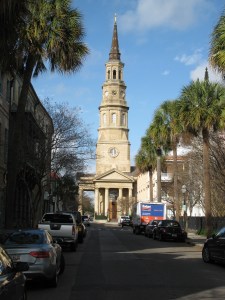
My ramblings took me as well to St. Michael’s Episcopal Church.

St. Michael's

St. Michael’s Episcopal Church
80 Meeting Street

Construction of the church began in 1751 but was not finished until 1761. 

 St. Michael’s may well be the church that The Humourist mentions in one of his later essays when he offers up a “Catalogue of several Paintings and Drawings … [including] a Church half-finished.”

I also visited St. Philip’s Church.

St. Philip's

St. Philips’ Church
142 Church Street

Founded in 1670, St. Philips Church is the oldest Anglican congregation south of Virginia.

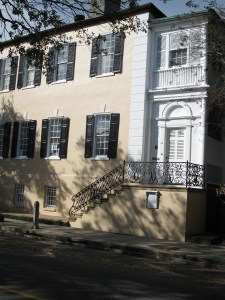
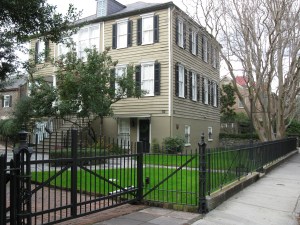
Finally, I wanted to see some houses that survived from the period when The Humourist would have walked these streets.  They are a goodly number, of course, but somehow I found myself in Ansonborough, laid out by Lord Admiral George Anson in 1745.  Some of Charleston’s oldest Greek Revival houses are in Ansonborough, and two caught my fancy.

The first was the Col. William Rhett house, built between 1711 and 1722.


Col. William Rhett House54 Hasell Street
Col. William Rhett House
54 Hasell Street

 The second was the Daniel Legare House, finished about 1760.  This is the oldest surviving house of Colonial Ansonborough.

014

Daniel Legare House
79 Anson Street

Hopefully, this helps you see in part Colonial Charles Towne as I glimpsed part of it in my meanderings yesterday, and as The Humourist saw it during his lifetime in the “Holy City.”

 And as I bring this post to a close, I wonder whether The Humorist ever saw in his lifetime what I just saw a few minutes ago—a first for me in my lifetime— when I stepped outside my hotel:  a double rainbow!  Single rainbows I have seen often, but never until today a double one: double rainbows are symbolic of joy and life transformations.

When the Charleston Library Society opens this morning at 9:30, who knows what I will find there that will bring me joy and that will “transform” my scholarly work on The Humourist essays?