Meanderings in Charleston, South Carolina

Here I am, at last, in Charleston, South Carolina, on a research trip that has several specific goals:

  1. verify my initial transcript of The Humourist essays against the original copies of The South Carolina Gazette;
  2. explore The South Carolina Gazette for 1753-1754 to make certain that I have not missed references to The Humourist;
  3. select specific Humourist essays to be used as facsimiles in my forthcoming publication of the essays; and
  4. examine other primary materials that will strengthen my case for authorial attribution.

The goals are ambitious for a five-day research trip, but if I stay focused, I am confident that  I will achieve the first three goals and that I will make progress with the fourth one.

I’ll be doing a large part of my work at the Charleston Library Society, established in 1748 by seventeen young men who wished to “avail themselves” of the latest publications from Great Britain. The Charleston Library Society paved the way for founding the College of Charleston in 1770, and its core collection of “natural history artifacts” served as the basis for the Charleston Museum, the first museum in America (1773).

Yesterday, when I arrived here, I had one simple task:  meander.  I wanted to walk the streets that The Humourist would have walked and see some of the buildings The Humourist would have seen when he lived in Charles Towne.  (The name was not changed officially to its current spelling until 1783.)  And as I walked the streets I was reminded of Henry Wadsworth Longfellow’s “My Lost Youth,” and, so, I will share a stanza or two here:

Often I think of the beautiful town 
  That is seated by the sea; 
Often in thought go up and down 
The pleasant streets of that dear old town, 
  And my youth comes back to me.          
    And a verse of a Lapland song 
    Is haunting my memory still 
    ‘A boy’s will is the wind’s will, 
And the thoughts of youth are long, long thoughts.’ 
 
I can see the shadowy lines of its trees,           
  And catch, in sudden gleams, 
The sheen of the far-surrounding seas, 
And islands that were the Hesperides 
  Of all my boyish dreams. 
    And the burden of that old song,           
    It murmurs and whispers still: 
    ‘A boy’s will is the wind’s will, 
And the thoughts of youth are long, long thoughts.’ 

My thoughts were long, long thoughts as I rambled the streets, trying to imagine what Charles Town would have been like in 1753/1754 when The Humourist wrote his essays.

The South Carolina Department of Parks and Tourism boasts of historic Charleston this way:

Known as the “Holy City”,  for its long tolerance for religions of all types, Charleston is the state’s most beautiful and historic treasure. Charleston has had a starring role in South Carolina history since its founding more than 300 years ago. The English established the first permanent European settlement on the Ashley River in 1670. War,  fires, earthquakes and hurricanes have threatened this resilient city over the years but it still stands strong and beautiful. The city’s historic district today has barely changed, boasting 73 pre-Revolutionary buildings, 136 late 18th century structures and over 600 others built in the 1840s.

My walk in the “Holy City” took many twists and turns, and, to my surprise I ended up at a building where perhaps I should have started since it is the oldest in Charles Towne.
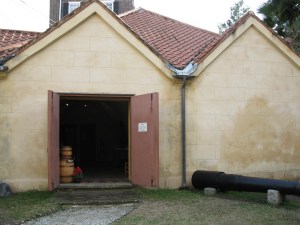
The Old Power Magazine (79 Cumberland Street)

The Old Power Magazine
79 Cumberland Street

The Old Powder Magazine is the only public building remaining from the era of the Lords Proprietors, the eight English aristocrats who owned Carolina from 1670 to 1719, under a charter granted by Charles II of England.

My ramblings took me as well to St. Michael’s Episcopal Church.
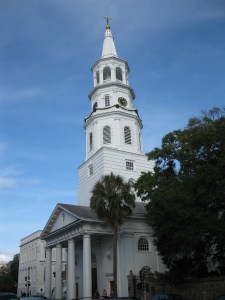
St. Michael's

St. Michael’s Episcopal Church
80 Meeting Street

Construction of the church began in 1751 but was not finished until 1761. 

 St. Michael’s may well be the church that The Humourist mentions in one of his later essays when he offers up a “Catalogue of several Paintings and Drawings … [including] a Church half-finished.”

I also visited St. Philip’s Church.
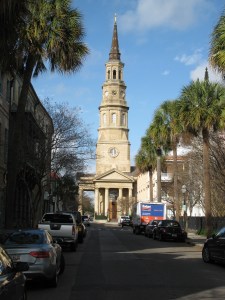
St. Philip's

St. Philips’ Church
142 Church Street

Founded in 1670, St. Philips Church is the oldest Anglican congregation south of Virginia.

Finally, I wanted to see some houses that survived from the period when The Humourist would have walked these streets.  They are a goodly number, of course, but somehow I found myself in Ansonborough, laid out by Lord Admiral George Anson in 1745.  Some of Charleston’s oldest Greek Revival houses are in Ansonborough, and two caught my fancy.

The first was the Col. William Rhett house, built between 1711 and 1722.
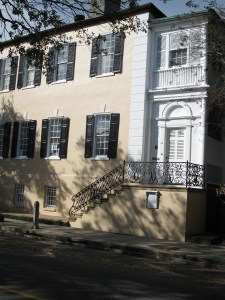
 

Col. William Rhett House54 Hasell Street
Col. William Rhett House
54 Hasell Street

 The second was the Daniel Legare House, finished about 1760.  This is the oldest surviving house of Colonial Ansonborough.
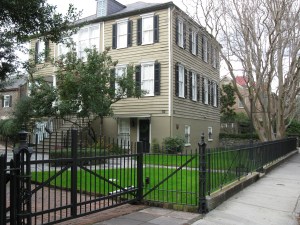
014

Daniel Legare House
79 Anson Street

Hopefully, this helps you see in part Colonial Charles Towne as I glimpsed part of it in my meanderings yesterday, and as The Humourist saw it during his lifetime in the “Holy City.”

 And as I bring this post to a close, I wonder whether The Humorist ever saw in his lifetime what I just saw a few minutes ago—a first for me in my lifetime— when I stepped outside my hotel:  a double rainbow!  Single rainbows I have seen often, but never until today a double one: double rainbows are symbolic of joy and life transformations.

When the Charleston Library Society opens this morning at 9:30, who knows what I will find there that will bring me joy and that will “transform” my scholarly work on The Humourist essays?

The Humorist (December 10, 1753)

Today, The Humorist returns, taking his rightful place center stage. However, before I retreat to the wings, let me share a few brief thoughts about some of my research challenges.

First, working with historical documents from the 1700s is a challenge in itself in terms of establishing editorial principles.  I have taken a conservative approach, always with an eye toward providing a text that is accurate yet readable.  With the following exceptions, I have preserved capitalization, paragraphing, spelling, and punctuation:

  • capitals of two fonts appearing in the same word have been emended to regular capitals;
  • ornamental words used at the beginning of paragraphs have been emended to upper and lower case letters; and
  • long s‘s have been shortened.

The second challenge is the fact that archivists have laminated some numbers of the Gazette in an attempt to mend torn pages.  As a result, I  struggle with reading some of the underlying passages.  <I enclose all conjectural transcriptions in angle brackets to alert the reader just as I have enclosed this sentence in angle brackets.> In any instance when I cannot read a word or if a line has been torn from the Gazette, I provide an alert in square brackets, such as [one illegible word] or [one missing line].  Fortunately, conjectural transcriptions, illegible words, and missing lines are infrequent.

A third challenge is translating some of the Latin quotations that The Humorist uses.  (How  I wish that I had studied Latin somewhere along the way!)  Often I have been able to find reliable translations.  Sometimes, however, I have not.  In today’s essay, for example, I need help with two passages:  see Notes 8 and 1.

Now, as promised, I retreat to the wings.  Enjoy The Humorist’s essay of December 10, 1753.  It’s a keeper.

THE HUMORIST.

A CHAP.  Wherein the author takes great pains to say more of himself than of the subject.

— — — Intent to gaze

Creation thro — — — THOMPSON.1

I promised in my last paper, to give you a copy of my countenance; but as it is impossible to procure it in any reasonable time, if the painter may be allowed to shew his skill or do justice to my person, I shall therefore beg my readers patience, and present them with a true sketch of my figure in print.

My body is small, my soul capacious, and my stature low; but what of that, a dwarf standing on the shoulders of a giant may see farther than a giant himself:2  I have extraordinary amorous eyes, for they are ever best employed in discerning each other.  These are the only singularities of my person.

I am possessed of an excellent perspective, that multiplies the species, and presents to my sight the actions of every man; for distinction’s sake, I term it the Otacousticon:3  By the help of this amazing machine, I can observe cuckold’s horns, the philosopher’s stone4, and new projections; I can discover windmills in one man’s head, and hornet’s nests in another.  This will amply suffice as an emblem of that power with which I am invested.

As to my private character, that falls more immediately within the sphere of the historian than the painter.

The curiosity of mankind may possibly extend so far as an impatience, to know what my inducements are for embracing such notional and vague sentiments; ambition is the answer:  I ever had a soaring mind.  A man may grovel like a reptile upon earth, from his entrance upon the stage of life to his exit, unnoticed, unobserved.

If a man wants to be talk’d of, he must surprise; there is nothing equal to a great action:  Longinus might bless his stars, when he wrote his treatise upon the Sublime;5 observe what eulogiums Eunapius bestowed upon him, he sties him, light of nature! giant of wit! eagle in the clouds! lamp of the world!6  These are the blest rewards of soaring minds!

I say with my good friend Horace, seriam sydera;7 I am for driving my head against the stars, snuffing the moon! and as Heinsius expresses himself, and that like a man of the first magnitude too, in speculo positus, omnia saecula, praeterita, praesentia videns, uno velut intuitu.8

If cold white mortals censure these great deeds,

Warn them; they judge not of superior beings,

Souls make of fire, and children of the sun.  Young.9

But to resume the thread of my discourse, and argue in a more serious way.  Aerial Architecture is of great antiquity; the tower of Babel10 is one notable instance; this evidently shews that the ancients supposed a possibility of building castles in the air:  To dwell long upon a case so much in point, would argue a kind of suspicion in me to produce any other instances; have we not essays on the non-existence of matter, on the non-existence of religion, and quires of paper fruitlessly scribbled over, upon the possibility of longitude?

What immense pains have been taken, and to no purpose, to find out the quadrature of a circle, and the creeks and sounds of the north east and north west passages?  Are not these so many notable instances of castle-building; so many ideas, so many notional and imaginary conceptions, tending to justify that boldness which primá facie appears in this undertaking?

All this, and more, is literally true:  Search the records of old time, and look into the annals of the present, to authenticate what I assert.  They were most certainly unsuccessful in their endeavours; but, as good often arises out of evil, and as the vulgar proverb says, ’tis a bad wind that blows benefit to no one, I am the better for it:  I have collected such materials from their ruins, as will shortly convince mankind of the reasonableness of these fabrics, and the great and innumerable advantages arising therefrom.

I shall pursue my design; it is indeed my duty to do so:  Quintilian peremptorily says, perseverandum est, quia cæpimus.11

ADVERTISEMENTS.

To be sold very reasonable, many considerable lots, and an estate of great value, a wide expanse! in Nubibus only.

Wanted, immediately, a professor of the occult sciences, an adept in palmistry and physiognomy, and a gentleman of a liberal education, who can serve in the capacity of an itinerant thro the twelve signs of the zodiac.

Wanted, several artificers, mechanics, etc. etc. etc. to assist the author in fitting up his aerial habitation:  ‘Tis hoped the prices will not be extravagant, as the workmen will live more reasonably than when employed in their terrene occupations, and as their diet will capacitate them to dispatch more business and in a shorter time, having nothing to subsist on but air.

NOTES

1 James Thompson (1700-1748), English poet and author of The Seasons. The quote comes from “Summer” and, in full context, reads: “Nor to this evanescent speck of earth / Poorly confined, the radiant tracts on high / Are her exalted range; intent to gaze / Creation through; and, from that full complex / Of never ending wonders, to conceive / Of the Sole Being right, who spoke the Word, / And Nature moved complete.”

2 Isaac Newton wrote to Robert Hooke in 1676 saying, “What Descartes did was a good step. You have added much several ways, and especially in taking the colours of thin plates into philosophical consideration. If I have seen a little further it is by standing on the shoulders of Giants.” However, the phrase goes back to the twelfth century and is attributed to humanist and philosopher, Bernard of Chartres.

3 An instrument used to assist in hearing.

4 The Oxford English Dictionary defines this as “A mythical solid substance, supposed to change any metal into gold or silver and (according to some) to cure all wounds and diseases and prolong life indefinitely.”

5 Attributed to Longinus, a Greek rhetorician and literary critic who may have lived in the 1st or 3rd century AD, “On the Sublime” is a treatise on aesthetics and literary criticism and is generally considered to rank second in importance to Aristotle’s Poetics.

6 Eunapius (c. 345 – c. 420), a Greek historian known for his Lives of the Philosophers and Sophists.

7 Horace (65BC-27AD), a leading Roman lyric poet.

8 Daniel Heinsius (1580-1655), a Dutch scholar and poet.  Wanted, a translator:  “in speculo positus, omnia saecula, praeterita, praesentia videns, uno velut intuitu.”  ‘Tis hoped the prices will not be extravagant, as the translators will translate more reasonably than when employed in their terrene occupations.

9 Edward Young (1683-1765), British poet and dramatist. The lines are from his The Revenge: A Tragedy in Five Acts (1721).

10 “1 And the whole earth was of one language, and of one speech. 2 And it came to pass, as they journeyed from the east, that they found a plain in the land of Shinar; and they dwelt there. 3 And they said one to another, Go to , let us make brick, and burn them throughly. And they had brick for stone, and slime had they for morter. 4 And they said , Go to , let us build us a city and a tower, whose top may reach unto heaven; and let us make us a name, lest we be scattered abroad upon the face of the whole earth. 5 And the LORD came down to see the city and the tower, which the children of men builded . 6 And the LORD said , Behold, the people is one, and they have all one language; and this they begin to do : and now nothing will be restrained from them, which they have imagined to do” (Genesis 11:1-6, King James Version).

11 Marcus Fabius Quintilianus (c. 35 – c. 100). a Roman rhetorician known for his 12-volume Institutio Oratoria (Institutes of Oratory).  Wanted, a translator:  perseverandum est, quia cæpimus”.   ‘Tis hoped the prices will not be extravagant, as the translators will translate more reasonably than when employed in their terrene occupations.