Confessions of an Editor: THE INFANT SPHINX Reviewed. (From Dusty Folder to Digital Ink. Part II.)

“A letter is a soul, so faithful an echo of the speaking voice that to the sensitive it is among the richest treasures of love.”

Honoré de Balzac (1799-1850; French novelist and playwright whose works are considered foundational to the realism movement in literature; the quote is from his novel Père Goriot.)

Last week, I unveiled the captivating and downright riveting backstory of my The Infant Sphinx: Collected Letters of Mary E. Wilkins Freeman, highlighting the book’s serendipitous journey from manuscript to publication. I recounted my bold encounter with the president of Scarecrow Press at an American Library Association conference, leading to the acceptance of my manuscript. I shared with you the details of preparing my own camera-ready copy to ensure that the letters I had spent ten years locating, transcribing, and annotating were faithful to their originals when they were published and sent out into the world for all the world to read.

I ended the post with a teaser, hoping to lure you back this week!

In my Scarecrow Press folder that I had forgotten about, I found a forgotten copy of a review that I wrote of my own book. How preposterous is that? Well, it sounds exactly like something that I would do. I’m always telling friends and colleagues that I know no shame. I guess I didn’t back then either. However, I can not for the life of me remember whether I sent my self-review out for publication. I must have because what I discovered in my dusty folder is a photocopy, and it’s so faded that I struggled to read it.

But read it, I did. Dare I say that I enjoyed doing so? I did. Even this many years later, my review strikes me as fresh and refreshing. I’m surprised that I seemed to have found my writer’s voice relatively early in my career, and it has not changed that much at all. Dare I say that I have worked hard down through the years to keep my writer’s voice–even in academic publications–from sounding snotty? I have. Simplicity is always a suit that fits me perfectly in all ways.

By and large, I stand by everything in my review, except for two points. When I wrote the review, I really liked the book’s title, The Infant Sphinx. However, since then, I’ve come to like the title less, and I have come to know Freeman more. Let me explain. In the review, I commented that “I confess to a deep-down-inside wish that a cache of letters secreted away somewhere would be made public and smash to smithereens my claim of having yielded up all there is.”

A cache of letters has not appeared, but enough individual letters have surfaced here and there that I’m working on an updated two-volume work that will use a name more to my liking and more to the liking of Freeman’s closest friends–and presumably more to Freeman’s liking as well– since it’s the name they called her: Dolly. The book title will be Dolly: Life and Letters of Mary E. Wilkins Freeman. Vol. I: The New England Years (1852-1901). Vol. II: The New Jersey Years (1902-1930).

Now, Dear Readers, I know no shame as I share with you my review of my own scholarly book, written 39 years ago and published for the first time right here, right now..

Enjoy!

Confessions of an Editor:  The Infant Sphinx Reviewed

The Infant Sphinx: Collected Letters of Mary E. Wilkins Freeman.
Edited with Biographical/Critical Introductions and Annotations by Brent L. Kendrick.
(Metuchen, N.J. and London: Scarecrow Press, Inc., 1985)
634 pages Illus. ISBN 0-8108-1775-06 $35.00

Mary E. Wilkins Freeman, American short-story writer and novelist with more than forty fictional volumes to her credit, has been so long and so unjustly neglected by twentieth century readers that I don’t even blush as I write my own review of her collected letters. A contemporary of Mark Twain, she shared with him the honor of being one of America’s most beloved writers. She was the first recipient of the William Dean Howells Gold Medal for Distinguished Work in Fiction. She was among the first women elected to membership in the National Institute of Arts and Letters. She was the one posthumously honored when the American Academy of Arts and Letters installed its bronze doors in 1938: “Dedicated to the Memory of Mary E. Wilkins Freeman and the Women Writers of America.”

Obviously, Freeman deserves attention. Twenty-two of her books are in print today. It is fitting that her collected letters should join those volumes rightfully hers and that they should join the slight biography of her that is in print and the equally small critical study.

Freeman was herself described by her townspeople in Randolph, Massachusetts, where she was born in 1852, as “a tiny person, all in brown, like a little mouse.” This volume of her letters is similarly attired: brown buckram covers with gold stamping. But its 634 pages make it somewhat more than tiny. I confess a fear, though, that despite its size and its wealth of information, it might go unnoticed in as unjust a fashion as Freeman herself has gone. I hope not. Once letters appear in print, people are compelled to consult them.

Forgetting this feat, however, it seems to me that a review by a book’s editor (or, for that matter, by a book’s author) is rather innovative and not such a bad idea after all. Who better knows what went into its making? Who better knows why it appears as it does? The answer, of course, is the editor.

The Infant Sphinx was conceived in September 1972. I had just read my first Mary E. Wilkins Freeman short story, “On the Walpole Road.” Before then I had never heard the author’s name. That story so impressed me with its technique, its humor, its characters’ steadfastness in the face of obstacles that I recognized an unusual combination of realism with an inherent belief in man’s thrust toward greatness. Here was a peculiarly American story that was truthful yet positive.

I liked that story so much that I wanted to read more. I moved on to Freeman’s A Humble Romance (1887). The selection was accidental. Little did I know at the time that it was her first collection of adult short stories. Little did I know that it made her a near-overnight success. I learned both facts later. What I knew after finishing that volume was that I liked this author more and more. Then, I read her second collection, A New England Nun (1891). My initial opinion was confirmed: here were powerful stories and powerful characters. Here was a thematic thrust toward greatness. Or, as Freeman said herself in “The Revolt of Mother,” “nobility of character manifests itself in small loop holes when it is not provided large doors.”

I was so intrigued that I wanted to know more about the author. Her biography had been written. But it reduced her entire life to only 194 pages. In fact, it skimmed over her last 30 years in a mere 36 pages. And possibly, worst of all, it had not one photograph of the writer who had so won my attention.

Solace came in the belief that biographies are not always that insightful anyway. So, I resolved to read her letters. I immediately went to a local university library. When I found no catalog entry for Freeman’s correspondence, I attributed it to underdeveloped collections. I checked Books in Print. No luck. I perused guides to our nation’s libraries. Again, no luck. Ultimately, I faced up to the bittersweet fact: Freeman’s letters had never been published.

I resolved at once to undertake the task. I did not dream that it would require nearly ten years. But little did I dream that the letters were deposited in more than fifty library collections (public and personal). They are. Or, perhaps more accurately, were. They are physically still with their owners, of course. But the beauty of an edition of letters is the bringing together of so many separate parts into their rightful whole. That which was scattered becomes united.

A total of 517 items of correspondence were brought together in The Infant Sphinx. Although the last numbered letter in the volume is 510, seven others are “hidden” in between: 110a, 194a, 260a, 281a, 282a, 293a, and 439a. I confess some embarrassment. But what else could I do? All along I had prided myself in including all Freeman letters, even some so scant and some so poor they hardly deserved inclusion. But I wanted the title collected to be accurate. I wanted my claim of having include all letters to be true. So, when these seven wayward epistles were sent to me late in the editing stage, I felt compelled to place them in their proper chronological places.

I confess that I wish there were more. How can it be that a woman who lived so much of her life before the existence of the telephone began to deprive us all of letters wrote so few of the same? Or how can it be that those who received letters from one so popular and so famous kept so few? How can such a woman be survived by a mere 517 letters? I suggest in the edition that Freeman was so busy with her fiction that she did not have much time for letter writing. I point out too that many of her letters were deliberately or accidentally destroyed. I account for the dearth in other ways as well. But I confess to a deep-down-inside wish that a cache of letters secreted away somewhere would be made public and smash to smithereens my claim of having yielded up all there is.

Obviously, it did not take me ten years to collect and edit so few letters. I spent more than half that time gathering biographical material to include in the introduction. The Infant Sphinx has six. The “General Introduction” provides a broad overview. Then there are five others, one for each division. I did not plan it that way initially. But in the end the book took its own shape despite my predetermined wishes. I found myself following the natural biographical divisions of Freeman’s life. Part One, for example, focuses largely on Brattleboro, Vermont, where she launched her literary career, and it traces her shift from a children’s writer (poetry was the genre; children, the audience) to a short story writer for adults. That part, like each of the remaining four, has its own title: “Raising Wonders in a New Literary Field.”

I can take no real credit for those titles. As any perceptive reader will discover, each comes from the letters themselves. I simply selected the quote most appropriate to the section. I remain pleased with the choices. During the years covered by Part One, Freeman did raise wonders on both sides of the Atlantic, and it was in a new literary field. She shifted from poetry to short stories. Her audience changed from children to adults.

“Deviations from My Usual Line of Work” was her title for Part Two. It seemed fit. It was a period of artistic experimentation as she tried her hand at both dramas and novels. I’ve never really cared for her efforts in either direction. I would except from that blanket statement her first two novels, Jane Field (1893) and Pembroke (1894). As for her other thirteen novels, I have not bothered going back to see whether they are any better the second time around. High praises are sounded for her The Shoulders of Atlas (1908). Its probing into homosexuality was a pioneering effort for the time.

Part Three is called “A Hopeless Sort of Chase of Myself.” It was precisely that. Freeman was terribly overworked. She was overworked all her life. How else could she have written over forty volumes in a fifty-year career? But that was not the real reason she was engaged in a hopeless sort of chase. Somehow, she came up with the idea that she should marry even though she was nearly fifty. She decided to leave her native New England where her daily life (and her neighbors’, too) had become almost inseparable from her fiction. Marry. Move. She did both. But she did neither before going off to Paris, presumably to think things over. The trip only made her seasick. It did not change her mind.

She married Charles Manning Freeman, a non-practicing physician, who owned and operated a lucrative coal and lumber business. She moved to her husband’s hometown of Metuchen, New Jersey. Both took place on New Year’s Day, 1902.

That new beginning occupies Part Four, “Tiptoeing Along the Summit.” The quote has nothing to do with the early years of their marriage which were quite happy enough. Neither does it relate to the building of their colonial mansion, “Freewarren,” built with money earned from The Shoulders of Atlas. Nor does it have any relevance to the many volumes of fiction written during that time. Rather, it was prompted by Freeman’s belief that her novel Jerome (1897) was to be made into a movie. On that particular point, Freeman probably tottered from the summit. I was never able to locate a movie version of that novel. Perhaps it appeared under some other title. If so, the underlying work was not credited. Two other movies, however, were made from her books. One was An Alabaster Box (1917) based on the novel of the same name written collaboratively with Florence Morse Kingsley. The other was False Evidence (1919) based on Madelon. That Jerome was not preserved on celluloid hardly matters. Two other novels were. She could rightfully tiptoe.

Earlier in this review I claimed satisfaction with the letter quotes as subtitles. That is, I confess, only four-fifths true. I waivered with Part Five. I changed its title just a few weeks before the volume went to press. Originally, it had been called “Exigencies of Existence.” I had reservations from the start. In the first place, I like words that are easily pronounced and easily understood. Exigencies is neither. But I kept it because it pointed in the direction of truth. Freeman’s final years were difficult. She wrote less and less. Or, more accurately, she wrote quite a lot, but her work was rejected more and more. She had never enjoyed good health, and with age she did so even less.

But most difficult of all was the tragic ending of her marriage. Dr. Freeman had always been fond of his scotch. By 1917 he was so addicted to alcohol and drugs that he was committed to the New Jersey Asylum for the Insane at Trenton. He was released ultimately. Fearing for herself and her servants (of which she usually had several maids and a chauffeur), Freeman obtained a legal separation. Imagine her shock when the doctor died suddenly of heart failure on March 7, 1923, in the home of his chauffeur. Imagine again how she and her four sisters-in-law felt when the chauffeur brought forth a will, naming him as sole executor and heir and leaving Freeman with only $1.00. They fought and broke that will. It required many years and thousands of dollars in lawyers’ fees. All the details are in The Infant Sphinx. Little wonder that Freeman spoke of the exigencies of existence.

But that title bothered me beyond my dislike of the word exigencies. The title conveyed only partial truth. Tragedy loomed large in Freeman’s final years. But so did glory. In 1919, Harper & Brothers, her principal publisher all along, brought out a Modern Classics edition of her New England Nun. In 1926, she was the first recipient of the prestigious William Dean Howells Gold Medal for Distinguished Work in Fiction. Also, in 1926, she was among the first women admitted to membership in the National Institute of Arts and Letters. In 1928, Henry Lanier brought out The Best Short Stories of Mary E. Wilkins. Honor came from her Metuchen neighbors as well. They made her an honorary member of the Borough Improvement League. The mayor even proclaimed a “Mary E. Wilkins Day.” “Exigencies of Existence” simply would not do. I fretted. I looked. I looked and I fretted. Finally, I saw a phrase appropriate to the English language and in keeping with a conscience bent on telling the truth. At the last moment, it was selected for Part Five: “Obstacles in the Path of Pleasure and Duty.”

I can’t claim the book’s title either. Neither can Freeman. Henry Mills Alden takes full credit. One of her closest friends and also editor of Harper’s Weekly, he felt that she was so old and wise in some ways and so young and infantile in others that he called her “The Infant Sphinx.” She had visited in his Metuchen home for nearly a decade before moving there herself. The town immediately dubbed itself “The Brainy Borough.” Afterwards the Freemans and the Aldens dined together often. They played bridge together with even greater frequency. And the Aldens regularly critiqued her work. That is, until she became so sensitive that they dared voice only approval. Henry Alden was certainly qualified to give the transplanted spinster an epithet. His certainly outdistanced “Pussy Willow,” the nickname given her by Mary Louise Booth, another close friend and editor of Harper’s Bazar. Equally inferior were three other endearments: “Mamie,” “Dolly,” and “Cherie.” Alden certainly knew best.

The range of possibilities underlying his epithet comes across strongest in the analysis of Freeman as a businesswoman. I confess that there were times when the dollar sign loomed so large and so often in the letters that Freeman’s artistic integrity was called into question. Such bargaining. Such quibbling. Such subtle strategies to get higher and higher prices. Such skill in financially pitting editor against editor. But I confess at the same time that I enjoyed a restoration of faith when I read in the letters that such actions panged her own New England conscience and that they were prompted by harsh necessity.

Here was no Harriet Beecher Stowe with a family and husband to back her. Here was no Sarah Orne Jewett with a doctor for a father. Here was Mary Wilkins. To be sure, she came from good New England stock on both sides. But there was no money. Her father had been a housewright in Randolph, Massachusetts. Later he was a dry goods merchant in Brattleboro, Vermont. But, when he died in 1883, Mary was left alone. Her inheritance was $969 in cash and one-half interest in the Steen/Wilkins block in Brattleboro, Vermont. She was forced to earn her own living. Writing was her second occupational choice. Years later, she recalled, “I did not want to write at all. I wanted to be an artist. But for lack of paint, etc., and sufficiency of pens, ink, and paper, I wrote” (Letter 478). She did a splendid job. One novel alone brought her outright $20,000. With that money she built a grand colonial house. With royalties earned from other fiction, she bought expensive automobiles and antique oriental rugs. She purchased emerald and diamond rings, just to cheer herself out of moods of depression. But she also invested wisely in stocks ranging from American Telephone and Telegraph to Bohemia Gold mining Company. After her death on March 13, 1930, the auctioned value of her estate came to $118,099. Obviously, this was one American writer with a clear business head. What I can’t quite understand is how such a good businesswoman could die and not leave a last will and testament. Freeman did just that.

I confess that I take great pride in the volume’s 16-page special photographic insert section. Here can be found photographs of Freeman, the men, the houses, and the honors in her life. Elsewhere in the volume can be found facsimiles of Freeman’s letters and an architectural drawing by her father.

And now I have my final confession. Writing a review such as this has been tremendously rewarding. I dare hazard it is just as objective, just as honest, and hopefully just as helpful as one by an outsider would be. I’ve never paid much attention to reviews. I’ve always wanted to make up my own mind. I’ve even known of reviews written by reviewers who had not even read the books. That certainly is not the case here.

A review is intended to whet the appetite, to encourage readers to read, to encourage books to sell. I hope this one scores a big success on all three counts. This much I know. Anyone interested in Mary E. Wilkins Freeman is compelled to read this edition, or risk being criticized for not exploring all the primary and secondary sources. Anyone interested in women’s studies would do well to take notice. Before Freeman’s time, she had no equal among American women writers. She very well may not have had since then. Anyone interested in nineteenth century American literature can find enough here of significance to merit consulting the volume’s thirty-page index at least. More than a hundred letters are to the House of Harper. There is also extensive correspondence to early American newspaper syndicates. Those individuals whose interests aren’t covered by these categories should read The Infant Sphinx just for the sake of their own enlightenment.
Circling Back Home

“We circle the subject to see it most whole.”

Bret Lott (b. 1958; American author and memoirist whose themes focus on family, faith, and the complexities of human relationships.)

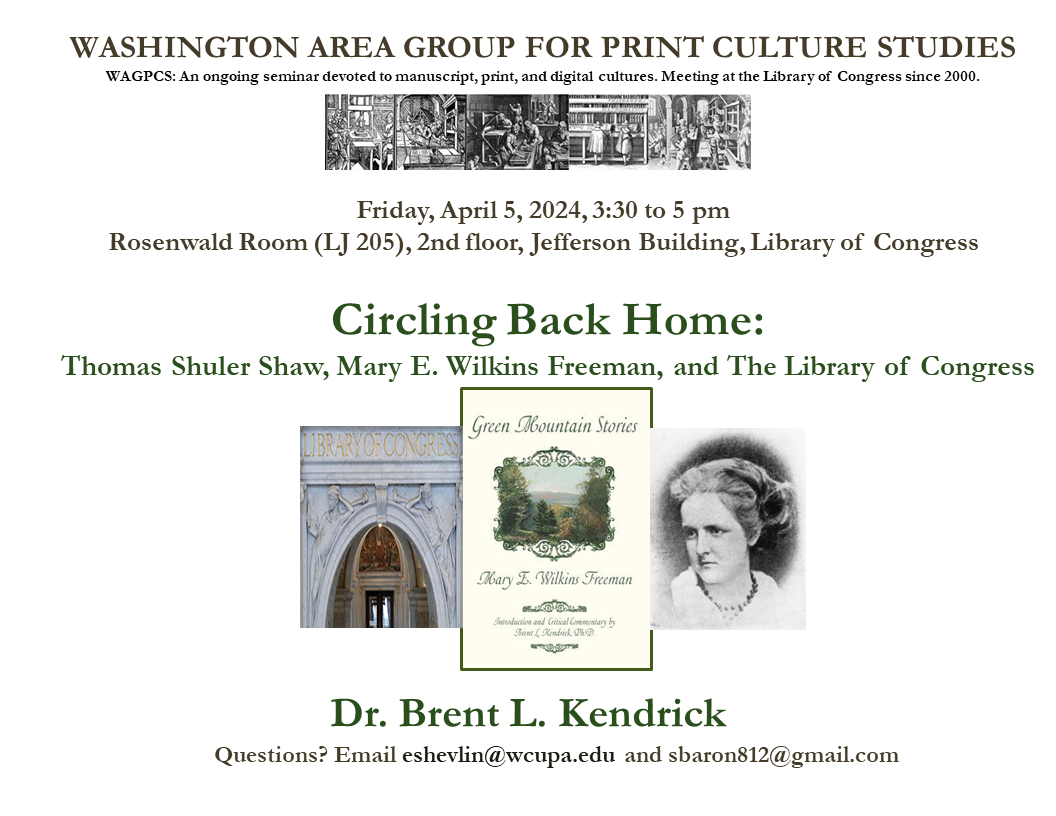
Next week I’ll be circling back home to the Library of Congress (LOC) where I enjoyed a glorious career spanning twenty-five years. I won’t be going home alone. Joining me will be the woman I’ve had an affair with for the last fifty years or so. I’m speaking, of course, of none other than my lady, Mary E. Wilkins Freeman. As part of my ongoing work on my two-volume Dolly: Life and Letters of Mary E. Wilkins Freeman, I’m circling back to LOC’s Rare Book and Special Collections to revisit some important Freeman materials. The beautiful part, however, is that the Washington Area Group for Print Culture Studies (WAGPCS) has invited me to talk about my research. I am thrilled beyond thrilled to be circling back home and to have the opportunity to share my ongoing and exciting work on Freeman.

Below is the abstract of my talk followed by a WAGPCS promotional for the event!

ABSTRACT

On March 15, 1930, the acclaimed American short story writer, Mary E. Wilkins Freeman, passed away. Her legacy, however, continues to resonate. At the turn of the twentieth century, Freeman and Mark Twain stood as America’s most beloved writers. She blazed a trail for women in literature, becoming the first recipient of the William Dean Howells Gold Medal for Distinguished Work in Fiction (awarded by the American Academy of Arts and Letters in 1925). She achieved the distinction of being among the first women elected to membership in the National Institute of Arts and Letters in 1926. Additionally, the bronze doors at the American Academy of Arts and Letters in New York (West 155 Street Administration Building) bear the inscription, “Dedicated to the Memory of Mary E. Wilkins Freeman and the Women Writers of America.”

Enter Thomas Shuler Shaw, a librarian at the Library of Congress, who embarked on an ambitious project in December 1931: writing what would have been the first biography of Mary E. Wilkins Freeman. His goal was to illuminate the life and literary contributions of this remarkable author.

However, fate had other plans. Shaw’s biography, titled A Nineteenth Century Puritan, faced rejection from prominent publishers such as Harper & Brothers, Ladies’ Home Journal, and The Saturday Evening Post. Despite setbacks, Shaw persevered. His meticulously curated scrapbooks and the typescript of his unpublished biography found a home in the Rare Book & Special Collections Division. These artifacts, along with Freeman’s books donated by Shaw to the Library of Congress, provide a rich tapestry of insights into her life and work. Notably, some of these materials reside in the Rare Book/Special Collections, while others find their place in the General Collections.

Fast-forward to 1985. Dr. Brent L. Kendrick, then serving as the Training Coordinator for United States Copyright at the Library of Congress, unveiled a literary treasure: The Infant Sphinx: Collected Letters of Mary E. Wilkins Freeman. Kendrick’s work, enriched by Shaw’s scrapbooks and unpublished biography, delves into Freeman’s correspondence. Through these letters, we glimpse the inner world of a prolific writer who defied conventions and left an indelible mark on American literature.

Fast forward again to May 2023. Kendrick continues his scholarly immersion into Freeman’s world and edits a new edition of her first collection of short stories for adults. Originally published as A Humble Romance and Other Stories in 1887, the book was meant to bear the title Green Mountain Stories. Now, 136 years later, it finally emerges under its intended name: Green Mountain Stories. Kendrick’s edition includes extensive critical commentary, unraveling the intriguing backstory behind this literary transformation.

But Kendrick’s scholarly pursuits don’t end there. Armed with fresh discoveries—significant letters previously absent from his earlier work, The Infant Sphinx—he embarks on a new two-volume project: Dolly: Life and Letters of Mary E. Wilkins Freeman. Vol. I: The New England Years (1852-1901). Vol. II: The New Jersey Years (1902-1930).

With these ongoing scholarly endeavors in mind, Dr. Kendrick returns full circle to the Library of Congress, a place where both he and Shaw once contributed their efforts. Here, he plans to delve once more into Shaw’s meticulously curated scrapbooks and unpublished biography, reexamining their contents to discern fresh insights that could enrich his comprehensive exploration of Freeman’s life and correspondence. This return to the archives not only honors the legacy of Shaw’s dedication but also underscores the enduring significance of the Library of Congress as a nexus for scholarly inquiry into the lives and works of American literary figures.

Reflections on Reinvention

“No one can see their reflection in running water. It is only in still water that we can see.”

Taoist proverb

The extraordinary connection between self-reflection and performance is well-known and well-documented. For example, in their Harvard Business Review article “Don’t Underestimate the Power of Self-Reflection,” James R. Bailey and Scheherazade Rehman show that the “habit of reflection can separate extraordinary professionals from mediocre ones. We would go so far as to argue that it’s the foundation that all other soft skills grow from.”

Luckily for me, I’ve been doing self-reflection since early childhood. At dinner, as we all sat around the kitchen table, we had a regular ritual. Everyone reflected on their day. We turned our dinner-table sharings into dinner-table learning moments. Each of us reflected on–and talked about–what had happened during the day and what impact it had on us. 

My dad’s coal-mining reflections always impressed me the most. His pay was based on how many coal cars he loaded each day, shovel by shovel, working in seams of coal sometimes no higher than 40 inches. He and his fellow coal miners shoveled coal while lying on their backs or kneeling on their knees. Generally, my dad was pleased by what he accomplished–he actually enjoyed being a coal miner. But since his pay and his family’s livelihood depended on how many coal cars he loaded, he would strategize what he might do to load one more car the next day. It was a succession of what-ifs. The next day, he’d let us know whether his strategy had worked.

Looking back, I realize that day after day, my dad was measuring his performance against his plan. Looking back, I realize that we were all doing the same thing as we gathered around our kitchen table and shared thoughtful, deliberate, and sometimes courageous self-reflections.

Self-reflection.

Measuring performance against plan.

I have always done that, willingly and enthusiastically throughout my careers. During the years that I taught at Laurel Ridge Community College (formerly Lord Fairfax Community College; 1999-2022), I spent the better part of December standing still, reflecting on my year of teaching that had just ended. I turned my self-reflections into my annual self-evaluation, complete with supporting documentation. Generally, those self-evaluations were longer than 150 pages, covering accomplishments as well as areas that I wanted to work on and explore during the next year. They meant so much to me that I had them bound in leather. Most of the time, those self-evaluations weren’t required, and even when they were, the requirement was never as great as the distance that I went. It was my ongoing way of ensuring that I measured my performance against my plan.

In January of this year, I started reinventing myself. Now, with seven months behind me, I’m standing still long enough to reflect and to share my self-reflections with you.

ACCOMPLISHMENTS

1. Book Publications

I am really proud that I’ve had two books published since January. One was published in April: In Bed: My Year of Foolin’ Around.

The second, a scholarly work, was published in May: Green Mountain Stories. Mary E. Wilkins Freeman. Introduction and Critical Commentary by Brent L. Kendrick.

Obviously, I had been working on both books long before I started my reinvention. Books don’t spring into existence overnight. At the same time, seeing two books through the publication process brought me great joy.

On reflection, however, I wish that I had allowed more time between the two books. I had to do far more heavy lifting, getting them published than I ever expected. I don’t think that I will ever again have two books in the publication hopper at the same time.

2. Book Launches

Without a blush of shame, I did my own launch of In Bed: My Year of Foolin’ Around. I did it right here in my blog, in my May 8 post: Just Published. In Bed: My Year of Foolin’ Around.

The next week, I cast shame aside once again and promoted my Green Mountain Stories: My Forthcoming Book Will Anchor Mary E. Wilkins Freeman to Vermont, Now and Forever.

Fortunately, Green Mountain Stories had two launches sponsored by other people. The first was by the book’s publisher, Onion River Press: Brent Kendrick. Book Launch Celebration. The second book launch took place in Brattleboro, Vermont, where Freeman began her acclaimed literary career: Green Mountain Stories. Live at the Library.

3. Library Presentation

On Sunday, July 9, I was the guest speaker at the New Market Area Library (New Market, VA). My topic? Reinvention and my own attempts to begin new “chapters” in my life. 

I targeted my presentation toward anyone considering a new beginning, aspiring writers, and lovers of short stories.

CHALLENGES

1. Giving Myself Permission to Chill.

I have an incredibly strong work ethic, which has always kept me hard at work doing something. It brings me great joy.

Even though I have set up my own work schedule, I have discovered that I have more time now to just chill. I’m not talking about meditation. I’ve done that forever. I’m talking about curling up with a book for the entire day. I did just that last week when I re-read (for the fifth time) George Saunders’ Lincoln in the Bardo. It was a luxurious experience, but from time to time, I had to chase away the thought that I should be up and about doing something.

It will take me some time, but I’m working on chilling.

2. Reassessing My Structure.

This challenge is related closely to my first one. I’m a laid-back, go-with-the-flow guy. Right? Well, I am. However, I like my days to be structured. Actually, that’s an understatement. I like–and live–a regimented existence. I always have. If I shared my day-planner–(Don’t ask; I won’t share.) –you would discover that all the timeslots are full, from sunup to sundown.

These days, I’m discovering that I can accomplish everything that I want to accomplish in a day and still have some free time slots for me. Mine. All mine. This is a new sensation for me, and I like it. I had no idea before that 30 minutes here and there could expand into such vastly soft and silky luxuriousness.

ONGOING AND UPCOMING PROJECTS

1. Weekly Blog Posts.

I never dreamt how important my weekly blog posts would become to me. In the midst of whatever might be going on, writing my posts anchors me. They are essential components of who I am and of who I am yet to become.

2. Dolly: Life and Letters of Mary E. Wilkins Freeman.

My goodness. You know you’re in love when the love grows richer over time. My love affair with Mary E. Wilkins Freeman is now in its fifth decade.

My current project has as its foundation my The Infant Sphinx: The Collected Letters of Mary E. Wilkins Freeman (Scarecrow, 1985), praised by The Journal of Modern Literature as “the most complete record to date of Freeman’s life as writer and woman.” 

Since that publication, more letters have surfaced. Rather than simply updating The Infant Sphinx, I am working on a two-volume book: Dolly: Life and Letters of Mary E. Wilkins Freeman. Vol. 1: The New England Years (1852-1901). Vol II: The New Jersey Years (1902-1930).

This is a major scholarly work will take several more years. I am hopeful that Volume I will be published by the end of 2024 or the beginning of 2025.

3. Edinburg Ole Time Festival Authors Tent.

Look for me on September 16 and 17 in the lineup with other local authors. If you live in the area, please stop by not only to say “Hi” but also to support the festival.

4. The Humourist Essays.

This blog had its birth when I was a Chancellor’s Professor (2012-2014). My project focused on a remarkable collection of Colonial American essays, songs, poems, and advertisements published pseudonymously under the name of “The Humourist” in the South Carolina Gazette during 1753-1754. The Encyclopedia of the Essay (ed. Tracy Chevalier, 1997) places “The Humourist” essays in the tradition of Samuel Johnson’s Rambler essays and observes that they are the only “full-fledged literary” works to have appeared in the South Carolina Gazette. J. A. Leo Lemay (du Pont Winterthur Professor of English at the University of Delaware) noted in A Bibliographical Guide to the Study of Southern Literature (1969) that the essays should be edited, published, and the author identified.

I completed all of those tasks. My plan is to start sending the completed manuscript to publishers by the end of September, with an eye toward publication in January/February2024.

ACCOUNTABILITY PARTNERS

I’m really glad that I’m continuing my decades-old practice of regularly reflecting on my performance. This time, though, is singularly different. I’m sharing my self-reflections with you. I like that. Actually, I like that a lot. By sharing my plans with you, I am, of course, holding myself accountable to readers from around the world. The ramifications are far-reaching. Equally important, by sharing my plans with you, you become my virtual accountability partners. You can count on me, and I know that I can count on you!

Just Released: New Scholarly Book on Acclaimed Writer Mary E. Wilkins Freeman

“Dedicated to the Memory of Mary E. Wilkins Freeman
and the Women Writers of America”

Bronze Doors Inscription, American Academy of Arts and Letters, New York.

If the wheels of progress turn exceedingly slow–and they do–then the wheels of scholarly publishing turn even more slowly. Many steps are involved in publishing a book, especially an academic one with multiple contributors: finding a publisher; issuing the call for proposals (CFP); accepting proposals; writing; peer reviewing; revising; copy editing; and, finally, publishing. On average, it takes about two years for a scholarly book to find its way into print.

But the quality of the scholarship and the advances made by the research make the wait worthwhile.

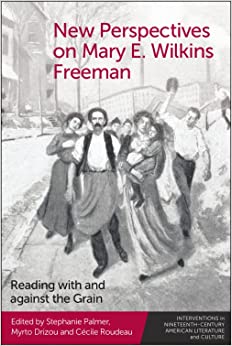
New Perspectives on Mary E. Wilkins Freeman: Reading with and against the Grain is a perfect example. The editors–professors Stephanie Palmer (Nottingham Trent University, United Kingdom); Myrto Drizou (Boğaziçi University, Turkey); and Cécile Roudeau (Université Paris Cité, France) issued the book’s CFP all the way back in April 2019.

As a well-known Freeman scholar, I responded and proposed a chapter. I am sharing my chapter’s abstract below, not to promote myself but rather to provide general background information for my blog readers who may not be familiar with Freeman.

The distinguished accolades enjoyed by Mary E. Wilkins Freeman are numerous and well known. At the start of the Twentieth Century—when her career was at its height—she and Mark Twain were considered America’s most beloved writers. She was the first recipient of the William Dean Howells Gold Medal for Distinguished Work in Fiction (1925). She was among the first women elected to membership in the National Institute of Arts and Letters (1926). And the bronze doors at the American Academy of Arts and Letters in New York (installed at its West 155 Street Administration Building in 1938) bear the inscription, “Dedicated to the Memory of Mary E. Wilkins Freeman and the Women Writers of America.”

What is not well known, however, is Freeman’s financial success as a businesswoman. Freeman started her career in 1883 with $962.09 in cash and with one-half interest in a piece of Brattleboro, Vermont, property. Yet after her death in 1930, the value of her estate at the height of the Great Depression—even after her personal property had been auctioned off at embarrassingly low prices—came to a grand and spectacular finale of $117,285.41. Adjusted for inflation, that would be equivalent to starting out with $24,214.38 in 1883 and ending up with $1,804,925 in 1930 when the market was at its worst.

By any standard, that’s quite a financial success story, especially for a writer who at the start of her career maintained, “I know so little about business and business customs.”

Careful research into the business side of Freeman’s life demonstrates that necessity taught her a lot about business and business customs.

This chapter zooms in on Freeman’s career not only as a successful writer but also as an independent woman. Single for most of her life and without financial backing (unlike her contemporaries Harriet Beecher Stowe, Sarah Orne Jewett, and Kate Chopin), she knew that she had to fend for herself.  Or, as she herself commented in a 1919 letter to American literary scholar Fred Lewis Pattee, “I wrote no more vers de societe. No more Cherries in Blossom. My dear Sir, do you remember I wrote you that I had to earn my living? I did not write this, but I had an Aunt to support. How could I have accomplished these feats on poetry?”

She couldn’t accomplish it by poetry alone, but she could by exploiting multiple genres: 3 plays, 14 novels, 3 volumes of poetry, 22 volumes of short stories, over 50 uncollected short stories and prose essays, and 1 motion picture play.

Over the course of a career that spanned nearly 50 years and through nothing more than the power of her pen and her astute business acumen, she amassed a fortune. Hers is a story of phenomenal magnitude, unparalleled in all of nineteenth century American literature, especially among women writers, and this paper will chronicle her financial success story.

Now, nearly four years later (delayed, no doubt, by the COVID-19 Pandemic), the book was published this month by Edinburgh University Press.

Edinburgh University Press; 1st edition
(February 28, 2023)
Hardcover ‏ : ‎ 328 pages
ISBN-10 ‏ : ‎ 1399504479
ISBN-13 ‏ : ‎ 978-1399504478

My contribution–“Literary Businesswoman Extraordinaire”–appears as Chapter 9 in the section Women’s Work: Capital, Business, Labor.

Kinship Outside of Normative Structures
1. Mary E. Wilkins Freeman’s Neighborly Encounters and the Project of Neighborliness – Jana Tigchelaar
2. “Her Own Creed of Bloom”: The Transcendental Ecofeminism of Mary E. Wilkins Freeman – Susan M. Stone
3. “Preposterous Fancies” or a “Plain, Common World?” Queer World-Making in Mary E. Wilkins Freeman’s “The Prism” (1901) – H.J.E. Champion

Violent, Criminal, and Infanticidal: Freeman’s Odd Women
4. The Reign of the Dolls: Violence and the Nonhuman in Mary E. Wilkins Freeman – Donna M. Campbell
5. Transatlantic Lloronas: Infanticide and Gender in Mary E. Wilkins Freeman and Alexandros Papadiamantis – Myrto Drizou
6. Redefining the New England Nun: A Revisionist Reading in the Context of Pembroke and Irish American Fiction – Aušra Paulauskienė

Women’s Work: Capital, Business, Labor
7. Hunger Strikes:Queer Naturalism and the Gendering of Solidarity in Mary E. Wilkins Freeman’s The Portion of Labor – Justin Rogers-Cooper
8. “It Won’t Be Long Before the Grind-Mill in There Will Get Hold of Him”: The Theft of Childhood in Mary E. Wilkins Freeman’s The Portion of Labor – Laura Dawkins
9. Literary Businesswoman Extraordinaire – Brent L. Kendrick
10. “Deconstructing Upper-Middle-Class Rites and Rituals: Reading Mary E. Wilkins Freeman’s Stories Alongside Mary Louise Booth’s Harper’s Bazar“– Audrey Fogels

Periodization Reconsidered
11. Mobilizing the Great War in Mary E. Wilkins Freeman’s Edgewater People – Daniel Mrozowski
12. A Cacophony of Voices: Freeman’s Modernism – Monika Elbert
13. Underground Influence: Sylvia Townsend Warner’s Pastiche of Mary E. Wilkins Freeman – Stephanie Palmer
14. Untimely Freeman – Cécile Roudeau

Afterword: Why Mary E. Wilkins Freeman? Why Now? Where Next? – Sandra A. Zagarell

New Perspectives on Mary E. Wilkins Freeman is rich and robust, adding new dimensions to earlier book-length studies:

Edward Foster, Mary E. Wilkins Freeman (Hendricks House, 1956). Foster started his Freeman biography right after her death in 1930. At the time, he was a doctoral student at Harvard. One of the book’s many strengths is its inclusion of information gained from interviewing Freeman’s friends and relatives.

Perry Westbrook, Mary Wilkins Freeman (Twayne, 1967; rev. 1988). Westbrook explores some of Freeman’s richest and most significant works, anchoring them to the New England local color tradition as well as to women writers.

Brent L. Kendrick, ed., The Infant Sphinx: Collected Letters of Mary E. Wilkins Freeman (Scarecrow, 1985). Praised by The Journal of Modern Literature as “the most complete record to date of Freeman’s life as writer and woman.” I have a new two-volume update in progress: Dolly: Life and Letters of Mary E. Wilkins Freeman. Vol I: The New England Years (1852-1901). Vol II: The New Jersey Years (1902-1930).

Leah Blatt Glasser, In a Closet Hidden (University of Massachusetts Press, 1996). Glasser’s work is a literary biography that “traces Freeman’s evolution as a writer, showing how her own inner conflicts repeatedly found expression in her art.”

Aside from book publications, Freeman has merited state-wide celebrations, too.

In 1991, Newark Public Library, the New Jersey College English Association, and the English Department of Kean College celebrated Freeman’s life and works in a series of free public programs. Jim Florio, New Jersey’s governor at the time, issued a formal proclamation, declaring “November, 1991 as Mary E. Wilkins Freeman Month.”

Additionally, in October 2019, Freeman was featured as part of the Brattleboro (VT) Literary Festival. Recognizing her connections to Brattleboro and to the Green Mountain State, Vermont Governor Phillip B. Scott proclaimed October 17, 2019, as “MARY E. WILKINS FREEMAN DAY
in Vermont.”

On January 17 the next year, Freeman’s home at 207 Lake Avenue in the Borough of Metuchen in Middlesex County, New Jersey, where she lived and wrote from 1902 to 1907, was added to the National Register of Historic Places.

New Perspectives on Mary E. Wilkins Freeman is a welcome addition to Freeman scholarship. Taken as a whole, the book provides a greater understanding of Freeman’s unequivocal–and sometimes unrivaled–impact on American letters.