From Dusty Folder to Digital Ink. Part I: The Untold Story of THE INFANT SPHINX

“Backstories are the breadcrumbs that lead readers deeper into the forest of the narrative, revealing hidden truths along the way.”

Ursula K. Le Guin (1929-2018; influential American author whose writing often explored themes of anthropology, sociology, gender, and the human condition.)

Almost everything in life has a backstory, and sometimes its dimensions are too rich and multifaceted to be tossed aside as having a lesser value. Consider, for instance, the genesis of a scholarly book, the product of years of research, contemplation, and dedication. Behind the polished cover and meticulously cited pages lies a narrative of passion, struggle, and serendipity that often goes untold.

My own scholarly work The Infant Sphinx: Collected Letters of Mary E. Wilkins Freeman is a perfect example. It has an incredible backstory, and I am always ready to share snippets, especially as it relates to the book’s publication history. Snippets, mind you. Until now, I’ve never shared the entire backstory. Here goes!

When I finished the manuscript in 1984, I sent it to the University of Massachusetts Press. They accepted it but advised me that publication would be delayed by at least a year, perhaps two years or longer. I declined their offer because, as a young scholar eager to be published, I wanted the book on library shelves yesterday or the day before.

A few months later, I happened to be in Dallas for the American Library Association’s Annual Conference. ALA’S book exhibition hall always features lots of publishers from all across the country. I decided to spend a few hours there, not with an eye toward finding a publisher for my book but rather with an eye toward seeing what free books and book paraphernalia I could take back home with me. In the midst of my freebie rambles, I found myself looking at a Scarecrow Press book exhibit. I nearly walked right on past, but I looked more closely and saw its location: Metuchen, New Jersey.

“OMG!” I thought to myself. “My lady–Mary E. Wilkins Freeman–lived in Metuchen from her marriage in 1902 until her death in 1930.”

Without any hesitancy whatsoever, I smiled at the man standing by the exhibit and declared, in what I hoped would be a convincing voice:

“Today is your lucky day!”

“Oh, yeah? Why’s that?”

I proceeded to tell him about Freeman, her connection to Metuchen, and my hot manuscript. His eyes sparkled, his smile stretched from ear to ear, and his every movement exuded enthusiasm.

“I’d love the chance to consider your manuscript for publication. Send it to me when you get back home.”

We shook hands.

“I’m Esh,” he said casually.

I knew as I walked away that Esh and I had just entered into a gentleman’s agreement. I knew that Esh would accept the manuscript. I knew that Scarecrow Press would publish The Infant Sphinx. Ironically, I didn’t know until I got back to my hotel room and looked at the business card that Esh was none other than William Eshelman, the president of Scarecrow Press.

And so, it came to pass. Esh was impressed by my manuscript and accepted it. When the book was released in 1985, Scarecrow invited me to Metuchen for talks, receptions, and book signings. I will always remember that week as one of the most memorable chapters in my life, especially the book celebration with the ladies of the Quiet Hour Club, several of whom–Dolly Buchanan and Lois Lord–befriended me during my years of doing research in Metuchen. What made it even more special is the fact that Freeman herself was an honorary club member.

I share the preceding snippets of the backstory often, especially with students and aspiring writers, as an example of serendipity. When I went to the ALA conference in the summer of 1984, I never dreamt that I would find a publisher for The Infant Sphinx. Also, I share it as an example of how it pays to be bold. I was the epitome of boldness when I approached a rank stranger, standing beside his publishing-house exhibit, declaring that it was his lucky day. Little did I know that he was the company’s president. What nerve! Yet, what would have happened if I hadn’t been so bold?

The book’s backstory has other details, too, but until now, I haven’t shared those snippets. For example, I didn’t trust anyone to typeset my manuscript. I had spent a decade carefully deciphering and transcribing Freeman’s letters. I was worried that a typesetter would mess up the format, regularize the spellings, and introduce mistakes. Esh agreed that if I could provide Scarecrow with camera-ready copy, they would provide me with a higher royalty. I don’t remember how much. Also, I don’t remember the technical details of preparing camera-ready copy. I do remember, however, that it was before personal computers. I rented a fancy machine of some sort–a “Compu” something or other–and for months, I spent evenings and weekends working on a gargantuan task. No. I confess. It was a Herculean task. But guess what? I loved every eye-strained, wrist-pained moment of it.

I don’t usually share that part of the backstory, not because I’m embarrassed to let the world know that I find joy in scholarly drudgery but rather because I’m embarrassed to let the world know that I don’t recall more of the minor details.

Recently, however, serendipity brought to the surface a dusty folder that has lots and lots of details plus a major “find” that even I had forgotten. Just a week or so ago, when the idea for this post popped into my mind, I went looking for the Scarecrow Press folder that I knew I had surely kept. Indeed, I had kept it. Indeed, it was exactly where I knew it would be. Now, I have all the facts that I need not only to flesh out the entire backstory but also to reveal a teaser to lure you back next week.

The first detail is that Esh and I wasted no time. I sent him my manuscript on July 11. He gave me an acceptance phone call on July 16 and followed up the next day with a formal letter, returning the manuscript along with “model paper on which [I could] prepare camera-ready copy.”

The second detail is this. The “Compu thing” that I couldn’t remember turns out to have been a Compucorp 675, Diablo 630. My lease agreement with Word Rentals is in the folder. The rental was $600 monthly, commencing August 1. By November 6, I had finished my task.

The third detail–the royalty–turns out to have been 15%. Looking back, I should have asked for more considering the direct rental expense that I incurred for the Compucorp. However, I have used The Infant Sphinx over and over again for my own research, and I haven’t found any mistakes. I have no regrets about the price that I paid for the quality that Freeman’s letters deserved.

The last minor detail is this. The book was released officially on April 28, 1985, exactly 39 years ago. From this point forward, April 28 will be a red-letter date on my calendar!

Now, the big teaser reveal. In the Scarecrow folder, I found a review of The Infant Sphinx that I had written myself! How preposterous is that! Well, it sounds exactly like something that I would do. I’m always telling friends and colleagues that I know no shame. I guess I didn’t back then either. However, I cannot for the life of me remember whether I sent it out for publication. I must have, because what I discovered in my dusty folder is a photocopy, and it’s so faded that I struggled to read it.

Ultimately, however, I managed to read the text, fading away as fast as my memory. Next week, I will share my “Confessions of an Editor,” unabashedly raw and candid, just as I wrote the review 39 years ago.

In the meantime, whenever you pick up a scholarly book or any work of art, take a moment to consider its backstory. You might be surprised by the passion, perseverance, and sheer stubbornness that lie beneath the surface. Or you might stumble upon a review of the book written by the scholar himself, such as the review you will be able to read right here next week in Part II.
Circling Back Home

“We circle the subject to see it most whole.”

Bret Lott (b. 1958; American author and memoirist whose themes focus on family, faith, and the complexities of human relationships.)

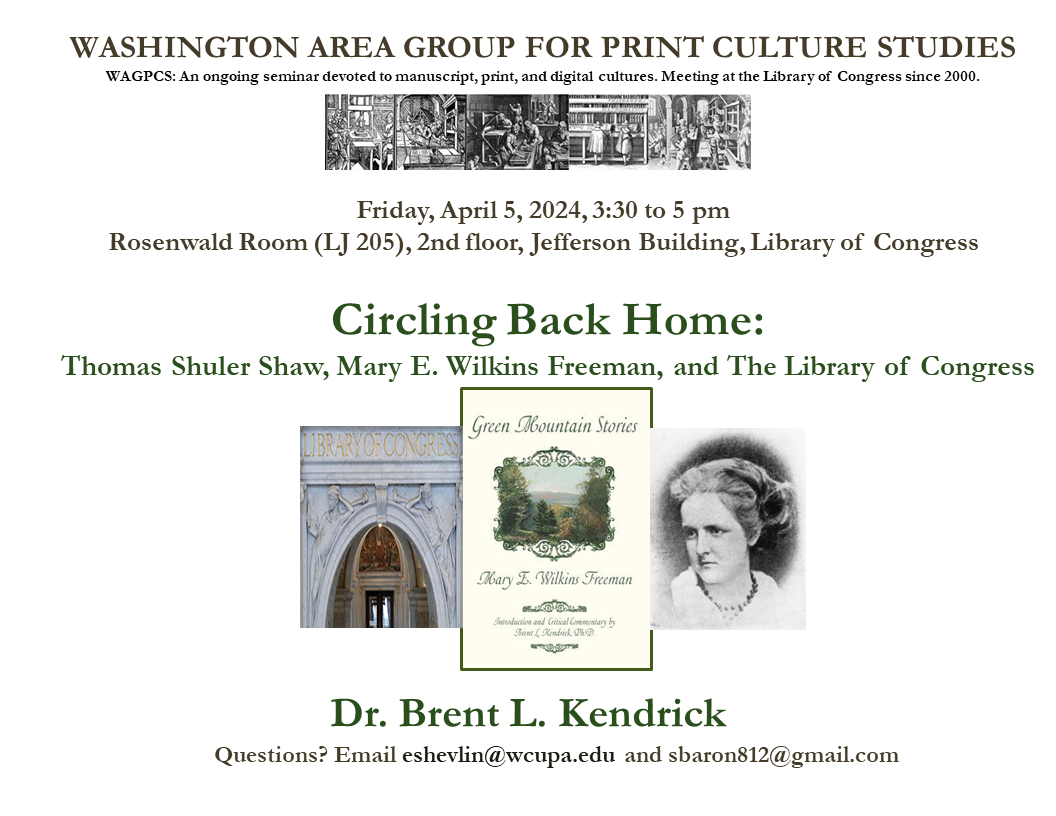
Next week I’ll be circling back home to the Library of Congress (LOC) where I enjoyed a glorious career spanning twenty-five years. I won’t be going home alone. Joining me will be the woman I’ve had an affair with for the last fifty years or so. I’m speaking, of course, of none other than my lady, Mary E. Wilkins Freeman. As part of my ongoing work on my two-volume Dolly: Life and Letters of Mary E. Wilkins Freeman, I’m circling back to LOC’s Rare Book and Special Collections to revisit some important Freeman materials. The beautiful part, however, is that the Washington Area Group for Print Culture Studies (WAGPCS) has invited me to talk about my research. I am thrilled beyond thrilled to be circling back home and to have the opportunity to share my ongoing and exciting work on Freeman.

Below is the abstract of my talk followed by a WAGPCS promotional for the event!

ABSTRACT

On March 15, 1930, the acclaimed American short story writer, Mary E. Wilkins Freeman, passed away. Her legacy, however, continues to resonate. At the turn of the twentieth century, Freeman and Mark Twain stood as America’s most beloved writers. She blazed a trail for women in literature, becoming the first recipient of the William Dean Howells Gold Medal for Distinguished Work in Fiction (awarded by the American Academy of Arts and Letters in 1925). She achieved the distinction of being among the first women elected to membership in the National Institute of Arts and Letters in 1926. Additionally, the bronze doors at the American Academy of Arts and Letters in New York (West 155 Street Administration Building) bear the inscription, “Dedicated to the Memory of Mary E. Wilkins Freeman and the Women Writers of America.”

Enter Thomas Shuler Shaw, a librarian at the Library of Congress, who embarked on an ambitious project in December 1931: writing what would have been the first biography of Mary E. Wilkins Freeman. His goal was to illuminate the life and literary contributions of this remarkable author.

However, fate had other plans. Shaw’s biography, titled A Nineteenth Century Puritan, faced rejection from prominent publishers such as Harper & Brothers, Ladies’ Home Journal, and The Saturday Evening Post. Despite setbacks, Shaw persevered. His meticulously curated scrapbooks and the typescript of his unpublished biography found a home in the Rare Book & Special Collections Division. These artifacts, along with Freeman’s books donated by Shaw to the Library of Congress, provide a rich tapestry of insights into her life and work. Notably, some of these materials reside in the Rare Book/Special Collections, while others find their place in the General Collections.

Fast-forward to 1985. Dr. Brent L. Kendrick, then serving as the Training Coordinator for United States Copyright at the Library of Congress, unveiled a literary treasure: The Infant Sphinx: Collected Letters of Mary E. Wilkins Freeman. Kendrick’s work, enriched by Shaw’s scrapbooks and unpublished biography, delves into Freeman’s correspondence. Through these letters, we glimpse the inner world of a prolific writer who defied conventions and left an indelible mark on American literature.

Fast forward again to May 2023. Kendrick continues his scholarly immersion into Freeman’s world and edits a new edition of her first collection of short stories for adults. Originally published as A Humble Romance and Other Stories in 1887, the book was meant to bear the title Green Mountain Stories. Now, 136 years later, it finally emerges under its intended name: Green Mountain Stories. Kendrick’s edition includes extensive critical commentary, unraveling the intriguing backstory behind this literary transformation.

But Kendrick’s scholarly pursuits don’t end there. Armed with fresh discoveries—significant letters previously absent from his earlier work, The Infant Sphinx—he embarks on a new two-volume project: Dolly: Life and Letters of Mary E. Wilkins Freeman. Vol. I: The New England Years (1852-1901). Vol. II: The New Jersey Years (1902-1930).

With these ongoing scholarly endeavors in mind, Dr. Kendrick returns full circle to the Library of Congress, a place where both he and Shaw once contributed their efforts. Here, he plans to delve once more into Shaw’s meticulously curated scrapbooks and unpublished biography, reexamining their contents to discern fresh insights that could enrich his comprehensive exploration of Freeman’s life and correspondence. This return to the archives not only honors the legacy of Shaw’s dedication but also underscores the enduring significance of the Library of Congress as a nexus for scholarly inquiry into the lives and works of American literary figures.

Just Released: New Scholarly Book on Acclaimed Writer Mary E. Wilkins Freeman

“Dedicated to the Memory of Mary E. Wilkins Freeman
and the Women Writers of America”

Bronze Doors Inscription, American Academy of Arts and Letters, New York.

If the wheels of progress turn exceedingly slow–and they do–then the wheels of scholarly publishing turn even more slowly. Many steps are involved in publishing a book, especially an academic one with multiple contributors: finding a publisher; issuing the call for proposals (CFP); accepting proposals; writing; peer reviewing; revising; copy editing; and, finally, publishing. On average, it takes about two years for a scholarly book to find its way into print.

But the quality of the scholarship and the advances made by the research make the wait worthwhile.

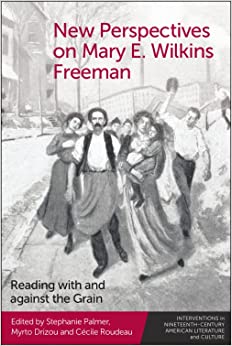
New Perspectives on Mary E. Wilkins Freeman: Reading with and against the Grain is a perfect example. The editors–professors Stephanie Palmer (Nottingham Trent University, United Kingdom); Myrto Drizou (Boğaziçi University, Turkey); and Cécile Roudeau (Université Paris Cité, France) issued the book’s CFP all the way back in April 2019.

As a well-known Freeman scholar, I responded and proposed a chapter. I am sharing my chapter’s abstract below, not to promote myself but rather to provide general background information for my blog readers who may not be familiar with Freeman.

The distinguished accolades enjoyed by Mary E. Wilkins Freeman are numerous and well known. At the start of the Twentieth Century—when her career was at its height—she and Mark Twain were considered America’s most beloved writers. She was the first recipient of the William Dean Howells Gold Medal for Distinguished Work in Fiction (1925). She was among the first women elected to membership in the National Institute of Arts and Letters (1926). And the bronze doors at the American Academy of Arts and Letters in New York (installed at its West 155 Street Administration Building in 1938) bear the inscription, “Dedicated to the Memory of Mary E. Wilkins Freeman and the Women Writers of America.”

What is not well known, however, is Freeman’s financial success as a businesswoman. Freeman started her career in 1883 with $962.09 in cash and with one-half interest in a piece of Brattleboro, Vermont, property. Yet after her death in 1930, the value of her estate at the height of the Great Depression—even after her personal property had been auctioned off at embarrassingly low prices—came to a grand and spectacular finale of $117,285.41. Adjusted for inflation, that would be equivalent to starting out with $24,214.38 in 1883 and ending up with $1,804,925 in 1930 when the market was at its worst.

By any standard, that’s quite a financial success story, especially for a writer who at the start of her career maintained, “I know so little about business and business customs.”

Careful research into the business side of Freeman’s life demonstrates that necessity taught her a lot about business and business customs.

This chapter zooms in on Freeman’s career not only as a successful writer but also as an independent woman. Single for most of her life and without financial backing (unlike her contemporaries Harriet Beecher Stowe, Sarah Orne Jewett, and Kate Chopin), she knew that she had to fend for herself.  Or, as she herself commented in a 1919 letter to American literary scholar Fred Lewis Pattee, “I wrote no more vers de societe. No more Cherries in Blossom. My dear Sir, do you remember I wrote you that I had to earn my living? I did not write this, but I had an Aunt to support. How could I have accomplished these feats on poetry?”

She couldn’t accomplish it by poetry alone, but she could by exploiting multiple genres: 3 plays, 14 novels, 3 volumes of poetry, 22 volumes of short stories, over 50 uncollected short stories and prose essays, and 1 motion picture play.

Over the course of a career that spanned nearly 50 years and through nothing more than the power of her pen and her astute business acumen, she amassed a fortune. Hers is a story of phenomenal magnitude, unparalleled in all of nineteenth century American literature, especially among women writers, and this paper will chronicle her financial success story.

Now, nearly four years later (delayed, no doubt, by the COVID-19 Pandemic), the book was published this month by Edinburgh University Press.

Edinburgh University Press; 1st edition
(February 28, 2023)
Hardcover ‏ : ‎ 328 pages
ISBN-10 ‏ : ‎ 1399504479
ISBN-13 ‏ : ‎ 978-1399504478

My contribution–“Literary Businesswoman Extraordinaire”–appears as Chapter 9 in the section Women’s Work: Capital, Business, Labor.

Kinship Outside of Normative Structures
1. Mary E. Wilkins Freeman’s Neighborly Encounters and the Project of Neighborliness – Jana Tigchelaar
2. “Her Own Creed of Bloom”: The Transcendental Ecofeminism of Mary E. Wilkins Freeman – Susan M. Stone
3. “Preposterous Fancies” or a “Plain, Common World?” Queer World-Making in Mary E. Wilkins Freeman’s “The Prism” (1901) – H.J.E. Champion

Violent, Criminal, and Infanticidal: Freeman’s Odd Women
4. The Reign of the Dolls: Violence and the Nonhuman in Mary E. Wilkins Freeman – Donna M. Campbell
5. Transatlantic Lloronas: Infanticide and Gender in Mary E. Wilkins Freeman and Alexandros Papadiamantis – Myrto Drizou
6. Redefining the New England Nun: A Revisionist Reading in the Context of Pembroke and Irish American Fiction – Aušra Paulauskienė

Women’s Work: Capital, Business, Labor
7. Hunger Strikes:Queer Naturalism and the Gendering of Solidarity in Mary E. Wilkins Freeman’s The Portion of Labor – Justin Rogers-Cooper
8. “It Won’t Be Long Before the Grind-Mill in There Will Get Hold of Him”: The Theft of Childhood in Mary E. Wilkins Freeman’s The Portion of Labor – Laura Dawkins
9. Literary Businesswoman Extraordinaire – Brent L. Kendrick
10. “Deconstructing Upper-Middle-Class Rites and Rituals: Reading Mary E. Wilkins Freeman’s Stories Alongside Mary Louise Booth’s Harper’s Bazar“– Audrey Fogels

Periodization Reconsidered
11. Mobilizing the Great War in Mary E. Wilkins Freeman’s Edgewater People – Daniel Mrozowski
12. A Cacophony of Voices: Freeman’s Modernism – Monika Elbert
13. Underground Influence: Sylvia Townsend Warner’s Pastiche of Mary E. Wilkins Freeman – Stephanie Palmer
14. Untimely Freeman – Cécile Roudeau

Afterword: Why Mary E. Wilkins Freeman? Why Now? Where Next? – Sandra A. Zagarell

New Perspectives on Mary E. Wilkins Freeman is rich and robust, adding new dimensions to earlier book-length studies:

Edward Foster, Mary E. Wilkins Freeman (Hendricks House, 1956). Foster started his Freeman biography right after her death in 1930. At the time, he was a doctoral student at Harvard. One of the book’s many strengths is its inclusion of information gained from interviewing Freeman’s friends and relatives.

Perry Westbrook, Mary Wilkins Freeman (Twayne, 1967; rev. 1988). Westbrook explores some of Freeman’s richest and most significant works, anchoring them to the New England local color tradition as well as to women writers.

Brent L. Kendrick, ed., The Infant Sphinx: Collected Letters of Mary E. Wilkins Freeman (Scarecrow, 1985). Praised by The Journal of Modern Literature as “the most complete record to date of Freeman’s life as writer and woman.” I have a new two-volume update in progress: Dolly: Life and Letters of Mary E. Wilkins Freeman. Vol I: The New England Years (1852-1901). Vol II: The New Jersey Years (1902-1930).

Leah Blatt Glasser, In a Closet Hidden (University of Massachusetts Press, 1996). Glasser’s work is a literary biography that “traces Freeman’s evolution as a writer, showing how her own inner conflicts repeatedly found expression in her art.”

Aside from book publications, Freeman has merited state-wide celebrations, too.

In 1991, Newark Public Library, the New Jersey College English Association, and the English Department of Kean College celebrated Freeman’s life and works in a series of free public programs. Jim Florio, New Jersey’s governor at the time, issued a formal proclamation, declaring “November, 1991 as Mary E. Wilkins Freeman Month.”

Additionally, in October 2019, Freeman was featured as part of the Brattleboro (VT) Literary Festival. Recognizing her connections to Brattleboro and to the Green Mountain State, Vermont Governor Phillip B. Scott proclaimed October 17, 2019, as “MARY E. WILKINS FREEMAN DAY
in Vermont.”

On January 17 the next year, Freeman’s home at 207 Lake Avenue in the Borough of Metuchen in Middlesex County, New Jersey, where she lived and wrote from 1902 to 1907, was added to the National Register of Historic Places.

New Perspectives on Mary E. Wilkins Freeman is a welcome addition to Freeman scholarship. Taken as a whole, the book provides a greater understanding of Freeman’s unequivocal–and sometimes unrivaled–impact on American letters.