Meanderings in Charleston, South Carolina

Here I am, at last, in Charleston, South Carolina, on a research trip that has several specific goals:

  1. verify my initial transcript of The Humourist essays against the original copies of The South Carolina Gazette;
  2. explore The South Carolina Gazette for 1753-1754 to make certain that I have not missed references to The Humourist;
  3. select specific Humourist essays to be used as facsimiles in my forthcoming publication of the essays; and
  4. examine other primary materials that will strengthen my case for authorial attribution.

The goals are ambitious for a five-day research trip, but if I stay focused, I am confident that  I will achieve the first three goals and that I will make progress with the fourth one.

I’ll be doing a large part of my work at the Charleston Library Society, established in 1748 by seventeen young men who wished to “avail themselves” of the latest publications from Great Britain. The Charleston Library Society paved the way for founding the College of Charleston in 1770, and its core collection of “natural history artifacts” served as the basis for the Charleston Museum, the first museum in America (1773).

Yesterday, when I arrived here, I had one simple task:  meander.  I wanted to walk the streets that The Humourist would have walked and see some of the buildings The Humourist would have seen when he lived in Charles Towne.  (The name was not changed officially to its current spelling until 1783.)  And as I walked the streets I was reminded of Henry Wadsworth Longfellow’s “My Lost Youth,” and, so, I will share a stanza or two here:

Often I think of the beautiful town 
  That is seated by the sea; 
Often in thought go up and down 
The pleasant streets of that dear old town, 
  And my youth comes back to me.          
    And a verse of a Lapland song 
    Is haunting my memory still 
    ‘A boy’s will is the wind’s will, 
And the thoughts of youth are long, long thoughts.’ 
 
I can see the shadowy lines of its trees,           
  And catch, in sudden gleams, 
The sheen of the far-surrounding seas, 
And islands that were the Hesperides 
  Of all my boyish dreams. 
    And the burden of that old song,           
    It murmurs and whispers still: 
    ‘A boy’s will is the wind’s will, 
And the thoughts of youth are long, long thoughts.’ 

My thoughts were long, long thoughts as I rambled the streets, trying to imagine what Charles Town would have been like in 1753/1754 when The Humourist wrote his essays.

The South Carolina Department of Parks and Tourism boasts of historic Charleston this way:

Known as the “Holy City”,  for its long tolerance for religions of all types, Charleston is the state’s most beautiful and historic treasure. Charleston has had a starring role in South Carolina history since its founding more than 300 years ago. The English established the first permanent European settlement on the Ashley River in 1670. War,  fires, earthquakes and hurricanes have threatened this resilient city over the years but it still stands strong and beautiful. The city’s historic district today has barely changed, boasting 73 pre-Revolutionary buildings, 136 late 18th century structures and over 600 others built in the 1840s.

My walk in the “Holy City” took many twists and turns, and, to my surprise I ended up at a building where perhaps I should have started since it is the oldest in Charles Towne.
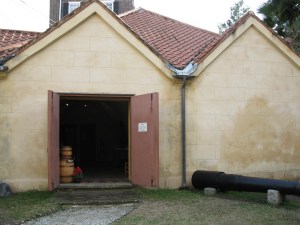
The Old Power Magazine (79 Cumberland Street)

The Old Power Magazine
79 Cumberland Street

The Old Powder Magazine is the only public building remaining from the era of the Lords Proprietors, the eight English aristocrats who owned Carolina from 1670 to 1719, under a charter granted by Charles II of England.

My ramblings took me as well to St. Michael’s Episcopal Church.
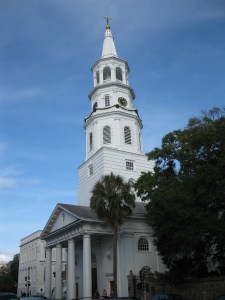
St. Michael's

St. Michael’s Episcopal Church
80 Meeting Street

Construction of the church began in 1751 but was not finished until 1761. 

 St. Michael’s may well be the church that The Humourist mentions in one of his later essays when he offers up a “Catalogue of several Paintings and Drawings … [including] a Church half-finished.”

I also visited St. Philip’s Church.
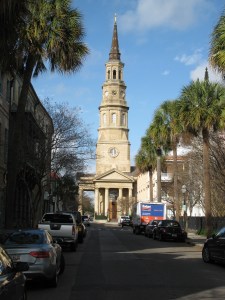
St. Philip's

St. Philips’ Church
142 Church Street

Founded in 1670, St. Philips Church is the oldest Anglican congregation south of Virginia.

Finally, I wanted to see some houses that survived from the period when The Humourist would have walked these streets.  They are a goodly number, of course, but somehow I found myself in Ansonborough, laid out by Lord Admiral George Anson in 1745.  Some of Charleston’s oldest Greek Revival houses are in Ansonborough, and two caught my fancy.

The first was the Col. William Rhett house, built between 1711 and 1722.
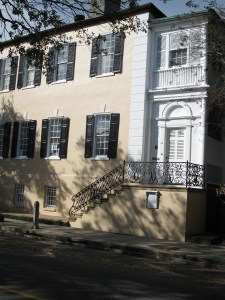
 

Col. William Rhett House54 Hasell Street
Col. William Rhett House
54 Hasell Street

 The second was the Daniel Legare House, finished about 1760.  This is the oldest surviving house of Colonial Ansonborough.
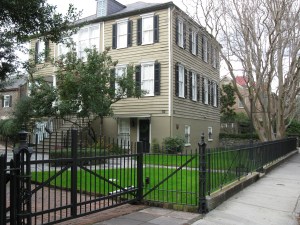
014

Daniel Legare House
79 Anson Street

Hopefully, this helps you see in part Colonial Charles Towne as I glimpsed part of it in my meanderings yesterday, and as The Humourist saw it during his lifetime in the “Holy City.”

 And as I bring this post to a close, I wonder whether The Humorist ever saw in his lifetime what I just saw a few minutes ago—a first for me in my lifetime— when I stepped outside my hotel:  a double rainbow!  Single rainbows I have seen often, but never until today a double one: double rainbows are symbolic of joy and life transformations.

When the Charleston Library Society opens this morning at 9:30, who knows what I will find there that will bring me joy and that will “transform” my scholarly work on The Humourist essays?

The Humorist (December 10, 1753)

Today, The Humorist returns, taking his rightful place center stage. However, before I retreat to the wings, let me share a few brief thoughts about some of my research challenges.

First, working with historical documents from the 1700s is a challenge in itself in terms of establishing editorial principles.  I have taken a conservative approach, always with an eye toward providing a text that is accurate yet readable.  With the following exceptions, I have preserved capitalization, paragraphing, spelling, and punctuation:

  • capitals of two fonts appearing in the same word have been emended to regular capitals;
  • ornamental words used at the beginning of paragraphs have been emended to upper and lower case letters; and
  • long s‘s have been shortened.

The second challenge is the fact that archivists have laminated some numbers of the Gazette in an attempt to mend torn pages.  As a result, I  struggle with reading some of the underlying passages.  <I enclose all conjectural transcriptions in angle brackets to alert the reader just as I have enclosed this sentence in angle brackets.> In any instance when I cannot read a word or if a line has been torn from the Gazette, I provide an alert in square brackets, such as [one illegible word] or [one missing line].  Fortunately, conjectural transcriptions, illegible words, and missing lines are infrequent.

A third challenge is translating some of the Latin quotations that The Humorist uses.  (How  I wish that I had studied Latin somewhere along the way!)  Often I have been able to find reliable translations.  Sometimes, however, I have not.  In today’s essay, for example, I need help with two passages:  see Notes 8 and 1.

Now, as promised, I retreat to the wings.  Enjoy The Humorist’s essay of December 10, 1753.  It’s a keeper.

THE HUMORIST.

A CHAP.  Wherein the author takes great pains to say more of himself than of the subject.

— — — Intent to gaze

Creation thro — — — THOMPSON.1

I promised in my last paper, to give you a copy of my countenance; but as it is impossible to procure it in any reasonable time, if the painter may be allowed to shew his skill or do justice to my person, I shall therefore beg my readers patience, and present them with a true sketch of my figure in print.

My body is small, my soul capacious, and my stature low; but what of that, a dwarf standing on the shoulders of a giant may see farther than a giant himself:2  I have extraordinary amorous eyes, for they are ever best employed in discerning each other.  These are the only singularities of my person.

I am possessed of an excellent perspective, that multiplies the species, and presents to my sight the actions of every man; for distinction’s sake, I term it the Otacousticon:3  By the help of this amazing machine, I can observe cuckold’s horns, the philosopher’s stone4, and new projections; I can discover windmills in one man’s head, and hornet’s nests in another.  This will amply suffice as an emblem of that power with which I am invested.

As to my private character, that falls more immediately within the sphere of the historian than the painter.

The curiosity of mankind may possibly extend so far as an impatience, to know what my inducements are for embracing such notional and vague sentiments; ambition is the answer:  I ever had a soaring mind.  A man may grovel like a reptile upon earth, from his entrance upon the stage of life to his exit, unnoticed, unobserved.

If a man wants to be talk’d of, he must surprise; there is nothing equal to a great action:  Longinus might bless his stars, when he wrote his treatise upon the Sublime;5 observe what eulogiums Eunapius bestowed upon him, he sties him, light of nature! giant of wit! eagle in the clouds! lamp of the world!6  These are the blest rewards of soaring minds!

I say with my good friend Horace, seriam sydera;7 I am for driving my head against the stars, snuffing the moon! and as Heinsius expresses himself, and that like a man of the first magnitude too, in speculo positus, omnia saecula, praeterita, praesentia videns, uno velut intuitu.8

If cold white mortals censure these great deeds,

Warn them; they judge not of superior beings,

Souls make of fire, and children of the sun.  Young.9

But to resume the thread of my discourse, and argue in a more serious way.  Aerial Architecture is of great antiquity; the tower of Babel10 is one notable instance; this evidently shews that the ancients supposed a possibility of building castles in the air:  To dwell long upon a case so much in point, would argue a kind of suspicion in me to produce any other instances; have we not essays on the non-existence of matter, on the non-existence of religion, and quires of paper fruitlessly scribbled over, upon the possibility of longitude?

What immense pains have been taken, and to no purpose, to find out the quadrature of a circle, and the creeks and sounds of the north east and north west passages?  Are not these so many notable instances of castle-building; so many ideas, so many notional and imaginary conceptions, tending to justify that boldness which primá facie appears in this undertaking?

All this, and more, is literally true:  Search the records of old time, and look into the annals of the present, to authenticate what I assert.  They were most certainly unsuccessful in their endeavours; but, as good often arises out of evil, and as the vulgar proverb says, ’tis a bad wind that blows benefit to no one, I am the better for it:  I have collected such materials from their ruins, as will shortly convince mankind of the reasonableness of these fabrics, and the great and innumerable advantages arising therefrom.

I shall pursue my design; it is indeed my duty to do so:  Quintilian peremptorily says, perseverandum est, quia cæpimus.11

ADVERTISEMENTS.

To be sold very reasonable, many considerable lots, and an estate of great value, a wide expanse! in Nubibus only.

Wanted, immediately, a professor of the occult sciences, an adept in palmistry and physiognomy, and a gentleman of a liberal education, who can serve in the capacity of an itinerant thro the twelve signs of the zodiac.

Wanted, several artificers, mechanics, etc. etc. etc. to assist the author in fitting up his aerial habitation:  ‘Tis hoped the prices will not be extravagant, as the workmen will live more reasonably than when employed in their terrene occupations, and as their diet will capacitate them to dispatch more business and in a shorter time, having nothing to subsist on but air.

NOTES

1 James Thompson (1700-1748), English poet and author of The Seasons. The quote comes from “Summer” and, in full context, reads: “Nor to this evanescent speck of earth / Poorly confined, the radiant tracts on high / Are her exalted range; intent to gaze / Creation through; and, from that full complex / Of never ending wonders, to conceive / Of the Sole Being right, who spoke the Word, / And Nature moved complete.”

2 Isaac Newton wrote to Robert Hooke in 1676 saying, “What Descartes did was a good step. You have added much several ways, and especially in taking the colours of thin plates into philosophical consideration. If I have seen a little further it is by standing on the shoulders of Giants.” However, the phrase goes back to the twelfth century and is attributed to humanist and philosopher, Bernard of Chartres.

3 An instrument used to assist in hearing.

4 The Oxford English Dictionary defines this as “A mythical solid substance, supposed to change any metal into gold or silver and (according to some) to cure all wounds and diseases and prolong life indefinitely.”

5 Attributed to Longinus, a Greek rhetorician and literary critic who may have lived in the 1st or 3rd century AD, “On the Sublime” is a treatise on aesthetics and literary criticism and is generally considered to rank second in importance to Aristotle’s Poetics.

6 Eunapius (c. 345 – c. 420), a Greek historian known for his Lives of the Philosophers and Sophists.

7 Horace (65BC-27AD), a leading Roman lyric poet.

8 Daniel Heinsius (1580-1655), a Dutch scholar and poet.  Wanted, a translator:  “in speculo positus, omnia saecula, praeterita, praesentia videns, uno velut intuitu.”  ‘Tis hoped the prices will not be extravagant, as the translators will translate more reasonably than when employed in their terrene occupations.

9 Edward Young (1683-1765), British poet and dramatist. The lines are from his The Revenge: A Tragedy in Five Acts (1721).

10 “1 And the whole earth was of one language, and of one speech. 2 And it came to pass, as they journeyed from the east, that they found a plain in the land of Shinar; and they dwelt there. 3 And they said one to another, Go to , let us make brick, and burn them throughly. And they had brick for stone, and slime had they for morter. 4 And they said , Go to , let us build us a city and a tower, whose top may reach unto heaven; and let us make us a name, lest we be scattered abroad upon the face of the whole earth. 5 And the LORD came down to see the city and the tower, which the children of men builded . 6 And the LORD said , Behold, the people is one, and they have all one language; and this they begin to do : and now nothing will be restrained from them, which they have imagined to do” (Genesis 11:1-6, King James Version).

11 Marcus Fabius Quintilianus (c. 35 – c. 100). a Roman rhetorician known for his 12-volume Institutio Oratoria (Institutes of Oratory).  Wanted, a translator:  perseverandum est, quia cæpimus”.   ‘Tis hoped the prices will not be extravagant, as the translators will translate more reasonably than when employed in their terrene occupations.

Literary Mysteries: Solved and Unsolved

“A lot of the fun lies in trying to penetrate the mystery; and this is best done by saying over the lines to yourself again and again, till they pass through the stage of sounding like nonsense, and finally return to a full sense that had at first escaped notice.” —Anthony Hecht

Dare I confess how gratified I have been with my blog’s traffic since it began a week ago today?  Well, I am!

  • 446 views (including 1 from the United Kingdom!)
  • 38 followers

Not bad stats for my first week.  Now bad at all for a first-time blogger.  Thank you!

And since I am confessing, let me confess something else:  I’ve shared my joy—and my amazement—with a handful of folks in my close circle, and, over and over again, they have replied enthusiastically with the likes of:

“WOW!  Doesn’t surprise me a BIT!!!!!  Everybody wants to know who wrote those essays!”

Some of your comments affirm:

“Ahhh…everyone loves a good mystery!” 

“Oooh, I love a good mystery! … I look forward to watching you unravel this centuries old mystery.”

To be certain, I’m hooked on the mystery, too:  who was The Humourist?  Preparing a critical edition of his essays will be straightforward—well, to the extent that scholarly research is ever straightforward.  On the other hand, identifying the author will require keen analysis and extensive research in order to make a conclusive (and, if not conclusive, then convincing) case that will stand up to scrutiny and review.

Solving the mystery hinges to a large degree on internal clues to be extracted from the essays.  Looking at the Humourist’s November 26, 1753, essay, we find three clues already.

Clue One: One of my followers—soyfig, in fact—picked up on this one by writing:  “I had to read the Humourist’s first essay three times before I began to understand it!  They certainly wrote on a higher plane then than now!”

Indeed.  Whoever he is, the Humourist is erudite.  In one short essay, he provides a sweeping overview of literary tastes, going all the way back to “Days of monkish Ignorance” and continuing on up to novel writing that reigned in his own time.  

Clue Two Whoever he is, the Humourist seems fascinated by the past.  He opens his first essay with a quote from Horace, and he refers to the past several times in that essay:  “If we make a Retrospect into past Times” and “various Tastes of Mankind in the former ages.”

Clue ThreeWhoever he is, the Humourist seems to have an intense interest in painting:  “as an inducement to the World to read my Paper, they may shortly expect a Present of my Picture.”  However, as we shall discover next week in his December 10, 1753, essay, “as it is impossible to procure it [the painting] in any reasonable time, if the painter be allowed to shew his skill or do justice to my person, I shall therefore beg my readers patience, and present them with a true sketch of my figure in print.”

What a mystery!  What a puzzle!

As I move ahead with my efforts to solve the mystery, I have another confession to make:  I love the task of transcribing the Humourist essays—of sitting at my computer, typing away on the keyboard.

Typing.  I love it:  typing!  It’s not nearly as poetic as the suggestion that Anthony Hecht offers up for penetrating a mystery:  “saying over the lines to yourself again and again, till they pass through the stage of sounding like nonsense, and finally return to a full sense that had at first escaped notice.”  

Typing.  It’s probably more akin to what Carl Jung says about mysteries:

“Often the hands will solve a mystery that the intellect has struggled with in vain.”

In that sense, then, as I transcribe the Humourist’s essays—as I type them—my hands are helping me become familiar with the essence of his literary outpourings, character by character, letter by letter, word by word, paragraph by paragraph, essay by essay.  My hands are helping me become familiar with his style.  My hands are helping me see what he put in—and what he left out!

After I have typed one of his essays once or twice—actually, I typed his November 26, 1753, essay three times—I can say with some degree of certainty:  I know that essay well.

I know that essay even better because I have done what I always do with documents:  I checked the Readability Statistics.  So, here’s Clue Four.  Whoever he is, the readability statistics for the Humourist’s November 26, 1753, essay are as follows:

Counts

  • Words:  444
  • Characters:  2181
  • Paragraphs:  20
  • Sentences:  13

Averages

  • Sentences per Paragraph:  1.3
  • Words per Sentence:  24.6
  • Characters per Word:  4.6

Readability

  • Passive Sentences:  15%
  • Flesch Reading Ease: 56.7
  • Flesch-Kincaid Grade Level:  10.3

Admittedly, these readability statistics are skewed because the Humourist quotes other writers rather extensively in his first essay.  Nonetheless, it is a beginning.

As we move to future essays—and as I continue doing what I have begun doing—all the clues will converge, and I am certain that the Humourist himself will lead me to discovering who he is.

But I digress.  My scheme for sharing Humourist essays with you will be in the same fashion that he shared them with the world:  weekly.  This week, however, he did not publish an essay.  (His next one will appear on December 10.)

Therefore, as I contemplated my post for this week, I was intrigued by how intrigued my readers were by the mystery—by my efforts to solve this literary whodunit—and I was particularly smitten by “soyfig’s” comment:

“A different mystery has been solved.”

Continue reading

Coming in December!

December 3

  • The Wired Researcher explores “Literary Mysteries:  Solved and Unsolved.”
  • To be posted during the late afternoon or early evening.

December 10

  • The Humorist presents us with a “true sketch of [his] figure in print,” and he ruminates on “Aerial architecture.”

December 17

  • The Wired Researcher shares his “Meanderings in Charleston, SC.”

December 24

  • The Humorist ponders the art and science of “Castle-building.”

Opportunity Knocks Twice in the Virginia Community College System

“A man may die, nations may rise and fall, but an idea lives on.  Ideas have endurance without death.”  

–John F. Kennedy

Whoever said that opportunity knocks but once doesn’t know the opportunities in the Virginia Community College System (VCCS):  opportunities that give our students and our faculty not only fresh new starts but sometimes second chances, second opportunities.

The VCCS gave me a fresh start when I left the federal sector in 1998 to pursue my childhood dream of becoming a college English Professor.  And this year, the VCCS gave me a second chance—a second opportunity—to complete a research project that I didn’t complete nearly four decades ago.

I’m still pinching myself in disbelief, but I really do have a second chance to get it right this time around.  Let me explain. Continue reading

“The Humourist” (November 26, 1753)

Step back into history with me, if you will:  two hundred and fifty nine years ago, today—November 26, 1753.  We’re in Colonial America, specifically, Charleston, South Carolina. 

We’re looking at the November 26 issue of The South Carolina Gazette, where we notice the first of many essays to be published in that newspaper under the title, “The Humourist.”

As we continue to read the weekly Gazette through 1754, we uncover a total of 17 essays, 7 letters, 1 song, 1 unfinished poem, 2 advertisements, and 2 related items—all by “The Humourist.”  Finally, we come to his “Retirement Notice”:

The Humourist is become an Invalid, and as he loves Retirement must quit the foolish busy World, and please his vacant Hours with the secret Satisfaction of having intentionally displeased no one.  He thanks the Publick for having generously constructed these Papers; but, for some private Reasons, is under a Necessity of declaring, that he will never more (either under this or any other Title, or on any Pretence, or on any Occasion whatsoever) enter the Lists of Authorism in this Province.

The essays which began so mysteriously have ended thus strangely and inexplicably.  The retirement notice was the last contribution by “The Humourist.”

Join me in this blog as I explore, study, analyze—and enjoy— The Humourist’s contributions to Colonial American Literature.  Join me as I try to solve this literary “whodunit.”  Who is the author writing under the pseudonym of The Humourist?  By giving his essays a close textual reading, I’m confident that I will solve the mystery!

Let’s get started by reading his first essay, published on November 26, 1753.  It sets the stage and provides a good sampling of essays that will follow in later blog posts.


The Humourist.

From my chambers in the Air, Nov. 26.

Quocunque volunt mentem auditoris agunto. HOR.1

It is necessary to premise that I am a Man of a peculiar odd Way of Thinking, and I shall consequently make myself very merry at the Particularities of other People.  Thus much for Preface.

The Humourist2 will never pester the World with Incoherency or unnatural Occurrences, under the specious Pretence of painting true Life or copying after Nature.  Thus much for Self-Praise.

If we make a Retrospect into past Times,  we shall find, that as the Morals of the People varied, so did their Species of Writing.  In the Days of monkish Ignorance,3 romantic Legends bore an universal Sway; and in the happy Times of good Queen Bess,4 the World was joyously entertained with Fairy Land, and Tales of Chivalry; Spenser5 is my Testimony, and Sir Philip’s Acadia6 confirms it:  Then it was (as Milton unerringly expresses it) their Art

—Chief Mastery to dissect,

With long and tedious Havoc, fabled Knights

In Battle feign’d.

—Or to describe Races and Games;

Or tilting Furniture, emblazon’d Shields,

Impresses quaint, Caparisons and Steeds;

Bases and tinsel Trappings, gorgeous Knights

At Jouse and Tournament; then marshall’d Feasts

Serv’d up in Halls with Sewers and Seneschals.7

 In the Reign of James I,8 the People were all scared at imaginary Ghosts and headless Apparitions, with Tales of Witches suck’d by ram Cats, and Devils smoaking Tobacco.

The Restoration,9 amongst other of its happy Consequences, introduced a certain Gaieté de Cœur, an Ease and Familiarity, and all Things seem’d to breathe the spirit

—Of Love and amorous Delight;10

From this Moment I date the Stony-heartedness of pretty Misses to their languishing Admirers, and the glorious Opportunity for plotting Wives to bamboozle their jealous pated Husbands.

Thus have I cursorily run over the various Tastes of Mankind in the former Ages; and therefore cannot avoid mentioning that reigning one of these Days, Novel11 writing without Reason, and Lies without Meaning.

If then the Humourist is so happy as to avoid these Errors, and is capable to strike out some few Lights, or keep in a due and entertaining Medium between them, the Satisfaction will amply recompence the Trouble, and tend both to please the Writer and amuse the Reader.

The utmost Aim of my Compositions shall be directed to please; and if I now and then chance to tour uncommon Heights, the World must understand that I am improving the Method of Writing, and that my Habitation is in the Air.

I am an aerial Spirit; and as an inducement to the World to Read my Paper, they may shortly expect a Present of my Picture, which, like the Statue of Mercury in the Fable,12 shall be thrown into the Bargain.

Notes

1 And raise men’s passions to what heights they will. Horace, Ars Poetica, v. 100. More likely than not, the Humourist took the quote from Joseph Addison’s Spectator essay 420 (July 2, 1712), often heralded as the beginning of modern literary aesthetics. In subsequent essays, the Humourist uses numerous mottoes from many classical writers.

2 The Oxford English Dictionary provides three definitions of the word humourist, also spelled humorist: (1) “A person subject to ‘humours’ or fancies; a fantastical or whimsical person; a faddist” (2) “A facetious or comical person, a wag; a humorous talker, actor, or writer; in mod. use esp. one skilled in the literary or artistic expression of humour.” (3) “One given to humouring or indulging.”

3 The Humourist is making a sweeping reference to Medieval monasticism. The Oxford English Dictionary notes that by 1576, “Monkish” was used frequently in a derogatory manner similar to the way The Humourist is using the word here in conjunction with “ignorance.”

4 Queen Elizabeth I (1533-1603). During her reign, known as the Elizabethan Age, drama flourished with playwrights such as William Shakespeare and Christopher Marlowe.

5 Edmund Spenser (1552-1559), generally considered one of the greatest poets in the English language and best known for his epic poem The Faerie Queene.

6 Sir Philip Sidney (1554-1586), one of the most prominent figures of ther Elizabethan Age and well known for his romance The Arcadia.

7 The quote is from Book IX of Paradise Lost and shows Milton’s contempt of romances.

8 James I (1566-1625), the first of England’s Stuart Kings.

9 In English literature, the Restoration covers 1660-1700 and is referred to often as the Age of Dryden.

10 Book VIII, Milton’s Paradise Lost.

11 The novel emerged in the Eighteenth Century as the middle class grew, as more people learned to read, and as more people had money to spend on literature. Major novelists of the period include Daniel Defoe (Robinson Crusoe, 1719; Moll Flanders, 1722); Samuel Richardson (Pamela, 1740-41; Clarissa, 1747-48); and Henry Fielding (Joseph Andrews, 1742; Tom Jones, 1749).

12 Aesop’s fable of “Mercury and the Sculptor.”