“How much money is enough? Just a little bit more.” —John D. Rockefeller (1839–1937). American industrialist and founder of Standard Oil.
Massive, floor-to-ceiling plate glass windows were on my left, as if welcoming me into the waiting room. I was surprised by how clean and shiny they were, allowing me to see clearly the vehicles–all makes and sizes and colors on the other side–as they made their way past a small crew, working with assembly-line precision as they cleaned and detailed the interior.
I took a seat near the exit so that I could keep an eye on my Jeep as it edged its way along.
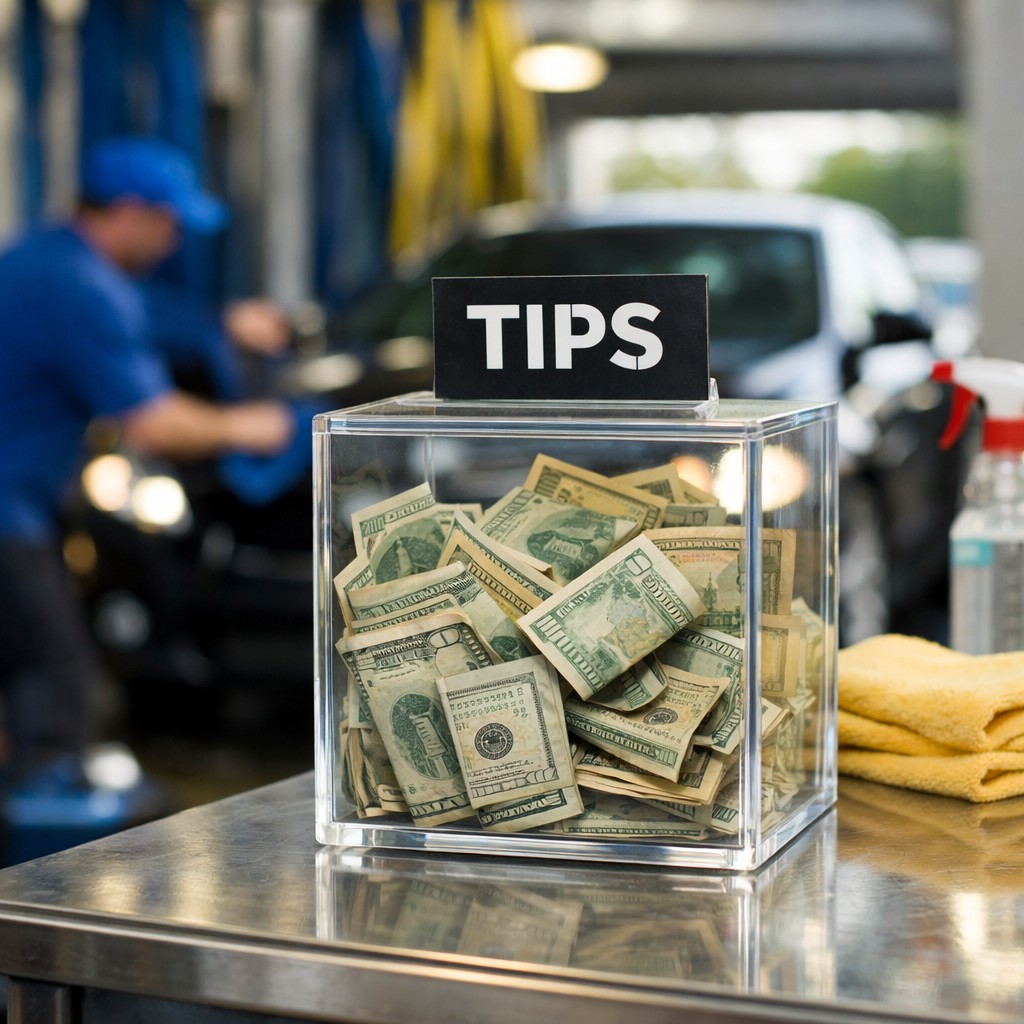
To my right, on a stand, was a lucite box, perhaps a foot square and nearly two feet tall. Its hard, clear sides and top revealed everything inside. Above, a simple sign:
TIPS
I was impressed. It was nearly full. Not loose change, mind you. Bills. Ones. Fives. Tens.
I struck up a conversation with the man across from me.
“Impressive tips.”
“Yeah, but I doubt it’s just for today.”
It was a Tuesday morning, so no doubt he was correct.
“It’s probably from the weekend.”
Another customer chimed in.
“I hear they empty it at the end of the month.”
“Hmmm,” I said. “Maybe that’s why it’s chock-full.”
It was the 22nd.
“I suspect so. Anyway, they empty it and always divide the tips among the employees.”
Several people ahead of me deposited more bills as they walked out to their vehicles.
I smiled:
“Not a bad system. Not bad at all.”
I smiled even more as my Jeep came through, looking as new as it must have looked when it first rolled off the assembly line.
The grill, a dark geometry of openings and shadows, each precise angle rinsed clean.
The wheel rims and tires, the rubber deep and purposeful, the metal darkened to a soft sheen, every groove, ready for the road again.
Rubicon standing in deliberate red against the deep Army green, the letters steady and assured.
The trim, black and firm along the edges, the lines gathering light and holding it.
The windows, so clear they seemed hardly there at all, bouncing the faint movement of the world beyond them.
I stood up, discreetly folded a Jackson, and added it to the box.
As soon as one of the workers opened my Jeep’s door, the new-car fragrance and the buffed leather interior made me realize that this crew had earned all the tips growing inside.
“Wow! I’m impressed! I left a nice tip in the box.”
“Thank you.”
“You all divide the tips?”
“No, not exactly.”
“Why not?”
“They say they add the tips to our pay.”
“Does it make your check much larger?”
“Nah, we don’t see any difference.”
I pulled another bill from my pocket and gave it to him.
“I thought you all divided the tips. Please share this with your team.”
I shook his hand, stepped into the Jeep, and headed home. I kept replaying the conversation at the exit, about where the tips actually went, and who, in the end, did not receive them. Nothing about the Jeep had changed, and yet everything about it had. The Army green that had moments earlier seemed to hold the light now appeared flatter and more ordinary. The bold red of Rubicon no longer declared quite so confidently. Even the glass, so recently transparent, now reflected more than it revealed. The careful geometry of the grill, the purposeful weight of the tires, the clean lines of the trim—all remained exactly as they were, yet seemed subtly altered.
“Our lives begin to end the day we become silent about things that matter.”
–Dr. Martin Luther King, Jr. (1929–1968). More than a civil rights leader, Dr. King spent his life demanding justice for the marginalized and calling out moral silence wherever it lived. His words still hold us accountable.
We’ve had a lot of rain lately here in the Shenandoah Valley of Virginia, in the shadow of the Nation’s Capitol. And with it, a whole lot of fog—literal and metaphorical.
It’s put me in a reflective mood.
It started one morning when I was scrolling casually through the headlines. I sat up and took notice when I saw:
“Estimated Cost of Trump’s June 14 Parade? $40 Million.”
Not as bad as the $95 million that had been projected.
But still.
Forty. Million. Dollars.
For a parade.
Let’s be clear. My reflections aren’t a swipe at the military or the veterans who’ve served with honor. I respect them deeply. I always have.
What leaves me flummoxed—furious, frankly—is that we dropped forty million dollars on smoke and swagger.
● Not for healthcare. ● Not for housing. ● Not for education. ● Not for the aging. ● Not for the homeless. ● Not for the hungry. ● Not for climatejustice? ● Not for Diversity, Equity, andInclusion.
Not for [inhale, DearReader, and name one or two things that you would add to the chance to spend $40 million well and wisely for the benefit of humanity].
Not one penny went to any of those things.
Instead, we spent it on a parade. And not much of one at that.
Mind you, I’m not against a little razzle-dazzle. I’m not even against a lot of razzle dazzle. I love a marching band. And I’ve been known to twirl a dish towel like a drum major when I think no one’s looking. But this wasn’t Macy’s Thanksgiving. This was missile-forward, masculinity-on-wheels, smoke-and-flag showmanship—aimed at impressing whom, exactly?
And all I could think was:
Icould do a lot with that.
I started Googling some numbers. These aren’t fantasy figures that I’m about to share. They’re ballpark estimates based on real programs already out there doing the real work.
Education
I spent twenty-three years in the community-college classroom. I know what $40 million could do when it puts on a blazer of determination and joins hands at a table that includes all the diverse stakeholders waiting for their lives to be transformed:
● Two years of community college for around 15,000 students. That’s 15,000 young folks trading fear for futures.
● Salaries and benefits for 500 new public school teachers. The ones fighting ignorance and inequality every day.
● After-school programs for 100,000 children. Imagine safe spaces, hot meals, books, and someone who actually listens.
● $20,000 for every public school in Virginia. For libraries. For music. For classrooms without walls.
● 400 endowed scholarships that would change entire family trees. Can you imagine such a forest of hope?
Or, How’s This? Give It to Me.
That’s right. Just hand it over, every copper penny of that $40 million. I promise to use it wisely—and a little wickedly.
I’d found a rural writers’ residency here in the Shenandoah Valley—where ideas blossom, meals come with flaky sourdough biscuits, and the only uniform required is pajamas and nerve.
I’d start a learning center for older adults who want to tango with AI rather than fear it. There’d be cakes, cakes, and more cakes. And, yes, I’d teach the class. For free.
I’d fund free college courses for anyone over 70. I know firsthand that curiosity doesn’t age—and neither should opportunity.
I’d create a cozy grant for storytellers who need time, space, and soup. You bring the plot twist; I’ll bring the pot and the lentils. And the mic. And the computers with printers and some really good paper. Maybe even some vellum. Everyone has a story to tell. And everyone’s story deserves to be shared.
And yes—I’d upgrade my Wi-Fi. But I’d pay for that perk out of my own pocket. I can’t possibly imagine a future on a buffering screen like mine.
But Let’s Go Bigger. Let’s Go National. Let’s Get Serious.
What else could we buy with $40 million?
HEALTHCARE
● 13,000 diabetics could get insulin for a year.
● 8,000 people could have cataract surgeries to restore sight and dignity.
● 4,000 new therapy slots could be created for those in need of mental health care.
● Mobile clinics could motor in to rural Americans who don’t have a doctor, let alone a parade.
HOUSING
● 800 tiny homes for unhoused veterans.
● 6,500 rental assistance grants to prevent families from being evicted into the street.
● Thousands of critical home repairs for aging Americans clinging to the roof over their heads.
Or simply this: $40 million could give dignity back to the people living in tents and doorways.
People say we have a housing shortage. We don’t. We have a compassion shortage.
FOOD & NUTRITION
● Feed 60,000 families of four for a month.
● Provide 20 million school lunches.
● Stock rural food banks for a year.
CHILDCARE & EARLY LEARNING
● 1,500 toddlers in full-time childcare for a year.
● 4,000 Head Start slots—the kind that change lives before kindergarten.
INFRASTRUCTURE & JOBS
● 20 miles of roads resurfaced.
● 1,000 community clean-up and green jobs created at $40K/year.
● 1 million trees planted in urban neighborhoods, providing shade, oxygen, and hope.
ADDICTION & PUBLIC SAFETY
● 100,000 naloxone kits to reverse opioid overdoses.
● 500 addiction recovery beds funded for a full year.
And that’s just the start.
$40 million could fund addiction clinics, community gardens, clean drinking water, and elder care.
It could stock classrooms with books, shelters with blankets, neighborhoods with trees, and rural towns with Wi-Fi.
It could buy wheelchairs, job training, clean clothes, bus passes, internet hotspots, warm meals, and cool air in heatwaves.
Forty million dollars could meet people where they are—and remind them they matter.
Instead, $40 million gave us a parade of tanks.
And flyovers.
And swagger.
I suppose there’s a place for showmanship. But if you ask me—when you’ve got $40 million to spend and a nation full of potholes, potholes in minds and hearts and homes—it might be time to fund possibility instead of parades.
You know what else? I’ll bet that if you asked the uniformed troops who were supposedly being honored, they too would vote for funding a world of forever possibilities instead of one day with a parade.
Because the real power? It isn’t missiles or marching.
It’s in meals, and music, and morning classes.
It’s in someone whispering, “I believe in you,” with a scholarship check in hand.
It’s in turning the lights on in places that have lived too long in the dark.
But we didn’t choose any of that.
We chose a spectacle.
We chose to posture for the world—while the world watched a nation that can’t feed its children waste millions playing dress-up with its military.
It wasn’t patriotism.
It was performance.
History saw June 14, 2025, for what it was—a flag-wrapped, reality-show distraction from the real work of freedom.

 The Wired Researcher