What Goes Unseen


“It’s not what you look at that matters, it’s what you see.”

Henry David Thoreau (1817–1862). American essayist, naturalist, and philosopher whose Walden made him a foundational voice in the tradition of contemplative attention to the natural world.


Not long ago—on a warm spring Saturday morning, I stopped weedwhacking just long enough to rewind the twine so that I could have at it again. While I was at it, I decided to clean the underside of the guard.

That’s when I saw it.

A small, flat blade, tucked along the inner rim of the guard. It was so unassuming it might as well have been part of the plastic. Rectangular. Steel. Fixed in place with a single screw, its edge squared off and purposeful. Not sharp in the dramatic sense, not gleaming, not new—but worn to a quiet efficiency.

It didn’t move. It didn’t need to.

Set at just the right angle, it waited where the spinning line would meet it—again and again—shearing it back to proper length with each pass. No noise of its own. No flourish. Just a precise cut, a limit imposed, a boundary kept.

What struck me wasn’t what it did, but that I had never noticed it doing it.

All that time—decades of weedwhacking—this little blade had been there, keeping things in check. Silently. Reliably. Without ever asking to be seen.

But as I sat there seeing it for the first time, I was drawn—in a moment that seemed mysteriously magical—to a rhododendron in full bloom, its entire orb covered with flowers.

A burst of color rising from the green—full, rounded, almost extravagant—each cluster pressing outward as if the whole shrub could hardly contain what it was doing.
Then a single flower—open and inviting, its petals soft and flared, a quiet architecture of color and form, drawing the eye inward without insisting.

Then a blossom—closer now—where the curves deepen, the colors gather, and something more intricate begins to reveal itself.

And then—at the center—the pistil and stamen. Slender. Reaching. Dusted and deliberate.
It’s the latter I had never quite seen before—stamens bearing pollen, a pistil poised to receive it—the quiet exchange that makes the next bloom possible.

And as I sat there, momentarily mesmerized, I heard the sonorous buzzing of a bee—
thick-bodied and deliberate, its wings a blur against the stillness, its black-and-gold frame pressing into the bloom as if it belonged there, as if it knew exactly where to go and what to do.

It moved without hesitation—dipping, turning, pushing past petal and filament—gathering as it went, brushing against what needed to be brushed, carrying what needed to be carried.
Not for beauty. Not for show. But for the work.

And there, along its legs, dusted and clinging—
pollen.

A thing so small, yet so bold as to carry the world to its foretold future.

How many other things go unseen in life that keep the engines running—

The tightening at the corners of the eyes—subtle at first, almost imperceptible, until something gathers there, waiting.

A glance held a fraction longer than needed—just beyond the ordinary exchange, between two people.

The tug to say less—a quiet restraint, felt rather than reasoned, that keeps a word from tipping.

The faint sense of standing there before—a recognition unannounced.

The deep inhale that comes—slowly, almost deliberately, as if the body knows.
Crystal Clear


“How much money is enough? Just a little bit more.”
—John D. Rockefeller (1839–1937). American industrialist and founder of Standard Oil.


Massive, floor-to-ceiling plate glass windows were on my left, as if welcoming me into the waiting room. I was surprised by how clean and shiny they were, allowing me to see clearly the vehicles–all makes and sizes and colors on the other side–as they made their way past a small crew, working with assembly-line precision as they cleaned and detailed the interior.

I took a seat near the exit so that I could keep an eye on my Jeep as it edged its way along.

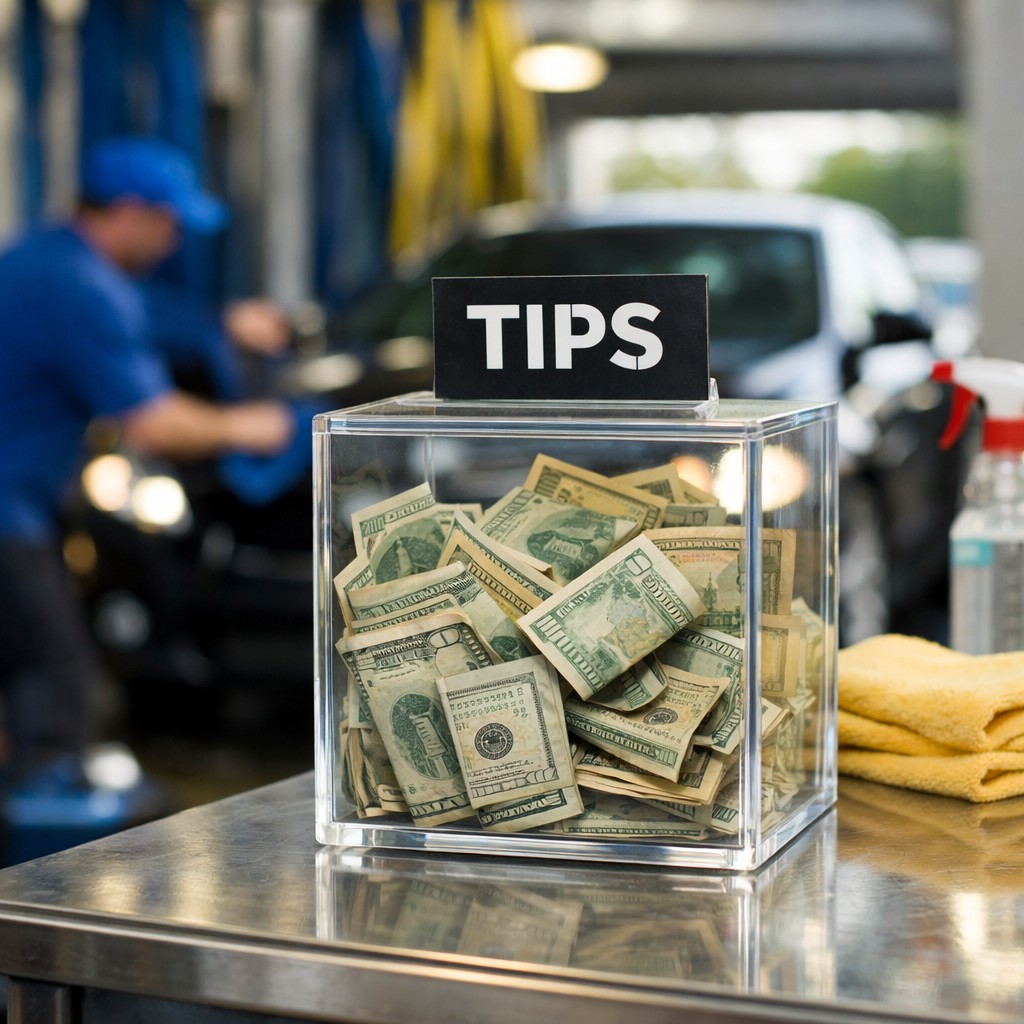
To my right, on a stand, was a lucite box, perhaps a foot square and nearly two feet tall. Its hard, clear sides and top revealed everything inside. Above, a simple sign:

TIPS

I was impressed. It was nearly full. Not loose change, mind you. Bills. Ones. Fives. Tens.

I struck up a conversation with the man across from me.

“Impressive tips.”

“Yeah, but I doubt it’s just for today.”

It was a Tuesday morning, so no doubt he was correct.

“It’s probably from the weekend.”

Another customer chimed in.

“I hear they empty it at the end of the month.”

“Hmmm,” I said. “Maybe that’s why it’s chock-full.”

It was the 22nd.

“I suspect so. Anyway, they empty it and always divide the tips among the employees.”

Several people ahead of me deposited more bills as they walked out to their vehicles.

I smiled:

“Not a bad system. Not bad at all.”

I smiled even more as my Jeep came through, looking as new as it must have looked when it first rolled off the assembly line.

The grill, a dark geometry of openings and shadows, each precise angle rinsed clean.

The wheel rims and tires, the rubber deep and purposeful, the metal darkened to a soft sheen, every groove, ready for the road again.

Rubicon standing in deliberate red against the deep Army green, the letters steady and assured.

The trim, black and firm along the edges, the lines gathering light and holding it.

The windows, so clear they seemed hardly there at all, bouncing the faint movement of the world beyond them.

I stood up, discreetly folded a Jackson, and added it to the box.

As soon as one of the workers opened my Jeep’s door, the new-car fragrance and the buffed leather interior made me realize that this crew had earned all the tips growing inside.

“Wow! I’m impressed! I left a nice tip in the box.”

“Thank you.”

“You all divide the tips?”

“No, not exactly.”

“Why not?”

“They say they add the tips to our pay.”

“Does it make your check much larger?”

“Nah, we don’t see any difference.”

I pulled another bill from my pocket and gave it to him.

“I thought you all divided the tips. Please share this with your team.”

I shook his hand, stepped into the Jeep, and headed home. I kept replaying the conversation at the exit, about where the tips actually went, and who, in the end, did not receive them. Nothing about the Jeep had changed, and yet everything about it had. The Army green that had moments earlier seemed to hold the light now appeared flatter and more ordinary. The bold red of Rubicon no longer declared quite so confidently. Even the glass, so recently transparent, now reflected more than it revealed. The careful geometry of the grill, the purposeful weight of the tires, the clean lines of the trim—all remained exactly as they were, yet seemed subtly altered.

The tip box had become crystal clear.