
“The truth is, no one of us can be free until everybody is free.”
—Maya Angelou (1928–2014). American poet, author, and civil rights activist whose writings explored identity, dignity, freedom, and the shared humanity of all people.
“Write. Just write.”
That’s what I always tell aspiring writers.
“Write as if this will be your last line and your life depends on it. Or maybe your life after death depends on your last line.”
They stare. They roll their eyes. They purse their lips. They start. They write.
And after they’ve written several pages, I interrupt, knowing the gasps that will follow:
“Ignore the first page or two. Writers often discover their real starting point at the top of page two or three.”
“Ignore it? Throw it away?”
“Yeah, usually. Think of those pages as a warm-up exercise. Think of those pages as a way of finding the starting point.”
Ironically, it’s almost always true, even for seasoned writers. Maybe especially for seasoned writers.
I wish it were true for me. This time. This post.
But it’s not.
There’s no way—there’s just no way—that I’m going to start this post with the line I’d have to start it with if I applied my own advice:
“Are you a friend of Dorothy’s?”
Here’s why I wouldn’t.
I’m betting you’d ask:
“Who’s Dorothy?”
That’s what I asked myself yesterday when I stumbled accidentally upon the question. After I found the answer, I kept wishing I had known about it in the 1950s when I was growing up, wondering how on earth I’d ever recognize someone else like me. Queer.
Let’s face it. The eye contact thing—the looking back to see if he was looking back to see—was a hard if not impossible way to identify a kindred soul. How could I be sure? And I wasn’t about to come out and ask:
“Are you, you know—like me.”
But if I had known about Dorothy, I would have let it slip casually into the conversation:
“And are you a friend of Dorothy’s?”
“Yes” would have moved the conversation far, far away from small talk.
But I didn’t know then that the question was a coded phrase used by the LGBTQ+ community—particularly gay men—throughout the mid-20th century to discreetly identify one another.
Safe. Veiled. No risk. No exposure. No hostility. No legal trouble.
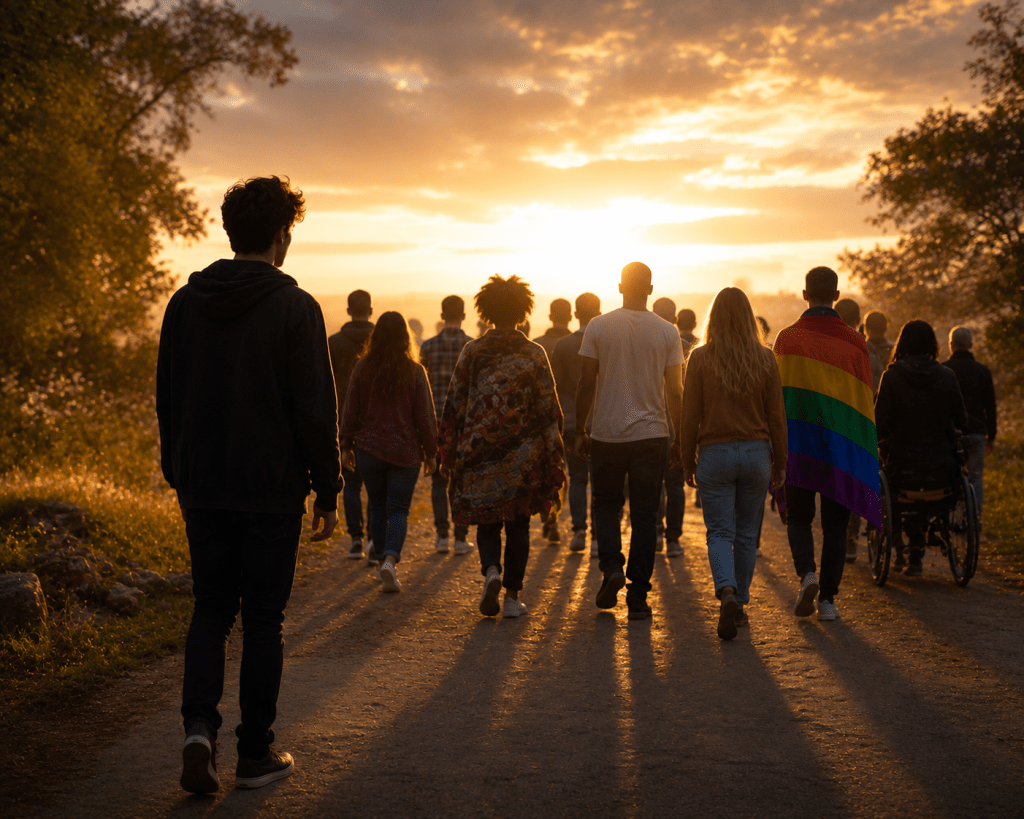
I’m surprised that it took me seventy-eight years to learn about the question and its answer. But I’m not surprised that I did so during Pride Month.
I had been paying close attention to the June headlines.
Some were celebratory. Governor Hochul proclaimed June 2026 LGBTQ+ Pride Month in New York. Orange County recognized Pride Month for the first time. Richmond listed eleven events to check out this June.
Others were not. Indiana’s governor declared Pride Month “Nuclear Family Month.” Republican governors across the country rebranded it with conservative alternatives. Tennessee followed Indiana’s lead. In Pinellas, Pride met “Faith and Family” pushback.
Then came a headline closer to home. It hit hard. Someone I knew shamed their former employer on FB for celebrating Pride Month and used a classic but outlandish propaganda technique: mix a few kernels of truth with a few outdated statistics, several disputed claims, some outright falsehoods, and then present everything under the banner:
“No Pride in Gay Life: THE FACTS.”
It only took me a minute or so to read the FB post. But it took me far longer to process my emotions. Anger. Sadness. Disappointment. Exhaustion. Surprise that it came from—someone I knew.
It took me even longer as I questioned what exactly we’re celebrating in June. Being gay, lesbian, bisexual, transgender, or queer? Hard-won advances that allow millions of people to live more openly than they could a generation ago? Battles that remain to be fought?
They’re not the same things. One is identity: human beings with shared blood pulsing in our veins and with shared hopes living in our hearts. The second is history: yesterday. The third is hope: today and tomorrow.
Suddenly, I realized that when we celebrate Pride Month, June ends and LGBTQ+ people remain marginalized.
Suddenly, I realized that when we celebrate Black History Month, February ends and Black Americans remain marginalized.
Suddenly, I realized that when we celebrate Women’s History Month, March ends and women remain marginalized.
Suddenly, I realized that when we celebrate Native American History Month, November ends and Native Americans remain marginalized.
Suddenly, I realized that we’ve gotten very good at celebrating people we’re still marginalizing.
We can do better.
We can be better.
We must.
I hope I live to see the day when Pride Month never ends.
I hope I live to see the day when Black History month never ends.
I hope I live to see the day when Women’s History Month never ends.
I hope I live to see the day when Native American Month never ends.
I hope I live to see the day when special months never end because we no longer need a special time to remind us that we are special humans every moment of every day of every month—all the time.
A day when dignity is not reserved for June or February or March or November.
A day when respect does not depend upon race, religion, gender, orientation, age, birthplace, wealth, education, politics, or any of the countless labels we use to divide ourselves into tribes.
A day when we stop asking who belongs and start assuming that everyone does.
Come fast the day when we see the person before we see the category.
Come fast the day when our differences invite our curiosity rather than our suspicion.
Come fast the day when no child grows up wondering whether there is anyone else in the world like them.
Come fast the day when we won’t need to ask, “Are you a friend of Dorothy’s?”


Brent, thank you for this thoughtful reflection. What struck me most was not the history of Dorothy’s question, but your deeper point: we have become very good at celebrating people while still marginalizing them.
Your hope for a day when no child wonders whether they belong, when dignity is not limited to a designated month, and when we see the person before the category is both powerful and necessary. As someone who has spent a lifetime working to create spaces of belonging, I share that hope.
May we all strive to be the kind of people who ensure that no one has to ask if they belong—because they already know they do.
LikeLike
Amen to all. And thank you for your thoughtful response. Your words mean a great deal to me.
LikeLike
Your opening question had me going down a different rabbit hole! My first thought was, “Dorothy Zbornak from The Golden Girls or Dorothy from The Wizard of Oz?” Haha!!!!
All kidding aside, beautifully written and a powerful reminder that every person should be treated with dignity, respect, acceptance and kindness, daily, simply because we’re human.
LikeLike
Thanks for your poignant reminder that we’re all human! 👍
LikeLike