The Solitary Flag


“The care of human life and happiness, and not their destruction, is the first and only legitimate object of good government.” —Thomas Jefferson (1743–1826). Principal author of the Declaration of Independence and third President of the United States.


At the far end of the deck, beyond the flowers and conversation, the flag flew. The mountain breeze caught it softly, lifting and releasing it against the deep green of the forest. There was something almost reverential about its solitude.

Time was it would have had company. A flag flying on the opposite end. Two in the middle. And spanning the entire 70-foot deck, bunting—the classic pleated red, white, and blue fanned ones that unfurl patriotism, national unity, and civic belonging.

After all, this time was different. It was special. It was unlike any Fourth of July that has come before. We were not simply marking another birthday. We were celebrating the 250th anniversary of the signing of the Declaration of Independence. Two hundred and fifty years. It is an astonishing span of time, and I suspect most Americans, if they paused to think about it at all, felt at least a quiet sense of gratitude for having lived to witness such an anniversary.

I did.

Ordinarily, I would have looked for something even bolder than bunting and traditional flags to mark the occasion. After all, I enjoy celebrations of almost every kind. Give me the first tomato from the garden, a birthday, an anniversary, a hummingbird’s return, a friend’s good fortune, or even a pie that slices perfectly, and I can usually find a reason to raise a glass or gather people around the table. Celebration comes naturally to me.

This year, however, I couldn’t muster up more than one solitary flag flying in the northeast corner of our deck. Somehow that seemed enough.

If you are tempted to think that I’m less than patriotic, you would be mistaken. I love this country deeply. My family has lived on this soil for generations. Some of my ancestors fought in the American Revolution. Others answered their country’s call in wars that followed. Their sacrifices are woven into my family’s story, just as surely as they are woven into the story of our nation.

Perhaps that’s why I found myself standing on the deck, looking toward the flag, wondering why my heart felt quieter than usual.

The answer, I think, had been unfolding for days.

It had not been building toward any single event. Iran and the United States had exchanged military strikes, then edged toward a ceasefire. Venezuela’s government and Washington were trading threats over what might come next. Russia’s war in Ukraine ground on into another season, no closer to resolution than it had been the season before. And closer to home, even Greenland—a name I never expected to hear in a conversation about American power—had become a subject of dispute over sovereignty and strategic interest. Not all of these were wars in the traditional sense. But each was a test of what a nation is willing to risk, and what it is willing to say out loud that it wants.

What surprised me was not the speed of events.

It was the speed with which many of us seemed to move on.

I searched and listened for conversations at stores and among friends. I expected arguments. I expected anxiety. I expected outrage or relief—something to suggest that Americans were wrestling with the gravity of what had happened and were asking the tough questions.

Had military action become the only option? Were the stated objectives achieved? What might the long-term consequences be—for everyone involved?

Why weren’t more of us asking those questions?

Instead, I encountered what felt like an extraordinary calm.

Life simply continued. People packed restaurants. Families headed to the beach. Neighbors mowed their lawns. Social media filled with photographs of backyard cookouts, grandchildren chasing sparklers, fresh peaches, birthday cakes, and sunsets.

I smiled at many of those photographs. Some of them were my own, on Facebook.

Gary and I watered flowers. Ruby ran around the yard. We welcomed Gary’s daughter and her family into our home.

We did all those things and more. Life, after all, does not suspend itself because the world has become uncertain.

Yet a question continued to follow me from room to room.

When did war become something we simply live around?

I found myself looking for the national conversation I remembered from years ago. Not agreement. We have never agreed about war. During the Cold War, neighbors disagreed about nuclear weapons and foreign policy. During Vietnam, families argued around dinner tables. After September 11, Americans wrestled with difficult questions about security and liberty. The conversations were often messy, sometimes angry, but they happened.

But here’s why I’m uneasy now.

I grew up in a world where war mattered, not because I fought in one. I didn’t. But because nearly everyone around me had been touched by one.

As a boy growing up in the coal camps of southern West Virginia, I knew men whose lives had been interrupted by World War II. Others had served in Korea. They did not often tell long stories, but they didn’t have to. Sometimes a single sentence carried the weight of an entire lifetime. Sometimes it was a photograph on the mantel. Sometimes a missing friend whose name was spoken only once each Memorial Day.

War was never merely an item in the newspaper. It lived among us. We didn’t live around it. There is a difference.

We are, after all, a nation born in revolution. Our earliest history is inseparable from war—not because Americans glorified it, but because they believed certain principles were worth extraordinary sacrifice. Life. Liberty. The pursuit of happiness. Those words were never meant to make war ordinary. If anything, they remind us that the decision to wage war should never become ordinary.

Human beings were never designed to carry the weight of every tragedy occurring on every continent every hour of every day. We still have gardens to tend, meals to prepare, dogs to walk, children to raise, aging parents to love, and neighbors who need us.

Even after the wars I’ve known had ended, the possibility of another one lingered in the background of everyday life. My generation practiced air-raid drills in school. We learned unfamiliar words like “fallout” and “radiation” before we fully understood them. During the Cuban Missile Crisis, adults spoke in quieter voices, and children sensed enough to know that the world itself seemed less certain than it had the week before.

I suppose every generation grows accustomed to the anxieties of its own time.

Perhaps ours has simply grown accustomed to too many.

Pandemics.

Political divisions.

Economic uncertainties.

Iran. Venezuela. Ukraine. Greenland. Names that, a few years ago, would each have commanded a nation’s full attention for weeks. Now they arrive almost in the same breath, take their turn in the headlines, and give way to whatever comes next.

The headlines arrive with urgency, remain for a few days, and then quietly slide aside to make room for the next emergency waiting in line.

That is not entirely our fault. Life insists upon being lived.

And yet…

Conflict—and especially the prospect of war—ought to interrupt us.

It ought to remind us that somewhere a young American is standing watch far from home. Somewhere parents are waiting for a telephone call they hope never comes. Somewhere families in Iran, or Kyiv, or towns whose names we’re only now learning, are wondering whether tomorrow will resemble yesterday or whether everything familiar will disappear before morning.

Distance may explain why we do not feel their fear. However, it should not excuse forgetting it.

I have no grand solutions to offer. I cannot tell diplomats how to negotiate or generals how to wage war. I have lived long enough to distrust simple answers to complicated questions.

What I do know is this.

A nation that celebrates its freedom should never grow so accustomed to conflict, wherever it appears and whatever name it goes by, that it no longer pauses to consider what such conflict asks of everyone it touches.

On the morning of the Fourth of July, I stepped onto our deck and looked toward the flag flying quietly in the northeast corner. It moved gently in the mountain breeze, exactly as it had moved the day before and the day before that.

I realized then that I hadn’t celebrated less because I loved my country less. I simply chose to celebrate more quietly because I found myself loving my country differently.

Two hundred and fifty years ago, Americans pledged “our Lives, our Fortunes, and our sacred Honor.” That pledge was never only a declaration of independence. It was an invitation to keep asking, generation after generation, what independence should cost us and what it should demand of us.

That solitary flag in the corner of the deck was never a sign that I loved my country less.

It was a reminder that some anniversaries call not only for celebration, but for an honest reckoning with who we are, what we stand for, and what kind of nation we hope to become.

17,000+ Reasons to Be Grateful


Writers may write alone, but essays are completed by readers.
Brent L. Kendrick (b. 1947)


Today marks the halfway point of 2026, and I’m delighted to share a milestone.

During the first six months of the year, The Wired Researcher has been viewed more than 17,000 times.

When I embarked on this new chapter inventing myself, I wondered where I would find the conversations that had sustained me for so many years in the classroom. I eventually discovered that they hadn’t ended at all. They had simply moved online, where every Monday morning another essay leaves my desk and finds its way into the world.

Some essays make readers laugh. Others invite reflection. A few stir memories. Every once in a while, one seems to touch something I never anticipated.

Here are this year’s most-read essays so far:

Oh, No! No Sourdough!
Death Watch
Two Porches. One Voice
Poor Brentford Gives a Knuckle Rap
What We Know. What We Believe
Carrying the Bags of Colonial America’s Humourist
Crystal Clear
Keeping Up with the Evidence
The Long Way a Voice Comes Home
I Want to Know Why
Friends in All Places
The Journey Is the Gift
Underneath a Jacket and Yaller Pants

What pleases me most isn’t that one essay did well. It’s that readers have embraced essays about humor, language, gardening, relationships, cooking, aging, memory, and the unexpected moments that make ordinary life extraordinary. That tells me you’re returning not just for a topic, but for the journey.

Thank you for reading. Thank you for commenting, sharing, and encouraging me week after week. Writers may write alone, but essays are completed by readers.

Here’s to the essays that have already been shared—and to those still waiting patiently for Monday morning.

To you, My Dear Readers, I am grateful beyond measure.

Mallet. Ball. Wicket.


“There is always one more shot worth believing in.”
—Brent L. Kendrick (b. 1947)


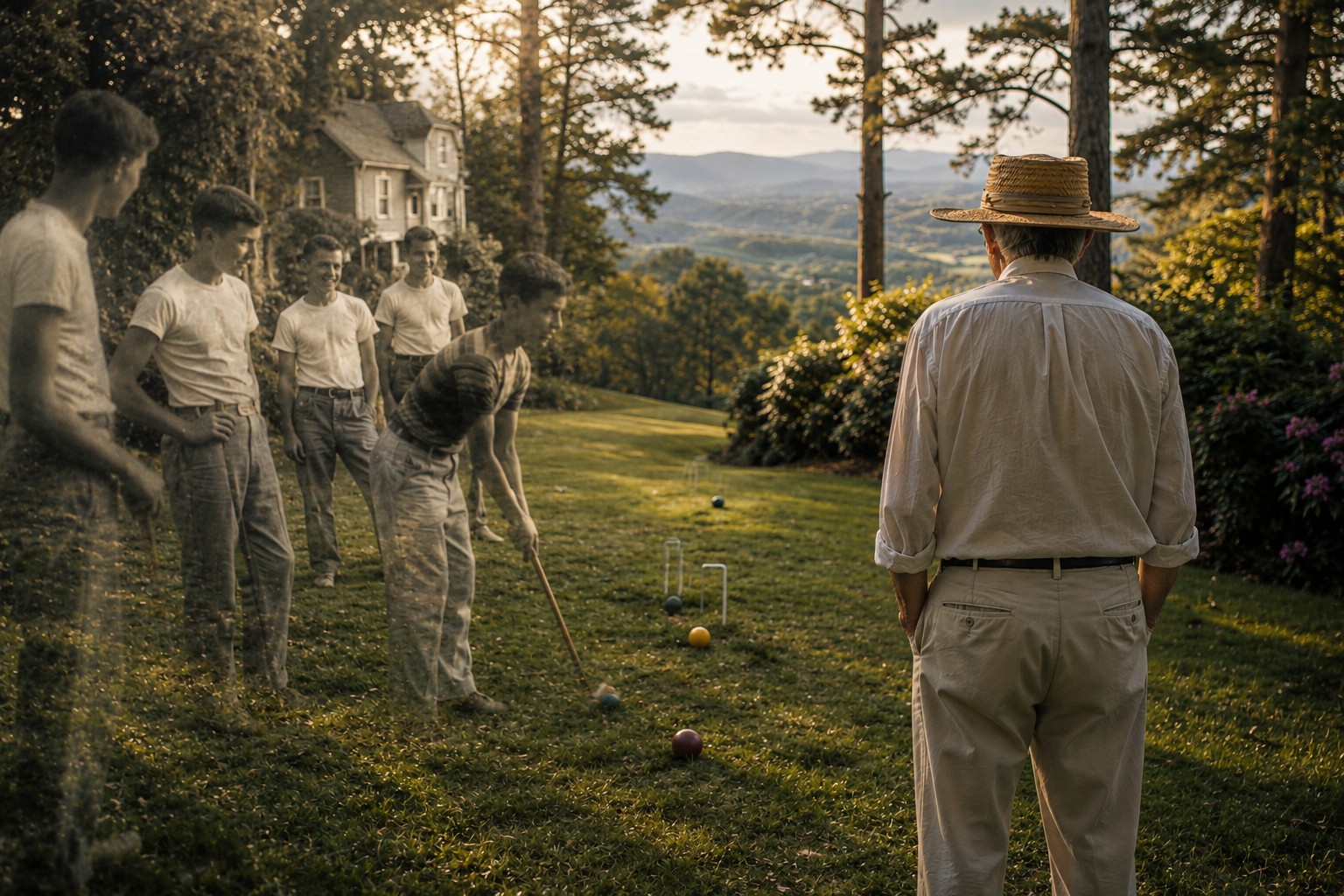
My feet were planted firmly and deliberately on the ground, slightly wider than shoulder width. My body, relaxed and balanced. One hand rested at waist level atop the mallet handle while the other settled lower, wherever comfort and habit had taught it to belong. The mallet hung naturally between my legs, its head poised just behind the ball. I lowered my eyes and followed an invisible line from the center of the ball toward my target. Everything aligned—the ball, the mallet, the distant wicket.

I knew exactly what would come next. With a smooth pendulum swing, I would send the mallet forward, hopefully striking the exact middle of the ball with the center of the mallet head. Just a clean, controlled stroke followed by an easy, unforced follow-through.

Before the mallet could complete its journey, my eyes wandered across the court. It sloped. It dipped. It rose unexpectedly. Grass gave way to patches of dirt. Dirt surrendered to weeds. A ball aimed carefully at a wicket might obey the player—or it might obey the slope. Every shot demanded adjustment. Every turn required patience. Success depended as much on adaptation as skill.

The course occupied a small clearing below the house, tucked among towering trees and surrounded by gardens that had spent decades settling into the mountain. From some spots, the Shenandoah Valley peeked through the foliage below. From others, the trees enclosed the court in a world of their own. Sunlight filtered through the leaves overhead, scattering patches of light and shadow across the grass. No two shots looked quite the same.

A croquet purist would likely find fault with nearly everything about it. The ground wasn’t level. The grass wasn’t uniform. Roots lurked beneath the surface. Gravity inserted itself into nearly every decision. Yet the court possessed a certain stubborn charm. It was not the court one might design from scratch. It was the court the mountain allowed. It was the court that Gary designed, determined to play here on the mountain.

My body remembered this. It had known this posture longer than the mountain had known this court.

To reach that court, I had to climb up a steep flight of concrete steps and walk through a loosely hinged metal gate that opened onto a long expanse of turf, cut close and tight. The starting point was a little way ahead, not far from the double clothesline stretched tight between two iron T’s. It was a narrow yard behind a white, clapboard colonial house across the road where I lived. Looking uphill beyond the fence, I could just barely see the roofline of a small cottage midway up the mountain. Looking to the end of the yard, the grass seemed to end where a fence had once been and where a grove of white pines towered over their needled floor, shading the two-story brick house in their midst.

The court began at the start of the clothesline, continued across the grass, and double-diamonded its way through an expansive and steep pine-needled slope behind the neighboring brick house, where the air turned cool and sharp with the smell of pine. On that court, too, a ball aimed carefully at a wicket might obey the player—or it might obey the slope. Every shot demanded adjustment. Every turn invited improvisation. Success depended as much on imagination as skill.

“You’re taking too long,” Gary called.

The mallet met the ball with a satisfying crack. My burgundy ball started confidently toward the waiting white wicket before surrendering, inch by inch, to the quiet persuasion of gravity.

Gary, shaded beneath his floppy blue sun hat, watched it drift off course and laughed. Beneath the broad brim of my straw hat, I laughed too. There we stood, two old men peering from beneath oversized brims, smelling of sunscreen and freshly cut grass, both convinced that the next shot would surely behave itself.

It didn’t.

Our next shots were even worse. Both balls gathered speed, raced gleefully downhill, crossed the boundary, and disappeared into the weeds. We looked at one another for a moment, then burst into laughter—the kind born of disbelief, optimism, and the certainty that we’d simply climb the hill and try again.

We retrieved our balls, walked back uphill, and tried again.

The older boys—home from college for the summer—were already waiting, mallets in hand. Impossibly slim in their side-tabbed trousers and white T-shirts, bronzed and unworried by the sun, they stood with the easy confidence of boys who belonged to the game. The air around them carried the faint, exotic drift of Jade East. Word traveled fast in a small town. They knew. Before I had even reached the gate, the squabbling began—whose team I would join, whose side would have me. I stepped into my place among them, planted my feet, lowered my eyes to the ball, and looked toward the waiting wicket.

That summer lived inside those arguments over me. I was one of them—not the youngest tag-along, not the kid from across the road, but a player worth having. Damned good, if the squabbling meant anything. The laughter came easily there, too. Cheers rose when a ball slipped cleanly through a wicket. Groans turned into laughter when it didn’t. Before the echoes faded, someone was already settling over the next shot, convinced this one would be different.

The wicket waited.

So did the slope.

So did the laughter.

Hands settled comfortably on well-worn mallets.

Feet found familiar ground.

Eyes followed an invisible line toward a distant wicket.

Everything aligned.

The mallet. The ball. The wicket.

And for one suspended moment, before the swing began, there was only belief that the ball would find its line.

Are You a Friend of Dorothy’s?


“The truth is, no one of us can be free until everybody is free.”
—Maya Angelou (1928–2014). American poet, author, and civil rights activist whose writings explored identity, dignity, freedom, and the shared humanity of all people.


“Write. Just write.”

That’s what I always tell aspiring writers.

“Write as if this will be your last line and your life depends on it. Or maybe your life after death depends on your last line.”

They stare. They roll their eyes. They purse their lips. They start. They write.

And after they’ve written several pages, I interrupt, knowing the gasps that will follow:

“Ignore the first page or two. Writers often discover their real starting point at the top of page two or three.”

“Ignore it? Throw it away?”

“Yeah, usually. Think of those pages as a warm-up exercise. Think of those pages as a way of finding the starting point.”

Ironically, it’s almost always true, even for seasoned writers. Maybe especially for seasoned writers.

I wish it were true for me. This time. This post.

But it’s not.

There’s no way—there’s just no way—that I’m going to start this post with the line I’d have to start it with if I applied my own advice:

“Are you a friend of Dorothy’s?”

Here’s why I wouldn’t.

I’m betting you’d ask:

“Who’s Dorothy?”

That’s what I asked myself yesterday when I stumbled accidentally upon the question. After I found the answer, I kept wishing I had known about it in the 1950s when I was growing up, wondering how on earth I’d ever recognize someone else like me. Queer.

Let’s face it. The eye contact thing—the looking back to see if he was looking back to see—was a hard if not impossible way to identify a kindred soul. How could I be sure? And I wasn’t about to come out and ask:

“Are you, you know—like me.”

But if I had known about Dorothy, I would have let it slip casually into the conversation:

“And are you a friend of Dorothy’s?”

“Yes” would have moved the conversation far, far away from small talk.

But I didn’t know then that the question was a coded phrase used by the LGBTQ+ community—particularly gay men—throughout the mid-20th century to discreetly identify one another.

Safe. Veiled. No risk. No exposure. No hostility. No legal trouble.

I’m surprised that it took me seventy-eight years to learn about the question and its answer. But I’m not surprised that I did so during Pride Month.

I had been paying close attention to the June headlines.

Some were celebratory. Governor Hochul proclaimed June 2026 LGBTQ+ Pride Month in New York. Orange County recognized Pride Month for the first time. Richmond listed eleven events to check out this June.

Others were not. Indiana’s governor declared Pride Month “Nuclear Family Month.” Republican governors across the country rebranded it with conservative alternatives. Tennessee followed Indiana’s lead. In Pinellas, Pride met “Faith and Family” pushback.

Then came a headline closer to home. It hit hard. Someone I knew shamed their former employer on FB for celebrating Pride Month and used a classic but outlandish propaganda technique: mix a few kernels of truth with a few outdated statistics, several disputed claims, some outright falsehoods, and then present everything under the banner:

“No Pride in Gay Life: THE FACTS.”

It only took me a minute or so to read the FB post. But it took me far longer to process my emotions. Anger. Sadness. Disappointment. Exhaustion. Surprise that it came from—someone I knew.

It took me even longer as I questioned what exactly we’re celebrating in June. Being gay, lesbian, bisexual, transgender, or queer? Hard-won advances that allow millions of people to live more openly than they could a generation ago? Battles that remain to be fought?

They’re not the same things. One is identity: human beings with shared blood pulsing in our veins and with shared hopes living in our hearts. The second is history: yesterday. The third is hope: today and tomorrow.

Suddenly, I realized that when we celebrate Pride Month, June ends and LGBTQ+ people remain marginalized.

Suddenly, I realized that when we celebrate Black History Month, February ends and Black Americans remain marginalized.

Suddenly, I realized that when we celebrate Women’s History Month, March ends and women remain marginalized.

Suddenly, I realized that when we celebrate Native American History Month, November ends and Native Americans remain marginalized.

Suddenly, I realized that we’ve gotten very good at celebrating people we’re still marginalizing.

We can do better.

We can be better.

We must.

I hope I live to see the day when Pride Month never ends.

I hope I live to see the day when Black History month never ends.

I hope I live to see the day when Women’s History Month never ends.

I hope I live to see the day when Native American Month never ends.

I hope I live to see the day when special months never end because we no longer need a special time to remind us that we are special humans every moment of every day of every month—all the time.

A day when dignity is not reserved for June or February or March or November.

A day when respect does not depend upon race, religion, gender, orientation, age, birthplace, wealth, education, politics, or any of the countless labels we use to divide ourselves into tribes.

A day when we stop asking who belongs and start assuming that everyone does.

Come fast the day when we see the person before we see the category.

Come fast the day when our differences invite our curiosity rather than our suspicion.

Come fast the day when no child grows up wondering whether there is anyone else in the world like them.

Come fast the day when we won’t need to ask, “Are you a friend of Dorothy’s?”

What We Tend


Dedicated to Gary — I see without looking.


The rake lay across the heart, as if it were Cupid’s arrow. Beads of water gathered on the thermos, upright on the nearby stone bench, right beside St. Francis of Assisi. Leather gloves and pruning shears bore witness to a gardener. Gary.

I couldn’t see him, but I knew he couldn’t be far away because his seafoam, floppy hat was not on the bench with his other things.

I knew what he was up to.

The time had come for him to do what I had done down through the years since I built the garden, filling it in with tons of tan pea gravel and surrounding it with a hedge of Little Missy boxwood.

Early on, the labor of weeding was easy. The pea gravel kept unwanted growth under control and beneath the surface. But over time the Angelina Sedum, filling the two circles in the heart’s upper lobes and surrounding the Magnolia in the lower cusp’s circle, died out but not before leaping over the rings that held them. Small chartreuse-yellow clusters softened the heart but lessened its definition.

Gary, my partner—the man who now shares this mountain life me—was doing more than weeding. He had already restored the flagstone pathway leading from heart to home and back again. Now he was planting healing Ajuga that will settle in and stay within the upper rings, eventually sending up purple spikes. Now he was cleaning, making everything as pristine as the day I finished my handiwork. I sat down on the bench, surveyed the slope, and sighed,

“Well done.”

I never had any intention of building the heart garden. My late partner Allen and I had tamed our mountaintop wilderness with so many paradisiacal garden beds that we had declared a moratorium:

“No more.”

But when Allen died and I reflected on where I would scatter his ashes, as mutually agreed upon, I could not for the life of me decide upon the right spot.

We had talked about resting places on our mountaintop, usually settling on the peony garden. Once, even, Allen suggested the Koi Pond would be perfect, but amid laughter, we both exclaimed:

“Oh, no! What happens when the pond filters get cleaned.”

Then, a few months after his death, he came to me in a dream, his voice carrying into my awakening and lingering there:

“Build my heart.”

I knew where. Near the house, at road’s edge—an untamed area we thought about gardening if we ever gave our moratorium a reprieve.

I had no idea how, but I figured a little math and lots of heart would make it happen.

And it did. I marked off an area twenty feet wide and thirty feet deep, sketched a heart with a black water hose, freed the earth of weeds, and blanketed it with pea gravel running deep. For Allen’s celebration of life, I surrounded the heart with SunPatiens, alternating red and white with tears and rain. I bought a wooden Zen rake, perfect for committing Allen’s ashes to the gravel, leaving tracings that mirrored the heart’s design, growing smaller and smaller as the center neared. Later, I planted the boxwood hedge.

Thus, the heart’s beginning.

Time has been kind. But still, the heart needs Gary’s loving care and tenderness. It rests within the landscape, its presence a part of forever.

The morning after Gary finished, we decided to amble down the path, pristinely cleaned and gently curved, with the heart in clear view.

“You go ahead. I’ll be there shortly.”

“No. I’ll wait. For you.”

It was peaceful and inviting.

We talked a little less than usual, as the morning chill quickened us and a Northern Cardinal in the treetops above whistled out its own litany of little questions.

“I want your ashes to be happy here.”

They will.

And when Gary’s time comes, I’ll board the train, his weight on my lap, my hands on the box, making his final journey to Minnesota where his story began.

This One Is Different


“Like an old friend waiting on the porch, Poor Brentford appears at the entrance to each section, tips his hat, shares a thought, and invites readers to come a little farther along.”


Drumroll, please!

The moment absolutely no one has been waiting for has arrived!

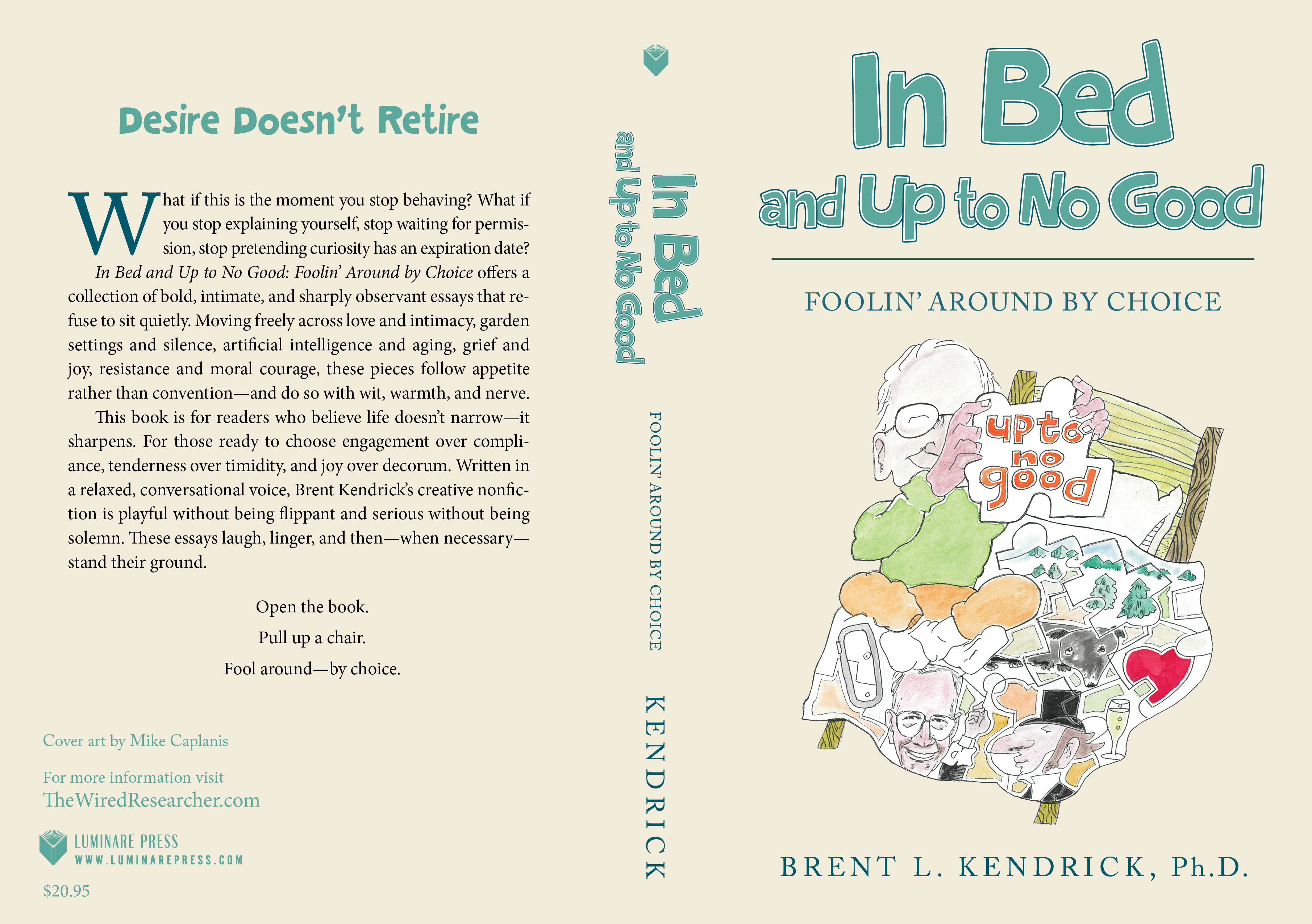
I’m pleased to announce that Up to No Good, the fifth book in The Wired Researcher Series and my fourth In Bed book, is now available.

But before I tell you where to find it, let me tell you why it’s different.

For the past several years, I’ve been foolin’ around in bed. Stop right there! Don’t you dare call the authorities. I’m talking about writing.

The first volume appeared in 2023. Two more followed. Each gathered together a year’s worth of essays from The Wired Researcher, preserving them much as they originally appeared—one after another, week after week, moving steadily forward through time.

There was something honest about that approach. Readers experienced the essays in much the same order that I lived them.

But while assembling this fourth volume, I discovered something that surprised me.

A collection gathers.

A book shapes.

The distinction may sound small, but it changed everything.

For the first time, I stopped thinking primarily about chronology and started thinking about conversation.

● What happens when essays written months apart find themselves side by side?

● What emerges when humor sits next to heartbreak?

● What new meaning appears when an essay about gardening quietly speaks to one about grief, love, aging, democracy, memory, or biscuits?

The more I explored those questions, the more I realized that this volume wanted to become something different.

Not merely a collection.

A book.

A reading experience.

In the introduction, I explain that these essays are grouped “by the questions they worry, the moments they linger over, the emotional weather they share.”

That simple shift transformed the project.

Essays began speaking to one another.

Patterns emerged.

Themes surfaced that I hadn’t fully recognized when writing the individual pieces.

Then something else happened.

Poor Brentford Lee got involved.

Those of you who have followed my blog know Poor Brentford—the mountain philosopher, accidental theologian, occasional dispenser of homespun wisdom, and longtime observer of life’s oddities and wonders.

In earlier volumes, Poor Brentford mostly wandered in and out of individual essays.

This time, he grabbed hold of the entire book.

As the sections took shape, Poor Brentford somehow appointed himself official greeter, introducing each one with a bit of homespun wisdom uniquely his own.

“Most of what saves us wasn’t planned. It just kept growing anyway.”

“Everybody’s handed something they didn’t order. The rest is choice.”

“We were just boxwoods until someone believed we could be part of something beautiful.”

Frankly, I’m not sure I had much say in the matter.

Poor Brentford can be bodacious that way.

The result is that he now wanders throughout the book, standing at the entrance to every section, tipping his hat, offering a thought, and inviting readers to come a little farther along.

In many ways, Poor Brentford became the connective thread that helped transform a collection of essays into a unified reading experience.

Instead of moving week by week through a calendar year, readers move through twelve thematic landscapes:

What Grows, Teaches explores gardens, reinvention, second chances, patience, and grace.

What We Do with What We’re Given examines mishearings, limitations, temptations, acceptance, and the choices that shape a life.

Chosen Ground asks what it means to belong—to a place, to a memory, and ultimately to ourselves.

Those We Carry reflects on the people who continue to live within us long after they are gone.

Plagiarism À La Carte celebrates borrowing, influence, recipes, wit, and the occasional joyful act of making something unmistakably your own.

What We Lean On explores the quiet structures that steady us through uncertainty, solitude, and change.

On Our Own Terms examines aging, authenticity, self-authorship, and the liberating realization that we no longer need permission to be ourselves.

Giving Forward honors educators, mentors, benefactors, and all those who quietly build bridges for others.

Together, One ventures into fascinating territory where human curiosity meets artificial intelligence and asks what happens when we learn alongside the tools we create.

Literary Wanderings follows books, writers, forgotten voices, and the ideas that continue to shape us.

Choosing Love Again explores something I never expected to experience at this stage of life: the extraordinary privilege of falling in love once more.

And finally, When Democracy Falters gathers essays written from the conviction that citizenship is not a spectator sport and that silence carries consequences of its own.

Looking back, I realize that what changed wasn’t merely the arrangement of the essays.

What changed was the way I saw them.

Teaching literature for decades trained me to look beneath the surface, to ask how individual parts contribute to larger meanings. Somewhere along the way, I began applying that same close reading to my own writing.

The result is this book.

Some readers will recognize essays they first encountered on the blog. I hope they do. But I also hope they’ll discover something new in the conversations those essays now have with one another.

Others will be encountering many of these pieces for the first time.

Either way, my hope is that readers will find themselves lingering.

Laughing.

Remembering.

Questioning.

Growing.

Perhaps even falling a little more deeply in love with life itself.

After all, that’s what these essays have been teaching me all along.

In Bed and Up to No Good: Foolin’ Around by Choice is now available through Amazon and Barnes & Noble.

If you’d like to see what happens when a collection becomes a book—and when Poor Brentford appoints himself tour guide—I’d be honored to have you join me for the journey.

And as always, thank you for reading. Without readers, essays are merely conversations waiting to happen.

Once More: Glimpses of My Mother’s Hands

On this Mother’s Day weekend, I’m thinking not only of mothers, but of everyone who has nurtured, steadied, comforted, protected, and loved—often quietly, often without recognition.

For those celebrating mothers, missing mothers, remembering mothers, or mothering others in their own ways, I wanted to share this post again.


“Mothers hold their children’s hands for a short while, but their hearts forever.”
–Unknown


On top of my bedroom chest of drawers is a pair of studio portraits of my father and my mother. They’re hand-colored originals, each measuring 3 inches by 4 inches, taken a year or so after my parents’ 1932 marriage. The portraits are in hinged gold frames. My father is on the left. My mother is on the right. A lamp behind illuminates both.

Right now, as I lie in bed, I’m focusing on my mother. Even though her portrait is five feet or so away, she is as clear to my sight as if she were right beside my bed. I’m glimpsing into a distant past, where memories of her linger like whispers.

She’s seated on a bench, wooden, perhaps. The artistic backdrop transports me outdoors. Trees frame the scene, a tall one behind her, their branches reaching skyward, and shorter ones in the background, on the bank of a calm body of water, perhaps a serene river.

She’s wearing a dark dress with short sleeves and a deep-cut neckline, accentuated by a glistening leaf-shaped brooch.

Her finger-waved hair, parted in the middle, falls softly just below her ears. Her eyes are dark and intense, with a gaze that seems to pierce through the image. They are surrounded by her soft, light skin tone, which provides a striking contrast. Their depth and intensity draw me in and make me wonder. What secrets lie hidden behind them? What stories and dreams do they hold? Are they looking into the depths of the world, seeking answers and understanding? Are they inviting me to join in their quest for knowledge?

Her features captivate and mesmerize me, regardless of how often I look at her portrait. Somehow, though, I seem to see my mother’s hands the most. Their contours are soft and graceful, and the fingers curve delicately, one hand gently clasping the other hand.

I see my mother’s hands the most because I know her hands the best.

My mother’s hands are engaging handsHer hands held mine when I was but a child, and we scurried down the path behind our home where two boulders stood sentinel on either side as colored snow fell down in green and pink and blue flakes, making me believe in magic. Her hands held mine when I was a few years older, and she led me outdoors when our world was covered in snow and showed me how to lie down in stillness, moving arms and legs left and right to create angel wings, making me believe in flight. Her hands held mine a few years later when our world was green with summer and led me to lie down in warm grass, eyes skyward, discovering cloud figures, pointing out the details to one another so vividly that each could see brand new worlds of our own imaginings, making me believe in sharing visions so that others might see.

My mother’s hands are cooking hands. Her hands could transform pinto beans, onions, cornbread, buttermilk, and sweet potato cobbler into a feast, making me want it weekly. Her hands could turn a 25-pound turkey into a bronzed Thanksgiving dinner that rivaled Norman Rockwell’s iconic oil painting Freedom from Want, making art come alive in our own coal camp kitchen. Her hands could measure out with perfection all the ingredients for any dish from any cuisine that she had tasted with no need for recipe and with no need for measurements, teaching me to trust my senses.

My mother’s hands are versatile hands. Her hands could make our clothing without pattern, simply by taking our measure with her hands, making me aware that some things are more felt than seen. Her hands could cut my hair using scissors, comb, and the soft stretch of her fingers, reinforcing in my mind the marriage of expertise and craftsmanship. Her hands could take a pastry brush and turn a greased baking sheet or cake pan into a perfect likeness of Christ, making me see Holiness in the everyday.

My mother’s hands are industrious hands. Her hands could transform a grassy field into a kaleidoscope of gladiolas or dahlias, bursting with vibrant hues, teaching me to see potential in the ordinary. Her hands could hold her side of a wooden pole stretched through handles of a galvanized tub, carrying water to the garden, making me realize that many hands can carry heavy loads. Her hands could hang wallpaper with finesse, demonstrating how effort can elevate even the smallest task to art.

My mother’s hands are inclusive hands. Her hands always opened wide the door, welcoming everyone as guests into our home, making me value open-heartedness and acceptance of others, regardless of differences. Her hands always set a place for them at our modest table, making me understand that meager becomes abundance when shared with others. Her hands always held theirs in loving celebration and thanksgiving, making me a witness to the genuine communion of mankind.

My mother’s hands are nurturing hands. Her hands cared for her father and her mother in times when they could not take care of themselves, impressing on me the importance of helping others. Her hands cared for my dad and me and all my siblings, even when our hands might well have lessened the weight that she carried in hers, showing me that strength comes with sacrifice. Her hands took pine rosin to hold tight and heal the gash in my foot, the scar on my sole still a reminder of what she had learned from her mother’s hands, helping me appreciate generational know-how and wisdom.

My mother’s hands are writing hands. Her hands penned sermons when she pastored a church, making me realize that the intellect can lead the heart to be slain by the Holy Spirit. Her hands sent letters out into the world to those she knew well and to those she hardly knew at all, making me see that the power of words reaches beyond the pulpit. Her hands discovered typewriter keys late in life, determined that hand tremors would not tame her self-expression, making me realize the strength of determination.

My mother’s hands are spiritual hands. Her hands joined the hands of other warriors, praying over me as a child with polio, making me–one of the lucky, uncrippled survivors–a believer in the power of prayer. Her hands walked their way through her Bible and her commentary books–from cover to cover–more than thirty times in her lifetime, making me know the richness to be gained through close readings and research. Her hands clapped, sending thunderous applause into the Heavens to show her thankfulness and gratitude, making me know the joy of praise.

My mother’s hands are clasped hands. As she lay in her casket after her funeral, I removed her rings, took her hands and clasped one gently on top of the other, leaned in for a farewell kiss, and, then, closed the lid.

After her burial, my hands–strong from the strength of hers–released from their cage three white doves, flying upward toward the celestial realm, perhaps at that same mysterious moment when my mother found her way back home and celebrated her arrival with outstretched hands.

§ § §

Bertha Pearl Witt Kendrick (May 16, 1912–May 30, 2010)

Ounce of Prevention. Pound of Cure.


“Never mistake the season for the signal.”

—Poor Brentford Lee (b. 1947.) He reads the signs, trusts the seasons, studies the soil—and is not above reminding others when they’ve mistaken one for the other.


“Absolutely not!”

“You must! Please, help.”

“This time, young man, you’ve gotten yourself in so deep that I can’t help.”

“Yes, you can. I know you can. You know everything.”

I was certain my pitiful entreaties would soften Poor Brentford’s heart and move him to help.

But no. He would not be moved.

“You got yourself into this mess all by yourself.”

“And just how did I do that? Come on, Brentford Lee. Help me.”

“I can’t. Why on earth did you think you could read Mother Nature—in April, no less? Don’t you know that’s the cruelest month of all, especially in the Shenandoah Valley?”

I knew that, of course. It’s the time of year when the world seems to be coming alive again—only to have Mother Nature step in and kill that vibrant new growth with a harsh, chilling frost.

That’s why Valley folks rarely plant tender crops until mid-May, after the danger of frost has passed.

So. There. I do know those precautions.

But last year, we found ourselves in a new gardening zone. Our old Zone 6 became Zone 7, with the danger of frost ending around mid-April.

I was cautiously thrilled—but I still waited until early May, when the ground was warm and the forest fully leafed.

This year, though, my mountaintop felt different. The soil warmed sooner. The forest leafed sooner. Sooner, it turned out, was early April.

“Wait and see,” I kept telling Gary. “When the mountaintop turns green, we’re past the danger of frost.”

“Are you sure?”

“Of course, I am. Mother Nature knows what she’s doing. She’s telling us Spring has overtaken Winter.”

And so it was. I had convinced myself. I managed to convince Gary. Together, we planted—and rejoiced in the head start.

Just as we beamed our widest smiles, we checked the weather.

Mother Nature was pulling a switcheroo.

Frost. April 22. 2:00 a.m. to 10:00 a.m.

27°? 30°?

The forecasts varied, but we knew: our plants were doomed unless we intervened—and maybe even then.

Poor Brentford was no help whatsoever. He had the nerve to smirk:

“An ounce of prevention is worth a pound of cure.”

I know. I know. We should not have planted.

But we did.

And there we were, scrambling to invent a pound of cure for our poor, tender, pitiful plants—deck, patio, yard—everywhere. Pots filled with blooms that had no business showing off this early.

What followed was less a plan than an emergency deployment.

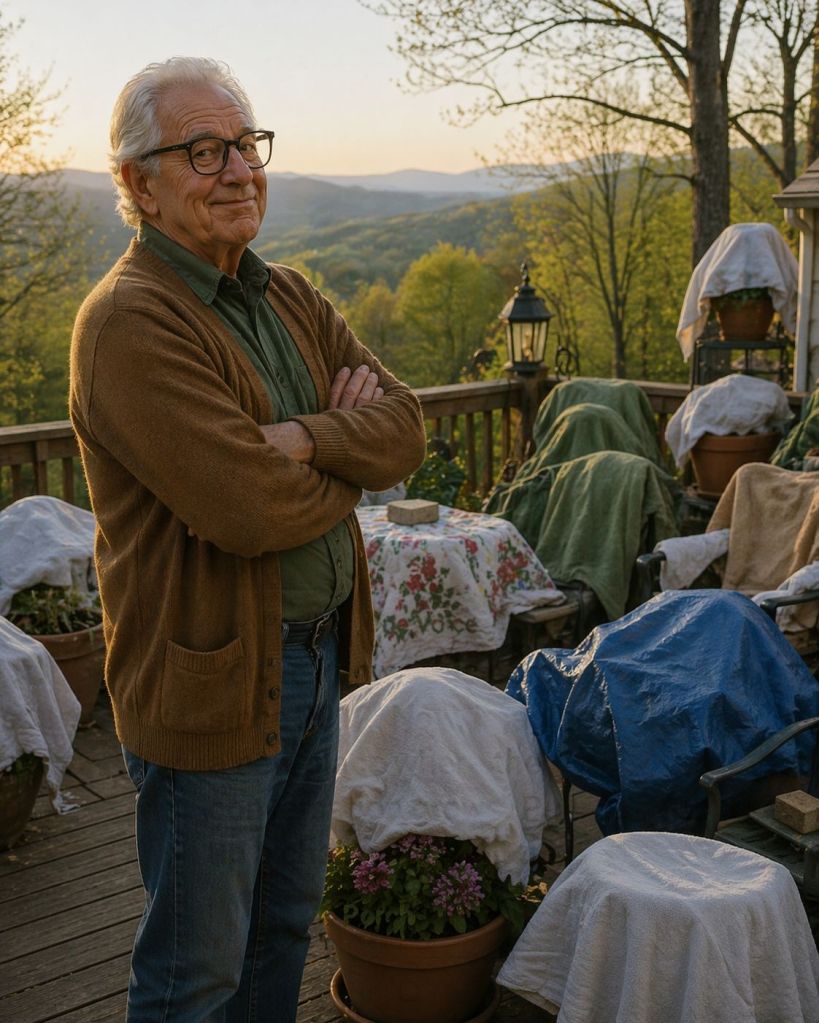
Tarps emerged from the basement. Towels defected from bathrooms. A festive tablecloth—clearly never intended for agricultural duty—was reassigned to frost prevention. Gary moved with operational urgency.

Clay pots became heat traps. Chairs became scaffolding. We hurried bewildered begonias to safer quarters. We draped. We pinned. We tucked. We hoped.

By dusk, the deck resembled an archaeological dig disguised as a linen sale. Shapes rose under fabric—domes, humps, improbable ridgelines of cotton and optimism. Each tender plant huddled beneath its improvised shelter, awaiting judgment from a sky that had seemed so kind only hours before.

Poor Brentford Surveys the Scene.

Judgment came in the early morning hours.

Harsher than expected.
Colder than predicted.
Twenty-four degrees.

Poor Brentford surveyed the scene.

“Your pound of cure was heroic,” he observed. “But was it enough?”

I looked out at the mountains and smiled. The trees, in all their green fullness, had been spared.

We began uncovering our plants.

One by one.

Here a bloom lifted.
There a stem held.
Elsewhere, leaves—cold, but alive.

We kept going.

More life.
More holding on.
More quiet insistence.

In the end, we lost only one.

And that one? To be honest, I had not been covered it very well at all.

I stood there a moment longer than necessary.

I had been prepared to blame the frost.

This time, I didn’t.

And I let that be enough.

Oh, No! No Sourdough!


“Convince me that you have a seed there, and I am prepared to expect wonders.”

—Henry David Thoreau (1817–1862). American essayist, naturalist, and author of Walden, whose writings celebrated attentive living and the quiet wisdom of nature.


Superstitions surrounding Friday the 13th do not concern me. If my middle name weren’t Lee, it would be Lucky. I walk under ladders, ignore black cats, shop, travel and do all the things others won’t do. I will keep right on doing what I’ve always done. But this year, my luck may have run out. Or not.

The day started out on as good a note as possible. I fed my sourdough starter in my usual fashion even though the kitchen was a tad cooler than usual. A slow rise never kept me from planning ahead for scrumptious sourdough pancakes.

After our usual morning routines, Gary and I went out for lunch and returned home. In the afternoon, I preheated the oven to 350° so that it would be ready for whatever it was that I planned to cook for dinner.

Then I went about my affairs as usual. That is until I smelled a wonderful aroma wafting out from the kitchen. Bread? Cake? I was fascinated because I hadn’t started dinner. What could it possibly be?

Just as I walked into the kitchen to see what had lured me there, I exclaimed,

“Oh. No. My sourdough!”

When I turned the oven to preheat after lunch, I forgot that hours earlier I had put my sourdough starter in there on “proof” to get a faster rise.

What I saw when I opened the oven door was not fermentation. It was transformation.

The jar no longer held a living starter. It held evidence of my carelessness. The sides were lacquered in amber and gold, as if the sourdough had tried to climb out and been stopped mid-escape. A caramelized tide line marked how high it had risen before heat overtook it. What had once been soft and elastic was now fixed in place, streaked and hardened like candle wax after a long vigil.

Inside, the starter had transformed into something strangely geological. A pale, spongy dome baked solid at the edges, its surface torn open in small craters where trapped gases had burst and frozen in time. The smell was unmistakable: toasted flour, faint sweetness, a whisper of bread that almost existed.

I stood there looking at a crime scene, fully aware that the culprit and the witness were one and the same.

I had been the one who coaxed these mountain spores into life years ago, watching their first tentative bubbles gather and rise as if they had somewhere important to be. I had fed them, talked about them, and trusted them to do their quiet work while I went about mine.

They had made their way into breads and cakes and cookies and scones and cinnamon rolls, earning praise far beyond my mountaintop kitchen. And yet, on this particular Friday the 13th, I had forgotten them entirely, leaving a small natural wonder behind, unnoticed, to the fate of an oven I had set to preheat.

For a time, I did nothing but stand there, laughing at my stupidity while absorbing the lesson. There seemed little left to do but clean the jar and move on.

But just when I was feeling the depth of loss, I remembered. Flakes. Sourdough flakes.

A year or so ago I had dried some starter and set it aside, more as an experiment than anything else. I never imagined needing them. They sat unnoticed in a small jar, ordinary and still, offering no hint that they might hold anything alive.

I weighed a small portion and put it in a bowl with an equal amount of warm water. I watched as they softened and disappeared into a cloudy mixture. Then I added an equal amount of flour, creating a pasty potential. It felt more like a laboratory ritual than a kitchen rescue. Truthfully, I wasn’t certain anything would happen. But I held on to hope, realizing that those flakes were the only thing left for me to try.

At first, nothing happened.

The mixture sat on the counter looking exactly as one might expect flour and water to look when stirred together: pale, still, and entirely unremarkable. I told myself not to expect too much. After all, these were only dried remnants, fragments of something that had once been alive. Whatever vitality they possessed had long since faded.

But some time later–hours, perhaps less–I noticed a change so small it might easily have been missed. A tiny bubble appeared along the edge of the bowl. Then another. The surface loosened almost imperceptibly, as if taking a slow breath after a long sleep.

By the next morning, there was no denying it. The mixture had awakened. Fine bubbles traced delicate pathways through the paste, and a faint, familiar aroma rose to meet me—not flour, not water, but something living. Something remembering what it had been.

What astonished me most was not simply that the sourdough culture had returned, but how quickly it did so. Years ago, when I first coaxed those mountain spores into existence, I waited days for signs of life, peering into the jar with the anxious patience of a novice. This time, revival came with confidence, as though the culture already knew what it was meant to do.

Up from the flakes it arose.

What had seemed lifeless only hours earlier now stretched upward, gathering strength from invisible work. I found myself watching it the way one watches a garden after rain—not interfering, not hurrying, simply witnessing growth. A living culture once again, carrying within it all the strength and possibility of its ancestral spores.

And standing there, I realized that nothing about it felt accidental. Life, given the smallest chance, had simply resumed its work.

Watching it rise again, I began to understand that what I had witnessed was more than a small kitchen recovery. I had baked the starter, yes. But I had not baked the possibility.

Something essential had been preserved long before the mistake was made. Tucked away almost absentmindedly, those flakes had carried forward what mattered most. Given warmth, patience, and a little attention, the sourdough culture simply resumed its work, as though interruption were only a pause and not an ending.

It struck me then how stubbornly life finds its way back, even after neglect, even after carelessness. What appears lost may only be waiting for the right conditions to begin again.

Perhaps that is the real lesson Friday the 13th had to offer me this year. Not bad luck. Not superstition confirmed. Just a moment of carelessness and a jar of forgotten flakes, both filled with truth. We measure our mistakes with finality, and we assume that one moment of inattention defines the whole story.

Nature does not agree.

Two Porches. One Voice.


“The first porch is where you find your voice. The second porch is where your voice finds others.” —Poor Brentford Lee (b. 1947. Keeper of two porches, one mountain, one dog, and an inexhaustible supply of things worth saying—none of which he has to say alone anymore, thanks to his partner, Gary.)


Dear Faithful Readers,

You’ve been here with me on the porch since—well, some of you since the very beginning, back when I built it as nothing more than a place where you could pull up a chair and talk with me about the joys, challenges, and discoveries of research. We kept right on doing that from 2012 to 2021 when I decided to make the porch a little more fun by bringing you weekly creative nonfiction essays.

I’m still at it. Nearly 750,000 words later. Yes, you read it right. Foolin’ around in bed every night with ideas and words adds up. I’m spurred on by you, my Dear Readers, whose numbers keep increasing annually! Last year, we shared more than 35,000 views right here on the porch.

But I’ve built a brand-new porch, and I want you to be the first to know about it.

Don’t worry, though. I’m not leaving The Wired Researcher porch. It will remain open virtually forever. Same Monday mornings. Same voice–mine, with Poor Brentford’s voice chiming in from time to time. We’ll both be there, waiting for you.

I just heard someone shout out:

“So, why are you building a new porch? What’s that all about?”

Well, for starters, it has better lighting, and it might just bring in more neighbors for all of us to visit and exchange ideas.

I’m counting on you to check it out. I’ve named the second porch The Kendrick Chronicles.

“Where on earth is this new porch of yours?”

Gracious me! You know that I like to take my time–slow and easy like. In a sec, I’ll give you the link so that you can check it out for yourself. And when you do, go ahead and Subscribe! From that point forward, my essays–ever goldern new one that hits the world, every Monday morning like a neighbor who always brings something worth reading and never overstays his welcome–will find their way directly to your Inbox.

You can find this new porch of mine in Substack. Here’s the link:

brentlkendrick.substack.com

“What will I find when I get to this new porch of yours?”

Why, gracious me! You’ll find a comfy chair with your name on it and a handful of your favorite essays with my name on ’em:

● Redbuds of Remembrance

● Learning to Love in New Ways

● I Am Afraid

● Poor Brentford Cleans the Wax Out of His Ears

● Two, Together

● Glimpses of My Mother’s Hands

● The Ghost of Palmyra Church Road

● Truths Half-Told. Letters Half-Burned. A Legacy Waiting to Be Fully Heard.

● Carrying the Bags of Colonial America’s Humourist

And get this. If you subscribe, next week you’ll get an essay about a kitchen disaster beyond belief: “Oh, No! No Sourdough!” And the week after that, “What We Know. What We Believe.” It may be the most complete thing I’ve ever written about who I am and what I believe about what comes next.

So go on now. Pull up a chair. Same voice. Wider porch.

Come find me there:

The Kendrick Chroniclesbrentlkendrick.substack.com

But always remember to come back here, as I remain–

Epigraphically yours forever,

Brent L. Kendrick
(—and Poor Brentford Lee, who deserves full credit for my nonsense)