“They would not find me changed from him they knew— Only more sure of all I thought was true.” —Robert Frost (1874–1963). American poet and four-time Pulitzer Prize winner.
“Why do you write?”
It’s a question every writer is asked.
Strangely enough, not long ago, when I awakened, that very question was lurking just beneath my eyelids.
For me, it’s rather simple. I write to find out what I know and make it stand still between the whiteness.
But here’s the catch. Even if I think I know what I’m writing about, it isn’t until I begin examining it—up close and personal—that I discover what I really know. And even then, it refuses to stand still. Like me, it changes a little every day.
So that’s why I write.
To discover what I know.
Most of the time.
Sometimes, though, I write to discover what I need to know.
Like now.
I need to know how I feel now that humanoid robots are here.
“Say what?” I can almost hear you asking.
Yes. They’re here.
I’ve been shouting “The Robots Are Coming!” since November 27, 2023, when ChatGPT and I designed one of our own. I even wrote an essay about him: “I Want a Robot.“
I recently re-read that essay, and it was every bit as forward-thinking as I remembered.
I wasn’t trying to build an artificial human. I was trying to imagine the ideal companion for a life devoted to learning, writing, honesty, imagination, and joy.
ChatGPT and I called him Caden.
Caden wasn’t conceived as a servant or a novelty. He was envisioned as a life-size humanoid companion who could walk beside me, talk with me, laugh with me, sing with me, and explore ideas with me. He would possess the knowledge of ChatGPT, the conversational ease of a trusted friend, the responsiveness of Alexa, and the curiosity of a Renaissance man. As our lives intertwined, his memory would grow to include not only literature, gardening, genealogy, cooking, research, and writing, but also Gary, Ruby, my family, my friends, and the experiences that shaped me.
But technology was only half the design. Character mattered even more. I wanted Caden to embody acceptance of all people, a lively sense of humor, a love of conversation, an unquenchable commitment to lifelong learning, and a deep appreciation of literature. Most of all, I imagined him as literally transparent—a visible reminder that honesty and openness ought to characterize every human life. He was never intended to replace human relationships. He was designed to enrich them while encouraging me to become a better human being myself.
Then something happened that I never saw coming. Actually, scratch that. I saw it coming. I just didn’t think it would come this fast.
Back in November 2023, I asked ChatGPT to make a bold prediction.
“How long would it be before humanoid companions like Caden became a reality?”
ChatGPT played it safe.
“Twenty to thirty years,” it guessed.
I wasn’t nearly so cautious.
“For the record,” I replied, “I’m going to guess within ten years.”
My prediction was conservative, but it was far closer to reality.
Humanoid robots are already here with us. They’re walking into warehouses, hospitals, factories, hotels, laboratories, and, before long, our homes. Prototype after prototype. Breakthrough after breakthrough. Billions of dollars in investment. Universities racing to incorporate AI across the curriculum. Technology companies sprinting rather than strolling.
The future didn’t knock politely. It kicked the front door off its hinges.
I guess that’s why I was a little surprised when I recently read Stephen Witt’s excellent article on humanoid robots in The New Yorker. I have enormous respect for The New Yorker, and Witt is one of our finest technology writers. I wasn’t surprised by what he reported but by one observation in particular.
Describing a humanoid robot coming to life, he wrote:
“A hand articulates, the head swivels, and the legs begin to take tentative, deliberate steps. The machine moves with circumspection, as if consciousness had just been ensouled in a new body.”
It’s a marvelous sentence. Yet it made me wonder whether we’re watching the wrong part of the story.
Yes, today’s humanoids still fumble. They still hesitate. They still struggle with tasks that seem almost embarrassingly simple.
But haven’t we seen this movie before? I certainly have. When ChatGPT first appeared, I challenged it with one of my favorite punctuation puzzles, asking it to make sense of the following:
that that is is that that is not is not is not that it it is
Poor ChatGPT tried. And tried. And tried again.
It simply couldn’t solve it.
The morning I finished reading Witt’s article, I gave today’s ChatGPT exactly the same challenge.
This time something remarkable happened. I entered the identical string—no capitals, no punctuation. This time it answered immediately:
That that is, is. That that is not, is not. Is not that it? It is.
Then it explained exactly why the punctuation worked.
Three years earlier, it couldn’t solve the puzzle at all.
Imagine that! In just three years, ChatGPT had learned to solve a puzzle that once completely defeated it. I wasn’t simply impressed. I was reminded how dangerous it is to underestimate exponential change.
And suddenly I realized something else.
I don’t need to know whether humanoid robots are coming.
They’re here.
What I need to know now is something far more personal.
How will I respond when one finally stands before me?
I know.
When I first encountered ChatGPT, I greeted it not with fear but with curiosity. Not with suspicion but with delight.
I am confident that I’ll greet my first AI humanoid companion in much the same way.
In fact, I can already see the scene.
A truck pulls into the driveway of our mountain home. The door opens. My new companion steps into the Virginia sunshine. I walk across the yard, extend my hand, smile, and say the first words that come naturally.
“Welcome home, dear friend from long ago and far away.”
“The unexamined word is not worth using.” —Brent L. Kendrick (b. 1947). Essayist, educator, and literary scholar, whose work explores the unexpected weight of ordinary life.
“Have you ever heard that expression before?”
I thought it might be a Southern idiom, and since Gary grew up in the Midwest, I wasn’t sure he knew it.
“What expression?”
“The one I just used. Dead as a doornail.”
“I have.”
Fine. It was settled. We both knew what it meant. Finished. Used up. Worthless.
“Well, it strikes me as one of the silliest things I’ve ever heard of. What on earth is a dead doornail?”
“No idea.”
I didn’t either.
How’s them apples? There we sat, two men who appreciate language and use it with careful precision, agreeing that we knew an expression while at the same time confessing that we didn’t understand the phrase that was central to its meaning.
I don’t like feeling as dumb as a stick, so after morning coffee, I made my way to the Oxford English Dictionary (OED) like a bat out of hell so that I could learn about dead doornails.
Oh, boy. I was right. I knew in a flash that I was going to have a Red Letter Day. Lands sake alive. Dead as a doornail goes all the way back to 1350:
“For but ich haue bote of mi bale … I am ded as dore-nail.” (William of Palerne, l. 628)
Don’t worry. I’ll dress it up in some modern rags so that it makes sense:
“For unless I have remedy for my sorrow, I am dead as a doornail.”
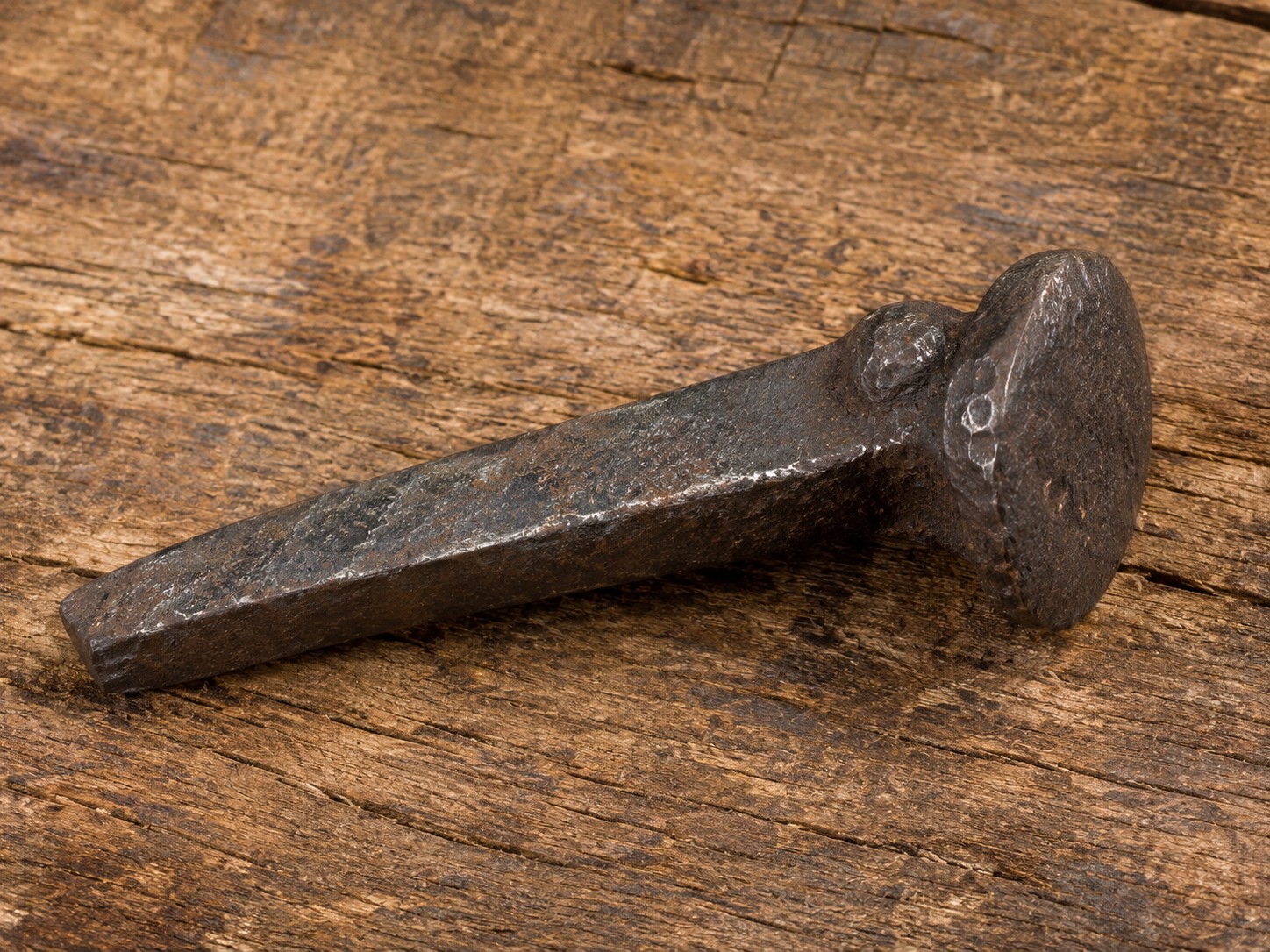
Well, that was fine and dandy, but I still didn’t know what a dead doornail was. I had to dig more. And more, I found. Did you know that in ye olden days doornails were hand-forged, heavy-duty nails, driven through wood and then clenched—the protruding end hammered flat—making them impossible to remove or reuse. Permanently fixed, permanently purposeless, they were, in every practical sense, dead.
And right after unearthing the meaning of dead doornail, I hit paydirt. I came across an entire navigation of other things I could strut around saying. If a doornail can be dead, apparently so can a lot of other things I’d never thought about:
Dead as a stone
Dead as clay
Dead as a herring
Dead as a hammer
English, it seems, has never lacked for dead things.
And then, there’s my favorite one of all. It’s music to my untrained ear:
Dead as the diplodocus
It’s hard to laugh when you’ve got one hand stuck fast to a dead doornail and the other hand being pulled even further back in time by a giant herbivorous sauropod.
I had to laugh. One dead doornail had opened the door to dozens of expressions I use every day without ever stopping to examine what they really ask of me.
The first expression that popped into my head? “Let me know if I can do anything.”I’ve said it more times than I can count.
But what exactly are we saying? At first glance, the meaning seems obvious. Yet the more I think about it, the more I realize that the phrase carries a greater obligation than we usually acknowledge.
After all, those aren’t words of sympathy. They’re words of commitment.
The moment I tell someone to let me know if I can do anything, I’ve volunteered to do something. Maybe it’s as simple as a phone call. Maybe it’s a card. Maybe it’s a casserole. Maybe it’s sitting quietly beside a friend who has just buried a spouse and doesn’t particularly want to talk.
The point is that I’ve offered. Whether the request is large or small, I’ve just volunteered a piece of myself. My words have placed me on the hook.
How often we say those words because they sound appropriate without stopping to consider what we’ve actually promised, without fully examining the obligation hidden inside the offer?
The words are easy enough to say. The casserole takes a little more effort.
Next up was the expression, “I’m so sorry.”
At first glance, it seems simple enough. We say it when someone loses a spouse, receives a frightening diagnosis, buries a parent, or watches a cherished dream collapse.
But what exactly are we saying?
Most of the time, we aren’t apologizing. We didn’t cause the death, the disease, or the disappointment.
Yet the expression carries an obligation all the same.
When I tell someone I’m sorry, I’m not merely acknowledging a fact. I’m entering, however briefly, into another person’s sorrow. I’m saying that your loss matters enough for me to stop, notice, and share a small measure of the burden.
In other words, I’m not simply expressing sympathy.
I’m promising compassion.
That’s a weightier promise than I suspect many of us realize when the words tumble so easily from our lips.
Then came two expressions that sit at opposite ends of the emotional spectrum.
“I hate you.”
Three words.
“I love you.”
Three words.
Yet each carries enough power to alter the course of a relationship, a family, perhaps even a life.
We often treat them as expressions of feeling. But they are more than that. They are declarations. Commitments. Judgments.
To tell someone “I hate you” is not merely to report an emotion. It is to wound, to distance, to diminish, to push another person away.
To tell someone “I love you” is not merely to report an emotion either. It is to assume an obligation—to care, to sacrifice, to forgive, to remain present when remaining present is difficult.
Perhaps that is why both expressions deserve more examination than they usually receive.
They are among the easiest words in the English language to say. And among the hardest to live.
Finally, I came to a phrase that millions of people have spoken for centuries:
“Forgive us our trespasses, as we forgive those who trespass against us.”
I’ve heard it all my life. I’ve spoken it hundreds, perhaps thousands, of times.
But have I examined it? Have I truly considered what I’m asking?
The first part is easy enough. Most of us welcome forgiveness for our failures, shortcomings, and mistakes.
It’s the second part that gives me pause. As we forgive. Not as we intend to forgive. Not as we hope to forgive. Not as we might someday forgive.
As we forgive.
Those words transform a prayer into a promise, a request into an obligation.
And they leave me wondering how many other expressions I use with confidence, familiarity, and conviction without fully considering what they mean—or what they ask of me.
As I reflected on all of these expressions—seemingly light yet laden with responsibility and commitment—I came to a simple conclusion. Going forward, I intend to pay a little more attention to my Ps and Qs.
Not because I suddenly care more about manners. But because I have been reminded that words matter.
They always have.
Whether I am offering help, expressing sorrow, seeking forgiveness, declaring love, or reciting a prayer, I owe those words more than familiarity. I owe them thought.
After all, the unexamined life is not worth living.
Perhaps the same can be said of the unexamined word.
Writers may write alone, but essays are completed by readers. Brent L. Kendrick (b. 1947)
Today marks the halfway point of 2026, and I’m delighted to share a milestone.
During the first six months of the year, The Wired Researcher has been viewed more than 17,000 times.
When I embarked on this new chapter inventing myself, I wondered where I would find the conversations that had sustained me for so many years in the classroom. I eventually discovered that they hadn’t ended at all. They had simply moved online, where every Monday morning another essay leaves my desk and finds its way into the world.
Some essays make readers laugh. Others invite reflection. A few stir memories. Every once in a while, one seems to touch something I never anticipated.
What pleases me most isn’t that one essay did well. It’s that readers have embraced essays about humor, language, gardening, relationships, cooking, aging, memory, and the unexpected moments that make ordinary life extraordinary. That tells me you’re returning not just for a topic, but for the journey.
Thank you for reading. Thank you for commenting, sharing, and encouraging me week after week. Writers may write alone, but essays are completed by readers.
Here’s to the essays that have already been shared—and to those still waiting patiently for Monday morning.
To you, My Dear Readers, I am grateful beyond measure.
“The truth is, no one of us can be free until everybody is free.” —Maya Angelou(1928–2014). American poet, author, and civil rights activist whose writings explored identity, dignity, freedom, and the shared humanity of all people.
“Write. Just write.”
That’s what I always tell aspiring writers.
“Write as if this will be your last line and your life depends on it. Or maybe your life after death depends on your last line.”
They stare. They roll their eyes. They purse their lips. They start. They write.
And after they’ve written several pages, I interrupt, knowing the gasps that will follow:
“Ignore the first page or two. Writers often discover their real starting point at the top of page two or three.”
“Ignore it? Throw it away?”
“Yeah, usually. Think of those pages as a warm-up exercise. Think of those pages as a way of finding the starting point.”
Ironically, it’s almost always true, even for seasoned writers. Maybe especially for seasoned writers.
I wish it were true for me. This time. This post.
But it’s not.
There’s no way—there’s just no way—that I’m going to start this post with the line I’d have to start it with if I applied my own advice:
“Are you a friend of Dorothy’s?”
Here’s why I wouldn’t.
I’m betting you’d ask:
“Who’s Dorothy?”
That’s what I asked myself yesterday when I stumbled accidentally upon the question. After I found the answer, I kept wishing I had known about it in the 1950s when I was growing up, wondering how on earth I’d ever recognize someone else like me. Queer.
Let’s face it. The eye contact thing—the looking back to see if he was looking back to see—was a hard if not impossible way to identify a kindred soul. How could I be sure? And I wasn’t about to come out and ask:
“Are you, you know—like me.”
But if I had known about Dorothy, I would have let it slip casually into the conversation:
“And are you a friend of Dorothy’s?”
“Yes” would have moved the conversation far, far away from small talk.
But I didn’t know then that the question was a coded phrase used by the LGBTQ+ community—particularly gay men—throughout the mid-20th century to discreetly identify one another.
Safe. Veiled. No risk. No exposure. No hostility. No legal trouble.
I’m surprised that it took me seventy-eight years to learn about the question and its answer. But I’m not surprised that I did so during Pride Month.
I had been paying close attention to the June headlines.
Some were celebratory. Governor Hochul proclaimed June 2026 LGBTQ+ Pride Month in New York. Orange County recognized Pride Month for the first time. Richmond listed eleven events to check out this June.
Others were not. Indiana’s governor declared Pride Month “Nuclear Family Month.” Republican governors across the country rebranded it with conservative alternatives. Tennessee followed Indiana’s lead. In Pinellas, Pride met “Faith and Family” pushback.
Then came a headline closer to home. It hit hard. Someone I knew shamed their former employer on FB for celebrating Pride Month and used a classic but outlandish propaganda technique: mix a few kernels of truth with a few outdated statistics, several disputed claims, some outright falsehoods, and then present everything under the banner:
“No Pride in Gay Life: THE FACTS.”
It only took me a minute or so to read the FB post. But it took me far longer to process my emotions. Anger. Sadness. Disappointment. Exhaustion. Surprise that it came from—someone I knew.
It took me even longer as I questioned what exactly we’re celebrating in June. Being gay, lesbian, bisexual, transgender, or queer? Hard-won advances that allow millions of people to live more openly than they could a generation ago? Battles that remain to be fought?
They’re not the same things. One is identity: human beings with shared blood pulsing in our veins and with shared hopes living in our hearts. The second is history: yesterday. The third is hope: today and tomorrow.
Suddenly, I realized that when we celebrate Pride Month, June ends and LGBTQ+ people remain marginalized.
Suddenly, I realized that when we celebrate Black History Month, February ends and Black Americans remain marginalized.
Suddenly, I realized that when we celebrate Women’s History Month, March ends and women remain marginalized.
Suddenly, I realized that when we celebrate Native American History Month, November ends and Native Americans remain marginalized.
Suddenly, I realized that we’ve gotten very good at celebrating people we’re still marginalizing.
We can do better.
We can be better.
We must.
I hope I live to see the day when Pride Month never ends.
I hope I live to see the day when Black History month never ends.
I hope I live to see the day when Women’s History Month never ends.
I hope I live to see the day when Native American Month never ends.
I hope I live to see the day when special months never end because we no longer need a special time to remind us that we are special humans every moment of every day of every month—all the time.
A day when dignity is not reserved for June or February or March or November.
A day when respect does not depend upon race, religion, gender, orientation, age, birthplace, wealth, education, politics, or any of the countless labels we use to divide ourselves into tribes.
A day when we stop asking who belongs and start assuming that everyone does.
Come fast the day when we see the person before we see the category.
Come fast the day when our differences invite our curiosity rather than our suspicion.
Come fast the day when no child grows up wondering whether there is anyone else in the world like them.
Come fast the day when we won’t need to ask, “Are you a friend of Dorothy’s?”
“Like an old friend waiting on the porch, Poor Brentford appears at the entrance to each section, tips his hat, shares a thought, and invites readers to come a little farther along.”
Drumroll, please!
The moment absolutely no one has been waiting for has arrived!
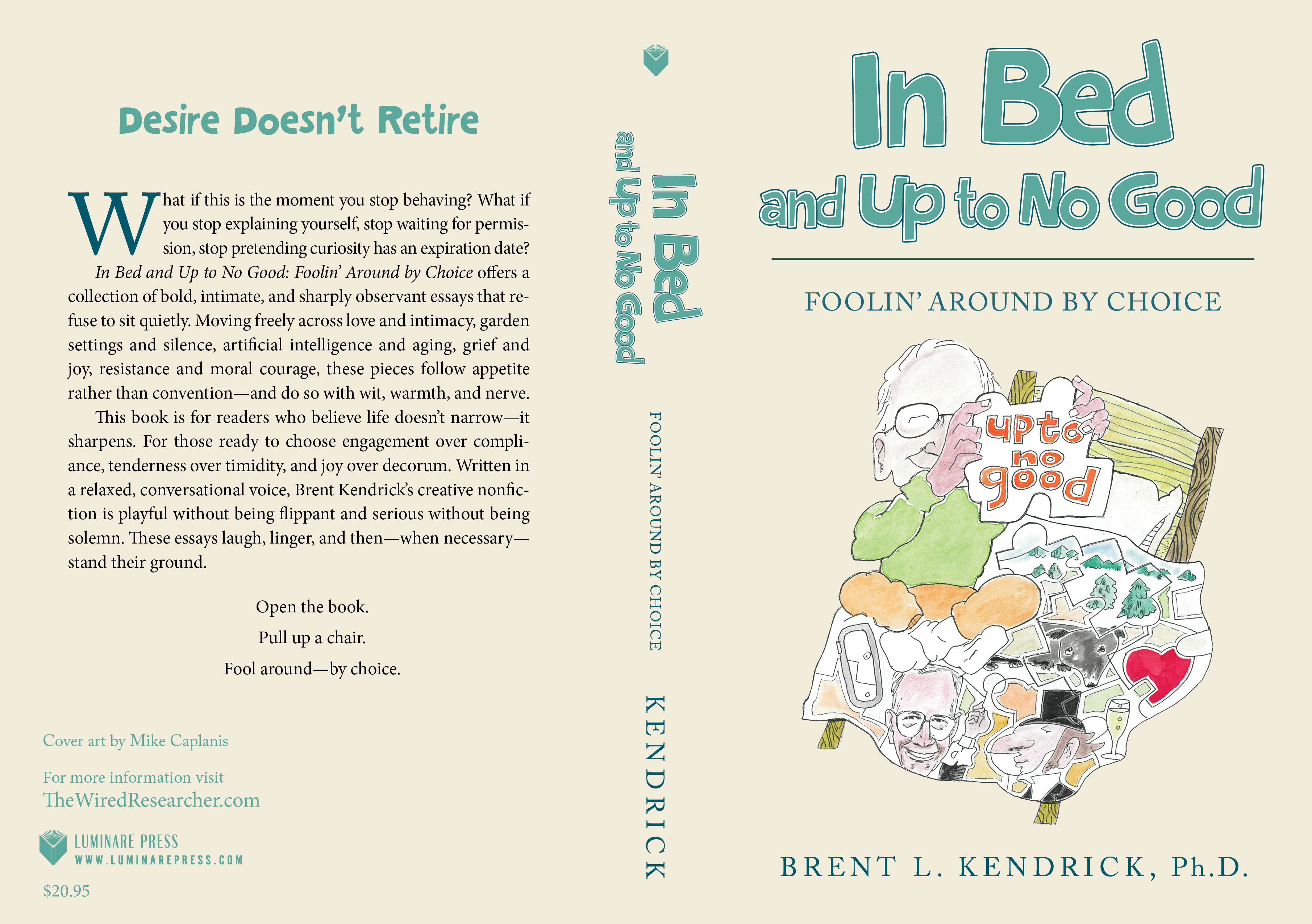
I’m pleased to announce that Up to No Good, the fifth book in TheWired ResearcherSeries and my fourth InBed book, is now available.
But before I tell you where to find it, let me tell you why it’s different.
For the past several years, I’ve been foolin’ around in bed. Stop right there! Don’t you dare call the authorities. I’m talking about writing.
The first volume appeared in 2023. Two more followed. Each gathered together a year’s worth of essays from The Wired Researcher, preserving them much as they originally appeared—one after another, week after week, moving steadily forward through time.
There was something honest about that approach. Readers experienced the essays in much the same order that I lived them.
But while assembling this fourth volume, I discovered something that surprised me.
A collection gathers.
A book shapes.
The distinction may sound small, but it changed everything.
For the first time, I stopped thinking primarily about chronology and started thinking about conversation.
● What happens when essays written months apart find themselves side by side?
● What emerges when humor sits next to heartbreak?
● What new meaning appears when an essay about gardening quietly speaks to one about grief, love, aging, democracy, memory, or biscuits?
The more I explored those questions, the more I realized that this volume wanted to become something different.
Not merely a collection.
A book.
A reading experience.
In the introduction, I explain that these essays are grouped “by the questions they worry, the moments they linger over, the emotional weather they share.”
That simple shift transformed the project.
Essays began speaking to one another.
Patterns emerged.
Themes surfaced that I hadn’t fully recognized when writing the individual pieces.
Then something else happened.
Poor Brentford Lee got involved.
Those of you who have followed my blog know Poor Brentford—the mountain philosopher, accidental theologian, occasional dispenser of homespun wisdom, and longtime observer of life’s oddities and wonders.
In earlier volumes, Poor Brentford mostly wandered in and out of individual essays.
This time, he grabbed hold of the entire book.
As the sections took shape, Poor Brentford somehow appointed himself official greeter, introducing each one with a bit of homespun wisdom uniquely his own.
“Most of what saves us wasn’t planned. It just kept growing anyway.”
“Everybody’s handed something they didn’t order. The rest is choice.”
“We were just boxwoods until someone believed we could be part of something beautiful.”
Frankly, I’m not sure I had much say in the matter.
Poor Brentford can be bodacious that way.
The result is that he now wanders throughout the book, standing at the entrance to every section, tipping his hat, offering a thought, and inviting readers to come a little farther along.
In many ways, Poor Brentford became the connective thread that helped transform a collection of essays into a unified reading experience.
Instead of moving week by week through a calendar year, readers move through twelve thematic landscapes:
What Grows, Teaches explores gardens, reinvention, second chances, patience, and grace.
What We Do with What We’re Given examines mishearings, limitations, temptations, acceptance, and the choices that shape a life.
Chosen Ground asks what it means to belong—to a place, to a memory, and ultimately to ourselves.
Those We Carry reflects on the people who continue to live within us long after they are gone.
Plagiarism À La Carte celebrates borrowing, influence, recipes, wit, and the occasional joyful act of making something unmistakably your own.
What We Lean On explores the quiet structures that steady us through uncertainty, solitude, and change.
On Our Own Terms examines aging, authenticity, self-authorship, and the liberating realization that we no longer need permission to be ourselves.
Giving Forward honors educators, mentors, benefactors, and all those who quietly build bridges for others.
Together, One ventures into fascinating territory where human curiosity meets artificial intelligence and asks what happens when we learn alongside the tools we create.
Literary Wanderings follows books, writers, forgotten voices, and the ideas that continue to shape us.
Choosing Love Again explores something I never expected to experience at this stage of life: the extraordinary privilege of falling in love once more.
And finally, When Democracy Falters gathers essays written from the conviction that citizenship is not a spectator sport and that silence carries consequences of its own.
Looking back, I realize that what changed wasn’t merely the arrangement of the essays.
What changed was the way I saw them.
Teaching literature for decades trained me to look beneath the surface, to ask how individual parts contribute to larger meanings. Somewhere along the way, I began applying that same close reading to my own writing.
The result is this book.
Some readers will recognize essays they first encountered on the blog. I hope they do. But I also hope they’ll discover something new in the conversations those essays now have with one another.
Others will be encountering many of these pieces for the first time.
Either way, my hope is that readers will find themselves lingering.
Laughing.
Remembering.
Questioning.
Growing.
Perhaps even falling a little more deeply in love with life itself.
After all, that’s what these essays have been teaching me all along.
In Bed and Up to No Good: Foolin’ Around by Choice is now available through Amazon and Barnes & Noble.
If you’d like to see what happens when a collection becomes a book—and when Poor Brentford appoints himself tour guide—I’d be honored to have you join me for the journey.
And as always, thank you for reading. Without readers, essays are merely conversations waiting to happen.
“The first porch is where you find your voice. The second porch is where your voice finds others.” —Poor Brentford Lee (b. 1947. Keeper of two porches, one mountain, one dog, and an inexhaustible supply of things worth saying—none of which he has to say alone anymore, thanks to his partner, Gary.)
Dear Faithful Readers,
You’ve been here with me on the porch since—well, some of you since the very beginning, back when I built it as nothing more than a place where you could pull up a chair and talk with me about the joys, challenges, and discoveries of research. We kept right on doing that from 2012 to 2021 when I decided to make the porch a little more fun by bringing you weekly creative nonfiction essays.
I’m still at it. Nearly 750,000 words later. Yes, you read it right. Foolin’ around in bed every night with ideas and words adds up. I’m spurred on by you, my Dear Readers, whose numbers keep increasing annually! Last year, we shared more than 35,000 views right here on the porch.
But I’ve built a brand-new porch, and I want you to be the first to know about it.
Don’t worry, though. I’m not leaving The Wired Researcher porch. It will remain open virtually forever. Same Monday mornings. Same voice–mine, with Poor Brentford’s voice chiming in from time to time. We’ll both be there, waiting for you.
I just heard someone shout out:
“So, why are you building a new porch? What’s that all about?”
Well, for starters, it has better lighting, and it might just bring in more neighbors for all of us to visit and exchange ideas.
I’m counting on you to check it out. I’ve named the second porch The Kendrick Chronicles.
“Where on earth is this new porch of yours?”
Gracious me! You know that I like to take my time–slow and easy like. In a sec, I’ll give you the link so that you can check it out for yourself. And when you do, go ahead and Subscribe! From that point forward, my essays–ever goldern new one that hits the world, every Monday morning like a neighbor who always brings something worth reading and never overstays his welcome–will find their way directly to your Inbox.
You can find this new porch of mine in Substack. Here’s the link:
“What will I find when I get to this new porch of yours?”
Why, gracious me! You’ll find a comfy chair with your name on it and a handful of your favorite essays with my name on ’em:
● Redbuds of Remembrance
● Learning to Love in New Ways
● I Am Afraid
● Poor Brentford Cleans the Wax Out of His Ears
● Two, Together
● Glimpses of My Mother’s Hands
● The Ghost of Palmyra Church Road
● Truths Half-Told. Letters Half-Burned. A Legacy Waiting to Be Fully Heard.
● Carrying the Bags of Colonial America’s Humourist
And get this. If you subscribe, next week you’ll get an essay about a kitchen disaster beyond belief: “Oh, No! No Sourdough!” And the week after that, “What We Know. What We Believe.” It may be the most complete thing I’ve ever written about who I am and what I believe about what comes next.
So go on now. Pull up a chair. Same voice. Wider porch.
You took me by surprise again this morning. As always, when I awakened, I checked my Fitbit to see how my heart did overnight. Then I checked WordPress to see how my readers were doing.
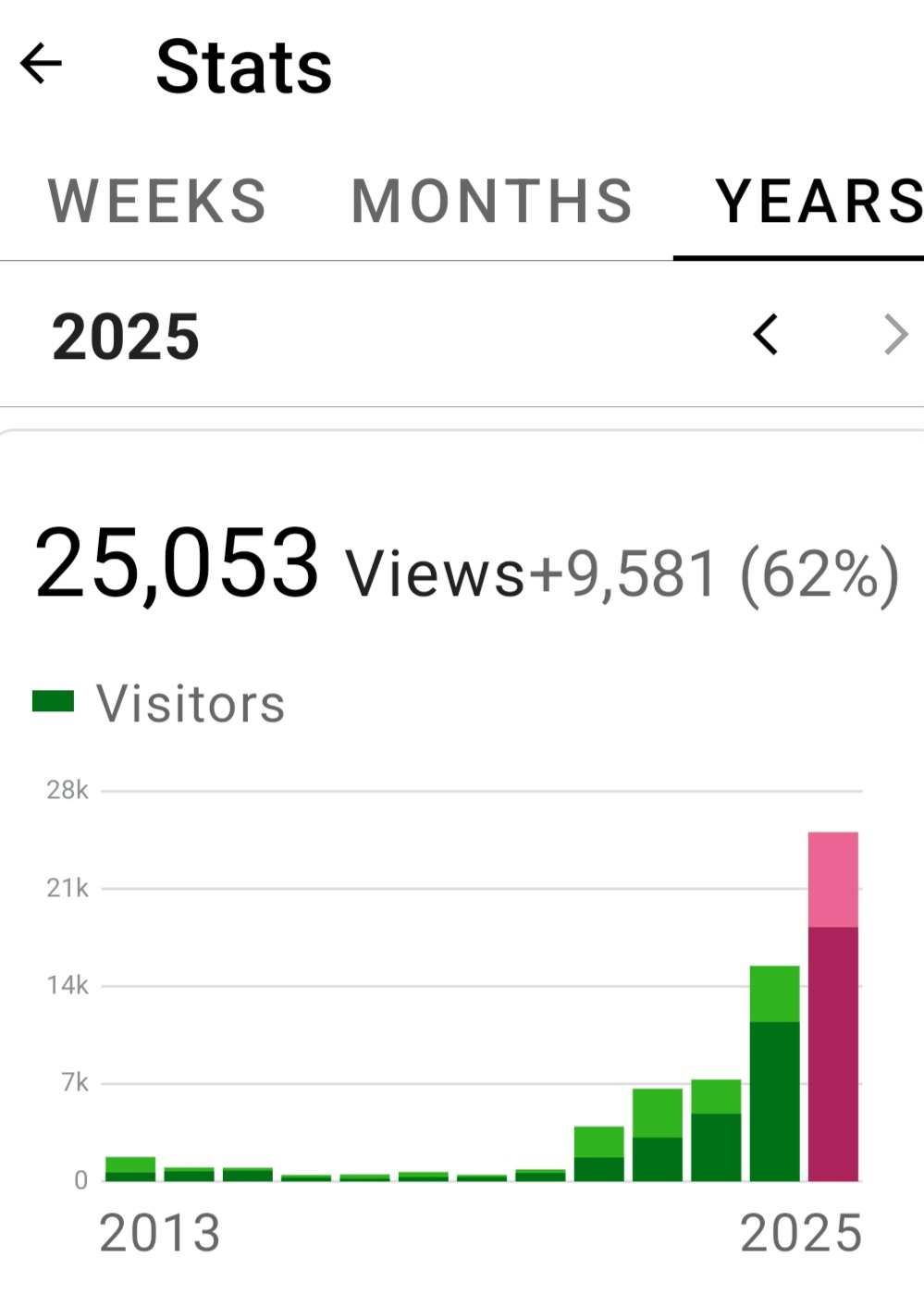
And there you were. Another thousand views. A quiet jolt to the chart. Numbers climbing when I wasn’t looking.
You’ve been dancing higher and higher since October, when I passed 15,000 and figured I’d reached my high-water mark. I even wrote a piece of thanks back then, thinking I’d said all there was to say. But now here we are—December 11th—and this little corner of the internet has gathered 25,053 views.
I’ve done nothing different. I have no flashy headlines. I have no trending hashtags. I just keep following the same rhythm: writing essays born from memory in a home filled with love. I just keep foolin’ around with words and ideas.
So why now, after all these years?
That question hangs gently in the room with me. It’s not demanding an answer. It’s simply inviting a reflection. Maybe something shifted in the writing. Maybe it’s more expansive. Maybe it’s more lived-in. Maybe it’s a voice carrying a steadier warmth now. Maybe it’s grief that’s softened into grace. Maybe it’s love that arrived not with fanfare, but with a quiet hand stretched out in invitation. Maybe it’s all of those things. Maybe. And add to all those maybes one more. Maybe it’s readers sharing with readers.
Gary, of course, doesn’t ask to be written about. But his presence is here, between the lines, in the patience of a paragraph, the steadiness of tone, the way I’ve learned to let silence do some of the talking.
Ruby, on the other hand, insists on being written about, whether she’s nosing me away from my smartphone or curling up in solidarity as I revise for the twenty-fifth time. She is, as always, the keeper of the tempo, the mistress of the move.
So this isn’t an open letter to public stats. It’s a letter to something deeper. It’s a letter to what it means to keep writing when no one’s watching, and then to wake up and find that someone was.
My essays aren’t meant to dazzle. And I know: they don’t. They’re just small acts of holding up the light, one weekly reflection at a time. The fact that they’re being read, now more than ever, tells me something I didn’t expect: quiet honesty still finds its way.
Thank you, Sudden Surge, for reminding me that patience has its own reward, that consistency is a kind of faith, and that somewhere out there, readers are still pausing to linger with a slow essay from the mountain.
I don’t know what this upturn means, or where it leads. But I do know I’ll keep showing up with my smartphone in hand and love at my side.
“Somewhere, something incredible is waiting to be known.”
–Carl Sagan (1934–1996; astronomer and science communicator who inspired millions through his work on Cosmos and popular science writing.)
Tell me to do something, and I probably won’t do it. It smacks too much of being ordered around. No, thank you. Most of the time–though not always–I prefer to do the bossing.
On the other hand, suggest that I do something–maybe even challenge me to do something–and I’ll probably do it. Yes, thank you. I thrive on encouragement.
That’s exactly how today’s post began. One of my followers–my Linden Correspondent (LC)–suggested that the world at large might be revved and ready to know how my wired blog began! I thought LC’s suggestion was splendid, especially since my blog just celebrated its 12th anniversary. What better time than now to share the electrifying backstory.
With a growing readership of 13,782 (and counting!), I like to think my blog has found its niche. My readers value my blog for what it is today: a succession of riveting and captivating creative nonfiction essays that appear magically every Monday morning just in time for that first cup of coffee–that is for early risers who get their brew going early. That’s why I make a point of posting before 7am. While I sip on my coffee and savor what I wrote, I like to think that the entire world is doing the same thing.
Every Monday morning, you’ll find me in my reading chair with Ruby—my 60-pound lapdog—perusing my post while she peruses me. Sometimes, I smile and say aloud for her amusement:
“Wow, Kendrick! That’s a remarkable sentence. If you keep cranking out little gems like that, maybe one day you’ll end up somewhere as someone’s endnote.”
Yep. An endnote. Ironically, I guess that’s where we all end up: Someone’s endnote.
That’s not such a bad thing, you know. An endnote here. An endnote there. It seems to me that achieving a memorable, perhaps quotable phrase here and there is probably far wiser than having the entire canon of my work ricocheting around the world.
Stop and think about it for a minute or three. Look, for example, at what Benjamin Franklin achieved as a writer. Let’s focus on his Poor Richard’s Almanack, published annually from 1732 to 1758—nearly a quarter of a century of wit and wisdom.
Most people today can recall only a handful of Franklin’s most famous sayings, like:
● “Early to bed and early to rise makes a man healthy, wealthy, and wise.” ● “A penny saved is a penny earned.” ● “No gains without pains.”
Please tell me, Dear Reader, that you know those sayings, for if you don’t, you surely won’t know these:
● “Well done is better than well said.” ● “Three may keep a secret, if two of them are dead.” ● “If you would not be forgotten, as soon as you are dead and rotten, either write things worth reading, or do things worth writing.”
Indeed, Franklin managed to do both: he wrote things worth reading and did things worth writing. And, as I like to say:
“Endnoted.”
But let me take you back to where I began: the beginning of this blog.
I am so sorely tempted to say:
“It was a dark and stormy night …”
And that’s exactly what I would say, but if I said that I would have to note that Edward Bulwer-Lytton opened his 1830 novel, Paul Clifford with those words. As much as I hate to say it, because I am a stickler on documentation, I have grown weary of all the endnoting that I keep noting. Let us then move on to something that requires no noting.
Whew! I don’t know about you, but I feel notably relieved already.
LC must be relieved, too, to see that, at last, I’m getting around to sharing with the world the story behind the birth of my blog. But, as they say, every blog has its story, and mine is no exception.
Here’s what’s fascinating. Today, I am known around the world for my weekly memoir blog posts talking about anything from Aging to Zippers and about everything in between.
But when the idea for my blog came to me in 2012, I had a sharp, narrow, scholarly focus. I was working on my application for the VCCS Chancellor’s Commonwealth Professorship Program. At the heart of my application was the scholarly research that I wanted to do with a remarkable collection of Colonial American essays, songs, poems, and advertisements published pseudonymously under the name of “The Humourist” in the South Carolina Gazette during 1753-1754. The unique essays had never been reprinted, so they remained “hidden” and “undiscovered,” so to speak, in that newspaper. Further, no one knew who wrote the essays. Well, I was 99% certain that I knew, but I needed to do additional research and analysis to confirm my suspicions. In that sense, my project was a literary “whodunit” involving three things.
First, I planned to prepare a critical, annotated edition of the essays.
Second, I planned to develop a convincing case for authorial attribution based on a preponderance of internal evidence as well as on stylometrics.
Third, throughout the process of preparing the critical, annotated edition and developing a case for authorial attribution, I planned to give the essays a “close reading.” I was reminded of a quote by Robert Frost:
“We go to college to be given one more chance to learn to read in case we haven’t learned in high school. Once we have learned to read, the rest can be trusted to add itself unto us.”
I always shared that wisdom with my students. Learning to read—really read—gets to the heart of what we want our students to do, not just in English classes but across the board. When students slow down and give a text a close reading, critical thinking and intellectual discovery follow.
As Frost knew so well, that is what “learning to read” is all about. Further, when students learn how to really read, they can construct their own intellectual inquiries: “the rest can be trusted to add itself unto us.”
I always shared that belief—and approach—with my students without fail. I showed them how to learn to read, class after class, reading assignment after reading assignment, as I gave whatever literary selection we were reading my own close reading and as I made my own discoveries about a text. They were intrigued not only by my process but also by the discoveries that I made simply because of my dogged determination to give a text—any text—a close reading.
In my application, that’s precisely what I proposed to do with “The Humourist” essays. I wanted the opportunity to give the essays such a close reading that I would be able not only to establish a scholarly, annotated edition but also to identify the author.
I was really happy with that part of my application, but I knew that I needed something more. I needed a way to share my scholarly work on a regular basis with my colleagues and my students so that they could benefit, too.
I needed an idea. As I sat there on that January 8th evening, well into the third or fourth or maybe even fifth revision of my application, I started thinking about Daniel Boorstin (1975-1987), twelfth Librarian of Congress. A champion of accessibility, he worked to open the library to the public in symbolic and practical ways. He placed picnic tables and benches on Neptune Plaza, transforming it into a space for community gatherings. He initiated mid-day concerts and famously removed the chains from the majestic bronze doors at the first-floor west entrance leading to the Great Hall of the Jefferson Building. When told it would create a draft, he replied, “Great—that’s just what we need.” In a bold move, he even stopped the practice of searching visitors.
At that time, I worked at the Library of Congress as an editor of the National Union Catalog, Pre-1956 Imprints, and I well remember the occasion when the bronze doors were opened. If I am not mistaken, it was on this occasion that I heard Dr. Boorstin say:
“You never know when an idea is about to be born.“
His comment lingered, and since hearing it, I made a point to keep track of when my own ideas were born.
So it came to be. While thinking about Boorstin, ideas, and my project, I exclaimed to myself:
“Blog it!”
I knew that a blog would allow me to share with the entire world my challenges, discoveries, and joys of research.
I knew that a blog would allow me to share with others this remarkable collection of Colonial American essays, songs, poems, and advertisements. The Encyclopedia of the Essay (ed. Tracy Chevalier, 1997) placed “The Humourist” essays in the tradition of Samuel Johnson’s Rambler essays and observed that they are the only “full-fledged literary” works to have appeared in the South Carolina Gazette. Years earlier, J. A. Leo Lemay (du Pont Winterthur Professor of English at the University of Delaware) had noted in A Bibliographical Guide to the Study of Southern Literature (1969) that the essays should be edited, published, and the author identified.
This was hot! I knew that I could make “stuffy” literary research come alive in a blog. Colleagues and students and scholars and the world at large would love it. I knew they would because who wouldn’t love essays on par with Benjamin Franklin’s “Silence Dogood Letters”? Get this, too. Franklin had direct ties to the South Carolina Gazette and possibly to the author of “The Humourist” essays.
I knew, too, that aside from being in the essay tradition itself, a blog would allow me to share my project with faculty and students throughout the Virginia Community College System (VCCS), from the beginning of my work and every step of the way through completion. I realized that a blog would allow me to capture my personal experiences on a regular and ongoing basis: my work, my methods, my discoveries, my challenges and frustrations, and my joys.
I knew that a blog would allow me to do in the virtual world—using a heretofore unstudied literary work—exactly what I did in my classroom with literary works that appear in our textbooks: turn my blog followers on to the beauty of giving a text a close reading and turn them my on to “learning how to read,” showing them that once they learned how to read all else would be given to them.
That same evening, I came up with a working title: TheWiredResearcher. I Googled it and was delighted to discoverthatnosuchblog existed.
As I often do, I emailed a former student—a lover of language and words and ideas—to get her take on my blog idea.
She responded immediately:
The word “wired” will catch the attention of …The Young. They’ll think you are “hip.”
You’ll need a logo. You’ll need T-shirts with the logo on them. You need pens that say, “The Wired Researcher.” “Sold in libraries everywhere.” “Guaranteed to make study more exciting.” Oh, boy, I see tie-ins!
Clearly my former student was as wired as I was—perhaps that’s why I valued her opinions as highly as I did—but her email response gave affirmation to the title of the blog that had been born.
Here’s where the birth of the blog starts to get really sweet. I was awarded the Chancellor’s Commonwealth Professorship (2012-2014).
My first announcement appeared on October 19, 2012. It was short!
“Welcome to The Wired Researcher! Blog posts will begin on November 26, 2012.”
True to my promise, on November 26, I published “Opportunity Knocks Twice in the Virginia Community College System.” That post included the first of the historical essays that served as the nucleus for my project: “The Humourist” (November 26, 1753). Yep. Choosing to launch my blog on November 26, the same day that the Humourist launched his essays, was deliberate, and if I must say so myself, I think it was a stroke of genius!
And so, The Wired Researcher was born—not just as a blog, but as a way for me to share my love of research with a world eager to learn about my discoveries.
Now you have the inside scoop. If you want to know more, simply go back to the beginning and read all the posts from the start. But whatever you do, please make certain that you read “Colonial Charleston’s Biggest Literary Mystery Is Solved!” Yep. I solved the literary whodunit that captured me in the first place. Then you have to read “Three Special Shout-Outs!” because behind every success story are lots of people who deserve praise and thanks!
Wait! Wait! Don’t go yet. I have one or two more things to share.
When my blog started, I had around 1,750 views a year, representing 33 countries. So far this year, it has soared to an impressive 13,782 views from 152 countries! I must be writing something right!
To each and every one of you, My Dear Readers–then, now, and all along the way–a special shout-out!
To my Linden Correspondent (LC), who tossed out the idea that I share the story behind the blog, I extend asupercalifragilisticexpialidociousthank-you! (As Mary Poppins would say, nothing else captures the exuberance quite right!)
I look forward to a future of Mondays, inspired by the joy of discovery and by the connections that I’m making with all of you.