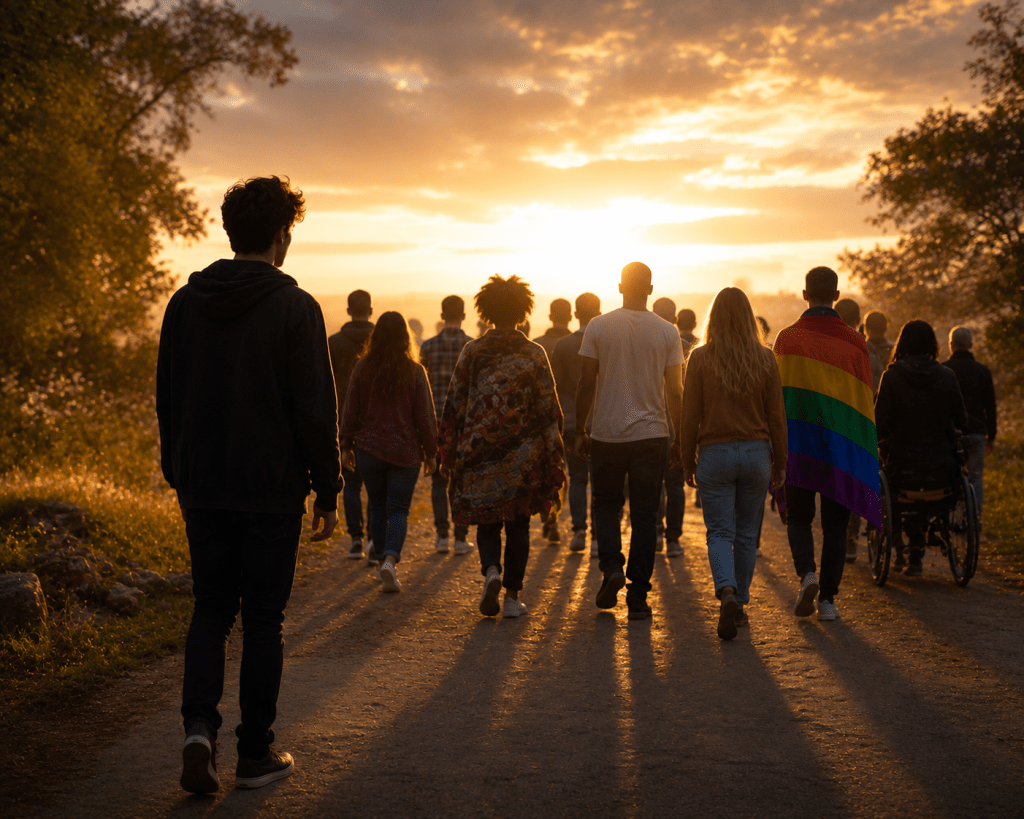
Are You a Friend of Dorothy’s?


“The truth is, no one of us can be free until everybody is free.”
—Maya Angelou (1928–2014). American poet, author, and civil rights activist whose writings explored identity, dignity, freedom, and the shared humanity of all people.


“Write. Just write.”

That’s what I always tell aspiring writers.

“Write as if this will be your last line and your life depends on it. Or maybe your life after death depends on your last line.”

They stare. They roll their eyes. They purse their lips. They start. They write.

And after they’ve written several pages, I interrupt, knowing the gasps that will follow:

“Ignore the first page or two. Writers often discover their real starting point at the top of page two or three.”

“Ignore it? Throw it away?”

“Yeah, usually. Think of those pages as a warm-up exercise. Think of those pages as a way of finding the starting point.”

Ironically, it’s almost always true, even for seasoned writers. Maybe especially for seasoned writers.

I wish it were true for me. This time. This post.

But it’s not.

There’s no way—there’s just no way—that I’m going to start this post with the line I’d have to start it with if I applied my own advice:

“Are you a friend of Dorothy’s?”

Here’s why I wouldn’t.

I’m betting you’d ask:

“Who’s Dorothy?”

That’s what I asked myself yesterday when I stumbled accidentally upon the question. After I found the answer, I kept wishing I had known about it in the 1950s when I was growing up, wondering how on earth I’d ever recognize someone else like me. Queer.

Let’s face it. The eye contact thing—the looking back to see if he was looking back to see—was a hard if not impossible way to identify a kindred soul. How could I be sure? And I wasn’t about to come out and ask:

“Are you, you know—like me.”

But if I had known about Dorothy, I would have let it slip casually into the conversation:

“And are you a friend of Dorothy’s?”

“Yes” would have moved the conversation far, far away from small talk.

But I didn’t know then that the question was a coded phrase used by the LGBTQ+ community—particularly gay men—throughout the mid-20th century to discreetly identify one another.

Safe. Veiled. No risk. No exposure. No hostility. No legal trouble.

I’m surprised that it took me seventy-eight years to learn about the question and its answer. But I’m not surprised that I did so during Pride Month.

I had been paying close attention to the June headlines.

Some were celebratory. Governor Hochul proclaimed June 2026 LGBTQ+ Pride Month in New York. Orange County recognized Pride Month for the first time. Richmond listed eleven events to check out this June.

Others were not. Indiana’s governor declared Pride Month “Nuclear Family Month.” Republican governors across the country rebranded it with conservative alternatives. Tennessee followed Indiana’s lead. In Pinellas, Pride met “Faith and Family” pushback.

Then came a headline closer to home. It hit hard. Someone I knew shamed their former employer on FB for celebrating Pride Month and used a classic but outlandish propaganda technique: mix a few kernels of truth with a few outdated statistics, several disputed claims, some outright falsehoods, and then present everything under the banner:

“No Pride in Gay Life: THE FACTS.”

It only took me a minute or so to read the FB post. But it took me far longer to process my emotions. Anger. Sadness. Disappointment. Exhaustion. Surprise that it came from—someone I knew.

It took me even longer as I questioned what exactly we’re celebrating in June. Being gay, lesbian, bisexual, transgender, or queer? Hard-won advances that allow millions of people to live more openly than they could a generation ago? Battles that remain to be fought?

They’re not the same things. One is identity: human beings with shared blood pulsing in our veins and with shared hopes living in our hearts. The second is history: yesterday. The third is hope: today and tomorrow.

Suddenly, I realized that when we celebrate Pride Month, June ends and LGBTQ+ people remain marginalized.

Suddenly, I realized that when we celebrate Black History Month, February ends and Black Americans remain marginalized.

Suddenly, I realized that when we celebrate Women’s History Month, March ends and women remain marginalized.

Suddenly, I realized that when we celebrate Native American History Month, November ends and Native Americans remain marginalized.

Suddenly, I realized that we’ve gotten very good at celebrating people we’re still marginalizing.

We can do better.

We can be better.

We must.

I hope I live to see the day when Pride Month never ends.

I hope I live to see the day when Black History month never ends.

I hope I live to see the day when Women’s History Month never ends.

I hope I live to see the day when Native American Month never ends.

I hope I live to see the day when special months never end because we no longer need a special time to remind us that we are special humans every moment of every day of every month—all the time.

A day when dignity is not reserved for June or February or March or November.

A day when respect does not depend upon race, religion, gender, orientation, age, birthplace, wealth, education, politics, or any of the countless labels we use to divide ourselves into tribes.

A day when we stop asking who belongs and start assuming that everyone does.

Come fast the day when we see the person before we see the category.

Come fast the day when our differences invite our curiosity rather than our suspicion.

Come fast the day when no child grows up wondering whether there is anyone else in the world like them.

Come fast the day when we won’t need to ask, “Are you a friend of Dorothy’s?”

You, When Others Wouldn’t

“If you light a lamp for someone, it will also brighten your own path.”

— Buddha (Siddhārtha Gautama, c. 563–483 BCE). One of history’s most influential spiritual teachers.

Lost once again. The map was blurred, the faces were turned away, and even my voice felt foreign in my own mouth. I asked for help—and the world, polite but indifferent, kept walking past me.

Then, from the corner of the dream, they came: a quiet order of nuns, habits brushing against the air like whispered prayers. They didn’t question, didn’t doubt, didn’t ask why I’d lost my way. They simply pointed, walked beside me, and led me back—not home, but to shelter.

The next day, in a hall filled with strangers, I stood and wept. A litany rose unbidden from somewhere deep inside my soul:

“You, when others wouldn’t.
You who stopped.
You who listened.
You who saw.
You who guided.”

Even in dreams, grace has its own coordinates. It finds the weary traveler and teaches him again how to say thank you.

If we can rise to that level of grace in our dreams, surely, we can do the same in our waking worlds, not only as we approach tomorrow’s Giving Tuesday but also for the days and dreams following.

I’m always moved by Giving Tuesday, but here’s what touches me most about all giving on any day. It’s rarely the grand gesture that changes a life. It’s the small one. The held door. The unexpected kindness. The “you, when others wouldn’t.”

History is full of moments when the world pivoted because someone chose to act quietly.

A schoolteacher once told a shy seamstress she had worth. Rosa Parks carried that worth onto a bus—and stayed seated. One small affirmation. One historic refusal to rise.

A girl in a noisy cafeteria slid her tray beside the classmate no one chose. Temple Grandin steadied. And the world gained a scientist who would reshape our understanding of animal behavior with a mind sharpened by that single act of belonging.

A janitor, keys jangling at his side, unlocked a door he technically wasn’t supposed to open. Katherine Johnson stepped through that doorway and, years later, calculated trajectories that sent astronauts safely around the earth and back again. A quiet gesture. A giant leap.

A grieving orphan found milk bottles on her doorstep each morning—paid for by a neighbor who refused to let her go without. Eleanor Roosevelt drank that kindness into her bones and later poured it back into a nation hungry for courage and compassion.

A librarian in rural Arkansas bent one small rule and whispered, “Take as many as you can carry.” Maya Angelou carried the world home in her arms. One book. One voice saved.

A neighbor left warm pies on the porch of a lonely, sick boy. Fred Rogers tasted gentleness—and spent his life serving that same gentleness back to millions.

And once, in a coal camp tucked into the hills of West Virginia, there was a boy with more dreams than dollars. Family scraped together what they could. Hometown folks established a scholarship for books. And a benefactor he never met—a woman with a soft spot for sons of coal miners—left a scholarship in her will. A small legacy. A single key. It opened the doors of Alderson–Broaddus, and he walked through. One quiet kindness at a time, my whole life unfolded.

Giving Tuesday began the same way—a small act against a noisy world.

In 2012, while Black Friday and Cyber Monday shouted for our wallets, one community center in New York whispered a different idea: What if we set aside a day to give instead of grab? No marching band. No corporate roar. Just a fragile invitation to generosity.

From that whisper came a wave.

By 2013, national organizations amplified the call, and tiny local charities set $1,000 goals for school supplies—and met them.

By 2017, corporations began matching donations in the millions, while families sent $10 to local food pantries so children could eat over the weekend.

In 2020, during the hardest months of the pandemic, Giving Tuesday saw its greatest surge—global giving and neighborhood kindness flowing side by side, from billion-dollar pledges to collected change for an elderly couple’s grocery delivery.

By 2023, U.S. donors gave over $3.1 billion, even as small wildlife refuges and shelters used single matching gifts to exceed their modest goals.

And 2024 reached new heights: an estimated $3.6 billion donated nationwide. But alongside those vast totals was a tiny nonprofit raising just over $5,000 from 37 supporters—enough to keep its doors open one more year.

Big gestures.
Small gestures.
All pointing the way.

The nuns in my dream offered direction, compassion, a hand on my elbow saying, “This way.” They changed everything by simply choosing to care. The nuns in my dream led me to shelter.

This Giving Tuesday, maybe we can do the same—for someone still searching for the way back.

When the Well Runs Dry: Writers’ Fears about Running Out of Ideas

“A rock pile ceases to be a rock pile the moment a single man contemplates it, bearing within him the image of a cathedral.”

Antoine de Saint-Exupéry (1900–1944; French writer, aviator, and philosopher, best known for The Little Prince. His works explore themes of human connection, imagination, and the search for meaning.)

Knife raised in the air, just a few inches or so above the kitchen counter, I stood there nearly motionless. I’d like to say that it was one of my better knives, maybe my Shun or my Wüsthof. But it wasn’t. I’d like to say that it was about to land on one of my better cutting boards, maybe my Boos or my Ironwood. But it wasn’t. And I’d like to say that I was about to execute some fancy-schmancy cut, maybe Chiffonade or Julienne. But I wasn’t.

I was just standing there with ordinary carrots, celery, and onions arranged on an ordinary cutting board as I minced them with my ordinary paring knife for an ordinary pasta sauce.

But as I stood there, something extraordinary happened in that ordinary moment.

Just as my knife was coming down, Billy Collins’ “I Chop Some Parsley While Listening to Art Blakey’s Version of ‘Three Blind Mice'” seemed to shimmer across the blade. Maybe that was to be expected. I love Billy Collins’ poetry, and, after all, there I stood chopping, and in Collins’ poem, there he stands chopping parsley and dicing onions.

But get this. As he wields his knife, he’s not at all concerned about how or why, in the nursery rhyme—the supposed thrust of his bluesy poetic mirepoix—the mice managed to be in the direct path of the farmer’s wife’s blade. Of course, he’s not. We all know how that story ends. But at that moment, standing in my own kitchen, I had no idea how mine would.

But Collins does something I’ve never seen anyone else do. Instead of focusing on how the mice lost their tails, which we know already, he sets up his own minor tragedy filled with blues and tears by raising questions about their blindness:

Was it congenital?

Was it a common accident?

Did each come to blindness separately,

How did they manage to find one another?

After posing those weighty questions–ones that I dare say most of us have never even vaguely contemplated–Collins gets emotional as he thinks about the mice without eyes and without tails running through moist grass or slipping around a baseboard corner.

Actually, he’s brought to tears, but don’t worry. He has two good covers:

By now I am on to dicing an onion
which might account for wet stinging,
in my own eyes, though Freddie Hubbard’s
mournful trumpet on “Blue Moon,”
which happens to be the next cut,
cannot be said to be making matters any better.

There you have it. Just as the end of Collins’ poem trailed across the blade, my knife landed once more on the veggies, and I remembered what I had been thinking before Billy Collins had the nerve to drag the farmer’s wife’s mice and Art Blakey’s music into my kitchen uninvited.

I was recalling Mary E. Wilkins Freeman, best known for her A Humble Romance and Other Stories as well as A New England Nun and Other Stories. At the start of her acclaimed literary career that spanned nearly a half century, she commented:

I wonder if there is such a thing as working a vein so long that the gold ceases to be gold. There is no use in worrying, for another vein might open.

Despite her concerns, her literary canon powerfully demonstrates that more than one gold vein opened for her. She went on to write 3 plays, 14 novels, 3 volumes of poetry, 22 volumes of short stories, over 50 uncollected short stories and prose essays, and 1 motion picture play.

Freeman’s literary output never ceases to amaze me. As soon as her fears and successes bubbled up in my mind, it seemed that every time I lifted my knife to continue chopping, I thought of other writers and their fears about running out of ideas.

As a writer myself, and especially as a former Creative Writing professor, I’ve always paid attention to the ways writers wrestle with their fears. I always managed to sprinkle writers’ fears and their successes throughout my classes, and these days, I try sprinkling the same reminders throughout my own days of doubt.

What about Stephen King, one of the most prolific and celebrated writers of our time, who has openly feared creative depletion? He once admitted:

“Sometimes I wonder if I’ve already written my best book. And if I have, I’m all done.”

But King’s fears didn’t stop him. He continued to write, producing novels across multiple decades, from Misery to The Green Mile, 11/22/63, and Billy Summers, proving that the well of creativity runs deeper than we sometimes believe.

What about Margaret Atwood, best known for The Handmaid’s Tale, who has openly acknowledged her anxiety about running out of ideas? She once said:

“I live in fear of running out of ideas. I tell my subconscious to keep the pipeline full.”

But Atwood’s fears didn’t stop her. She has continued to produce groundbreaking fiction, essays, and poetry well into her later years, including The Testaments, which won the Booker Prize decades after her first major successes.

What about Isaac Asimov, the visionary mind behind Foundation and I, Robot, who, despite his prolific output, still feared creative emptiness? He once asked:

“What if suddenly I can’t think of anything? What if the words stop coming?”

But Asimov’s fears didn’t stop him. He went on to publish over 500 books across multiple genres—science fiction, history, and even chemistry—proving that creativity is not finite but ever-expanding.

What about Louisa May Alcott, best known for Little Women, who felt the pressure of creative exhaustion, particularly because she wrote at a relentless pace to support her family? She once confessed in her journal:

“I can only wander and wait, wishing I could rush into a new book with the old eagerness.”

But Alcott’s fears didn’t stop her. Despite her anxieties, she went on to write Little Men and Jo’s Boys, along with numerous other novels, short stories, and essays that secured her place in literary history.

What about Neil Gaiman, the imaginative force behind American Gods and Coraline, who has openly admitted that the idea of creative depletion haunts him? He once said:

“People ask me where I get my ideas from, and I feel like they should be asking, ‘How do you keep from running out of ideas?’ Because that’s what terrifies me.”

But Gaiman’s fears didn’t stop him. He has continued crafting captivating stories across novels, graphic novels, and television, proving that creativity is a muscle that strengthens with use, not one that simply wears out.

What about Maya Angelou, the legendary poet and memoirist, who feared that one day her words might simply stop? She once admitted:

“I have written eleven books, but each time I think, ‘Uh oh, they’re going to find out now. I’ve run a game on everybody, and they’re going to find me out.’”

But Angelou’s fears didn’t stop her. She continued to write, speak, and inspire, producing Even the Stars Look Lonesome, Letter to My Daughter, and numerous volumes of poetry that touched lives around the world.

And what about Christopher Isherwood, best known for The Berlin Stories (which inspired Cabaret), who worried about creative stagnation, especially as he aged. He once wrote:

“I kept asking myself: What am I really doing? Do I have anything left to say?”

But Isherwood’s fears didn’t stop him. He went on to write A Single Man, one of the most important gay novels of the 20th century, as well as an acclaimed series of autobiographical works well into his later years.

My reveries into literary fears and successes could have lasted forever. But just as I finished with Isherwood, I looked down at my ordinary carrots, celery, and onions arranged on an ordinary cutting board, and I realized that I had finished mincing them with my ordinary paring knife.

In that moment, I remembered that my reverie had not started with Mary E. Wilkins Freeman and Billy Collins at all. It had commenced with me standing there, wondering: What would I do if I ran out of ideas? What would I do if I worked my literary vein so much that whatever little gold it might have ceased to be gold?

But I can’t worry about that right now. I have a few book titles to my own credit, with two more to be added this year. For now, I’ll continue to contemplate the ordinary truths that surround me in my ordinary world.

Who knows. Maybe one day, history will add my name to the list of writers who feared running out of ideas—but never actually did.