Are You a Friend of Dorothy’s?


“The truth is, no one of us can be free until everybody is free.”
—Maya Angelou (1928–2014). American poet, author, and civil rights activist whose writings explored identity, dignity, freedom, and the shared humanity of all people.


“Write. Just write.”

That’s what I always tell aspiring writers.

“Write as if this will be your last line and your life depends on it. Or maybe your life after death depends on your last line.”

They stare. They roll their eyes. They purse their lips. They start. They write.

And after they’ve written several pages, I interrupt, knowing the gasps that will follow:

“Ignore the first page or two. Writers often discover their real starting point at the top of page two or three.”

“Ignore it? Throw it away?”

“Yeah, usually. Think of those pages as a warm-up exercise. Think of those pages as a way of finding the starting point.”

Ironically, it’s almost always true, even for seasoned writers. Maybe especially for seasoned writers.

I wish it were true for me. This time. This post.

But it’s not.

There’s no way—there’s just no way—that I’m going to start this post with the line I’d have to start it with if I applied my own advice:

“Are you a friend of Dorothy’s?”

Here’s why I wouldn’t.

I’m betting you’d ask:

“Who’s Dorothy?”

That’s what I asked myself yesterday when I stumbled accidentally upon the question. After I found the answer, I kept wishing I had known about it in the 1950s when I was growing up, wondering how on earth I’d ever recognize someone else like me. Queer.

Let’s face it. The eye contact thing—the looking back to see if he was looking back to see—was a hard if not impossible way to identify a kindred soul. How could I be sure? And I wasn’t about to come out and ask:

“Are you, you know—like me.”

But if I had known about Dorothy, I would have let it slip casually into the conversation:

“And are you a friend of Dorothy’s?”

“Yes” would have moved the conversation far, far away from small talk.

But I didn’t know then that the question was a coded phrase used by the LGBTQ+ community—particularly gay men—throughout the mid-20th century to discreetly identify one another.

Safe. Veiled. No risk. No exposure. No hostility. No legal trouble.
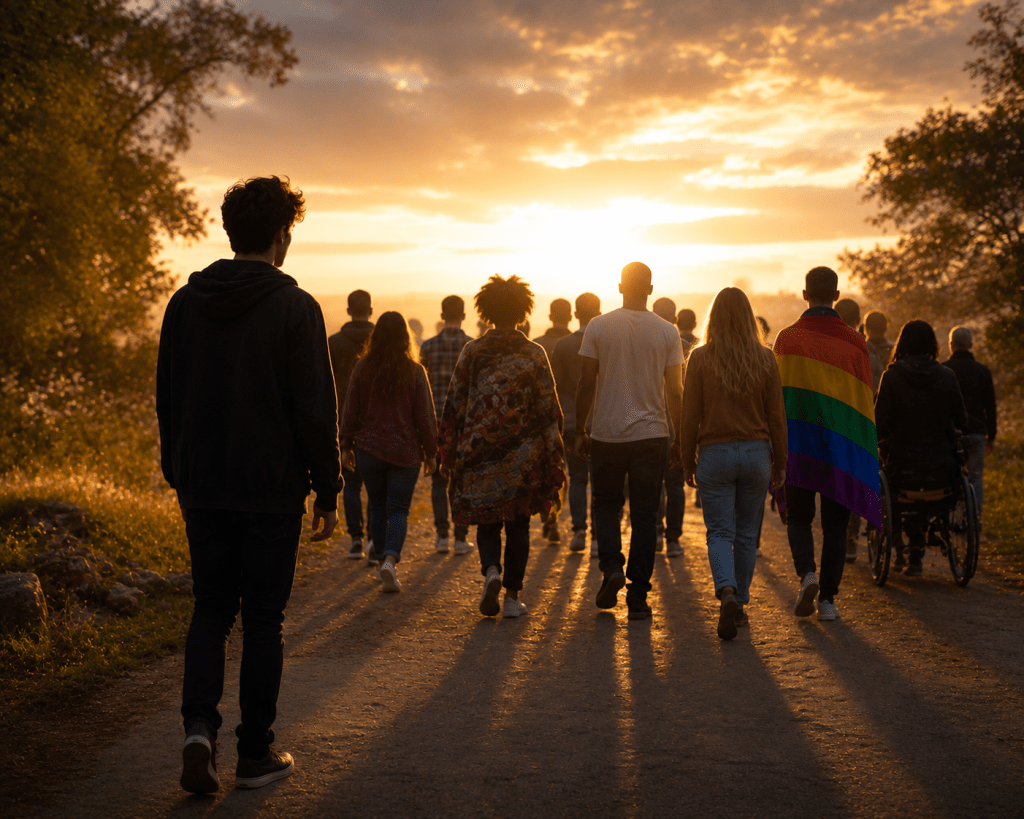
I’m surprised that it took me seventy-eight years to learn about the question and its answer. But I’m not surprised that I did so during Pride Month.

I had been paying close attention to the June headlines.

Some were celebratory. Governor Hochul proclaimed June 2026 LGBTQ+ Pride Month in New York. Orange County recognized Pride Month for the first time. Richmond listed eleven events to check out this June.

Others were not. Indiana’s governor declared Pride Month “Nuclear Family Month.” Republican governors across the country rebranded it with conservative alternatives. Tennessee followed Indiana’s lead. In Pinellas, Pride met “Faith and Family” pushback.

Then came a headline closer to home. It hit hard. Someone I knew shamed their former employer on FB for celebrating Pride Month and used a classic but outlandish propaganda technique: mix a few kernels of truth with a few outdated statistics, several disputed claims, some outright falsehoods, and then present everything under the banner:

“No Pride in Gay Life: THE FACTS.”

It only took me a minute or so to read the FB post. But it took me far longer to process my emotions. Anger. Sadness. Disappointment. Exhaustion. Surprise that it came from—someone I knew.

It took me even longer as I questioned what exactly we’re celebrating in June. Being gay, lesbian, bisexual, transgender, or queer? Hard-won advances that allow millions of people to live more openly than they could a generation ago? Battles that remain to be fought?

They’re not the same things. One is identity: human beings with shared blood pulsing in our veins and with shared hopes living in our hearts. The second is history: yesterday. The third is hope: today and tomorrow.

Suddenly, I realized that when we celebrate Pride Month, June ends and LGBTQ+ people remain marginalized.

Suddenly, I realized that when we celebrate Black History Month, February ends and Black Americans remain marginalized.

Suddenly, I realized that when we celebrate Women’s History Month, March ends and women remain marginalized.

Suddenly, I realized that when we celebrate Native American History Month, November ends and Native Americans remain marginalized.

Suddenly, I realized that we’ve gotten very good at celebrating people we’re still marginalizing.

We can do better.

We can be better.

We must.

I hope I live to see the day when Pride Month never ends.

I hope I live to see the day when Black History month never ends.

I hope I live to see the day when Women’s History Month never ends.

I hope I live to see the day when Native American Month never ends.

I hope I live to see the day when special months never end because we no longer need a special time to remind us that we are special humans every moment of every day of every month—all the time.

A day when dignity is not reserved for June or February or March or November.

A day when respect does not depend upon race, religion, gender, orientation, age, birthplace, wealth, education, politics, or any of the countless labels we use to divide ourselves into tribes.

A day when we stop asking who belongs and start assuming that everyone does.

Come fast the day when we see the person before we see the category.

Come fast the day when our differences invite our curiosity rather than our suspicion.

Come fast the day when no child grows up wondering whether there is anyone else in the world like them.

Come fast the day when we won’t need to ask, “Are you a friend of Dorothy’s?”

Redbuds of Remembrance

To be remembered, to have one’s name spoken—these are the most powerful things anyone can hope for.

–Paul Monette (1945–1995; award-winning gay author, poet, and activist. His 1988 Borrowed Time: An AIDS Memoir was one of the first memoirs to document the AIDS crisis from a personal, unflinching perspective.)

Cercis canadensisor Redbud, as we call it here in the Shenandoah Valley of Virginia—is blooming now, as April unfurls, splashing the forest with an unmistakable purple that defies subtlety. Not pink. Not lavender. But a wild, jubilant purple that dares the bare trees around it to remember what life feels like. Its blossoms don’t wait for leaves, and they don’t hide behind foliage. They burst straight from the bark, bold and tender all at once—like a memory that insists on being remembered.

They seem more magnificent this year, tugging at my heart more fiercely than ever before, making David’s words ring out above his gentle whisper:

“When the Redbuds bloom, remember me.”

David and I knew one another decades ago at the Library of Congress where we both worked in the United States Copyright Office. When we first met, David was a Cataloger, and I was a Technical Support Specialist and then Copyright Training Coordinator. We were hello-in-passing colleagues.

Later, a close and unexpected bond developed between us. I became the Library of Congress Intern Director, coordinating a 9-month program that brought together a dozen or so highly talented librarians from within the Library and across the nation, providing them with an in-depth understanding of the library’s collections, its services, and its management infrastructure.

Sitting in my office about two weeks before the program’s start, I looked up and saw David standing there. After I congratulated him on being selected for that year’s Intern class, he gave me a troubled look:

“Thanks. Can we talk?”

“Of course. Come on in.”

He closed the door as he entered. He sat down, sighed, and shot me another look that to this day remains in my memory as one of existential angst:

“I have AIDS.”

My reply hung in the air, like eternity:

“I’m so sorry.”

What else could I have said? It was 1985. Even though AIDS (Acquired ImmunoDeficiency Syndrome) was generally known to most Americans, as it spread within the gay community, it started making its way to sensational articles in national newspapers, leaving all of us–especially in the gay community–terror stricken.

● 37% in Poll Say AIDS Altered Their Attitude to Homosexuals

● Saliva Discounted as an AIDS Threat

● More and More AIDS Cases Found Among Drug Users

● Panel Disagrees Over AIDS Risk for Public

● Grim New Ravage of AIDS: Brain Damage

● Rock Hudson, Screen Idol, Dies at 59

I had read those articles and more, but they had not prepared me for this moment.

Sitting across the desk from me was not Rock Hudson. Not a brain-ravaged AIDS person. Not a drug user. Not any of the things that I had read about.

Sitting across the desk from me was my friend David. David, poised at a high point in his career. David, diagnosed with AIDS. David. Death.

Before my three words had reached David’s ears, I walked around to where he sat. As I stretched out my arms, David stood to receive my embrace. Each knowing that friends stand for friends. Each knowing that friends stand with friends.

“I don’t know what to do?”

“About what?”

“About starting the Intern program.”

I knew the answer that I was about to give David was true. It had nothing to do with being gay. Nothing to do with AIDS. It had everything to do with being. Everything to do with living.

“I don’t have a magic ball, David, but it seems to me that as you face unknown health issues, a structured program like this might just be the anchor that you need.”

“But what about my fellow interns?”

David was well aware that for the next nine months, we would all share a small classroom–with top library officials appearing and making presentations throughout the day. It was close quarters. It was rigorous. It was intense.

He was also well aware of the public reaction to AIDS. Fear was thick in the air—fear of infection, fear of proximity, even fear within the gay community itself. At one point, some wondered whether poppers had caused the epidemic.

“I don’t know how your fellow Interns will react, but I’d urge you to stick with the program. I’ll be with you every day, and I’ll have your back.”

David left my office, leaving each of us with lots to think about.

For David, thinking about whether to continue with the program or let a disease with an unknown trajectory–other than eventual death–take charge of his life and spirit.

For me, thinking about navigating the months ahead while remembering that I was directing the most prestigious Library Intern program in the nation.

Two weeks passed. No word from David. Hopeful, I went ahead and made his name tent, stacking it with the others. As I stood at the door, greeting each of the Interns, I saw David walking my way:

“Let’s do it!”

And do it, we did, for a succession of days strung together like a strand of survival pearls. Then, one day, just before we were breaking for lunch, David asked whether he could share something with his classmates.

I knew what was coming. I knew, too, that anyone with something to share knows better than anyone else not only when to share but also how to share.

David shared his news with them as bluntly as he had shared it with me, but his existential angst had softened, perhaps in the hope that a burden shared would become a burden lessened.

I watched each face in the room. I listened to every word. To every breath between the words. One by one, each Intern summoned courage to offer consolation, support, hope, and help. When the last among them had offered all they had to give, one spoke again, laying one thing more upon love’s altar:

“Let’s have lunch brought in so we can all stay here together. Today. With David.”

We did.

The spirit that shone around the room that day continued to shine upon us day after day, month after month, all the way through a triumphant Intern graduation with David as one of our speakers.

David and his fellow Interns proved themselves to be a class beyond measure.

Where many people spoke of separation, the Interns spoke of inclusion.

Where many people chose to remain socially ignorant, the Interns chose to embrace information as power.

Where many people practiced discrimination, the Interns practiced acceptance.

I like to think that all of us rose to the occasion. We did. At the same time, I know that it was David who helped us rise higher than we ever imagined simply because we were not trying to rise. We were just trying to be … ourselves. We were just trying to let him be … himself.

In David, we did not see the face of AIDS.

In David, we saw the face of humanity.

In David, we saw the face of ourselves.

In David, we saw the depth of our empathy.

In David, we saw the things that each of us valued most.

In David, we saw opportunities to be more present, to say “I love you” more, and to recalibrate the course of our own lives.

In David, we saw the face of our own mortality, our fears of not having lived fully, of leaving things unsaid, and of being forgotten.

Through David and with David, we grappled with all of those grave issues–spoken and unspoken–confident of being fellow travelers on a shared journey.

Through David, with the arrival of every new spring since–now numbering forty–I am wrapt by redbuds of remembrance.