
“The meaning of the past is never finished.”
Hannah Arendt (1906–1975). From her Between Past and Future (1961), where she argues that history is not closed or complete, but morally alive, awaiting renewed attention, responsibility, and understanding.
Last week, I found my way to a small library tucked behind a hardware store in Deltaville, Virginia. It was the sort of place you might drive past without ever knowing it was there—a quiet, cream-colored building softened by climbing vines and brightened by a mural where hummingbirds hovered and monarchs drifted above a riot of painted flowers. A sailboat logo and a modest white sign announced Middlesex County Public Library — Deltaville Branch, a name that made the place feel both official and intimate at once. Nothing about it was grand, but everything about it felt intentional. Step through the doors, and you are immediately reminded why libraries endure: they do not shout their importance; they simply keep offering it.
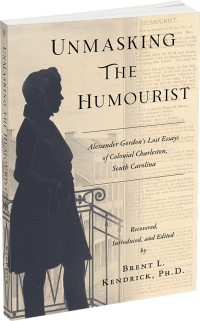
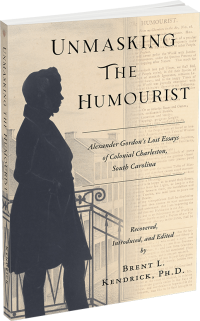
I had been invited to speak about Unmasking The Humourist: Alexander Gordon’s Lost Essays of Colonial Charleston, South Carolina, a project that has occupied a surprising amount of my life. But as I stood there, in a room filled with people who had given their afternoon to books, it became clear that what I was really there to talk about was not a colonial essayist at all. It was about the invisible network of librarians, teachers, archivists, and patient institutions that had made that work possible.
Nothing I have written would exist without them. Not the book. Not the essays. Not even the questions that led me to them.
For most of us, research looks solitary. A scholar in a reading room. A book on a desk. A voice speaking from a distant century. But none of that happens without a vast, quiet scaffolding behind it, made up of people who catalog, preserve, teach, fund, and protect the materials that others one day come to use.
Libraries quietly hold information—sometimes for centuries—without knowing who will need it, or when, or why. They preserve voices long after those voices have gone silent, trusting that someday someone will come along prepared to listen carefully.
That afternoon in Deltaville, surrounded by that small but devoted group of Library Friends, I realized I was standing inside the visible tip of something much larger. A chain of care that stretches across generations, linking a colonial newspaper, a Charleston library, a community college system, and a branch library in the heart of the Chesapeake Bay.
My own place in that chain began long before I knew it. When I was a graduate student in the early 1970s, I stumbled across a series of anonymous essays published in the 1750s in The South-Carolina Gazette. A leading scholar, Leo LeMay, had remarked that they were among the finest essays in all of early American literature and had urged that someone edit them, publish them, and identify their author. The challenge sat there for decades, unanswered.
What allowed me to return to it was not individual brilliance, but institutional grace. I spent twenty-five years at the Library of Congress, learning how archives think and how preservation outlasts any single lifetime. Later, the Virginia Community College System gave me something just as precious when I turned fifty: the chance to become an English professor, a dream I had carried since childhood. And then, when I was named Chancellor’s Professor, it gave me a two-year appointment that provided something more precious than funding. It provided time. Time to think. Time to return to unfinished questions. Time to do the kind of slow, careful work that real discovery requires.
That is why educators and educational institutions matter so deeply in this story. They do not just transmit knowledge; at their best, they grant permission. Permission to linger with a problem. Permission to follow a hunch. Permission to trust that careful thinking is worth the investment.
Being in Deltaville also gave me something I had not realized I was missing: the chance to thank Glenn DuBois in person. Glenn was Chancellor during two important turning points of my professional life. He was Chancellor when the Virginia Community College System first welcomed me into the classroom at age fifty, and he was Chancellor again years later when I was named Chancellor’s Professor, the appointment that made this work possible.
We rarely get to look someone in the eye and say, simply and honestly, “You changed my life.” But that afternoon, in a small library behind a hardware store, I did. It was one of those moments when gratitude stops being abstract and becomes something you can actually feel in the room.
The essays I eventually brought back into the light turned out to belong to Alexander Gordon, a Scottish-born scholar and singer who lived in colonial Charleston. But authorship matters because it allows us to place a voice in a life, a mind in a world, and a text in a tradition.
There is a Jewish folk belief that a person dies twice: once when the body stops, and again when their name is spoken for the last time. If that is so, then archives are a kind of moral infrastructure, designed to keep names from slipping into that second death. Every catalog entry, every preserved page, every carefully tended collection is an act of faith in the future.
So is education. When the Virginia Community College System opened its doors to me in midlife, it did not just give me a job. It gave me a second beginning. Without that second chance, the first version of my curiosity would have remained unfinished.
All of this came together for me in that small Deltaville library. A place without marble columns or grand staircases, but full of the same quiet dignity that animates every serious library anywhere. People had gathered not to be dazzled, but to listen. To care. To take part in the long human habit of keeping stories alive.
Today, Gordon’s voice is no longer anonymous. His essays are no longer orphans. A lost body of work has been restored to its author, and a chapter of early American literary history has been set right. That restoration belongs not just to a scholar or a book, but to the institutions that made it possible—to libraries that guard knowledge, to educators who foster discovery, and to communities that believe the past is worth preserving.
All proceeds from my book go to the Virginia Foundation for Community College Education, which feels exactly right. Libraries and community colleges share the same moral instinct: they exist to hold doors open, not to keep people out.
I left Deltaville with a deeper gratitude for the fact that nothing we do alone ever really is. Behind every footnote stands a librarian. Behind every discovery stands a teacher. Behind every second act stands an institution willing to say yes.
And behind every recovered voice stands a chain of quiet, faithful human hands, passing something forward because they believe someone, someday, will need it.

 The Wired Researcher