How a 300-Year-Old Voice Ended Up on a Listserv


“But this is not the final word on Alexander Gordon. In many ways, it is only the beginning.” —Brent L. Kendrick (b. 1947). Author/editor of Unmasking The Humourist: Alexander Gordon’s Lost Essays of Colonial Charleston, South Carolina (2025).


Sometimes scholarship moves quietly through archives, footnotes, and years of patient reading. And sometimes—if we are very lucky—it suddenly circles back into public conversation after centuries of silence.

Yesterday, I did something that felt equal parts scholarly, hopeful, and just a little audacious: I posted a Call for Papers to the Society of Early Americanists Listserv proposing a conference panel built around The Humourist essays of 1753–54—essays that circulated for nearly three centuries without a known author before I definitively identified Alexander Gordon as the writer behind them in Unmasking The Humourist: Alexander Gordon’s Lost Essays of Colonial Charleston, South Carolina (2025).

The panel proposal grows out of a question that has increasingly occupied my thinking since the book appeared: What happens when a substantial colonial voice—one hidden in plain sight for nearly 300 years—suddenly reenters the conversation?

Not simply the classroom conversation, though that matters too. I mean the larger conversation about early American literary history itself.

The more I have lived with these essays, the more convinced I have become that Gordon’s work has implications extending well beyond a solved literary mystery. The Humourist complicates familiar narratives centered primarily on New England and Philadelphia. It invites fresh consideration of the colonial South as a site of literary sophistication and intellectual exchange. And because Gordon himself moved so fluidly between Scotland, London, antiquarian scholarship, theater, and colonial Charleston, the essays also open intriguing transatlantic questions about literary identity, influence, and cultural circulation in mid-eighteenth-century British America.

Will the idea for the panel succeed? Honestly, I have no idea. Academic conferences are busy ecosystems, deadlines are tight, and assembling a thoughtful interdisciplinary panel in just a few weeks may prove wildly optimistic.

But some ideas are too interesting not to toss into the scholarly waters.

So yesterday, that is exactly what I did. Below is the call that went out to the Society of Early Americanists membership.


Call for Papers | Society of Early Americanists | March 18-20, 2027

Hidden in Plain Sight:

The Humourist and the Rewriting of Early American Literary History 

For nearly three centuries, the essays of The Humourist (1753–54), published in the South-Carolina Gazette, circulated pseudonymously without an author—admired but ultimately unclaimed and unstudied. That silence has now been broken. Unmasking The Humourist: Alexander Gordon’s Lost Essays of Colonial Charleston, South Carolina (2025) definitively establishes Alexander Gordon, Clerk of His Majesty’s Council in South Carolina, as the author of these essays, restoring to early American studies a substantial and long-missing colonial voice.

The implications are considerable.

The Humourist introduces into mid-eighteenth-century colonial literature a voice that is satirical, learned, rhetorically sophisticated, and deeply embedded in the intellectual and political life of Charleston. Written during the same years that Benjamin Franklin was shaping his public literary persona, these essays compel us to reconsider the contours of early American literary culture: its geography, its centers of influence, its relationship to British models, and its internal diversity.

This panel asks what follows from that recognition.

How does the presence of Gordon and The Humourist alter prevailing accounts of early American literary history? What happens to a canon long organized around New England and Philadelphia when a sustained, sophisticated essay tradition emerges from the colonial South? How might these essays reshape our understanding of authorship, anonymity, print culture, and the relationship between colonial and metropolitan literary forms? What new lines of inquiry—literary, historical, and transatlantic—open once this body of work is taken seriously?

At the same time, the recovery of The Humourist raises a second, equally pressing question: how does a newly established body of work move from archive into interpretation, and from interpretation into the classroom?

Possible topics include, but are not limited to:

  • the implications of Gordon’s authorship for early American literary history
  • The Humourist in relation to Franklin and the periodical essay tradition
  • regional imbalance and the place of the colonial South in the canon
  • transatlantic literary identity and British-American cultural exchange
  • satire, persona, and public discourse in colonial print culture
  • political knowledge and insider perspective in the essays
  • literary, historical, or rhetorical analysis of specific essays
  • future directions for research suggested by the recovery of this corpus
  • the movement from recovery to curriculum: teaching newly established texts

Panelists will be asked to engage with a shared selection of The Humourist essays in order to ground discussion in the texts themselves. The essays are included in Unmasking The Humourist (2025), accessible via Kindle; a PDF of the text can be shared with panel participants.

Please send a 250–300-word abstract and brief bio directly to Professor Brent L. Kendrick at brentlkendrick@gmail.com by May 16, 2026.

Questions and expressions of interest are warmly welcome.


Whether the panel materializes or not, the act of sending the call felt like its own small ceremony. It’s one more way of insisting that this voice, so long unheard, deserves a seat at the table. The deadline for panel submissions is May 16th. The conference is scheduled for March 2027. And Alexander Gordon has already waited nearly three hundred years. Sure, we can give him a little more time.
The Place: Charleston, SC. The Venue: Charleston Library Society. The Moment: October 1.

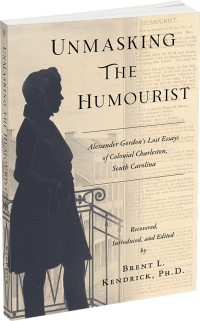
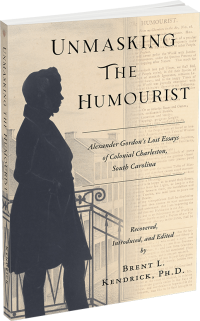
This week’s post is arriving early, because in just a few days I will step into a room filled with history and voices that refuse to fade. On October 1, the Charleston Library Society—the oldest cultural institution in the South and the second-oldest circulating library in the nation—will host the launch of my Unmasking The Humourist: Alexander Gordon’s Lost Essays of Colonial Charleston, South Carolina.

Why Charleston? Because the city itself is part of the story. It was here, in November 1753, that Alexander Gordon began publishing his Humourist essays in The South-Carolina Gazette. Through wit and irony, Gordon held up a mirror to colonial society, skewering hypocrisy, praising learning, and questioning authority. His essays pulsed with the contradictions of a city that was both refined and raw, elegant and quarrelsome. Charleston was his stage, and for nearly three centuries his voice remained hidden in the fragile pages of a newspaper few had cause to revisit.

That is, until now.

The Charleston Library Society is not just the venue for this launch—it is the very repository that safeguarded the Gazette itself, preserving the faint ink on brittle pages that carried Gordon’s words into the future. Founded in 1748, just five years before The Humourist first appeared, the Library has weathered fires, wars, earthquakes, and centuries of change. Its shelves and archives testify to the endurance of ideas—and to the truth that words matter. To stand in this place and reintroduce Gordon’s voice is both an author’s honor and a literary historian’s homecoming.

This launch also falls on a milestone: 272 years since the first Humourist essay appeared in Charleston. That span of time is almost unimaginable. Empires have risen and fallen, nations have been born, wars have been fought, and yet these essays—sharp, funny, insightful—still breathe. They remind us that human folly, ambition, vanity, and hope are constants. Gordon was not writing only for 1753. He was writing for us.

For me, this book represents years of research and a kind of detective work: following a trail of clues, comparing voices, weighing evidence, and finally piecing together the case for Gordon’s authorship. It is scholarship, yes—but it is also a story of recovery. Of bringing back a writer who deserved to be remembered, who deserves a place in our understanding of American letters.

And so, on October 1, Unmasking The Humourist will take its first public bow in the very city that first gave it life.

If you are in or near Charleston, I would be delighted to see you at the Charleston Library Society. If you are far away, I hope you will celebrate with me from wherever you are.

Because this launch is not just mine—it belongs to every reader who believes in the power of words to survive, to provoke, to amuse, and to endure.

About the Book

This edition definitively establishes Alexander Gordon (c. 1692–1754)—antiquarian, Egyptologist, scholar, singer, and later Clerk of His Majesty’s Council of South Carolina—as the author of The Humourist essays, restoring his rightful place in literary history.

The Introduction confirms Gordon’s authorship and provides the necessary historical context surrounding the essays and their publication in The South-Carolina Gazette.

The Humourist Essays section presents the complete authoritative text. Each essay is introduced with a detailed headnote offering historical context, exploring key themes, and situating the essay within broader literary and cultural traditions. These headnotes also clarify references, highlight rhetorical and satirical techniques, and connect The Humourist to its periodical essay tradition. Following each essay, explanatory notes supply annotations that illuminate historical allusions, linguistic nuances, and biographical details, making the essays more accessible to modern readers while preserving their original wit and bite.

The Afterword suggests areas for future scholarship—richer literary analysis of Gordon’s techniques, his engagement with Charleston’s intellectual and political life, his later years in South Carolina, and his place in transatlantic literary traditions. This volume thus serves both as a definitive authorship study and as a definitive text, laying a foundation for future research.

Finally, the Appendix corrects a 277-year-old historical error that mistakenly attributed to Gordon a natural history of South Carolina. This archival correction not only restores the record but also underscores the importance of rigorous scholarship—whether in reclaiming a forgotten author’s voice or in ensuring that legacy is preserved with accuracy.

Unmasking The Humourist: Alexander Gordon’s Lost Essays of Colonial Charleston, South Carolina is available now:

Amazon and Barnes & Noble

All proceeds from the sale of this book will be donated to The Virginia Foundation for Community College Education

The Humourist Nears the Light

“To publish is to make knowledge public, to assert its value, and to offer it up to the judgment of the world.”

–—Robert Darnton (b. 1939), American cultural historian of the Enlightenment and former Director of the Harvard University Library; renowned for his work on the history of the book and 18th-century France, including The Literary Underground of the Old Regime and The Case for Books.

Surely, you’ll remember the groundbreaking work I finished earlier this year on one of the greatest literary mysteries in early American history.

The Humourist—a sharp-witted, enigmatic essayist whose satirical columns lit up the front page of The South-Carolina Gazette in 1753 and 1754—had been lost to time, his identity buried beneath centuries of silence.

Through meticulous research—poring over newspapers, historical records, forgotten manuscripts, and overlooked clues—I solved the mystery, unmasking the man behind the essays: Alexander Gordon. His identity, his world, and the forces that led to his disappearance are now fully revealed.

I shared that discovery through this blog, but solving the mystery was only the beginning. The real work—the restoration—was still to come.

Now, after years of refining that research, the book I’ve long envisioned is finally becoming a reality.

Yesterday, I received the first proof of the book’s interior pages. Looking at them is more than a thrill—it is validation. These pages mark the first step toward publication and the return of a long-silenced voice.

Unmasking The Humourist: Alexander Gordon’s Lost Essays of Colonial Charleston, South Carolina is not just a rediscovery. It is a scholarly edition that restores one of the most significant—but overlooked—literary voices of colonial America. The essays appear in full, meticulously annotated and contextualized, accompanied by a critical introduction that explores Gordon’s identity, influences, and legacy.

Why This Book Matters

This is more than the story of a forgotten writer. It’s about:

● The literary landscape of colonial America and its deep connections to the English essay tradition.
● The power of satire to shape public discourse—even in a bustling port city like Charleston.
● The intimate intersection of literature, politics, and history, as seen through the eyes of a writer who was both observer and insider.

For the first time, The Humourist’s essays will step out of the yellowed pages of The South-Carolina Gazette and into the full light of historical and literary analysis.

The Book Will Arrive This Fall

This carefully curated edition will include:

● All of The Humourist’s essays, fully annotated.
● A critical introduction grounded in original scholarship.
● Historical and literary commentary that situates Gordon in both local and transatlantic traditions.
● A call for further scholarly attention to this long-overlooked voice.

Stay Tuned

In the coming months, I’ll be sharing exclusive glimpses into the publication journey, from typesetting to launch. The return of The Humourist is well underway.

The mystery was solved long ago. But this fall, the voice that once stirred Charleston will speak again—with clarity, context, and a proper name.

A Forgotten Voice, A Solved Mystery—And Soon, A Book

“What is research but a blind date with knowledge?”
— Will Harvey (b. 1963; computer scientist and entrepreneur known for his contribution to the field of interactive entertainment.)

“The greatest part of a writer’s time is spent in reading, in order to write; a man will turn over half a library to make one book.”
— Samuel Johnson (1709-1784; poet, essayist, moralist, and lexicographer, best known for compiling A Dictionary of the English Language, 1755.)

Years ago, I solved one of the greatest literary mysteries in early American history. The Humourist—a sharp-witted, enigmatic essayist whose work graced the front page of The South-Carolina Gazette in 1753 and 1754—had been lost to time, his identity obscured by history.

Through meticulous research—poring over newspapers, historical records, forgotten manuscripts, and overlooked clues—I solved the mystery, uncovering the man behind the words—his identity, his world, and the forces that led to his disappearance.

I shared my discovery with the world through my copyrighted blog, laying bare the identity of The Humourist. But there was more to be done. Solving the mystery was only the beginning.

Now, after years of refining my research, the book I’ve long envisioned is finally becoming a reality. Unmasking The Humourist: Alexander Gordon’s Lost Essays of Colonial Charleston, South Carolina, will be a available in September. It’s a definitive edition that not only reveals The Humourist’s true identity but also presents his essays in full, with critical commentary, historical context, and meticulous annotations. This is not just a rediscovery; it is a restoration of one of the most significant but overlooked literary voices of Colonial America.

Why This Book Matters

This is more than just the story of an anonymous writer. It’s about:

Colonial America’s literary landscape and its connections to the great essay traditions of England.

The power of satire in shaping public discourse—even in a bustling port city like Charleston.

The intersection of literature, politics, and history, as seen through the eyes of a writer who was both an observer and an insider.

For the first time, The Humourist’s essays will step out of the yellowed pages of The South Carolina Gazette and into the full light of historical and literary analysis.

The Book Will Arrive This Fall

This carefully curated edition will include:
● All of The Humourist’s essays, fully annotated.
● A critical introduction that explores his identity, influences, and legacy.
● A deep dive into the historical and literary significance of his work.
● A call for further scholarly research into this long-forgotten but pivotal writer.

Stay Tuned!

Over the coming months, I’ll be sharing exclusive glimpses into the book’s publication journey, including its official launch. Follow my blog for exclusive updates—you won’t want to miss what’s next!

I solved the mystery years ago. Now—early this fall—the book that brings #The Humourist back to life will be available not only on Amazon but also in a bookstore near you!