“The facts may remain the same. The narrative doesn’t have to.” —Brent L. Kendrick (b. 1947).
I’ve written it before and I’ll write it again.
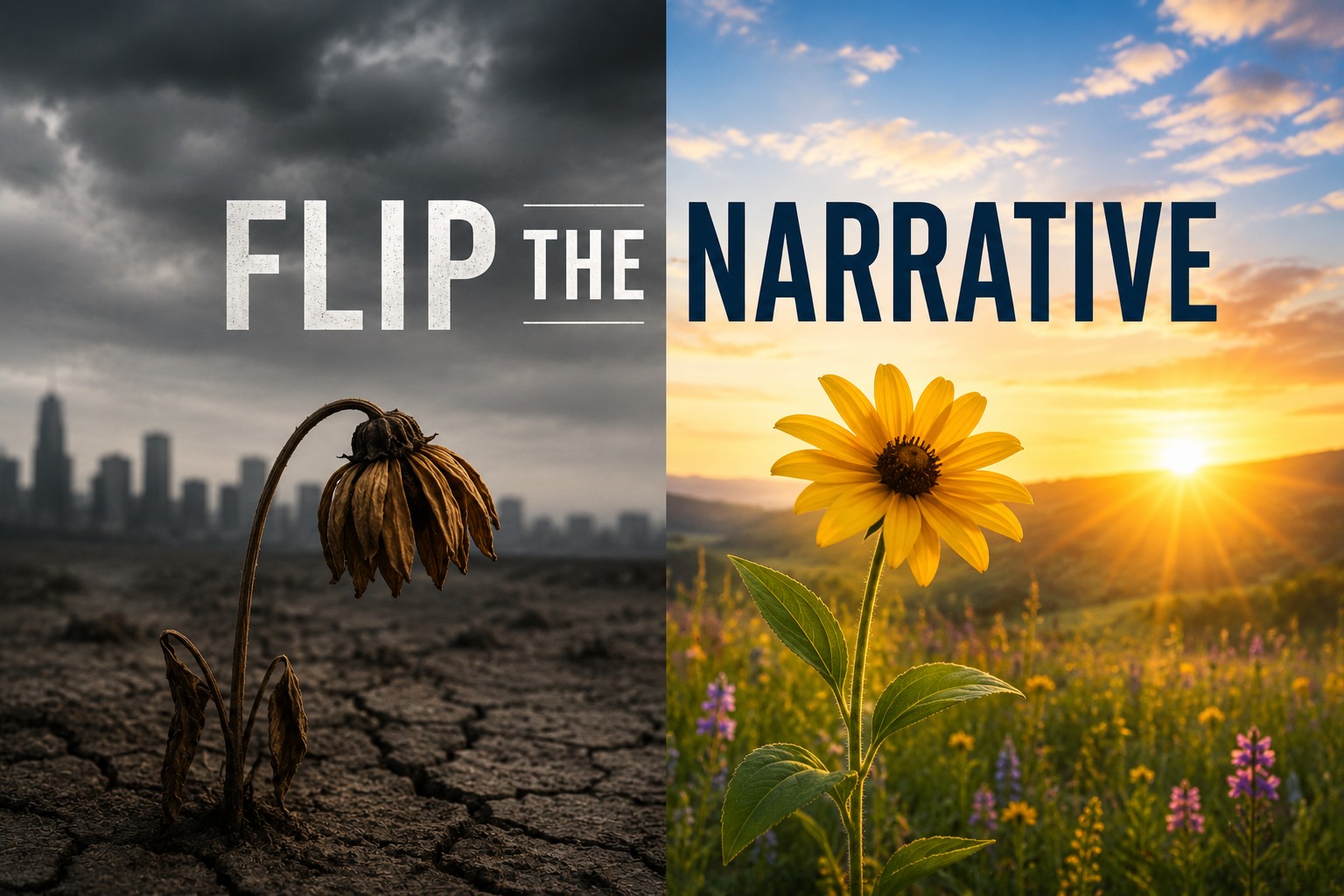
Flip the narrative.
You read it right. But I want you to read it again.
Flip the narrative.
When the daily news overwhelms you, flip the narrative.
When technology frightens you, flip the narrative.
When society disappoints you, flip the narrative.
When family and friends let you down, flip the narrative.
When your body reminds you that you’re getting older, flip the narrative.
When life seems to be shrinking, flip the narrative.
When hope begins to flicker, flip the narrative.
And if you think you know what I’m going to say next, I’m making my point.
Flip the narrative.
Flip the narrative because the daily news is not the whole story. Headlines are paid to interrupt your breakfast, not to nourish your soul. They shine spotlights on what is broken, while millions of quiet acts of kindness slip by unnoticed every single day. If all you read is the news, you will eventually believe darkness has won. It hasn’t. Flip the narrative.
Flip the narrative because technology is neither angel nor devil. It is a tool, and tools have no conscience of their own. We lend them ours. Every generation has feared the next invention, certain it would be the one to finally replace the human heart. It never has. The hands change. The fear stays the same. Flip the narrative.
Flip the narrative because society is more than its loudest voices. Every day, strangers hold doors, volunteers serve meals, neighbors check on neighbors, teachers stay late, and someone somewhere chooses grace over anger. Those stories rarely make the evening news, but they make the world worth living in. Flip the narrative.
Flip the narrative because the people who love us are gloriously, frustratingly human. They disappoint us. We disappoint them. If we measure every relationship by its failures, we will eventually stand alone. Better to count forgiveness as often as we count offenses. Better to remember that imperfect love is still love. Flip the narrative.
Flip the narrative because every birthday steals something and gives something back. Your knees may protest. Your memory may hesitate. Your hair may surrender. But wisdom quietly takes a seat beside you. Perspective grows stronger. Small things become precious. You stop trying to impress everyone and start noticing what truly matters. Flip the narrative.
Flip the narrative because a life that seems to be shrinking is often becoming more focused. Doors close. Dreams change. The horizon may draw nearer. Yet, somehow, the heart discovers that depth can be every bit as magnificent as distance. Sometimes life doesn’t become smaller. It becomes richer. Flip the narrative.
Flip the narrative because hope is not pretending everything is fine. Hope looks reality squarely in the eye and refuses to let despair have the final word. Hope has outlived kingdoms, survived wars, buried loved ones, endured heartbreak, and still gets up the next morning expecting light.
Writers may write alone, but essays are completed by readers. Brent L. Kendrick (b. 1947)
Today marks the halfway point of 2026, and I’m delighted to share a milestone.
During the first six months of the year, The Wired Researcher has been viewed more than 17,000 times.
When I embarked on this new chapter inventing myself, I wondered where I would find the conversations that had sustained me for so many years in the classroom. I eventually discovered that they hadn’t ended at all. They had simply moved online, where every Monday morning another essay leaves my desk and finds its way into the world.
Some essays make readers laugh. Others invite reflection. A few stir memories. Every once in a while, one seems to touch something I never anticipated.
What pleases me most isn’t that one essay did well. It’s that readers have embraced essays about humor, language, gardening, relationships, cooking, aging, memory, and the unexpected moments that make ordinary life extraordinary. That tells me you’re returning not just for a topic, but for the journey.
Thank you for reading. Thank you for commenting, sharing, and encouraging me week after week. Writers may write alone, but essays are completed by readers.
Here’s to the essays that have already been shared—and to those still waiting patiently for Monday morning.
To you, My Dear Readers, I am grateful beyond measure.
“The meaning of the past is never finished.” Hannah Arendt (1906–1975). From her Between Past and Future (1961), where she argues that history is not closed or complete, but morally alive, awaiting renewed attention, responsibility, and understanding.
Last week, I found my way to a small library tucked behind a hardware store in Deltaville, Virginia. It was the sort of place you might drive past without ever knowing it was there—a quiet, cream-colored building softened by climbing vines and brightened by a mural where hummingbirds hovered and monarchs drifted above a riot of painted flowers. A sailboat logo and a modest white sign announced Middlesex County Public Library — Deltaville Branch, a name that made the place feel both official and intimate at once. Nothing about it was grand, but everything about it felt intentional. Step through the doors, and you are immediately reminded why libraries endure: they do not shout their importance; they simply keep offering it.
I had been invited to speak about Unmasking The Humourist: Alexander Gordon’s Lost Essays of Colonial Charleston, South Carolina, a project that has occupied a surprising amount of my life. But as I stood there, in a room filled with people who had given their afternoon to books, it became clear that what I was really there to talk about was not a colonial essayist at all. It was about the invisible network of librarians, teachers, archivists, and patient institutions that had made that work possible.
Nothing I have written would exist without them. Not the book. Not the essays. Not even the questions that led me to them.
For most of us, research looks solitary. A scholar in a reading room. A book on a desk. A voice speaking from a distant century. But none of that happens without a vast, quiet scaffolding behind it, made up of people who catalog, preserve, teach, fund, and protect the materials that others one day come to use.
Libraries quietly hold information—sometimes for centuries—without knowing who will need it, or when, or why. They preserve voices long after those voices have gone silent, trusting that someday someone will come along prepared to listen carefully.
That afternoon in Deltaville, surrounded by that small but devoted group of Library Friends, I realized I was standing inside the visible tip of something much larger. A chain of care that stretches across generations, linking a colonial newspaper, a Charleston library, a community college system, and a branch library in the heart of the Chesapeake Bay.
My own place in that chain began long before I knew it. When I was a graduate student in the early 1970s, I stumbled across a series of anonymous essays published in the 1750s in The South-Carolina Gazette. A leading scholar, Leo LeMay, had remarked that they were among the finest essays in all of early American literature and had urged that someone edit them, publish them, and identify their author. The challenge sat there for decades, unanswered.
What allowed me to return to it was not individual brilliance, but institutional grace. I spent twenty-five years at the Library of Congress, learning how archives think and how preservation outlasts any single lifetime. Later, the Virginia Community College System gave me something just as precious when I turned fifty: the chance to become an English professor, a dream I had carried since childhood. And then, when I was named Chancellor’s Professor, it gave me a two-year appointment that provided something more precious than funding. It provided time. Time to think. Time to return to unfinished questions. Time to do the kind of slow, careful work that real discovery requires.
That is why educators and educational institutions matter so deeply in this story. They do not just transmit knowledge; at their best, they grant permission. Permission to linger with a problem. Permission to follow a hunch. Permission to trust that careful thinking is worth the investment.
Being in Deltaville also gave me something I had not realized I was missing: the chance to thank Glenn DuBois in person. Glenn was Chancellor during two important turning points of my professional life. He was Chancellor when the Virginia Community College System first welcomed me into the classroom at age fifty, and he was Chancellor again years later when I was named Chancellor’s Professor, the appointment that made this work possible.
We rarely get to look someone in the eye and say, simply and honestly, “You changed my life.” But that afternoon, in a small library behind a hardware store, I did. It was one of those moments when gratitude stops being abstract and becomes something you can actually feel in the room.
The essays I eventually brought back into the light turned out to belong to Alexander Gordon, a Scottish-born scholar and singer who lived in colonial Charleston. But authorship matters because it allows us to place a voice in a life, a mind in a world, and a text in a tradition.
There is a Jewish folk belief that a person dies twice: once when the body stops, and again when their name is spoken for the last time. If that is so, then archives are a kind of moral infrastructure, designed to keep names from slipping into that second death. Every catalog entry, every preserved page, every carefully tended collection is an act of faith in the future.
So is education. When the Virginia Community College System opened its doors to me in midlife, it did not just give me a job. It gave me a second beginning. Without that second chance, the first version of my curiosity would have remained unfinished.
All of this came together for me in that small Deltaville library. A place without marble columns or grand staircases, but full of the same quiet dignity that animates every serious library anywhere. People had gathered not to be dazzled, but to listen. To care. To take part in the long human habit of keeping stories alive.
Today, Gordon’s voice is no longer anonymous. His essays are no longer orphans. A lost body of work has been restored to its author, and a chapter of early American literary history has been set right. That restoration belongs not just to a scholar or a book, but to the institutions that made it possible—to libraries that guard knowledge, to educators who foster discovery, and to communities that believe the past is worth preserving.
All proceeds from my book go to the Virginia Foundation for Community College Education, which feels exactly right. Libraries and community colleges share the same moral instinct: they exist to hold doors open, not to keep people out.
I left Deltaville with a deeper gratitude for the fact that nothing we do alone ever really is. Behind every footnote stands a librarian. Behind every discovery stands a teacher. Behind every second act stands an institution willing to say yes.
And behind every recovered voice stands a chain of quiet, faithful human hands, passing something forward because they believe someone, someday, will need it.
“It is good to have an end to journey toward; but it is the journey that matters, in the end.” —Ursula K. Le Guin (1929–2018). American novelist and essayist whose work consistently emphasizes process, patience, and the moral meaning of how lives are lived.
Hopefully, talking about December holidays isn’t limited to December alone, because here it is January—and I’m still talking.
“You and Gary must have had MAHvelous celebrations,” someone, somewhere out there, exclaimed.
Actually, we did. We started early, weaving joy into as long a string as possible. And get this—it’s the week after Epiphany, and we’re not finished.
For real. The trees are still up, their lights burning every evening. Lighted garlands trace the banister and the fireplace mantels in both the living room and the kitchen. Outdoors, lighted deer still prance on the deck, a Snoopy tree shimmers in the lower yard, and shrubs outside the kitchen bid a bright welcome.
Is that wonderful or what? Here we are, still enjoying our holiday decorations—largely Gary’s labor of love—which he began the day after Thanksgiving and created day by day thereafter, with no real rush to get anything or everything done.
Don’t worry. Soon enough we’ll box everything up and unplug the trees. We’ll pack it all away. But we won’t be finished. I’ll still be talking about something simple I learned this holiday.
Come to think of it, that’s exactly what I’m doing right now. I want to tell you why this might have been my best Christmas celebration ever.
I think I know.
Christmases past always felt like a frenzied process leading up to a single day. December 25 arrived. Poof. Done. Over.
Time and time again, I found myself humming “Is That All There Is” made famous by Peggy Lee.
The song opens with a childhood fire—flames consuming a house, a father carrying his daughter to safety, the world burning down while she stands shivering in her pajamas. And when it’s all over, the child asks herself:
“Is that all there is to a fire?“
Later comes the circus—spectacle, color, astonishment—followed by a curious sense of absence. Something missing, though nothing is obviously wrong.
“Is that all there is to a circus?“
Then love. Long walks. Gazing into one another’s eyes. And then loss. The beloved leaves. The heart breaks. But still, life goes on.
Even death, waiting at the end, offers no final revelation—only the same unanswered question.
Again and again, the song circles moments that promise transcendence but refuse to deliver a final explanation.
It’s as if the great events of a life—fire, wonder, love, even death—never quite measure up to the meaning we expect them to deliver.
This year, for the first time I can remember, I didn’t find myself humming that song.
I didn’t hear myself asking that question at all.
This year, I didn’t build toward a payoff.
This year, I didn’t measure the season by a single day.
This year, I realized that Christmas lives in the spirit we practice all year long, not in the triumph of a single day.
This year, I learned to take my cue from a slower rhythm—one built day by day, without hurry.
This year, I found pleasure in the making, not the finishing.
This year, the question never came.
Much of that rhythm was Gary’s, and I was wise enough to follow it and learn from it.
It applies to education— not just the diploma, but the nights spent puzzling, reading, failing, beginning again.
It applies to work— not just the promotion or the retirement toast, but the showing up, the learning, the imperfect days that add up to a life.
It applies to friendships— not just the anniversaries and milestones, but the long conversations, the forgiveness, the staying.
It applies to love— not just the moment we fall, but the daily choosing, the adjusting, the patience, the tenderness that deepens over time.
It applies to vacations— not just the photograph-worthy view, but the planning, the anticipation, the getting lost, the laughing along the way.
It applies to accomplishments— books written one page at a time, great rides pedaled one indoor revolution at a time, gardens grown one season at a time.
It applies, I think, to almost everything that matters.
What I was given this Christmas was not a better ending, but a better way of moving through things. A way that lets the journey matter. A way that frees us from asking too much of a single moment, and invites us to live more fully in all the moments that lead up to it.
And so the lights will come down. The boxes will go back into their places. January will move on, as it always does.
But I’ll carry this with me: meaning doesn’t arrive—it accumulates. With that gift, I found a better way to live inside my days.
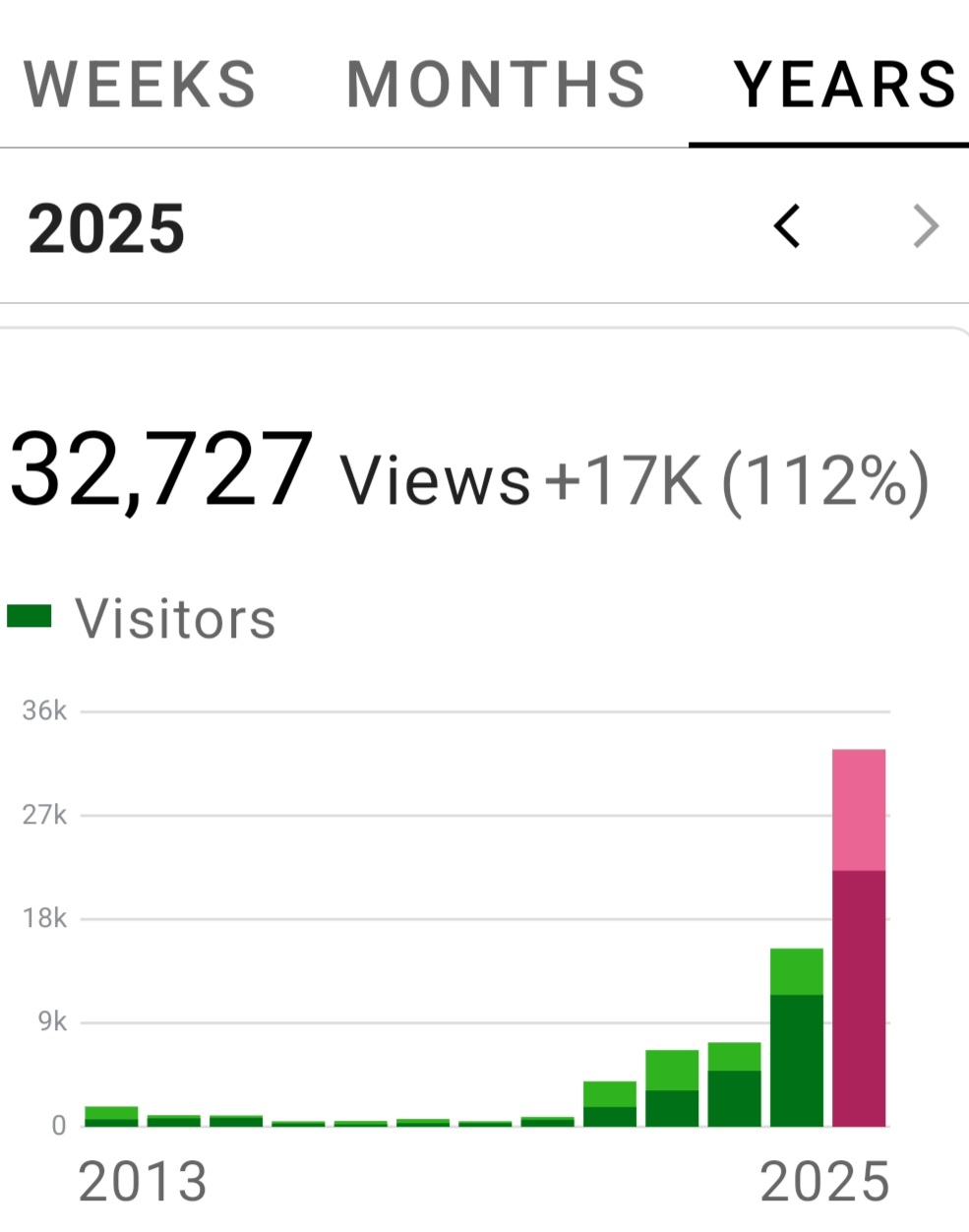
As this year draws to a close, I want to thank you for visiting my blog 32,727 times.
That didn’t happen overnight. And it didn’t happen by accident.
This year, more people found their way here than ever before—slowly, steadily, and often by returning. Compared with last year, readership grew significantly, not because anything went viral, but because the writing kept meeting the right readers at the right moment.
Growth, the quiet way,
These pages have held many things:
● 18th-century satire and present-day kitchens. ● Scholarship and softness. ● Books, biscuits, dogs, devotion, memory, love.
Some posts traveled far. Others found only a handful of readers. But every one was written with care—and read with attention.
I don’t think of these as clicks.
I think of them as moments of shared presence in a distracted world.
You made this a banner year.
If you were one of the 32,725:
● thank you for reading, ● thank you for lingering, ● thank you for making this a place worth returning to.
Here’s to a year shaped by patience, curiosity, and generosity of spirit—and to whatever quiet magic comes next.
You took me by surprise again this morning. As always, when I awakened, I checked my Fitbit to see how my heart did overnight. Then I checked WordPress to see how my readers were doing.
And there you were. Another thousand views. A quiet jolt to the chart. Numbers climbing when I wasn’t looking.
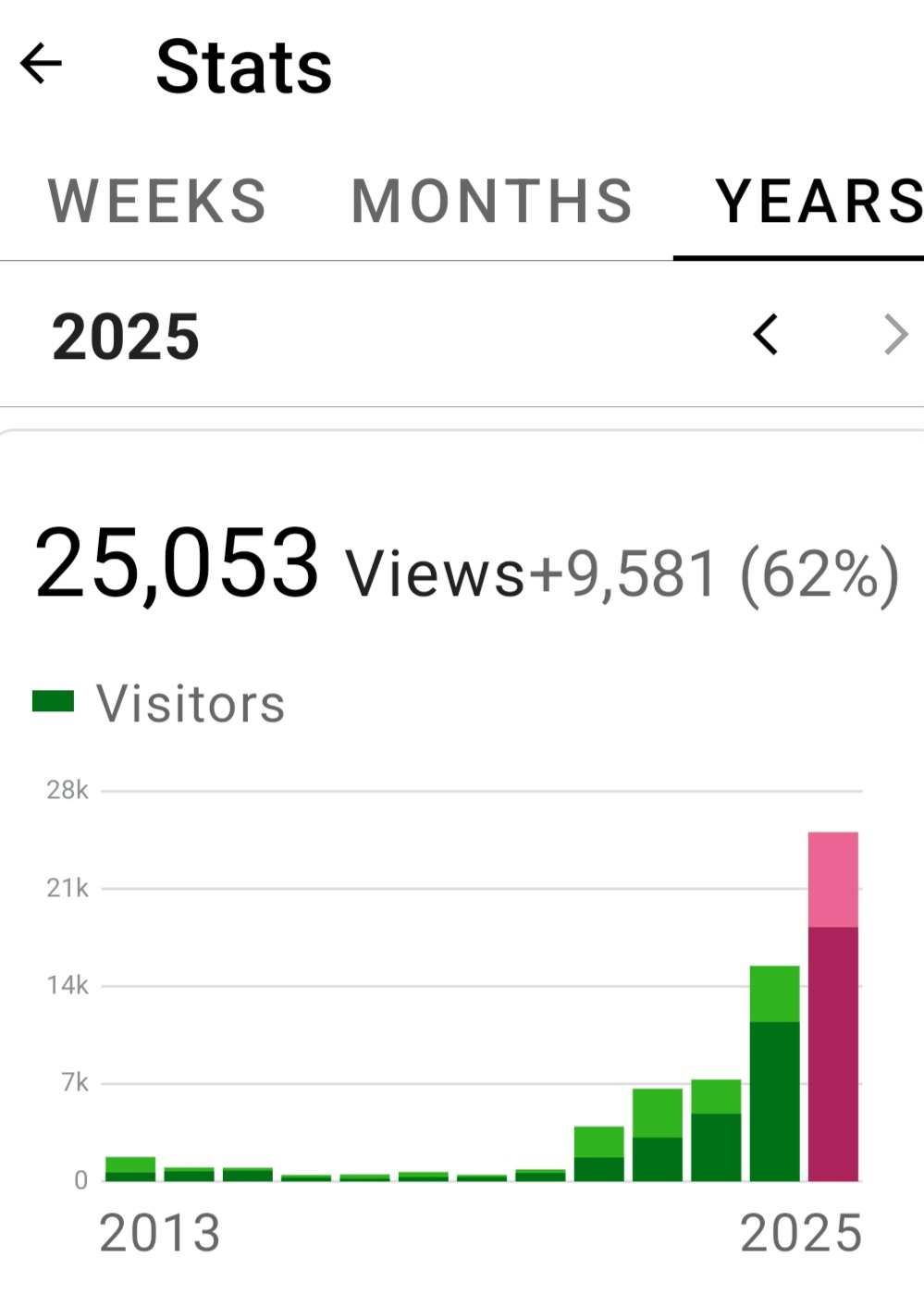
You’ve been dancing higher and higher since October, when I passed 15,000 and figured I’d reached my high-water mark. I even wrote a piece of thanks back then, thinking I’d said all there was to say. But now here we are—December 11th—and this little corner of the internet has gathered 25,053 views.
I’ve done nothing different. I have no flashy headlines. I have no trending hashtags. I just keep following the same rhythm: writing essays born from memory in a home filled with love. I just keep foolin’ around with words and ideas.
So why now, after all these years?
That question hangs gently in the room with me. It’s not demanding an answer. It’s simply inviting a reflection. Maybe something shifted in the writing. Maybe it’s more expansive. Maybe it’s more lived-in. Maybe it’s a voice carrying a steadier warmth now. Maybe it’s grief that’s softened into grace. Maybe it’s love that arrived not with fanfare, but with a quiet hand stretched out in invitation. Maybe it’s all of those things. Maybe. And add to all those maybes one more. Maybe it’s readers sharing with readers.
Gary, of course, doesn’t ask to be written about. But his presence is here, between the lines, in the patience of a paragraph, the steadiness of tone, the way I’ve learned to let silence do some of the talking.
Ruby, on the other hand, insists on being written about, whether she’s nosing me away from my smartphone or curling up in solidarity as I revise for the twenty-fifth time. She is, as always, the keeper of the tempo, the mistress of the move.
So this isn’t an open letter to public stats. It’s a letter to something deeper. It’s a letter to what it means to keep writing when no one’s watching, and then to wake up and find that someone was.
My essays aren’t meant to dazzle. And I know: they don’t. They’re just small acts of holding up the light, one weekly reflection at a time. The fact that they’re being read, now more than ever, tells me something I didn’t expect: quiet honesty still finds its way.
Thank you, Sudden Surge, for reminding me that patience has its own reward, that consistency is a kind of faith, and that somewhere out there, readers are still pausing to linger with a slow essay from the mountain.
I don’t know what this upturn means, or where it leads. But I do know I’ll keep showing up with my smartphone in hand and love at my side.
“I would maintain that thanks are the highest form of thought.”
—G. K. Chesterton (1874–1936,). influential English essayist whose sharp wit, moral clarity, and human warmth made him one of the most quoted thinkers of his time.
My blog surprised me again this week. Back in October, I crossed 15,000 views and thought I’d reached my high-water mark for the year. Now, barely a month later, I’m staring at an even bigger number:
20,062 views—with a full month still to go.
That’s more than last year, more than the year before, and more than I ever expected from this little mountain corner of mine. Apparently, these memoir stories I write from a quiet oasis in the wilderness of Virginia keep finding their way into far-off places—and into the hands and hearts of readers I’ll never meet yet somehow feel connected to all the same.
ReasonstoBeGrateful
But 20,062 isn’t really a number. Not to me.
It’s the sum of moments someone chose to spend with my words. It’s a cup of coffee that went cold on a stranger’s table because they lingered. It’s a pause in someone’s busy day. It’s a late-night scroll where someone said, without ever typing the words, “I’ll stay a little longer.” Twenty thousand tiny gestures of yes in a world full of noise.
And the deeper truth behind that math—the part I keep circling back to—is that this milestone isn’t about reach or visibility or bragging rights. It’s about what it represents in the long arc of a life. I’ve lived enough years, and carried enough stories, to know that readers don’t show up unless something in the writing rings true. They don’t return unless the voice feels familiar, honest, worth sitting with. They certainly don’t keep climbing toward 20,000 unless the stories hold something real.
So this isn’t a celebration of views.
It’s a quiet acknowledgment that I’ve kept faith with my own voice—through reinvention, through loss, through love found unexpectedly, through the strange and luminous chapters that have made up this year. And somehow, astonishingly, readers have kept faith with me.
And yes, threaded into the margins—without ever mentioning Gary by name—is the quiet steadiness that has shaped this year in ways I’m still learning to articulate. Love doesn’t call attention to itself; it simply widens the edges of your life. It softens how you move through the world, deepens the tone of your voice, and reminds you that being read is wonderful, but being seen—fully, gently, without hurry—is something else entirely.
This year, more than any before, has reminded me that showing up with a story is an act of hope. And reading one is, too. Somewhere in that exchange—when the writing meets the reading—something human and steady is created. Something that matters.
So here I sit, on a chilly Thanksgiving week, taking in this milestone not as a trumpet blast but as a simple moment of gratitude. Gratitude for the readers who knock on my digital door day after day. Gratitude for the chance to tell the stories I’ve carried for decades. Gratitude for the ways this year has widened, softened, and surprised me—and for the quiet presence that keeps teaching me that the best stories are the ones we live, not just write.
I didn’t expect this climb to 20,062. But I’m grateful for every step, every reader, every quiet yes.
And with a month still to go, I’ll just say it now—
Benjamin Franklin had Poor Richard. TheWiredResearcher has Poor Brentford Lee and welcomes him back as a guest contributor— louder than a sardine timer and twice as slippery— to sanctify our Thanksgiving tables with a bold mix of satire and sass.
Discerning readers like you, My Dear Friends, have no doubt noticed that from time to time, I write my posts under what I would call my nom de plume, Poor Brentford Lee. I like it, especially since it always makes me feel that I’m right up there in American letters right beside Ben Franklin and his famed Poor Richard.
I suspect it is with me as it was with Franklin. Using a nom de plume allows me to say things that I might have better sense than to say under my real name.
Anyway, I like Poor Brentford Lee enough that I let him grab hold of my smartphone and tap his heart away to share whatever it is he insists on sharing about Thanksgiving!
And this, My Dear Friends, is precisely where I step aside and let Poor Brentford take over. He’s already clearing his throat, poised to pontificate about Thanksgiving and give you a mouthful about all the other holidays we might celebrate. Or not.
Take it away, Poor Brentford…
Law me, Child, you would think folks would leave well enough alone and let Thanksgiving shine on its own once a year. But no. One day’s not enough for some people. They’ve gone and populated the whole turkey week with holidays!
Where shall I begin and how shall I spit out all the celebrations making every day on my calendar look like parchment with measles.
I’ll tell you here and now. Lace your girdle. Tighten your suspenders. Better still. Do both.
“Who? Me?”
“Yes. You. You tin-bellied Buzzard.”
And no. It is not true, the rumor that you may have heard that Ben Franklin wanted the buzzard to be declared America’s national bird. (And even if he had, he would not have endorsed eating it for Thanksgiving instead of turkey. So don’t let my nonsense bother your pretty little mind nary a whit when you sit down and take a gander at the golden bird on your table. It’s a turkey. And, besides, a turkey by any other name tastes the same.) But he did prefer the turkey over the Bald Eagle–which was, is, and forever shall be America’s national bird. He thought the eagle had “bad moral character” whereas the turkey was a bird “of courage.” But I assure you, Franklin never advocated that the turkey–or buzzard–be elevated to a national symbol.
But let’s get back to this bird of courage, with my genuine assurance that you’ll be stuffed by the time yours is done. (And it may be already.)
Do you realize that just a few days ago–Monday, November 24–folks celebrated:
● CelebrateYourUniqueTalentDay. (Law me, Child, half of us still haven’t identified a talent, and the other half are busy showing theirs off on Facebook. Settle down and smooth your feathers. We’re all special just as we are.)
● D. B. Cooper Day. (Lord help us! Who in their stuffed mind celebrates a masked, unidentified airplane hijacker? Pass the gravy, please—and make it strong.)
● International Au Pair Day. (Bless their ambitious little hearts. Raising other people’s children while living in their basements. That’s not a holiday—that’s a calling.)
● National Brand Day. (Because nothing says Thanksgiving spirit like corporate logos. Law me twice and hand me a napkin.)
● National Fairy Bread Day. (Child, that’s just white bread with butter and sprinkles. The Australians have some nerve calling it a delicacy. Bless their festive little hearts.)
● National Sardines Day. (Well, thank you! I think I will. Pass the saltines, please. Those fishies may be little, but they sure pack the omegas. Goodness, no. No need to open the windows. Light a candle? Have you lost your mind? Eat some sardines and chill.)
Land’s sake. That’s just Monday’s shenanigans.
I won’t dare trot my way through Tuesday and Wednesday, and when we get to Thanksgiving Day(the granddaddy of all American feasts), we’ve got at least five other celebrations dotting up my measled calendar—including Turkey-Free Thanksgiving. (I’m about to faint. Run fetch the smelling salts, please.)And Pins and Needles Day.(No doubt all the turkeys in the land are on theirs. My stars, even the Macy’s balloons look nervous.)
And don’t get me started on what follows on Friday. It’s none other than Black Friday, but Poor Brentford calls it National Lose Your Religion Day.
Thank your lucky un-plucked feathers that brings us to December, filled with an entire navigation of celebratory days that won’t get stuck in anybody’s craw.
The month barely opens before we’re knee-deep in Advent (which starts on November 30 this year—law me, Sweetheart, someofusarestilldigestingstuffingandtherestofusarerememberingthatwe meant to buy candles).
Then comes December 8, the Feast of the Immaculate Conception (a reminder that December still knows how to be holy before the cookies take over).
December 10 brings Human Rights Day (which, given the state of the world, ought to be celebrated daily, loudly, and with snacks).
December 12 offers the Feast of Our Lady of Guadalupe (a celebration so radiant it could light a path clear across the Shenandoah), and December 13 arrives with SaintLucy’sDay (bless their bright little candles; it’s the one holiday where setting fire to your hair is considered festive).
And then, Sugar, December 21 rolls in with the Winter Solstice (the shortest day of the year—when the sun says “I’m tired” and slips behind the hills before Poor Brentford has found his reading glasses).
December 24 is Christmas Eve (the day we all lie and say “just one more cookie”), December 25 is Christmas Day (the grandmammy of gift wrap and gravy boats), and December 26 brings the first day of Kwanzaa and Boxing Day (a pair of celebrations that stretch the season just a little sweeter and a little longer).
Finally, December 31 lurches toward us as New Year’s Eve (when half the country watches the ball drop and the other half drops before the ball does).
And before you start thinking December has nothing left to get stuck in your craw, Dear One, let Poor Brentford assure you otherwise. We haven’t even touched the other December shenanigans—those bafflin’, bedazzlin’, bubble-blowin’ celebrations that make a body wonder who’s in charge of this calendar.
Take Package Protection Day (Law me, Sweetheart, if your packages need protection, it’s already too late).
Then there’s Bathtub Party Day (Heavens no. These bubbles are reserved for… well, that’s none of your business).
Put On Your Own Shoes Day arrives next (bless their slow little hearts—and who, pray tell, was puttin’ ’em on before today?).
National Letter Writing Day finally appears (fetch me a quill and ink pot pen before the feeling passes), followed closely by Weary Willie Day (and aren’t we all, after this calendar?).
Then up pops Dewey Decimal System Day (now kiss my librarian grits—this is a holiday worthy of humanity), and International Mountain Day (Child, here in the Shenandoah, every day is Mountain Day, even Tuesday).
Fast-forward a bit and December tosses out National Whiners’ Day (celebrated mostly by folks returning gifts they don’t deserve), followed by Still Need To Do Day (my to-do list fainted dead away—fetch the smelling salts), and finally Make Up Your Mind Day (if only—Poor Brentford’s been undecided since the first time he picked up a pen).
As for me, I’ve made up my mind that I’ve stuffed you with enough celebrations already, and I’m not about to puff up my feathers and strut around with more. Land’s sake alive! If I got going on all the celebrations we won’t be celebrating in 2026, I’d be here forever and you’d be reading even longer. (One reader told me just a feather or two ago that I was getting pretty windy.)
Now, before you fan yourself and declare that Poor Brentford has lost the last marble he was ever loaned, let me tell you something plain and true. All this fussin’ and frettin’ over holidays—big ones, little ones, ridiculous ones—might seem like the carryings-on of a nation that’s plum run out of sense. But Sugar, I don’t think that’s it at all. Not deep down.
I think we keep inventing these goldurned celebrations because we’re hungry for each other. Hungry for community, for belonging, for a reason—any reason—to stop the world long enough to say, “I’m here, you’re here, thank heavens we made it another day.”
We are a scattered people trying to stitch ourselves back together with whatever thread we can find—peppermint bark, bathtub bubbles, mountain days, turkey days, even days devoted to weary Willies and packages that need protecting. It’s laughable, yes. But it’s also a kind of hope. A kind of reaching.
And if you ask me—and you didn’t, but here I go anyway—I think we ought to take these foolish little observances and set them right on the Thanksgiving table alongside the mashed potatoes and cranberry sauce. Call them what they are:
Laughable Blessings.
Because heaven knows we need reasons to laugh. We need excuses to gather. We need bright spots—silly or sacred—that remind us we belong to one another, even on the days we feel most alone.
So Child, if some little holiday comes along and tickles your wishbone or nudges your heart, pull up a chair at your Thanksgiving table and let it sit a spell. Celebrate it. Laugh at it. Give thanks for it.
Light a candle. Bake a pie. Wear the dress or don’t (but mercy, cover the essentials). Put on your own shoes—today or tomorrow.
Because in the end, Thanksgiving isn’t only about turkeys and table linens. It’s about noticing the small things—absurd, tender, holy—that remind us how lucky we are to be here at all.
And that, My Dear Readers, is a blessing worth celebrating on Thanksgiving and every day of the year.
Poor Brentford Says
Eat well. Laugh loudly. And Sweetheart, if life insists on giving you a celebration for every day on the calendar… count them as blessings — even the laughable ones.
—Terry Tempest Williams (b. 1955. American writer and environmental activist whose lyrical essays explore the intersections of personal narrative, place, and ecological stewardship.)
Something snuck up on me yesterday.
I was talking on the phone with my 90-year-old sister when I glanced down at my smartphone, saw my WordPress dashboard—and nearly did a spit take.
Over 15,188 views this year already!
That’s already more than all of 2024, and we still have October, November, and December to go. Apparently, my little mountain corner has gone global again—and I couldn’t be more grateful.
To every one of you, My Dear Readers, who reads, comments, shares, or quietly lingers over a sentence or two: thank you. You’ve turned this space into a community of curiosity, compassion, and laughter. Every click, every view, every thoughtful message reminds me that words still matter—and that connection runs deeper than algorithms.
Your Top 10 Favorites of 2025 (So Far)
Every year tells its own story through what readers choose. This year’s list made me smile. It’s a mix of reflection, resilience, and rediscovery—with a dash of irreverence (because, well, it’s me or Poor Brentford Lee or maybe both).
● “I Am Afraid” — A wake-up call for our country—and a reminder of who we still can be.
●“The Place: Charleston” — The launch of my Unmasking The Humourist: Alexander Gordon’s Lost Essays of Colonial Charleston, South Carolina.
There’s still more to come before year’s end—new essays, reflections, maybe even a few surprises that have been sitting in my drafts waiting for the right moment. Perhaps even one or two guest posts by our famed and acclaimed Poor Brentford Lee.
I can’t promise I’ll always be profound, but I can promise I’ll keep showing up with authenticity, honesty, humor, and heart.
Thank you, My Dear Readers, for being here, for reading, and for reminding me—every day—that a single voice can still find an echo.
“The reader is the final arbiter of a text. Without the reader, the words are silent.”
—Margaret Atwood (b. 1939). Canadian poet, novelist, essayist, and critic, one of the most influential literary voices of our time.
My Dear Readers, I blinked yesterday, and suddenly my little corner of the internet tallied 12,000 views for 2025—with three months still to go!
That’s not just a number. It’s 12,000 moments of connection. 12,000 times someone out there paused long enough to read my words, nod, chuckle, roll an eye, or maybe even find a flicker of themselves in my essays.
And here’s the part that stuns me: with this pace, we’re on track to sail past last year’s phenomenal 15,000 peak—a record I once thought unrepeatable. But here we are, repeating (and then some).
The 10 You Loved the Loudest
Every essay I publish is a seed tossed into the world. Some sprout quietly. Some bloom bold and bright. Here are the ten that you watered most generously this year:
Whether you’ve been here since my first blog post nearly 13 years ago or you just stumbled across my latest musings, you’ve made this milestone possible. I don’t take your presence lightly.
So, here’s to you—my companions in this ongoing experiment of storytelling, memory-making, and meaning-finding. Let’s see how far we can climb before 2025 closes the books.
After all, the numbers matter—but the connections matter more.