“But this is not the final word on Alexander Gordon. In many ways, it is only the beginning.” —Brent L. Kendrick (b. 1947). Author/editor of Unmasking The Humourist: Alexander Gordon’s Lost Essays of Colonial Charleston, South Carolina (2025).
Sometimes scholarship moves quietly through archives, footnotes, and years of patient reading. And sometimes—if we are very lucky—it suddenly circles back into public conversation after centuries of silence.
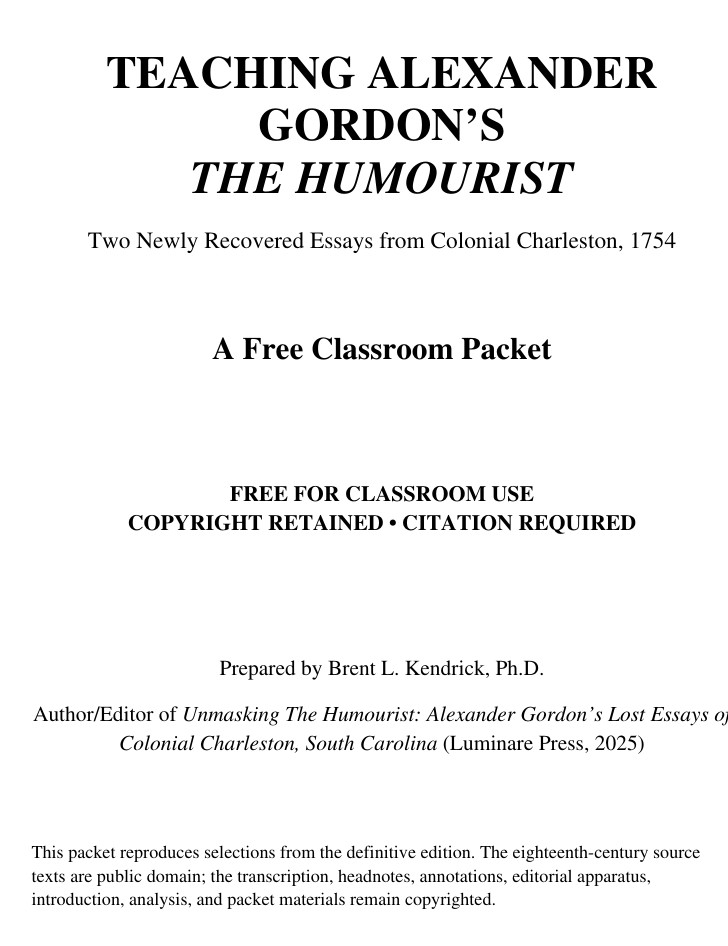
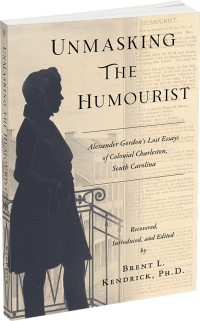
Yesterday, I did something that felt equal parts scholarly, hopeful, and just a little audacious: I posted a Call for Papers to the Society of Early Americanists Listserv proposing a conference panel built around The Humourist essays of 1753–54—essays that circulated for nearly three centuries without a known author before I definitively identified Alexander Gordon as the writer behind them in Unmasking The Humourist: Alexander Gordon’s Lost Essays of Colonial Charleston, South Carolina (2025).
The panel proposal grows out of a question that has increasingly occupied my thinking since the book appeared: What happens when a substantial colonial voice—one hidden in plain sight for nearly 300 years—suddenly reenters the conversation?
Not simply the classroom conversation, though that matters too. I mean the larger conversation about early American literary history itself.
The more I have lived with these essays, the more convinced I have become that Gordon’s work has implications extending well beyond a solved literary mystery. The Humourist complicates familiar narratives centered primarily on New England and Philadelphia. It invites fresh consideration of the colonial South as a site of literary sophistication and intellectual exchange. And because Gordon himself moved so fluidly between Scotland, London, antiquarian scholarship, theater, and colonial Charleston, the essays also open intriguing transatlantic questions about literary identity, influence, and cultural circulation in mid-eighteenth-century British America.
Will the idea for the panel succeed? Honestly, I have no idea. Academic conferences are busy ecosystems, deadlines are tight, and assembling a thoughtful interdisciplinary panel in just a few weeks may prove wildly optimistic.
But some ideas are too interesting not to toss into the scholarly waters.
So yesterday, that is exactly what I did. Below is the call that went out to the Society of Early Americanists membership.
Call for Papers | Society of Early Americanists | March 18-20, 2027
Hidden in Plain Sight:
The Humourist and the Rewriting of Early American Literary History
For nearly three centuries, the essays of The Humourist (1753–54), published in the South-Carolina Gazette, circulated pseudonymously without an author—admired but ultimately unclaimed and unstudied. That silence has now been broken. Unmasking The Humourist: Alexander Gordon’s Lost Essays of Colonial Charleston, South Carolina (2025) definitively establishes Alexander Gordon, Clerk of His Majesty’s Council in South Carolina, as the author of these essays, restoring to early American studies a substantial and long-missing colonial voice.
The implications are considerable.
The Humourist introduces into mid-eighteenth-century colonial literature a voice that is satirical, learned, rhetorically sophisticated, and deeply embedded in the intellectual and political life of Charleston. Written during the same years that Benjamin Franklin was shaping his public literary persona, these essays compel us to reconsider the contours of early American literary culture: its geography, its centers of influence, its relationship to British models, and its internal diversity.
This panel asks what follows from that recognition.
How does the presence of Gordon and The Humourist alter prevailing accounts of early American literary history? What happens to a canon long organized around New England and Philadelphia when a sustained, sophisticated essay tradition emerges from the colonial South? How might these essays reshape our understanding of authorship, anonymity, print culture, and the relationship between colonial and metropolitan literary forms? What new lines of inquiry—literary, historical, and transatlantic—open once this body of work is taken seriously?
At the same time, the recovery of The Humourist raises a second, equally pressing question: how does a newly established body of work move from archive into interpretation, and from interpretation into the classroom?
Possible topics include, but are not limited to:
- the implications of Gordon’s authorship for early American literary history
- The Humourist in relation to Franklin and the periodical essay tradition
- regional imbalance and the place of the colonial South in the canon
- transatlantic literary identity and British-American cultural exchange
- satire, persona, and public discourse in colonial print culture
- political knowledge and insider perspective in the essays
- literary, historical, or rhetorical analysis of specific essays
- future directions for research suggested by the recovery of this corpus
- the movement from recovery to curriculum: teaching newly established texts
Panelists will be asked to engage with a shared selection of The Humourist essays in order to ground discussion in the texts themselves. The essays are included in Unmasking The Humourist (2025), accessible via Kindle; a PDF of the text can be shared with panel participants.
Please send a 250–300-word abstract and brief bio directly to Professor Brent L. Kendrick at brentlkendrick@gmail.com by May 16, 2026.
Questions and expressions of interest are warmly welcome.
Whether the panel materializes or not, the act of sending the call felt like its own small ceremony. It’s one more way of insisting that this voice, so long unheard, deserves a seat at the table. The deadline for panel submissions is May 16th. The conference is scheduled for March 2027. And Alexander Gordon has already waited nearly three hundred years. Sure, we can give him a little more time.

 The Wired Researcher