“It is the job of the biographer to capture not just the facts, but the person—to recreate a life that breathes.”
–Richard Holmes (b. 1945. British biographer and literary historian, best known for revolutionizing the art of biography by blending rigorous research with narrative grace. Holmes treats biography as “a pursuit”—a physical and emotional journey that mirrors the subject’s life and traces the biographer’s own evolving understanding.)
Last week, I had the honor of speaking to the Mary E. Wilkins Freeman Society—an international gathering of scholars and fellow literary sleuths—about a woman who has occupied both my imagination and my file drawers for over fifty years. The event was titled An Hour with Mary E. Wilkins Freeman and Brent L. Kendrick, though truth be told, Freeman took up more than her share of the hour—quite the feat for someone 95 years late to the party.
My talk focused on the biographer’s challenge—specifically, the one I’ve taken on in my newest work-in-progress: Dolly: Life and Letters of Mary E. Wilkins Freeman, a two-volume biography that attempts not just to recount her life but also to reckon with it. And as I spoke, I realized: you, my Dear Readers, might want to know the thrust of those challenges too.
Besides, if the rocks on the mountain above me ever come tumbling down around my head—and let’s be honest, erosion is undefeated—I’d like to think I’ve left behind notes coherent enough for some poor soul to pick up the thread and carry on. Consider this a digital trail of sourdough breadcrumbs. Or a literary will. Or maybe just a slightly compulsive footnote to posterity.
Let’s began with where I began my conversation with the Society! To my surprise–well, not really–I departed from my prepared PowerPoint presentation and shared with everyone some of my recent finds. Not all. Just a few. Like some first editions of her books that survive with dust jackets intact: Doc Gordon (1906) and An Alabaster Box, co-authored with Florence Morse Kingsley (1917).
Then I had to share a copy of her Pembroke with an 1894 letter tipped in, expressing her surprise to learn of a Pembroke, New Hampshire and insisting that the Pembroke in her novel was an imaginary town.
I could have gone on and on, but I had to get started with my prepared PowerPoint. Even so, I was dying to share one of my most treasured finds in recent years: an association copy of her Jane Field (1892) from the library of Thomas Hardy, no less. It even has his book plate! And get this! Tipped into the book is a letter from Freeman to Hardy, written in 1894 when she was still Mary E. Wilkins.
I had to share those items because discoveries like that make research truly enjoyable.
After that gem, I decided to begin my formal presentation, so I started with silence. No. No. Not her Silence and Other Stories (1898) that I had included in my show-and-tell of her books with dust jackets.
And I wasn’t talking about the peaceful kind of silence. I had in mind the charged, maddening kind that suggests everything while saying nothing. My work on Freeman’s is a study in absences. No children. No will. No literary executor. No neat stack of labeled folders tucked away in a special collections box. Just scattered letters—some stiff and formal, others intimate and tender, many conspicuously missing. A few were destroyed by well-meaning friends who, bless them, thought privacy more valuable than posterity. That’s loyalty with scissors.
And yet, what’s missing speaks volumes. Silence, when it’s deliberate, isn’t absence—it’s presence with its mouth closed. It points to pain, privacy, or power. It challenges the biographer to resist the urge to fill in gaps with imagination. Biography isn’t fiction. And Freeman, who lived within boundaries, both imposed and self-constructed, deserves to have her story told with respect for what she chose not to share.
I used to think my job was to uncover. But every time I held her letters—some brittle, some bold, many barely surviving—I understood something deeper. My job was to listen. Not for revelations, but for nuance. I hoped the silences might eventually yield confessions. What I found instead was the eloquence of restraint.
And that restraint continues through the patchwork of what remains. What I’m working with wasn’t curated; it was cobbled together from libraries, estates, eBay listings, obscure auctions, and—on more than one occasion—serendipity. A letter here. A scribbled marginal note there. A donation from someone who thought, “This might be of interest.” And indeed, it was.
From this mosaic, one truth stood out: Freeman was no literary waif wandering the fields of New England and New Jersey with a bonnet full of feelings. She was sharp. Strategic. A woman who tracked her payments, negotiated contracts, and protected her work with steely precision. She didn’t just write to be heard—she wrote to be paid. And she succeeded.
But there were ways in which she was silenced, or at least reframed. Take her first collection of stories for adults, for example. The world knows it as A Humble Romance, but that was not her title. She wanted Green Mountain Stories. One editorial misstep reshaped her critical reception for generations. In an attempt to set the record straight, I published the collection in 2023 under the title she originally intended. It wasn’t just an act of publishing—it was an act of restoration. A reclamation. A literary correction served warm.
Place shaped her profoundly. Born in Massachusetts, forged in Vermont, and, by her own reluctant admission, tethered to New Jersey. Who claims her? Each state might try, but perhaps none can fully. Those Vermont years were transformative—not just scenic. She didn’t merely write about place; she grew into herself there. Critics, of course, pinned her as “local color,” as though geography were quaint decoration instead of animating force.
At one point, I thought I could simply revise my earlier book, The Infant Sphinx. Dust off a few facts, plug in a few letters, call it an update. My Dear Readers, I could not. With over 587 pages already in print and decades of new discoveries, it became clear: this wasn’t a renovation. This was a whole new house.
I decided to start from the ground up. Volume I: The New England Years (1852–1901) tracks her ascent—her voice, her control, her deliberate rise. Volume II: The New Jersey Years (1902–1930) explores unraveling and resilience. Her husband’s alcoholism, his institutionalization, his escape, his death, and his final legacy: disinheriting her in favor of his chauffeur. But those years also brought triumph. Freeman became the first recipient of the William Dean Howells Gold Medal. She was elected to the National Institute of Arts and Letters. She endured—and she flourished.
As I worked, she shifted in my mind from “The Infant Sphinx” to something more intimate. Her friends called her “Dolly.” So do I. Because what emerged wasn’t a mask, but a woman: shrewd, vulnerable, funny, driven. Someone who resisted easy summary. Someone who might have written my biography better than I’ll ever write hers.
Of course, none of this would’ve been possible in 1985. Back then, research meant microfilm, train stations, and airports. Now, it means auction alerts, digital archives, and collectors who drop treasures into my inbox. I’ve found letters in university databases, estate catalogs, and the odd footnote in a forgotten article. The crowd, the cloud, and the collector—they’ve all joined the project. I don’t always have to go to the archive anymore. Sometimes, the archive comes to me.
In some ways, I’ve spent my whole career waiting for this moment. Waiting for the tools to catch up to the mystery. Waiting for the materials to surface. Waiting for my own understanding to mature.
That’s why Dolly had to happen now.
And apparently, I’m not the only one who thinks so. What began as a one-time Zoom talk has unexpectedly grown legs—and possibly a handbag. To my surprise and delight, the talk was a hit. I’ve been invited to give it again on June 27, and word keeps trickling in. Emails from those who missed it have arrived, each bearing some variation of “Please tell me it was recorded.”
Hannah Champion, President of the Freeman Society and Assistant Professor of Nineteenth-Century American Literature at Université Bordeaux Montaigne, has asked me to do a formal recording for the Society’s blog. Apparently, I’m more popular than I realized—or perhaps Mary is, and I’m just her current mouthpiece with a sometimes-decent Wi-Fi signal and a fondness for dust-jacket ephemera.
However that may be, one thing is certain: Mary E. Wilkins Freeman isn’t just a name on a title page or a portrait in an outdated textbook. She’s a presence. One I’ve come to know. One I hope you’ll come to know, too.
And if the mountain above me holds steady a while longer, I’ll finish her story—not as I once imagined it, but exactly as Dolly now insists on having it told.
I am honored to be featured on Barney Smith’s Vermont Artists and Authors podcast, StoryComic, Episode 361.
I had a delightful time talking with Barney about Vermont’s most famous writer, Mary E. Wilkins Freeman, and my book Green Mountain Stories, a collection of 28 stories by Mary E. Wilkins Freeman. Originally published in 1887 under the title A Humble Romance and Other Stories, it’s now in print 136 years later under what appears to have been the title that Freeman and her editor, Mary Louise Booth, had agreed upon: Green Mountain Stories.
You can hear more about Freeman and the book’s backstory in Barney’s interview. I emphasize the fact that Freeman is a Vermont writer, and that Green Mountain Stories is made in Vermont.
■ I hope that Green Mountain Storiesbringsgreat inspiration to readers across Vermont.
■ I hope that each of the 262,852 households in Vermont buys a copy.
■ I hope that each of the 185 public libraries in Vermont buys at least one copy.
■ And I hope that each of the 250 public schools in Vermont figures out a way to incorporate at least one Mary E. Wilkins Freeman short story into their curriculum. They will find many suitable ones in Green Mountain Stories–stories on par with the best in American Literature, right up there with Nathaniel Hawthorne, Edgar Allan Poe, Sarah Orne Jewett, Mark Twain, Stephen Crane, Sherwood Anderson, and William Faulkner.
“Backstories are the breadcrumbs that lead readers deeper into the forest of the narrative, revealing hidden truths along the way.”
Ursula K. Le Guin (1929-2018; influential American author whose writing often explored themes of anthropology, sociology, gender, and the human condition.)
Almost everything in life has a backstory, and sometimes its dimensions are too rich and multifaceted to be tossed aside as having a lesser value. Consider, for instance, the genesis of a scholarly book, the product of years of research, contemplation, and dedication. Behind the polished cover and meticulously cited pages lies a narrative of passion, struggle, and serendipity that often goes untold.
My own scholarly work The Infant Sphinx: Collected Letters of Mary E. Wilkins Freemanis a perfect example. It has an incredible backstory, and I am always ready to share snippets, especially as it relates to the book’s publication history. Snippets, mind you. Until now, I’ve never shared the entire backstory. Here goes!
When I finished the manuscript in 1984, I sent it to the University of Massachusetts Press. They accepted it but advised me that publication would be delayed by at least a year, perhaps two years or longer. I declined their offer because, as a young scholar eager to be published, I wanted the book on library shelves yesterday or the day before.
A few months later, I happened to be in Dallas for the American Library Association’s Annual Conference. ALA’S book exhibition hall always features lots of publishers from all across the country. I decided to spend a few hours there, not with an eye toward finding a publisher for my book but rather with an eye toward seeing what free books and book paraphernalia I could take back home with me. In the midst of my freebie rambles, I found myself looking at a Scarecrow Press book exhibit. I nearly walked right on past, but I looked more closely and saw its location: Metuchen, New Jersey.
“OMG!” I thought to myself. “My lady–Mary E. Wilkins Freeman–lived in Metuchen from her marriage in 1902 until her death in 1930.”
Without any hesitancy whatsoever, I smiled at the man standing by the exhibit and declared, in what I hoped would be a convincing voice:
“Today is your lucky day!”
“Oh, yeah? Why’s that?”
I proceeded to tell him about Freeman, her connection to Metuchen, and my hot manuscript. His eyes sparkled, his smile stretched from ear to ear, and his every movement exuded enthusiasm.
“I’d love the chance to consider your manuscript for publication. Send it to me when you get back home.”
We shook hands.
“I’m Esh,” he said casually.
I knew as I walked away that Esh and I had just entered into a gentleman’s agreement. I knew that Esh would accept the manuscript. I knew that Scarecrow Press would publish The Infant Sphinx. Ironically, I didn’t know until I got back to my hotel room and looked at the business card that Esh was none other than William Eshelman, the president of Scarecrow Press.
And so, it came to pass. Esh was impressed by my manuscript and accepted it. When the book was released in 1985, Scarecrow invited me to Metuchen for talks, receptions, and book signings. I will always remember that week as one of the most memorable chapters in my life, especially the book celebration with the ladies of the Quiet Hour Club, several of whom–Dolly Buchanan and Lois Lord–befriended me during my years of doing research in Metuchen. What made it even more special is the fact that Freeman herself was an honorary club member.
I share the preceding snippets of the backstory often, especially with students and aspiring writers, as an example of serendipity. When I went to the ALA conference in the summer of 1984, I never dreamt that I would find a publisher for TheInfantSphinx. Also, I share it as an example of how it pays to be bold. I was the epitome of boldness when I approached a rank stranger, standing beside his publishing-house exhibit, declaring that it was his lucky day. Little did I know that he was the company’s president. What nerve! Yet, what would have happened if I hadn’t been so bold?
The book’s backstory has other details, too, but until now, I haven’t shared those snippets. For example, I didn’t trust anyone to typeset my manuscript. I had spent a decade carefully deciphering and transcribing Freeman’s letters. I was worried that a typesetter would mess up the format, regularize the spellings, and introduce mistakes. Esh agreed that if I could provide Scarecrow with camera-ready copy, they would provide me with a higher royalty. I don’t remember how much. Also, I don’t remember the technical details of preparing camera-ready copy. I do remember, however, that it was before personal computers. I rented a fancy machine of some sort–a “Compu” something or other–and for months, I spent evenings and weekends working on a gargantuan task. No. I confess. It was a Herculean task. But guess what? I loved every eye-strained, wrist-pained moment of it.
I don’t usually share that part of the backstory, not because I’m embarrassed to let the world know that I find joy in scholarly drudgery but rather because I’m embarrassed to let the world know that I don’t recall more of the minor details.
Recently, however, serendipity brought to the surface a dusty folder that has lots and lots of details plus a major “find” that even I had forgotten. Just a week or so ago, when the idea for this post popped into my mind, I went looking for the Scarecrow Press folder that I knew I had surely kept. Indeed, I had kept it. Indeed, it was exactly where I knew it would be. Now, I have all the facts that I need not only to flesh out the entire backstory but also to reveal a teaser to lure you back next week.
The first detail is that Esh and I wasted no time. I sent him my manuscript on July 11. He gave me an acceptance phone call on July 16 and followed up the next day with a formal letter, returning the manuscript along with “model paper on which [I could] prepare camera-ready copy.”
The second detail is this. The “Compu thing” that I couldn’t remember turns out to have been a Compucorp 675, Diablo 630. My lease agreement with Word Rentals is in the folder. The rental was $600 monthly, commencing August 1. By November 6, I had finished my task.
The third detail–the royalty–turns out to have been 15%. Looking back, I should have asked for more considering the direct rental expense that I incurred for the Compucorp. However, I have used The Infant Sphinx over and over again for my own research, and I haven’t found any mistakes. I have no regrets about the price that I paid for the quality that Freeman’s letters deserved.
The last minor detail is this. The book was released officially on April 28, 1985, exactly 39 years ago. From this point forward, April 28 will be a red-letter date on my calendar!
Now, the big teaser reveal. In the Scarecrow folder, I found a review of TheInfantSphinx that I had written myself! How preposterous is that! Well, it sounds exactly like something that I would do. I’m always telling friends and colleagues that I know no shame. I guess I didn’t back then either. However, I cannot for the life of me remember whether I sent it out for publication. I must have, because what I discovered in my dusty folder is a photocopy, and it’s so faded that I struggled to read it.
Ultimately, however, I managed to read the text, fading away as fast as my memory. Next week, I will share my “Confessions of an Editor,” unabashedly raw and candid, just as I wrote the review 39 years ago.
In the meantime, whenever you pick up a scholarly book or any work of art, take a moment to consider its backstory. You might be surprised by the passion, perseverance, and sheer stubbornness that lie beneath the surface. Or you might stumble upon a review of the book written by the scholar himself, such as the review you will be able to read right here next week in Part II.
—Bret Lott (b. 1958; American author and memoirist whose themes focus on family, faith, and the complexities of human relationships.)
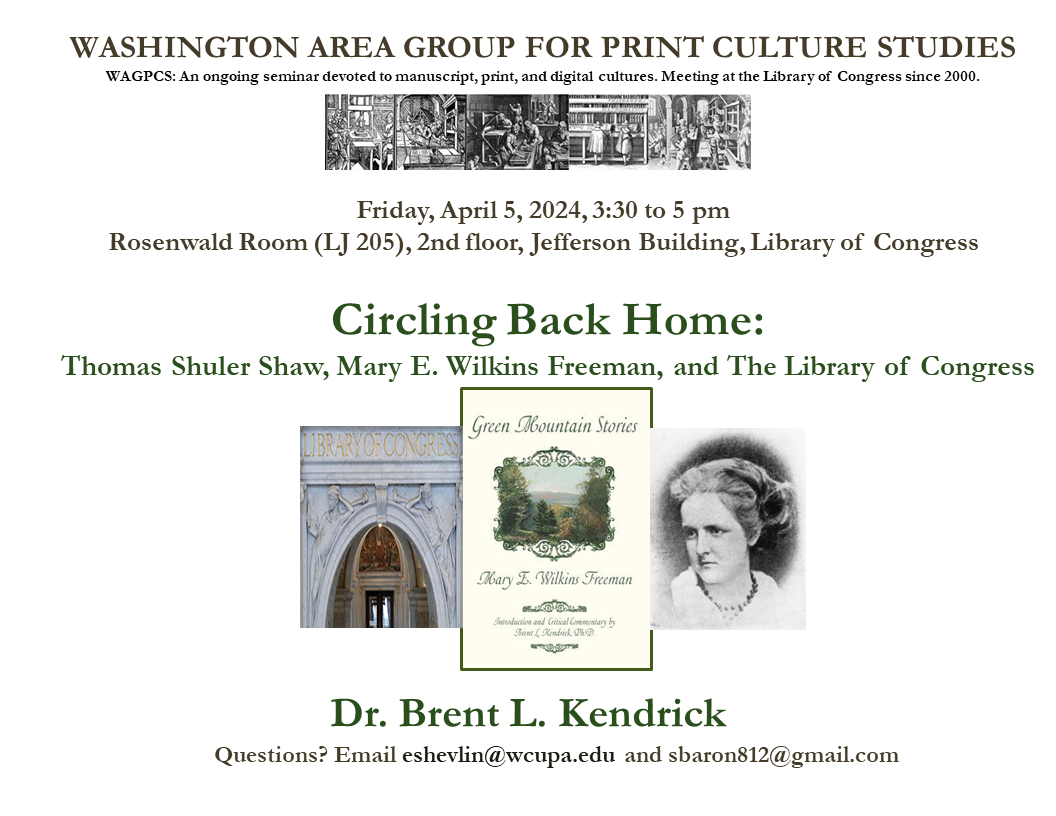
Next week I’ll be circling back home to the Library of Congress (LOC) where I enjoyed a glorious career spanning twenty-five years. I won’t be going home alone. Joining me will be the woman I’ve had an affair with for the last fifty years or so. I’m speaking, of course, of none other than my lady, Mary E. Wilkins Freeman. As part of my ongoing work on my two-volume Dolly: Life and Letters of Mary E. Wilkins Freeman, I’m circling back to LOC’s Rare Book and Special Collections to revisit some important Freeman materials. The beautiful part, however, is that the Washington Area Group for Print Culture Studies (WAGPCS) has invited me to talk about my research. I am thrilled beyond thrilled to be circling back home and to have the opportunity to share my ongoing and exciting work on Freeman.
Below is the abstract of my talk followed by a WAGPCS promotional for the event!
ABSTRACT
On March 15, 1930, the acclaimed American short story writer, Mary E. Wilkins Freeman, passed away. Her legacy, however, continues to resonate. At the turn of the twentieth century, Freeman and Mark Twain stood as America’s most beloved writers. She blazed a trail for women in literature, becoming the first recipient of the William Dean Howells Gold Medal for Distinguished Work in Fiction (awarded by the American Academy of Arts and Letters in 1925). She achieved the distinction of being among the first women elected to membership in the National Institute of Arts and Letters in 1926. Additionally, the bronze doors at the American Academy of Arts and Letters in New York (West 155 Street Administration Building) bear the inscription, “Dedicated to the Memory of Mary E. Wilkins Freeman and the Women Writers of America.”
Enter Thomas Shuler Shaw, a librarian at the Library of Congress, who embarked on an ambitious project in December 1931: writing what would have been the first biography of Mary E. Wilkins Freeman. His goal was to illuminate the life and literary contributions of this remarkable author.
However, fate had other plans. Shaw’s biography, titled A Nineteenth Century Puritan, faced rejection from prominent publishers such as Harper & Brothers, Ladies’ Home Journal, and The Saturday Evening Post. Despite setbacks, Shaw persevered. His meticulously curated scrapbooks and the typescript of his unpublished biography found a home in the Rare Book & Special Collections Division. These artifacts, along with Freeman’s books donated by Shaw to the Library of Congress, provide a rich tapestry of insights into her life and work. Notably, some of these materials reside in the Rare Book/Special Collections, while others find their place in the General Collections.
Fast-forward to 1985. Dr. Brent L. Kendrick, then serving as the Training Coordinator for United States Copyright at the Library of Congress, unveiled a literary treasure: The Infant Sphinx: Collected Letters of Mary E. Wilkins Freeman. Kendrick’s work, enriched by Shaw’s scrapbooks and unpublished biography, delves into Freeman’s correspondence. Through these letters, we glimpse the inner world of a prolific writer who defied conventions and left an indelible mark on American literature.
Fast forward again to May 2023. Kendrick continues his scholarly immersion into Freeman’s world and edits a new edition of her first collection of short stories for adults. Originally published as A Humble Romance and Other Stories in 1887, the book was meant to bear the title Green Mountain Stories. Now, 136 years later, it finally emerges under its intended name: Green Mountain Stories. Kendrick’s edition includes extensive critical commentary, unraveling the intriguing backstory behind this literary transformation.
But Kendrick’s scholarly pursuits don’t end there. Armed with fresh discoveries—significant letters previously absent from his earlier work, The Infant Sphinx—he embarks on a new two-volume project: Dolly: Life and Letters of Mary E. Wilkins Freeman. Vol. I: The New England Years (1852-1901). Vol. II: The New Jersey Years (1902-1930).
With these ongoing scholarly endeavors in mind, Dr. Kendrick returns full circle to the Library of Congress, a place where both he and Shaw once contributed their efforts. Here, he plans to delve once more into Shaw’s meticulously curated scrapbooks and unpublished biography, reexamining their contents to discern fresh insights that could enrich his comprehensive exploration of Freeman’s life and correspondence. This return to the archives not only honors the legacy of Shaw’s dedication but also underscores the enduring significance of the Library of Congress as a nexus for scholarly inquiry into the lives and works of American literary figures.
–Ursula K. Le Guin (1929-2018; American novelist and essayist renowned for her contributions to science fiction and fantasy literature; from her 1969 novel, The Left Hand of Darkness.)
Every now and then, a Silly Notion finds its way inside my head and takes up residence there. Try as I will, it won’t move out, even when I threaten it with eviction notices.
The Silly Notion that I can’t get rid of now is that I might be happier if I were to move away from my mountaintop oasis and find myself a lower-maintenance oasis downtown in a fabulous city somewhere. This Silly Notion has been living quietly in my head for a long, long time. I’ll give you an example.
In the fall of 2019, my late partner and I spent a week in Brattleboro (VT), where I was the keynote speaker at the Brattleboro Literary Festival. I had been to Brattleboro many times before, but it was Allen’s first visit. He fell in love with the mountains and the river and the funky downtown, a little San Francisco rolled up into a few blocks.
When it was obvious that our Brattleboro love was a shared one, we had some serious conversations about packin’ up and movin’. I was a little surprised that Allen–a Floridian–would even consider such a northerly move, especially Brattleboro’s average snowfall of 56 inches. However, I didn’t even have to bring up that topic. Allen settled the whole discussion when he gave me his coy, twinkly-eyed angelic smile that only he could give:
“Sure, we’ll move to Brattleboro, but we’ll have to airlift our gardens if we do.”
I laughed. We had had similar conversations before, and I had heard Allen’s response before when we visited Asheville (NC), Charleston (SC), and Savanah (GA). He and I loved the downtown vibes of small cities.
Obviously, we loved our mountaintop oasis more. Obviously, too, I still love it more because I’m still here, but that Silly Notion of moving is still in my head, too. Here’s what’s really funny. The notion is so silly that it actually thinks that I could sell my mountaintop home rather quickly. Hmmm. On reflection, I probably could. One of my neighbors told me once that if I ever sold, he’d like first dibs on my upper lots.
“I doubt that I’d ever sell just a part of my property. If I ever sell, it will be a total package, and I come with it.”
I guess he didn’t like my on-the-spot, standing-up proposal because he didn’t accept. Too bad. He would have gotten a damned good bargain.
I imagine, however, if I approached him now with the opportunity to buy–knowing that I’m no longer part of the deal–he might give it some serious thought. He should. If he didn’t, I’m sure some city slicker would, just as I did when I became a DC refugee. City slickers would love my Shenandoah Valley heaven. They could trade their car horns for my bird songs and their traffic jams for my stargazing escapades. My serene landscape and tranquil nights would woo even the most urban soul. Plus, and I’m not boasting, my oasis has one of the most commanding views anyone could ever hope to find in this part of the Shenandoah Valley.
§ § §
Selling my home, then, isn’t the challenge. The challenge is straightforward: where would I go? I have lots of options. So that I don’t show my leanings and inclinations–Scorpions like me, after all, like to keep people guessing–I’ll talk about them in alpha(betical) order.
Asheville, NC.: I’ve been to Asheville countless times, and the idea of living in that vibrant city is enticing. It might be wonderful to return, immerse myself in its artistic culture, and walk around the neighborhood where Thomas Wolfe lived. I could stand on the Square where Grover stood in Wolfe’s “The Lost Boy,” listening to his thoughts:
“Here,” thought Grover, “here is the Square as it has always been–and papa’s shop, the fire department and the City Hall, the fountain pulsing with its plume, the street cars coming in and halting at the quarter hour, the hardware store on the corner there, the row of old brick buildings oil this side of the street, the people passing and the light that comes and changes and that always will come back again, and everything that comes and goes and changes in the Square, and yet will be the same again. And here,” the boy thought, “is Grover with his paper bag. Here is old Grover, almost twelve years old. Here is the month of April, 1904. Here is the courthouse bell and three o’clock. Here is Grover on the Square that never changes. Here is Grover, caught upon this point of time.”
Aside from the literary appeal is the culinary one. Cúrate’s thriving treasure troves of Mediterranean food and wine would beckon me for regular lunches. I could take in art exhibits at the Asheville Art Museum, shop at all the funky shops, and enjoy chocolates at French Broad Chocolate Lounge. The sound of street musicians and the sight of quirky art installations would inspire and heighten my own bursts of creative energy. Add to all those joys the high of hiking Mount Mitchell and DuPont State Forest.
Let me check out some condos. Wow! I would have lots of options–to rent or to buy–but I am gobsmacked by the amazing condo that I just stumbled upon. It’s in downtown Asheville, above Ben and Jerry’s, near parks, shopping, dining, and all the action. 2 bedrooms. 2 baths. 1,130 square feet. OMG. It has a cozy balcony with views of Pritchard Park and Haywood Street, a working brick fireplace, gorgeous hardwood floors, and tons of windows with mountain breeze. It’s my reinvention dream come true. Say whaaaat? $749,000, plus monthly condo fees! Hmmm. Next time, I’ll look at the price first before my soaring hopes get sore.
Even if I could find a less-expensive condo (and I’m sure that I could), I wonder. How long would the initial creative rush of downtown Asheville continue to nourish me?
Brattleboro, VT: I did as I said that I would do. I looked at the price first: $279,000! I’ll tell you more about that gem after contemplating the treasures that Brattleboro offers. Those who know me well know that I love Brattleboro. I’ve been visiting there since the 1970s when I started my research on Mary E. Wilkins Freeman, who launched her acclaimed literary career while living in Brattleboro and captured the spirit of the town beautifully:
“Oh how wonderfully beautiful it was in Brattleboro. I used to walk to the head of High Street, and stand and look at the mountain in winter. The beauty in Brattleboro made a great difference in my life.” (To the Citizens of Brattleboro, Vermont, December 14, 1925. Letter 461. The Infant Sphinx: Collected Letters of Mary E. Wilkins Freeman. Edited with Biographical/Critical Introductions and Annotations by Brent L. Kendrick. Scarecrow, 1985.)
Every time that I’m in Brattleboro, I explore the streets where Freeman lived and walked. If I moved there, it would be a real boost to my ongoing Freeman research. Aside from that perk, Brattleboro is a delightfully charming town. I always refer to it as Vermont’s own Asheville. It’s artsy, and it has a bohemian vibe with free spirits roaming freely. It’s nestled along the Connecticut River with Mount Wantastiquet rising up on the other side.
But, whoa! You’re not going to believe the gem of a home that I found there. Picture this: a charming pergola, a delightful stone terrace, and enchanting gardens. It’s like stepping into a world that beautifully blends Old-World charm with the vibrant vibes of downtown living. And here’s the real treat–not one, but two porches that would allow me to admire those picturesque gardens and stonework. But the icing on the cake has to be the view. I can soak in the breathtaking Wantastiquet ridgeline and witness the moon climbing up the mountain just as Freeman did:
“The memory of the moon rising over the mountain causes the same surprise, the old leaping thrill of wonder at unexpected loveliness. […] I cannot now rid myself of the conviction that it was a special moon, rising nowhere else in the world. Its glory would fling out its road before it, then the first gleam of celestial fire would show over the mountain summit, and an elderly woman, for whom the good of her soul the old remained new, would call out: ‘there it is, the moon.'” (To the Citizens of Brattleboro, Vermont, December 14, 1925. Letter 461. The Infant Sphinx: Collected Letters of Mary E. Wilkins Freeman. Edited with Biographical/Critical Introductions and Annotations by Brent L. Kendrick. Scarecrow, 1985.)
This place really might be a dream come true. Oh. My. Yes. If I moved to Brattleboro, I would become a citizen of Vermont. I’d be a Vermonter, and I wouldn’t have to keep waiting for my friends or benevolent groups or the governor himself to bestow honorary citizenship.
My Freeman research would keep me enchanted, just as it has for five decades. But I wonder. How long would the other creative rushes of Brattleboro continue to nourish me, especially during the heavy snows of winter?
Savannah, GA: I must confess. Of all the places that my Silly Notion keeps making me think about, Savannah seems to have the least charm. It’s not as if I don’t like the city. I do. I’ve stayed there on several occasions, once at the awesome Planter’s Inn, in the epicenter of Savannah’s historic district and just a stone’s throw from River Street and the Savannah River. Another time, I stayed in a gorgeous historic home facing Forsyth Square, an enchanting urban oasis adorned with centuries-old oaks, cobblestone paths, and a mesmerizing central fountain. Living there, I could explore each of its historic squares, enjoy its coastal charm, and feel a sense of timelessness.
As for finding a condo there, I just stumbled upon an extraordinary gem. Actually, it’s an absolute dream. How about a 3-bed, 2-bath waterfront unit with exposed brick, hardwood floors, and iron detailing. The real showstopper? It overlooks the majestic Savannah River! The open layout is bathed in natural light. But wait for it… the price tag? A cool 1.1 million! Gasp! I forgot to look at the price first.
Well, I need not wonder whether Savannah’s charm would see me through the long haul. It’s a certainty: I won’t be going there. Now, all that I have to do is make the Silly Notion in my head understand my decision.
Washington, DC (Capitol Hill): Capitol Hill is awesomely significant to me. After all, I lived there for a quarter of a century, working at The Library of Congress, in whose hallowed, marble halls I grew up and became a professional. It was at the Library of Congress that I got turned on to research and decided to pursue my Ph. D. in American Literature. After I earned the degree, I returned to the Library of Congress, where I enjoyed a glorious and life-changing career.
Even though I’ve been away from DC for about as long as I lived there, when I return for daytrips, nostalgia and belonging wash over me. Even after the passage of so many years, when I visit the iconic Eastern Market, many vendors still remember me, and I am reminded of the neighborhood’s small-town, vibrant community spirit. Living at the heart of a dynamic city, where history, culture, and politics converge always made each day an exciting journey for me, and I am sure it would do the same once more.
Wait! Wait! Here’s the clincher that might just make moving to DC a no-brainer. I’ve just uncovered a condo conveniently situated right across the street from the prestigious Hart Senate Office Building and various other Senate offices. Natural light pours through oversized, brand-new windows. The modern, white kitchen features granite countertops, a gas range, dishwasher, and microwave–perfect for whipping up my culinary masterpieces. The updated bathroom is a retreat with its soaking tub shower, a stylish vanity, and a generously sized window with lots of sunlight. The entire unit has been tastefully updated, freshly painted, and boasts new flooring throughout. But here’s the kicker: no full bedroom! Where in the world would I catch some Zs? Holy smokes! But it’s only $385,000. Trust me: I know how to bloom wherever I’m planted. I see an outlandishly elegant Murphy Bed in my future.
Without a doubt, DC is as close to home as I can ever hope to be. I know that living there again would stimulate me intellectually, culturally, and socially. But I wonder. Would all of its parks, the Botanical Gardens, the Tidal Basin. Rock Creek Parkway, and the National Zoo give me the soul food that I get here on my mountaintop oasis when I do my down-and-dirty gardening?
§ § §
Well, let me say simply what Scarlet O’Hara would say:
“I can’t think about that today. I’ll have to think about that tomorrow.”
Right now, I have to think about other things. Clearly, I have some idyllic cities calling out my name. It’s equally clear that I’d be able to find a buyer for my mountaintop paradise.
But I’ve moved several times in the past, and I know what I have to do to prepare my home for the market. I realize that it will be a wild ride, so I need to start thinking and planning.
The Great Stuff Purge: I’ll start with the hardest part first. After all, I have kept everything forever. Now I wonder why. Who on earth cares about all of my canceled checks from the first one until I shifted to electronic banking? Who on earth cares about all of my tax returns going back to the first one heat I ever filed? Who on earth cares about all of the personal letters and cards that I have ever received? Those are only three categories of things that I’ve kept forever. I need to get rid of all that stuff. Then, I’ll tackle my loft, chock-full of Shenandoah Valley collectibles bought at auctions down through the years. OMG! I just had a marvelous idea. I acquired most of that stuff at Laughlin Brothers Auctions! I’ll sell it back to those guys. Then my loft will be empty, and I can convert it into a Zen-like meditation room. Dark hardwood floors. Light-colored walls. Wall-mounted light panels made of Himalayan salt. Meditation cushions. It will create a perfect ambiance, especially with an Anjali Namaste Mudra Buddhist Monk statue standing at top of the stairs bidding a prayerful welcome to the inner sanctum. What an asset that will be when the house hits the market. (I know. I’m brilliant. Thank you, for reminding me.)
The Deep Clean Extravaganza: This won’t be too bad because I’ve been deep cleaning since the Covid Pandemic started. I’m sure that you remember how “My Imaginary Guests” helped me keep my home spic-and-span clean. But I’ll arm myself once more with a mop, a feather duster, and a metaphorical superhero cape (purple, of course), and I’ll tackle dust bunnies and cobwebs with unmatched determination.
The Decor Remix: Honestly, I like my decor exactly as it is. It’s a perfect mix of antiques and modern–old and new. My guests always feel at home, so I imagine prospective buyers will, too.
The Garden Magic: I have been working diligently to restore my gardens into the pristine beds they once were. If I time everything just right, I can have the house ready for showing by mid-May 2024, when my peonies will be in bloom, ready to steal the heart of anyone who takes one look.
The “Fix It” Finale: Luckily, I fix things when they need to be fixed. Just yesterday, I had the plumber expertly snake my sluggish kitchen drain. It swirls around effortlessly and melodiously now. In a week or so, my new double wall ovens and my new stove top will be installed. I’ll probably go ahead and replace my inefficient electric water heater with a space-saving, more efficient, on-demand, gas water heater. The major fix-it, however, will be the road. Right before the house goes on the market, I’ll have crush-and-run put down so that prospective buyers will have a smooth ride up. I want the first one up to want to stay here forever!
Photoshoot Mania: I love to take photos, but I’ll need a professional photographer who can make my home and the spectacular surrounding views blush with flattering lighting and expert angles.
Baked Goods Invasion: Nothing makes a home smell better than freshly baked bread and pastries. I’ll be baking every day that my agent plans to show my home. I may even leave a gift basket of goodies on the kitchen table.
§ § §
I believe that’s it, but bear with me while I give the above pre-sale preparations a quick review. I don’t know what you think, but I think I have laid out a wonderful and workable plan.
“Would you two just knock it off! I’m trying to think.”
I guess I had better explain. You know all about the Silly Notion that lives in my head. However, I haven’t told you about the Sensible Notion that also lives in my head. Usually, they coexist peacefully on opposite sides of my brain, but right now, they are having a major squabble. Geez! I can’t get any peace at all.
Silly Notion: Butt out. This is my brilliant idea, and you have absolutely no right whatsoever to show up now.
Sensible Notion: Of course, I do. Remember: I have exclusive life rights. All you have is a towering stack of eviction notices.
Silly Notion: Scoot over. I don’t want you encroaching on my side of his brain.
Sensible Notion: Well, excuse me. I’ll graciously give you all the space that you want. Fortunately, I don’t require much space. With just a smidgen, I’ll work my magic and make him forget your delightful silliness and return to his senses.
Have you ever heard such a racket in all your life? I can’t enjoy a moment’s silence even within the domain of my own brain. I think that I feel a headache coming on. Oh. No. I think it might be a migraine.
Whew. It was neither as bad nor as lingering as I initially feared. An apple cider vinegar cloth applied to the temple always works wonders.
As I reclined on my sofa, allowing the vinegar vapors to perform their enchanting alchemy, I suddenly had an epiphany. It was yet another option, perhaps even more dazzling—if such a thing be possible—than the ones that previously danced around in my head, demanding to go on stage right here in my blog!
Let me explain. I will charge ahead with The Great Stuff Purge, The Deep Clean Extravaganza, The Garden Magic, and The “Fix-It” Finale. When I get all of that done, my mountaintop oasis will be transformed into a pristine paradise, so incredibly paradisical that I wouldn’t dare entertain the thought of moving.
But wait, here’s the pièce de résistance. Since I won’t be moving, I won’t have to fork over a hefty commission to a real estate broker. Instead, I can squirrel away those substantial savings and treat myself to several weeks (or maybe even a full month) each year in my cherished duo of cities that will forever hold a special place in my heart: DC, and Brattleboro. Who knows? I might even sprinkle in some vacation time in Asheville, Charleston, and Savannah.
Who says I can’t have the best of both worlds? I certainly can. My plan lets me live in my luxurious and enchanting mountaintop world for most of the year and, for a month or two each year, I can savor the richness of my favorite metropolitan worlds. You bet. I had to do some hefty packin’ up and gettin’ ready, but I ain’t movin’ nowhere (at least, no time soon anyway).
The roldengod and the soneyhuckle the sack eyed blusan and the wistle theed are all tangled with the oison pivy the fallen nine peedles and the wumbleteed.
I know. I know. It’s Halloween. BOO! That’s as far as I’m going to go. Don’t expect any tricks in this post. You won’t find any. With a little luck, though, you might find a treat. Perhaps two. I found a big one, and I was not even expecting it.
But before I tell you about my big treat, I must tell you that I am spooked. Truly and positively spooked. Yep. I am.
I cannot believe the batty thing that I have done.
Somehow, I have allowed myself to be spirited into the notion that just because October 31 this year happens to fall on a Monday–the day that I publish my blog–I somehow have to make this post fit the hobgoblin occasion.
To spooked, let me now add phooey. So, phooey. It’s all a bunch of hocus pocus.
Since when have I ever written anything for an occasion? Sure, I write from time to time, as in occasionally. But an occasional writer is one who writes for specific occasions, with or without the benefit of a patron who supports the arts.
Two Colonial Americans known for writing on specific occasions come to mind when I think of occasional writers.
No doubt the ending of her poem left Colonial Christians feeling jittery and unbalanced. If they didn’t feel that way, they should have. Wheatley saw the truth that they may have been too blind to see.
But since Wheatley and Bradstreet were both poets, I started wondering whether occasional writers are always poets.
A quick google search chilled me to the bone because I had to read what I uncovered several times. Even then I was not certain that I could break the spell of what it really meant.
Read an excerpt for yourself and then we can compare our fright notes.
[…]the key concept of occasional literature and its specific position between writer and patron, fiction and reality. The latter is defined in terms of two kinds of referentiality: on the one hand, the text’s connection to the occasion (pretext/performance); on the other, its (literary/potentially fictive) representation of a ‘reality’ that is relevant to that occasion.
All right. I get it, but only because I bring to the reading of the paragraph prior knowledge of occasional literature. Without that prior knowledge, would I get it? I don’t think so.
I suppose that I could rewrite the passage in plain English, but since the original was written in academic English, it might lose something in translation. And what if the author heard about my translation and decided to translate it back to academic English. That version might be even more frightful.
Wouldn’t that be a hoot!
I had not thought of it until now, but that scenario is incredibly similar to what happened to Mark Twain and his “Jumping Frog of Calaveras County.” Twain wrote the story in English with lots of dialect. Then it was pirated and translated into French–literally, word for word– with no attempt to capture the many colorful nuances of dialect. Twain found out about the French version and translated it back into English. The intriguing literary menage de trois was exposed to the entire world in 1903 as The Jumping Frog : In English, Then in French, Then Clawed Back into a Civilized Language Once More by Patient, Unremunerated Toil.
While my google search for occasional writers thrilled me because it prompted me to conjure up how Mark Twain clawed his famed story back into civilized English, it spooked me away from digging further into the catacombs of occasional writers.
Nonetheless, my goblinesque spell was not broken.
Somehow, I remained cauldron-bent that this post would ride along on some sort of literary broom.
I soon came up with what I thought was a perfect slant: famous writers who died on Halloween. Wouldn’t that be fun! Indeed, a number of famous people died on Halloween, including Henri Houdini (1874-1926) who made a career out of defying all odds, but in the end could not out-magician the Grim Reaper. However, I found only one writer who died on Halloween: Natalie Babbitt (1932-2016), writer and illustrator of children’s books. In her best-known work, Tuck Everlasting, a family discovers life everlasting.
Obviously, that angle handed me no real treats. How about the flip side: writers who were born on Halloween?
Lest I be accused of being a trickster, let me tell you up front that I know already of one writer whose birthday is October 31. (But I will swear on a stack of pumpkins that I had forgotten all about it until I started writing this part of the post.) She, however, will follow John Keats (1795-1821), English Romantic poet, whose poem “‘Tis the Witching Time of Night” is fitting, perhaps, for Halloween:
‘Tis ” the witching time of night”, Orbed is the moon and bright, And the stars they glisten, glisten, Seeming with bright eyes to listen — For what listen they?
The opening line of Keat’s poem is, of course, a play on the Soliloquy in Shakespeare’s Hamlet.
With that out of the way, let’s move on to the woman writer who shares her birthday with Halloween. She is none other than my lady, Mary E. Wilkins Freeman (1852-1930). I say “my lady” because she has bewitched me into spending five decades digging up her life and letters, and I am still not finished. At the turn of the twentieth century, she and Mark Twain were America’s most beloved writers. And when Twain was celebrated with lavish abandon on the occasion of his 70th birthday, Freeman was his guest, and he escorted her into Delmonico’s where she dined at his table. Anyway, I just perused my The Infant Sphinx: Collected Letters of Mary E. Wilkins Freeman to see whether she had written any letters on any of her birthdays. I found two, but neither mentioned her birthday or Halloween.
But in one letter written late in her life, she reflects on the October 4, 1869, flood, which was among the most disastrous floods in the history of Brattleboro (VT) where she lived at the time:
I remember the Flood with a capital F, when Whetstone brook went on a rampage, and Brattleboro was cut in twain by a raging torrent, in which lives were lost, and–a minor tragedy, savoring of comedy to all save the chief actor–a rooster went sailing past on a rolling pumpkin into the furious Connecticut river. [Letter 461]
Maybe Freeman was always out trick-or-treating. I doubt it. More likely than not she was at home, working on one of her own spooky supernatural stories for which she is well known, most notably her The Wind in the Rose-Bush and Other Stories of the Supernatural (1903). If you like stories about body-snatchers–of sorts–you might enjoy her “Luella Miller,” one of her most critically acclaimed supernatural stories with Luella cast as a New England vampire:
Weak heart; weak fiddlesticks! There ain’t nothin’ weak about that woman. She’s got strength enough to hang onto other folks till she kills ’em.
Actually, talking about Freeman’s stories of the supernatural requires a brief nod to two of her literary ancestors.
If you’re thinking Edgar Allan Poe, you’re right. Although Freeman claimed that she read nothing which she thought might influence her, in the same letter she acknowledges that she read Poe. [Letter 441] Without doubt, the madness in Poe’s “The Fall of the House of Usher” and Freeman’s “The Hall Bedroom” are kin, with both stories calling into question the sanity of their respective narrators.
And if you are thinking of Nathaniel Hawthorne in addition to Poe, good for you. Freeman read him as well. Just as Hawthorne was heir to a Puritan tradition, think of Freeman as heiress to the same Puritan tradition but with a far greater emphasis on psychological probing and on characters with such warped wills they border on the grotesque. Sir Arthur Conan Doyle called Freeman’s novel Pembroke “the greatest piece of fiction in America since [Hawthorne’s] The Scarlet Letter” (The Infant Sphinx, 2-3). A good Hawthorne story to read on Halloween might be his “Young Goodman Brown“:
“Welcome, my children,” said the dark figure, “to the communion of your race! Ye have found, thus young, your nature and your destiny. My children, look behind you!” They turned; and flashing forth, as it were, in a sheet of flame, the fiend-worshippers were seen; the smile of welcome gleamed darkly on every visage.
And we can’t look back at Freeman’s literary ancestors without noting several of her literary offspring. Freeman’s exploration of grotesque characters–village types with strong-wills, walking blindly the warped paths of their own existence–made heads turn in her own time and paved the way for future writers who were equally fixated on unearthing their own grotesque characters.
It’s not too great a stretch of the imaginative web of literary influence to say that without Freeman, we wouldn’t have Sherwood Anderson’s tales of grotesque village types memorialized in his Winesburg, Ohio. Don’t be fearful. Open the book and read “The Book of the Grotesque” or “Hands.” Or go beyond Winesburg and read one of Anderson’s later stories “The Man Who Became a Woman.”
The web grows larger with another writer known for his Southern Gothicism. Who does not recall the macabre ending to William Faulkner’s “A Rose for Emily”?
For a long while we just stood there, looking down at the profound and fleshless grin. The body had apparently once lain in the attitude of an embrace, but now the long sleep that outlasts love, that conquers even the grimace of love, had cuckolded him. What was left of him, rotted beneath what was left of the nightshirt, had become inextricable from the bed in which he lay; and upon him and upon the pillow beside him lay that even coating of the patient and biding dust.
Then we noticed that in the second pillow was the indentation of a head. One of us lifted something from it, and leaning forward, that faint and invisible dust dry and acrid in the nostrils, we saw a long strand of iron-gray hair.
And somewhere in the web we might even find Toni Morrison. Though she denied it, she was heavily influenced by Faulkner. (She had to have been influenced by him. After all, she did her master’s thesis on Faulkner.) Therefore, Morrison could have been indirectly influenced by Freeman as well, at least by Freeman’s significant role in the American Gothic literary tradition. In fact, in Freeman’s “Old Woman Magoun,” the grandmother’s decision to murder her granddaughter Lily to save her from a fate worse than death is not too unlike Sethe’s decision in Morrison’s Beloved to murder her daughter rather than have her face the horrors of slavery.
Well, one thing is not up for conjecture. This post has taken twists and turns that I never expected. Go figure.
Now the challenge is how to bring the post to its logical conclusion. Initially, I had every intention to end with the last few lines of “A Nosty Fright”:
Will it ever be morning, Nofember virst,
skue bly and the sappy hun, our friend?
With light breaves of wall by the fayside?
I sope ho, so that this oem can pend.
But now another ending is required.
I am shrieking with laughter. To think that I started this post by protesting that I was not an occasional writer–one who writes on special occasions. Yet look at what I’ve gone and done. I’ve managed to dig up a lot of literary supernatural greats and, without any original intent whatsoever, I’ve managed to explain how they’re all connected in one way or another to my lady, Mary E. Wilkins Freeman, known to her closest friends (and to me) as Dolly.
How twisted is that? And just think. I did it all quite by accident on the occasion of her Halloween birthday! That makes it even more bizarre!
I believe fully that I am bewitched! No, I believe fully that I am possessed. Either way, I have a solid defense: the goblins made me do it.
Bewitched and possessed, let me mount my broom, summit my mountain, and screech in a voice sufficiently loud to wake the living and the dead:

 The Wired Researcher