“Never mistake the undone for the unworthy. The desk may be cluttered. The life is not.”
—Poor Brentford Lee (b. 1947. Altar ego—with an alter ego, too, of course. He ministers and he meddles. Life coach without credentials. Available for lectures, upbraidings, and unsolicited reminders of everything you’ve already accomplished.)
Sometimes we’re our own worst enemies. Maybe, all times. I know I am.
It doesn’t matter how much I get done, it’s always the undone that grabs hold of me in my waking hours and throws me into a tiff.
Just the other day—just as dawn was breaking—I sprang up in bed, asking myself:
“Where did it go? Where did it all go?”
Not my life, mind you. That’s still very much in progress.
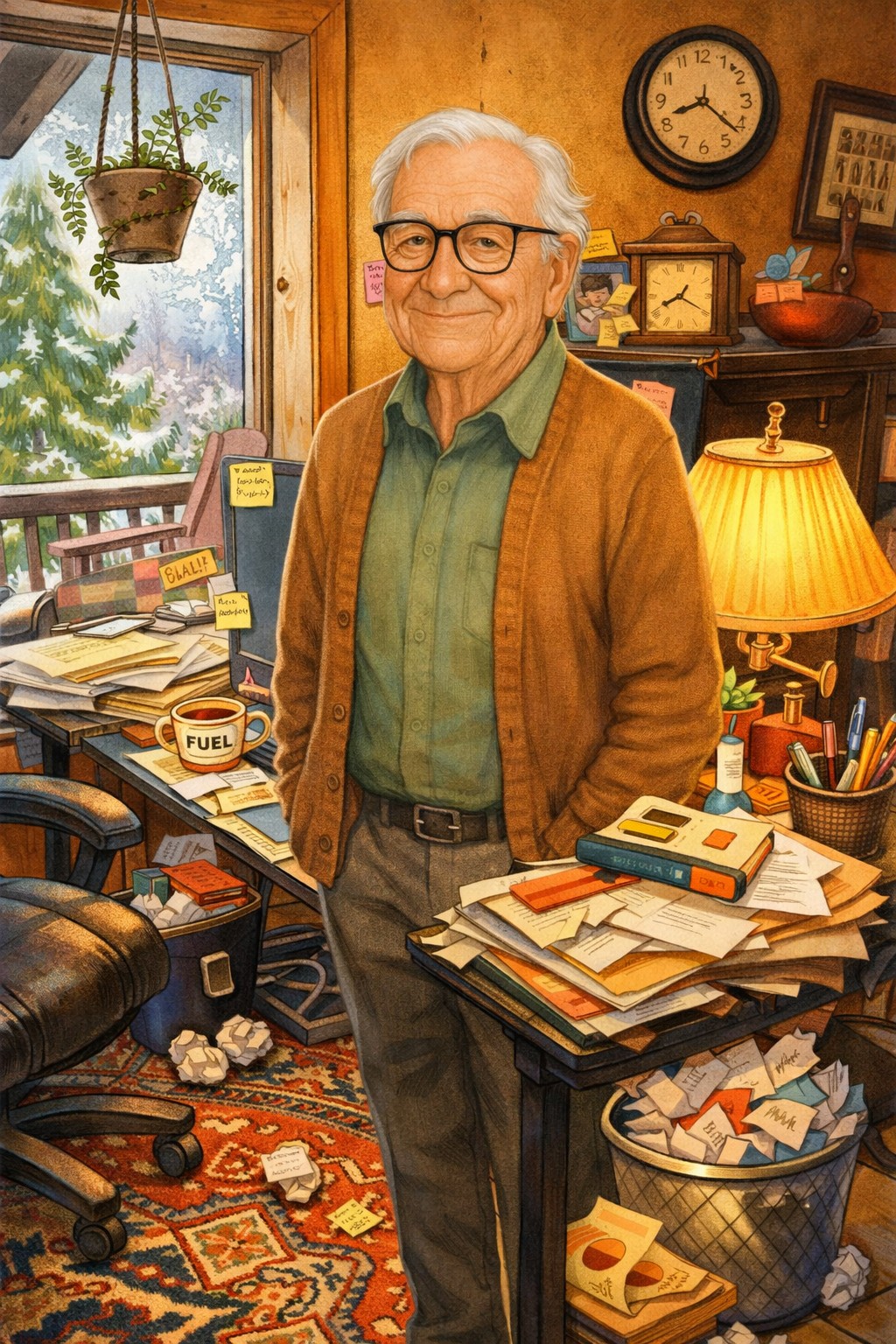
I meant January and February—two months that often keep me snowed in on my mountaintop here in the Shenandoah Valley. And this year—once and for all—they were supposed to be the two perfect months to bring order to chaos. To organize my office.
Boxes. Amazon boxes, to be precise—a small mountain of them, stacked near the woodstove like a cardboard monument to every good intention I’ve ever had. Some are open. Some are not. All of them smile at me. That relentless Amazon smile, curved and cheerful and absolutely unbothered by my shame. I have begun to suspect they are multiplying when I’m not looking.
Desk and worktable. Buried. Buried under manila envelopes, unopened mail, a box of highlighters, a coffee mug that may or may not still contain coffee, and enough paper to reforest a modest hillside. The lamp burns bravely through the chaos like a lighthouse in a nor’easter.
Even the plants have opinions. Two magnificent specimens—sprawling dramatically across their ornate iron stands—have taken matters into their own fronds. One has sent a long, accusatory leaf directly toward my leather chair. As if pointing.
Pointing. Yes, pointing. The same way the ghost of my gray-haired grade school history teacher would point and declare with the wrath of an angry God:
“A cluttered desk is the devil’s workshop.”
And between Mrs. Snyder’s admonitions and my lament—”Where did it go? Where did it all go?”—Poor Brentford appeared as if in a vision rising up from nowhere in particular and everywhere at once.
“Where did it all go, you ask? Where did it all go? I’ll tell you exactly where it went. Pull up a chair if you can find one in that brain of yours, all cluttered now with nonsense.”
I thought I knew for sure where his harangue was headed. But for once he surprised. He did not stoop so low as to rap knuckles with any of the cliches from his repertoire of wisdom.
Not once did I hear,
“Time and tide wait for no one.”
Not once did I hear,
“Make hay while the sun shines.”
I didn’t even hear the one I was certain he would speak with calm certainty,
“Lost time is never found again.”
He didn’t recite any of those things.
Instead, he cleared his throat with great ceremony and delivered his first knuckle rap with the precision of a surgeon and the satisfaction of a man who has been waiting a very long time.
“Only handle it once.”
He let it hang there. Just those four words. Floating in the air above the Amazon boxes and the buried desk and the manila envelopes and the coffee mug of uncertain vintage.
“Your words. Well, Grace Reed’s words, if we’re being precise. Your Copyright Office colleague. The woman whose office was lean, mean, and sparse. The woman whose wisdom you borrowed, researched, published, celebrated, and then—apparently—left to ride around in the Jeep with the junk mail.”
He fixed me with a look that left no room for argument.
“Don’t bemoan where it all went. You know fully well. And you know exactly what to do.”
Then Poor Brentford’s voice softened. Just slightly. Just enough.
“Do you remember what you wrote on January 15th, 2024? You raised your Bunnahabhain to all the tarriers, the delayers, and the occasional shelver. You said, and I quote, ‘Here’s to the to-morrowers, the champions of It can wait until tomorrow, because sometimes tomorrow is just a delay away from today.'”
He smiled. For the first time.
“And do you remember Scarlett?
“She understood something you sometimes forget. Tomorrow is not surrender. Tomorrow is strategy.”
Poor Brentford gestured grandly at the Amazon boxes.
“Your Tara is a little more cardboard than hers. But the principle holds.”
He straightened his jacket.
“The office will get cleaned. One day. Tomorrow, perhaps. Or the day after. Or sometime before the Amazon boxes learn to walk.”
“Scarlett managed. So will you.”
But Poor Brentford wasn’t finished. He stood there, poised to deliver his final and most devastating knuckle rap. Quietly. Almost tenderly.
“Forget the cluttered office for now. I want you to remember something you wrote, something about a young professor who stopped you in a hallway and handed you an offprint with four words inscribed on the front.”
He paused.
“This is life everlasting.”
Another pause. Longer this time.
“You asked whether he was suggesting that we live on forever through what we share with others: ideas immortalized in print. You answered your own question. Here you are, nearly fifty years later, speaking his name. Professor Myerson continues to live.”
He leaned in close.
“And so will you. Through every word you have ever written. Eight books. More than a million words. Scholarship and essays that will outlast every Amazon box in that corner.”
“THAT is your life everlastin’. Now act like it.”
Just when my chair started getting uncomfortable, Poor Brentford had the nerve to tell me to shout out:
“Get behind me, Satan.”
I sprang up at once because in that command I recognized my own mother’s voice. Over and over again I had heard her rebuke the Devil whenever she faced her own pole of proverbial chaos.
Only then did I realize what Poor Brentford had done.
He had serenaded me with snippets of my own advice—counsel I had been publishing right here in this column for years.
I could hardly be offended.
I looked again at the Amazon boxes. The buried desk. The pointing plant.
“The universal does not attract us until housed in an individual.”
—Ralph Waldo Emerson (1803–1882; American essayist, lecturer, philosopher, and poet who led the Transcendentalist movement of the mid-19th century. Known for his influential essays including Self-Reliance and The Over-Soul.)
Memoirists writers are shamelessly self-centered, and I ought to know. I’m one of ’em. And of course, I know that you really want to know why I used ’em instead of them.
You do want to know, don’t you? You don’t?
Well, this is where things start to get dicey, because I’m going to tell you anyway.
I chose ’em instead of them because the former seemed more casual and playful and, in my mind, it makes me feel comfortable bashing the hell out of ’em since I’m bashing the hell out of myself at the same time. Now you know.
Aren’t you glad that I told you? You’re not?
No problem. Like I said. We’re shamelessly self-centered.
Now that I’ve cleared the air about that one teensy-weensy word choice–it was a choice, of course, though I’m not sure ’em should count as a word–let me tell you how the title of today’s post bullied its way to the top.
You do want to know, don’t you? You don’t?
Well, I’m betting that you know exactly what’s coming next. You’re right. I’m going to tell you anyway. Like I said. We’re shamelessly self-centered.
Originally, today’s post was titled “An Apologia for Memoirists.” Clever, no? I thought so, too, despite the way the word apologia looks. It may look like an apology, but it is not an apology at all. Aucontraire. It is a staunch defense of something.
Let me give you an example of an old and famous apologia. I’m thinking of Plato’s Apologia Socratis, the legal self-defense that Socrates spoke at his own trial for impiety and corruption. He was defending himself against the charges of corrupting the youth and of not believing in acknowledged and accepted gods.
After thinking about that example, I decided that apologia was a poor word choice for inclusion in the title of today’s post. As I have just demonstrated, its meaning is easily misconstrued. Beyond that, its pronunciation is not easy either.
Is it “a–puh-low-jee–uh?”
or
Is it “a–puh–low-jee-uh?”
Damned if I know. And if I don’t know how to pronounce a word, I’ll be damned if I’m going to use it.
So, in a touch or two on my Smartphone, I struck right through AnApologia and replaced it with two words that are easily pronounced and readily understood: InDefense.
There. I’ve straightened out Apologia. Now, let me explain why I scrapped Memoirists. I suppose any reader who knows what a memoir is would know–or quickly deduce– that a memoirist is “a person who writes memoirs.” Don’t you detest circular definitions like that? I do. But you can’t blame me for it! Blame dictionary.com. That’s where the definition came from, and that’s why I put it in quotes. I may go ’round in circles, but I would never give you a circular definition. I’d spit it out exactly as it is. A memoirist is someone like me who takes the raw material of their life—its triumphs, trials, quirks, and quiet moments—and shapes it into a narrative that not only reflects their truth but connects with the truths of others.
That definition is mine, and I like it. However, I scrapped Memoirists for an entirely different reason. If you think pronouncing Memoir is an exercise in tongue-mouth calisthenics, try pronouncing Memoirists:
● mem-wahr-ists
or
● mem-wawr-ists
Well, maybe it rolls off your tongue just fine, but it gets stuck to the roof of my mouth. And, I don’t know about you, but when something sticks to the roof of my mouth, I get rid of it as quickly as possible.
That’s just what I did with Memoirists. I got rid of it. Quickly. In just a touch or two on my Smartphone, I struck right through part of Memoiristsand replaced it with Memoir Writers. I know. Two words instead of one. Fine. What I lost in word count, I gained in mouth feel.
It took a while, but now you know–even if you had no desire in knowing–everything you never wanted to know about the origin of the title In Defense of Memoir Writers. Like I said. We’re shamelessly self-centered.
Now, I’m certain that you want to know why I feel the need to defend myself and other memoir writers. You do want to know, don’t you? You don’t?
Well, I’m betting that you know exactly what’s coming …
Like I said. We’re shamelessly self-centered. Right? I mean, after all, we share all of the intimate details of our lives with the entire world as if they give a rat’s ass about our world. But we do it anyway. Is that self-centered or what?
Take me, for example. I may have one-upped Anne Sexton who commented, “I tell so much truth in my poetry that I’m a fool if I say more.” I don’t know how many words are in her canon–she does have a canon, you know, though I shudder at the thought–but since 2021 when my blog shifted focus from research to memoir, I’ve spewed out nearly 300,000 words. My God. I’m taken aback. How is it possible that I have shared so much about me, especially when I tell writers that there’s no me in memoir. If they looked closely, they would see for themselves that there is a me in the word, and, like I’ve said all along, memoir writers like me are shamelessly self-centered. This post proves it. After all that I’ve written who would think that I could write more, but here I am, dragging you along to somewhere I think you might want to be for a few minutes–perhaps leading you to somewhere you might even want to stay a while to rest, perhaps to heal.
I shudder at the things that I have shared with you. I do. You know as much about me as I know about myself, and if you don’t know it off the top of your head–and that’s how certain I am that I matter to you–you can find it by foolin’ around in my blog. Let me zing you with a few things, and as I do, I wonder–I just wonder–whether you would put yourself out there for all the world to know.
You know that I’m so full of myself that I fully believe that I helped my Mother give me birth so that I could start charting new territories in my brand-new world.
You know that as my mother preached I wiped away the tears that fell from women’s eyes, some of them slain in the Spirit and hopping from the back of one pew to the next, all the way up to the front of the church and then all the way back again, never missing a jump and never suffering a fall.
You know that when I hold out my right hand to you, you’re grasping the hand that my Father held tight after he nearly cut it off accidentally while butchering a chicken.
You know the challenges that I faced as a gay guy born in the Bible-Belt in the late 1940s, growing up there in the 1950s and 1960s, trying my best to stay true to my authentic self.
You know that I chase dreams and never let go, even if it takes me 50 years as it took me to become an English professor.
You know that the praying hands my Mother and I witnessed in the lid of my Father’s coffin took us both by surprise with the words, “May God hold you in the palm of His hand until we meet again,” holding for me, and me alone, a lasting message.
You know that after my Mother’s burial, I took my hands–strong from the strength of hers–and released from their cage three white doves, flying upward, perhaps at that same mysterious moment when my mother found her way back home and celebrated her arrival with outstretched hands.
You know that when I wrote my late partner’s obituary, it was as if angel wings brushed across the page, just as magically as Allen brushed across and touched our life together.
Equally important, you know that I sometimes ignore dust bunnies and cobwebs; that I get ideas for writing everywhere, even when biking or weeding; that I notice smells like dill and black snakes; and that when I’m not having real guests, I’m conjuring up imaginary ones.
You know all these things and so much more about me because of one thing that I keep on doing right here in my blog post. Week after week after week, I take my bony index finger, hook the side of my metaphorical homespun curtains, and pull them back gently so that you can see through the fragile glass pane and catch glimpses of my world–past, present, and future. Creation. Faith. Survival. Authenticity. Perseverance. Grace. Transcendence. Love. Imagination.
From that perspective, it occurs to me that maybe memoir writers like me aren’t shamelessly selfish after all. Maybe we take our triumphs, trials, quirks, and quiet moments and try to shape them into a narrative that not only reflects our truths as we know them but also connects with your own truths as you glimpse into your world–past, present, and future.
Maybe memoir writers like me aren’t shamelessly selfish at all. Instead, maybe, just maybe, we’re shamelessly selfless—willing to sacrifice our private selves so that something universal can emerge from the personal. Even if the greater good is one solitary soul, needing an oar to stay afloat, it’s in the act of revealing our individual stories that we reflect something far larger than ourselves.
Maybe that’s our truest calling—not selfishness, but selflessness. And perhaps that’s the best defense I can offer for memoir writers like me.
“You can’t break something that’s already broken, but you can always build something new.“
–Yoko Ono (b. 1933; best known for her avant-garde art and her influence in the peace movement alongside John Lennon.)
The pieces are on top of a bookcase, and they’ve been there for a month or so. Every time I walk past, I see them, five torn pieces of paper boasting blue, picked up from the floor after my dog finished her clandestine mischief.
Once upon a time, I would have just thrown the paper scraps away. This time, I didn’t. This time, I’ll take my time to put the pieces back together.
Here’s why. What Ruby tore apart and left behind for me to find was an important family recipe. Imagine an exquisitely moist applesauce cake replete with raisins, pecans, and candied cherries, baked in a pressure cooker. My mother made the cake every year a few weeks before Christmas, and it was one of my favorites. I haven’t had one of those cakes in decades, maybe longer.
Lately, I’ve had a hankering for that cake, and I’ve searched all over the Internet for the recipe, not remembering that I had it already. My mother had given me the recipe. One day, while looking for something else, I found the full-page recipe with ingredients and instructions, all in her gentle cursive.
I’ll do my best to piece that page together again, hopefully with enough precision that I can read the full recipe. The page, of course, won’t be the same. It never can be. Ironically, it will take on even more meaning because I cared enough to mend it and put it back together. Even though it will always show its brokenness, it will still be my mother’s recipe in her handwriting on her paper. I’ll bake the cake when Christmas nears, and I fully believe that it will be the best one ever because it will have an extra scoop of love.
This is not the first time that I’ve mended the broken.
I’m thinking of a sculpture in my living room. Its earthy tones reflect seamlessly into the highly polished cherry coffee table. The sedimentary rock reveals the raw beauty of erosion and time, with jagged edges and smooth, wave-like ridges suggesting years of elemental force, reminders of the rock’s enduring strength. The fissures, winding through the top, were not there when my late partner gave me the sculpture. But a month or so before Allen’s death, he stumbled against it, and there it lay on the coffee table, shattered brokenness. It stayed there, a daily reminder of fragility and brokenness. Time passed, and I mustered up the courage to artfully glue it back together, its fissures now seemingly an integral part of the rock, adding an almost mystical feel. It’s still on my living room coffee table. It’s still very much alive and reminds me of Allen’s presence.
I had another encounter with the beauty of brokenness years earlier. I had built a graceful, curved walkway on the east side of my home, near the Koi Pond. I wanted to maintain a natural rustic look, so I made the walkway out of large, rectangular natural stone pavers, stabilized by the very earth itself. I leveled the ground as I put the pavers in place, making sure they didn’t move when stepped on. When I finished the 60-foot stretch of walkway, I decided to test its stability by jumping on each paver. When I landed on the second paver from the end, I heard a crack. I looked down and could see a fissure running through the center. I looked beneath the two pieces and discovered a rock, small enough to escape my searching eyes when leveling the paver but large enough to cause brokenness. My immediate reaction was to replace the paver. But I had second thoughts. It still functioned as an integral part of the walkway, and if I widened the fissure just a little and filled it with soil, it might even add a sense of age and character, especially when small patches of grass and weeds started to grow through the crack, proclaiming nature’s power to take back what we think is ours.
My decision to repair what was broken in these three instances was influenced directly by Kintsugi, the centuries-old Japanese art of repairing broken pottery by mending the breaks with a lacquer that’s mixed with silver, gold, or even platinum. The intent, obviously, is not to disguise the brokenness but rather to celebrate its repair and survival, believing that the broken can be mended, made stronger, and remain useful and purposeful.
It seems to me that we can all benefit from an important lesson, whether it be found in broken Japanese art, a broken paver, a broken sculpture, or a broken recipe. The essence of being is being broken. The strength of being is the power of repairing the broken. The virtue of being is valuing and celebrating brokenness.
Let’s face it. As human beings, we are all flawed and broken. It seems to me that if we can repair our broken objects and continue to see their value and their beauty, so too can we repair the broken parts of our own lives.
In our personal lives, we’re destined to encounter moments of fracture—relationships that crack, trust that falters. It’s easy to walk away and to discard the pieces. But when something matters—when love, friendship, or family is at stake—mending becomes an act of grace. It is in the careful work of rebuilding that we find deeper connections and more profound love.
Similarly, in our professional lives, we are not immune to failure. Our careers break under the weight of expectations, and our ambitions sometimes shatter. But brokenness does not mark the end of a career; it marks a turning point. The effort to repair, to rebuild, to piece together what once was, shapes not just our work but our purpose.
And in our spiritual lives—our most intimate, vulnerable selves—there are moments of doubt, of disconnection, of feeling broken. Yet, like ancient pottery, our spiritual cracks are not meant to be hidden. They are to be filled with light, with the gold of wisdom, faith, and renewal. It is through our brokenness that we find our way back to our wholeness.
What is broken can be mended. What is flawed can be made beautiful again. The cracks, the breaks—they are part of the story. And for the things that matter most—our relationships, our work, our spirit—they are worth every moment of care, every act of patience, every effort to repair and restore so that we can celebrate beauty in brokenness.
“The right word may be effective, but no word was ever as effective as a rightly timed pause.”
–Attributed to Mark Twain (1835-1910; one of America’s most celebrated writers and humorists; often referred to as the “father of American literature.”)
By now, MyDearReaders, you know more about me than you should, including the titillating fact that I keep everything. I mean everything. I do. If you doubt me or if you have forgotten my-way-too-personal disclosures, check out “My Taxing Review: A Reality Post” or “OHIO on My Mind,” but not until you finish reading this post. Until then, you’re mine, all mine. I want to keep you to myself. Stay put and relax while I tell you about something I’ve held on to without even knowing that I was holding on to it.
I realized just the other day that I was getting an outlandish number of emails from companies, foundations, and organizations, just because I gave them my email address eons ago, simply to get that 15% discount or simply to get a freebie by donating to a good cause. Over time, “DELETE” became my morning email mantra simply because it never occurred to me that I could stop getting those no-longer-wanted and no-longer-valued emails simply by clicking on UNSUBSCRIBE.
UNSUBSCRIBE. Can you imagine. Is that a brilliant solution or what? Easy-peasy, lemon-squeezy, right? Wrong. More like stressed, depressed lemon zest.
Sometimes, though not too often, unsubscribing is easy. The option appears prominently right at the top of the email.
More often than not, however, I have to work really hard at unsubscribing. More often than not, the option appears hidden amongst all kinds of other options at the very end of the screed that I didn’t want to read anyway. Even then, the option to unsubscribe is in a smaller font requiring a magnifying glass, or it’s in an entirely different color font, almost always so light that it’s impossible to read. And get this. Sometimes, I don’t have a clear unsubscribe option at all. Sometimes, I blaze my way to unsubscribe by clicking on the preferences option.
Unsubscribing, as a rule, is anything but straightforward. Even after finding my way there, I have to confirm that I really do want to sever the tie that I had been holding on to. It’s as if I’m being reminded that I need to think twice. It’s as if I’m being reminded that I need to think twice.
I cannot help but wonder what other areas in our lives we might want to think twice about before taking action.
What about things we often say things to friends in moments of emotion or impulsiveness, forgetting that words can have lasting impacts.
● “I’m too busy right now.”
● “I don’t really care what you do.”
● “I don’t know why I’m even friends with you.”
Perhaps if we paused and considered the weight of our words, we could strengthen our friendships rather than strain them.
Or consider the dynamics of family relationships, where familiarity sometimes leads us to make careless remarks.
● “I’ll call you later.” (But never do.)
● “Why can’t you be more like …?”
● “You’ve always been a disappointment to me.”
Perhaps we need to pause for a moment to remember that our words can either heal or hurt, especially with those closest to us.
Let’s not forget our professional environments where words can carry significant consequences, especially with our boss.
● “I’ll get to it when I can.”
● “That’s not my job.”
● “I think you’re making a big mistake.”
Perhaps we need to pause and remember the powerful importance of tact and diplomacy when communicating with authority figures.
Also, I wonder about our constant self-talk, especially when we become our own harshest critics.
● “I can’t believe I messed that up.”
● “I’m not good enough for this.”
● “I’m not lovable.”
Perhaps we need to think twice before engaging in negative self-talk and instead replace it with a kinder, more supportive internal dialogue that sends us a strong, empowering message.
Finally, what about thinking twice before questioning or challenging our higher spiritual and philosophical beliefs?
● “I don’t know if you’re really there.”
● “Why is this happening to me?”
● “I’ve lost all faith.”
Perhaps we need to pause and approach our beliefs with respect and thoughtfulness in a way that fosters a sense of reconciliation and growth.
Oh. There’s one more thing that I’ve noticed. More often than not, the last thing that happens when unsubscribing is a pop-up window, sighing:
“Sorry to see you go, but if you change your mind …”
It seems to me that if foundations, organizations, and companies are willing to have us back after we unsubscribe from their mailing lists, then surely our friends, our family, our boss, and our Higher Being, will welcome us back into the fold as well. And with any luck, we’ll even come to understand that we are worthy and welcome unto our very selves.
One thing’s for sure. The next time I consider unsubscribing—from an email or a relationship—I’ll remember the power of pausing before acting. And if I act in a way that I later regret, I’ll remind myself that our relationships, like our subscriptions, can often be mended with effort and humility.
Down and dirty and pumped. Yep. That’s what I am. And I’ve had one helluva good time getting there. For the last week or so, I’ve been manhandling the garden that I moaned and groaned about in “Digging Deeper: A Gardening Lesson Applied to Life.”
Remember? I was working in my 70-foot garden, a serene haven that runs along the east side of my home. The garden starts with a small patio beside a waterfall cascading into a Koi Pond and ends with a towering granite Pagoda. A flagstone walkway curves between these two focal points, with a bog garden on one side, originally full of Pitcher Plants, Sundews, Cardinal Flower and Pond Sedge, and a specimen garden on the other, showcasing Clumping Bamboo, Hinoki Cypress, Flowering Crabapple, and more.
It was everything I ever wanted in a small garden—until the Pond Sedge and the Clumping Bamboo began taking over. Then, it became something that I … never wanted.
At first, I thought cutting back the invasive plants would solve the problem, but they kept returning, seemingly stronger each time. The roots were thriving beneath the surface, undeterred by my efforts. Now, I faced a choice: keep battling the tops or dig up the deep, stubborn roots once and for all.
I made the right choice, the only one for me. I decided to do the hard work now and reclaim my garden.
I knew right away that I needed the big guys to get the job done. The first was my 40-inch, fiber-glass-handle trenching spade. It’s lightweight but has a penchant for heavy-duty roughness. With a backstep that provides increased leverage, it’s perfect for getting beneath the roots and lifting them out.
The second is a handheld, dual-headed, carbon steel big guy. It’s great to use when I’m sitting on the ground, really getting down and dirty, digging up roots that the spade didn’t lift out. One head is a pick that goes deep with every thrust; the other, a fork that yanks out mass roots with every pull.
I’ve been putting both big guys to good use for the last week or so, during which time I’ve learned a lot about roots.
First, roots grow in places that I didn’t even know existed. Imagine it, and I can find roots there. Second, roots can be long, really long. I’ve dug out some that were even 10 feet long. Most have been around 3 or 4 feet. Third, roots love to grow beneath flagstone pavers, beneath rocks, and even in and amongst roots of other plants, making the smell of Theodore Roethke’s “Root Cellar” a reality:
“Shoots dangled and drooped, Lolling obscenely from mildewed crates, Hung down long yellow evil necks, like tropical snakes. And what a congress of stinks!”
Fourth, roots grow in clay and rubble where nothing else would dare stake out a claim to life on less-than-meager fare.
Even though I’ve learned a lot, it’s been drudgery. By the end of a day’s work–a kind of outdoor dirt prayer–my hands feel arthritic from sustained gripping, and my blue jeans are knee- and butt-dirty from kneeling and sitting. But I do what I do not only to control the roots and but also to give me the fleeting assurance that they don’t control me.
I won’t tell you about other things that happened while digging up roots, like adding scalloped stone edging along the walkway or relocating a granite pagoda lantern to a slightly higher spot or popping in a new evergreen shrub or three here and there to brighten the fresh layer of pine bark mulch.
And if I’m not going to tell you about all of those enhancements, then I’m certainly not going to tell you about how open and expansive my specimen garden feels now, with all the Bamboo and Pond Sedge gone–tops above and roots below. I know. I know. It’s no bigger than it ever was, but it looks twice as big as ever.
But don’t worry. I’ve got some important observations that I’m about to share with you. They’re important to me, and, hopefully, they’ll resonate with you, too.
For starters, I’m delighted that I had the daring-do to tackle root removal of this magnitude. Even though I still have more work to do, I sprawl out on the ground from time to time, celebrating what I’m accomplishing, knowing that in gardening, as in life, superficial fixes won’t solve deep-rooted problems. Just like with my invasive plants, truly eliminating an issue requires getting to the root of it. Whether in health, relationships, career, or broader societal issues, confronting and removing the roots of our challenges allows us to live more intentional and fulfilling lives.
But get this. As I sprawl in celebration, I do so modestly. I claim no victory. I know that these roots run deep. I know that these roots run wherever they’re inclined to run. I know that remnants of these roots remain, and that probably by the end of this season, Bamboo and Pond Sedge will sprout up here and there all over again. I know that these roots have a tenacious hold.
Those gardening observations remind me that even though roots–literal and metaphorical–may need to be removed when they cause problems, most of the time, roots are essential anchors that ground us.
I’m thinking, for example, about my love of the outdoors. My connections to nature and the environment serve as a grounding force, offering me peace, perspective, and a sense of renewal. Those roots go back to my childhood and even further back to generations of farmers who make up my heritage. Even during periods of my life when I lived in cities, I always found ways to allow the natural world to dig deep into the fiber of my being.
Or here’s another example. My love of cooking. It runs in my family, including my father and my brothers. We felt as much at home over the kitchen stove as we did anywhere else. Let me add to that our love of ethnic foods. I can trace those roots back to my childhood and my cultural heritage in the coal camps of Southern West Virginia. Our little town was a melting pot of nationalities, and everyone shared recipes with one another. Greek Green Beans. Hungarian Chocolate Potato Cake. Caribbean Souse Meat. Polish Cabbage Rolls. Italian Gnocchi. Jewish Latkes. Those ethnic foods and many others continue to tease my palate and provide a sense of belonging.
Or what about the roots that anchor my simple philosophy of life? I believe in the inherent goodness of life, all life. I believe that life is purposeful. I believe in life’s thrust toward greatness. When I look into my metaphorical mirror, I always say, “Every day in every way, I grow a little better.” Those principles—learned in childhood—have always directed my actions and my choices, and they continue to help me navigate my life.
Even when it comes to my notion of community and social connections, my roots run deep. From childhood, I learned to value and embrace diversity, equity, and inclusion. It’s part of who I am. I like to think that I have always been sensitive to race, ethnicity, gender identity, sexual orientation, socioeconomic status, religious beliefs, age, and other unique variations that make us human. Because of those roots, I like to think that regardless of where I might be in the world, I will always enjoy a sense of belonging, and I will always lend a helping hand to those around me.
Also, my work ethic has deep roots. I was born into a working family, and I grew up in a working community. Everyone worked, and, equally important, everyone enjoyed working. Working is what we did. I’ve shared before–and I’ll share it again–the little poem that I cut my teeth on:
“If a job is once begun, Never leave until it’s done. Be its labor, great or small, Do it well or not at all.”
Later on in school, one of my history teachers reminded me and my classmates regularly of the Biblical proverb, “Idle hands are the devil’s workshop.” Her voice echoes still. Even today–after a 25-year federal career and a subsequent 23-year teaching career–I’m reinventing myself, working as much now as ever. Work continues to give me stability, purpose, and a sense of accomplishment. I have every expectation that I will work forever and beyond.
My education and learning roots run deep, too. Even though I grew up in the coal fields of West Virginia, I had some of the best educators in the world, formally and informally. Because of them, I came to believe that an education allows anyone to do anything and to go anywhere. I came to believe that an education is the best investment ever, knowing that it will never depreciate and knowing that no one can ever take it away. I came to believe that learning is lifelong, requiring little more than an inquiring mind focusing on the 5 W’s of writing and journalism: Who, What, When, Where, and Why. What a powerful and empowering foundation for growth.
Personal resilience is a root for me as well, always anchoring me during challenging times. I believe in the power to adapt and grow in any circumstance. I practice what my mother taught me, “Bloom where you’re planted.” I’ve spent a lifetime doing just that. My childhood dream of becoming a college professor was deferred until I turned fifty. Nonetheless, I thrived during those intervening years and had a distinguished career at the Library of Congress. Those 25 years paved the way for me to become a college professor and helped make me the educator that I became.
Intertwined with it all, of course, are the roots of my faith and spirituality. Both have always played a role in my life. My mother was a fundamentalist minister and prayer warrior whose influence on my life is immeasurable. I have always felt that my life was governed by an Unseen Hand, even in times when I was unaware that I was being led. It gives me a sense of connection and grounding, in all times but especially in times of uncertainty. Don’t ask me to explain the Unseen Hand. I’m not sure that I could even begin to do so, other than to celebrate my belief that my God is a big God who loves all creation and who embraces all creation.
So, there you have it. Roots. They anchor us, shape us, and sometimes challenge us. Whether in the garden, where I wrestle with the stubborn roots of Pond Sedge and Bamboo, or in life, where I draw strength from the deep roots of my beliefs, family, and experiences, they are always there. They remind me that while we may need to dig deep to address life’s challenges, we also need to nurture the roots that sustain us.
Every day, as I work in the garden or reflect on the day’s events, I’m reminded that roots are both the foundation and the framework of our lives. They’re what give us stability when the winds of change blow, what nourish us in times of need, and what connect us to the larger world around us.
And as I continue to tend to my garden, both literal and metaphorical, I know that I’m not just removing what doesn’t belong—I’m also nurturing what does. In the end, it’s the roots that keep us grounded, it’s the roots that keep us growing, and it’s the roots that remind us of who we are and where we come from.
Every day, in every way, I grow a little better—roots and all.
—Socrates (470-399 BCE; classical Greek philosopher best known for his Socratic method, which aims to elicit truth by asking questions and engaging in dialogue.)
One of my favorite short stories is Mark Twain’s “The Celebrated Jumping Frog of Calaveras County” (1865). No doubt you’ve read it, too, and will recall how old garrulous Simon Wheeler traps the narrator with a long-winded tale about a man named Jim Smiley and his famous jumping frog. Wheeler’s rambling accounts of Jim Smiley’s exploits appeal to me, especially as they become increasingly elaborate and exaggerated. Smiley and Wheeler are portrayed as eccentric characters with idiosyncratic behaviors and quirks. Who can forget Smiley’s obsession with betting on animals or Wheeler’s folksy storytelling. The premise of the entire story—a man who trains a frog to jump competitively and then loses a bet because the frog has been tampered with—is inherently absurd, adding to the comedic tone.
More than any of those dimensions, however, I like the story’s situational humor. The narrator is “backed into a corner” by Simon Wheeler and unable to escape until the end of his monotonous monologue. If you look at the story closely, you will discover that everything from the fourth paragraph all the way up to and including the next to the last paragraph is enclosed in quotation marks. This setup creates a sense of trapped amusement. The narrator is helpless in the face of Wheeler’s relentless storytelling and remember, as well, that Wheeler physically corners the narrator with his chair, thereby adding a visual element to the absurd humor.
The juxtaposition of the narrator’s predicament and Wheeler’s obliviousness to his captive audience adds a richness to the subtle humor. Here’s why. Even if readers are not consciously aware of that aspect of the story–that the narrator is literally backed into a corner–it seems to me that they pick up on it intuitively because we can all relate to feeling trapped in real-life situations where we are unable to escape.
Twain succeeded in tapping into a universal experience that readers understand. It’s a perfect “been there, done that” moment.
No doubt, you’ve been there, done that, too. Remember that party where you found yourself cornered by the resident “over-sharer”? They regale you with the intricate details of their recent colonoscopy, leaving you desperately searching for an escape route while nodding along, trapped in a vortex of TMI. Hopefully, over time, you came to terms with your boundaries, and you’re comfortable with giving an assertive but diplomatic response:
“I appreciate your openness, but I have to admit, discussing medical procedures makes me a bit squeamish. Let’s shift the conversation to something more lighthearted.”
Such a response communicates your discomfort with the topic, sets a clear boundary in a respectful manner, redirects the conversation without dismissing the other person, and maintains a friendly and polite tone.
Or maybe your friends dragged you off to a karaoke bar, and despite your protests that you couldn’t carry a tune to save your life, they insisted that you join in. As you droned an off-key rendition of “Every Breath You Take,” you felt like a reluctant participant in a musical hostage situation.
Getting backed into a corner by peers happens over and over again until we take time to reflect on our personal boundaries with a determination to be more assertive. When we gain insights into those areas, we know our limits, we know how to stand firm, and we know how to say “no.”
Or maybe you got backed into a corner at a family gathering where you’re bombarded with questions about your career, relationship status, and future plans. Despite your discomfort, you navigated the awkward interrogations with forced smiles and vague answers, feeling trapped in a whirlwind of familial expectations and scrutiny.
How can you avoid feeling trapped in future family gatherings? Consider your comfort level with discussing personal topics. Set your own boundaries. Once again, by gaining insights into those areas, you can navigate future events with greater ease and respond to questions assertively and confidently.
Hopefully, you’re getting my point. We’re all backed into corners by family and friends in social situations where we never expected to be in the corner, feeling so uncomfortable.
But if we seize those encounters as opportunities to examine why we felt uncomfortable, to clarify in our own minds our beliefs, to understand the nature of our boundaries, and to resolve to assert ourselves, we can navigate future social situations like that with far greater confidence, simply because we took the time to examine ourselves.
I am reminded of something that acclaimed writer Mary E. Wilkins Freeman once said:
Sometimes I believe that the greatest thing a man’s friends can do for him is to drive him in a corner with God.
Whoever, whatever, whenever, wherever or even if God is, we all know exactly what Freeman has in mind. It’s that final moment of reckoning when we are accountable unto ourselves.
But here’s the thing. Why wait for friends? More likely than not, our friends are too polite. More likely than not, our friends are too nonconfrontational. More likely than not, our friends are too diplomatic. Let’s not wait, then, for our friends to drive us in a corner. Let’s not expect God to be in the corner waiting for us, either. Let’s just go on and do it. Let’s just go ahead and back ourselves into our own uncomfortable corners so that once and for all, we have to address major issues that we can’t escape. Let’s not avoid them. Let’s not pay lip service to them. Let’s not talk out of both sides of our mouths about them. Let’s simply back ourselves into our respective corners, examine the issues, and discover where we stand.
God knows that I’ve lived long enough to back myself into lots of corners. For some, I’ve been in them so often and so long that they’re rounded. For others, I’ve just gotten in them, and I’m discovering their recency, their rawness, and their sharpness. Let me share some of my corners. As you read about mine, be mindful that I am not trying to convince you to share my beliefs. You’ve got your own beliefs and your own corners–soft or hard. At the same time, I am encouraging you to back yourself into your own corners and to examine your issues and concerns in private before the world forces you to examine them in public.
One of my corners deals with Racism and Discrimination. Growing up in West Virginia coal camps alongside African Americans, Whites, Greeks Hispanics, Jews, Italians, and Hungarians, I witnessed the power of unity and mutual respect. Our dads worked together in the mines; our moms cooked together in the kitchens; and we kids played together in the yards. We recognized each other’s humanity and worth. Today, I cringe when I witness racism and discrimination that cast a dark shadow over all of us. I am pained as I examine the harsh reality of ongoing injustices and the destructive impact of discrimination. Yet, I remain steadfast in my belief in the interconnectedness of humanity and our entitlement to equal rights. Simply acknowledging the problem isn’t sufficient; we must actively advocate for change and dismantle oppressive structures. By standing in solidarity with marginalized communities and confronting racism abd discrimination head-on, we can move towards a more just and cohesive society. Every individual, regardless of race or background, deserves to be valued and respected. It’s time to build a future where equality and inclusion are the cornerstones of our society.
The Russia-Ukraine War and the Israel-Gaza Crisis leave me speechless in disbelief as I examine the issues in my corner. How can this be happening in our world today? The unprovoked invasion by Russia into Ukraine and the attacks from Gaza into Israel are stark reminders of the fragility of peace and stability in our world. In these tumultuous times, I firmly believe that the United States and other nations must stand together on the side of justice and righteousness. We cannot turn a blind eye to aggression and violence. It’s imperative for the international community to rally behind efforts for peace, diplomacy, and the protection of innocent lives. We must advocate for dialogue, de-escalation, and respect for international law to ensure a safer and more just world for all.
Another corner that I’m examining is Artificial Intelligence (AI). As a staunch AI supporter, I’m deeply concerned by the lack of awareness surrounding its potential and our collective responsibility in shaping its trajectory for the greater good of mankind. AI has the power to revolutionize countless aspects of our lives, from healthcare to transportation, education to entertainment. However, without careful consideration and ethical oversight, there’s a risk of unintended consequences and misuse. We must advocate for transparency, accountability, and inclusivity in the development and deployment of AI technologies. By promoting education and fostering informed dialogue, we can ensure that AI is harnessed responsibly to benefit humanity as a whole, rather than serving narrow interests or exacerbating existing inequalities. Let’s work together to shape a future where AI serves as a force for progress and empowerment, guided by principles of ethics, empathy, and equity.
You’ll find me in a corner, too, with Global Warming. It terrifies me. Its effects are undeniable. Extreme weather and melting ice caps make it clear. Our planet is in crisis. I’m so alarmed that I even contemplate solutions like space colonization. But while this idea may gain traction, it shouldn’t be our first resort. Instead, urgent action is needed. Transitioning to renewables and reducing emissions are crucial steps. The time for change is now. We must prioritize Earth’s preservation, ensuring space colonization remains a last resort.
My next corner is a hard one because discussing politics has never been my cup of tea. But with a Presidential Election ahead of us–presumably between President Biden and Donald Trump–I feel compelled to examine where I stand. Key issues like the economy, world trade, green investments, race, and criminal justice weigh heavily on my mind. In those areas–and others–President Biden earns my support with his comprehensive plans and commitment to progress. However, there’s one more crucial factor that will sway my vote: morality and decency. In this election, every vote cast will shape the narrative of a major morality play. The character and integrity of our leaders matter deeply. It’s about more than policies; it’s about the soul of our nation. I believe President Biden embodies the values of empathy, integrity, and decency that are essential for effective leadership. While I may not agree with every decision or policy, I trust that President Biden will lead with compassion and integrity, prioritizing the well-being of all Americans. At the end of the day, my vote for him may just tip the scales towards a more just and compassionate future.
Economic Inequality hits home for me, too. As the son of a West Virginia coal miner whose family often lived from paycheck to paycheck, I know firsthand all about economic inequality. Despite some progress, I still see in my own community the struggle of living on an inadequate minimum wage. It’s frustrating to witness marginalized groups face barriers to advancement, especially when it comes to leadership roles and fair pay. Addressing these issues demands systemic change in workplaces. Additionally, the current minimum wage barely covers basic needs, widening the wealth gap. I firmly believe in raising the minimum wage, implementing fair tax policies, and investing in education as crucial steps. We must break barriers so that everyone can have a shot at a better future.
What can I say about my LGBTQ+ corner? I’m intimately familiar with the journey of self-discovery, self-examination, and the courage it takes to live authentically. Growing up, I carried the weight of my identity, aware of my differences before I even started school. All along my journey, I assumed that everyone knew that I was gay. However, it wasn’t until I reached the age of 50 and found my soulmate that I felt emboldened to “come out.” I had Allen’s support. I had Emerson’s backing, expressed so eloquently in his “Self-Reliance.” My colleagues, my students, and my friends made me know the warmth and authenticity of their embraces, yet I encountered unexpected pushback, rebuke, and rejection from some members of my own family. My personal journey underscores the importance of advocating for LGBTQ+ rights. While we’ve made significant progress, regressive actions both domestically and internationally threaten the rights and protections we’ve fought for. Discriminatory laws persist, jeopardizing the hard-won gains of the LGBTQ+ community. From rollbacks on protections for transgender individuals to the criminalization of same-sex relationships, the fight for equality continues. Despite the challenges we face, I remain steadfast in my belief in our right to live authentically, free from discrimination. We must persevere in our advocacy efforts, challenging discriminatory practices and demanding equality for all LGBTQ+ individuals. Together, we can work towards a future where LGBTQ+ individuals are fully recognized, respected, and afforded the same rights as everyone else.
In addition to these societal challenges, what about Women’s Rights? The persisting inequities within homes and workplaces, coupled with debates on reproductive autonomy, require examination, too. The burden of domestic responsibilities disproportionately falls on women, intertwining with workplace disparities like the unyielding gender pay gap. Conversations surrounding women’s reproductive rights, notably access to abortions, remain a contentious battleground. Addressing these issues isn’t merely a call for justice; it’s an urgent plea for societal transformation. Let us back ourselves into the corners of these crucial discussions, questioning norms, challenging biases, and advocating for a world where women stand on equal ground in every facet of life.
I’ve saved my overarching corner for last. Am I my brother’s keeper? Absolutely. Yes. It doesn’t matter whether you’re gay or straight; poor or wealthy; Democrat or Republication; believer in climate change or not; for or against AI; Russian or Ukrainian; Jew or Palestinian; African American, White, Greek Hispanic, Italian, Hungarian, or any other cultural group. My conviction runs deep and is rooted in my belief that we are all interconnected, all part of the same human family. My brother isn’t just a blood relative; they’re every person I encounter, every life I touch. Witnessing and examining the struggles and injustices faced by one or faced by all fuels my passion for advocacy and compassion. It’s not enough to stand idly by; I am compelled to act, to uplift, and to support those in need. Whether through lending a helping hand, speaking out against injustice, or simply offering a listening ear, I embrace my role as my brother’s keeper. Together, we can build a world where empathy and solidarity reign, where every individual is valued and empowered to thrive.
Obviously, numerous other issues weigh heavily on my spirit, too. Environmental Sustainability. Healthcare Access. Education Equity. Immigration Reform. Their significance is not lost on me. Often, I’m in my corner examining them, too.
I know all too well that life’s demands and distractions can easily cause us to sidestep uncomfortable truths and to skirt prickly issues that challenge our beliefs and convictions. However, I maintain that one of the most enlightening experiences we can gift ourselves is to willingly back ourselves into a corner, metaphorically speaking, where we are compelled to confront and examine the depths of our convictions and the authenticity of our beliefs. By immersing ourselves in situations that demand introspection and self-examination, we open the door to profound personal growth and a deeper understanding of ourselves and the world around us.
I didn’t intend for today’s post to end up being a call to action. Yet, it is. I’m asking that we examine our core beliefs about the issues that matter most to us. We don’t have to march out onto the world’s stage and be advocates if we’re uncomfortable being front and center, wearing the shield of our beliefs. However, when the world comes to us–as it most assuredly will, at parties, at family gatherings, among peers, or even at work–I hope that we are bold enough not only to share our beliefs but also to stand by them.
Today, I challenge you to examine your life and to examine the issues that surround not only you but also the rest of the world. Go on. Do it. Back yourself into a corner.
“Knowing yourself is the beginning of all wisdom.”
–Aristotle (384–322 BC; Greek philosopher whose foundational contributions to philosophy, science, and ethics profoundly influenced Western thought and continue to shape intellectual inquiry today.)
As a lifelong learner, I never cease to be amazed by the little things that I learn–more or less by accident or by trial and error–that have far-reaching significance when I apply them to my life.
One day last week, for example, I was in the kitchen after dinner, trying to make the biggest decision of the day. Do I use the dishwasher? Do I wash the dishes by hand?
It was hardly a decision. Actually, it was a no-brainer, especially since we had seven inches of snow on the ground, and I had spent a lot of energy that day clearing the stone walkway and the gravel driveway. It was a quick and decisive win for the dishwasher.
I loaded it systematically, popped in the little Cascade pod, selected NORMAL and SANITIZE, pressed START, and closed the door. Usually, at that moment, a red beam flashes on the floor, just below the dishwasher’s door. I never look to make certain, but this time, something made me look back. No light.
Hmmm. Maybe I didn’t press START. I opened the door, pressed START, and closed the door. Once again, the light did not shine its beam.
I opened the dishwasher and looked at the control panel more carefully. To the far left, I saw ON/OFF. Then I remembered the electrical hiccup earlier in the day. Maybe if I turned the dishwasher OFF and waited for a while, it would reset itself. If powering OFF works for computers and other gadgets, it might work for dishwashers, too.
Sure enough. Five minutes later, I pressed ON, NORMAL, SANITIZE, and START. The red light beamed on the floor, and my Bosch worked as beautifully as ever.
Imagine that! All that it took was turning it OFF, waiting a bit, and turning it back ON. One switch was all that it took to get it going again, just like new.
Somehow, I immediately started thinking about aspects of my life where I might need to press the OFF switch in order to come back ON again with greater vigor.
I wasn’t thinking about a major life reset, nudging me to step back in order to get back on course. I wasn’t thinking about having a day of unplugging my Smartphone, my PC, and my other electronics as people are challenged and encouraged to do on the Global Day of Unplugging.
What I had in mind was exploring some areas of my life that I could turn OFF long enough to allow me to step back, evaluate, develop new strategies, and then turn back ON with a new sense of purpose and joy.
Luckily, my life is simple. I do what I do by choice. I try to avoid extraneous activities or social connections that aren’t meaningful.
Luckily, too, I don’t need to push the OFF switch on areas of my life such as finances, friendships, reinvention, research, or writing. They can remain ON.
Luckily, I don’t have a lot of OFF/ON considerations to make. Nonetheless, I have a few things to consider.
The first thing that sprouted in my mind was gardening. How ironic considering the seven inches of snow on the ground. But, hey, my first gardening catalog had arrived from Plant Delights Nursery, and I had been in a lustful mood ever since. Who wouldn’t be with gorgeous specimens such as Philipp Hardy Ladyslipper Orchid and Gay Paree Peony staring at me, winking at me, and tempting me.
The shameless seduction went on, page after page. Every time I saw a hot specimen that I had to have, I dog-eared that page. The catalog had 113 pages, and that’s exactly how many dog ears I had. Don’t worry. With each wink, I mentally surveyed my snow-covered garden, planning where I would bed down this plant and where I would tuck in the next plant and the next and the next.
And the next thing I knew, I pressed my gardening OFF switch. Here’s why. My garden beds have always involved huge investments of time and money. For twenty years, my late partner and I took great joy in creating new beds and putting in new specimen plants. Each year, the gardens and our investments grew exponentially. However, since Allen’s death, I’ve had to do the “doing” alone.
What better time than right now in the dead of winter with snow on the ground to press the gardening OFF switch? Maybe my decision will provide unexpected emotional healing. Maybe it will allow me to acknowledge the weight of past investments and the changes that have occurred in my life during the last three years. By giving myself permission to hit the OFF switch and step back, maybe I’ll be honoring Allen’s memories while also prioritizing my own well-being. Maybe my ultimate decision will be to focus on garden maintenance and garden celebration instead of new projects and new plants. It might give me a deeper appreciation for the beauty of the present moment while laying the groundwork for continued growth and creativity in the gardening seasons yet to come.
Then, I started thinking about cooking and baking. Next to gardening, that’s probably the area in my life gobbling up the most time and money. Don’t get me wrong. I love my kitchen adventures. But here’s the thing. I like to cook daily, using fresh ingredients bought daily. While I like simple down-home foods, more often than not, I’m traipsing into the more complicated culinary wilderness of international cuisines, especially Thai and Vietnamese. To make matters more complex, I don’t like leftovers, especially if I’m going to pop them into the freezer to be thawed for future consumption. Sorry. It just doesn’t turn me on at all. On top of all that, these days I’m cooking and baking most of the time just for me. I still use my best linens, china, flatware, and stemware daily, but it can be a challenge even when I’m dining by candlelight or in front of the kitchen fireplace.
If it sounds lovely, it is. But I’m wondering what would happen if I turned my cooking/baking switch OFF for a while, maybe for just a week. Maybe stepping away from daily cooking and baking routines would prompt me to appreciate the simplicity of meals prepared with minimal effort. Or I might discover the joy of uncomplicated dishes and find satisfaction in the ease of preparation. Or maybe it would deepen my appreciation for the artistry and craftsmanship of professional chefs, especially if I ate out or (God forbid!) ordered takeout during my OFF week. It might inspire me with new culinary ideas and perspectives and enrich my future cooking endeavors. If nothing else, stepping away only to reaffirm my belief that home cooking always wins would be worth switching to OFF for a week.
Next up, my exercise routine. I’ve been biking indoors seven days a week for 20+ years. Obviously, I love my Schwinn. In addition, I have a LifeFitness weightlifting system, and I try to work out three times a week. However, if I had to pick one word to describe how I feel about my exercise routine these days, it would be boring. Yep. Boring. I really need to hit the OFF switch for a while. Even before I do, I know that I will be miserable and grouchy. Aside from needing physical benefits, I need the emotional centering that biking gives me. Maybe I need to “miss” it in order to rekindle the flame. But what about the weights? I ain’t missing them at all, yet I know that a man my age needs to lift weights to maintain muscle strength and bone density. Who knows what my OFF time will do? Maybe I’ll end up joining a local gym so that I have more structure, discipline, camaraderie, and even competition. OMG! Maybe I’ll end up with a personal trainer. Double OMG!! Maybe I’ll end up with a home sauna as an incentive to work up a sweat. Triple OMG!!! Maybe both, at home!
I have one last dimension of my life to think about. My spirituality. I like to believe that I know who I am. I like to believe that I know my core values and beliefs. I like to believe that I know how things stand between me and the universe and a snowy winter day. I like to believe that I listen to the constant whisperings of my inner voice.
Yet, even in the still and calm of my mountain world, the busy-ness of my daily life creates mind chatter that interferes with spiritual communication signals. It’s been a while since the flutter of angel wings, the sound of unknown voices, or the mysteries of Third Eye visions have made me pause, longing for lasting. I want those spiritual moments to be more frequent and more abiding.
To reach them, I won’t turn my spirituality switch to OFF. Instead, I will turn everything else OFF as I head off to a retreat–perhaps a day, perhaps a weekend, or perhaps a week–with nothing required of me other than honoring a vow of silence so that I might better hear the sound of my soul calling.
Flipping the switches to OFF will not redefine me. It will refuel me.
Flipping the switches to OFF will not weaken me. It will strengthen me.
Flipping the switches to OFF will ignite a more profound ON and will push me forward, nourished, rejuvenated and powered by newfound vigor and dynamics.

 The Wired Researcher