“The facts may remain the same. The narrative doesn’t have to.” —Brent L. Kendrick (b. 1947).
I’ve written it before and I’ll write it again.
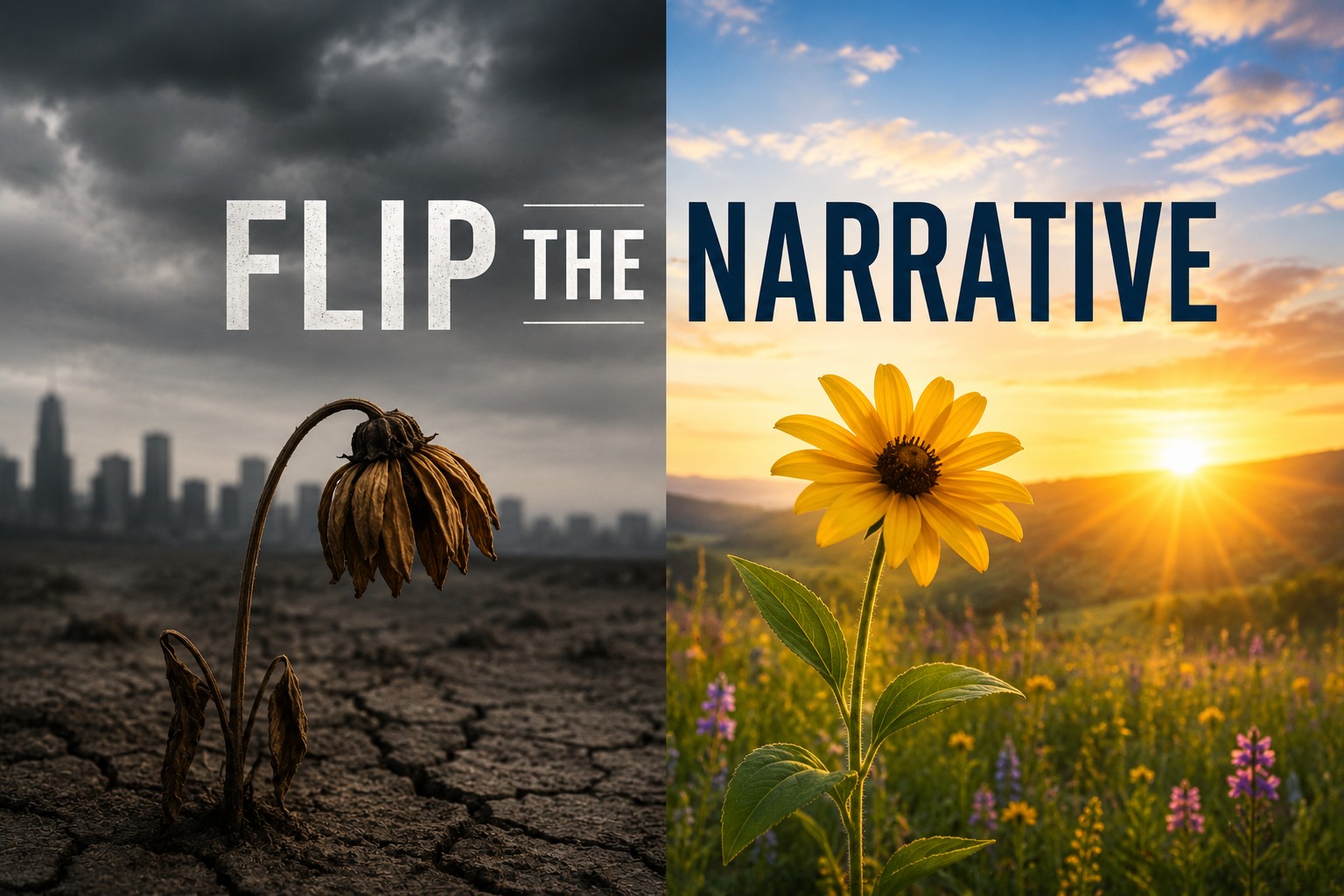
Flip the narrative.
You read it right. But I want you to read it again.
Flip the narrative.
When the daily news overwhelms you, flip the narrative.
When technology frightens you, flip the narrative.
When society disappoints you, flip the narrative.
When family and friends let you down, flip the narrative.
When your body reminds you that you’re getting older, flip the narrative.
When life seems to be shrinking, flip the narrative.
When hope begins to flicker, flip the narrative.
And if you think you know what I’m going to say next, I’m making my point.
Flip the narrative.
Flip the narrative because the daily news is not the whole story. Headlines are paid to interrupt your breakfast, not to nourish your soul. They shine spotlights on what is broken, while millions of quiet acts of kindness slip by unnoticed every single day. If all you read is the news, you will eventually believe darkness has won. It hasn’t. Flip the narrative.
Flip the narrative because technology is neither angel nor devil. It is a tool, and tools have no conscience of their own. We lend them ours. Every generation has feared the next invention, certain it would be the one to finally replace the human heart. It never has. The hands change. The fear stays the same. Flip the narrative.
Flip the narrative because society is more than its loudest voices. Every day, strangers hold doors, volunteers serve meals, neighbors check on neighbors, teachers stay late, and someone somewhere chooses grace over anger. Those stories rarely make the evening news, but they make the world worth living in. Flip the narrative.
Flip the narrative because the people who love us are gloriously, frustratingly human. They disappoint us. We disappoint them. If we measure every relationship by its failures, we will eventually stand alone. Better to count forgiveness as often as we count offenses. Better to remember that imperfect love is still love. Flip the narrative.
Flip the narrative because every birthday steals something and gives something back. Your knees may protest. Your memory may hesitate. Your hair may surrender. But wisdom quietly takes a seat beside you. Perspective grows stronger. Small things become precious. You stop trying to impress everyone and start noticing what truly matters. Flip the narrative.
Flip the narrative because a life that seems to be shrinking is often becoming more focused. Doors close. Dreams change. The horizon may draw nearer. Yet, somehow, the heart discovers that depth can be every bit as magnificent as distance. Sometimes life doesn’t become smaller. It becomes richer. Flip the narrative.
Flip the narrative because hope is not pretending everything is fine. Hope looks reality squarely in the eye and refuses to let despair have the final word. Hope has outlived kingdoms, survived wars, buried loved ones, endured heartbreak, and still gets up the next morning expecting light.
The rake lay across the heart, as if it were Cupid’s arrow. Beads of water gathered on the thermos, upright on the nearby stone bench, right beside St. Francis of Assisi. Leather gloves and pruning shears bore witness to a gardener. Gary.
I couldn’t see him, but I knew he couldn’t be far away because his seafoam, floppy hat was not on the bench with his other things.
I knew what he was up to.
The time had come for him to do what I had done down through the years since I built the garden, filling it in with tons of tan pea gravel and surrounding it with a hedge of Little Missy boxwood.
Early on, the labor of weeding was easy. The pea gravel kept unwanted growth under control and beneath the surface. But over time the AngelinaSedum, filling the two circles in the heart’s upper lobes and surrounding the Magnolia in the lower cusp’s circle, died out but not before leaping over the rings that held them. Small chartreuse-yellow clusters softened the heart but lessened its definition.
Gary, my partner—the man who now shares this mountain life me—was doing more than weeding. He had already restored the flagstone pathway leading from heart to home and back again. Now he was planting healing Ajuga that will settle in and stay within the upper rings, eventually sending up purple spikes. Now he was cleaning, making everything as pristine as the day I finished my handiwork. I sat down on the bench, surveyed the slope, and sighed,
“Well done.”
I never had any intention of building the heart garden. My late partner Allen and I had tamed our mountaintop wilderness with so many paradisiacal garden beds that we had declared a moratorium:
“No more.”
But when Allen died and I reflected on where I would scatter his ashes, as mutually agreed upon, I could not for the life of me decide upon the right spot.
We had talked about resting places on our mountaintop, usually settling on the peony garden. Once, even, Allen suggested the Koi Pond would be perfect, but amid laughter, we both exclaimed:
“Oh, no! What happens when the pond filters get cleaned.”
Then, a few months after his death, he came to me in a dream, his voice carrying into my awakening and lingering there:
“Build my heart.”
I knew where. Near the house, at road’s edge—an untamed area we thought about gardening if we ever gave our moratorium a reprieve.
I had no idea how, but I figured a little math and lots of heart would make it happen.
And it did. I marked off an area twenty feet wide and thirty feet deep, sketched a heart with a black water hose, freed the earth of weeds, and blanketed it with pea gravel running deep. For Allen’s celebration of life, I surrounded the heart with SunPatiens, alternating red and white with tears and rain. I bought a wooden Zen rake, perfect for committing Allen’s ashes to the gravel, leaving tracings that mirrored the heart’s design, growing smaller and smaller as the center neared. Later, I planted the boxwood hedge.
Thus, the heart’s beginning.
Time has been kind. But still, the heart needs Gary’s loving care and tenderness. It rests within the landscape, its presence a part of forever.
The morning after Gary finished, we decided to amble down the path, pristinely cleaned and gently curved, with the heart in clear view.
“You go ahead. I’ll be there shortly.”
“No. I’ll wait. For you.”
It was peaceful and inviting.
We talked a little less than usual, as the morning chill quickened us and a Northern Cardinal in the treetops above whistled out its own litany of little questions.
“I want your ashes to be happy here.”
They will.
And when Gary’s time comes, I’ll board the train, his weight on my lap, my hands on the box, making his final journey to Minnesota where his story began.
“Convince me that you have a seed there, and I am prepared to expect wonders.”
—Henry David Thoreau (1817–1862). American essayist, naturalist, and author of Walden, whose writings celebrated attentive living and the quiet wisdom of nature.
Superstitions surrounding Friday the 13th do not concern me. If my middle name weren’t Lee, it would be Lucky. I walk under ladders, ignore black cats, shop, travel and do all the things others won’t do. I will keep right on doing what I’ve always done. But this year, my luck may have run out. Or not.
The day started out on as good a note as possible. I fed my sourdough starter in my usual fashion even though the kitchen was a tad cooler than usual. A slow rise never kept me from planning ahead for scrumptious sourdough pancakes.
After our usual morning routines, Gary and I went out for lunch and returned home. In the afternoon, I preheated the oven to 350° so that it would be ready for whatever it was that I planned to cook for dinner.
Then I went about my affairs as usual. That is until I smelled a wonderful aroma wafting out from the kitchen. Bread? Cake? I was fascinated because I hadn’t started dinner. What could it possibly be?
Just as I walked into the kitchen to see what had lured me there, I exclaimed,
“Oh. No. My sourdough!”
When I turned the oven to preheat after lunch, I forgot that hours earlier I had put my sourdough starter in there on “proof” to get a faster rise.
What I saw when I opened the oven door was not fermentation. It was transformation.
The jar no longer held a living starter. It held evidence of my carelessness. The sides were lacquered in amber and gold, as if the sourdough had tried to climb out and been stopped mid-escape. A caramelized tide line marked how high it had risen before heat overtook it. What had once been soft and elastic was now fixed in place, streaked and hardened like candle wax after a long vigil.
Inside, the starter had transformed into something strangely geological. A pale, spongy dome baked solid at the edges, its surface torn open in small craters where trapped gases had burst and frozen in time. The smell was unmistakable: toasted flour, faint sweetness, a whisper of bread that almost existed.
I stood there looking at a crime scene, fully aware that the culprit and the witness were one and the same.
I had been the one who coaxed these mountain spores into life years ago, watching their first tentative bubbles gather and rise as if they had somewhere important to be. I had fed them, talked about them, and trusted them to do their quiet work while I went about mine.
They had made their way into breads and cakes and cookies and scones and cinnamon rolls, earning praise far beyond my mountaintop kitchen. And yet, on this particular Friday the 13th, I had forgotten them entirely, leaving a small natural wonder behind, unnoticed, to the fate of an oven I had set to preheat.
For a time, I did nothing but stand there, laughing at my stupidity while absorbing the lesson. There seemed little left to do but clean the jar and move on.
But just when I was feeling the depth of loss, I remembered. Flakes. Sourdough flakes.
A year or so ago I had dried some starter and set it aside, more as an experiment than anything else. I never imagined needing them. They sat unnoticed in a small jar, ordinary and still, offering no hint that they might hold anything alive.
I weighed a small portion and put it in a bowl with an equal amount of warm water. I watched as they softened and disappeared into a cloudy mixture. Then I added an equal amount of flour, creating a pasty potential. It felt more like a laboratory ritual than a kitchen rescue. Truthfully, I wasn’t certain anything would happen. But I held on to hope, realizing that those flakes were the only thing left for me to try.
At first, nothing happened.
The mixture sat on the counter looking exactly as one might expect flour and water to look when stirred together: pale, still, and entirely unremarkable. I told myself not to expect too much. After all, these were only dried remnants, fragments of something that had once been alive. Whatever vitality they possessed had long since faded.
But some time later–hours, perhaps less–I noticed a change so small it might easily have been missed. A tiny bubble appeared along the edge of the bowl. Then another. The surface loosened almost imperceptibly, as if taking a slow breath after a long sleep.
By the next morning, there was no denying it. The mixture had awakened. Fine bubbles traced delicate pathways through the paste, and a faint, familiar aroma rose to meet me—not flour, not water, but something living. Something remembering what it had been.
What astonished me most was not simply that the sourdough culture had returned, but how quickly it did so. Years ago, when I first coaxed those mountain spores into existence, I waited days for signs of life, peering into the jar with the anxious patience of a novice. This time, revival came with confidence, as though the culture already knew what it was meant to do.
Up from the flakes it arose.
What had seemed lifeless only hours earlier now stretched upward, gathering strength from invisible work. I found myself watching it the way one watches a garden after rain—not interfering, not hurrying, simply witnessing growth. A living culture once again, carrying within it all the strength and possibility of its ancestral spores.
And standing there, I realized that nothing about it felt accidental. Life, given the smallest chance, had simply resumed its work.
Watching it rise again, I began to understand that what I had witnessed was more than a small kitchen recovery. I had baked the starter, yes. But I had not baked the possibility.
Something essential had been preserved long before the mistake was made. Tucked away almost absentmindedly, those flakes had carried forward what mattered most. Given warmth, patience, and a little attention, the sourdough culture simply resumed its work, as though interruption were only a pause and not an ending.
It struck me then how stubbornly life finds its way back, even after neglect, even after carelessness. What appears lost may only be waiting for the right conditions to begin again.
Perhaps that is the real lesson Friday the 13th had to offer me this year. Not bad luck. Not superstition confirmed. Just a moment of carelessness and a jar of forgotten flakes, both filled with truth. We measure our mistakes with finality, and we assume that one moment of inattention defines the whole story.
It could be any morning up here on the mountain. Any season. The light spills over the valley like it’s been rehearsing for centuries, finding its way to the deck that I sanded and painted myself. Ruby’s already made her first round of the yard, nose to the wind, tail announcing that all is well in our little dominion—hers and mine and Gary’s.
From the outside, it might look like the middle of nowhere. But to us, it’s home. It’s our mountaintop oasis. It speaks peace. It speaks love. It knows both.
And yet—I am afraid.
I’m not afraid of dying.
I’m not afraid of the questions at my annual doctor’s visit—how’s the sleep, how’s the balance, any falls lately? I know the drill, know the tone. It’s the small talk we make with time itself.
I am afraid of more than that. Much more.
I am afraid of living.
I am afraid when I watch our nation take one step, then another, back and back and back toward what too many call the “Good Ole Days.” Days that weren’t always that good in reality—at least not for everyone. I’ve seen real progress during my seventy-seven years, hard-won and deeply felt. But now I know what it feels like to watch it slip away.
I am afraidwhen I see the National Guard deployed to American cities—unbidden, uninvited—storming in under the cloak of “security,” while local leaders protest and courts rule against the deployment as unconstitutional.
I am afraidwhen I see streams of homeless men, women, and children forcibly cleared from our Nation’s capital—not relocated, but shamed off the sidewalks, invisible again to the people who run the city.
I am afraidwhen masked men wearing ICE uniforms sweep through neighborhoods in unmarked vans—when people are grabbed at early hours, dragged from their routines, as children watch from windows.
I am afraid when I see our public health agencies bend—when the CDC overturns or ignores scientific consensus, issuing guidelines that feel political more than medical, eroding trust in what should be shields, not targets.
I am afraidwhen I see older Americans treated as burdens instead of blessings—when Social Security and food programs are cut under the banner of “efficiency,” when Medicare oversight is weakened and the sickest lose coverage, when senior housing programs vanish from federal budgets as if aging were a mistake. When growing old becomes a liability instead of an honor, a nation has lost its sense of inheritance.
I am afraidwhen I see poor and working families once again blamed for their poverty—when SNAP and WIC are gutted, when rent assistance dries up, when wages shrink while profits soar. Poverty is being rebranded as personal failure again, as though the system itself weren’t tilting the table.
I am afraid when I see classrooms and libraries turned into battlegrounds—when teachers are monitored, words are banned, and curiosity is treated as defiance. When education becomes indoctrination, the light that should guide us turns inward and burns.
I am afraidwhen I see our museums stripped of independence—when curators are told which histories to showcase and which to hide, when funding depends on keeping donors and politicians comfortable instead of keeping the record honest. When museums are told what stories to tell, history itself becomes propaganda.
I am afraid when I see the earth itself crying out—when wildfires, floods, and droughts speak the truth our leaders refuse to hear. When those in power in Washington call climate change a hoax, mock science, and dismantle what fragile protections remain—treating the planet not as inheritance but as inventory. The soil, the rivers, the air—they are not ours to own. They are the breath of every living thing that will come after us.
I am afraidwhen I see our history books rewritten—when the ugliness of our past is softened or omitted altogether, as if truth were a stain to be scrubbed away. I am afraid when textbooks trade context for comfort, when children are taught pride without responsibility. That’s not education. That’s amnesia dressed as virtue.
I am afraidwhen I see books banned from shelves—works of art, witness, and imagination stripped from students’ hands because someone decided fear should be the curriculum. A nation that fears its own words is a nation already forgetting how to think.
I am afraid when I see faith itself being rewritten—when those who hold the Bible high forget the heart of its message: love thy neighbor as thyself. When “the least of these” are ignored or condemned, when compassion is replaced with control, when the name of Christ is used not to comfort but to conquer.
I am afraid when I see the Department of Defense renamed the War Department—as if we’ve abandoned even the language of restraint, as if the goal were not defense but dominance. Words matter. Change the name, and you change the story. Change the story, and you change what we become.
I’ve lived long enough to see this nation inch closer to its promise, step by hard-won step. I watched the Civil Rights Movement force open doors that had been locked for centuries. I watched women claim the rights and respect they were long denied. I watched same-sex marriage move from silence to law, from whispers to weddings. I watched a Black man take the oath of office as President of the United States and felt, for the first time in my life, that maybe—just maybe—we were learning what equality really means.
And yet, I’m watching so much of that progress being undone in plain sight—rolled back by men who smile as they sign the papers. That’s what eats at me. We came so far. We proved we could change. And now I fear we’re proving how quickly we can forget.
I have one more fear—one that hits closer to home for me than any of the others, and yet it reaches out and encompasses them all.
I am afraid when I see LGBTQ freedoms stripped away in bill after state bill—protections withdrawn, rights revoked, marriages questioned, school policies reversed—while the rhetoric whispers “return to order,” but the victims are many.
It hits me hard, like a gut punch, because I know what it feels like to live quietly on the margins of acceptance. I had a place at the table—as long as I behaved. As long as I laughed at the right jokes. As long as I didn’t speak the truth of who I was. I was welcome, yes—but only in disguise. That was the unspoken bargain: conformity in exchange for belonging. A seat, but not a voice. Presence without personhood.
It took me years to understand that silence isn’t peace—it’s erasure wrapped in politeness. And acceptance that depends on pretending is not acceptance at all. So when I see hard-won freedoms for LGBTQ people being stripped away, I don’t see politics. I see people—people like me—being pushed back into the shadows we worked so long to escape.
Iamafraid, too, of the silence that wears love’s disguise. Of families who say they accept us—so long as it’s private. Who love their gay brother or their trans child quietly, behind closed doors, but never speak that love out loud. Because public love takes courage, and private love costs nothing.
Iam afraidthat if the reckoning comes—and it may—some of us will look around and find that the people who said they loved us privately will deny us publicly.
And I am afraid that the ground is shifting for all of us—that what’s being erased is not just rights, but recognition of value.
I am afraid that we are being bombarded deliberately with so much chaos and confusion that we are forgetting what lies at the core of who we are—as Americans, yes, but more deeply, as human beings: the value of the individual.
The gay and the straight. The trans and the cis. The believer and the atheist. The refugee and the citizen. The imprisoned and the free. The Black and the white. The immigrant and the native-born. The woman and the man. The poor and the privileged. The child and the elder. The body that moves easily, and the one that cannot. The mind that remembers, and the mind that forgets. The one who speaks, and the one who has no voice. The one who is seen, and the one who is invisible.
Each carries the same sacred value. Each bears the image of us all. Leave one behind, and the whole is diminished. Forget one, and the soul of the people forgets itself.
I am afraidthat this forgetting has already begun. It’s not just in Washington, though Washington leads the charge. It seeps into pulpits, classrooms, living rooms—into the quiet corners of our own decency. It’s in the news we scroll past, the cruelty we explain away, the silence we call “staying out of it.”
I am afraid because I see what happens when the faceless stay faceless—when the homeless become numbers, when the refugee becomes a threat, when the trans child becomes a talking point. I am afraid because I know what happens when we stop seeing each other as sacred.
And I am afraidbecause I’m not sure what I can do.
But I know I have to do something. We all do.
We can vote. We can write. We can reach out to those in power and to those who believe they hold it. But maybe more than any of those things, we can be fearless in proclaiming that we are afraid—afraid of what is happening, afraid of what might come, afraid of becoming numb to it all.
We can name it. We can put a face to it. We can be the moral engine of one— each of us reaching further than comfort, further than tribe or label— to hold on to what makes us human, to reclaim it before it slips away.
One human being girding up another. One hand extended. One voice saying, I see you. That’s where resistance begins.
We can show, by the way we live, that each person matters—every single one. The forgotten, the dismissed, the weary, the silenced. Because the measure of a democracy—like the measure of a soul—is not how it treats the powerful, but how it protects the powerless.
So yes, I am afraid. But fear, spoken aloud, can become light. And light, once shared, can become strength.
Maybe that’s where our healing begins: in the courage to care out loud, to stand with the one beside us and say, You are not forgotten.
Because the next person erased could be someone we love. Or it could be us. You. Me. But if we stand together—if we keep standing— it will not be all of us.
⸻ ✦ ⸻ ⸻ ✦ ⸻ ⸻ ✦ ⸻
If this essay speaks to your heart, please like it. Please share it. Let it travel further than fear—and bring us closer to hope.
“The act of writing is the act of discovering what you believe.”
— David Hare (b. 1947.) British playwright and screenwriter, whose works probe truth, belief, and the human condition.
Sometimes in the hush of evening, when the lamp spills its amber light and the world grows gentle, I watch. His head tilts slightly, caught by the glow, and suddenly, the years loosen their grip. The lines that life has written across his face soften; the jaw loosens, light as breath; the mouth, so often set in quiet thought, curves with the ease of youth. His eyes, clear and steady, seem to brighten from within, carrying a spark that belonged first to a boy and then to a young man. Slowly, the present thins. I see him slipping into his past. Fifty. Thirty. Twenty. And then, for the briefest moment, the man beside me becomes the eighteen-year-old he once was—time erasing each layer, revealing what was always there: the young man, quietly returning.
As I glance elsewhere in the room, I see an artifact from his past—one that has crossed time and threshold to find its place in ours: the grand piano. Massive and unyielding, it took four men to wrestle it off the truck and ease it through the doorway. Yet here it rests, polished wood catching the lamplight, waiting.
At this moment, I still hear the sound as his hands moved across the piano earlier in the day—measured, assured, easy. And I heard “For All We Know” rise into the room, each note carrying a hush that reached backward in time. The melody was not just music; it was memory, and it wrapped itself around him, around me, around the room itself. Ruby retreated to the bed, but not fully at rest. She leaned forward, her body stretched long, her head angled as far as she dared—as though even she knew the swell of sound carried us into places layered and deep. She held herself at the edge, cautious not to tumble into the wandering past, into the chasms of memory, beckoning us toward knowing and truth.
Elsewhere in the room, near the piano, another layer from the past peels back. Hanging on the wall is a sepia-toned etching—Salena Gazebo, number 8 of only 200, signed by the artist Carl Johnson. The lines are delicate, deliberate: the curving path, the quiet trees, the pavilion standing open like an invitation. It feels less like a structure than a memory, as if the paper itself breathed it into being. When I look at it, I sense not just the gazebo, but the moments once lived beneath it—the warmth of gatherings, the hush of twilight, the whispered vows of past lovers who lingered there. Dream and truth blur, as though the etching had captured not a place at all but a pulse of longing and a flicker of knowledge, carrying us softly toward knowing and truth.
In another room, on top of the chest of drawers, rest family photographs. Portraits, a chorus of faces gathered through years, smiling, standing, caught in stillness. They look out across the room with a quiet weight, less about who they are than the collective feel they give: belonging, continuity, the insistence that life moves forward even as it circles back. They do not need names to speak; their presence alone is enough.
Nearby, on a table, sits something smaller, more ordinary yet no less enduring: an iron toast holder. His grandmother’s. On his mother’s side? Or, maybe, his father’s? The lineage matters less than the fact that he kept it, carried it through moves and years, never discarding, never forgetting. The metal holds more than memories of bread he may never have seen toasted. It holds a thread of persistence, a reason to keep even the smallest objects close.
In the dining room, on a side table, another artifact gleams in silver relief: The Last Supper, framed, gifted to his maternal grandparents on their fiftieth wedding anniversary. Sacred and commemorative at once, it shimmers with devotion, not only to faith but also to family. The silver has traveled down through generations, carried into his keeping, held as though letting go would diminish more than memory. It is a marker of continuity, of reverence, of love that lasted long enough to be honored.
And then there is the little boy riding a dog—a keepsake that belonged first to his father when his father was a child, before his life was cut tragically short. A small porcelain figure, a child astride a loyal companion, frozen in time. Yet in that figure is more than innocence; it is a bridge across absence, a way of knowing a father he never met. It survived when the man did not, passed on to him as both wound and inheritance, loss and gift. That little boy on the dog rides still through the years, carrying ache and legacy.
Through these artifacts, I glimpse the man I already know and love, his story unfolding in fragments that matter. In the little boy riding the dog, I see both wound and inheritance, a bridge across absence. In the Last Supper, I see reverence, devotion, love honored and passed along. In the iron toast holder, I see endurance, the instinct to keep and carry even what is small. In the family photographs, I see continuity, lives pressed together across generations. In the drawing of the gazebo, I see invitation and hush—the twilight blur where dreams fade into memory and truth. And in the grand piano, I hear the melody that threads them all together—still rising, still echoing, ever playing in the quiet of his soul.
These artifacts matter to him and, now, to me. I could point to others. But I won’t. Yet one more remains, quiet and insistent, the truest of them all—not carved in silver or pressed into porcelain, but carried in ink and idea. His 1965 high-school graduation essay. He was co-valedictorian. He was eighteen.
It rests inside his high-school yearbook, the Bluejay, its cover deep blue and gilt, its pages a mosaic of faces, cheers, and world events already turning into history. And there, slipped carefully between those pages, lies his speech—typed, carried through six decades of moves and seasons. The paper holds its shape, and the words stand sure, preserved as though waiting for their moment to be read again. In its keeping, I see more than memory; I see devotion—the instinct to preserve not only what he did but who he was becoming. It is an artifact, yes, but it is also a testament, held safe in the place that marked his youth and carried forward into the man he is now.
I smiled and whispered:
“Show me what you wrote.”
He lifted the page, holding it in his hands, just as he held it onstage sixty years ago. Soft at first, his voice grew firmer as he returned to the beliefs that had steadied him even then: that learning gives life its shape, that responsibility gives it weight, that hope gives it breath, and that perseverance gives it endurance. Sixty years have passed, yet as he read, I heard not only the boy addressing his classmates but the man beside me—the same convictions intact, the same spirit enduring.
In those moments, as his voice stretched back and returned to me across the decades, I realized that of all his artifacts, this was the richest. My partner, Gary T. Knutson, wrote those words in youth. They carried him into a future he could not yet imagine. And they anchor him still—steadying him in the present, guiding him toward tomorrow. The piano may sing, the photographs may remember, the silver may gleam, the porcelain boy may still ride—but they can only point, only hint. His own words, fragile on paper yet alive in spirit, opened the door wider. They revealed not just what he kept but who he was becoming, and who he still is.
That is the power of words—not just Gary’s words, but all our words. They outlast objects, outshine heirlooms, outlive even memory. In them can be found who we are when all else has been stripped away—values, beliefs, longings, the essence of self, laid bare. And more than that, words do not simply keep; they move. They persuade and console, ignite and endure. They reveal who we were, and they shape who we might yet become. That is their gift, and their power—becoming, in a way, stronger than stone.
Show me what you wrote, and I’ll see who you are—then, now, and still becoming. For words outlast memory and outshine the heirlooms we keep. They carry the essence. They carry the longing. And they proclaim the truths we’ve always held.
“You may have to fight a battle more than once to win it.”
— Margaret Thatcher (1925–2013) British Prime Minister, nicknamed the “Iron Lady” for her fierce persistence.
Swearing is not my thing. But right now—for once, maybe even on a stack of Bibles (to my Mother’s eternal horror)—I’m going to do it anyway. I swear that my daily demons line themselves up every night when I go to bed, watching as I lie there all peaceful like, orchestrating my next-day goals.
I see them out of the corner of my eye, leaning in, peering, looking carefully as I tap, tap my list on my phone.
And you know what? I swear, they’re waiting for me the next morning.
More often than not, they show up as soon as I start my biking, maybe because that’s how I start my day, right after coffee. I know that if I don’t bike then, I won’t bike at all. The first demon arrives before I even lace my shoes. It whispers:
“Why so early? You’ve got other things you need to do first. You can bike later.”
Nice try. But I’m on to that trick. I know that when it comes to biking, later never comes.
Another one comes at me from a different angle.
“Today? You’ve been doing this every day. You need a break. Take the day off.”
“Get behind me, Satan! I’m biking as usual.”
But get this. By mile three, another demon shows up:
“You’ll never finish.”
I keep pedaling, but the demons keep coming. By mile seven, I’m hearing:
“Yeah. Your butt sure is sore. If you keep going, it’s going to be sore as hell tomorrow.”
I keep on going. And so it goes, on and on through all the miles—10, 15, 20—riding against a whole Satanic chorus, chasing me faster and faster and faster.
Fiercely determined. Fiercely persistent. Fiercely anchored. That’s how I win the biking battle. Usually.
The next demon that hounds me is procrastination. Don’t get me wrong—I know better. I know the wisdom about “breaking things down,” about taking the first step, about Ben Franklin’s truth that “little strokes fell great oaks.” But when I’m staring at the big picture, the demon of procrastination is quick to pounce.
It starts yammering:
“It’s too much. You don’t even know where to start. Better put it off until tomorrow. You’ll see it clearer then, rested and fresh.”
And the sly part is—it sounds almost reasonable. That’s how this demon works. It pretends it’s looking out for me. But I know the truth: once I give in, tomorrow becomes the next day, and the next day, and soon the oak is still standing, unscarred.
So I fight. I start small. One tap of the keys, one page, one email sent. A single stroke against the oak.
Fiercely determined. Fiercely persistent. Fiercely anchored. That’s how I win the procrastination battle. Usually.
I have other demons, of course. But they’re far too personal to divulge for all the world to know. I’m not about to share them.
Like the demon that tells me that my writing will never be good enough to be discovered by a magazine or a newspaper syndicate.
Or the demon that mocks long-range planning at my age, reminding me that there’s far more behind me than there will ever be ahead.
And I’m certainly not going to tell you about the demon that wonders what waits on the other side of the great divide—the same divide every one of us will cross, where all have gone before to face the mysteries of beyond forever.
Like I said, they’re way too personal. So I’ll keep them to myself.
But I’ve gotten to the point in my life that my demons don’t embarrass me anymore because I know that to be human is to battle the demons that strive to undo us.
And besides, we all have our demons. You do, too. Some of them may be the same as mine.
Or maybe you have the demon of worry, who shows up right on schedule, carrying a suitcase that never unpacks. The demon of regret, who loves to remind us of choices we can’t un-choose, words we can’t un-say. The demon of loneliness, who doesn’t bother knocking—just slips in and makes himself at home.
Or the demon of disappointment who lingers when the prize you’ve chased turns out to be a shadow.
Or what about weariness, when the weight of the day presses like red Virginia clay, and every step feels heavier than the last.
And then there’s doubt—the slyest demon of them all—always ready with the same question:
“Are you sure you’re enough?”
These aren’t strangers to you or to me or to any of us. They’re regulars. They know the way in. They don’t need an invitation.
I’m fairly certain that I heard someone somewhere right now screaming in disbelief:
“Get real. Those don’t count as demons at all compared to the ones that I’m battling.”
I hear you. I understand. I’ve been blessed because I’ve never had to deal with the demons of addiction—alcohol, drugs, gambling. Or the demons of abuse—physical, emotional, sexual—the kind that scar the body and the soul.
I’ve never faced the demon of homelessness, not knowing where I’d sleep. Or the demon of hunger, not knowing where my next meal would come from.
I’ve been spared the demon of crushing poverty, the one that never lets you breathe free. And I’ve never lived under the demon of war, with its bombs and sirens and losses that can’t be counted.
But it seems to me—and yes, I know my limited experience might make this sound overly simplistic—whatever demon we face, we have to be fiercely determined. We have to be fiercely persistent. We have to be fiercely anchored. That’s how we win our daily battles with whatever demons come after us.
But let me emphasize here one key word that I emphasized earlier. Usually.
Being fiercely determined, being fiercely persistent, and being fiercely anchored enables us to win our battles daily. Usually.
But as we all know, some days we lose the battle. We all do. And when we lose, it stings. The demons strut, they jeer, they claim the day as theirs. They would have us believe that losing once means losing for good.
But they’re wrong.
Because a lost battle is not a lost war. It’s a stumble, not a surrender. And tomorrow—always tomorrow—the fight begins again.
The demons will be there, lined up and waiting, whispering their same old lies. And we’ll be there, too. Fiercely determined. Fiercely persistent. Fiercely anchored. Ready to face them.
We may not win every day. Sometimes, we do. Sometimes, we don’t. But we show up anyway. Because being human has never been about living without demons. It’s about never letting them have the last word.
And in case you’re wondering, let me assure you. They’ll be back. But guess what? We’ll be back—bruised, stubborn, laughing, and still ready to wrestle.
“Accept—then act. Whatever the present moment contains, accept it as if you had chosen it.”
–Eckhart Tolle (b. 1948). German-born spiritual teacher and author of The Power of Now and A New Earth, whose teachings focus on presence, acceptance, and personal transformation.
A few weeks ago, over cocktails and conversation, my neighbor—an IT guy with a philosophical streak—offered a twist on the old “glass half full or half empty” dilemma. His late wife, Jody, always saw the glass as half-full, but as an engineer, Gary sees it differently:
“Just get a glass that’s the right size for what you’ve got.”
At the time, I nodded politely and filed it under:
“Clever things other people say that may or may not linger in my memory.”
Turns out, I remembered.
A few mornings later—cue ominous music!—my tablet powered up with all the charm of a sulky teenager and promptly informed me that Microsoft had done me the favor of wiping my PowerPoint app into oblivion.
This, mind you, on the eve of speaking to the Mary E. Wilkins Freeman Society—an international gathering of scholars and fellow literary sleuths—about a woman who has occupied both my imagination and my file drawers for over fifty years. The event was titled An Hour with Mary E. Wilkins Freeman and Brent L. Kendrick. The tech test was hours away. I clicked. I reinstalled. I cursed. Nothing. Nada. Zilch.
And then I thought of my neighbor.
“Wrong glass, Brent.”
I hauled my all-in-one PC upstairs to the better WiFi zone, and boom—there it was. Slides intact. Calm restored. Presentation saved.
Turns out, sometimes you don’t need more water. You just need the right-size glass.
Since then, I’ve been thinking more about the right-size-glass concept, and I can think of several other times when I applied it unawares.
There was a time, for example, when I thought my glass had shattered completely. Not cracked—shattered. After Allen died, I wasn’t sure there was any vessel left that could hold what I’d once poured so freely: love, joy, even hope. For a long while, I didn’t try. But healing has its own quiet rhythm, and eventually, I realized I didn’t need the same glass. I just needed one shaped for the life I have now. It took a while, but recently I’ve found one the right size to hold who I’ve become. To hold who I am. Now.
Long before that right-size-glass moment came the time when I first moved to my mountain. I wanted a cabin in the clearing—so I cleared a wide swath of woods to make it so. I cleared far more than I could have imagined, and certainly more than I could realistically manage, especially now at my age. Some days, it feels like my glass is half empty, like I’m falling behind. But the truth is, I just need a different-sized glass. If I choose—as I have chosen—to let some of those cleared areas return to their wild, natural state, I haven’t lost anything. In fact, my glass is now full—full of birdsong and the wisdom of knowing when to stop clearing and simply let things grow.
I think we can apply the “right-size-glass” concept to more than gardening and grief.
Let’s begin with a few low-stakes moments—the ones that test our patience more than our purpose.
● Cooking substitution. Out of buttermilk? Use yogurt and lemon. Different glass. Same outcome.
● Gardening workaround. Tried planting in the wrong spot? Don’t mourn the wilt—move the pot.
● Home décor puzzle. Wardrobe too big for one wall? Move it to a room with a larger wall that showcases all of its Shaker joinery.
Some shifts, though, aren’t minor—they’re wake-up calls. Still, the right-size glass helps.
● Travel plans. Canceled? Money’s tight? Plan a “staycation” with the same sense of purpose.
● Exercise limitations. Can’t run anymore? Try swimming or yoga. Same vitality, different vessel.
● Friendship shift. Someone pulls away? Focus on others who consistently show up.
● Career detours. Passed over for a promotion? Use the freedom to explore a side gig or project with heart.
Or let’s move on up a little higher to some emotional and existential applications.
● Creative droughts. When the writing won’t flow, ask: is it really writer’s block—or just the wrong-shaped glass for the ideas trying to come through?
● Life plan upended. Divorce, retirement, illness—what happens when your “glass” shatters? You pick up what still holds and find a new container for your spirit.
● Shifting beliefs. Formerly held faith, politics, or ideals evolve? Refill your life with what still nourishes—and let go of the brittle framework.
By now, I’m willing to bet you’ve started thinking of your own moments—the ones when you didn’t force what no longer fit, but quietly shifted, adjusted, adapted. Maybe you pivoted. Maybe you paused. Either way, those are the moments that reshape a life.
So, myDear Readers, consider this your open invitation to rethink how you hold disappointment, change, resistance—or anything else that life sets before you. Not by pouring harder into what doesn’t fit, but by choosing a different container altogether.
Here’s to finding the right-size glass—for your spirit, your strength, your joy.
“I may not have gone where I intended to go, but I think I have ended up where I needed to be.”
—Douglas Adams (1952–2001. Best known for his 1979 novel The Hitchhiker’s Guide to the Galaxy, a blend of science fiction, sharp wit, and existential insight.)
Home was just a few miles away–ten at best–and I knew exactly how to get there. I could have done it blindfolded. But as I headed home, I decided to fool around with my Jeep’s navigation system. Just for fun. Just for the hell of it.
● Start ENGINE
● Press NAV
● Select HOME
● Press GO!
Getting home have been easier. I knew that a gentle voice would tell me just what to do and when to do it.
● Please proceed to the highlighted route
● At end of the road, turn left on Hoover Road
● Turn left
I decided to turn right. That’s where my fun began.
● Route recalculated
● At end of the road, turn right
● In one thousand feet turn right
● Take the next right onto I-81 toward Edinburg
No way. I wasn’t about to hop on the Interstate, head south to Edinburg, then backtrack on Rt. 11 toward home.
I ignored the commands. I kept right on going while my Jeep’s voice kept right on trying to change my mind:
● Route recalculation. Make a U-turn where possible.
Eventually, I decided that I needed to stop foolin’ around. It was obvious–and I knew it anyway–that my Jeep’s navigation system would keep redirecting me with each of my wrong turns until I reached home.
But that little joyride made me realize something. I may not be the world’s best when it comes to getting from one place to the next, but I’ve always managed to find my way. Even in the days of printed road maps, I got where I needed to go. I highlighted my routes in yellow so I could see them clearly. And even when I forgot the map, I figured that I’d end up in the right place if I followed the road signs, stayed mindful of cardinal directions, and paid attention to my brain’s compass. It always seemed to work.
These days, with GPS built into every vehicle, I may not always take the shortest route. But I trust my Jeep’s system enough to head off anywhere, barely noticing my surroundings, confident that I’ll get a heads-up when it’s time to turn.
Still, after that bit of foolin’ around, I found myself scratching my head and wondering:
Do I extend that same trust to the systems that guide my life’s journey?
Do you?
In truth, we have navigational systems for nearly everything that matters—health, learning, careers, relationships, aging, and faith. We know the basics. We’ve heard about them. We’ve read about them. We’ve lived long enough to know that they work. But how often do we trust them? How often do we follow their cues with the same confidence that we give a GPS?
Take health, for example. The map isn’t mysterious: eat real food, move your body, sleep enough, manage your stress, hydrate, and laugh once in a while. We’ve seen the studies. We’ve heard it from doctors and mothers and friends who’ve faced wake-up calls. And still, we drive right past the obvious. We skip meals or eat meals that barely qualify as such. We stay up late, ignore symptoms, and postpone appointments. The check engine light flashes, and we figure we’ll deal with it next week.
And then there’s education. Curiosity and critical thinking are clearly marked paths. We’re told to keep learning, keep questioning, and keep evolving. And yet, how many of us treat learning like something that ends with a diploma or a degree? Or reject new ideas because they don’t come from their usual route? We scroll more than we study and nod along more than we inquire. We’d rather feel certain than feel stretched.
When it comes tocareers, we’ve got entire industries built around career navigation—assessments, mentors, and step-by-step plans. We’re advised to find meaning, stay flexible, and avoid burnout. But those signs are easy to ignore when the faster route promises more money, more status, or just less fear. We trade direction for acceleration, only to find we’re speeding toward a place we never meant to go.
Even in relationships, we know the guidance there too: communicate, be honest, show up, listen, say thank you, and forgive. Don’t just speak—connect. Love is not a mystery novel. And yet we sabotage, assume, ghost, or stay silent. We expect relationships to work without maintenance. And when they don’t, we blame the other driver instead of checking the map.
Aging? There’s no avoiding this road. Ask me. I know. But there is a way to travel it. Let go of what no longer fits. Befriend your limits. Gather your joys and carry them with you. The people who age well usually do it with humor, grace, and a willingness to take new roads—even slower ones. But many of us cling to the idea that if we just hit the gas hard enough, we can outrun time. Spoiler alert: we can’t.
And faith—whatever form that takes. Every tradition has its own kind of compass. Not a GPS, no. There’s no turn-by-turn audible voice telling you exactly what to do. But there is the inner voice–the compass that knows, even when the map is blank. And there are coordinates: love, service, awe, humility, and compassion. Yet faith may be one of the hardest to trust because we’re not 100% certain of the destination. At best, we have a hope that we will arrive. In the meantime, faith requires that we keep on moving, even when the road ahead is unknown and sometimes dark.
I scratch my head again, and I wonder: Why is it so easy to trust the voice in our vehicles–and so hard to trust the wisdom we’ve already been given?
I think I know. Maybe it’s because GPS promises certainty. It offers fast answers, smooth roads, and an almost soothing illusion that we are in control. Life doesn’t work that way. Life meanders. It doubles back. It throws in detours, delays, and dead ends. And unlike our vehicles’ voices, the inner systems that help us live well—truly live—don’t shout. They speak softly in hushed tones. They require attention. They assume we’re willing to participate.
Still, I wonder: what if we gave those quiet inner systems the same trust that we give the GPS?
What if we followed the map toward health, education, careers, relationships, aging, and faith—not perfectly, but faithfully? What if, when we made a wrong turn, we heard a calm voice say: Don’t worry. Recalculating. What if we believed it?
Maybe then we’d realize that we were never really lost. We were just rerouted, always headed in the right direction–home.
“Life is not about waiting for the storm to pass but about learning to dance in the rain.”
—Vivian Greene (American author and motivational speaker who focuses on themes of personal growth, resilience, and embracing life’s challenges.)
Winter settled in early here in the Shenandoah Valley of Virginia. Its chill, chillier. Its still, stiller. With night temps below zero and day temps hovering in the teens and twenties, my mountain road became ice layer upon ice layer. Snow still blankets the Great North Mountain Range across the valley, ridgelines shadowed, deep furrows of gray wrinkles defining sharp and rugged terrain lulled into surrender.
As I bring my glance closer to home, I see my wrap-around, snow-covered deck, and in the midst of the floating whiteness is a fire-engine-red hand cart.
I smile as it transports me to last year when my deck, always my above-ground oasis, became a special summer escape. I spent weeks getting down and dirty, scraping off years of deck paint and putting on new primer and new paint. It looked so beautiful that I decided to make it even more special than usual. I married lush greens and artful design, allowing nature and human craftsmanship to merge mid-air. The solid presence of four Adirondack chairs and matching lounger–rich burgundy slats with jet black frames–offered a ready invitation to sit, glide, recline, and be. The rugs defining the sitting areas–bursts of Oriental color and abstract design with blues, pinks, and golds–grounded the whole deck.
I won’t even blush by telling you that my plants last summer stole the show. My tall, stately night-blooming Cereus stretched upward as if trying to touch the sky, while elephant ears fanned outward, their broad, green leaves catching the light just so. The royal purple Musa banana plants, their wide leaves giving off a tropical vibe, reminded me daily that tropical life can flourish for a season, right here on my mountaintop deck. Tucked betwixt and between, smaller pots cradled succulents and geraniums and ferns, almost spilling into the space, their feathery fronds adding softness to the more structured, towering greens. For me, it all felt perfectly placed yet organic, as if my deck had become one with the natural world that surrounds it.
It’s my summer space to unwind, reflect, and listen to the rustle of the breeze, framed by the valley and mountains beyond. It always seems perpetually forever.
Yet, I always know that when fall arrives, my deck morphs into a transition space, caught between seasons. I always move the houseplants indoors, leaving behind scattered soil, stray leaves, and colorful rugs peppered with dirt—a stark contrast to the vibrant life that flourished there just a few days before the march indoors began.
I’ve always loved this parade of plants. I loved it more when I was younger, and my muscles could handle the massive ceramic pots and even larger plants that were a gardener’s eye candy. This past year, the plants seemed lusher, the pots seemed larger, and everything seemed heavier.
I realized that in order to keep the parade moving, I needed a hand cart to help with what had become too big to handle. The cart worked beautifully. Together, we moved the pots so that I could roll up the rugs and ready the deck for its long winter sleep.
When I finished, I left the fire-engine-red hand cart on the deck, right where it made its final lift. I wanted it to stand out, bold and purposeful, a conscious and constant reminder of the options I had when I discovered that the pots and plants on my deck were too big for me to handle.
In that moment, I could have decided that too big to handle was fate’s way of telling me to give up–to stop doing what I’ve spent decades doing; to stop enjoying what I’ve spent decades enjoying. I do not believe the season will ever come when I’ll sigh:
“Enough. I’m done.”
But if that season should arrive, I like to think that I will celebrate it triumphantly with all the notes my feeble gardener’s voice can warble.
Then again, I could have decided that too big to handle was a subtle nudge to scale back, to embrace smaller pots and smaller plants. I know that season may come when I’ll answer the call of the bonsai.
Standing there, however, I realized that too big to handle was not a defeat, but instead, it was an opportunity for me to get the job done differently.
You might be wondering why I didn’t decide to hire someone to move the pots and plants for me. If they’d been in the yard, I might have. To me, the deck is personal, even sacred. It’s me, myself, reaching out to touch the forest beyond and the sky above. The sky and forest reach back, their touch completing the connection. Somehow, the deck is me–one with the universe.
For now–and now is all that matters–I have my fire-engine-red hand cart, my ready ally, poised to see me into a new season and all that might seem too big to handle.
Down and dirty and pumped. Yep. That’s what I am. And I’ve had one helluva good time getting there. For the last week or so, I’ve been manhandling the garden that I moaned and groaned about in “Digging Deeper: A Gardening Lesson Applied to Life.”
Remember? I was working in my 70-foot garden, a serene haven that runs along the east side of my home. The garden starts with a small patio beside a waterfall cascading into a Koi Pond and ends with a towering granite Pagoda. A flagstone walkway curves between these two focal points, with a bog garden on one side, originally full of Pitcher Plants, Sundews, Cardinal Flower and Pond Sedge, and a specimen garden on the other, showcasing Clumping Bamboo, Hinoki Cypress, Flowering Crabapple, and more.
It was everything I ever wanted in a small garden—until the Pond Sedge and the Clumping Bamboo began taking over. Then, it became something that I … never wanted.
At first, I thought cutting back the invasive plants would solve the problem, but they kept returning, seemingly stronger each time. The roots were thriving beneath the surface, undeterred by my efforts. Now, I faced a choice: keep battling the tops or dig up the deep, stubborn roots once and for all.
I made the right choice, the only one for me. I decided to do the hard work now and reclaim my garden.
I knew right away that I needed the big guys to get the job done. The first was my 40-inch, fiber-glass-handle trenching spade. It’s lightweight but has a penchant for heavy-duty roughness. With a backstep that provides increased leverage, it’s perfect for getting beneath the roots and lifting them out.
The second is a handheld, dual-headed, carbon steel big guy. It’s great to use when I’m sitting on the ground, really getting down and dirty, digging up roots that the spade didn’t lift out. One head is a pick that goes deep with every thrust; the other, a fork that yanks out mass roots with every pull.
I’ve been putting both big guys to good use for the last week or so, during which time I’ve learned a lot about roots.
First, roots grow in places that I didn’t even know existed. Imagine it, and I can find roots there. Second, roots can be long, really long. I’ve dug out some that were even 10 feet long. Most have been around 3 or 4 feet. Third, roots love to grow beneath flagstone pavers, beneath rocks, and even in and amongst roots of other plants, making the smell of Theodore Roethke’s “Root Cellar” a reality:
“Shoots dangled and drooped, Lolling obscenely from mildewed crates, Hung down long yellow evil necks, like tropical snakes. And what a congress of stinks!”
Fourth, roots grow in clay and rubble where nothing else would dare stake out a claim to life on less-than-meager fare.
Even though I’ve learned a lot, it’s been drudgery. By the end of a day’s work–a kind of outdoor dirt prayer–my hands feel arthritic from sustained gripping, and my blue jeans are knee- and butt-dirty from kneeling and sitting. But I do what I do not only to control the roots and but also to give me the fleeting assurance that they don’t control me.
I won’t tell you about other things that happened while digging up roots, like adding scalloped stone edging along the walkway or relocating a granite pagoda lantern to a slightly higher spot or popping in a new evergreen shrub or three here and there to brighten the fresh layer of pine bark mulch.
And if I’m not going to tell you about all of those enhancements, then I’m certainly not going to tell you about how open and expansive my specimen garden feels now, with all the Bamboo and Pond Sedge gone–tops above and roots below. I know. I know. It’s no bigger than it ever was, but it looks twice as big as ever.
But don’t worry. I’ve got some important observations that I’m about to share with you. They’re important to me, and, hopefully, they’ll resonate with you, too.
For starters, I’m delighted that I had the daring-do to tackle root removal of this magnitude. Even though I still have more work to do, I sprawl out on the ground from time to time, celebrating what I’m accomplishing, knowing that in gardening, as in life, superficial fixes won’t solve deep-rooted problems. Just like with my invasive plants, truly eliminating an issue requires getting to the root of it. Whether in health, relationships, career, or broader societal issues, confronting and removing the roots of our challenges allows us to live more intentional and fulfilling lives.
But get this. As I sprawl in celebration, I do so modestly. I claim no victory. I know that these roots run deep. I know that these roots run wherever they’re inclined to run. I know that remnants of these roots remain, and that probably by the end of this season, Bamboo and Pond Sedge will sprout up here and there all over again. I know that these roots have a tenacious hold.
Those gardening observations remind me that even though roots–literal and metaphorical–may need to be removed when they cause problems, most of the time, roots are essential anchors that ground us.
I’m thinking, for example, about my love of the outdoors. My connections to nature and the environment serve as a grounding force, offering me peace, perspective, and a sense of renewal. Those roots go back to my childhood and even further back to generations of farmers who make up my heritage. Even during periods of my life when I lived in cities, I always found ways to allow the natural world to dig deep into the fiber of my being.
Or here’s another example. My love of cooking. It runs in my family, including my father and my brothers. We felt as much at home over the kitchen stove as we did anywhere else. Let me add to that our love of ethnic foods. I can trace those roots back to my childhood and my cultural heritage in the coal camps of Southern West Virginia. Our little town was a melting pot of nationalities, and everyone shared recipes with one another. Greek Green Beans. Hungarian Chocolate Potato Cake. Caribbean Souse Meat. Polish Cabbage Rolls. Italian Gnocchi. Jewish Latkes. Those ethnic foods and many others continue to tease my palate and provide a sense of belonging.
Or what about the roots that anchor my simple philosophy of life? I believe in the inherent goodness of life, all life. I believe that life is purposeful. I believe in life’s thrust toward greatness. When I look into my metaphorical mirror, I always say, “Every day in every way, I grow a little better.” Those principles—learned in childhood—have always directed my actions and my choices, and they continue to help me navigate my life.
Even when it comes to my notion of community and social connections, my roots run deep. From childhood, I learned to value and embrace diversity, equity, and inclusion. It’s part of who I am. I like to think that I have always been sensitive to race, ethnicity, gender identity, sexual orientation, socioeconomic status, religious beliefs, age, and other unique variations that make us human. Because of those roots, I like to think that regardless of where I might be in the world, I will always enjoy a sense of belonging, and I will always lend a helping hand to those around me.
Also, my work ethic has deep roots. I was born into a working family, and I grew up in a working community. Everyone worked, and, equally important, everyone enjoyed working. Working is what we did. I’ve shared before–and I’ll share it again–the little poem that I cut my teeth on:
“If a job is once begun, Never leave until it’s done. Be its labor, great or small, Do it well or not at all.”
Later on in school, one of my history teachers reminded me and my classmates regularly of the Biblical proverb, “Idle hands are the devil’s workshop.” Her voice echoes still. Even today–after a 25-year federal career and a subsequent 23-year teaching career–I’m reinventing myself, working as much now as ever. Work continues to give me stability, purpose, and a sense of accomplishment. I have every expectation that I will work forever and beyond.
My education and learning roots run deep, too. Even though I grew up in the coal fields of West Virginia, I had some of the best educators in the world, formally and informally. Because of them, I came to believe that an education allows anyone to do anything and to go anywhere. I came to believe that an education is the best investment ever, knowing that it will never depreciate and knowing that no one can ever take it away. I came to believe that learning is lifelong, requiring little more than an inquiring mind focusing on the 5 W’s of writing and journalism: Who, What, When, Where, and Why. What a powerful and empowering foundation for growth.
Personal resilience is a root for me as well, always anchoring me during challenging times. I believe in the power to adapt and grow in any circumstance. I practice what my mother taught me, “Bloom where you’re planted.” I’ve spent a lifetime doing just that. My childhood dream of becoming a college professor was deferred until I turned fifty. Nonetheless, I thrived during those intervening years and had a distinguished career at the Library of Congress. Those 25 years paved the way for me to become a college professor and helped make me the educator that I became.
Intertwined with it all, of course, are the roots of my faith and spirituality. Both have always played a role in my life. My mother was a fundamentalist minister and prayer warrior whose influence on my life is immeasurable. I have always felt that my life was governed by an Unseen Hand, even in times when I was unaware that I was being led. It gives me a sense of connection and grounding, in all times but especially in times of uncertainty. Don’t ask me to explain the Unseen Hand. I’m not sure that I could even begin to do so, other than to celebrate my belief that my God is a big God who loves all creation and who embraces all creation.
So, there you have it. Roots. They anchor us, shape us, and sometimes challenge us. Whether in the garden, where I wrestle with the stubborn roots of Pond Sedge and Bamboo, or in life, where I draw strength from the deep roots of my beliefs, family, and experiences, they are always there. They remind me that while we may need to dig deep to address life’s challenges, we also need to nurture the roots that sustain us.
Every day, as I work in the garden or reflect on the day’s events, I’m reminded that roots are both the foundation and the framework of our lives. They’re what give us stability when the winds of change blow, what nourish us in times of need, and what connect us to the larger world around us.
And as I continue to tend to my garden, both literal and metaphorical, I know that I’m not just removing what doesn’t belong—I’m also nurturing what does. In the end, it’s the roots that keep us grounded, it’s the roots that keep us growing, and it’s the roots that remind us of who we are and where we come from.
Every day, in every way, I grow a little better—roots and all.


 The Wired Researcher