As a Matter of Stats

“Somewhere, an editor is waiting to fall in love with what I’ve written. That’s not ego. That’s faith.”

—Brent L. Kendrick (b. 1947). Blogger, literary scholar, creative nonfiction writer (who loves to fool around in bed), and once-upon-a-time professor who splits his reinvention time between restoring lost voices of American literature and discovering new ways to live, love, laugh, and write with meaning. He’s been sighted in the mountains of Virginia. (Authorial aside to all editors: Sit up and take notice—because if you snooze, you lose. This dude’s relatively cheap, cleans up well, once got compared to Garrison Keillor by someone in Tennessee, and yes—he’ll bake sourdough and seduce the annotations, headnotes, footnotes, and endnotes into (mis)behaving.)

Stats?

Oh. Sorry. I don’t mean my vitals. Though I do check them daily. Why not? My Fitbit provides it all, right on my wrist. Heart rate. Breathing rate. Temp. Heart rate variability. Blood oxygenation. Stress. So, yeah. I check those first thing every morning when I wake up.

I meant another set of stats that matter to me.

My WordPress stats.

I like to know how many people are checking out my blog on any given day.

I like to know what countries they’re from.

I especially like to know what posts they’re reading. That info lets me know what’s hot and what’s not. Every now and then, I lean in and almost let myself believe that what’s hot might just be me. I do. Really. I do. Especially when I see hits on my About Me or About My Blog or Contact Me pages. Like the time one lone reader from Lithuania clicked through twelve posts in an hour—and paused on “About Me.” I remember thinking:

“This is it. This is my moment.”

I guess I figure that if someone is going to all the trouble of background snooping, they’re probably on the verge of being the genius who goes down in history as the one who discovered me, thus ensuring that I go down neither unfootnoted nor unnoted.

Me? Discovered?

Don’t scoff! Stranger things have happened, you know. I mean, I wouldn’t be the first writer catapulted into history and literary fame by an editor with deep belief and keen vision.

One writer who has just been catapulted into history comes to mind immediately.

Alexander Gordon (c. 1692-1754).

Did I just hear you gasp:

“Who’s that?”

Surely, I did not, for if you don’t know who he is, then you must not be the faithful follower I know you to be.

If you’re following me–my blog, I should add for your clarity and my protection–then you know that I recently finished a book about Alexander Gordon, the long-forgotten colonial satirist who published his literary works pseudonymously in The South-Carolina Gazette in 1753-54 under the name The Humourist, and then—like so many voices history forgets—he vanished. No one knew who he was. One scholar asked. But he didn’t bother to find out. No one else did, either. Then I came along. I had a lot of curiosity. I had a tolerance for long hours in dusty archives. Eventually, I had a hunch, and I discovered a clue.

“What happened next?” you ask.

I found him. I pieced together the man behind the pen. I wrote him back into existence. Now, he lives once more for all the world—including you—to read and enjoy again. Unmasking The Humourist: Alexander Gordon’s Lost Essays of Colonial Charleston.

So don’t tell me that a writer getting discovered is a myth. I just did that very thing with Alexander Gordon. Guess what else? It occurs to me that he now stands as the first American writer to be thrust by an editor into fame.

Yes. That’s true and, I’ll make that claim. Right here. Right now.

Someone just upbraided me:

“Excuse me. You’re wrong. Anne Bradstreet was the first.”

Being upbraided is something up with which I will not put.

So ekscuuuuuuuuuuse meeeeee! You’re wrong.”

Here’s why.

I know. I know. You’re probably thinking about her one and only book The Tenth Muse Lately Sprung Up in America. In case you don’t know the story surrounding its 1650 publication, it goes like this. Her brother-in-law John Woodbridge spirited her manuscript off to England and published it behind her back, unbeknownst to her.

Bradstreet herself seems to back up that claim, especially in her “The Author to Her Book” offering up her well-known and oft-quoted lament:

Thou ill-form’d offspring of my feeble brain,
Who after birth didst by my side remain,
Till snatched from thence by friends, less wise than true,
Who thee abroad, expos’d to publick view,
Made thee in raggs, halting to th’ press to trudge,
Where errors were not lessened (all may judg).

How convenient for Bradstreet. Her posturing created a persona of Puritan modesty and aversion to recognition as compelling as the narrative of her “stolen” book of poetry—the very tale that helped catapult her into public view.

But here’s the thing. Actually, two things. First, Woodbridge was not her editor. Second, despite the storybook notion that Bradstreet considered her womanly role subordinate to the role of Puritan men, scholars maintain that it was “a propaganda campaign” launched by Bradstreet and her family. I’m thinking particularly of Charlotte Gordon’s “Humble Assertions: The True Story of Anne Bradstreet’s Publication of The Tenth Muse,” maintaining that Bradstreet was not surprised by the publication of her book and that, in fact, she was actively involved in its publication.

So there! Bradstreet does not beat Alexander Gordon when it comes to the first American writer thrust into fame by an editor.

But let me not digress from the claim that I am making. Think as long and as hard as you will about American writers between the publication of The Tenth Muse and the publication of the Humourist essays, and if you can come up with someone else who can seize the claim, reach out to me, and I’ll blog it. Better still, reach out to me, and we’ll co-blog it.

But I won’t hold my breath. The Humourist remained pseudonymous from his first November 26, 1753, essay through his final notice on April 9, 1754, known but to God. That is until I came along and solved the greatest literary mystery in perhaps all of American literature. I unmasked The Humourist and revealed him to be none other than Alexander Gordon, clerk of His Majesty’s Council in South Carolina.

Now, through my dogged determination, my literary sleuthing, and my scholarly editing, Gordon will be known forever more and throughout the world as the acclaimed author of the Humourist essays, among the liveliest and most original voices in Colonial American Literature, right up there and on par with Ben Franklin’s Silence Dogood essays.

Needless to say, there have been other American writers who were brought into public view by editors–all boasting just a smidgen of modesty, of course, comparable to mine–who knew talent when they saw it.

I’m thinking of my lady Mary E. Wilkins Freeman and my book The Infant Sphinx: Collected Letters of Mary E. Wilkins Freeman. Although I edited the letters, provided thorough annotations, and wrote biographical introductions to the book itself and each of its five sections, I’m not the editor who discovered her on her way to literary stardom.

Credit for that goes to someone else. Here’s the brief backstory. Freeman started her career as a children’s writer but then extended her literary efforts into the realm of adult short stories. Lippincott’s, Century, and the Atlantic rejected her “Two Old Lovers.” Then she sent it to Mary Louise Booth, editor of Harper’s Bazar, who read the story three different times during three different moods, as was her custom, and accepted it for publication in the March 31, 1883, issue. From that point forward, Freeman wrote regularly for the Harper’s Bazar and Harper’s Monthly, and, in fact, Harper & Brothers became her regular publisher.

In a way, then, it was Mary Louise Booth’s editorial acumen that escorted Freeman into the international literary acclaim she continues to enjoy even today, though in fairness to Freeman, her talent was such that it would have found its way into the spotlight in one way or another. Talent will always out.

I could go on and on with this litany of writers who were discovered by editors, sometimes against the odds. I’m tempted to say that I won’t, but on second thought, I think that I will share with you snippets of some paired writers and editors who come to mind.

I’ll start with Flannery O’Connor, so well known for her bold and unconventional Southern Gothic voice. It was Robert Giroux, an editor at Harcourt who believed in her debut novel, Wise Blood, and guided it into print—despite its eccentric style and religious overtones.

Or what about Jack Kerouac? His On the Road was originally a 120-foot scroll—raw, unfiltered, and “unpublishable.” But Viking Press editor Malcolm Cowley saw gold and helped shape it into the beat-generation classic it became.

Then we’ve got a postal worker with a cult following in underground poetry circles: Charles Bukowski. He caught the attention of John Martin at Black Sparrow Press. Martin offered him a year’s salary to quit his job and write full time. It was the start of a prolific and gritty career.

No doubt you know the minimalist voice of Raymond Carver. His works might have stayed buried had it not been for Gordon Lish at Esquire. Lish gave Carver his break, though not without some brutal edits.

Closer to me and my situation in many ways is Frank McCourt, who, as a retired teacher in his 60s, wrote Angela’s Ashes. Nan Graham at Scribner wept when she read it and championed it into publication. Oh. My. It won the Pulitzer. It sold millions. My kingdom for a Nan.

And if McCourt was close to me occupationally—educator turned writer; I, of course, am still living according to most recent news reports—then I have to mention Jeanette Walls, whose roots are close to mine since we’re both West Virginians. Her memoir The Glass Castle was going nowhere fast until editor Deb Futter read it and saw its power. Her support turned it into a bestseller and reshaped what memoir could be.

And last but perhaps most important to the hope that I carry (like a well-worn talisman) that an editor will discover me and, in a poof, turn me into star dust is Andy Weir. He self-published his The Martian chapter by chapter online. Julian Pavia at Crown Publishing read it, loved it, and bought it. The novel became a bestseller and hit film.

Oh. My. God. I’m doing exactly what Weir did. I’m publishing all of my Foolin’ Around in Bed essays right here, week by week. Once again, my kingdom for a Pavia unless a Nan has already catapulted my bed into fame.

I could share other snippets, but I confess. Right now, I’m in a pickle. But don’t worry. I have a way out. It will work for me, and, as you are about to see, it will work for you too.

I’m going to do what Margaret Atwood did in her story “Happy Endings.” I’m going to give you options.

A. What happens next? Don’t be so impatient. History is based on facts and evidence. Come back for the ending when the ending is written.

B. What happens next? Dear Reader, you know exactly what comes next. Yours truly–Brent(ford) L(ee) Kendrick–aka TheWiredResearcher—keeps right on doing what he’s been doing with his writing and his research. And he keeps right on hoping that an editor–a believer—is out there, poised and ready to do for him what he’s just done for Alexander Gordon.

Not just this blog. Not just my Foolin’ Around in Bed essays. But Gordon. Freeman. Years of words, research, story, and sweat. A whole body of work—waiting for the right editor/reader to say: “This one. This voice.”

“Which ending do you like?” someone queried.

I much prefer B. After all, keepin’ on keepin’ on is the road I’m traveling. Even if it is the one less traveled by, it makes all the difference. Especially when it leads past the stats and toward the stars. (Whew! What a relief. I figured out a way to bring Robert Frost into this post. It’s been too long–far too long.)

Besides, putting aside my own preference for an ending, I have no doubt in the world that right now, an editor is out there who believes in me, who might be scrolling through my “About Me,” pausing over a sentence, clicking “Contact Me,” and thinking:

This one. This voice.”

OMG. I just felt the earth shift.

I did. I really did.

Did you?

No? You didn’t?

Don’t worry. Be happy. Somewhere, right now, someone’s opening a drawer, clicking a link, or flipping a page—and everything’s about to begin.

It’s just a matter of time and a matter of stats.

Unmasking The Humourist. From Colonial Shadows into Modern Light

“The pursuit of historical truth requires rigorous attention to evidence, but also imagination—an ability to see beyond the silences.”

Eric Foner (b. 1943), Columbia University historian and Pulitzer Prize–winning author of The Fiery Trial.

It began with a clue. A slip of language. A name tucked too neatly into silence.

For years, The Humourist was one of colonial America’s most compelling mysteries: a sharp, satirical voice that burst onto the front page of The South-Carolina Gazette in 1753 and 1754—then disappeared without a trace.

No signature. No farewell. Just a trail of dazzling essays and a question no one could quite answer: Who was he?

What followed, for me, was part scholarship, part sleuthing. I tracked language patterns, pored over wills, newspapers, shipping records, and marginalia. I followed leads from Charleston to Edinburgh and back again. And finally, I solved the puzzle, and the answer emerged:

Alexander Gordon—a Scottish-born antiquarian and early Egyptologist, who would eventually serve as Clerk of His Majesty’s Council in South Carolina. A man educated in Enlightenment thought, fluent in satire, and bold enough to take aim at power in a bustling port city where reputation was currency.

The mystery is solved. But Unmasking The Humourist doesn’t just name the man—it restores his voice.

This authoritative and definitive edition brings Gordon’s essays back into circulation for the first time in nearly 270 years, fully annotated and critically framed, with a scholarly introduction that explores Gordon’s identity, influences, and the forces that led to his disappearance from literary memory.


Why These Essays Matter

The Humourist columns are more than colonial curiosities. They are early American satire at its finest—witty, incisive, and rich with transatlantic influence. Gordon’s essays place Charleston on the literary map, not as a provincial outpost, but as a vibrant participant in the Enlightenment-era conversation about politics, identity, and the press.

This book marks a breakthrough in how we understand the American essay tradition. It challenges the idea that colonial literature was all sermons and pamphlets. Here, we meet a writer who was sharp, worldly, and unafraid to poke fun at hypocrisy—whose pen was as powerful as any pulpit or platform of his day.


A Milestone Moment

Today, I submitted the final corrections to the publisher, along with keywords, pricing, and metadata. The next step is the printed proof—then, in due time, the book itself.

It’s a strange and beautiful feeling. Emily Dickinson said it best:

“After great pain, a formal feeling comes.”

This project has spanned decades. It has taken me deep into archival records, across centuries of silence, and finally into the steady light of historical clarity.

And Now?

I’m proud to share the cover—front and back. Because The Humourist, like all great stories, deserves both.

Launch Details?

Not quite yet. But soon. The typeset is locked. The voice is ready.

This fall, a long-lost satirist steps out of the colonial shadows—and into the modern light.

Rise Up with Words. A Declaration for Our Troubled Times.

THEN. July 2, 1776: The Continental Congress stood up to a king and voted to declare independence.

NOW. July 2, 2025: I’m standing up to the costume drama unfolding in our Capitol—my words against their charades, my truth against their power.

ACTION NEEDED. This is the most important piece I’ve written all year.

Please read. Please share. Please TAKE A STAND.

“First they came for the socialists, and I did not speak out—because I was not a socialist.
Then they came for the trade unionists, and I did not speak out—because I was not a trade unionist.
Then they came for the Jews, and I did not speak out—because I was not a Jew.
Then they came for me—and there was no one left to speak for me.”

Martin Niemöller (1892–1984), Lutheran minister and former U-boat commander who became one of Hitler’s most vocal clerical critics. Imprisoned in concentration camps from 1937 to 1945, Niemöller’s words became a timeless warning against silence in the face of tyranny.

We all know that words matter. But in these politically charged times — when so many people feel hopeless, unheard, and unseen — words matter even more. Words have always been more than sound or scribble; they are lifelines—tied to truth, tossed to the drowning. They can carry us from despair to resolve, from silence to solidarity, from helplessness to empowerment. They can become the bridge that carries us across the moments when our spirit grows weak. In moments like these, words aren’t just language. They are lifeboats we cling to, rallying cries we raise, and sparks that illuminate a path forward.

I have no doubt in the world that some of you are nodding in agreement while at the same time saying to yourself:

“Yes. Words matter, but I’m not good with words, and I’m certainly not good enough with words to build a bridge from here to anywhere.”

I hear you. Loud and clear.

But here’s the good thing: In times like these, when every nerve and muscle of our being is tested, we can turn to the famous words of history—words spoken or written in moments that felt just as dark as these—and draw strength from their resonance. At a minimum, we can be uplifted toward a more hopeful place. And perhaps—just perhaps—those words can fan a flame strong enough to make us stand, to speak out, to let our voices ring forth with all the conviction and courage we can muster, even if they aren’t as eloquent or melodious as we’d like them to be.

When our hope wanes as we witness an overwhelming litany of decisions made in the highest office of our land—unleashed overnight without consulting Congress—our hearts can still swell as we remember: this is not who we said we would be.

Colonial Americans didn’t stay silent. They made their grievances known in the Declaration of Independence—taxation without representation, abuse of power, the erosion of rights, power wielded like a whip, the slow strangling of liberty. And they didn’t just grumble. They declared. Boldly. They named the wrongs and named their remedy: a clean break from tyranny.

When our hope wanes as we witness the word “diversity” being rebranded as dangerous, when “equity” is twisted into an accusation, and when “inclusion” is weaponized to divide, our hearts can swell as we remember: this is not who we said we would be.

Our Nation’s Founding Fathers, for all their inconsistencies, still struck a promise into the air—a promise capacious enough to grow. And others carried it forward, naming the vision in clearer, bolder language.

In his 1782 essay What Is an American?, J. Hector St. John de Crèvecœur offered a radical vision of unity through difference:

“Here individuals of all nations are melted into a new race of men, whose labours and posterity will one day cause great changes in the world.”

This was not a call for sameness, but for a shared becoming—a future rooted in diversity, not afraid of it.

And even earlier, in 1774, America’s first published Black poet—Phillis Wheatley—penned a letter to the Reverend Samson Occom that reads like a quiet trumpet blast.

“In every human breast,” she wrote, “God has implanted a principle, which we call love of freedom; it is impatient of oppression and pants for deliverance.”

And then, with the same clarity, she penned the line that shames us in today’s politically charged times:

“How well the cry for liberty, and the reverse disposition for the exercise of oppressive power over others agree—I humbly think it does not require the penetration of a philosopher to determine.”

She wasn’t just America’s first great poet of color—she was its first great poet of conscience. And her words, like Crèvecœur’s, echo louder now than the noise trying to drown them.

When our hope wanes as we witness emergency decrees, loyalty tests, and watchdog purges—all pointing to a dangerous concentration of executive power, monarchical behavior parading around in a republic’s clothing—our hearts can swell as we remember: this is not who we said we would be.

Our Founding Fathers didn’t fight a king just to crown another in modern garb. They resisted not just a monarch, but monarchy itself—the idea that one man’s will should outweigh the people’s voice.

In 1776, as the revolution took hold, John Adams captured the essence of the American project with unwavering clarity:

“A republic is a government of laws, not of men.”

James Madison, writing in Federalist No. 47 (1788), took the warning further:

“The accumulation of all powers, legislative, executive, and judiciary, in the same hands… may justly be pronounced the very definition of tyranny.”

And Thomas Paine, never one to soften the blow, wrote in Common Sense (1776):

“A king hath little more to do than to make war and give away places; which in plain terms is to impoverish the nation and set it together by the ears.”

He cut straight to the danger of one man’s whims becoming national policy. Our founders knew what unchecked power looked like. They didn’t whisper. They shouted. And like the NO KINGS protests rising across our land today, they made it plain: we were never meant to be ruled.

When our hope wanes as we witness the slow dismantling of institutional independence—over 160 officials purged from agencies like the EEOC and NLRB, watchdogs replaced with loyalists, courts straining to hold the line—our hearts can swell again as we remember: this is not who we said we would be.

James Madison, in 1788, understood that power itself isn’t evil—but left unchecked, it becomes so.

“Wherever the real power in a Government lies,” he wrote, “there is the danger of oppression.”

He wasn’t warning about nameless bureaucrats—he was warning about any one person or faction gathering too much control, silencing dissent, and bypassing the balance that keeps liberty alive.

And Patrick Henry, fiery and fearless, stood on the floor of the Virginia Convention in 1775 and made no apologies for confronting tyranny:

“Caesar had his Brutus, Charles the First his Cromwell, and George the Third… may profit by their example. If this be treason, make the most of it.”

Henry wasn’t inciting violence—he was demanding vigilance. He knew that loyalty to country means resisting those who betray its principles.

And now, as the Justice Department targets political opponents, journalists, legal voices, and civil society groups, we know without a doubt. This isn’t democracy defending itself. It’s power consuming dissent.

When our hope wanes as we watch protections rolled back—clean air, safe water, wild land handed over to those who see only profit—our hearts can swell again as we remember: this is not who we said we would be.

From the very start, we claimed a promise—not just to ourselves, but to our posterity. That word wasn’t filler. It meant something. It still does. Climate justice is that promise in action—seen now in rising seas, poisoned wells, and forests burning faster than we can name them. When leaders silence the science and gut the safeguards, they’re not just changing direction. This isn’t a policy shift. It’s a broken covenant.

Thomas Jefferson, a farmer before he was a Founder, believed that the land was not merely a resource but a shared inheritance. He wrote in 1785:

“The earth belongs…to the living.”

But even that came late. Native nations understood long before we put pen to parchment that land is not a prize—it’s a trust. They signed treaties in good faith. We broke them.

And now? We’re breaking faith again—not just with those who came before, but with those still to come. The damage isn’t distant. It’s here. The question isn’t whether we can fix it. The question is whether we will rise and demand that our leaders honor the covenant: to preserve the land, protect the future, and remember—this earth was never ours to ruin.

When our hope wanes as we watch truth itself come under siege—journalists threatened, teachers silenced, libraries politicized—our hearts can swell again as we remember: this is not who we said we would be.

Thomas Jefferson, in 1787, didn’t hedge:

“Were it left to me to decide whether we should have a government without newspapers or newspapers without a government, I should not hesitate a moment to prefer the latter.”

Even in their disagreement, our founders understood the power of a free press not just to inform, but to guard against tyranny.

Benjamin Franklin, both printer and revolutionary, warned us plainly:

“Whoever would overthrow the liberty of a nation must begin by subduing the freeness of speech.”

And it isn’t just the founding generation we can turn to. In 1949, Harry Truman, no stranger to press scrutiny, said:

“Once a government is committed to silencing the voice of opposition, it has only one way to go—and that is down the path of increasingly repressive measures, until it becomes a source of terror to all its citizens.”

These weren’t sentimental niceties. They were warnings. We don’t need to like every headline or trust every journalist. But when we allow the press to be painted as treasonous, we’re not protecting freedom—we’re abandoning it.

When our hope wanes as we watch universities bow to political pressure—when scholars are silenced, curriculums censored, and the pursuit of knowledge reshaped to please the powerful—our hearts can swell again as we remember: this is not who we said we would be.

Harvard, our first university, wasn’t founded to flatter authority. It was founded in 1636 to train ministers, yes—but also to nurture thought, sharpen conscience, and elevate public understanding. In 1650, its charter affirmed that the ends of education were not just knowledge, but wisdom.

And yet now, we see calls for partisan oversight of hiring and research. Ideological litmus tests. Attempts to turn places of learning into arenas of political control. Harvard, so far, has stood its ground—but the pressure is mounting. And the lesson is not just for Harvard. At Columbia, at UVA, across campuses nationwide, faculty and students are being told to speak carefully or not at all.

Academic freedom isn’t a fringe privilege. It’s a cornerstone of democracy. John Adams, educated at Harvard, warned back in 1765:

“Liberty cannot be preserved without a general knowledge among the people, who have a right… to knowledge as they have to liberty.”

He knew: take away knowledge, and liberty won’t be far behind. That’s what’s at stake now—not just tenure or textbooks, but the freedom to think without permission. A nation that punishes thinking is not preparing its future. It’s protecting the throne of a wannabe king.

When our hope wanes as we watch even the Library of Congress—the nation’s repository of truth—reduced to a partisan pawn, our hearts can swell again as we remember: this is not who we said we would be.

Established in 1800, the Library of Congress was created for one reason: to serve all members of Congress, regardless of party, with nonpartisan, factual information to guide legislation and uphold the public good.

It wasn’t designed to serve the president. It wasn’t created to chase political favor. It was built to anchor democracy with facts, scholarship, and shared access to knowledge.

When Jefferson sold his personal library to rebuild the collection after the War of 1812, he wrote:

“There is, in fact, no subject to which a member of Congress may not have occasion to refer.”

That was the point: to ensure no lawmaker, from any district or ideology, would be left without the resources to govern wisely.

Today, that founding principle is under siege. Efforts to reshape the Library’s leadership along partisan lines don’t merely politicize a post—they betray the institution’s very purpose. When the branch meant to inform all of Congress begins answering to one man, we haven’t just weakened an agency. We run the risk of surrendering our intellectual compass. Library of Congress leadership—and Congress—must stand strong against the whims of power.

When our hope wanes as we watch a president bypass Congress and drop bombs in secret—our hearts can swell again as we remember: this is not who we said we would be.

James Madison, in 1795, saw the danger long before drones and bunker-busters:

“The executive is the branch of power most interested in war, and most prone to it… It has accordingly, with studied care, vested the question of war in the legislature.”

On June 22, 2025, under the name Operation Midnight Hammer, U.S. bombers struck three Iranian nuclear facilities—Fordow, Natanz, and Isfahan. No congressional debate. No formal authorization. No imminent threat. Just one man, acting alone—bypassing the branch meant to check him, using our military not to defend, but to declare.

This wasn’t war by necessity. It was war by fiat—a president bypassing the branch meant to restrain him, using our military not to defend the nation, but to flex unchecked power.

And here’s what should keep us up at night: presidents no longer need troops on the ground to wage war. All it takes is air clearance, a press team to spin the story, and a public too stunned or exhausted to object. When war becomes a solo act, democracy becomes a stage—and we become the silent audience. This isn’t national security. It’s autocracy with attitude and altitude. And if we shrug it off now, we may not recognize the next war until it’s already being fought in our name—with no one left to ask for permission.

And so, to every American who feels the ground shifting beneath us—hear this:

Our liberty was not built for silence.
Our independence was not meant to sleep.
Our democracy was not handed down to be hoarded or hollowed out.

It was meant to be lived—fought for—spoken into being.

So we rise.

To take a stand against leaders who crave loyalty but abandon law.
To take a stand against forests felled and futures stolen.
To take a stand against truth trampled beneath propaganda—and the politicizing of the Library of Congress itself.
To take a stand against teachers gagged, reporters threatened, watchdogs replaced.
To take a stand against bombs dropped in secret and power seized in silence.

We rise with our voices—
not to plead, but to proclaim.
Not to whisper but to roar.

Because words are not ornaments. They are weapons—sacred ones.
They are how a free people sharpen their resolve.
They are how we mark the line: This far. No further.

We will not go quiet.
We will not stand down.
We will not forget who we said we would be.

As we honor the liberty and independence that define who we are, who we were, and who we still must become—

Let us remember, on this Fourth of July:

Take a stand with words.
They matter now more than ever.

The Third Time’s the Charm — Now in Hardcover!

Good news, friends!

The Third Time’s the Charm: Still Foolin’ Around in Bed is now available in hardcover — alongside paperback and Kindle editions.

Whether you’re reading in bed, on your favorite chair, or anywhere your journey takes you, The Third Time’s the Charm promises to entertain, uplift, and inspire. Settle in and let the journey begin.

In this third volume of delightfully thought-provoking essays, I invite you into the most intimate spaces—both literal and metaphorical—of a life lived fully and authentically.
From Appalachian coal camps to deep connections with family, friends, and a loyal canine companion, these essays explore joy and loss, solitude and connection, memory and reinvention—with warmth, wit, and unflinching honesty.

You’ll find stories of dust bunnies and online dating, gardening and global warming, grief and the wonder of AI. Each essay offers a window into the universal truths that shape our lives, reminding us that every “postage stamp” of existence is rich, rooted, and uniquely ours.

Thank you for being part of this journey. Let’s keep turning pages together!

P.S. The hardcover version makes a pretty terrific gift — especially for anyone who loves life’s twists, turns, and unexpected laughter.

An Unexpected and Charming Surprise

Holding a book in your hands is like holding another human being.

Leah Price (b. 1970. Literary scholar and historian of the book, known for her work on how and why we read across time and format.)

Well, this was unexpected—in the best possible way.

The paperback edition of The Third Time’s the Charm: Still Foolin’ Around in Bed just became available—much earlier than planned! I was already celebrating the Kindle release today, and now, here comes the paperback joining the party.

So whether you’re a digital reader who likes to swipe beneath the covers, or someone who prefers the feel of a real book in hand, you now have options. The hardcover (with its fabulous dust jacket) is still on the way—but today, I’m just enjoying this double dose of charm.

This collection gathers 440 pages of essays written, as always, In Bed—thoughtful, humorous, grounded, and a little mischievous. If you decide to dive in, I hope it keeps you company, makes you smile, and maybe even nudges a memory or two of your own.

P.S. If you enjoy it, I’d be grateful if you’d leave a review. A few kind words go a long way in helping others discover this little book of big heart.

A Glimpse Beneath the Covers (Book Covers, That Is)

“Embrace the glorious mess that you are.”

–Elizabeth Gilbert (b. 1969. American author best known for her memoir Eat, Pray, Love, which became a global bestseller and cultural phenomenon. Her work blends introspection, humor, and an embrace of life’s messiness—much like the spirit behind my modest The Third Time’s the Charm.)

Guess what arrived in the mail today?

(Hint: it isn’t another gardening catalog—though those are always welcome at my house.)

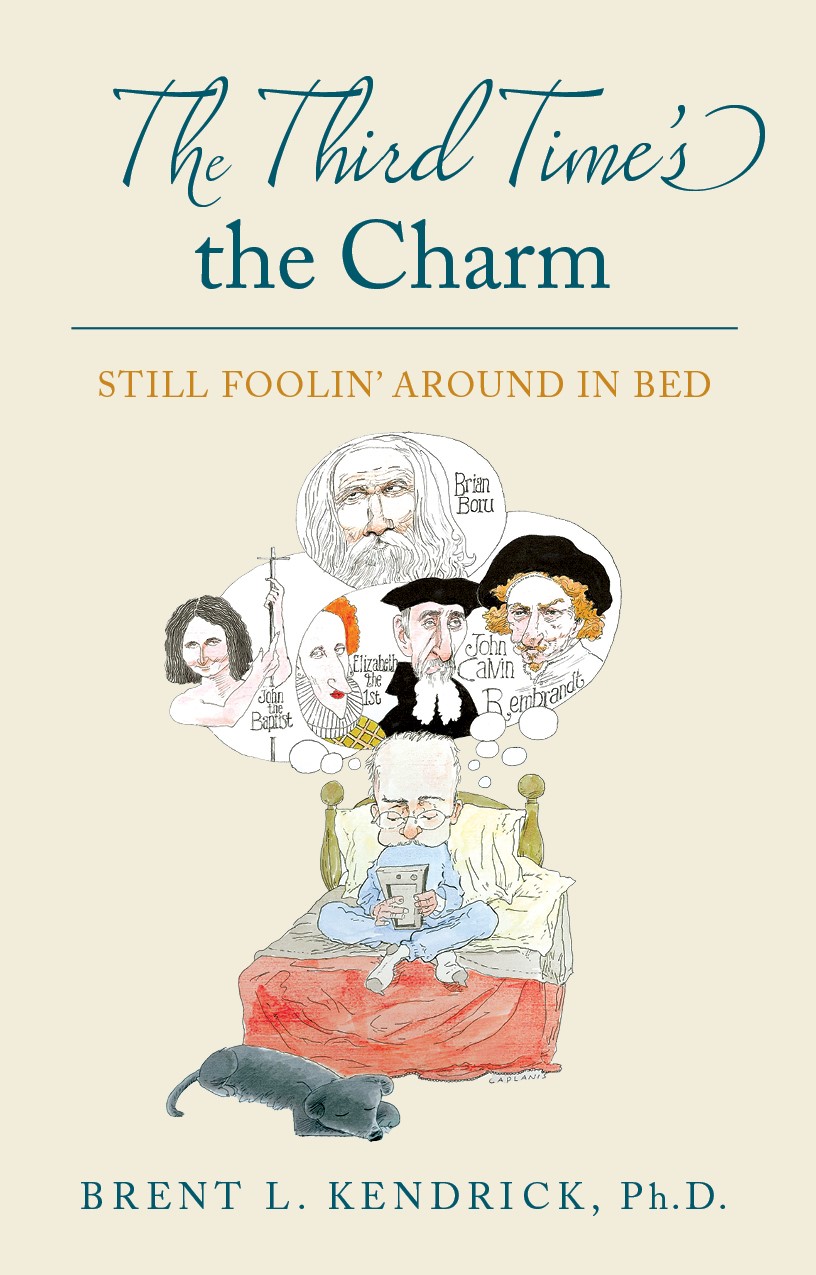
It’s the printed proof of my next book, The Third Time’s the Charm. At 440 pages, it’s a whopper! This brand-new collection of personal essays is drawn from my The Wired Researcher Series. Today, I’m delighted to share the cover art with you. Once again, the art is by acclaimed caricaturist Mike Caplanis. Although he was inspired by the essay “What If I’m Not Who You Think I Am?”, the book’s cover captures the spirit of this collection perfectly—thoughtful, mischievous, and comfortably tucked between the sheets.

This book is close to my heart. It’s a gathering of essays written—yes, literally, as you know already—in bed, where I do my most creative thinking and, often, my most honest writing. I hope these pieces reflect a voice that’s warm, a little witty, deeply rooted in everyday life, and shaped by the rhythms of memory, nature, and reflection.

William Faulkner once referred to his childhood landscape as “a postage stamp of native soil,” and in this collection, I’ve claimed one of my own. These essays rise from the soil that grounds me—Appalachian roots, coal camp memories, gardening, grief, and joy—and reach toward readers everywhere. I hope these pieces help you discover something true in your own story, too.

The book will be available very soon—just a few weeks away. For now, consider this a soft unveiling and a warm invitation. I’ll share more details soon, including where and how to get your copy. Until then, feel free to admire the cover, fluff your pillows, and prepare to join me—in spirit and in story—In Bed.

P.S. If you’d like to be among the first to know when the book is available, keep an eye here—or better yet, follow me if you’re not doing so already.

A Special Shout-Out to 6,164 Amazing Readers Around the World!

“A writer only begins a book. A reader finishes it.”

Samuel Johnson (1709-1784; English writer, poet, essayist, moralist, literary critic, biographer, editor, and lexicographer; best known for his A Dictionary of the English Language, 1755.)

I just checked my blog’s mid-year statistics, and I am thrilled beyond measure. Together, we did it! 6,164 of you have been reading my blog posts this year.

For me, that’s incredibly awesome.

I couldn’t have done it without you, my loyal readers. You have fueled my passion for writing, and it’s your engagement that motivates me to share not only stories but also moments of laughter, reflection, and sometimes even tears.

Reflecting on the Journey

When I shifted the focus of my blog from research to memoir, I had no idea that it would grow into what it is now. Each week, I pour my heart into writing, hoping to connect with you through my words. This journey has been one of personal growth and deep connection, overcoming initial uncertainties to find a community of readers who connect with what I write.

Highlights of the Year So Far

Let me share with you the posts that have been the most popular during the last six months:

Glimpses of My Mother’s Hands

Confessions of an Editor: The Infant Sphinx Reviewed

When Lilacs Meet Algorithms: The Unlikely Union of Walt Whitman and Artificial Intelligence (AI)

From Dusty Folder to Digital Ink

From Stars to Soil: Embracing My Family’s Garden Tradition

My Taxing Review: A Reality Post

Vermont’s Literary Daughter: Brent L. Kendrick on Mary E. Wilkins Freeman

Abandon Hope? Not a Chance!

My Kentucky Wonder

What My Father Saw

Not Alone

Looking Ahead

In case you’re wondering about future posts, let me share with you the tentative titles of drafts that I’m working on:

● The AI Times They Are A-Changin’

● The Sweet Taste of Defeat

● Literary Crosswalks at 76

● What I Would Say to My 18-Year-Old Self

● Fanning the Flame

● Turning Out the Lights: Reflections on Endurance and Hope

● Bigger than Ourselves

● Age of No Credit

● In Praise of Gratitude

● I Don’t Have Much to Give but What I Have I Give

● I Made It All Up

Looking at the Countries You Represent

And you, my 6,164 readers? What about you? You represent 145 countries from all around the world, showcasing an incredible diversity of cultures and perspectives. From Afghanistan to Zambia, including Bahrain, Cambodia, Denmark, Ecuador, Gabon, Hong Kong SAR China, Iceland, Japan, Kazakhstan, Latvia, Macao SAR China, Namibia, Oman, Pakistan, Qatar, Romania, Saudi Arabia, Taiwan, U.S. Virgin Islands, United States, United Kingdom, and Venezuela.

A Special Thank You

I want to give a special shoutout to each and every one of you, whoever you are, and wherever you are.

● You are my joy.

● You are my inspiration.

● You are my world.

Vermont’s Literary Daughter: Brent L. Kendrick on Mary E. Wilkins Freeman

I am honored to be featured on Barney Smith’s Vermont Artists and Authors podcast, StoryComic, Episode 361.

I had a delightful time talking with Barney about Vermont’s most famous writer, Mary E. Wilkins Freeman, and my book Green Mountain Stories, a collection of 28 stories by Mary E. Wilkins Freeman. Originally published in 1887 under the title A Humble Romance and Other Stories, it’s now in print 136 years later under what appears to have been the title that Freeman and her editor, Mary Louise Booth, had agreed upon: Green Mountain Stories.

You can hear more about Freeman and the book’s backstory in Barney’s interview. I emphasize the fact that Freeman is a Vermont writer, and that Green Mountain Stories is made in Vermont.

■ I hope that Green Mountain Stories brings great inspiration to readers across Vermont.

■ I hope that each of the 262,852 households in Vermont buys a copy.

■ I hope that each of the 185 public libraries in Vermont buys at least one copy.

■ And I hope that each of the 250 public schools in Vermont figures out a way to incorporate at least one Mary E. Wilkins Freeman short story into their curriculum. They will find many suitable ones in Green Mountain Stories–stories on par with the best in American Literature, right up there with Nathaniel Hawthorne, Edgar Allan Poe, Sarah Orne Jewett, Mark Twain, Stephen Crane, Sherwood Anderson, and William Faulkner.

Just Released: New Scholarly Book on Acclaimed Writer Mary E. Wilkins Freeman

“Dedicated to the Memory of Mary E. Wilkins Freeman
and the Women Writers of America”

Bronze Doors Inscription, American Academy of Arts and Letters, New York.

If the wheels of progress turn exceedingly slow–and they do–then the wheels of scholarly publishing turn even more slowly. Many steps are involved in publishing a book, especially an academic one with multiple contributors: finding a publisher; issuing the call for proposals (CFP); accepting proposals; writing; peer reviewing; revising; copy editing; and, finally, publishing. On average, it takes about two years for a scholarly book to find its way into print.

But the quality of the scholarship and the advances made by the research make the wait worthwhile.

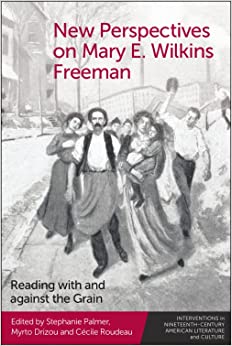
New Perspectives on Mary E. Wilkins Freeman: Reading with and against the Grain is a perfect example. The editors–professors Stephanie Palmer (Nottingham Trent University, United Kingdom); Myrto Drizou (Boğaziçi University, Turkey); and Cécile Roudeau (Université Paris Cité, France) issued the book’s CFP all the way back in April 2019.

As a well-known Freeman scholar, I responded and proposed a chapter. I am sharing my chapter’s abstract below, not to promote myself but rather to provide general background information for my blog readers who may not be familiar with Freeman.

The distinguished accolades enjoyed by Mary E. Wilkins Freeman are numerous and well known. At the start of the Twentieth Century—when her career was at its height—she and Mark Twain were considered America’s most beloved writers. She was the first recipient of the William Dean Howells Gold Medal for Distinguished Work in Fiction (1925). She was among the first women elected to membership in the National Institute of Arts and Letters (1926). And the bronze doors at the American Academy of Arts and Letters in New York (installed at its West 155 Street Administration Building in 1938) bear the inscription, “Dedicated to the Memory of Mary E. Wilkins Freeman and the Women Writers of America.”

What is not well known, however, is Freeman’s financial success as a businesswoman. Freeman started her career in 1883 with $962.09 in cash and with one-half interest in a piece of Brattleboro, Vermont, property. Yet after her death in 1930, the value of her estate at the height of the Great Depression—even after her personal property had been auctioned off at embarrassingly low prices—came to a grand and spectacular finale of $117,285.41. Adjusted for inflation, that would be equivalent to starting out with $24,214.38 in 1883 and ending up with $1,804,925 in 1930 when the market was at its worst.

By any standard, that’s quite a financial success story, especially for a writer who at the start of her career maintained, “I know so little about business and business customs.”

Careful research into the business side of Freeman’s life demonstrates that necessity taught her a lot about business and business customs.

This chapter zooms in on Freeman’s career not only as a successful writer but also as an independent woman. Single for most of her life and without financial backing (unlike her contemporaries Harriet Beecher Stowe, Sarah Orne Jewett, and Kate Chopin), she knew that she had to fend for herself.  Or, as she herself commented in a 1919 letter to American literary scholar Fred Lewis Pattee, “I wrote no more vers de societe. No more Cherries in Blossom. My dear Sir, do you remember I wrote you that I had to earn my living? I did not write this, but I had an Aunt to support. How could I have accomplished these feats on poetry?”

She couldn’t accomplish it by poetry alone, but she could by exploiting multiple genres: 3 plays, 14 novels, 3 volumes of poetry, 22 volumes of short stories, over 50 uncollected short stories and prose essays, and 1 motion picture play.

Over the course of a career that spanned nearly 50 years and through nothing more than the power of her pen and her astute business acumen, she amassed a fortune. Hers is a story of phenomenal magnitude, unparalleled in all of nineteenth century American literature, especially among women writers, and this paper will chronicle her financial success story.

Now, nearly four years later (delayed, no doubt, by the COVID-19 Pandemic), the book was published this month by Edinburgh University Press.

Edinburgh University Press; 1st edition
(February 28, 2023)
Hardcover ‏ : ‎ 328 pages
ISBN-10 ‏ : ‎ 1399504479
ISBN-13 ‏ : ‎ 978-1399504478

My contribution–“Literary Businesswoman Extraordinaire”–appears as Chapter 9 in the section Women’s Work: Capital, Business, Labor.

Kinship Outside of Normative Structures
1. Mary E. Wilkins Freeman’s Neighborly Encounters and the Project of Neighborliness – Jana Tigchelaar
2. “Her Own Creed of Bloom”: The Transcendental Ecofeminism of Mary E. Wilkins Freeman – Susan M. Stone
3. “Preposterous Fancies” or a “Plain, Common World?” Queer World-Making in Mary E. Wilkins Freeman’s “The Prism” (1901) – H.J.E. Champion

Violent, Criminal, and Infanticidal: Freeman’s Odd Women
4. The Reign of the Dolls: Violence and the Nonhuman in Mary E. Wilkins Freeman – Donna M. Campbell
5. Transatlantic Lloronas: Infanticide and Gender in Mary E. Wilkins Freeman and Alexandros Papadiamantis – Myrto Drizou
6. Redefining the New England Nun: A Revisionist Reading in the Context of Pembroke and Irish American Fiction – Aušra Paulauskienė

Women’s Work: Capital, Business, Labor
7. Hunger Strikes:Queer Naturalism and the Gendering of Solidarity in Mary E. Wilkins Freeman’s The Portion of Labor – Justin Rogers-Cooper
8. “It Won’t Be Long Before the Grind-Mill in There Will Get Hold of Him”: The Theft of Childhood in Mary E. Wilkins Freeman’s The Portion of Labor – Laura Dawkins
9. Literary Businesswoman Extraordinaire – Brent L. Kendrick
10. “Deconstructing Upper-Middle-Class Rites and Rituals: Reading Mary E. Wilkins Freeman’s Stories Alongside Mary Louise Booth’s Harper’s Bazar“– Audrey Fogels

Periodization Reconsidered
11. Mobilizing the Great War in Mary E. Wilkins Freeman’s Edgewater People – Daniel Mrozowski
12. A Cacophony of Voices: Freeman’s Modernism – Monika Elbert
13. Underground Influence: Sylvia Townsend Warner’s Pastiche of Mary E. Wilkins Freeman – Stephanie Palmer
14. Untimely Freeman – Cécile Roudeau

Afterword: Why Mary E. Wilkins Freeman? Why Now? Where Next? – Sandra A. Zagarell

New Perspectives on Mary E. Wilkins Freeman is rich and robust, adding new dimensions to earlier book-length studies:

Edward Foster, Mary E. Wilkins Freeman (Hendricks House, 1956). Foster started his Freeman biography right after her death in 1930. At the time, he was a doctoral student at Harvard. One of the book’s many strengths is its inclusion of information gained from interviewing Freeman’s friends and relatives.

Perry Westbrook, Mary Wilkins Freeman (Twayne, 1967; rev. 1988). Westbrook explores some of Freeman’s richest and most significant works, anchoring them to the New England local color tradition as well as to women writers.

Brent L. Kendrick, ed., The Infant Sphinx: Collected Letters of Mary E. Wilkins Freeman (Scarecrow, 1985). Praised by The Journal of Modern Literature as “the most complete record to date of Freeman’s life as writer and woman.” I have a new two-volume update in progress: Dolly: Life and Letters of Mary E. Wilkins Freeman. Vol I: The New England Years (1852-1901). Vol II: The New Jersey Years (1902-1930).

Leah Blatt Glasser, In a Closet Hidden (University of Massachusetts Press, 1996). Glasser’s work is a literary biography that “traces Freeman’s evolution as a writer, showing how her own inner conflicts repeatedly found expression in her art.”

Aside from book publications, Freeman has merited state-wide celebrations, too.

In 1991, Newark Public Library, the New Jersey College English Association, and the English Department of Kean College celebrated Freeman’s life and works in a series of free public programs. Jim Florio, New Jersey’s governor at the time, issued a formal proclamation, declaring “November, 1991 as Mary E. Wilkins Freeman Month.”

Additionally, in October 2019, Freeman was featured as part of the Brattleboro (VT) Literary Festival. Recognizing her connections to Brattleboro and to the Green Mountain State, Vermont Governor Phillip B. Scott proclaimed October 17, 2019, as “MARY E. WILKINS FREEMAN DAY
in Vermont.”

On January 17 the next year, Freeman’s home at 207 Lake Avenue in the Borough of Metuchen in Middlesex County, New Jersey, where she lived and wrote from 1902 to 1907, was added to the National Register of Historic Places.

New Perspectives on Mary E. Wilkins Freeman is a welcome addition to Freeman scholarship. Taken as a whole, the book provides a greater understanding of Freeman’s unequivocal–and sometimes unrivaled–impact on American letters.