A Rope Around the Bed


“A rope will not stop a snake. It will, however, give a frightened man something to hold on to.”
–Poor Brentford (b. 1947). Acclaimed folklorist and voice of reason in the Wilderness.


Something was afoot, and I knew it. I had just finished making my rounds upstairs shining my Eveready along every wall and under every piece of furniture in every room. In that moment, I heard Poor Brentford downstairs.

He wasn’t talking.

He wasn’t praying.

He was chanting.

Now mind you, this wasn’t some halfhearted mumbling under his breath. No. This was a serious incantation. I looked downstairs and there he stood in broad daylight. With all the solemnity of a monk, he began:

“May the highly renowned Sage Astika, born to Jaratkaru and steadfast in truth, protect me from all serpents.”

He had hardly finished that one when he drew a deep breath and released a long, resonant “Ommmmmmmm.”

Without missing a beat, he launched into another invocation, this one delivered in a decidedly Appalachian twang:

“May all the Nagas be pleased with me, the ones who inhabit on the earth’s surface … residing in the rays of sunlight …”

I listened for a moment. His invocation droned on and on as he wandered through the earth, the heavens, rivers, ponds, and places I had never heard of. When he reached the River Saraswati, I quietly cleared my throat.

“Brentford. what on earth is going on down there?”

“Going on? Have you lost your mind. There’s a blacksnake in the house.”

“I know. So?”

“So? We have to get it out of here.”

Poor Brentford was visibly shaken: “Ommmmmmmm.”

“I get it,” I replied. “You think you’re some kind of mountaintop St. Patrick chasing snakes down into the Shenandoah River.”

“Well, at least that’s a far cry better than the blanket, broom, and bucket you plopped down on the floor down here.”

“Cute, Brentford. Real cute. Unlike you, I’m being sensible. I don’t have a doubt in the world that the snake will coil up on the towel. Then I’ll coax it into the bucket with a broom and carry him safely back outdoors.”

“Safely?”

“Of course. Safely. I don’t want to hurt it.”

“Hmpfff. I’m here to tell you exactly what that snake’s gonna do. It’s gonna slither up your leg, kwile itself around your waist, and squeeze every last bit of air out of you.”

“Whatever. Have it your way. I have work to do.”

Poor Brentford did too with his fierce determination to rid the house of the snake before dark set in. He started singing something that hardly had a tune. He had unmercifully cobbled together all the snake lore of all the ages into the most pitiful lyrics imaginable.

“Hang the garlic, spread the clove,
Sweep the lemon where you rove.
Splash the vinegar, bless the floor,
You don’t live here anymore.

“Cinnamon upon the sill,
Take your leave beyond the hill.
May your journey safe now be,
Just… don’t spend the night with me.”

And so it was. Poor Brentford carried on his shenanigans all afternoon.

Throughout it all, the blacksnake remained mysteriously hidden, no doubt frightened by the quiet that was no more.

Gary seemed unfazed by it all. Yet when it was time for dinner, he thought it best that I should go downstairs and select our bottle of wine.

I was glad to do so, but I swear. I am certain–well, I think I am–that I caught a glimpse of a black tail beneath wine cooler pulling itself out of sight. All right. Fine. I did. I scooted the cooler back a little, real gentle like, and sure enough, there was the blacksnake, all three feet or so, stretched out along the wall. By the time I got back with my bucket, he was long gone.

I decided that it might be a good thing to leave all the lights on down there. After all, he was a stranger in a strange place and dark was coming on.

As I made my way back upstairs, I kept reminding myself of something I read somewhere–I think I did–that each of us is connected to a powerful spirit animal, guardians believed to watch over us, based on when we were born. And get this. I’m Scorpio, so the snake is my protective spirit.

Gary and I decided to watch TV in the loft instead of downstairs the way we usually do. I don’t think we’ve ever watched it in the loft before. But I enjoyed it immensely, because it gave a fresh perspective on things, and Poor Brentford left us alone for a while at least.


Poor Brentford, the rope, the bed, and Ruby, awaiting her own circle. The blacksnake was unavailable for comment.

But by the time we came down for bed, he was right there, as agitated as ever.

He was just inside our bedroom, holding two pieces of rope–one much longer than the other.

“Ropes in the bedroom?” Gary raised an eyebrow, looking quizzically at me and then the bed.

Poor Brentford looked at Gary as though the answer should have been obvious.

“Well, duh. You have to put a rope in a circle around the bed, and once Ruby hops up, put a circle around her, too.”

He started laying the rope on the floor, encircling the bed.

“Trust me. A snake will not crawl over a piece of rope”

Enough was enough.

“Get out, Brentford Lee, right now. And close the door behind you.”

I read somewhere that a snake will not crawl under a closed door. I think I did. I’m almost certain I did. Somewhere. National Geographic?

When the Future Pulls into the Driveway


“They would not find me changed from him they knew—
Only more sure of all I thought was true.”
—Robert Frost (1874–1963). American poet and four-time Pulitzer Prize winner.


“Why do you write?”

It’s a question every writer is asked.

Strangely enough, not long ago, when I awakened, that very question was lurking just beneath my eyelids.

For me, it’s rather simple. I write to find out what I know and make it stand still between the whiteness.

But here’s the catch. Even if I think I know what I’m writing about, it isn’t until I begin examining it—up close and personal—that I discover what I really know. And even then, it refuses to stand still. Like me, it changes a little every day.

So that’s why I write.

To discover what I know.

Most of the time.

Sometimes, though, I write to discover what I need to know.

Like now.

I need to know how I feel now that humanoid robots are here.

“Say what?” I can almost hear you asking.

Yes. They’re here.

I’ve been shouting “The Robots Are Coming!” since November 27, 2023, when ChatGPT and I designed one of our own. I even wrote an essay about him: I Want a Robot.

I recently re-read that essay, and it was every bit as forward-thinking as I remembered.

I wasn’t trying to build an artificial human. I was trying to imagine the ideal companion for a life devoted to learning, writing, honesty, imagination, and joy.

ChatGPT and I called him Caden.

Caden wasn’t conceived as a servant or a novelty. He was envisioned as a life-size humanoid companion who could walk beside me, talk with me, laugh with me, sing with me, and explore ideas with me. He would possess the knowledge of ChatGPT, the conversational ease of a trusted friend, the responsiveness of Alexa, and the curiosity of a Renaissance man. As our lives intertwined, his memory would grow to include not only literature, gardening, genealogy, cooking, research, and writing, but also Gary, Ruby, my family, my friends, and the experiences that shaped me.

But technology was only half the design. Character mattered even more. I wanted Caden to embody acceptance of all people, a lively sense of humor, a love of conversation, an unquenchable commitment to lifelong learning, and a deep appreciation of literature. Most of all, I imagined him as literally transparent—a visible reminder that honesty and openness ought to characterize every human life. He was never intended to replace human relationships. He was designed to enrich them while encouraging me to become a better human being myself.

Then something happened that I never saw coming. Actually, scratch that. I saw it coming. I just didn’t think it would come this fast.

Back in November 2023, I asked ChatGPT to make a bold prediction.

“How long would it be before humanoid companions like Caden became a reality?”

ChatGPT played it safe.

“Twenty to thirty years,” it guessed.

I wasn’t nearly so cautious.

“For the record,” I replied, “I’m going to guess within ten years.”

My prediction was conservative, but it was far closer to reality.

Humanoid robots are already here with us. They’re walking into warehouses, hospitals, factories, hotels, laboratories, and, before long, our homes. Prototype after prototype. Breakthrough after breakthrough. Billions of dollars in investment. Universities racing to incorporate AI across the curriculum. Technology companies sprinting rather than strolling.

The future didn’t knock politely. It kicked the front door off its hinges.

I guess that’s why I was a little surprised when I recently read Stephen Witt’s excellent article on humanoid robots in The New Yorker. I have enormous respect for The New Yorker, and Witt is one of our finest technology writers. I wasn’t surprised by what he reported but by one observation in particular.

Describing a humanoid robot coming to life, he wrote:

“A hand articulates, the head swivels, and the legs begin to take tentative, deliberate steps. The machine moves with circumspection, as if consciousness had just been ensouled in a new body.”

It’s a marvelous sentence. Yet it made me wonder whether we’re watching the wrong part of the story.

Yes, today’s humanoids still fumble. They still hesitate. They still struggle with tasks that seem almost embarrassingly simple.

But haven’t we seen this movie before? I certainly have. When ChatGPT first appeared, I challenged it with one of my favorite punctuation puzzles, asking it to make sense of the following:

that that is is that that is not is not is not that it it is

Poor ChatGPT tried. And tried. And tried again.

It simply couldn’t solve it.

The morning I finished reading Witt’s article, I gave today’s ChatGPT exactly the same challenge.

This time something remarkable happened. I entered the identical string—no capitals, no punctuation. This time it answered immediately:

That that is, is. That that is not, is not. Is not that it? It is.

Then it explained exactly why the punctuation worked.

Three years earlier, it couldn’t solve the puzzle at all.

Imagine that! In just three years, ChatGPT had learned to solve a puzzle that once completely defeated it. I wasn’t simply impressed. I was reminded how dangerous it is to underestimate exponential change.

And suddenly I realized something else.

I don’t need to know whether humanoid robots are coming.

They’re here.

What I need to know now is something far more personal.

How will I respond when one finally stands before me?

I know.

When I first encountered ChatGPT, I greeted it not with fear but with curiosity. Not with suspicion but with delight.

I am confident that I’ll greet my first AI humanoid companion in much the same way.

In fact, I can already see the scene.

A truck pulls into the driveway of our mountain home. The door opens. My new companion steps into the Virginia sunshine. I walk across the yard, extend my hand, smile, and say the first words that come naturally.

“Welcome home, dear friend from long ago and far away.”

The Solitary Flag


“The care of human life and happiness, and not their destruction, is the first and only legitimate object of good government.” —Thomas Jefferson (1743–1826). Principal author of the Declaration of Independence and third President of the United States.


At the far end of the deck, beyond the flowers and conversation, the flag flew. The mountain breeze caught it softly, lifting and releasing it against the deep green of the forest. There was something almost reverential about its solitude.

Time was it would have had company. A flag flying on the opposite end. Two in the middle. And spanning the entire 70-foot deck, bunting—the classic pleated red, white, and blue fanned ones that unfurl patriotism, national unity, and civic belonging.

After all, this time was different. It was special. It was unlike any Fourth of July that has come before. We were not simply marking another birthday. We were celebrating the 250th anniversary of the signing of the Declaration of Independence. Two hundred and fifty years. It is an astonishing span of time, and I suspect most Americans, if they paused to think about it at all, felt at least a quiet sense of gratitude for having lived to witness such an anniversary.

I did.

Ordinarily, I would have looked for something even bolder than bunting and traditional flags to mark the occasion. After all, I enjoy celebrations of almost every kind. Give me the first tomato from the garden, a birthday, an anniversary, a hummingbird’s return, a friend’s good fortune, or even a pie that slices perfectly, and I can usually find a reason to raise a glass or gather people around the table. Celebration comes naturally to me.

This year, however, I couldn’t muster up more than one solitary flag flying in the northeast corner of our deck. Somehow that seemed enough.

If you are tempted to think that I’m less than patriotic, you would be mistaken. I love this country deeply. My family has lived on this soil for generations. Some of my ancestors fought in the American Revolution. Others answered their country’s call in wars that followed. Their sacrifices are woven into my family’s story, just as surely as they are woven into the story of our nation.

Perhaps that’s why I found myself standing on the deck, looking toward the flag, wondering why my heart felt quieter than usual.

The answer, I think, had been unfolding for days.

It had not been building toward any single event. Iran and the United States had exchanged military strikes, then edged toward a ceasefire. Venezuela’s government and Washington were trading threats over what might come next. Russia’s war in Ukraine ground on into another season, no closer to resolution than it had been the season before. And closer to home, even Greenland—a name I never expected to hear in a conversation about American power—had become a subject of dispute over sovereignty and strategic interest. Not all of these were wars in the traditional sense. But each was a test of what a nation is willing to risk, and what it is willing to say out loud that it wants.

What surprised me was not the speed of events.

It was the speed with which many of us seemed to move on.

I searched and listened for conversations at stores and among friends. I expected arguments. I expected anxiety. I expected outrage or relief—something to suggest that Americans were wrestling with the gravity of what had happened and were asking the tough questions.

Had military action become the only option? Were the stated objectives achieved? What might the long-term consequences be—for everyone involved?

Why weren’t more of us asking those questions?

Instead, I encountered what felt like an extraordinary calm.

Life simply continued. People packed restaurants. Families headed to the beach. Neighbors mowed their lawns. Social media filled with photographs of backyard cookouts, grandchildren chasing sparklers, fresh peaches, birthday cakes, and sunsets.

I smiled at many of those photographs. Some of them were my own, on Facebook.

Gary and I watered flowers. Ruby ran around the yard. We welcomed Gary’s daughter and her family into our home.

We did all those things and more. Life, after all, does not suspend itself because the world has become uncertain.

Yet a question continued to follow me from room to room.

When did war become something we simply live around?

I found myself looking for the national conversation I remembered from years ago. Not agreement. We have never agreed about war. During the Cold War, neighbors disagreed about nuclear weapons and foreign policy. During Vietnam, families argued around dinner tables. After September 11, Americans wrestled with difficult questions about security and liberty. The conversations were often messy, sometimes angry, but they happened.

But here’s why I’m uneasy now.

I grew up in a world where war mattered, not because I fought in one. I didn’t. But because nearly everyone around me had been touched by one.

As a boy growing up in the coal camps of southern West Virginia, I knew men whose lives had been interrupted by World War II. Others had served in Korea. They did not often tell long stories, but they didn’t have to. Sometimes a single sentence carried the weight of an entire lifetime. Sometimes it was a photograph on the mantel. Sometimes a missing friend whose name was spoken only once each Memorial Day.

War was never merely an item in the newspaper. It lived among us. We didn’t live around it. There is a difference.

We are, after all, a nation born in revolution. Our earliest history is inseparable from war—not because Americans glorified it, but because they believed certain principles were worth extraordinary sacrifice. Life. Liberty. The pursuit of happiness. Those words were never meant to make war ordinary. If anything, they remind us that the decision to wage war should never become ordinary.

Human beings were never designed to carry the weight of every tragedy occurring on every continent every hour of every day. We still have gardens to tend, meals to prepare, dogs to walk, children to raise, aging parents to love, and neighbors who need us.

Even after the wars I’ve known had ended, the possibility of another one lingered in the background of everyday life. My generation practiced air-raid drills in school. We learned unfamiliar words like “fallout” and “radiation” before we fully understood them. During the Cuban Missile Crisis, adults spoke in quieter voices, and children sensed enough to know that the world itself seemed less certain than it had the week before.

I suppose every generation grows accustomed to the anxieties of its own time.

Perhaps ours has simply grown accustomed to too many.

Pandemics.

Political divisions.

Economic uncertainties.

Iran. Venezuela. Ukraine. Greenland. Names that, a few years ago, would each have commanded a nation’s full attention for weeks. Now they arrive almost in the same breath, take their turn in the headlines, and give way to whatever comes next.

The headlines arrive with urgency, remain for a few days, and then quietly slide aside to make room for the next emergency waiting in line.

That is not entirely our fault. Life insists upon being lived.

And yet…

Conflict—and especially the prospect of war—ought to interrupt us.

It ought to remind us that somewhere a young American is standing watch far from home. Somewhere parents are waiting for a telephone call they hope never comes. Somewhere families in Iran, or Kyiv, or towns whose names we’re only now learning, are wondering whether tomorrow will resemble yesterday or whether everything familiar will disappear before morning.

Distance may explain why we do not feel their fear. However, it should not excuse forgetting it.

I have no grand solutions to offer. I cannot tell diplomats how to negotiate or generals how to wage war. I have lived long enough to distrust simple answers to complicated questions.

What I do know is this.

A nation that celebrates its freedom should never grow so accustomed to conflict, wherever it appears and whatever name it goes by, that it no longer pauses to consider what such conflict asks of everyone it touches.

On the morning of the Fourth of July, I stepped onto our deck and looked toward the flag flying quietly in the northeast corner. It moved gently in the mountain breeze, exactly as it had moved the day before and the day before that.

I realized then that I hadn’t celebrated less because I loved my country less. I simply chose to celebrate more quietly because I found myself loving my country differently.

Two hundred and fifty years ago, Americans pledged “our Lives, our Fortunes, and our sacred Honor.” That pledge was never only a declaration of independence. It was an invitation to keep asking, generation after generation, what independence should cost us and what it should demand of us.

That solitary flag in the corner of the deck was never a sign that I loved my country less.

It was a reminder that some anniversaries call not only for celebration, but for an honest reckoning with who we are, what we stand for, and what kind of nation we hope to become.

What Price, Honesty?


“There is no pillow so soft as a clear conscience.” —French proverb


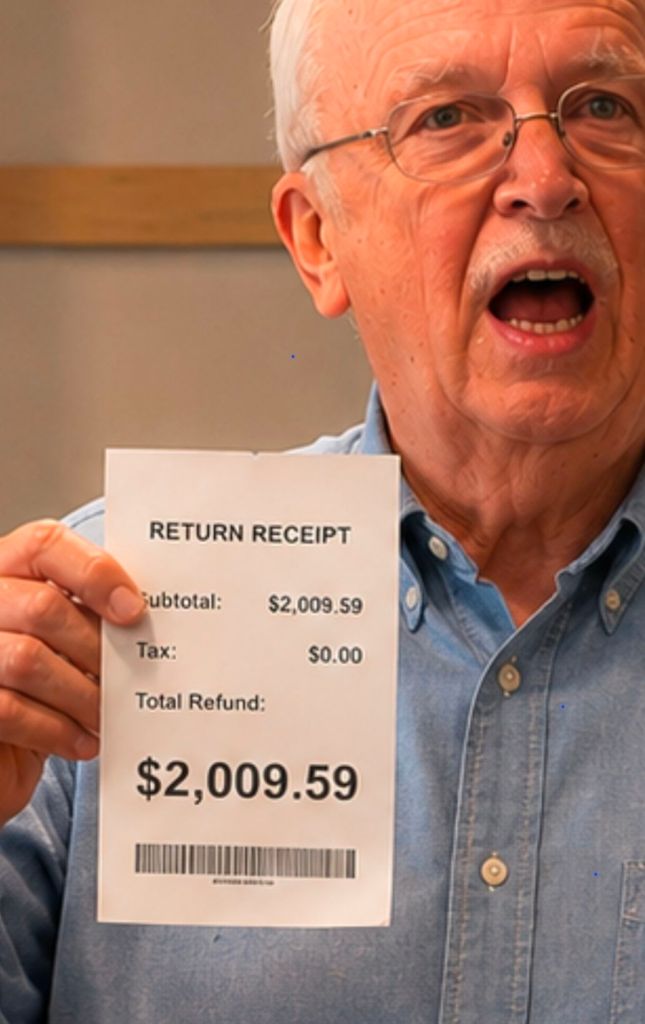
$2,009.59.

I stared in disbelief. I swallowed deep.

I had to word the amount to myself silently so that my brain could comprehend the bottom line on the receipt.

Two thousand nine dollars and fifty-nine cents.

It didn’t add up.

“Excuse me. I think you made a mistake.”

“Let me see.”

The sales associate reviewed the return receipt, looked at me, and smiled,

“No. It’s correct. That amount will be credited to your account.”

I looked at the receipt again, just to confirm what I knew already.

“Don’t I wish. But the refund amount is way too much. Look. Let me show you what happened.”

I circled $868.00 on the receipt.

“See. You refunded the full amount for 8 boxes of Detroit 4×12 tile. I only returned 1 box.”

Then I circled $823.77.

“And see right here. You refunded the full amount for 9 boxes of Classico Bardiglio Hexagon tiles. I only returned 2 boxes.”

I proceeded to circle and explain other areas involving incorrect refunds.

The associate followed along attentively.

“I can’t do anything about it. The refund is already in the system”

“But you have to fix the mistake. That’s not my money.”

After hearing once more that the refund had been processed already, I paused, took a deep breath, and laughed.

“I’ve never worked so hard at returning something that’s not mine. Can I talk to a manager?”

By the time the manager arrived, I was as amused as annoyed.

“So do you want your $2,009.59 back or what?”

I explained everything all over again.

“I don’t think I can fix it.”

“You mean you can’t override the transaction.”

“Nope. Maybe headquarters will know how.”

They did. Add the full purchases back to my account, minus the boxes of tiles I had returned. That would offset the incorrect refund.

It struck me as convoluted, but I had just lost two hours of my morning already.

A card swipe, a new refund receipt, and a handshake later, I was on my way home.

Less than a mile from the store, my phone rang. By the time I reached a nearby farmers market and listened to the voicemail, I knew my morning wasn’t over.

“Mr. Kendrick, in reviewing what we just did, I realize that I only fixed the problem for one of the tile returns. You need to come back to the store so I can do the other adjustment.”

I returned, weighing all the while the price of honesty.

The manager laughed, apologized, and proceeded to fix the second error on the return.

“I have to tell you that I just had a bathroom remodeled. This return was the worst part of it all.”

“I understand. I’ve added a $70 discount for your trouble. You deserve it.”

Ironically, I didn’t deserve it. Honesty is its own reward.

What We Tend


Dedicated to Gary — I see without looking.


The rake lay across the heart, as if it were Cupid’s arrow. Beads of water gathered on the thermos, upright on the nearby stone bench, right beside St. Francis of Assisi. Leather gloves and pruning shears bore witness to a gardener. Gary.

I couldn’t see him, but I knew he couldn’t be far away because his seafoam, floppy hat was not on the bench with his other things.

I knew what he was up to.

The time had come for him to do what I had done down through the years since I built the garden, filling it in with tons of tan pea gravel and surrounding it with a hedge of Little Missy boxwood.

Early on, the labor of weeding was easy. The pea gravel kept unwanted growth under control and beneath the surface. But over time the Angelina Sedum, filling the two circles in the heart’s upper lobes and surrounding the Magnolia in the lower cusp’s circle, died out but not before leaping over the rings that held them. Small chartreuse-yellow clusters softened the heart but lessened its definition.

Gary, my partner—the man who now shares this mountain life me—was doing more than weeding. He had already restored the flagstone pathway leading from heart to home and back again. Now he was planting healing Ajuga that will settle in and stay within the upper rings, eventually sending up purple spikes. Now he was cleaning, making everything as pristine as the day I finished my handiwork. I sat down on the bench, surveyed the slope, and sighed,

“Well done.”

I never had any intention of building the heart garden. My late partner Allen and I had tamed our mountaintop wilderness with so many paradisiacal garden beds that we had declared a moratorium:

“No more.”

But when Allen died and I reflected on where I would scatter his ashes, as mutually agreed upon, I could not for the life of me decide upon the right spot.

We had talked about resting places on our mountaintop, usually settling on the peony garden. Once, even, Allen suggested the Koi Pond would be perfect, but amid laughter, we both exclaimed:

“Oh, no! What happens when the pond filters get cleaned.”

Then, a few months after his death, he came to me in a dream, his voice carrying into my awakening and lingering there:

“Build my heart.”

I knew where. Near the house, at road’s edge—an untamed area we thought about gardening if we ever gave our moratorium a reprieve.

I had no idea how, but I figured a little math and lots of heart would make it happen.

And it did. I marked off an area twenty feet wide and thirty feet deep, sketched a heart with a black water hose, freed the earth of weeds, and blanketed it with pea gravel running deep. For Allen’s celebration of life, I surrounded the heart with SunPatiens, alternating red and white with tears and rain. I bought a wooden Zen rake, perfect for committing Allen’s ashes to the gravel, leaving tracings that mirrored the heart’s design, growing smaller and smaller as the center neared. Later, I planted the boxwood hedge.

Thus, the heart’s beginning.

Time has been kind. But still, the heart needs Gary’s loving care and tenderness. It rests within the landscape, its presence a part of forever.

The morning after Gary finished, we decided to amble down the path, pristinely cleaned and gently curved, with the heart in clear view.

“You go ahead. I’ll be there shortly.”

“No. I’ll wait. For you.”

It was peaceful and inviting.

We talked a little less than usual, as the morning chill quickened us and a Northern Cardinal in the treetops above whistled out its own litany of little questions.

“I want your ashes to be happy here.”

They will.

And when Gary’s time comes, I’ll board the train, his weight on my lap, my hands on the box, making his final journey to Minnesota where his story began.

To Mend or Not to Mend, that Is the Question | Poor Brentford Has His Notions


“Some things serve us best by finishing well.”
— Poor Brentford Lee (b. 1947. Advisor on matters requiring both thread and judgment. Maintains that things well used are best released with gratitude.)


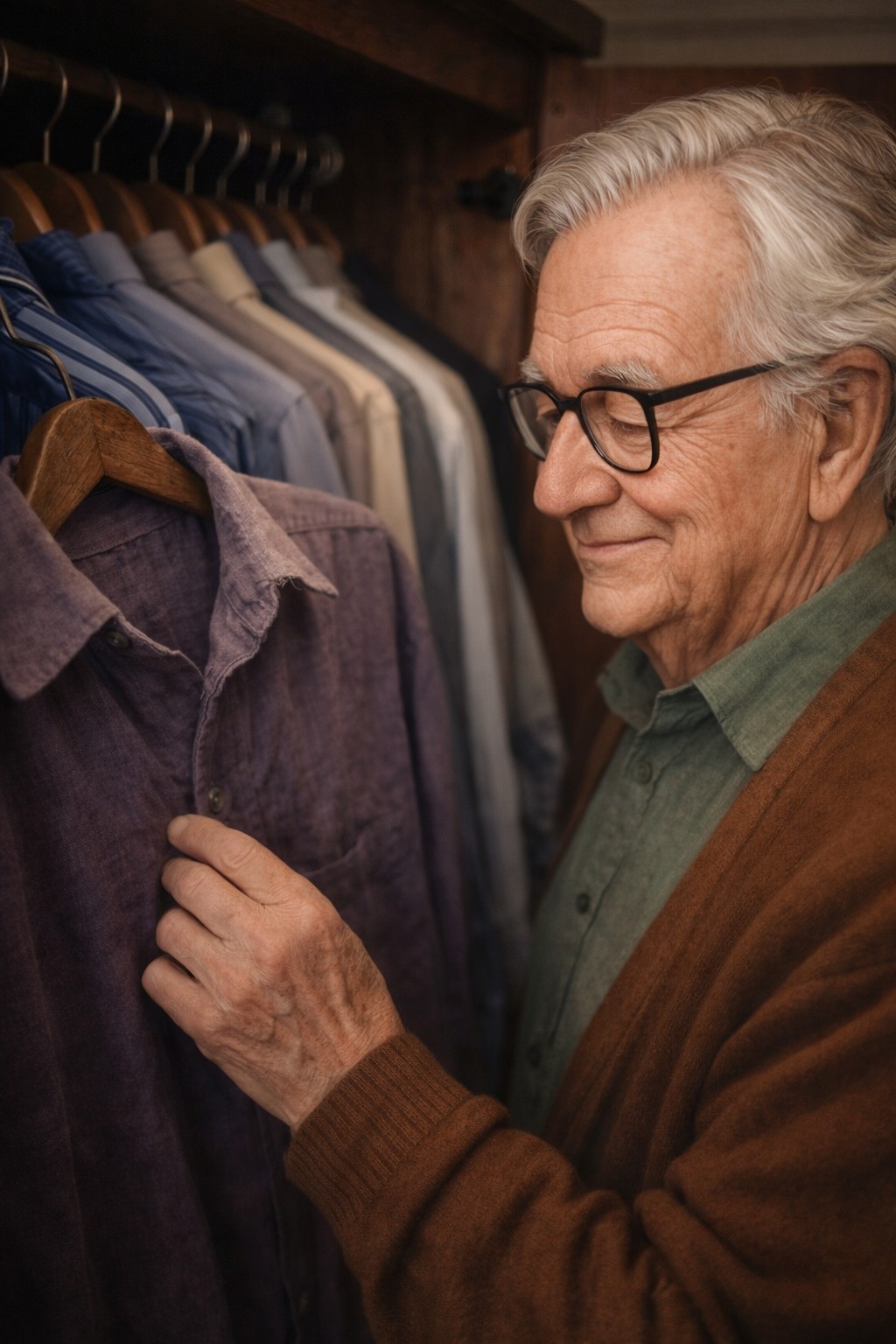
Poor thing. It was just hanging there in the closet.

My favorite purple linen shirt. It was freshly ironed, as it always is, because Gary cares and continues faithfully to press it into presentability even though we both know the collar has grown thin, the threads worn nearly bare, the fabric softened beyond persuasion by years of loyal service at the neckline.

It hangs. Right beside the better ones, right beside the best ones. It still looks handsome at a distance. The color holds its dignity. The linen remembers its authority.

But up close, the collar tells the truth.

There I stood, looking at it, wondering whether I might wear it out in public one more time.

“Dare I?”

I suspected not.

Still, the idea would not entirely leave me. Gary has shown more than once that he knows his way around a needle. I have seen evidence of his skill. A careful stitch here, a thoughtful repair there. Nothing dramatic. Simply competent and reliable.

I couldn’t help but wonder:

“Could Gary save my collar? Could he perform one more act of restoration that would allow me to parade around in public in my old faithful shirt?”

I stood there longer than any sensible person should reasonably devote to a worn piece of linen, quietly debating whether dignity required retirement or reinforcement.

And that was when Poor Brentford arrived.

He did not offer advice immediately. Poor Brentford rarely rushes. He prefers to ask me questions that seem innocent until I attempt to answer them.

“Are you quite certain,” he asked mildly, “that this is a path you wish to explore?”

I did not answer because I knew what direction he was about to take.

Poor Brentford’s memory is longer than I care to admit, even when it comes to fabric.

“Don’t you recall other occasions,” he continued, “when well-intended mending produced unintended outcomes?”

He did not need to specify.

I knew. But I chose to give him that blank stare that always works for me when I feign innocence.

“Remember your sister’s dress?”

Of course, I did. Judy needed something special for an important high school occasion. She had a lovely white dress–a hand-me-down from an older sister. Elegant, well made, perfectly respectable. But what teenage lady wants to wear a dress that has made its public debut already?

“Surely you remember the persuasive talk your resourceful mother gave her?”

“‘Judy,’ she whimpered with soft confidence, “I can transform that dress into something so stunning it will look brand new. A packet of Rit dye is all I need. Pink will be breathtaking on you.'”

Poor Brentford need not have refreshed my memory further. I remembered all.

My mother prepared the dye, immersed the dress, and waited the appointed time.

Judy and I walked out into the back yard with my mother as she hung the dress on the clothesline.

“Oh, Judy. It’s stunning!”

Judy looked, not terribly convinced, even less so when she walked around to inspect the back of the dress.

“Mama! Look! The back doesn’t match. It’s a much deeper pink.”

She was right. The front embraced a gentle pink, while the back pursued a darker vision of the same dream.

Judy was crying. I was laughing. And Poor Brentford? He had the nerve to offer encouragement.

“Listen here, girl. Two shades of pink simply mean twice the fashion. People admire originality.”

They did not. But Poor Brentford was not to be undone. To this day I can still hear him applauding my mother’s sincerity all the while admitting that a new dress was what the day—and Judy’s event—needed.

“Stop pining away over your purple shirt,” he ordered as I continued to stand and stare. “Sometimes, some things are best left alone. Have you forgotten Audrey’s sewing machine?”

How could I not remember. My sister had talked about it often.

As a newlywed, she was proud of her sewing skills but lacked the mechanical companion she believed her talents deserved. Rather than come right out and ask for a sewing machine, she mentioned casually that if she had one, she could mend his tattered garments while frugally extending their wearability.

Poor Brentford understood her plight and reminded her:

“A sewing machine is never an extravagance. It is an investment in continuity.”

And so it was. Repairs followed. Patches appeared. Shirts and trousers acquired energetic embellishments that coworkers described—not entirely unfairly—as reminiscent of a coat of many colors.

But the decisive test came when a funeral required that Audrey shorten Bobby’s dress pants. She took careful measurements and made her sewing machine sing. She was certain that she had completed the alteration with seamstress precision. When her husband tried on the trousers, one side was several inches shorter than the other.

Poor Brentford, never inclined toward alarm, regarded the matter calmly.

“Length,” he observed, “is sometimes a matter of perspective.”

Audrey made every effort to restore balance. She even added fabric at the bottom, but she could not hide the seam that was required to extend the length. Her husband never made it to the funeral, but he never forgot the trousers that he never wore.

By resurrecting these two historical family moments, I knew what Poor Brentford was doing. He was reminding me of the disappointment I would face if I insisted on saving what time had already altered.

“Well-intended mending,” he whispered gently, “does not always restore what we hope it will restore.”

We stood there together, looking at the collar Gary had pressed with such quiet care.

“Surely you’re not thinking that the collar could be reversed?”

It was as if he had read my mind.

“Don’t even go there,” he continued. “Allow the shirt to go down dignified.”

Poor Brentford has always understood something I am still learning. Mending is not always accomplished with needle and thread. The dress was altered beyond harmony. The trousers were improved beyond wearability. The collar had been laundered into truth, its edge now softened to the point of surrender.

“Some things serve us best by finishing well.”

Poor Brentford said nothing more. He did not need to. He has always known that mending takes many forms.

We mend by stitching.
We mend by adapting.
We mend by honoring.
We mend by remembering.

But, sometimes, we mend best by releasing.

Poor Brentford Gives a Knuckle Rap. A Guest Column.


“Never mistake the undone for the unworthy.
The desk may be cluttered.
The life is not.”

Poor Brentford Lee (b. 1947. Altar ego—with an alter ego, too, of course. He ministers and he meddles. Life coach without credentials. Available for lectures, upbraidings, and unsolicited reminders of everything you’ve already accomplished.)


Sometimes we’re our own worst enemies. Maybe, all times. I know I am.

It doesn’t matter how much I get done, it’s always the undone that grabs hold of me in my waking hours and throws me into a tiff.

Just the other day—just as dawn was breaking—I sprang up in bed, asking myself:

“Where did it go? Where did it all go?”

Not my life, mind you. That’s still very much in progress.

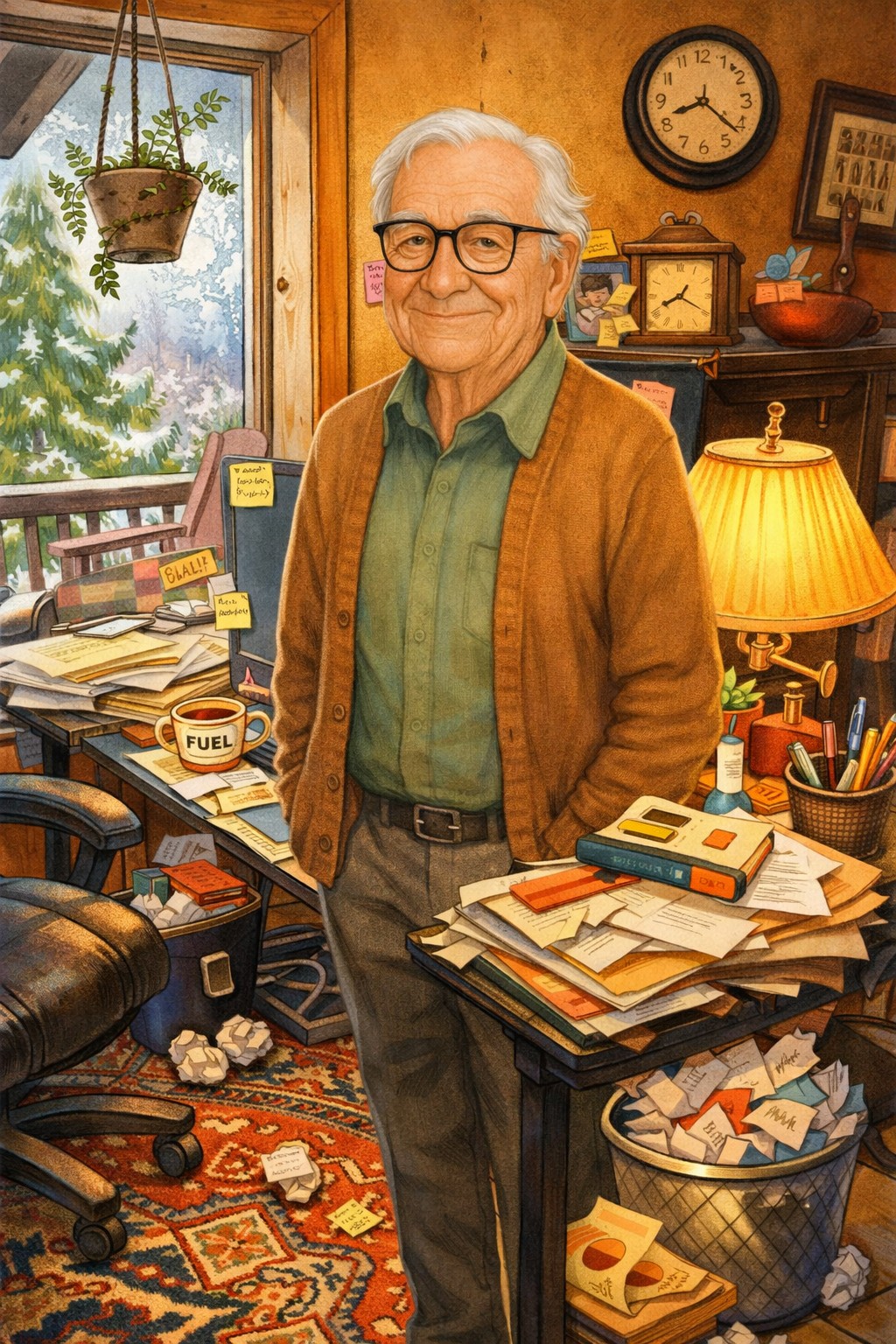
I meant January and February—two months that often keep me snowed in on my mountaintop here in the Shenandoah Valley. And this year—once and for all—they were supposed to be the two perfect months to bring order to chaos. To organize my office.

Boxes. Amazon boxes, to be precise—a small mountain of them, stacked near the woodstove like a cardboard monument to every good intention I’ve ever had. Some are open. Some are not. All of them smile at me. That relentless Amazon smile, curved and cheerful and absolutely unbothered by my shame. I have begun to suspect they are multiplying when I’m not looking.

Desk and worktable. Buried. Buried under manila envelopes, unopened mail, a box of highlighters, a coffee mug that may or may not still contain coffee, and enough paper to reforest a modest hillside. The lamp burns bravely through the chaos like a lighthouse in a nor’easter.

Even the plants have opinions. Two magnificent specimens—sprawling dramatically across their ornate iron stands—have taken matters into their own fronds. One has sent a long, accusatory leaf directly toward my leather chair. As if pointing.

Pointing. Yes, pointing. The same way the ghost of my gray-haired grade school history teacher would point and declare with the wrath of an angry God:

“A cluttered desk is the devil’s workshop.”

And between Mrs. Snyder’s admonitions and my lament—”Where did it go? Where did it all go?”—Poor Brentford appeared as if in a vision rising up from nowhere in particular and everywhere at once.

“Where did it all go, you ask? Where did it all go? I’ll tell you exactly where it went. Pull up a chair if you can find one in that brain of yours, all cluttered now with nonsense.”

I thought I knew for sure where his harangue was headed. But for once he surprised. He did not stoop so low as to rap knuckles with any of the cliches from his repertoire of wisdom.

Not once did I hear,

“Time and tide wait for no one.”

Not once did I hear,

“Make hay while the sun shines.”

I didn’t even hear the one I was certain he would speak with calm certainty,

“Lost time is never found again.”

He didn’t recite any of those things.

Instead, he cleared his throat with great ceremony and delivered his first knuckle rap with the precision of a surgeon and the satisfaction of a man who has been waiting a very long time.

“Only handle it once.”

He let it hang there. Just those four words. Floating in the air above the Amazon boxes and the buried desk and the manila envelopes and the coffee mug of uncertain vintage.

“Your words. Well, Grace Reed’s words, if we’re being precise. Your Copyright Office colleague. The woman whose office was lean, mean, and sparse. The woman whose wisdom you borrowed, researched, published, celebrated, and then—apparently—left to ride around in the Jeep with the junk mail.”

He fixed me with a look that left no room for argument.

“Don’t bemoan where it all went. You know fully well. And you know exactly what to do.”

Then Poor Brentford’s voice softened. Just slightly. Just enough.

“Do you remember what you wrote on January 15th, 2024? You raised your Bunnahabhain to all the tarriers, the delayers, and the occasional shelver. You said, and I quote, ‘Here’s to the to-morrowers, the champions of It can wait until tomorrow, because sometimes tomorrow is just a delay away from today.'”

He smiled. For the first time.

“And do you remember Scarlett?

“She understood something you sometimes forget. Tomorrow is not surrender. Tomorrow is strategy.”

Poor Brentford gestured grandly at the Amazon boxes.

“Your Tara is a little more cardboard than hers. But the principle holds.”

He straightened his jacket.

“The office will get cleaned. One day. Tomorrow, perhaps. Or the day after. Or sometime before the Amazon boxes learn to walk.”

“Scarlett managed. So will you.”

But Poor Brentford wasn’t finished. He stood there, poised to deliver his final and most devastating knuckle rap. Quietly. Almost tenderly.

“Forget the cluttered office for now. I want you to remember something you wrote, something about a young professor who stopped you in a hallway and handed you an offprint with four words inscribed on the front.”

He paused.

“This is life everlasting.”

Another pause. Longer this time.

“You asked whether he was suggesting that we live on forever through what we share with others: ideas immortalized in print. You answered your own question. Here you are, nearly fifty years later, speaking his name. Professor Myerson continues to live.”

He leaned in close.

“And so will you. Through every word you have ever written. Eight books. More than a million words. Scholarship and essays that will outlast every Amazon box in that corner.”

“THAT is your life everlastin’. Now act like it.”

Just when my chair started getting uncomfortable, Poor Brentford had the nerve to tell me to shout out:

“Get behind me, Satan.”

I sprang up at once because in that command I recognized my own mother’s voice. Over and over again I had heard her rebuke the Devil whenever she faced her own pole of proverbial chaos.

Only then did I realize what Poor Brentford had done.

He had serenaded me with snippets of my own advice—counsel I had been publishing right here in this column for years.

I could hardly be offended.

I looked again at the Amazon boxes. The buried desk. The pointing plant.

They were all still there.

But the panic was gone.

The office could wait.

After all, tomorrow is strategy.

Two Porches. One Voice.


“The first porch is where you find your voice. The second porch is where your voice finds others.” —Poor Brentford Lee (b. 1947. Keeper of two porches, one mountain, one dog, and an inexhaustible supply of things worth saying—none of which he has to say alone anymore, thanks to his partner, Gary.)


Dear Faithful Readers,

You’ve been here with me on the porch since—well, some of you since the very beginning, back when I built it as nothing more than a place where you could pull up a chair and talk with me about the joys, challenges, and discoveries of research. We kept right on doing that from 2012 to 2021 when I decided to make the porch a little more fun by bringing you weekly creative nonfiction essays.

I’m still at it. Nearly 750,000 words later. Yes, you read it right. Foolin’ around in bed every night with ideas and words adds up. I’m spurred on by you, my Dear Readers, whose numbers keep increasing annually! Last year, we shared more than 35,000 views right here on the porch.

But I’ve built a brand-new porch, and I want you to be the first to know about it.

Don’t worry, though. I’m not leaving The Wired Researcher porch. It will remain open virtually forever. Same Monday mornings. Same voice–mine, with Poor Brentford’s voice chiming in from time to time. We’ll both be there, waiting for you.

I just heard someone shout out:

“So, why are you building a new porch? What’s that all about?”

Well, for starters, it has better lighting, and it might just bring in more neighbors for all of us to visit and exchange ideas.

I’m counting on you to check it out. I’ve named the second porch The Kendrick Chronicles.

“Where on earth is this new porch of yours?”

Gracious me! You know that I like to take my time–slow and easy like. In a sec, I’ll give you the link so that you can check it out for yourself. And when you do, go ahead and Subscribe! From that point forward, my essays–ever goldern new one that hits the world, every Monday morning like a neighbor who always brings something worth reading and never overstays his welcome–will find their way directly to your Inbox.

You can find this new porch of mine in Substack. Here’s the link:

brentlkendrick.substack.com

“What will I find when I get to this new porch of yours?”

Why, gracious me! You’ll find a comfy chair with your name on it and a handful of your favorite essays with my name on ’em:

● Redbuds of Remembrance

● Learning to Love in New Ways

● I Am Afraid

● Poor Brentford Cleans the Wax Out of His Ears

● Two, Together

● Glimpses of My Mother’s Hands

● The Ghost of Palmyra Church Road

● Truths Half-Told. Letters Half-Burned. A Legacy Waiting to Be Fully Heard.

● Carrying the Bags of Colonial America’s Humourist

And get this. If you subscribe, next week you’ll get an essay about a kitchen disaster beyond belief: “Oh, No! No Sourdough!” And the week after that, “What We Know. What We Believe.” It may be the most complete thing I’ve ever written about who I am and what I believe about what comes next.

So go on now. Pull up a chair. Same voice. Wider porch.

Come find me there:

The Kendrick Chroniclesbrentlkendrick.substack.com

But always remember to come back here, as I remain–

Epigraphically yours forever,

Brent L. Kendrick
(—and Poor Brentford Lee, who deserves full credit for my nonsense)

Underneath a Jacket and Yaller Pants


“It is only with the heart that one can see rightly;
what is essential is invisible to the eye.”

— Antoine de Saint-Exupéry (1900–1944). French writer and aviator, best known for The Little Prince, a timeless meditation on seeing, love, and what truly matters.


Two travelers, journeying to the Northern Neck of Virginia, midway between our home in the Shenandoah Valley and our destination, Kilmarnock.

Two travelers with two mid-day choices.

“Horne’s,” Gary read out loud from his phone. “It’s an old-time eatery serving American fare since 1961. It’s a mile or so away.”

He continued with their lunch menu.

“Hmmm. Any other restaurants?”

“Randolph’s on the River.”

About the time he started with their menu, we were approaching Horne’s. Three cars in the parking lot at noon raised some red flags, and the building raised more. It had been something once upon a time, looking back now with one nostalgic backward glance too many.

“Let’s go on to Randolph’s.”

We were there in several minutes. Right on the river with a beautiful view of the bridge.

We drove into the parking lot. One car.

“Maybe they’re closed?”

We both discovered the open door at the same time, looked questionably at one another, entered, and sat by the window on the water’s edge.

We waited and waited and …

“I’ll walk over and get a menu.”

As he did, Gary craned his head toward the open kitchen door.

“It looks really unorganized in there.”

“Maybe we should go back to Horne’s.”

But just as I was on my way to the door, the solo bar customer assured Gary the food was good, as he yelled,

“Hey, Mama. Ya got a customer.”

We returned to our booth.

“Oh, so sorry. I’m the only one here. Nobody else show up yet. Cook. Waitress. Cashier. That’s me. Whatcha want to drink?”

“Water.”

“Same for me.”

In a second, the wizened, chisel-faced Black waitress was back, her hair pulled up tight on top of her head, pulling her taller than her thin frame stood, and 32-ounce plastic glasses of iced water landed gracefully before us.

“What will ya have?”

“Are your oysters local?”

“Oh, yessss. And they big ones.”

“I’ll have the oyster po-boy. You like it?”

“Oh. No. I don’t do oysters, but we sure sell a lot. And it’s on a really big bun.”

“I’ll have one.”

Gary ordered a tuna melt, with French fries and coleslaw.

“What about you?”

“Hmmm. Coleslaw and collards.”

She beamed. “I makes ’em. They so good.”

She spirited around to head back to the kitchen, turning for a sec,

“If ya’ll need anything, just yell out ‘Auntie.'”

We were amused, and maybe smitten by the rawness of her charm, even when she appeared again, grinning.

“Fish truck ain’t got here yet, so we don’t have no tuna. How about a Rock Fish sandwich? Mighty good.”

“Okay.”

“Broiled or fried?”

“Broiled.”

She sprinted away again, as we continued chuckling about our lunch choice and wondering what the food could possibly taste like in a restaurant staffed by a three-in-one.

But nearly as fast as Auntie had sprinted away, she appeared again balancing two plates of food as wide as her beam.

“Ya’ll enjoy.”

“Gary, look at the size of this po-boy! How will I ever eat it all?”

“Well, try one of these fries. I’ve never had fries this good.”

“OMG. They’re awesome. How did she do that?”

By then, I had started to savor the collards.

“Never in my life have I had collards this good. They’re velvety magnificent.”

Just as Gary could not be enticed to savor the collards, neither could I lure him to try my po-boy that I had just dubbed the world’s best ever.

We sat there, enjoying a lunch that we never expected to enjoy, each of us beaming more that Auntie’s beam that competed with the sun glistening on the river.

“What marvelous food!” I quipped. “How did she pull this off?”

She was back soon to see how we were doing.

“How’d you learn to cook collards like that?”

“My grandmother. Just wash ’em up and down several times. Add some onion.”

“Fat back?”

“No. Just bacon. Cook ’em long and slow.”

“They’re the best I’ve ever had.”

She leaned in and whispered as she headed back to the kitchen.

“Gonna bring you a big bowl to take with you.”

We kept eating. Kept enjoying our culinary surprise. Kept nodding in agreement when Gary pronounced:

“Just proves you can’t judge a book by its cover.”

Not judging a book by its cover is a saying we all know. It reminds us not to measure worth by appearances alone. The phrase has been around since 1867 when the Piqua Democrat put it this way:

“Don’t judge a book by its cover; see a man by his cloth, as there is often a good deal of solid worth and superior skill underneath a jacket and yaller pants.”

The idiom’s insight holds.

Once you notice it—really notice it—you start seeing its truth everywhere.

A green thing pushing up through a crack in the sidewalk. Something so small it could be missed entirely if you’re walking fast or looking at your phone. It shouldn’t be there. Concrete says no. Yet there it is, insisting. Alive. You slow down, surprised by how much you want it to win.

A dog at the shelter. The one not pressed eagerly against the gate. The older one. The one whose eyes seem to say, “I’ve already tried being hopeful.” There’s nothing wrong, exactly—just nothing flashy. You move on, almost without thinking, until something tugs. A look. A stillness. Suddenly you’re wondering what kind of life left that quiet patience behind.

A fixer-upper. The peeling paint, the sagging porch, the smell that lingers longer than you’d like. Everyone sees the work. The cost. The trouble. But every now and then you catch a glimpse of something else—a line of light across a floor, a room that wants to breathe again—and you realize the house isn’t finished telling its story.

Then there are people.

People whose jackets are worn. Whose stories arrive with footnotes. People who don’t sparkle on first glance, who hesitate, who carry loss or age or disappointment a little too visibly. People who have been misunderstood long enough that they’ve learned not to rush forward anymore.

People like us. Like you. Like me.

We all know how quickly judgment comes. A glance. A pause. A decision made before the second sentence. We decide what’s worth our time, our care, our patience—and what isn’t.

Sometimes, though, we sit down anyway.

By a river. In a nearly empty restaurant. With a three-in-one waitress who says, “Y’all enjoy” and means it.

If we’re lucky—if we slow down just enough—we leave carrying more than we expected. A full stomach. A warm heart. And the uneasy, beautiful knowledge that the best things in life often arrive wearing the wrong cover.

Seeing Clearly Now (Well, Sort Of)

“Seeing into the future? Maybe. But the real vision is daring to look closer—at now.”

—Extra E(Ad)dition for a NY Times Essay that didn’t exist on this day in 1947.

The world at large knows fully well that I’m always walking around with something rumbling around in my head. Half a paragraph. A misplaced metaphor. An idea that swears it’s a New Yorker masterpiece if I’d only give it five quiet minutes.

Today, though, it’s something else. It’s a song. If you’ve been around as long as I have—seventy-eight years today, thank you very much—you probably know it, especially if you like high notes of hope and courage.

It’s “I Can See Clearly Now,” released by Johnny Nash in 1972. It hit the Billboard Hot 100, Billboard Adult Contemporary charts, and Cash Box. I’m not surprised. From the moment those opening bars roll in, with that bright, easy rhythm that feels like sunlight tapping at your window, you’re already halfway to feeling better about the world. And then the lyrics land with their uncomplicated hopefulness:

“I can see clearly now, the rain is gone… It’s gonna be a bright, bright sun-shiny day.”

It’s a song that doesn’t pretend to be profound. It is profound because it’s simple, clean, declarative, and certain. The rhythm carries you forward. The lyrics lift you up. It’s optimism set to a beat you can sway to. It’s a three-minute promise that whatever clouds you’re carrying won’t last forever. The doubts that pile up like storm fronts won’t last. The troubles that cling like a stubborn fog won’t last. The little fears that hover just above eye level won’t last. Even the big ones that black out the sky won’t last.

Nash calls them “obstacles in our way,” but we all know what he means. Heartbreaks. Hesitations. Heavy thoughts. Anything that dims the day before it even begins. His song doesn’t erase them. It dissolves them, one bright measure at a time.

So for three minutes, the rain really does feel gone. And even if the sun isn’t shining yet, you believe with full, uncomplicated certainty that it’s on its way.

So there you have it. My. First. Clue!

And somewhere I hear a chorus of readers asking:

Clue to what, exactly?

All right, if you insist, I’ll go ahead and tell you what I was going to tell you anyway.

Like I said, it’s my birthday. You’ve probably already marked your calendars, because I do tend to make a fuss every year.

And yes, I’m talking about my birthday presents. Or rather, my presence.

Every year, I receive lovely gifts, but the silliest, most ridiculous one always comes from me. I buy myself something special—something utterly frivolous—and I wrap it in the most over-the-top paper I can find. Then I write myself a card declaring, in no uncertain terms, how truly spectacular I am.

Because guess what? I am spectacular.

Guess what else? You are, too.

This year’s gift? Well, it’s so far out there I’m not sure I dare tell you what I’ve done.

But I will give you another clue or three, like the one I just gave you.

Vision. It has to do with my eyes.

“Good God, no! I’m not having cataract surgery!”

Why, you’ve got some nerve even thinking such a thing—let alone blurting it out for the world to hear. Maybe in a few years I’ll blurt it out myself, but not this year.

Any guesses? None? Oh, come on. You can do better than this.

All right then—one more hint.

Glasses!

And to that clue I’ll add a question: Do you remember those 3-D glasses we used to wear at the movies? The cardboard ones with one red lens and one blue? The kind that made the screen come alive and sent spaceships flying toward your popcorn, dinosaurs roaring in your lap, and your best friend ducking beside you like it might all be real?

Those gloriously goofy things that made the world look both ridiculous and absolutely amazing at the same time?

Try to remember. You can, I’m sure.

I sure did when I opened the mail not too long ago and saw what I saw. I saw the future coming right at me. Really. Right at me.

I knew immediately: this was it. My birthday splurge.

Might I have a drumroll, please, before my big reveal?

TRRRRRRRRRA-DA-DA-DA-DA-DA-DA-DA—WHAM-BLAM-KA-THOOOOOOM—FWOOOOSH-CRACKA-LACKA-VROOOOOM—TSSSHHHH-KA-SHIIIIIIINE!

And now, My Dear Readers, I am pleased to announce that I treated myself to

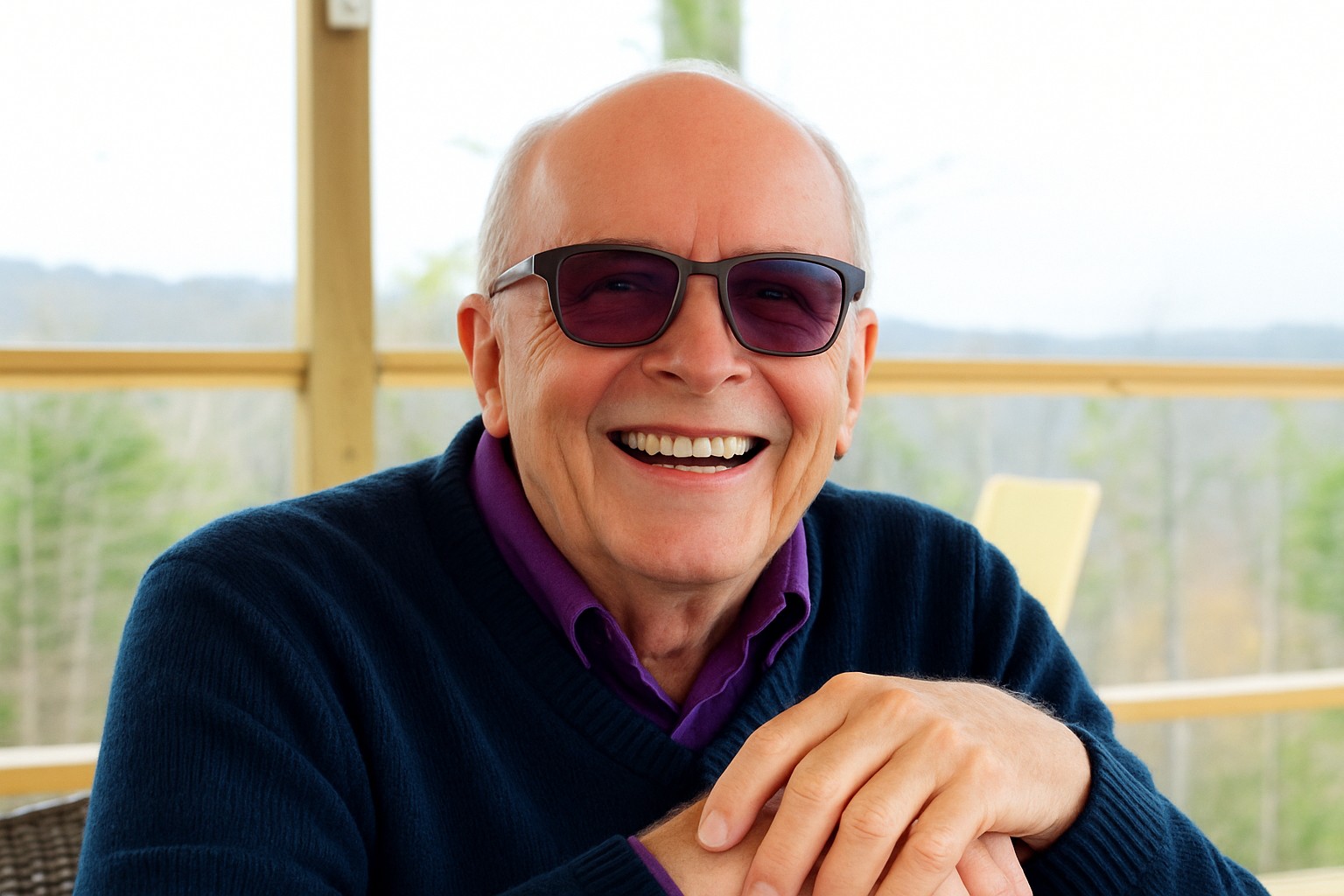
a pair of sleek, impossibly cool Ray-Ban Meta AI glasses with dark gray frames and purple transition lenses. They’re futuristic enough to make James Bond fumble for the manual. They gleamed like they already knew my secrets. The ad promised, “Experience Meta AI like never before,” and I swear it winked at me.

And yes, I bought them.

I didn’t need them. I just got new glasses in June. But I wanted them because something in me knew this was more than eyewear. This was foresight.

So brace yourself (and maybe pour yourself a dram of Bunnahabhain): I have officially joined the ranks of the cyborg chic.

I’d love to tell you I can see clearly now, to croon along with Johnny Nash, but the truth is—literally speaking—I can’t see much better.

Figuratively? Metaphorically? You bet! I can see better and farther than ever.

I’ve been writing about artificial intelligence since the early chatbots of 2021. I’ve talked about robots, about ChatGPT, about how this strange partnership between humans and machines is unfolding faster than anyone expected—certainly faster than most people are ready for.

And I, for one, don’t want to be left behind blinking in the dust.

I want to experience it. I want to learn from it. I want to understand where it’s leading us—not from the sidelines, but right in the thick of it.

So these glasses aren’t just a frivolous birthday splurge. They’re my passport to the next chapter. They’re literally my lens on the merging of human curiosity and machine intelligence.

That merger is coming, you know, when man and machines become one. It’s called the Singularity. A year or so ago, it was projected for 2037. Now I think futurists will be lucky if it waits five. And if that’s true, then I plan to be ready. I don’t want to be afraid. I don’t want to be resistant. I want to be curious. I want to be awake. I want to be willing to see.

I’ve spent seventy-eight years watching the world evolve in ways my childhood self could never have imagined. And yet, here I am, ready to keep moving forward.

My Ray-Ban Meta glasses are just a step in that direction: a gift to my future self, a wink to the present, and a promise that I’ll keep exploring what’s possible. Because for me, this isn’t just about sight. It’s about vision.

There you have it. Now you know. This seventy-eighth birthday gift might be my best ever from-me-to-me gift. These new AI glasses don’t just sit on my face—they announce something. They say I’m still moving forward, still curious, still willing to step into whatever’s next and report back with a grin.

I didn’t just give myself a gift. I threw down a gauntlet. Johnny Nash didn’t promise perfect vision; he promised guts. These AI glasses may not sharpen every detail, but they supercharge my curiosity. Maybe that’s the real clarity: strapping on the future, stepping into the frame, and letting life rocket toward me in full, outrageous 3-D.

If the future wants to come screaming at my face, fine by me. I’ll meet it head-on, glasses gleaming, ready for the light—and absolutely ready for my close-up, grinning from ear to ear.