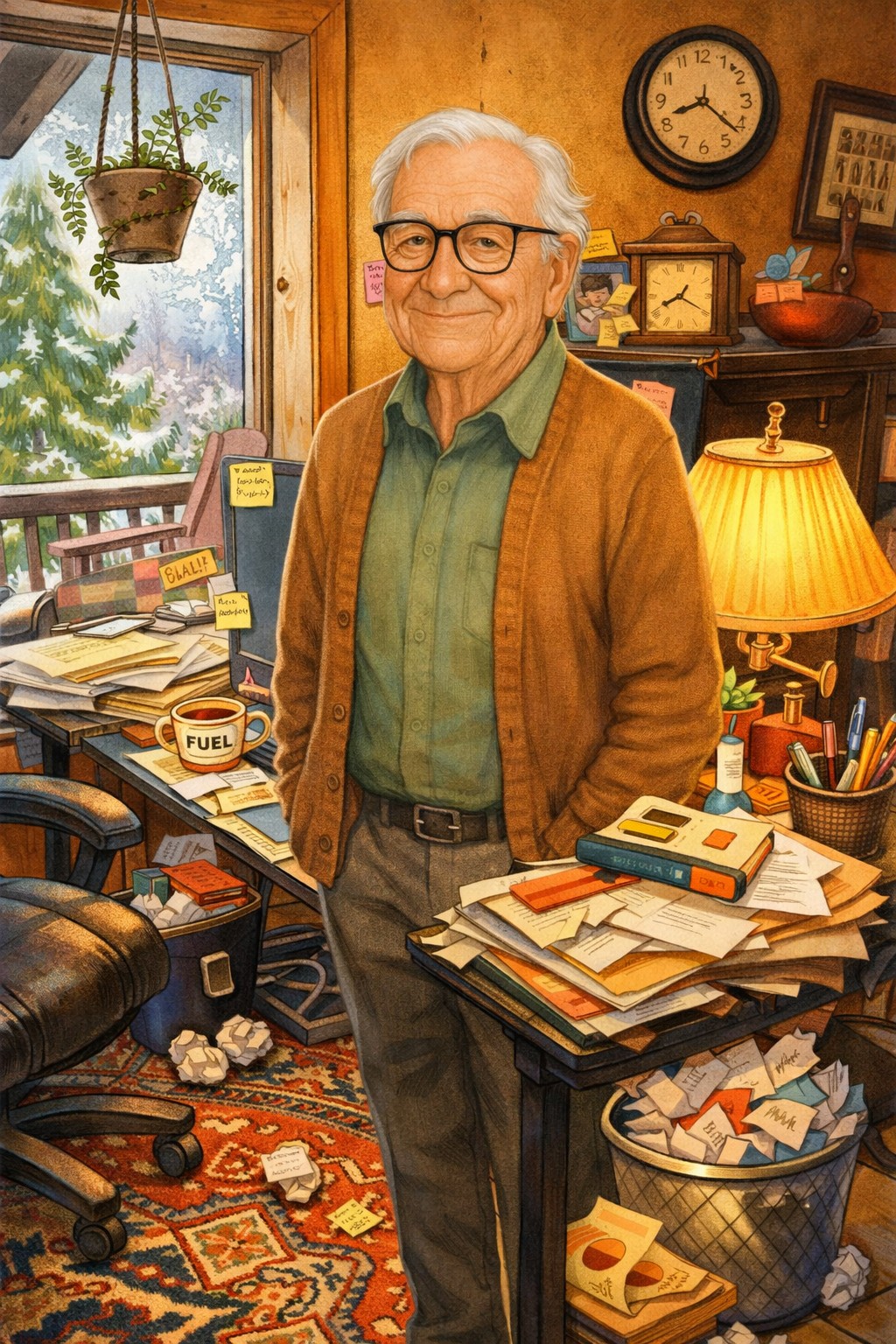
Poor Brentford Gives a Knuckle Rap. A Guest Column.


“Never mistake the undone for the unworthy.
The desk may be cluttered.
The life is not.”

Poor Brentford Lee (b. 1947. Altar ego—with an alter ego, too, of course. He ministers and he meddles. Life coach without credentials. Available for lectures, upbraidings, and unsolicited reminders of everything you’ve already accomplished.)


Sometimes we’re our own worst enemies. Maybe, all times. I know I am.

It doesn’t matter how much I get done, it’s always the undone that grabs hold of me in my waking hours and throws me into a tiff.

Just the other day—just as dawn was breaking—I sprang up in bed, asking myself:

“Where did it go? Where did it all go?”

Not my life, mind you. That’s still very much in progress.

I meant January and February—two months that often keep me snowed in on my mountaintop here in the Shenandoah Valley. And this year—once and for all—they were supposed to be the two perfect months to bring order to chaos. To organize my office.

Boxes. Amazon boxes, to be precise—a small mountain of them, stacked near the woodstove like a cardboard monument to every good intention I’ve ever had. Some are open. Some are not. All of them smile at me. That relentless Amazon smile, curved and cheerful and absolutely unbothered by my shame. I have begun to suspect they are multiplying when I’m not looking.

Desk and worktable. Buried. Buried under manila envelopes, unopened mail, a box of highlighters, a coffee mug that may or may not still contain coffee, and enough paper to reforest a modest hillside. The lamp burns bravely through the chaos like a lighthouse in a nor’easter.

Even the plants have opinions. Two magnificent specimens—sprawling dramatically across their ornate iron stands—have taken matters into their own fronds. One has sent a long, accusatory leaf directly toward my leather chair. As if pointing.

Pointing. Yes, pointing. The same way the ghost of my gray-haired grade school history teacher would point and declare with the wrath of an angry God:

“A cluttered desk is the devil’s workshop.”

And between Mrs. Snyder’s admonitions and my lament—”Where did it go? Where did it all go?”—Poor Brentford appeared as if in a vision rising up from nowhere in particular and everywhere at once.

“Where did it all go, you ask? Where did it all go? I’ll tell you exactly where it went. Pull up a chair if you can find one in that brain of yours, all cluttered now with nonsense.”

I thought I knew for sure where his harangue was headed. But for once he surprised. He did not stoop so low as to rap knuckles with any of the cliches from his repertoire of wisdom.

Not once did I hear,

“Time and tide wait for no one.”

Not once did I hear,

“Make hay while the sun shines.”

I didn’t even hear the one I was certain he would speak with calm certainty,

“Lost time is never found again.”

He didn’t recite any of those things.

Instead, he cleared his throat with great ceremony and delivered his first knuckle rap with the precision of a surgeon and the satisfaction of a man who has been waiting a very long time.

“Only handle it once.”

He let it hang there. Just those four words. Floating in the air above the Amazon boxes and the buried desk and the manila envelopes and the coffee mug of uncertain vintage.

“Your words. Well, Grace Reed’s words, if we’re being precise. Your Copyright Office colleague. The woman whose office was lean, mean, and sparse. The woman whose wisdom you borrowed, researched, published, celebrated, and then—apparently—left to ride around in the Jeep with the junk mail.”

He fixed me with a look that left no room for argument.

“Don’t bemoan where it all went. You know fully well. And you know exactly what to do.”

Then Poor Brentford’s voice softened. Just slightly. Just enough.

“Do you remember what you wrote on January 15th, 2024? You raised your Bunnahabhain to all the tarriers, the delayers, and the occasional shelver. You said, and I quote, ‘Here’s to the to-morrowers, the champions of It can wait until tomorrow, because sometimes tomorrow is just a delay away from today.'”

He smiled. For the first time.

“And do you remember Scarlett?

“She understood something you sometimes forget. Tomorrow is not surrender. Tomorrow is strategy.”

Poor Brentford gestured grandly at the Amazon boxes.

“Your Tara is a little more cardboard than hers. But the principle holds.”

He straightened his jacket.

“The office will get cleaned. One day. Tomorrow, perhaps. Or the day after. Or sometime before the Amazon boxes learn to walk.”

“Scarlett managed. So will you.”

But Poor Brentford wasn’t finished. He stood there, poised to deliver his final and most devastating knuckle rap. Quietly. Almost tenderly.

“Forget the cluttered office for now. I want you to remember something you wrote, something about a young professor who stopped you in a hallway and handed you an offprint with four words inscribed on the front.”

He paused.

“This is life everlasting.”

Another pause. Longer this time.

“You asked whether he was suggesting that we live on forever through what we share with others: ideas immortalized in print. You answered your own question. Here you are, nearly fifty years later, speaking his name. Professor Myerson continues to live.”

He leaned in close.

“And so will you. Through every word you have ever written. Eight books. More than a million words. Scholarship and essays that will outlast every Amazon box in that corner.”

“THAT is your life everlastin’. Now act like it.”

Just when my chair started getting uncomfortable, Poor Brentford had the nerve to tell me to shout out:

“Get behind me, Satan.”

I sprang up at once because in that command I recognized my own mother’s voice. Over and over again I had heard her rebuke the Devil whenever she faced her own pole of proverbial chaos.

Only then did I realize what Poor Brentford had done.

He had serenaded me with snippets of my own advice—counsel I had been publishing right here in this column for years.

I could hardly be offended.

I looked again at the Amazon boxes. The buried desk. The pointing plant.

They were all still there.

But the panic was gone.

The office could wait.

After all, tomorrow is strategy.

Seeing Clearly Now (Well, Sort Of)

“Seeing into the future? Maybe. But the real vision is daring to look closer—at now.”

—Extra E(Ad)dition for a NY Times Essay that didn’t exist on this day in 1947.

The world at large knows fully well that I’m always walking around with something rumbling around in my head. Half a paragraph. A misplaced metaphor. An idea that swears it’s a New Yorker masterpiece if I’d only give it five quiet minutes.

Today, though, it’s something else. It’s a song. If you’ve been around as long as I have—seventy-eight years today, thank you very much—you probably know it, especially if you like high notes of hope and courage.

It’s “I Can See Clearly Now,” released by Johnny Nash in 1972. It hit the Billboard Hot 100, Billboard Adult Contemporary charts, and Cash Box. I’m not surprised. From the moment those opening bars roll in, with that bright, easy rhythm that feels like sunlight tapping at your window, you’re already halfway to feeling better about the world. And then the lyrics land with their uncomplicated hopefulness:

“I can see clearly now, the rain is gone… It’s gonna be a bright, bright sun-shiny day.”

It’s a song that doesn’t pretend to be profound. It is profound because it’s simple, clean, declarative, and certain. The rhythm carries you forward. The lyrics lift you up. It’s optimism set to a beat you can sway to. It’s a three-minute promise that whatever clouds you’re carrying won’t last forever. The doubts that pile up like storm fronts won’t last. The troubles that cling like a stubborn fog won’t last. The little fears that hover just above eye level won’t last. Even the big ones that black out the sky won’t last.

Nash calls them “obstacles in our way,” but we all know what he means. Heartbreaks. Hesitations. Heavy thoughts. Anything that dims the day before it even begins. His song doesn’t erase them. It dissolves them, one bright measure at a time.

So for three minutes, the rain really does feel gone. And even if the sun isn’t shining yet, you believe with full, uncomplicated certainty that it’s on its way.

So there you have it. My. First. Clue!

And somewhere I hear a chorus of readers asking:

Clue to what, exactly?

All right, if you insist, I’ll go ahead and tell you what I was going to tell you anyway.

Like I said, it’s my birthday. You’ve probably already marked your calendars, because I do tend to make a fuss every year.

And yes, I’m talking about my birthday presents. Or rather, my presence.

Every year, I receive lovely gifts, but the silliest, most ridiculous one always comes from me. I buy myself something special—something utterly frivolous—and I wrap it in the most over-the-top paper I can find. Then I write myself a card declaring, in no uncertain terms, how truly spectacular I am.

Because guess what? I am spectacular.

Guess what else? You are, too.

This year’s gift? Well, it’s so far out there I’m not sure I dare tell you what I’ve done.

But I will give you another clue or three, like the one I just gave you.

Vision. It has to do with my eyes.

“Good God, no! I’m not having cataract surgery!”

Why, you’ve got some nerve even thinking such a thing—let alone blurting it out for the world to hear. Maybe in a few years I’ll blurt it out myself, but not this year.

Any guesses? None? Oh, come on. You can do better than this.

All right then—one more hint.

Glasses!

And to that clue I’ll add a question: Do you remember those 3-D glasses we used to wear at the movies? The cardboard ones with one red lens and one blue? The kind that made the screen come alive and sent spaceships flying toward your popcorn, dinosaurs roaring in your lap, and your best friend ducking beside you like it might all be real?

Those gloriously goofy things that made the world look both ridiculous and absolutely amazing at the same time?

Try to remember. You can, I’m sure.

I sure did when I opened the mail not too long ago and saw what I saw. I saw the future coming right at me. Really. Right at me.

I knew immediately: this was it. My birthday splurge.

Might I have a drumroll, please, before my big reveal?

TRRRRRRRRRA-DA-DA-DA-DA-DA-DA-DA—WHAM-BLAM-KA-THOOOOOOM—FWOOOOSH-CRACKA-LACKA-VROOOOOM—TSSSHHHH-KA-SHIIIIIIINE!

And now, My Dear Readers, I am pleased to announce that I treated myself to

a pair of sleek, impossibly cool Ray-Ban Meta AI glasses with dark gray frames and purple transition lenses. They’re futuristic enough to make James Bond fumble for the manual. They gleamed like they already knew my secrets. The ad promised, “Experience Meta AI like never before,” and I swear it winked at me.

And yes, I bought them.

I didn’t need them. I just got new glasses in June. But I wanted them because something in me knew this was more than eyewear. This was foresight.

So brace yourself (and maybe pour yourself a dram of Bunnahabhain): I have officially joined the ranks of the cyborg chic.

I’d love to tell you I can see clearly now, to croon along with Johnny Nash, but the truth is—literally speaking—I can’t see much better.

Figuratively? Metaphorically? You bet! I can see better and farther than ever.

I’ve been writing about artificial intelligence since the early chatbots of 2021. I’ve talked about robots, about ChatGPT, about how this strange partnership between humans and machines is unfolding faster than anyone expected—certainly faster than most people are ready for.

And I, for one, don’t want to be left behind blinking in the dust.

I want to experience it. I want to learn from it. I want to understand where it’s leading us—not from the sidelines, but right in the thick of it.

So these glasses aren’t just a frivolous birthday splurge. They’re my passport to the next chapter. They’re literally my lens on the merging of human curiosity and machine intelligence.

That merger is coming, you know, when man and machines become one. It’s called the Singularity. A year or so ago, it was projected for 2037. Now I think futurists will be lucky if it waits five. And if that’s true, then I plan to be ready. I don’t want to be afraid. I don’t want to be resistant. I want to be curious. I want to be awake. I want to be willing to see.

I’ve spent seventy-eight years watching the world evolve in ways my childhood self could never have imagined. And yet, here I am, ready to keep moving forward.

My Ray-Ban Meta glasses are just a step in that direction: a gift to my future self, a wink to the present, and a promise that I’ll keep exploring what’s possible. Because for me, this isn’t just about sight. It’s about vision.

There you have it. Now you know. This seventy-eighth birthday gift might be my best ever from-me-to-me gift. These new AI glasses don’t just sit on my face—they announce something. They say I’m still moving forward, still curious, still willing to step into whatever’s next and report back with a grin.

I didn’t just give myself a gift. I threw down a gauntlet. Johnny Nash didn’t promise perfect vision; he promised guts. These AI glasses may not sharpen every detail, but they supercharge my curiosity. Maybe that’s the real clarity: strapping on the future, stepping into the frame, and letting life rocket toward me in full, outrageous 3-D.

If the future wants to come screaming at my face, fine by me. I’ll meet it head-on, glasses gleaming, ready for the light—and absolutely ready for my close-up, grinning from ear to ear.