Poor Brentford Gives a Writerly Upbraiding


The writer who goes hunting ideas too aggressively usually returns with nothing but metaphors and poison ivy.” — Poor Brentford Lee. Reluctant naturalist and persistent thorn in his writerly side since 1947.


“Phooey!”

I swear on a stack of books yet to be written that’s exactly what Poor Brentford said.

And get this. He had the nerve to say it smack dab in the middle of a conversation with Gary while I was explaining that maybe, just maybe, I’d come up with something to write about while gardening.

“It’s not easy coming up with all these blog ideas.”

“But you seem to have more ideas than there are days.”

“I don’t know about that, but I came up with one right now. You’ll see.”

I wouldn’t be the first writer, of course, looking for something to write about.

I guess, truth be told, we all go hunting for material.

And precisely at that thought I heard:

“Phooey!”

Luckily, Gary did not hear Poor Brentford who was just getting started.

“It goes without saying that you’ll start your catalogue of examples with your Lady.”

“Of course I will. Mary E. Wilkins Freeman was notorious for writing about the people and happenings where she lived. And who, pray tell, knows that better than I?”

“Oh, Lord,” Poor Brentford moaned. “Must I listen one more time to your recitation of local influences in her Pembroke, People of Our Neighborhood, The Debtor …”

“Stop it. Stop it right there. That’s not fair. You know fully well that I don’t think I’ve ever said such a thing about those novels, but I could. She did.”

“What, then, were you going to corner me with?”

“Well, I was simply going to say that Freeman owned up to her literary heists.”

“Right. Sure, she did. Like she owned up to being ten years younger than she really was.”

Poor Brentford, I could tell, was a little more cantankerous than usual, so I decided to shut him up with proof.

“Here’s what she wrote a friend, and I quote, word for word: ‘Monday afternoon, I went a-hunting material too: We went to an old lady’s birthday-party. But …’:

He interrupted me mid-sentence.

“I’ve heard it before. Heard it all before, word by word: ‘… all I saw worth writing about there was a poor old dog who had been chained thirteen years, because he bit a man once, in his puppy-hood.'”

Poor Brentford was right, of course. I’ve written often about that poor puppy and how Freeman gave him a new life as Caesar in her “A New England Nun,” unaware perhaps that his resurrection in that story was linked inextricably and forever to sexual repression.

But was he kind enough to let me do it one more time? Of course not.

“You need to get new examples that will grab your readers’ attention the way that poor puppy grabbed Freeman’s heart.”

Before I could agree or disagree or even ask what writers he had in mind, he gave me a litany that lasted so long I needed a fresh shave. And get this. He had them all neatly organized by categories. It was disgusting. I mean he started off with the obvious, writers like Freeman who really did go looking. The way Henry David Thoreau did in Walden. Or Hemingway as he chased wars and bullfights and deep-sea fishing. Or Joan Didion’s notebooks capturing her fleeting impressions. He even had a list of counterparts across the Pond but before he could bless me with Dickens and his kith and kin, he lost his train of thought and started telling me about writers who made use of strange incidents.

Frankenstein grew out of a ghost-story contest during a rainy vacation.

Alice’s Adventures in Wonderland began as an improvised story told to amuse a child on a boat ride.

The Metamorphosis reportedly sprang from the absurd question: what if a man woke up as an insect?

● The Strange Case of Dr Jekyll and Mr. Hyde was inspired by a dream.

I listened attentively, storing up those examples with every intent to use them in something or other one day or another, but I stood up and objected vehemently when he had the nerve to expect me to follow along with his discussion of the intertextual path that some writers had taken as they wrote famous works based on other folks’ famous works. Ulysses parallels The Odyssey. Rosencrantz and Guildenstern Are Dead as a spin off from Hamlet. I had heard enough. More than enough.

“All right, Poor Brentford. Let’s make a truce. Let’s sign a pact. Let’s forget that I ever mentioned my hope of finding a blog idea to write about.”

I paused. He paused. We stared at one another.

“If you do, you’ll be sorry.”

“It won’t be the first time, I’m sure. But if you’ll excuse me, I have to garden so that I’ll find something to write about.”

“You’re wasting your time. When’s the last time that you ever went looking for an idea and found one?”

I started to reply, but he cut me short.

“Did it ever occur to you that you’ve got this writerly thing of yours all reversed?”

“Thing? Writerly thing?” Spit it out. What’s your point?”

“My point,” Poor Brentford said, with the air of a man who has been waiting his entire existence to say exactly this, “is that you didn’t find your ideas. Your ideas found you.”

I opened my mouth.

“Don’t.”

I closed it.

“Take your Lady. Do you honestly believe you went looking for Mary E. Wilkins Freeman? Or did she reach up out of some footnote or bibliography and grab you by the collar in 1973 and simply refuse to let go? Because last time I checked, she still hasn’t.”

I said nothing, which, as Poor Brentford knows perfectly well, is as good as an admission.

“More than fifty years, Brent. Fifty years she has had you. And you have the audacity—the sheer pomposity—to sit there and tell Gary you went looking for something to write about while gardening. How generous of you. How magnanimous. How utterly beside the point.

“And then there’s Alexander Gordon.”

He said it quietly, exactly the way Poor Brentford delivers his most devastating blows.

“You didn’t find The Humourist. The Humourist found you. He waited. Two hundred and nineteen years, give or take. Sitting in the only complete run of the South-Carolina Gazette in existence—survived earthquakes, fires, wars, and hurricanes, mind you—and then reached up out of a footnote in 1973 and grabbed a graduate student by the collar. And here you are, fifty-some years later, still in his grip. Still writing. Still talking about him at libraries.”

He paused for effect. He has always been insufferably good at pauses.

“They found you, Brent. Both of them. In the same year, no less. And they have never once seen fit to release you. How breathtakingly, magnificently pompous to think that you in your infinite wisdom found them.

I sat down, flummoxed.

“What on earth am I supposed to do with that? I don’t have all the time in the world, you know, to come up with ideas.”

Maybe,” Poor Brentford said, “that’s the whole point of this writerly thing I’m trying to help you understand.”

He settled back with an expression I hadn’t seen before. Not smug. Not cantankerous. Almost kind.

“Ideas,” he said, “are not sitting around waiting for you to come find them. They are, if you’ll permit me, already in motion. Floating. Drifting. Looking for the right home. The right mind. The right heart. They pass over some people entirely–perfectly nice people, mind you, and perfectly intelligent people–and move on. Then they find someone like you and they simply settle. Take up residence. Refuse to leave.”

I started to say something.

“Freeman settled in 1973. Gordon settled in 1973. The same year, Brent. Do you think that was your doing?”

I did not.

“Ideas are not hunted. They are not chased down like a rabbit hopping through your briary ravine.”

He folded his hands with great finality.

“They arrive. Always have. Always will. The only question that matters—the only question that ever has—is whether the writer is the kind of person who opens the door and makes a home.”

Poor Brentford Gives a Knuckle Rap. A Guest Column.


“Never mistake the undone for the unworthy.
The desk may be cluttered.
The life is not.”

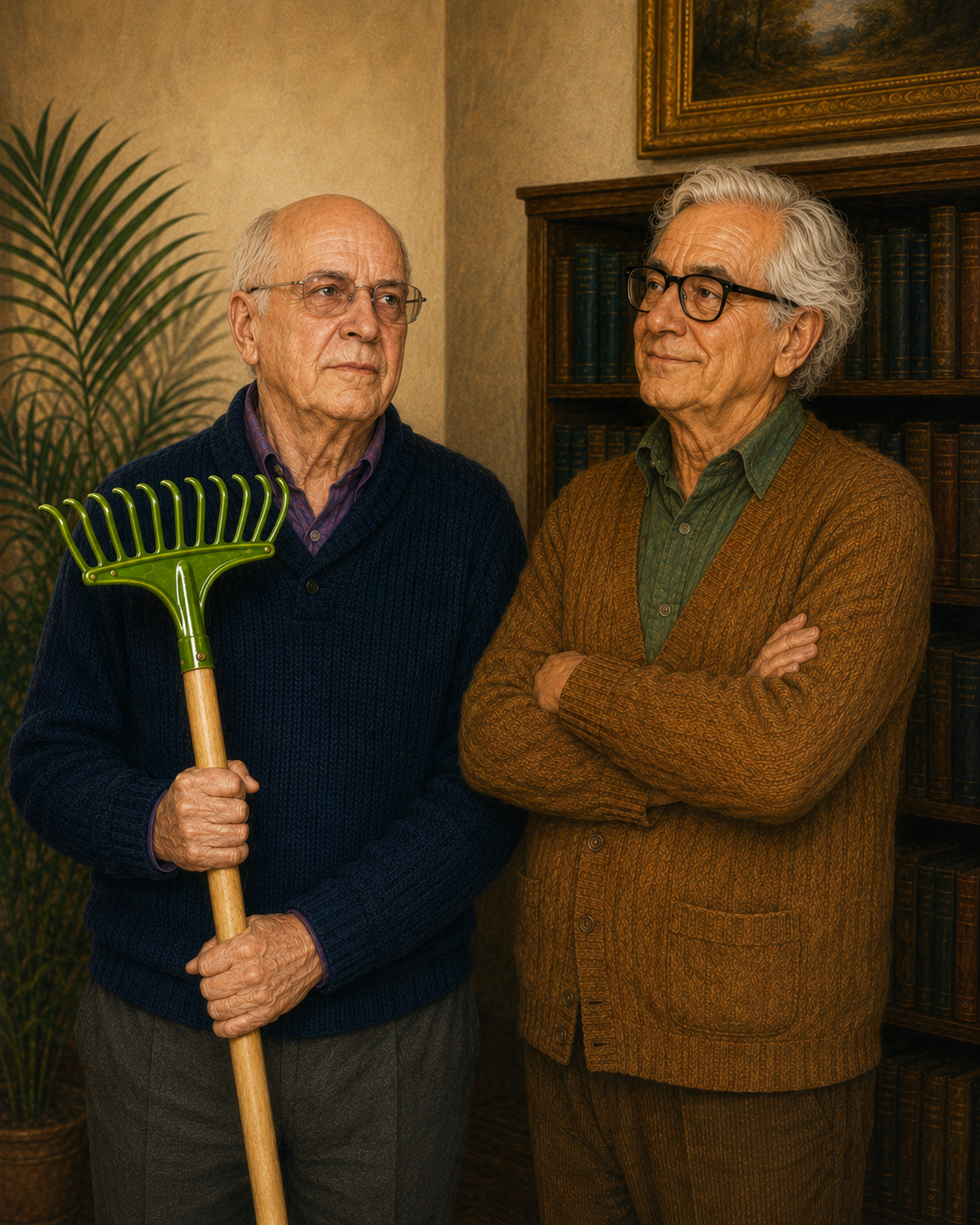
Poor Brentford Lee (b. 1947. Altar ego—with an alter ego, too, of course. He ministers and he meddles. Life coach without credentials. Available for lectures, upbraidings, and unsolicited reminders of everything you’ve already accomplished.)


Sometimes we’re our own worst enemies. Maybe, all times. I know I am.

It doesn’t matter how much I get done, it’s always the undone that grabs hold of me in my waking hours and throws me into a tiff.

Just the other day—just as dawn was breaking—I sprang up in bed, asking myself:

“Where did it go? Where did it all go?”

Not my life, mind you. That’s still very much in progress.

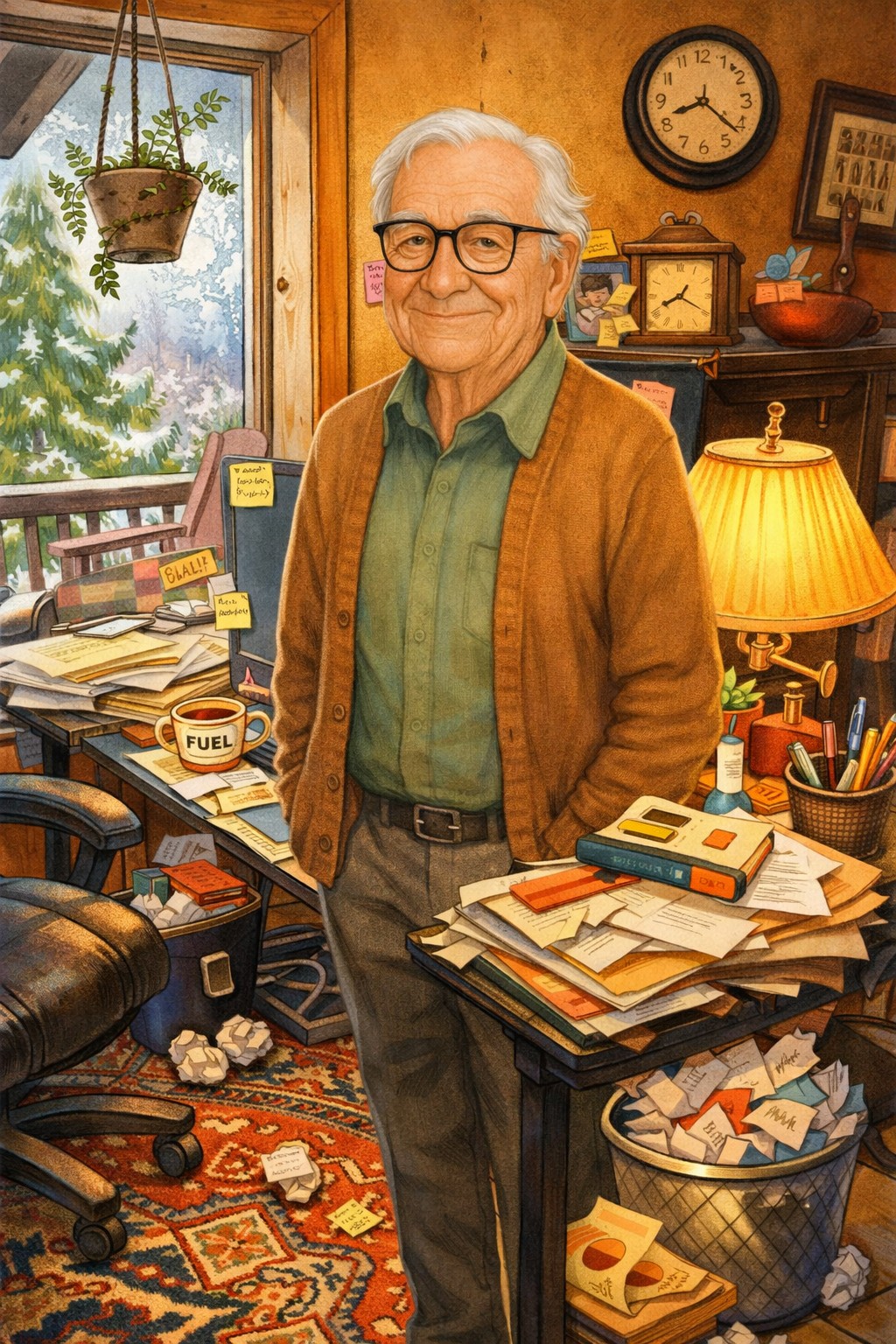
I meant January and February—two months that often keep me snowed in on my mountaintop here in the Shenandoah Valley. And this year—once and for all—they were supposed to be the two perfect months to bring order to chaos. To organize my office.

Boxes. Amazon boxes, to be precise—a small mountain of them, stacked near the woodstove like a cardboard monument to every good intention I’ve ever had. Some are open. Some are not. All of them smile at me. That relentless Amazon smile, curved and cheerful and absolutely unbothered by my shame. I have begun to suspect they are multiplying when I’m not looking.

Desk and worktable. Buried. Buried under manila envelopes, unopened mail, a box of highlighters, a coffee mug that may or may not still contain coffee, and enough paper to reforest a modest hillside. The lamp burns bravely through the chaos like a lighthouse in a nor’easter.

Even the plants have opinions. Two magnificent specimens—sprawling dramatically across their ornate iron stands—have taken matters into their own fronds. One has sent a long, accusatory leaf directly toward my leather chair. As if pointing.

Pointing. Yes, pointing. The same way the ghost of my gray-haired grade school history teacher would point and declare with the wrath of an angry God:

“A cluttered desk is the devil’s workshop.”

And between Mrs. Snyder’s admonitions and my lament—”Where did it go? Where did it all go?”—Poor Brentford appeared as if in a vision rising up from nowhere in particular and everywhere at once.

“Where did it all go, you ask? Where did it all go? I’ll tell you exactly where it went. Pull up a chair if you can find one in that brain of yours, all cluttered now with nonsense.”

I thought I knew for sure where his harangue was headed. But for once he surprised. He did not stoop so low as to rap knuckles with any of the cliches from his repertoire of wisdom.

Not once did I hear,

“Time and tide wait for no one.”

Not once did I hear,

“Make hay while the sun shines.”

I didn’t even hear the one I was certain he would speak with calm certainty,

“Lost time is never found again.”

He didn’t recite any of those things.

Instead, he cleared his throat with great ceremony and delivered his first knuckle rap with the precision of a surgeon and the satisfaction of a man who has been waiting a very long time.

“Only handle it once.”

He let it hang there. Just those four words. Floating in the air above the Amazon boxes and the buried desk and the manila envelopes and the coffee mug of uncertain vintage.

“Your words. Well, Grace Reed’s words, if we’re being precise. Your Copyright Office colleague. The woman whose office was lean, mean, and sparse. The woman whose wisdom you borrowed, researched, published, celebrated, and then—apparently—left to ride around in the Jeep with the junk mail.”

He fixed me with a look that left no room for argument.

“Don’t bemoan where it all went. You know fully well. And you know exactly what to do.”

Then Poor Brentford’s voice softened. Just slightly. Just enough.

“Do you remember what you wrote on January 15th, 2024? You raised your Bunnahabhain to all the tarriers, the delayers, and the occasional shelver. You said, and I quote, ‘Here’s to the to-morrowers, the champions of It can wait until tomorrow, because sometimes tomorrow is just a delay away from today.'”

He smiled. For the first time.

“And do you remember Scarlett?

“She understood something you sometimes forget. Tomorrow is not surrender. Tomorrow is strategy.”

Poor Brentford gestured grandly at the Amazon boxes.

“Your Tara is a little more cardboard than hers. But the principle holds.”

He straightened his jacket.

“The office will get cleaned. One day. Tomorrow, perhaps. Or the day after. Or sometime before the Amazon boxes learn to walk.”

“Scarlett managed. So will you.”

But Poor Brentford wasn’t finished. He stood there, poised to deliver his final and most devastating knuckle rap. Quietly. Almost tenderly.

“Forget the cluttered office for now. I want you to remember something you wrote, something about a young professor who stopped you in a hallway and handed you an offprint with four words inscribed on the front.”

He paused.

“This is life everlasting.”

Another pause. Longer this time.

“You asked whether he was suggesting that we live on forever through what we share with others: ideas immortalized in print. You answered your own question. Here you are, nearly fifty years later, speaking his name. Professor Myerson continues to live.”

He leaned in close.

“And so will you. Through every word you have ever written. Eight books. More than a million words. Scholarship and essays that will outlast every Amazon box in that corner.”

“THAT is your life everlastin’. Now act like it.”

Just when my chair started getting uncomfortable, Poor Brentford had the nerve to tell me to shout out:

“Get behind me, Satan.”

I sprang up at once because in that command I recognized my own mother’s voice. Over and over again I had heard her rebuke the Devil whenever she faced her own pole of proverbial chaos.

Only then did I realize what Poor Brentford had done.

He had serenaded me with snippets of my own advice—counsel I had been publishing right here in this column for years.

I could hardly be offended.

I looked again at the Amazon boxes. The buried desk. The pointing plant.

They were all still there.

But the panic was gone.

The office could wait.

After all, tomorrow is strategy.

Two Porches. One Voice.


“The first porch is where you find your voice. The second porch is where your voice finds others.” —Poor Brentford Lee (b. 1947. Keeper of two porches, one mountain, one dog, and an inexhaustible supply of things worth saying—none of which he has to say alone anymore, thanks to his partner, Gary.)


Dear Faithful Readers,

You’ve been here with me on the porch since—well, some of you since the very beginning, back when I built it as nothing more than a place where you could pull up a chair and talk with me about the joys, challenges, and discoveries of research. We kept right on doing that from 2012 to 2021 when I decided to make the porch a little more fun by bringing you weekly creative nonfiction essays.

I’m still at it. Nearly 750,000 words later. Yes, you read it right. Foolin’ around in bed every night with ideas and words adds up. I’m spurred on by you, my Dear Readers, whose numbers keep increasing annually! Last year, we shared more than 35,000 views right here on the porch.

But I’ve built a brand-new porch, and I want you to be the first to know about it.

Don’t worry, though. I’m not leaving The Wired Researcher porch. It will remain open virtually forever. Same Monday mornings. Same voice–mine, with Poor Brentford’s voice chiming in from time to time. We’ll both be there, waiting for you.

I just heard someone shout out:

“So, why are you building a new porch? What’s that all about?”

Well, for starters, it has better lighting, and it might just bring in more neighbors for all of us to visit and exchange ideas.

I’m counting on you to check it out. I’ve named the second porch The Kendrick Chronicles.

“Where on earth is this new porch of yours?”

Gracious me! You know that I like to take my time–slow and easy like. In a sec, I’ll give you the link so that you can check it out for yourself. And when you do, go ahead and Subscribe! From that point forward, my essays–ever goldern new one that hits the world, every Monday morning like a neighbor who always brings something worth reading and never overstays his welcome–will find their way directly to your Inbox.

You can find this new porch of mine in Substack. Here’s the link:

brentlkendrick.substack.com

“What will I find when I get to this new porch of yours?”

Why, gracious me! You’ll find a comfy chair with your name on it and a handful of your favorite essays with my name on ’em:

● Redbuds of Remembrance

● Learning to Love in New Ways

● I Am Afraid

● Poor Brentford Cleans the Wax Out of His Ears

● Two, Together

● Glimpses of My Mother’s Hands

● The Ghost of Palmyra Church Road

● Truths Half-Told. Letters Half-Burned. A Legacy Waiting to Be Fully Heard.

● Carrying the Bags of Colonial America’s Humourist

And get this. If you subscribe, next week you’ll get an essay about a kitchen disaster beyond belief: “Oh, No! No Sourdough!” And the week after that, “What We Know. What We Believe.” It may be the most complete thing I’ve ever written about who I am and what I believe about what comes next.

So go on now. Pull up a chair. Same voice. Wider porch.

Come find me there:

The Kendrick Chroniclesbrentlkendrick.substack.com

But always remember to come back here, as I remain–

Epigraphically yours forever,

Brent L. Kendrick
(—and Poor Brentford Lee, who deserves full credit for my nonsense)