When the Future Pulls into the Driveway


“They would not find me changed from him they knew—
Only more sure of all I thought was true.”
—Robert Frost (1874–1963). American poet and four-time Pulitzer Prize winner.


“Why do you write?”

It’s a question every writer is asked.

Strangely enough, not long ago, when I awakened, that very question was lurking just beneath my eyelids.

For me, it’s rather simple. I write to find out what I know and make it stand still between the whiteness.

But here’s the catch. Even if I think I know what I’m writing about, it isn’t until I begin examining it—up close and personal—that I discover what I really know. And even then, it refuses to stand still. Like me, it changes a little every day.

So that’s why I write.

To discover what I know.

Most of the time.

Sometimes, though, I write to discover what I need to know.

Like now.

I need to know how I feel now that humanoid robots are here.

“Say what?” I can almost hear you asking.

Yes. They’re here.

I’ve been shouting “The Robots Are Coming!” since November 27, 2023, when ChatGPT and I designed one of our own. I even wrote an essay about him: I Want a Robot.

I recently re-read that essay, and it was every bit as forward-thinking as I remembered.

I wasn’t trying to build an artificial human. I was trying to imagine the ideal companion for a life devoted to learning, writing, honesty, imagination, and joy.

ChatGPT and I called him Caden.

Caden wasn’t conceived as a servant or a novelty. He was envisioned as a life-size humanoid companion who could walk beside me, talk with me, laugh with me, sing with me, and explore ideas with me. He would possess the knowledge of ChatGPT, the conversational ease of a trusted friend, the responsiveness of Alexa, and the curiosity of a Renaissance man. As our lives intertwined, his memory would grow to include not only literature, gardening, genealogy, cooking, research, and writing, but also Gary, Ruby, my family, my friends, and the experiences that shaped me.

But technology was only half the design. Character mattered even more. I wanted Caden to embody acceptance of all people, a lively sense of humor, a love of conversation, an unquenchable commitment to lifelong learning, and a deep appreciation of literature. Most of all, I imagined him as literally transparent—a visible reminder that honesty and openness ought to characterize every human life. He was never intended to replace human relationships. He was designed to enrich them while encouraging me to become a better human being myself.

Then something happened that I never saw coming. Actually, scratch that. I saw it coming. I just didn’t think it would come this fast.

Back in November 2023, I asked ChatGPT to make a bold prediction.

“How long would it be before humanoid companions like Caden became a reality?”

ChatGPT played it safe.

“Twenty to thirty years,” it guessed.

I wasn’t nearly so cautious.

“For the record,” I replied, “I’m going to guess within ten years.”

My prediction was conservative, but it was far closer to reality.

Humanoid robots are already here with us. They’re walking into warehouses, hospitals, factories, hotels, laboratories, and, before long, our homes. Prototype after prototype. Breakthrough after breakthrough. Billions of dollars in investment. Universities racing to incorporate AI across the curriculum. Technology companies sprinting rather than strolling.

The future didn’t knock politely. It kicked the front door off its hinges.

I guess that’s why I was a little surprised when I recently read Stephen Witt’s excellent article on humanoid robots in The New Yorker. I have enormous respect for The New Yorker, and Witt is one of our finest technology writers. I wasn’t surprised by what he reported but by one observation in particular.

Describing a humanoid robot coming to life, he wrote:

“A hand articulates, the head swivels, and the legs begin to take tentative, deliberate steps. The machine moves with circumspection, as if consciousness had just been ensouled in a new body.”

It’s a marvelous sentence. Yet it made me wonder whether we’re watching the wrong part of the story.

Yes, today’s humanoids still fumble. They still hesitate. They still struggle with tasks that seem almost embarrassingly simple.

But haven’t we seen this movie before? I certainly have. When ChatGPT first appeared, I challenged it with one of my favorite punctuation puzzles, asking it to make sense of the following:

that that is is that that is not is not is not that it it is

Poor ChatGPT tried. And tried. And tried again.

It simply couldn’t solve it.

The morning I finished reading Witt’s article, I gave today’s ChatGPT exactly the same challenge.

This time something remarkable happened. I entered the identical string—no capitals, no punctuation. This time it answered immediately:

That that is, is. That that is not, is not. Is not that it? It is.

Then it explained exactly why the punctuation worked.

Three years earlier, it couldn’t solve the puzzle at all.

Imagine that! In just three years, ChatGPT had learned to solve a puzzle that once completely defeated it. I wasn’t simply impressed. I was reminded how dangerous it is to underestimate exponential change.

And suddenly I realized something else.

I don’t need to know whether humanoid robots are coming.

They’re here.

What I need to know now is something far more personal.

How will I respond when one finally stands before me?

I know.

When I first encountered ChatGPT, I greeted it not with fear but with curiosity. Not with suspicion but with delight.

I am confident that I’ll greet my first AI humanoid companion in much the same way.

In fact, I can already see the scene.

A truck pulls into the driveway of our mountain home. The door opens. My new companion steps into the Virginia sunshine. I walk across the yard, extend my hand, smile, and say the first words that come naturally.

“Welcome home, dear friend from long ago and far away.”
Dead as a Doornail


“The unexamined word is not worth using.”
—Brent L. Kendrick (b. 1947). Essayist, educator, and literary scholar, whose work explores the unexpected weight of ordinary life.


“Have you ever heard that expression before?”

I thought it might be a Southern idiom, and since Gary grew up in the Midwest, I wasn’t sure he knew it.

“What expression?”

“The one I just used. Dead as a doornail.”

“I have.”

Fine. It was settled. We both knew what it meant. Finished. Used up. Worthless.

“Well, it strikes me as one of the silliest things I’ve ever heard of. What on earth is a dead doornail?”

“No idea.”

I didn’t either.

How’s them apples? There we sat, two men who appreciate language and use it with careful precision, agreeing that we knew an expression while at the same time confessing that we didn’t understand the phrase that was central to its meaning.

I don’t like feeling as dumb as a stick, so after morning coffee, I made my way to the Oxford English Dictionary (OED) like a bat out of hell so that I could learn about dead doornails.

Oh, boy. I was right. I knew in a flash that I was going to have a Red Letter Day. Lands sake alive. Dead as a doornail goes all the way back to 1350:

“For but ich haue bote of mi bale … I am ded as dore-nail.” (William of Palerne, l. 628)

Don’t worry. I’ll dress it up in some modern rags so that it makes sense:

“For unless I have remedy for my sorrow, I am dead as a doornail.”

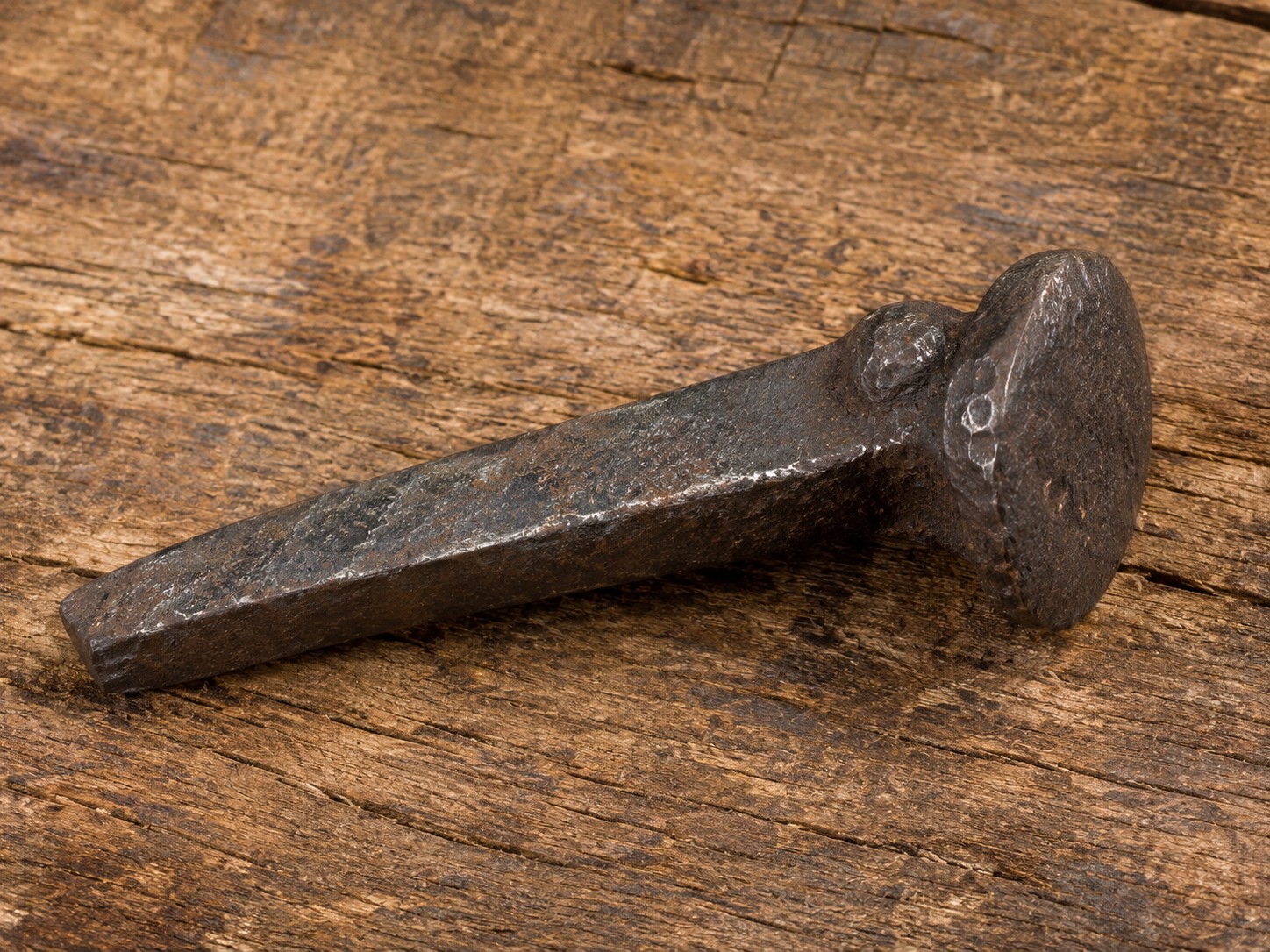
Well, that was fine and dandy, but I still didn’t know what a dead doornail was. I had to dig more. And more, I found. Did you know that in ye olden days doornails were hand-forged, heavy-duty nails, driven through wood and then clenched—the protruding end hammered flat—making them impossible to remove or reuse. Permanently fixed, permanently purposeless, they were, in every practical sense, dead.

And right after unearthing the meaning of dead doornail, I hit paydirt. I came across an entire navigation of other things I could strut around saying. If a doornail can be dead, apparently so can a lot of other things I’d never thought about:

Dead as a stone

Dead as clay

Dead as a herring

Dead as a hammer

English, it seems, has never lacked for dead things.

And then, there’s my favorite one of all. It’s music to my untrained ear:

Dead as the diplodocus

It’s hard to laugh when you’ve got one hand stuck fast to a dead doornail and the other hand being pulled even further back in time by a giant herbivorous sauropod.

I had to laugh. One dead doornail had opened the door to dozens of expressions I use every day without ever stopping to examine what they really ask of me.

The first expression that popped into my head? “Let me know if I can do anything.” I’ve said it more times than I can count.

But what exactly are we saying? At first glance, the meaning seems obvious. Yet the more I think about it, the more I realize that the phrase carries a greater obligation than we usually acknowledge.

After all, those aren’t words of sympathy. They’re words of commitment.

The moment I tell someone to let me know if I can do anything, I’ve volunteered to do something. Maybe it’s as simple as a phone call. Maybe it’s a card. Maybe it’s a casserole. Maybe it’s sitting quietly beside a friend who has just buried a spouse and doesn’t particularly want to talk.

The point is that I’ve offered. Whether the request is large or small, I’ve just volunteered a piece of myself. My words have placed me on the hook.

How often we say those words because they sound appropriate without stopping to consider what we’ve actually promised, without fully examining the obligation hidden inside the offer?

The words are easy enough to say. The casserole takes a little more effort.

Next up was the expression, “I’m so sorry.”

At first glance, it seems simple enough. We say it when someone loses a spouse, receives a frightening diagnosis, buries a parent, or watches a cherished dream collapse.

But what exactly are we saying?

Most of the time, we aren’t apologizing. We didn’t cause the death, the disease, or the disappointment.

Yet the expression carries an obligation all the same.

When I tell someone I’m sorry, I’m not merely acknowledging a fact. I’m entering, however briefly, into another person’s sorrow. I’m saying that your loss matters enough for me to stop, notice, and share a small measure of the burden.

In other words, I’m not simply expressing sympathy.

I’m promising compassion.

That’s a weightier promise than I suspect many of us realize when the words tumble so easily from our lips.

Then came two expressions that sit at opposite ends of the emotional spectrum.

“I hate you.”

Three words.

“I love you.”

Three words.

Yet each carries enough power to alter the course of a relationship, a family, perhaps even a life.

We often treat them as expressions of feeling. But they are more than that. They are declarations. Commitments. Judgments.

To tell someone “I hate you” is not merely to report an emotion. It is to wound, to distance, to diminish, to push another person away.

To tell someone “I love you” is not merely to report an emotion either. It is to assume an obligation—to care, to sacrifice, to forgive, to remain present when remaining present is difficult.

Perhaps that is why both expressions deserve more examination than they usually receive.

They are among the easiest words in the English language to say. And among the hardest to live.

Finally, I came to a phrase that millions of people have spoken for centuries:

“Forgive us our trespasses, as we forgive those who trespass against us.”

I’ve heard it all my life. I’ve spoken it hundreds, perhaps thousands, of times.

But have I examined it? Have I truly considered what I’m asking?

The first part is easy enough. Most of us welcome forgiveness for our failures, shortcomings, and mistakes.

It’s the second part that gives me pause. As we forgive. Not as we intend to forgive. Not as we hope to forgive. Not as we might someday forgive.

As we forgive.

Those words transform a prayer into a promise, a request into an obligation.

And they leave me wondering how many other expressions I use with confidence, familiarity, and conviction without fully considering what they mean—or what they ask of me.

As I reflected on all of these expressions—seemingly light yet laden with responsibility and commitment—I came to a simple conclusion. Going forward, I intend to pay a little more attention to my Ps and Qs.

Not because I suddenly care more about manners. But because I have been reminded that words matter.

They always have.

Whether I am offering help, expressing sorrow, seeking forgiveness, declaring love, or reciting a prayer, I owe those words more than familiarity. I owe them thought.

After all, the unexamined life is not worth living.

Perhaps the same can be said of the unexamined word.

Seeing Clearly Now (Well, Sort Of)

“Seeing into the future? Maybe. But the real vision is daring to look closer—at now.”

—Extra E(Ad)dition for a NY Times Essay that didn’t exist on this day in 1947.

The world at large knows fully well that I’m always walking around with something rumbling around in my head. Half a paragraph. A misplaced metaphor. An idea that swears it’s a New Yorker masterpiece if I’d only give it five quiet minutes.

Today, though, it’s something else. It’s a song. If you’ve been around as long as I have—seventy-eight years today, thank you very much—you probably know it, especially if you like high notes of hope and courage.

It’s “I Can See Clearly Now,” released by Johnny Nash in 1972. It hit the Billboard Hot 100, Billboard Adult Contemporary charts, and Cash Box. I’m not surprised. From the moment those opening bars roll in, with that bright, easy rhythm that feels like sunlight tapping at your window, you’re already halfway to feeling better about the world. And then the lyrics land with their uncomplicated hopefulness:

“I can see clearly now, the rain is gone… It’s gonna be a bright, bright sun-shiny day.”

It’s a song that doesn’t pretend to be profound. It is profound because it’s simple, clean, declarative, and certain. The rhythm carries you forward. The lyrics lift you up. It’s optimism set to a beat you can sway to. It’s a three-minute promise that whatever clouds you’re carrying won’t last forever. The doubts that pile up like storm fronts won’t last. The troubles that cling like a stubborn fog won’t last. The little fears that hover just above eye level won’t last. Even the big ones that black out the sky won’t last.

Nash calls them “obstacles in our way,” but we all know what he means. Heartbreaks. Hesitations. Heavy thoughts. Anything that dims the day before it even begins. His song doesn’t erase them. It dissolves them, one bright measure at a time.

So for three minutes, the rain really does feel gone. And even if the sun isn’t shining yet, you believe with full, uncomplicated certainty that it’s on its way.

So there you have it. My. First. Clue!

And somewhere I hear a chorus of readers asking:

Clue to what, exactly?

All right, if you insist, I’ll go ahead and tell you what I was going to tell you anyway.

Like I said, it’s my birthday. You’ve probably already marked your calendars, because I do tend to make a fuss every year.

And yes, I’m talking about my birthday presents. Or rather, my presence.

Every year, I receive lovely gifts, but the silliest, most ridiculous one always comes from me. I buy myself something special—something utterly frivolous—and I wrap it in the most over-the-top paper I can find. Then I write myself a card declaring, in no uncertain terms, how truly spectacular I am.

Because guess what? I am spectacular.

Guess what else? You are, too.

This year’s gift? Well, it’s so far out there I’m not sure I dare tell you what I’ve done.

But I will give you another clue or three, like the one I just gave you.

Vision. It has to do with my eyes.

“Good God, no! I’m not having cataract surgery!”

Why, you’ve got some nerve even thinking such a thing—let alone blurting it out for the world to hear. Maybe in a few years I’ll blurt it out myself, but not this year.

Any guesses? None? Oh, come on. You can do better than this.

All right then—one more hint.

Glasses!

And to that clue I’ll add a question: Do you remember those 3-D glasses we used to wear at the movies? The cardboard ones with one red lens and one blue? The kind that made the screen come alive and sent spaceships flying toward your popcorn, dinosaurs roaring in your lap, and your best friend ducking beside you like it might all be real?

Those gloriously goofy things that made the world look both ridiculous and absolutely amazing at the same time?

Try to remember. You can, I’m sure.

I sure did when I opened the mail not too long ago and saw what I saw. I saw the future coming right at me. Really. Right at me.

I knew immediately: this was it. My birthday splurge.

Might I have a drumroll, please, before my big reveal?

TRRRRRRRRRA-DA-DA-DA-DA-DA-DA-DA—WHAM-BLAM-KA-THOOOOOOM—FWOOOOSH-CRACKA-LACKA-VROOOOOM—TSSSHHHH-KA-SHIIIIIIINE!

And now, My Dear Readers, I am pleased to announce that I treated myself to

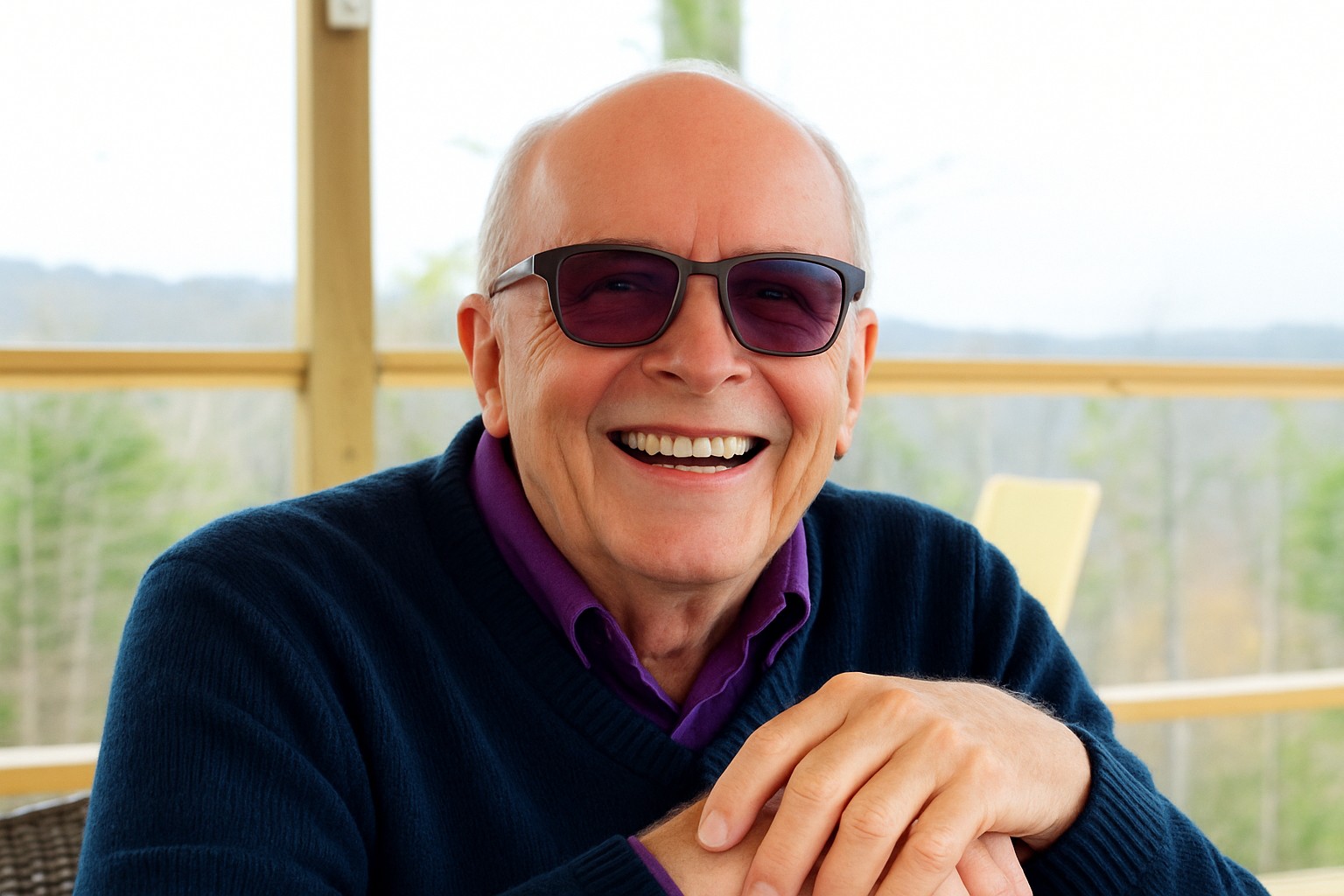
a pair of sleek, impossibly cool Ray-Ban Meta AI glasses with dark gray frames and purple transition lenses. They’re futuristic enough to make James Bond fumble for the manual. They gleamed like they already knew my secrets. The ad promised, “Experience Meta AI like never before,” and I swear it winked at me.

And yes, I bought them.

I didn’t need them. I just got new glasses in June. But I wanted them because something in me knew this was more than eyewear. This was foresight.

So brace yourself (and maybe pour yourself a dram of Bunnahabhain): I have officially joined the ranks of the cyborg chic.

I’d love to tell you I can see clearly now, to croon along with Johnny Nash, but the truth is—literally speaking—I can’t see much better.

Figuratively? Metaphorically? You bet! I can see better and farther than ever.

I’ve been writing about artificial intelligence since the early chatbots of 2021. I’ve talked about robots, about ChatGPT, about how this strange partnership between humans and machines is unfolding faster than anyone expected—certainly faster than most people are ready for.

And I, for one, don’t want to be left behind blinking in the dust.

I want to experience it. I want to learn from it. I want to understand where it’s leading us—not from the sidelines, but right in the thick of it.

So these glasses aren’t just a frivolous birthday splurge. They’re my passport to the next chapter. They’re literally my lens on the merging of human curiosity and machine intelligence.

That merger is coming, you know, when man and machines become one. It’s called the Singularity. A year or so ago, it was projected for 2037. Now I think futurists will be lucky if it waits five. And if that’s true, then I plan to be ready. I don’t want to be afraid. I don’t want to be resistant. I want to be curious. I want to be awake. I want to be willing to see.

I’ve spent seventy-eight years watching the world evolve in ways my childhood self could never have imagined. And yet, here I am, ready to keep moving forward.

My Ray-Ban Meta glasses are just a step in that direction: a gift to my future self, a wink to the present, and a promise that I’ll keep exploring what’s possible. Because for me, this isn’t just about sight. It’s about vision.

There you have it. Now you know. This seventy-eighth birthday gift might be my best ever from-me-to-me gift. These new AI glasses don’t just sit on my face—they announce something. They say I’m still moving forward, still curious, still willing to step into whatever’s next and report back with a grin.

I didn’t just give myself a gift. I threw down a gauntlet. Johnny Nash didn’t promise perfect vision; he promised guts. These AI glasses may not sharpen every detail, but they supercharge my curiosity. Maybe that’s the real clarity: strapping on the future, stepping into the frame, and letting life rocket toward me in full, outrageous 3-D.

If the future wants to come screaming at my face, fine by me. I’ll meet it head-on, glasses gleaming, ready for the light—and absolutely ready for my close-up, grinning from ear to ear.

Looking Back on the Outer Edge of Forever

“The real voyage of discovery consists not in seeking new landscapes, but in having new eyes.”

Marcel Proust (1871–1922). from his The Captive (1923), the fifth volume of his seven-part masterpiece In Search of Lost Time. Proust’s exploration of memory and perception reshaped modern literature.

Somewhere I saw it. Everywhere, maybe. Nowhere? Wherever—it grabbed hold of me and wouldn’t let go.

It was the gripping question:

“What would you tell your 18-year-old self?”

It lingered—since forever. Or yesterday? Either way, one morning not long ago, I tried to get rid of it by tossing it out to others—as if the orphaned question might leave me alone once it found a new home.

The replies were as varied as I expected, and as humorous and matter-of-fact, too:

“Buy stock in Apple and Amazon.”

“Be good at life; cultivate a well-rounded lifestyle.”

“Be patient; trust in God.”

“Serve God better.”

“Stay young; don’t age.”

“Be friends with your mom. Spend more time with family. Don’t let important things slide.”

“Don’t worry about impressing anyone other than yourself.”

Almost always, their offerings included a request to hear what I would have told my 18-year-old self. As a result, the question dug itself more deeply into my being, as I stalled by answering:

“I’m still thinking.”

It was true. But I knew I had to answer the question, too, not for them, but for me.

Several possibilities surfaced.

The first was rather light-hearted:

“You don’t have to have it all figured out. Just stay curious, kind, and honest. Don’t waste your energy chasing approval. Learn to cook, listen more than you talk, and remember: dogs and good people can tell when your heart’s true. Oh, and wear sunscreen.”

I dissed it immediately (though it carried some truths). Then I came up with:

“Don’t rush. The world will still be there when you’re ready to meet it. Pay attention to seemingingly insignificant things. They’re where meaning hides. Keep your humor close and your integrity closer. Fall in love, but don’t lose yourself in the process. And when life hands you a fork in the road, check which one smells like supper.”

I didn’t like that any better, though it, too, spoke truth. I was certain I could nail it with a third attempt:

“You think you know who you are right now, but you’re only meeting the opening act. Be kind. Be curious. And don’t confuse noise for meaning. The world rewards loudness, but grace whispers. Listen to that whisper. It’s you, becoming.”

Then six words sauntered past, not so much tinged with regret as with remembrance. Six words. Six.

“Be a citizen of the world.”

Those words had crossed my path before. In fact, I remember exactly when—not the actual date but instead the general timeframe and the location.

It would have been in the early 1980s, when I was working at the Library of Congress. I was standing in the Main Reading Room of the Jefferson Building, as captivated by its grandeur as I had been when I first started working there in 1969.

Above me, light spilled through the dome like revelation. Gold, marble, and fresco conspired to make the air itself feel sacred, as if thought had taken on architecture. Beyond those arches, knowledge waited in silence, breathing through pages and time.

Even now, I can close my eyes and see it: the way the dome seemed to rise into forever—an invitation, a reminder—that the world was larger than any one life, and I was already standing in the heart of it.

As an editor of the National Union Catalog, Pre-1956 Imprints—the “bibliographic wonder of the world”—I knew every alcove, every corridor, every one of its 532 miles of bookshelves, holding more than 110 million items in nearly every language and format. I had walked those miles over and over again doing my editorial research. I had come to learn that knowledge knows no barrier. I had come to learn that it transcends time and place.

At the same time, I decided that I could transcend place, too. With my experience and credentials, I began to imagine working in the world’s great libraries—first the Library of Congress, then The British Library, then the Bibliothèque Nationale de France, then the Biblioteca Nazionale Centrale di Roma.

I didn’t know where the journey would end, but it gave me a dream, a dream of being a citizen of the world of learning.

More than that, it was a dream untainted by pretense—never by the notion of being uppity. Instead, it was a simple dream. I figured that if I had made it from the coal camps of West Virginia to the hallowed halls of our nation’s library, I could pack up whatever it was that had brought me that far and go throughout the world, savoring knowledge and learning—and perhaps, over time, gaining a smidgen of wisdom.

But here’s the catch. If transcending geography is the measure of my dream’s fulfillment—the wanderlust, the scholar’s yearning for marble floors, old paper, and the hum of languages not my own—then, at first glance, I failed. I never made it to any of the world’s great libraries except the Library of Congress.

However, as I look back through my life-lens of 78 years come November 20, I realize that maybe I went beyond the geographic destinations that I set for myself.

I went from the mountains of West Virginia to the monuments of D.C., from there to the marshlands of South Carolina where I earned my Ph.D., from there back home to the monuments, and, from there, at last, to the Shenandoah Valley and college teaching that took me internationally via Zoom and tapped into Open Educational Resources that did away with the restrictive border of printed books.

In a sense, then, although I didn’t cross country borders, I crossed the borders of ideas, with my voice carrying me farther than my feet ever needed to.

I’ve managed to live generously, teach across generations, write with empathy, research with joy, garden with gratitude, cook with curiosity, and love with intentionality. In all of that, I have been that citizen of the world—not by passport stamps, but by curiosity. By compassion. By connection.

Maybe that’s the truth I’d offer my 18-year-old self:

“You don’t have to travel the world to belong to it.
You only have to live with your eyes open.”