Poor Brentford Gives a Writerly Upbraiding


The writer who goes hunting ideas too aggressively usually returns with nothing but metaphors and poison ivy.” — Poor Brentford Lee. Reluctant naturalist and persistent thorn in his writerly side since 1947.


“Phooey!”

I swear on a stack of books yet to be written that’s exactly what Poor Brentford said.

And get this. He had the nerve to say it smack dab in the middle of a conversation with Gary while I was explaining that maybe, just maybe, I’d come up with something to write about while gardening.

“It’s not easy coming up with all these blog ideas.”

“But you seem to have more ideas than there are days.”

“I don’t know about that, but I came up with one right now. You’ll see.”

I wouldn’t be the first writer, of course, looking for something to write about.

I guess, truth be told, we all go hunting for material.

And precisely at that thought I heard:

“Phooey!”

Luckily, Gary did not hear Poor Brentford who was just getting started.
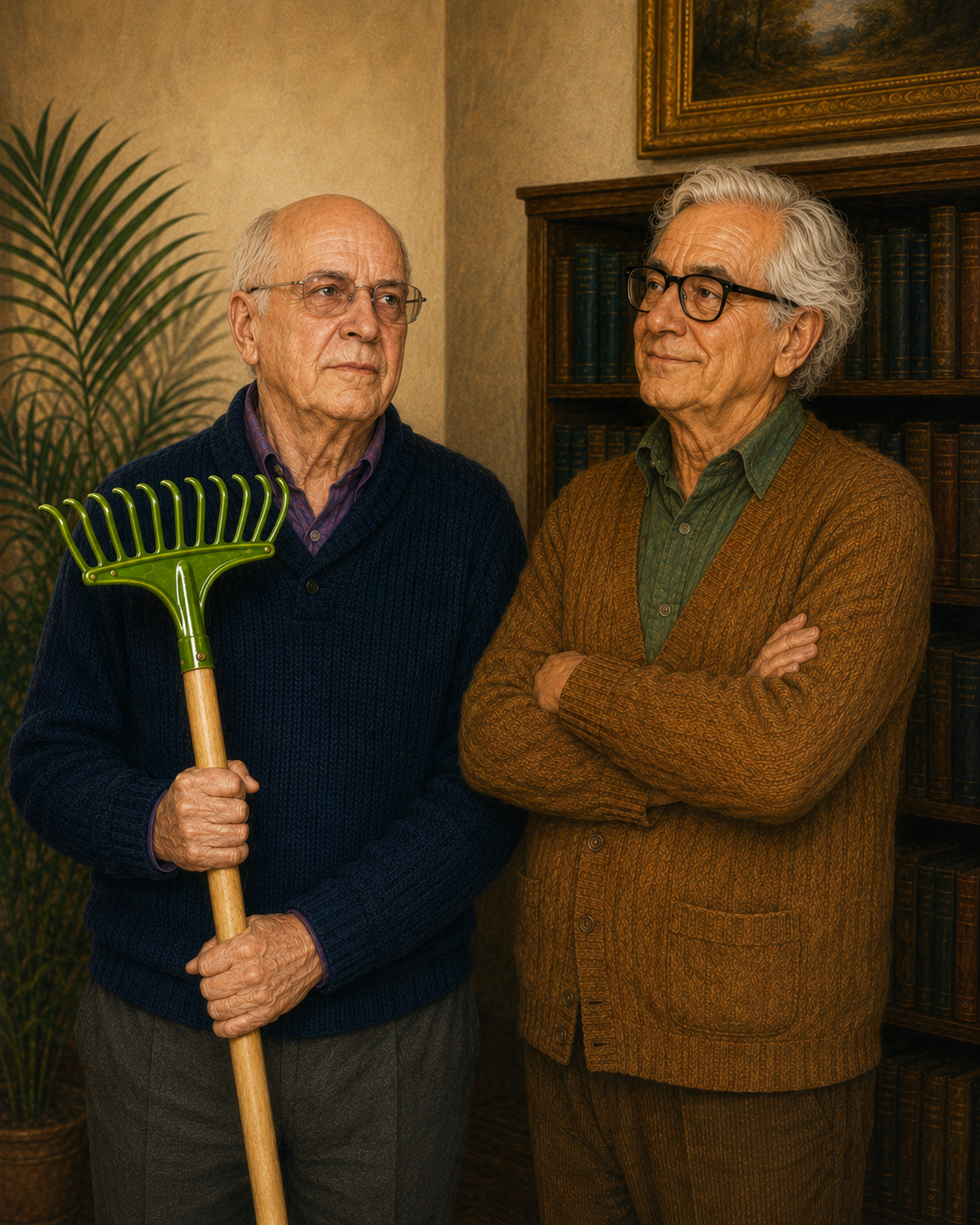
“It goes without saying that you’ll start your catalogue of examples with your Lady.”

“Of course I will. Mary E. Wilkins Freeman was notorious for writing about the people and happenings where she lived. And who, pray tell, knows that better than I?”

“Oh, Lord,” Poor Brentford moaned. “Must I listen one more time to your recitation of local influences in her Pembroke, People of Our Neighborhood, The Debtor …”

“Stop it. Stop it right there. That’s not fair. You know fully well that I don’t think I’ve ever said such a thing about those novels, but I could. She did.”

“What, then, were you going to corner me with?”

“Well, I was simply going to say that Freeman owned up to her literary heists.”

“Right. Sure, she did. Like she owned up to being ten years younger than she really was.”

Poor Brentford, I could tell, was a little more cantankerous than usual, so I decided to shut him up with proof.

“Here’s what she wrote a friend, and I quote, word for word: ‘Monday afternoon, I went a-hunting material too: We went to an old lady’s birthday-party. But …’:

He interrupted me mid-sentence.

“I’ve heard it before. Heard it all before, word by word: ‘… all I saw worth writing about there was a poor old dog who had been chained thirteen years, because he bit a man once, in his puppy-hood.'”

Poor Brentford was right, of course. I’ve written often about that poor puppy and how Freeman gave him a new life as Caesar in her “A New England Nun,” unaware perhaps that his resurrection in that story was linked inextricably and forever to sexual repression.

But was he kind enough to let me do it one more time? Of course not.

“You need to get new examples that will grab your readers’ attention the way that poor puppy grabbed Freeman’s heart.”

Before I could agree or disagree or even ask what writers he had in mind, he gave me a litany that lasted so long I needed a fresh shave. And get this. He had them all neatly organized by categories. It was disgusting. I mean he started off with the obvious, writers like Freeman who really did go looking. The way Henry David Thoreau did in Walden. Or Hemingway as he chased wars and bullfights and deep-sea fishing. Or Joan Didion’s notebooks capturing her fleeting impressions. He even had a list of counterparts across the Pond but before he could bless me with Dickens and his kith and kin, he lost his train of thought and started telling me about writers who made use of strange incidents.

Frankenstein grew out of a ghost-story contest during a rainy vacation.

Alice’s Adventures in Wonderland began as an improvised story told to amuse a child on a boat ride.

The Metamorphosis reportedly sprang from the absurd question: what if a man woke up as an insect?

● The Strange Case of Dr Jekyll and Mr. Hyde was inspired by a dream.

I listened attentively, storing up those examples with every intent to use them in something or other one day or another, but I stood up and objected vehemently when he had the nerve to expect me to follow along with his discussion of the intertextual path that some writers had taken as they wrote famous works based on other folks’ famous works. Ulysses parallels The Odyssey. Rosencrantz and Guildenstern Are Dead as a spin off from Hamlet. I had heard enough. More than enough.

“All right, Poor Brentford. Let’s make a truce. Let’s sign a pact. Let’s forget that I ever mentioned my hope of finding a blog idea to write about.”

I paused. He paused. We stared at one another.

“If you do, you’ll be sorry.”

“It won’t be the first time, I’m sure. But if you’ll excuse me, I have to garden so that I’ll find something to write about.”

“You’re wasting your time. When’s the last time that you ever went looking for an idea and found one?”

I started to reply, but he cut me short.

“Did it ever occur to you that you’ve got this writerly thing of yours all reversed?”

“Thing? Writerly thing?” Spit it out. What’s your point?”

“My point,” Poor Brentford said, with the air of a man who has been waiting his entire existence to say exactly this, “is that you didn’t find your ideas. Your ideas found you.”

I opened my mouth.

“Don’t.”

I closed it.

“Take your Lady. Do you honestly believe you went looking for Mary E. Wilkins Freeman? Or did she reach up out of some footnote or bibliography and grab you by the collar in 1973 and simply refuse to let go? Because last time I checked, she still hasn’t.”

I said nothing, which, as Poor Brentford knows perfectly well, is as good as an admission.

“More than fifty years, Brent. Fifty years she has had you. And you have the audacity—the sheer pomposity—to sit there and tell Gary you went looking for something to write about while gardening. How generous of you. How magnanimous. How utterly beside the point.

“And then there’s Alexander Gordon.”

He said it quietly, exactly the way Poor Brentford delivers his most devastating blows.

“You didn’t find The Humourist. The Humourist found you. He waited. Two hundred and nineteen years, give or take. Sitting in the only complete run of the South-Carolina Gazette in existence—survived earthquakes, fires, wars, and hurricanes, mind you—and then reached up out of a footnote in 1973 and grabbed a graduate student by the collar. And here you are, fifty-some years later, still in his grip. Still writing. Still talking about him at libraries.”

He paused for effect. He has always been insufferably good at pauses.

“They found you, Brent. Both of them. In the same year, no less. And they have never once seen fit to release you. How breathtakingly, magnificently pompous to think that you in your infinite wisdom found them.

I sat down, flummoxed.

“What on earth am I supposed to do with that? I don’t have all the time in the world, you know, to come up with ideas.”

Maybe,” Poor Brentford said, “that’s the whole point of this writerly thing I’m trying to help you understand.”

He settled back with an expression I hadn’t seen before. Not smug. Not cantankerous. Almost kind.

“Ideas,” he said, “are not sitting around waiting for you to come find them. They are, if you’ll permit me, already in motion. Floating. Drifting. Looking for the right home. The right mind. The right heart. They pass over some people entirely–perfectly nice people, mind you, and perfectly intelligent people–and move on. Then they find someone like you and they simply settle. Take up residence. Refuse to leave.”

I started to say something.

“Freeman settled in 1973. Gordon settled in 1973. The same year, Brent. Do you think that was your doing?”

I did not.

“Ideas are not hunted. They are not chased down like a rabbit hopping through your briary ravine.”

He folded his hands with great finality.

“They arrive. Always have. Always will. The only question that matters—the only question that ever has—is whether the writer is the kind of person who opens the door and makes a home.”

Friends in All Places


“The arts are not a way to make a living. They are a very human way of making life more bearable.” — Kurt Vonnegut (1922–2007). Acclaimed American novelist and satirist whose works blended humor, humanity, and sharp social insight.


“Wouldn’t it be funny if you bumped into someone you know!”

I knew it was a longshot. Gary was born in Minnesota, moved on to Illinois, then to Tennessee, and then to Virginia where we live now.

“I doubt it,” he whispered. “But you might. You taught here”

He was right.

“But that was ages ago.

It had been many years, in fact, since I had taught at the Fauquier Campus of Laurel Ridge Community College. Besides, we were at St. James Episcopal Church in downtown Warrenton.

We softened our laughter.

Shortly thereafter I glanced at the row ahead and sitting there was someone I knew.

“You’ll never believe it, but right in front of us is Eileen Rexrode, the former administrative assistant to the Humanities division at the college. I’d recognize the back of her head anywhere.”

A shoulder tap brought a gasp of joyful recognition, introductions–Eileen and Gary–and the news that another colleague from years gone by–Mary Ellen Welch who ran our bookstore–was sitting at the end of the row.

After a short chat with her, I settled down and began to focus on the printed program. I was hoping to see a familiar name–maybe another friend–among the singers, but I didn’t. However, I recognized Kristina Sheppard, artistic director of The Valley Chorale, whose name I remembered from a holiday concert last year.

Around us, the sanctuary slowly filled with sound. A piano tested a chord. Someone behind us turned a program page. Voices drifted out from somewhere unseen—scales, fragments, breaths finding pitch. Instruments tuned in brief uncertain bursts before settling into harmony. The room seemed to hover in that familiar moment between arrival and beginning.

I looked down again at the printed program.

ACT ONE, PART ONE: AMERICAN DREAMERS

“Every great dream begins with a dreamer.” — Harriet Tubman

Even before the first note was sung, I found myself smiling at the program in my hands. There was Harriet Tubman leading off the evening, still showing people the way after all these years.

Then another familiar friend appeared. Langston Hughes with his “Hold Fast to Dreams.” I have carried him with me for much of my adult life. Long after classrooms ended and lectures faded, his voice remained—wise, lyrical, hopeful, wounded, observant. Some writers stay on the page. Others take up residence within us.

And then came “No Time,” that haunting old camp meeting spiritual whose echoes linger somewhere as deep in my memory as in the American memory. The title alone summoned distant revivals, worn hymnals, wooden benches, and voices rising together into the night air. Some music entertains. Some music remembers.

Later came “Will the Circle Be Unbroken.” By then the pattern had become unmistakable. Everywhere I looked, I was running into old friends.

ACT ONE, PART TWO: FROM SEA TO SHINING SEA

Where we love is home—home that our feet may leave, but not our hearts.” — Oliver Wendell Holmes Jr.

Another old friend was waiting for me at the opening of the second section: Oliver Wendell Holmes Jr.

For years, Holmes has occupied a distinguished corner of my mental world—not merely as one of the most cited Supreme Court justices in American history, but as a powerful voice for civil liberties and the free exchange of ideas. Even now, his words still carry the calm authority of someone who understood that democracy depends upon allowing differing voices to be heard.

And then, just below him, another name stirred immediate recognition: Harriet Monroe.

My heart lifted when I saw her “The Blue Ridge.” The title alone felt close to home here in Virginia. But it was Monroe herself who truly drew me in. Long before most readers recognized them, she had opened the doors of Poetry Magazine to emerging writers like Ezra Pound and Robert Frost, helping shape the course of modern American poetry almost single-handedly. More than a founder, she became a quiet midwife to literary possibility, offering countless poets their first gentle nudge toward recognition.

By now, the afternoon had become something more than a concert. Everywhere I looked, old voices were rising again.

ACT ONE, PART THREE: WE GATHER TOGETHER

“Not until I went into the churches of America and heard her pulpits flame with righteousness did I understand the secret of her genius and power.” — Alexis de Tocqueville

By the third section, another deeply familiar voice appeared: Alexis de Tocqueville.

Few outsiders have ever understood America—or Americans—more perceptively than Tocqueville. Nearly two centuries ago, he looked past our politics and possessions and saw something more enduring: our restless idealism, our fierce independence, our faith communities, our belief that ordinary people could gather together and shape the moral character of a nation. Even now, his observations feel less like history than diagnosis.

Then came “I’m Going Home,” and my heart responded immediately.

I have long loved the old Sacred Harp tradition with its rawness, gravity, and communal force. The music does not perform itself delicately for an audience. It rises. It calls. It remembers. Even the title alone seemed to carry generations within it—voices lifted in wooden churches, harmonies swelling without ornament, faith carried not by perfection but by conviction.

Another old companion appeared: the African American spiritual “I Know I’ve Been Changed.”

No matter how many times I encounter these spirituals, they still move through me with unusual force. They are sorrow and endurance braided together. Survival transformed into music. Hope refusing to disappear. Some melodies entertain the ear. These seem to travel straight to the soul.

I was no longer merely reading a concert program. I was moving through a lifetime of voices that had shaped the way I understood literature, history, faith, music, and America itself.

ACT TWO, PART FOUR: THAT’S ENTERTAINMENT!

“Music must reflect the thoughts and aspirations of the people and the time. My people are American. My time is today.” — George Gershwin

Another familiar presence greeted me as the second act began: George Gershwin.

Who among Americans does not know Gershwin? More than any other American composer, he resides not merely in our musical history, but deep within our collective emotional memory. His melodies drift through concert halls, films, jazz clubs, television commercials, elevators, and childhood piano lessons alike. Even people who think they do not know Gershwin often do.

And what a marvelous quote to introduce this section. Music, Gershwin insisted, must reflect “the thoughts and aspirations of the people and the time.” Sitting there in that church in Warrenton, Virginia, listening to a concert that moved from spirituals to Sacred Harp to Broadway to jazz, it struck me that the entire afternoon had been built around that very idea.

But the title that reached out and grabbed me most forcefully was “It Don’t Mean a Thing (If It Ain’t Got That Swing).”

Oddly enough, my mind traveled immediately back to 2011 and an Evening of Poetry at the White House hosted by Barack Obama. Introducing Rita Dove, Obama remarked:

“As Rita Dove says, ‘If poetry doesn’t affect you on some level that cannot be explained in words, then the poem has not done its thing.’ Also known as: it don’t mean a thing if it ain’t got that swing.”

I can still hear the unified laughter that followed his aside.

The section closed with “Somewhere” from West Side Story, perhaps Stephen Sondheim’s most enduring song, and perhaps more poignant now than ever. Its longing for a place “for us” has lost none of its ache or urgency in an America still struggling toward tolerance, understanding, and peace.

ACT TWO, PART FIVE: LAND OF THE FREE, HOME OF THE BRAVE

“This great nation will endure as it has endured, will revive and will prosper.” — Franklin D. Roosevelt

The final section of the concert opened with the steady, reassuring voice of Franklin D. Roosevelt.

No American president ever spoke to the fears and hopes of ordinary citizens more directly than Roosevelt. Through depression and war, he reminded Americans not only that democracy could survive hardship, but that courage, resilience, and shared sacrifice still mattered. Reading his words, I could not help thinking how deeply they still resonate in our own uncertain moment. “This great nation will endure,” he insisted. The sentence reached across time itself.

Then came “America the Beautiful.” And truly—whose heart does not swell upon hearing it? Katharine Lee Bates managed to capture something rare in American life: patriotism without boasting and affection without blindness. Her lyrics celebrate not conquest, but aspiration—grace, brotherhood, generosity, and the hope that America might continue becoming worthy of its own ideals. Even now, the song carries enormous emotional force, especially when sung by many voices gathered together.

The section closed with “Homeland,” its title alone quietly gathering together everything the afternoon had been exploring all along: memory, belonging, community, endurance, and love of place. The concert no longer felt merely performative. It felt communal—almost liturgical in its affirmation of what Americans, at their best, still share.


As the final applause faded inside St. James Episcopal Church, I found myself thinking again about the title of the program: Of Thee I Sing: A Choral Love Letter to America.

It seemed to me that Kristina Sheppard and The Valley Chorale had quietly created something larger than a concert. Through spirituals, Broadway, folk traditions, poetry, jazz, and the voices of dreamers, reformers, composers, and presidents, the afternoon became a reminder of the many voices that continue to shape American life.

Not always in agreement. Not always in harmony. But still in conversation.

In these politically turbulent times, when democratic principles can sometimes feel fragile, the program struck me as a gentle and much-needed reminder of who we have been at our best for the 250 years of independence we’re celebrating this year as Americans—and who we still might become.

The afternoon reminded me that a lifetime spent reading, listening, teaching, and simply paying attention slowly fills the world with familiar voices. Some belong to the people we know personally. Others arrive through literature, music, history, faith, and art. Yet over time the distinction begins to blur. The writers, composers, poets, teachers, and dreamers who move us deeply enough eventually become part of our ongoing conversation with life itself.

At the beginning of the concert, Gary had whispered, “I doubt it. But you might.” As it turned out, he was right. I did bump into people I knew.

And I suspect nearly everyone there encountered an old friend somewhere along the way.

Poor Brentford Gives a Knuckle Rap. A Guest Column.


“Never mistake the undone for the unworthy.
The desk may be cluttered.
The life is not.”

Poor Brentford Lee (b. 1947. Altar ego—with an alter ego, too, of course. He ministers and he meddles. Life coach without credentials. Available for lectures, upbraidings, and unsolicited reminders of everything you’ve already accomplished.)


Sometimes we’re our own worst enemies. Maybe, all times. I know I am.

It doesn’t matter how much I get done, it’s always the undone that grabs hold of me in my waking hours and throws me into a tiff.

Just the other day—just as dawn was breaking—I sprang up in bed, asking myself:

“Where did it go? Where did it all go?”

Not my life, mind you. That’s still very much in progress.

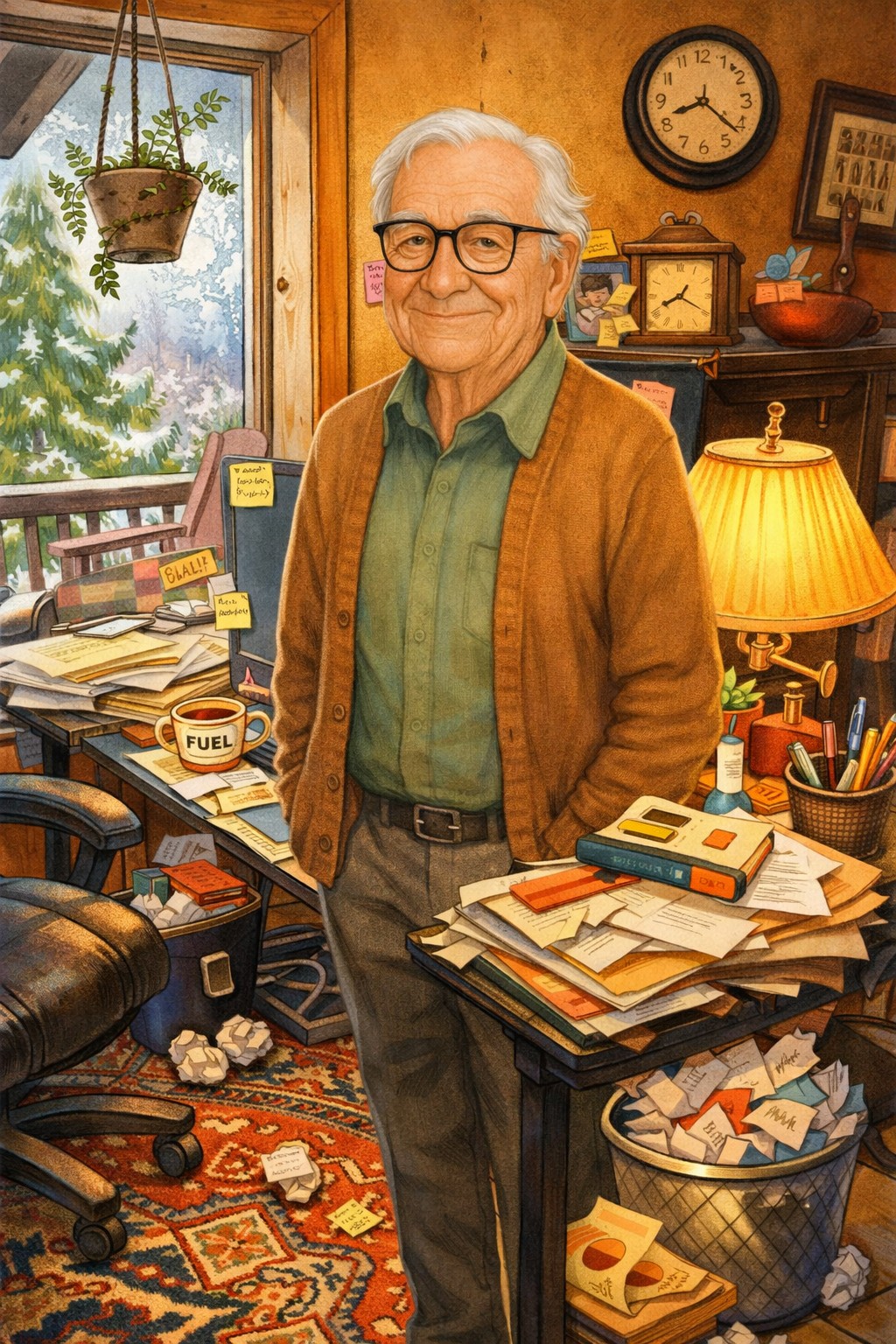
I meant January and February—two months that often keep me snowed in on my mountaintop here in the Shenandoah Valley. And this year—once and for all—they were supposed to be the two perfect months to bring order to chaos. To organize my office.

Boxes. Amazon boxes, to be precise—a small mountain of them, stacked near the woodstove like a cardboard monument to every good intention I’ve ever had. Some are open. Some are not. All of them smile at me. That relentless Amazon smile, curved and cheerful and absolutely unbothered by my shame. I have begun to suspect they are multiplying when I’m not looking.

Desk and worktable. Buried. Buried under manila envelopes, unopened mail, a box of highlighters, a coffee mug that may or may not still contain coffee, and enough paper to reforest a modest hillside. The lamp burns bravely through the chaos like a lighthouse in a nor’easter.

Even the plants have opinions. Two magnificent specimens—sprawling dramatically across their ornate iron stands—have taken matters into their own fronds. One has sent a long, accusatory leaf directly toward my leather chair. As if pointing.

Pointing. Yes, pointing. The same way the ghost of my gray-haired grade school history teacher would point and declare with the wrath of an angry God:

“A cluttered desk is the devil’s workshop.”

And between Mrs. Snyder’s admonitions and my lament—”Where did it go? Where did it all go?”—Poor Brentford appeared as if in a vision rising up from nowhere in particular and everywhere at once.

“Where did it all go, you ask? Where did it all go? I’ll tell you exactly where it went. Pull up a chair if you can find one in that brain of yours, all cluttered now with nonsense.”

I thought I knew for sure where his harangue was headed. But for once he surprised. He did not stoop so low as to rap knuckles with any of the cliches from his repertoire of wisdom.

Not once did I hear,

“Time and tide wait for no one.”

Not once did I hear,

“Make hay while the sun shines.”

I didn’t even hear the one I was certain he would speak with calm certainty,

“Lost time is never found again.”

He didn’t recite any of those things.

Instead, he cleared his throat with great ceremony and delivered his first knuckle rap with the precision of a surgeon and the satisfaction of a man who has been waiting a very long time.

“Only handle it once.”

He let it hang there. Just those four words. Floating in the air above the Amazon boxes and the buried desk and the manila envelopes and the coffee mug of uncertain vintage.

“Your words. Well, Grace Reed’s words, if we’re being precise. Your Copyright Office colleague. The woman whose office was lean, mean, and sparse. The woman whose wisdom you borrowed, researched, published, celebrated, and then—apparently—left to ride around in the Jeep with the junk mail.”

He fixed me with a look that left no room for argument.

“Don’t bemoan where it all went. You know fully well. And you know exactly what to do.”

Then Poor Brentford’s voice softened. Just slightly. Just enough.

“Do you remember what you wrote on January 15th, 2024? You raised your Bunnahabhain to all the tarriers, the delayers, and the occasional shelver. You said, and I quote, ‘Here’s to the to-morrowers, the champions of It can wait until tomorrow, because sometimes tomorrow is just a delay away from today.'”

He smiled. For the first time.

“And do you remember Scarlett?

“She understood something you sometimes forget. Tomorrow is not surrender. Tomorrow is strategy.”

Poor Brentford gestured grandly at the Amazon boxes.

“Your Tara is a little more cardboard than hers. But the principle holds.”

He straightened his jacket.

“The office will get cleaned. One day. Tomorrow, perhaps. Or the day after. Or sometime before the Amazon boxes learn to walk.”

“Scarlett managed. So will you.”

But Poor Brentford wasn’t finished. He stood there, poised to deliver his final and most devastating knuckle rap. Quietly. Almost tenderly.

“Forget the cluttered office for now. I want you to remember something you wrote, something about a young professor who stopped you in a hallway and handed you an offprint with four words inscribed on the front.”

He paused.

“This is life everlasting.”

Another pause. Longer this time.

“You asked whether he was suggesting that we live on forever through what we share with others: ideas immortalized in print. You answered your own question. Here you are, nearly fifty years later, speaking his name. Professor Myerson continues to live.”

He leaned in close.

“And so will you. Through every word you have ever written. Eight books. More than a million words. Scholarship and essays that will outlast every Amazon box in that corner.”

“THAT is your life everlastin’. Now act like it.”

Just when my chair started getting uncomfortable, Poor Brentford had the nerve to tell me to shout out:

“Get behind me, Satan.”

I sprang up at once because in that command I recognized my own mother’s voice. Over and over again I had heard her rebuke the Devil whenever she faced her own pole of proverbial chaos.

Only then did I realize what Poor Brentford had done.

He had serenaded me with snippets of my own advice—counsel I had been publishing right here in this column for years.

I could hardly be offended.

I looked again at the Amazon boxes. The buried desk. The pointing plant.

They were all still there.

But the panic was gone.

The office could wait.

After all, tomorrow is strategy.

A Banner Year, Gently Told

As this year draws to a close, I want to thank you for visiting my blog 32,727 times.

That didn’t happen overnight. And it didn’t happen by accident.

This year, more people found their way here than ever before—slowly, steadily, and often by returning. Compared with last year, readership grew significantly, not because anything went viral, but because the writing kept meeting the right readers at the right moment.

Growth, the quiet way,

These pages have held many things:

● 18th-century satire and present-day kitchens.
● Scholarship and softness.
● Books, biscuits, dogs, devotion, memory, love.

Some posts traveled far. Others found only a handful of readers. But every one was written with care—and read with attention.

I don’t think of these as clicks.

I think of them as moments of shared presence in a distracted world.

You made this a banner year.

If you were one of the 32,725:

● thank you for reading,
● thank you for lingering,
● thank you for making this a place worth returning to.

Here’s to a year shaped by patience, curiosity, and generosity of spirit—and to whatever quiet magic comes next.

Wired with wonder,
Brent

When the Book Review Becomes Real


“The pieces of the puzzle come together seamlessly; better still, Kendrick’s investigation informs and enriches the Humourist essays, illuminating their historical and literary contexts.” —Publishers Weekly


Publisher’s Weekly Cover, December 15-22, 2025

I knew the review was scheduled to appear. I’d marked the date. I’d even ordered copies in advance.

Still, nothing quite prepares you for the moment when the work arrives by weight.

Nineteen pounds, to be exact.

The box from Fry Communications sat innocently enough at the door, but when I lifted it, I laughed—an unguarded, surprised laugh. This wasn’t an email notification or a discreet PDF link. This was paper. Ink. Volume. Evidence that something quiet and patient had crossed a threshold into the world of objects.

Inside were stacks of Publishers Weekly—the December 15-22 issue, fresh from the press. And there it was: the review of Unmasking The Humourist, resting calmly among other books, other arguments, other claims on a reader’s attention. No fanfare. No special lighting. Just…there. As if it had always belonged.

The review in context.

That may sound small. It isn’t.

For writers—especially those of us who work in literary recovery, archival research, and historical attribution—most of the labor happens far from spectacle. It happens in libraries and databases, in footnotes and marginalia, in moments when you are unsure whether the trail you’re following will narrow into clarity or vanish altogether. There are no crowds for this kind of work. No applause when you discover one more corroborating detail, one more pattern that holds.

Unmasking The Humourist grew out of precisely that kind of sustained attention. The essays at its center—satirical, incisive, mischievous pieces published pseudonymously in the South-Carolina Gazette in the early 1750s—had long been admired but never convincingly attributed. Their author hid in plain sight. The work demanded patience: weighing tone against context, tracing bureaucratic fingerprints, listening carefully to what language reveals when you stop rushing it.

And patience is not fashionable. We live in a moment that rewards speed, certainty, and hot takes. Literary recovery is none of those things. It is slow, provisional, and often lonely. You work without knowing whether recognition will ever arrive—or whether it even should. You work because the work matters.

That’s why seeing the review in Publishers Weekly mattered to me—not as a trophy, but as confirmation that the argument held. That it made sense beyond my own desk. That it earned its place in the broader conversation about early American literature and satire.

What struck me most wasn’t pride. It was scale.

The full review.

Here was my book, not elevated or isolated, but contextualized—surrounded by other studies, other voices, other claims. This is where scholarship belongs: not shouted, but situated. Not proclaimed, but tested.

There’s something grounding about that.

I spread the pages out on the table. I read the review again, this time with the odd sensation of distance—as though I were encountering the project for the first time. The reviewer understood what I had tried to do. Better still, they understood why it mattered. That’s the quiet victory every researcher hopes for.

And then there was the sheer physicality of it all. The stacks. The heft. The knowledge that these copies would travel—to libraries, to colleagues, to readers I’ll never meet. Work that had lived for years in notes and drafts now had mass. It could be lifted. Shared. Passed hand to hand.

Research takes time. Recovery takes patience.

But sometimes—blessedly, unexpectedly—the work becomes something you can actually lift.

And when it does, you pause.
You hold it.
You let it be real.

An Open Letter to a Sudden Surge

The MtnHouse
December 11, 2025

Dear Sudden Surge,

You took me by surprise again this morning. As always, when I awakened, I checked my Fitbit to see how my heart did overnight. Then I checked WordPress to see how my readers were doing.

And there you were. Another thousand views. A quiet jolt to the chart. Numbers climbing when I wasn’t looking.

You’ve been dancing higher and higher since October, when I passed 15,000 and figured I’d reached my high-water mark. I even wrote a piece of thanks back then, thinking I’d said all there was to say. But now here we are—December 11th—and this little corner of the internet has gathered 25,053 views.

I’ve done nothing different. I have no flashy headlines. I have no trending hashtags. I just keep following the same rhythm: writing essays born from memory in a home filled with love. I just keep foolin’ around with words and ideas.

So why now, after all these years?

That question hangs gently in the room with me. It’s not demanding an answer. It’s simply inviting a reflection. Maybe something shifted in the writing. Maybe it’s more expansive. Maybe it’s more lived-in. Maybe it’s a voice carrying a steadier warmth now. Maybe it’s grief that’s softened into grace. Maybe it’s love that arrived not with fanfare, but with a quiet hand stretched out in invitation. Maybe it’s all of those things. Maybe. And add to all those maybes one more. Maybe it’s readers sharing with readers.

Gary, of course, doesn’t ask to be written about. But his presence is here, between the lines, in the patience of a paragraph, the steadiness of tone, the way I’ve learned to let silence do some of the talking.

Ruby, on the other hand, insists on being written about, whether she’s nosing me away from my smartphone or curling up in solidarity as I revise for the twenty-fifth time. She is, as always, the keeper of the tempo, the mistress of the move.

So this isn’t an open letter to public stats. It’s a letter to something deeper. It’s a letter to what it means to keep writing when no one’s watching, and then to wake up and find that someone was.

My essays aren’t meant to dazzle. And I know: they don’t. They’re just small acts of holding up the light, one weekly reflection at a time. The fact that they’re being read, now more than ever, tells me something I didn’t expect: quiet honesty still finds its way.

Thank you, Sudden Surge, for reminding me that patience has its own reward, that consistency is a kind of faith, and that somewhere out there, readers are still pausing to linger with a slow essay from the mountain.

I don’t know what this upturn means, or where it leads. But I do know I’ll keep showing up with my smartphone in hand and love at my side.

Wired with wonder and gratitude,
Brent

The Shape of a Surge

Looking Back on the Outer Edge of Forever

“The real voyage of discovery consists not in seeking new landscapes, but in having new eyes.”

Marcel Proust (1871–1922). from his The Captive (1923), the fifth volume of his seven-part masterpiece In Search of Lost Time. Proust’s exploration of memory and perception reshaped modern literature.

Somewhere I saw it. Everywhere, maybe. Nowhere? Wherever—it grabbed hold of me and wouldn’t let go.

It was the gripping question:

“What would you tell your 18-year-old self?”

It lingered—since forever. Or yesterday? Either way, one morning not long ago, I tried to get rid of it by tossing it out to others—as if the orphaned question might leave me alone once it found a new home.

The replies were as varied as I expected, and as humorous and matter-of-fact, too:

“Buy stock in Apple and Amazon.”

“Be good at life; cultivate a well-rounded lifestyle.”

“Be patient; trust in God.”

“Serve God better.”

“Stay young; don’t age.”

“Be friends with your mom. Spend more time with family. Don’t let important things slide.”

“Don’t worry about impressing anyone other than yourself.”

Almost always, their offerings included a request to hear what I would have told my 18-year-old self. As a result, the question dug itself more deeply into my being, as I stalled by answering:

“I’m still thinking.”

It was true. But I knew I had to answer the question, too, not for them, but for me.

Several possibilities surfaced.

The first was rather light-hearted:

“You don’t have to have it all figured out. Just stay curious, kind, and honest. Don’t waste your energy chasing approval. Learn to cook, listen more than you talk, and remember: dogs and good people can tell when your heart’s true. Oh, and wear sunscreen.”

I dissed it immediately (though it carried some truths). Then I came up with:

“Don’t rush. The world will still be there when you’re ready to meet it. Pay attention to seemingingly insignificant things. They’re where meaning hides. Keep your humor close and your integrity closer. Fall in love, but don’t lose yourself in the process. And when life hands you a fork in the road, check which one smells like supper.”

I didn’t like that any better, though it, too, spoke truth. I was certain I could nail it with a third attempt:

“You think you know who you are right now, but you’re only meeting the opening act. Be kind. Be curious. And don’t confuse noise for meaning. The world rewards loudness, but grace whispers. Listen to that whisper. It’s you, becoming.”

Then six words sauntered past, not so much tinged with regret as with remembrance. Six words. Six.

“Be a citizen of the world.”

Those words had crossed my path before. In fact, I remember exactly when—not the actual date but instead the general timeframe and the location.

It would have been in the early 1980s, when I was working at the Library of Congress. I was standing in the Main Reading Room of the Jefferson Building, as captivated by its grandeur as I had been when I first started working there in 1969.

Above me, light spilled through the dome like revelation. Gold, marble, and fresco conspired to make the air itself feel sacred, as if thought had taken on architecture. Beyond those arches, knowledge waited in silence, breathing through pages and time.

Even now, I can close my eyes and see it: the way the dome seemed to rise into forever—an invitation, a reminder—that the world was larger than any one life, and I was already standing in the heart of it.

As an editor of the National Union Catalog, Pre-1956 Imprints—the “bibliographic wonder of the world”—I knew every alcove, every corridor, every one of its 532 miles of bookshelves, holding more than 110 million items in nearly every language and format. I had walked those miles over and over again doing my editorial research. I had come to learn that knowledge knows no barrier. I had come to learn that it transcends time and place.

At the same time, I decided that I could transcend place, too. With my experience and credentials, I began to imagine working in the world’s great libraries—first the Library of Congress, then The British Library, then the Bibliothèque Nationale de France, then the Biblioteca Nazionale Centrale di Roma.

I didn’t know where the journey would end, but it gave me a dream, a dream of being a citizen of the world of learning.

More than that, it was a dream untainted by pretense—never by the notion of being uppity. Instead, it was a simple dream. I figured that if I had made it from the coal camps of West Virginia to the hallowed halls of our nation’s library, I could pack up whatever it was that had brought me that far and go throughout the world, savoring knowledge and learning—and perhaps, over time, gaining a smidgen of wisdom.

But here’s the catch. If transcending geography is the measure of my dream’s fulfillment—the wanderlust, the scholar’s yearning for marble floors, old paper, and the hum of languages not my own—then, at first glance, I failed. I never made it to any of the world’s great libraries except the Library of Congress.

However, as I look back through my life-lens of 78 years come November 20, I realize that maybe I went beyond the geographic destinations that I set for myself.

I went from the mountains of West Virginia to the monuments of D.C., from there to the marshlands of South Carolina where I earned my Ph.D., from there back home to the monuments, and, from there, at last, to the Shenandoah Valley and college teaching that took me internationally via Zoom and tapped into Open Educational Resources that did away with the restrictive border of printed books.

In a sense, then, although I didn’t cross country borders, I crossed the borders of ideas, with my voice carrying me farther than my feet ever needed to.

I’ve managed to live generously, teach across generations, write with empathy, research with joy, garden with gratitude, cook with curiosity, and love with intentionality. In all of that, I have been that citizen of the world—not by passport stamps, but by curiosity. By compassion. By connection.

Maybe that’s the truth I’d offer my 18-year-old self:

“You don’t have to travel the world to belong to it.
You only have to live with your eyes open.”

Climbing Higher and Higher: 12,000 Views (and Counting!)

“The reader is the final arbiter of a text. Without the reader, the words are silent.”

Margaret Atwood (b. 1939). Canadian poet, novelist, essayist, and critic, one of the most influential literary voices of our time.

My Dear Readers, I blinked yesterday, and suddenly my little corner of the internet tallied 12,000 views for 2025—with three months still to go!

That’s not just a number. It’s 12,000 moments of connection. 12,000 times someone out there paused long enough to read my words, nod, chuckle, roll an eye, or maybe even find a flicker of themselves in my essays.

And here’s the part that stuns me: with this pace, we’re on track to sail past last year’s phenomenal 15,000 peak—a record I once thought unrepeatable. But here we are, repeating (and then some).

The 10 You Loved the Loudest

Every essay I publish is a seed tossed into the world. Some sprout quietly. Some bloom bold and bright. Here are the ten that you watered most generously this year:

Redbuds of Remembrance

A Forgotten Voice, A Solved Mystery—And Soon, A Book

Rise Up with Words. A Declaration for Our Troubled Times

My Altar Ego

The Rust Whisperer

A Week Back to the Future

What Could $40 Million Do—Besides Fund a Parade? A Love Letter to Priorities (with a Side-Eye to A Spectacle)

Learning to Love in New Ways

Finding Love Later in Life—Baggage and All

A Culinary Heist in Broad Daylight

My Thanks

Whether you’ve been here since my first blog post nearly 13 years ago or you just stumbled across my latest musings, you’ve made this milestone possible. I don’t take your presence lightly.

So, here’s to you—my companions in this ongoing experiment of storytelling, memory-making, and meaning-finding. Let’s see how far we can climb before 2025 closes the books.

After all, the numbers matter—but the connections matter more.

The Demons We All Wrestle

“You may have to fight a battle more than once to win it.”

— Margaret Thatcher (1925–2013)
British Prime Minister, nicknamed the “Iron Lady” for her fierce persistence.

Swearing is not my thing. But right now—for once, maybe even on a stack of Bibles (to my Mother’s eternal horror)—I’m going to do it anyway. I swear that my daily demons line themselves up every night when I go to bed, watching as I lie there all peaceful like, orchestrating my next-day goals.

I see them out of the corner of my eye, leaning in, peering, looking carefully as I tap, tap my list on my phone.

And you know what? I swear, they’re waiting for me the next morning.

More often than not, they show up as soon as I start my biking, maybe because that’s how I start my day, right after coffee. I know that if I don’t bike then, I won’t bike at all. The first demon arrives before I even lace my shoes. It whispers:

“Why so early? You’ve got other things you need to do first. You can bike later.”

Nice try. But I’m on to that trick. I know that when it comes to biking, later never comes.

Another one comes at me from a different angle.

“Today? You’ve been doing this every day. You need a break. Take the day off.”

“Get behind me, Satan! I’m biking as usual.”

But get this. By mile three, another demon shows up:

“You’ll never finish.”

I keep pedaling, but the demons keep coming. By mile seven, I’m hearing:

“Yeah. Your butt sure is sore. If you keep going, it’s going to be sore as hell tomorrow.”

I keep on going. And so it goes, on and on through all the miles—10, 15, 20—riding against a whole Satanic chorus, chasing me faster and faster and faster.

Fiercely determined. Fiercely persistent. Fiercely anchored. That’s how I win the biking battle. Usually.

The next demon that hounds me is procrastination. Don’t get me wrong—I know better. I know the wisdom about “breaking things down,” about taking the first step, about Ben Franklin’s truth that “little strokes fell great oaks.” But when I’m staring at the big picture, the demon of procrastination is quick to pounce.

It starts yammering:

“It’s too much. You don’t even know where to start. Better put it off until tomorrow. You’ll see it clearer then, rested and fresh.”

And the sly part is—it sounds almost reasonable. That’s how this demon works. It pretends it’s looking out for me. But I know the truth: once I give in, tomorrow becomes the next day, and the next day, and soon the oak is still standing, unscarred.

So I fight. I start small. One tap of the keys, one page, one email sent. A single stroke against the oak.

Fiercely determined. Fiercely persistent. Fiercely anchored. That’s how I win the procrastination battle. Usually.

I have other demons, of course. But they’re far too personal to divulge for all the world to know. I’m not about to share them.

Like the demon that tells me that my writing will never be good enough to be discovered by a magazine or a newspaper syndicate.

Or the demon that mocks long-range planning at my age, reminding me that there’s far more behind me than there will ever be ahead.

And I’m certainly not going to tell you about the demon that wonders what waits on the other side of the great divide—the same divide every one of us will cross, where all have gone before to face the mysteries of beyond forever.

Like I said, they’re way too personal. So I’ll keep them to myself.

But I’ve gotten to the point in my life that my demons don’t embarrass me anymore because I know that to be human is to battle the demons that strive to undo us.

And besides, we all have our demons. You do, too. Some of them may be the same as mine.

Or maybe you have the demon of worry, who shows up right on schedule, carrying a suitcase that never unpacks. The demon of regret, who loves to remind us of choices we can’t un-choose, words we can’t un-say. The demon of loneliness, who doesn’t bother knocking—just slips in and makes himself at home.

Or the demon of disappointment who lingers when the prize you’ve chased turns out to be a shadow.

Or what about weariness, when the weight of the day presses like red Virginia clay, and every step feels heavier than the last.

And then there’s doubt—the slyest demon of them all—always ready with the same question:

“Are you sure you’re enough?”

These aren’t strangers to you or to me or to any of us. They’re regulars. They know the way in. They don’t need an invitation.

I’m fairly certain that I heard someone somewhere right now screaming in disbelief:

“Get real. Those don’t count as demons at all compared to the ones that I’m battling.”

I hear you. I understand. I’ve been blessed because I’ve never had to deal with the demons of addiction—alcohol, drugs, gambling. Or the demons of abuse—physical, emotional, sexual—the kind that scar the body and the soul.

I’ve never faced the demon of homelessness, not knowing where I’d sleep. Or the demon of hunger, not knowing where my next meal would come from.

I’ve been spared the demon of crushing poverty, the one that never lets you breathe free. And I’ve never lived under the demon of war, with its bombs and sirens and losses that can’t be counted.

But it seems to me—and yes, I know my limited experience might make this sound overly simplistic—whatever demon we face, we have to be fiercely determined. We have to be fiercely persistent. We have to be fiercely anchored. That’s how we win our daily battles with whatever demons come after us.

But let me emphasize here one key word that I emphasized earlier. Usually.

Being fiercely determined, being fiercely persistent, and being fiercely anchored enables us to win our battles daily. Usually.

But as we all know, some days we lose the battle. We all do. And when we lose, it stings. The demons strut, they jeer, they claim the day as theirs. They would have us believe that losing once means losing for good.

But they’re wrong.

Because a lost battle is not a lost war. It’s a stumble, not a surrender. And tomorrow—always tomorrow—the fight begins again.

The demons will be there, lined up and waiting, whispering their same old lies. And we’ll be there, too. Fiercely determined. Fiercely persistent. Fiercely anchored. Ready to face them.

We may not win every day. Sometimes, we do. Sometimes, we don’t. But we show up anyway. Because being human has never been about living without demons. It’s about never letting them have the last word.

And in case you’re wondering, let me assure you. They’ll be back. But guess what? We’ll be back—bruised, stubborn, laughing, and still ready to wrestle.

Celebrating a Mother, Not My Own

“I do not at all understand the mystery of grace—only that it meets us where we are but does not leave us where it found us.”

Annie Dillard (b. 1945). American essayist whose work reflects the natural world as a mirror for awe and meaning, most memorably in her Pulitzer Prize–winning Pilgrim at Tinker Creek.

What on earth am I doing writing about motherhood in the dog days of summer—the hottest, most humid stretch, when snakes go blind until their molting skin slips over their eyes—especially when I’m celebrating a mother, not my own?

I keep saying to myself:

“This would be perfect for a Mother’s Day post in May.”

But you, my Dear Reader, know that I rarely write to match the calendar—and this post won’t match it, either. That’s not to say I’ve never done it—only that I’ve never done it by design. It’s simply that from time to time an idea collides with an occasion—Mother’s Day or Father’s Day or Thanksgiving or … Hmmmm. Maybe I’ve done it more than I realize.

Anyway, if you browse through my posts, you’ll see the pattern of how I write. When something grabs hold of me and won’t let go, I know I’ve been called to share it—maybe for the greater good, even if it’s just one person who feels the same tug while reading that I felt while writing.

That’s exactly what happened with this post. Memories washed over me from long ago and far away. They had surfaced before, but only as ghostly apparitions drifting in a paused wave. This time, though, I was nearly pulled under by the current.

It began when I uncovered a hand-painted pillow I hadn’t used in years. Bold crimson flowers and curling green leaves still popped against a soft beige background. The piping had faded, and the stuffing had settled into the easy comfort of something well-loved. It was a little worn, and it was a little wistful, but it was still a bright relic from when I was just beginning to find my way.

As soon as I saw the pillow, I started remembering my neighbor who made it. She was an older woman, maybe a few years older than my Mother, but not many. She dressed neatly, always in small-print floral dresses, and, when at home, she always topped her dresses with matching aprons. Ringlets of white hair framed a face that seemed stern at first, but softened the moment she spoke. She had the bearing of someone who kept things in order—herself, her home, her garden, and her place in the community. No one ever doubted that she would follow through on whatever she took on.

Her name was Nell. Nell Barker Harris, but I never called her by her first name. My Mother taught me better. She was always Mrs. Harris to me, though I swear I had the hardest time making Mrs. sound like MIZ-iz. It always rolled off my tongue as MIZ.

My memories of her stretch back to 1958, when my parents bought our home in the subdivision that bore her last name. I had just turned eleven, and I loved exploring the uncharted woods surrounding our home and beyond.

Mrs. Harris and my Mother were good friends, sharing interests in church, cooking and canning, and working the polls on election days.

My Mother thought the world of her, and, looking back, most of what I came to know about her came from my Mother:

MIZ Harris this …” and “MIZ Harris that …” was a constant refrain, especially during summer and fall harvests.

Many were the days my Mother sent me to the Harrises—Nell and her husband Worthy—with fresh vegetables from our garden, or to fetch canning jars—the old timey blue ones with zinc lids—or to swap a recipe.

The Harrises lived close, but their house lay just out of sight from ours. All I had to do was cut across the garden, slip past the barbed-wire fence, run down a slope, and dash up a knoll to reach their faux-stone cottage. It was one of the finer ones in our small town, with more than a hint of upper-middle-class comfort. I’d climb the steps straight to the door, where Mrs. Harris usually met me, fulfilling the errand right there on the stoop.

From those errands and my Mother’s comments, I came to know Mrs. Harris well enough that one December, I went boldly to her house on my own. My sister Judy and I had decided to put up a Christmas tree while our Mother was shopping. I had long had my eyes set on a beautiful white pine—not for Christmas, but for love—growing in the Harris’s woods where I roamed. Off I went to ask if we could cut it down. She agreed, and though the tree seemed to shrink with every drag homeward, Judy and I had it lighted and decorated by the time our Mother returned. She knew exactly how to celebrate the surprise as a tribute to childhood ingenuity.

Another time, my parents sent me over with an idea that I’d dreamt up—again involving white pines. A dead-end dirt road ran between our home and the Harris’s land that we gardened, and we thought it would be beautiful to line its 200-foot stretch with pines. I asked Mrs. Harris if we could dig saplings from her woods. She agreed, though she thought fall would be a wiser planting time.

My parents insisted amongst ourselves that proper planting and deep watering would see them through. They were hardly more than spindly stems with a few scraggly needles, more like Charlie Brown’s Christmas tree than the giants we imagined. Pitiful as they were, they survived the July heat and, in time, grew straight and tall, rising with quiet majesty, as if they had always belonged there.

Later—June 1972, a few years out of college and working at the Library of Congress—I wanted more than the skyward-pointing pines. I wanted the land itself. I found myself in Mrs. Harris’s home, asking if she would sell me the very garden lots my parents and I had tended from pre-teen through early manhood.

I still remember sitting in their parlor that day—dress pants, crisp shirt, and a tie, as if I’d been summoned to defend my undergraduate honor’s thesis. I sat in an overstuffed chair in the corner, its armrests rising up to hold me accountable. The room itself seemed to echo their seriousness and my intent. Mahogany gleamed in the soft light. A large china cabinet dominated one wall, its shelves lined with Blue Willow dishes like the ones my oldest sister Audrey collected. Everything about the space spoke of order and permanence—qualities my Mother had always extolled in Mrs. Harris herself.

Across from me sat Nell and Worthy Harris, steady and composed, firing their questions in quick succession:

Why do you want the land?

Do you plan to build a house there one day?

How will you pay for it?

A bank loan? Do you understand that you’ll need a co-signer?

They had far more questions than I had answers. But a few days later, I rode with the Harrises in their blue-and-white Chevrolet to Raleigh County National Bank, a solemn drive dressed up in chrome and vinyl. I had made the appointment myself, though the banker’s name and face have faded. What remains is the setting: a huge walnut desk topped with thick glass, its surface spread with legal documents that seemed to weigh more than the paper they were printed on.

I signed, and Mrs. Harris co-signed—the literal and the metaphorical deed, both done and dated June 9. She was, after all, the owner of the land. The gleam on my face that day couldn’t have equaled hers, steady and satisfied, as though she had not only sold me a parcel of ground but had also planted me there, rooting me firmly to the very soil where those skyward pines had begun.

But the pillow dragged up one last memory of Mrs. Harris—a dim and shifting one, like an undertow I didn’t see coming.

One year—1965, just a month before graduating from high school—I nominated Mrs. Harris for “Mother of the Year.” She certainly was worthy of the recognition, although she never seemed like my Mother, not even like a mother figure, really. And now, looking back, I wonder whether it was my Mother herself who suggested the nomination. Or maybe it was my oldest sister Audrey. Both of them admired her immensely as one of the pillars of our community and the church that the three of them attended.

Whatever the springboard, I picture myself typing the letter—hunting and pecking as solemnly as if drafting a constitution—and then, with all the earnestness of seventeen, listing her many accomplishments.

I don’t remember a single sentence I wrote in that nomination, only that it won her the recognition we all thought she deserved. What I do remember is the aftermath: her picture in the newspaper, and maybe even a spot on a live radio interview, sharing her reaction:

“I’m just flabbergasted.”

Down through the years, I often found myself wondering how my Mother felt about my nominating Mrs. Harris instead of her. If she carried even a flicker of disappointment, she never showed it. And why would she? For all I know, she may have planted the idea in my head in the first place, speaking of Mrs. Harris with admiration the way she always did.

Years later, my parents came to live with me in DC after my dad suffered a stroke and needed more care than my Mother could manage alone. Audrey and I worked out a plan: summers in their own home, with her nearby to help; winters with me in DC. It was during those ten years that I found myself with a chance to do what I hadn’t done back in high school–nominate my own Mother for recognition as the remarkable woman she was.

The details of my Mother’s nomination are as vague in my memory as Mrs. Harris’s. I am fairly certain it was 1982—the year my parents celebrated their 50th wedding anniversary—and that DC’s “beautiful music station,” WGAY (99.5), sponsored the “Mother-of-the-Month” recognition. I nominated her by focusing on her long marriage to my dad, their six children, and the challenges she faced as an aging woman caring for her invalid husband, ten years her senior. Even though they lived with me, she was the caregiver during the day, and she carried the worry with her to bed at night. That, I believed, made her worthy of being honored.

I had been notified the day before that she had won, and that the radio host would call her live between 7:15 and 7:30 the next morning. I delayed leaving for work until the call came, turning on the radio to listen. The host told her about the award, and she responded in her plain, honest way:

“I am just flabbergasted.”

And here I am, decades later, unsettled by the blur of my memories of the honors given my Mother and Mrs. Harris. I wanted the details to come alive again here, to loom as large now as they did then. So, I went looking for the scoops that might have been reported in the newspapers.

I looked and looked again, but I found no newspaper coverage of my Mother being honored as “Mother of the Month.” That’s fine. My Mother doesn’t need to live in print—she lives on in me. Besides, I know the details by heart. I listened as she heard the radio broadcaster announce her status for all the listening world to hear. The radio station hosted a dinner for her. I pinned their orchid corsage to her dress, drove the two of us to the restaurant, and sat across the table from her.

We dined at The Monocle, seated at one of its linen-draped tables where the Capitol dome seemed near enough to touch. The restaurant buzzed with the voices of staffers and senators, but none of that mattered to me. What mattered was not the food or the setting, but the way she sat taller than usual, radiant with the glow of being truly seen.

I don’t remember the menu. I don’t remember what we ate or drank. What I do remember is my Mother spotlighted there, savoring a moment that was hers alone. She wasn’t the caregiver or the dutiful wife and mother that night. She was the honored radio station guest, my celebrated Mother, and I was lucky enough to be her escort.

I fared better in my search for Mrs. Harris’s recognition. I landed on the newspaper article itself, published in the Beckley Post-Herald on April 15, 1965. I was mistaken about nominating her for Mother of the Year, yet the headline showed I wasn’t far off:

“Shady Spring Woman Is ‘Mrs. Homemaker’”

“Mrs. Homemaker of 1964 and 1965 is the title which was bestowed on Mrs. Worthy Harris of Shady Spring on Saturday afternoon at the annual Home and Sport Show sponsored by Beckley Jaycees.”

It’s a long, long article, taking up nearly a quarter of a page and featuring a full-length photograph of Mrs. Harris holding a silver platter, one of her many gifts, along with a litany of her many talents that left me nodding in remembrance:

“An active member of White Oak Baptist Church, Mrs. Harris teaches crafts such as quilting, copper and leather tooling, refinishing furniture, cooking, canning, silk screening, lamp making, teaches home demonstration club classes, judges community fairs, and does upholstering as a hobby.”

As I continued reading, I realized that I was wrong about something else, too, so wrong that I was beyond flabbergasted:

“In her letter Mrs. [Audrey] Bateman stated, ‘Variety is the spice of life, and truly Mrs. Harris can attribute her zest to living to her many activities which center around her home and community. Her most admirable quality is that she always has time for God, her family, and friends.’”

I read the paragraph three times. Even then, I could only mutter to myself:

“Impossible!”

Surely, I was the one who wrote the nomination—I’d always been the family wordsmith, and the memory still lingers.

It was then that I called Audrey. Surely, she would know. She recalled Mrs. Harris’ recognition, but she was adamant that she had not written that letter, echoing the same sentiment that I had worried about down through the years:

“I wouldn’t dare have written that letter and slighted my own mother.”

Who knows. Maybe I wrote it for her to sign.

The truth lies somewhere in the mix—me, Audrey, and my Mother. All the careful lines blur, all the edges soften, until what’s left is simply presence—fluid, unguarded, and enough.

But now, sixty years after Mrs. Harris’s well-deserved recognition, I suspect it was my Mother herself who lined things up. I’m sure she never dreamt that one day I’d be celebrating her grace—while also celebrating a mother, not my own.