The Long Way a Voice Comes Home


“The meaning of the past is never finished.”
Hannah Arendt (1906–1975). From her Between Past and Future (1961), where she argues that history is not closed or complete, but morally alive, awaiting renewed attention, responsibility, and understanding.


Last week, I found my way to a small library tucked behind a hardware store in Deltaville, Virginia. It was the sort of place you might drive past without ever knowing it was there—a quiet, cream-colored building softened by climbing vines and brightened by a mural where hummingbirds hovered and monarchs drifted above a riot of painted flowers. A sailboat logo and a modest white sign announced Middlesex County Public Library — Deltaville Branch, a name that made the place feel both official and intimate at once. Nothing about it was grand, but everything about it felt intentional. Step through the doors, and you are immediately reminded why libraries endure: they do not shout their importance; they simply keep offering it.

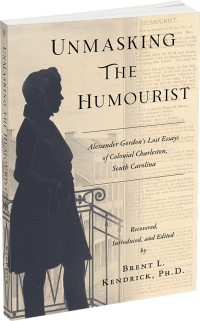
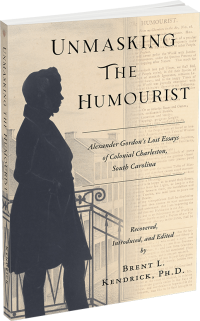
I had been invited to speak about Unmasking The Humourist: Alexander Gordon’s Lost Essays of Colonial Charleston, South Carolina, a project that has occupied a surprising amount of my life. But as I stood there, in a room filled with people who had given their afternoon to books, it became clear that what I was really there to talk about was not a colonial essayist at all. It was about the invisible network of librarians, teachers, archivists, and patient institutions that had made that work possible.

Nothing I have written would exist without them. Not the book. Not the essays. Not even the questions that led me to them.

For most of us, research looks solitary. A scholar in a reading room. A book on a desk. A voice speaking from a distant century. But none of that happens without a vast, quiet scaffolding behind it, made up of people who catalog, preserve, teach, fund, and protect the materials that others one day come to use.

Libraries quietly hold information—sometimes for centuries—without knowing who will need it, or when, or why. They preserve voices long after those voices have gone silent, trusting that someday someone will come along prepared to listen carefully.

That afternoon in Deltaville, surrounded by that small but devoted group of Library Friends, I realized I was standing inside the visible tip of something much larger. A chain of care that stretches across generations, linking a colonial newspaper, a Charleston library, a community college system, and a branch library in the heart of the Chesapeake Bay.

My own place in that chain began long before I knew it. When I was a graduate student in the early 1970s, I stumbled across a series of anonymous essays published in the 1750s in The South-Carolina Gazette. A leading scholar, Leo LeMay, had remarked that they were among the finest essays in all of early American literature and had urged that someone edit them, publish them, and identify their author. The challenge sat there for decades, unanswered.

What allowed me to return to it was not individual brilliance, but institutional grace. I spent twenty-five years at the Library of Congress, learning how archives think and how preservation outlasts any single lifetime. Later, the Virginia Community College System gave me something just as precious when I turned fifty: the chance to become an English professor, a dream I had carried since childhood. And then, when I was named Chancellor’s Professor, it gave me a two-year appointment that provided something more precious than funding. It provided time. Time to think. Time to return to unfinished questions. Time to do the kind of slow, careful work that real discovery requires.

That is why educators and educational institutions matter so deeply in this story. They do not just transmit knowledge; at their best, they grant permission. Permission to linger with a problem. Permission to follow a hunch. Permission to trust that careful thinking is worth the investment.

Being in Deltaville also gave me something I had not realized I was missing: the chance to thank Glenn DuBois in person. Glenn was Chancellor during two important turning points of my professional life. He was Chancellor when the Virginia Community College System first welcomed me into the classroom at age fifty, and he was Chancellor again years later when I was named Chancellor’s Professor, the appointment that made this work possible.

We rarely get to look someone in the eye and say, simply and honestly, “You changed my life.” But that afternoon, in a small library behind a hardware store, I did. It was one of those moments when gratitude stops being abstract and becomes something you can actually feel in the room.

The essays I eventually brought back into the light turned out to belong to Alexander Gordon, a Scottish-born scholar and singer who lived in colonial Charleston. But authorship matters because it allows us to place a voice in a life, a mind in a world, and a text in a tradition.

There is a Jewish folk belief that a person dies twice: once when the body stops, and again when their name is spoken for the last time. If that is so, then archives are a kind of moral infrastructure, designed to keep names from slipping into that second death. Every catalog entry, every preserved page, every carefully tended collection is an act of faith in the future.

So is education. When the Virginia Community College System opened its doors to me in midlife, it did not just give me a job. It gave me a second beginning. Without that second chance, the first version of my curiosity would have remained unfinished.

All of this came together for me in that small Deltaville library. A place without marble columns or grand staircases, but full of the same quiet dignity that animates every serious library anywhere. People had gathered not to be dazzled, but to listen. To care. To take part in the long human habit of keeping stories alive.

Today, Gordon’s voice is no longer anonymous. His essays are no longer orphans. A lost body of work has been restored to its author, and a chapter of early American literary history has been set right. That restoration belongs not just to a scholar or a book, but to the institutions that made it possible—to libraries that guard knowledge, to educators who foster discovery, and to communities that believe the past is worth preserving.

All proceeds from my book go to the Virginia Foundation for Community College Education, which feels exactly right. Libraries and community colleges share the same moral instinct: they exist to hold doors open, not to keep people out.

I left Deltaville with a deeper gratitude for the fact that nothing we do alone ever really is. Behind every footnote stands a librarian. Behind every discovery stands a teacher. Behind every second act stands an institution willing to say yes.

And behind every recovered voice stands a chain of quiet, faithful human hands, passing something forward because they believe someone, someday, will need it.

The Place: Charleston, SC. The Venue: Charleston Library Society. The Moment: October 1.

This week’s post is arriving early, because in just a few days I will step into a room filled with history and voices that refuse to fade. On October 1, the Charleston Library Society—the oldest cultural institution in the South and the second-oldest circulating library in the nation—will host the launch of my Unmasking The Humourist: Alexander Gordon’s Lost Essays of Colonial Charleston, South Carolina.

Why Charleston? Because the city itself is part of the story. It was here, in November 1753, that Alexander Gordon began publishing his Humourist essays in The South-Carolina Gazette. Through wit and irony, Gordon held up a mirror to colonial society, skewering hypocrisy, praising learning, and questioning authority. His essays pulsed with the contradictions of a city that was both refined and raw, elegant and quarrelsome. Charleston was his stage, and for nearly three centuries his voice remained hidden in the fragile pages of a newspaper few had cause to revisit.

That is, until now.

The Charleston Library Society is not just the venue for this launch—it is the very repository that safeguarded the Gazette itself, preserving the faint ink on brittle pages that carried Gordon’s words into the future. Founded in 1748, just five years before The Humourist first appeared, the Library has weathered fires, wars, earthquakes, and centuries of change. Its shelves and archives testify to the endurance of ideas—and to the truth that words matter. To stand in this place and reintroduce Gordon’s voice is both an author’s honor and a literary historian’s homecoming.

This launch also falls on a milestone: 272 years since the first Humourist essay appeared in Charleston. That span of time is almost unimaginable. Empires have risen and fallen, nations have been born, wars have been fought, and yet these essays—sharp, funny, insightful—still breathe. They remind us that human folly, ambition, vanity, and hope are constants. Gordon was not writing only for 1753. He was writing for us.

For me, this book represents years of research and a kind of detective work: following a trail of clues, comparing voices, weighing evidence, and finally piecing together the case for Gordon’s authorship. It is scholarship, yes—but it is also a story of recovery. Of bringing back a writer who deserved to be remembered, who deserves a place in our understanding of American letters.

And so, on October 1, Unmasking The Humourist will take its first public bow in the very city that first gave it life.

If you are in or near Charleston, I would be delighted to see you at the Charleston Library Society. If you are far away, I hope you will celebrate with me from wherever you are.

Because this launch is not just mine—it belongs to every reader who believes in the power of words to survive, to provoke, to amuse, and to endure.

About the Book

This edition definitively establishes Alexander Gordon (c. 1692–1754)—antiquarian, Egyptologist, scholar, singer, and later Clerk of His Majesty’s Council of South Carolina—as the author of The Humourist essays, restoring his rightful place in literary history.

The Introduction confirms Gordon’s authorship and provides the necessary historical context surrounding the essays and their publication in The South-Carolina Gazette.

The Humourist Essays section presents the complete authoritative text. Each essay is introduced with a detailed headnote offering historical context, exploring key themes, and situating the essay within broader literary and cultural traditions. These headnotes also clarify references, highlight rhetorical and satirical techniques, and connect The Humourist to its periodical essay tradition. Following each essay, explanatory notes supply annotations that illuminate historical allusions, linguistic nuances, and biographical details, making the essays more accessible to modern readers while preserving their original wit and bite.

The Afterword suggests areas for future scholarship—richer literary analysis of Gordon’s techniques, his engagement with Charleston’s intellectual and political life, his later years in South Carolina, and his place in transatlantic literary traditions. This volume thus serves both as a definitive authorship study and as a definitive text, laying a foundation for future research.

Finally, the Appendix corrects a 277-year-old historical error that mistakenly attributed to Gordon a natural history of South Carolina. This archival correction not only restores the record but also underscores the importance of rigorous scholarship—whether in reclaiming a forgotten author’s voice or in ensuring that legacy is preserved with accuracy.

Unmasking The Humourist: Alexander Gordon’s Lost Essays of Colonial Charleston, South Carolina is available now:

Amazon and Barnes & Noble

All proceeds from the sale of this book will be donated to The Virginia Foundation for Community College Education

Unmasking The Humourist. From Colonial Shadows into Modern Light

“The pursuit of historical truth requires rigorous attention to evidence, but also imagination—an ability to see beyond the silences.”

Eric Foner (b. 1943), Columbia University historian and Pulitzer Prize–winning author of The Fiery Trial.

It began with a clue. A slip of language. A name tucked too neatly into silence.

For years, The Humourist was one of colonial America’s most compelling mysteries: a sharp, satirical voice that burst onto the front page of The South-Carolina Gazette in 1753 and 1754—then disappeared without a trace.

No signature. No farewell. Just a trail of dazzling essays and a question no one could quite answer: Who was he?

What followed, for me, was part scholarship, part sleuthing. I tracked language patterns, pored over wills, newspapers, shipping records, and marginalia. I followed leads from Charleston to Edinburgh and back again. And finally, I solved the puzzle, and the answer emerged:

Alexander Gordon—a Scottish-born antiquarian and early Egyptologist, who would eventually serve as Clerk of His Majesty’s Council in South Carolina. A man educated in Enlightenment thought, fluent in satire, and bold enough to take aim at power in a bustling port city where reputation was currency.

The mystery is solved. But Unmasking The Humourist doesn’t just name the man—it restores his voice.

This authoritative and definitive edition brings Gordon’s essays back into circulation for the first time in nearly 270 years, fully annotated and critically framed, with a scholarly introduction that explores Gordon’s identity, influences, and the forces that led to his disappearance from literary memory.


Why These Essays Matter

The Humourist columns are more than colonial curiosities. They are early American satire at its finest—witty, incisive, and rich with transatlantic influence. Gordon’s essays place Charleston on the literary map, not as a provincial outpost, but as a vibrant participant in the Enlightenment-era conversation about politics, identity, and the press.

This book marks a breakthrough in how we understand the American essay tradition. It challenges the idea that colonial literature was all sermons and pamphlets. Here, we meet a writer who was sharp, worldly, and unafraid to poke fun at hypocrisy—whose pen was as powerful as any pulpit or platform of his day.


A Milestone Moment

Today, I submitted the final corrections to the publisher, along with keywords, pricing, and metadata. The next step is the printed proof—then, in due time, the book itself.

It’s a strange and beautiful feeling. Emily Dickinson said it best:

“After great pain, a formal feeling comes.”

This project has spanned decades. It has taken me deep into archival records, across centuries of silence, and finally into the steady light of historical clarity.

And Now?

I’m proud to share the cover—front and back. Because The Humourist, like all great stories, deserves both.

Launch Details?

Not quite yet. But soon. The typeset is locked. The voice is ready.

This fall, a long-lost satirist steps out of the colonial shadows—and into the modern light.

A Forgotten Voice, A Solved Mystery—And Soon, A Book

“What is research but a blind date with knowledge?”
— Will Harvey (b. 1963; computer scientist and entrepreneur known for his contribution to the field of interactive entertainment.)

“The greatest part of a writer’s time is spent in reading, in order to write; a man will turn over half a library to make one book.”
— Samuel Johnson (1709-1784; poet, essayist, moralist, and lexicographer, best known for compiling A Dictionary of the English Language, 1755.)

Years ago, I solved one of the greatest literary mysteries in early American history. The Humourist—a sharp-witted, enigmatic essayist whose work graced the front page of The South-Carolina Gazette in 1753 and 1754—had been lost to time, his identity obscured by history.

Through meticulous research—poring over newspapers, historical records, forgotten manuscripts, and overlooked clues—I solved the mystery, uncovering the man behind the words—his identity, his world, and the forces that led to his disappearance.

I shared my discovery with the world through my copyrighted blog, laying bare the identity of The Humourist. But there was more to be done. Solving the mystery was only the beginning.

Now, after years of refining my research, the book I’ve long envisioned is finally becoming a reality. Unmasking The Humourist: Alexander Gordon’s Lost Essays of Colonial Charleston, South Carolina, will be a available in September. It’s a definitive edition that not only reveals The Humourist’s true identity but also presents his essays in full, with critical commentary, historical context, and meticulous annotations. This is not just a rediscovery; it is a restoration of one of the most significant but overlooked literary voices of Colonial America.

Why This Book Matters

This is more than just the story of an anonymous writer. It’s about:

Colonial America’s literary landscape and its connections to the great essay traditions of England.

The power of satire in shaping public discourse—even in a bustling port city like Charleston.

The intersection of literature, politics, and history, as seen through the eyes of a writer who was both an observer and an insider.

For the first time, The Humourist’s essays will step out of the yellowed pages of The South Carolina Gazette and into the full light of historical and literary analysis.

The Book Will Arrive This Fall

This carefully curated edition will include:
● All of The Humourist’s essays, fully annotated.
● A critical introduction that explores his identity, influences, and legacy.
● A deep dive into the historical and literary significance of his work.
● A call for further scholarly research into this long-forgotten but pivotal writer.

Stay Tuned!

Over the coming months, I’ll be sharing exclusive glimpses into the book’s publication journey, including its official launch. Follow my blog for exclusive updates—you won’t want to miss what’s next!

I solved the mystery years ago. Now—early this fall—the book that brings #The Humourist back to life will be available not only on Amazon but also in a bookstore near you!