—Bret Lott (b. 1958; American author and memoirist whose themes focus on family, faith, and the complexities of human relationships.)
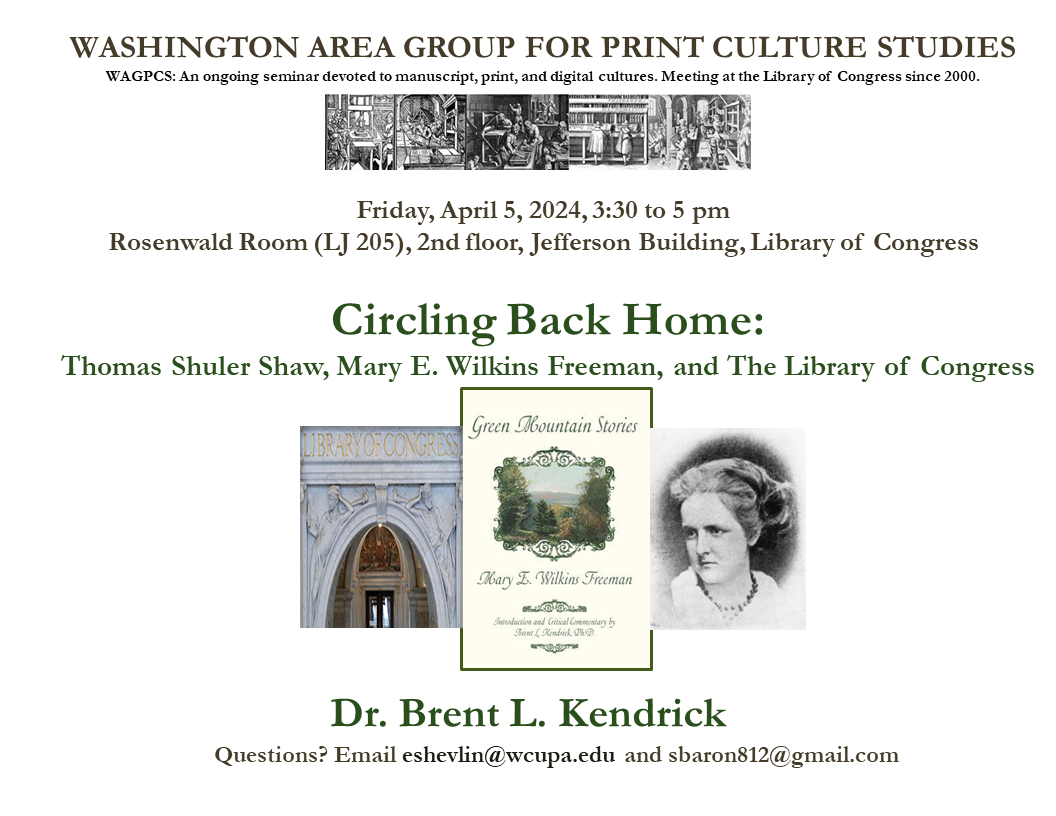
Next week I’ll be circling back home to the Library of Congress (LOC) where I enjoyed a glorious career spanning twenty-five years. I won’t be going home alone. Joining me will be the woman I’ve had an affair with for the last fifty years or so. I’m speaking, of course, of none other than my lady, Mary E. Wilkins Freeman. As part of my ongoing work on my two-volume Dolly: Life and Letters of Mary E. Wilkins Freeman, I’m circling back to LOC’s Rare Book and Special Collections to revisit some important Freeman materials. The beautiful part, however, is that the Washington Area Group for Print Culture Studies (WAGPCS) has invited me to talk about my research. I am thrilled beyond thrilled to be circling back home and to have the opportunity to share my ongoing and exciting work on Freeman.
Below is the abstract of my talk followed by a WAGPCS promotional for the event!
ABSTRACT
On March 15, 1930, the acclaimed American short story writer, Mary E. Wilkins Freeman, passed away. Her legacy, however, continues to resonate. At the turn of the twentieth century, Freeman and Mark Twain stood as America’s most beloved writers. She blazed a trail for women in literature, becoming the first recipient of the William Dean Howells Gold Medal for Distinguished Work in Fiction (awarded by the American Academy of Arts and Letters in 1925). She achieved the distinction of being among the first women elected to membership in the National Institute of Arts and Letters in 1926. Additionally, the bronze doors at the American Academy of Arts and Letters in New York (West 155 Street Administration Building) bear the inscription, “Dedicated to the Memory of Mary E. Wilkins Freeman and the Women Writers of America.”
Enter Thomas Shuler Shaw, a librarian at the Library of Congress, who embarked on an ambitious project in December 1931: writing what would have been the first biography of Mary E. Wilkins Freeman. His goal was to illuminate the life and literary contributions of this remarkable author.
However, fate had other plans. Shaw’s biography, titled A Nineteenth Century Puritan, faced rejection from prominent publishers such as Harper & Brothers, Ladies’ Home Journal, and The Saturday Evening Post. Despite setbacks, Shaw persevered. His meticulously curated scrapbooks and the typescript of his unpublished biography found a home in the Rare Book & Special Collections Division. These artifacts, along with Freeman’s books donated by Shaw to the Library of Congress, provide a rich tapestry of insights into her life and work. Notably, some of these materials reside in the Rare Book/Special Collections, while others find their place in the General Collections.
Fast-forward to 1985. Dr. Brent L. Kendrick, then serving as the Training Coordinator for United States Copyright at the Library of Congress, unveiled a literary treasure: The Infant Sphinx: Collected Letters of Mary E. Wilkins Freeman. Kendrick’s work, enriched by Shaw’s scrapbooks and unpublished biography, delves into Freeman’s correspondence. Through these letters, we glimpse the inner world of a prolific writer who defied conventions and left an indelible mark on American literature.
Fast forward again to May 2023. Kendrick continues his scholarly immersion into Freeman’s world and edits a new edition of her first collection of short stories for adults. Originally published as A Humble Romance and Other Stories in 1887, the book was meant to bear the title Green Mountain Stories. Now, 136 years later, it finally emerges under its intended name: Green Mountain Stories. Kendrick’s edition includes extensive critical commentary, unraveling the intriguing backstory behind this literary transformation.
But Kendrick’s scholarly pursuits don’t end there. Armed with fresh discoveries—significant letters previously absent from his earlier work, The Infant Sphinx—he embarks on a new two-volume project: Dolly: Life and Letters of Mary E. Wilkins Freeman. Vol. I: The New England Years (1852-1901). Vol. II: The New Jersey Years (1902-1930).
With these ongoing scholarly endeavors in mind, Dr. Kendrick returns full circle to the Library of Congress, a place where both he and Shaw once contributed their efforts. Here, he plans to delve once more into Shaw’s meticulously curated scrapbooks and unpublished biography, reexamining their contents to discern fresh insights that could enrich his comprehensive exploration of Freeman’s life and correspondence. This return to the archives not only honors the legacy of Shaw’s dedication but also underscores the enduring significance of the Library of Congress as a nexus for scholarly inquiry into the lives and works of American literary figures.
“You know you’re in love when you can’t fall asleep because reality is finally better than your dreams.“
–Dr. Seuss (Theodor Seuss Geisel, 1904-1991; American author, political cartoonist, poet, animator, and filmmaker, best known for his beloved children’s books, especially The Cat in the Hat AND GREEN Eggs and Ham.
Can you feel it? I can. It’s in the air. It’s everywhere. As the gentle Spring breeze carries the scent of blooming flowers and the melodies of birdsong fill the air, I feel the stirring of something magical. Yep. It’s love. It brings a lump to my throat, and I have to spell it L-U-V.
I’m spellbound. The whispers of renewal make me want to embrace new beginnings and the promise of blossoming romance. I can’t help but think of love, from the budding of tender feelings to the full bloom of enduring connections.
You guessed it. I’m a hopeless romantic. I believe in love at first sight. I believe in falling head-over-heels in love. I believe in being swept off my feet. I believe in being thunderstruck by love. I believe in one true love, love of a lifetime, the perfect match, my other half, my kindred spirit, and my soulmate. If you know of other similar clichés, I probably believe in them, too.
The expression “Love at first sight” has been around for thousands of years, going all the way back to literature and poetry from ancient times. One of the earliest recorded instances is from the Greek philosopher, Plato, in his work “Symposium” (ca. 385-370 BCE). In this dialogue, characters discuss the concept of love, including the idea of “falling in love at first sight.”
Love at first sight–soulmates, if you will–is still very much with us today, so I’m not alone in my love notions. In the United States, for example, the belief in soulmates is fairly common. In fact, I read somewhere not long ago that anywhere from 50% to over 70% of Americans believe in the existence of soulmates or the idea that there is one perfect match for each person.
But what about the rest of Americans who don’t believe in love at first sight? What kind of love do they believe in?
I think I know. Apparently, some people believe in “GrowingintoLove.” Maybe you’re one of them. I had never heard tell of such a thing until recently when I was scrolling through Facebook. I stopped. I stared. Two men were kissing passionately. (Both were extraordinarily handsome lookers, I might add.) But what made me stop and stare was the caption beneath this super-hot Mr. & Mr. duo:
GROWING INTO LOVE GETS BETTER EVERY DAY
“Growing into love.” That’s pretty new to me. I mean, I had to Google it just to wrap my head around the concept. Apparently, it kicks off with basics like mutual respect, understanding, and emotional connection. Starts off all casual, you know. Like, it could stem from friendship, shared values, or just a good old-fashioned sense of compatibility.
But let me pause right there. Honestly, at first glance, this whole “growing into love” idea seems a bit, well, textbook-ish, if you ask me. Like something straight out of a clinical relationship guide or a self-help book.
But hey, let’s soldier on. So, diving into the nitty-gritty, we’re talking about that initial phase where you’re just getting started with this whole “growing into love” deal. It’s all about that spark, that fluttery feeling in your stomach. Yeah, those butterflies. They’re part of the package.
Then, as time goes on, you start building on that initial attraction. Shared experiences, heartfelt conversations, and quality time together deepen the connection. Trust starts to bloom too, thanks to reliability, honesty, and support.
Sure, there might be bumps along the road—disagreements, conflicts, life throwing curveballs your way. But hey, you’re facing those challenges together. Right? It’s like relationship boot camp, strengthening the bond and making it all the more resilient.
As things progress, you might decide to take things to the next level—getting exclusive, maybe moving in together, or even making long-term plans. But hey, let’s remember, it’s all about choice here. No pressure.
And here’s the kicker. Love? It’s not some static thing. It’s a living, breathing entity that needs constant care and attention. You’ve got to keep those lines of communication open, be ready to compromise, and adapt to each other’s ever-evolving needs and desires.
So yeah, call me clueless, but I’m trying to wrap my head around this whole “growing in love” concept. I mean, it’s pretty cool how it acknowledges that building a lasting relationship takes more than just initial attraction. It’s about putting in the work, day in and day out, to nurture something real and meaningful.
I get it. I understand. But I’m still stuck way back there in Spring with love in the air and with love at first sight–the sheer poetry of it all. There’s a romantic allure to the notion of love at first sight that simply can’t be matched by any other approach to love. It’s like stumbling upon a rare, exquisite flower in the midst of a sprawling garden, instantly captivating your senses and drawing you in with its beauty and mystery.
Imagine this: you’re going about your day, minding your own business, when suddenly, across a crowded room your eyes meet theirs, and in that moment, time seems to stand still. There’s a spark, an inexplicable connection that transcends rationality and sweeps you off your feet in an instant.
It’s as if the universe has conspired to bring two souls together, weaving a fate and destiny together and binding you together in an unbreakable bond. There’s no need for words or explanations; the language of the heart speaks volumes, echoing with the resonance of shared dreams and desires.
In that split second, you just know—know that this person is meant to be a part of your life, know that your paths were always destined to intersect, know that you’ve found a kindred spirit who complements your very being in ways you never thought possible.
That’s precisely what happened when my late partner and I met. Our eyes locked, time stood still, and the world faded into the background, leaving only the two of us in a moment of perfect clarity. In that instant, Allen and I both knew our lives were meant to be shared, and our twenty-year love story began with that electrifying connection.
Sure, it may sound like something out of a fairy tale, but isn’t that the magic of love at first sight? It defies logic and reason, transcends the boundaries of time and space, and unites two souls in a symphony of passion and longing.
As much as I appreciate the gradual unfolding of love, my heart will always be drawn back to that fleeting moment of enchantment, where love blossoms like a flower in the springtime, filling the air with its intoxicating fragrance and leaving an indelible mark on our souls.
And you, DearReader? What about you? What about your love? Whether it unfolds gradually like the unfurling of a delicate Spring blossom or strikes suddenly like a bolt of lightning in a stormy Spring sky, always remember this: love, in all its forms, is a testament to the resilience of the human spirit, the capacity for connection, and the enduring power of hope.
“In the midst of winter, I found there was, within me, an invincible summer. And that makes me happy. For it says that no matter how hard the world pushes against me, within me, there’s something stronger – something better, pushing right back.”
Albert Camus (1913-1960; French philosopher, author, and journalist known for his existentialist philosophy and literary contributions; winner of the 1957 Nobel Prize in Literature for his significant literary achievements, which continue to influence existentialist thought.)
One of my greatest joys is watching people succeed against all odds. I write a lot about those triumphs, most recently in my “Let Your Light Shine Bright.” It seemed fitting that I do so since it was December, a month chockfull of celebrations, each carrying a unique message of hope, transcending boundaries, and unifying us in a shared spirit of optimism and celebration.
Most of the people who populated that post–ranging from Susan Boyle to Barack Obama–are out there in the public eye as performers or politicians. Others are out there as motivational speakers. I’m thinking especially of Nick Vujicic, a charismatic and dynamic speaker who captivates audiences with his powerful presence and inspiring message. Born without arms and legs, Nick exudes confidence, warmth, and authenticity as he shares his personal journey of overcoming adversity and finding purpose and joy in life.
His message is one of resilience, faith, and the limitless potential of the human spirit. He encourages listeners to embrace their own uniqueness, overcome obstacles with courage and determination, and live a life of purpose and meaning. Through his words and example, Nick inspires others to believe in themselves, pursue their dreams, and make a positive impact on the world.
While Nick’s triumphs are anything but silent, witnessing his resilience and ability to overcome immense challenges prompted me to think about the unnoticed private triumphs that people experience.
As you might expect from an English professor, I started thinking about the people from my literary world. One by one, characters tiptoed past, whispering their silent triumphs.
Hester Prynne from Hawthorne’s The Scarlet Letter reminded me that her silent triumph came in her resilience and strength in the face of public shaming and ostracism. Branded with the scarlet letter “A” for adultery, she quietly bore her punishment and found redemption through her unwavering love for her daughter, Pearl.
And what about Janie Crawford in Zora Neale Hurston’s novel TheirEyesWereWatchingGod? She underwent a journey of self-discovery and empowerment, ultimately finding her own voice and identity despite societal expectations and pressures. Her silent triumph came from her ability to assert her independence and pursue happiness on her own terms, even in the face of adversity and criticism.
Next Nora Helmer marched dramatically onto the stage of Henrik Ibsen’s ADoll’sHouse. Her silent triumph prevailed at the end of the play when she chose to leave her husband and children in order to seek personal freedom and self-realization despite the societal expectations and conventions of the time.
A more ambiguous and bittersweet silent triumph can be seen in Tom Wingfield from Tennessee Williams’ play The Glass Menagerie. He ultimately chose to leave his overbearing mother and disabled sister in search of his own dreams and aspirations, despite the guilt and responsibility he felt towards them. While his departure may seem selfish, it represented his quest for personal fulfillment and freedom from the constraints of his family’s expectations.
People in short stories have their silent triumphs, too. Consider Sammy in John Updike’s “A&P” who experienced a silent triumph when he quit his job at the supermarket in defiance of his boss’s mistreatment of a group of girls who entered the store wearing bathing suits. The potential consequences of his actions did not keep him from asserting his independence and standing up for what he believed was right.
In James Thurber’s “The Secret Life of Walter Mitty,” the protagonist, Walter Mitty, experienced silent triumphs throughout the story as he escaped into vivid daydreams to cope with his mundane existence. He found solace and fulfillment in his imaginative fantasies, where he became a hero, a pilot, a surgeon, and more. These silent triumphs allowed him to momentarily transcend his ordinary life and find excitement and adventure within his own mind.
Obviously, silent triumphs can be poetic, too. “Home Burial” by Robert Frost is a perfect example of a silent triumph. In this poignant dialogue, a husband and wife mourn their child’s loss differently. While the wife openly expressed her anguish, the husband silently strove to bridge the emotional gap between them, offering solace despite their differing ways of grieving. This silent triumph highlights the power of emotional connection amidst grief.
In Langston Hughes’ “Mother to Son,” the speaker’s resilience in facing life’s challenges is portrayed through the metaphor of a staircase. Despite hardships, she persevered, quietly inspiring her son and readers with her determination to keep climbing. This silent triumph underscored the power of resilience in overcoming adversity.
And, yes, they can triumph on the big screen, too. In TheTriptoBountiful, the victory occurred when the main character, Carrie Watts, finally made her journey back to her childhood home of Bountiful. Despite her age and frailty, Carrie’s determination and resilience shone through as she persisted in her quest to revisit the memories and places of her youth.
In FriedGreenTomatoes, a silent triumph occurred when Evelyn Couch, one of the main characters, underwent a transformation and found her inner strength and confidence. Throughout the film, Evelyn struggled with feelings of invisibility and dissatisfaction with her life. However, her friendship with Ninny Threadgoode and the stories she heard about the lives of the women in Whistle Stop, particularly Idgie and Ruth, inspired her to take control of her own destiny.
But guess what? The journey of silent triumphs extends far, far beyond the pages of literature and the spotlight of public figures. While they serve as poignant examples of silent triumphs, the essence of their victories resonates deeply within each of us. They are not confined to the extraordinary narratives of books or the public eye but are intricately woven into the fabric of our daily lives, waiting to be acknowledged and celebrated.
Conquering fears, whether big or small, such as fear of public speaking, fear of PowerPoint, or fear of rusty observation towers, can be a significant silent triumph. It may involve facing challenges head-on, pushing past comfort zones, and gaining confidence in one’s abilities.
Adopting healthier habits, such as exercising regularly, eating nutritious foods, quitting smoking, or reducing alcohol consumption, can be silent triumphs that contribute to improved well-being and quality of life.
Finding healing and closure from past traumas, heartbreaks, or losses can be a silent triumph. It may involve seeking therapy, practicing self-care, forgiveness, and cultivating resilience in the face of adversity.
Accomplishing personal goals, whether professional, academic, or creative, can be silent triumphs that signify hard work, perseverance, and dedication. It may involve setting SMART (Specific, Measurable, Achievable, Realistic, Time-bound) goals and taking consistent steps towards achieving them.
Speaking out against injustice, discrimination, or oppression, even in small ways like blogs, can be a silent triumph that demonstrates courage, integrity, and moral conviction.
Successfully navigating major life transitions, such as starting a new job, moving to a new city, becoming a parent, or retiringinventing, can be silent triumphs that require adaptability, resilience, and resourcefulness.
Finding peace, contentment, and fulfillment within oneself, despite external circumstances, can be a silent triumph that signifies self-awareness, acceptance, and gratitude.
Performing acts of kindness, generosity, or compassion towards others, without expecting recognition or reward, can be silent triumphs that contribute to building connections, fostering empathy, and making a positive difference in the world.
Challenging and overcoming self-limiting beliefs, insecurities, and negative self-talk can be silent triumphs that lead to increased self-confidence, self-esteem, and self-empowerment.
Discovering passion, purpose, or sense of calling in life can be a silent triumph that brings clarity, direction, and fulfillment. It may involve introspection, exploration, and embracing opportunities for growth and self-discovery.
Many of these triumphs often go unnoticed, obscured by the hustle and bustle of our daily lives, concealed within the folds of routine tasks and responsibilities.
Today, I urge you to pay attention to the silent triumphs of those around you, whether it’s a friend, family member, coworker, or stranger. Offer words of encouragement, support, or recognition to acknowledge the quiet victories that may go unnoticed by others but are meaningful, nonetheless. Extend compassion and appreciation to those around you. Foster a culture of empathy and recognition for the silent triumphs that unite us all.
Today, I encourage you to pause and reflect on the silent triumphs that have shaped your life. Embrace them with gratitude and pride, knowing that they are the threads that weave the tapestry of your existence.
Today, let’s join hands as we celebrate these silent triumphs–mine, yours, and others, real and imagined–knowing that as we do, we honor the essence of our humanity and inspire others to do the same.
Today, let’s salute the quiet heroes among us, whose resilience, courage, and determination light the path for us all. May we continue to cherish and champion these moments of victory, weaving them with pride and gratitude into the collective story of our silent triumphs.
“The joy of publishing is in sharing your stories with the world and knowing that they’ll live on long after you’re gone.”
–Maya Angelou (1928-2014; a renowned American author, poet, and Civil Rights activist whose works explore themes of identity, race, and resilience.)
DearReaders, gather ’round!
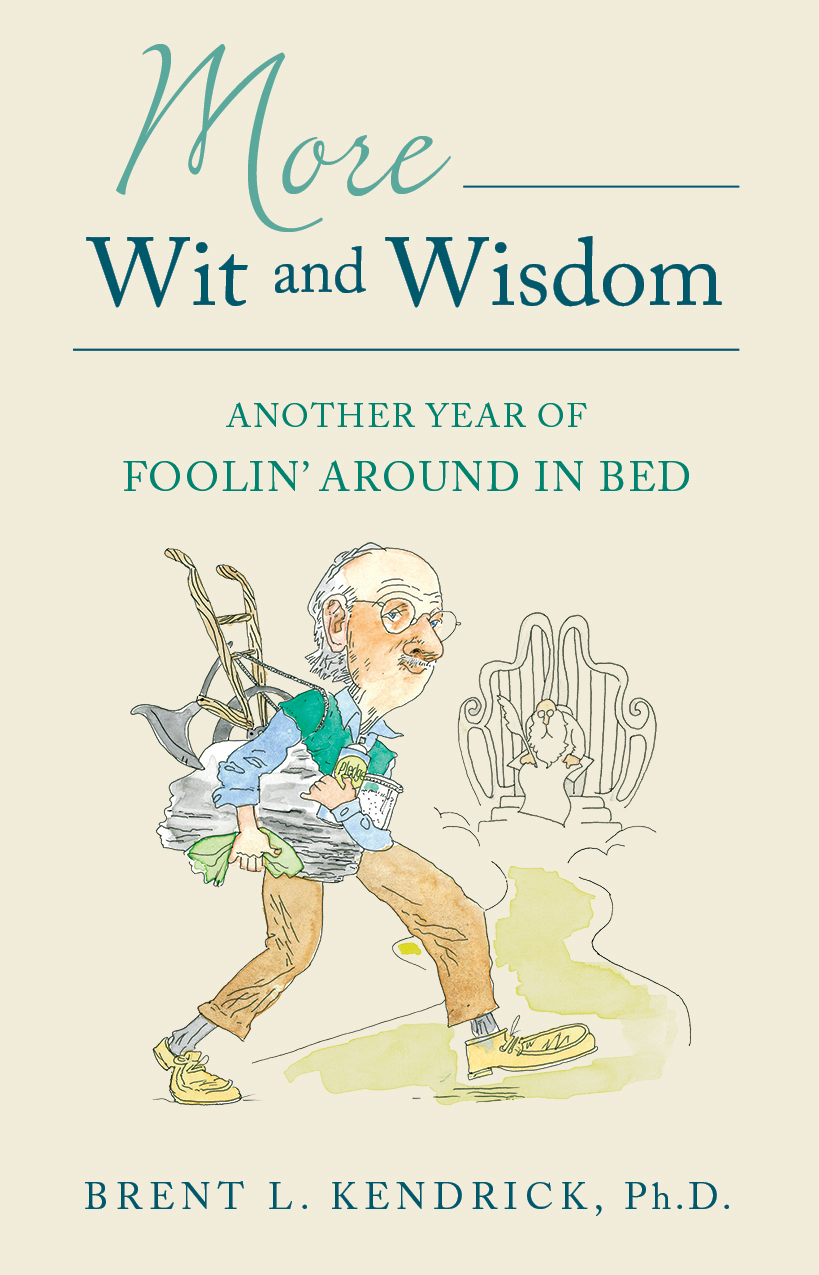
The moment we’re all eagerly waiting for is just around the corner. That’s right—my new book, More Wit and Wisdom: Another Year of Foolin’ Around in Bed–is getting closer and closer to its grand debut in late April, and boy, oh boy, do I have some juicy updates to share with you!
I’m thrilled to announce that I’ve personally PDFed every single one of the 380 interior pages, ensuring that each word, each sentence, shines as bright as a star in my mountaintop night sky. Proofing? Poof! Completed!
Whoever you are and wherever you are, your unwavering support means the world to me. MoreWitandWisdom: AnotherYearofFoolin’ AroundinBed isn’t just ink on paper. It’s a journey shared across 88 countries with 7,320 readers from the Shenandoah Valley to Okinawa.
But wait, wait! Don’t go! There’s one more thing. Feast your eyes upon the cover art for this new upcoming literary escapade. Just imagine it gracing your bookshelf, waiting to be cracked open and devoured, page by page. It will be available in hardback and paperback from Amazon, Barnes and Noble, and, hopefully, your own hometown bookstore. (Drumming up anticipation yet?)
Grand Publication Debut of a Soon-to-Be American Classic Expected by the End of April 2024. (Coverartbyacclaimedillustrator, Mike Caplanis.)
“I learned that courage was not the absence of fear, but the triumph over it. The brave man is not he who does not feel afraid, but he who conquers that fear.”
–Nelson Mandela (1918-2013; a towering figure in the fight against apartheid in South Africa and a symbol of resilience, reconciliation, and forgiveness worldwide.)
Have you ever found yourself sitting in front of your computer, fingerspoisedoverthekeyboard, eyeslockedontheblank screen? The cursor blinks, mocking your indecision. The room holds its breath, waiting for your next move.
Of course you have. We all have. I have, too.
Actually, I had that happen not long ago. I was sitting in front of my computer, enveloped in a curious trance as I looked at my PowerPoint options. Each was a digital beacon of possibilities, beckoning me into a realm where creativity and innovation might dance hand in hand.
My seasoned fingers, once adept at coaxing brilliance from the keys, hovered hesitantly over the mouse, betraying the uncertainty that clouded my thoughts. The screen gazed back at me with patient anticipation, as if urging me to breathe life into the blankness into which I stared.
But as I peered into the depths of the display, my mind became a whirlwind of memories. How many lectures had I crafted with this very tool? How many minds had I ignited with the flicker of a well-placed slide or the resonance of a perfectly timed transition?
And yet, despite my seasoned expertise, I found myself transfixed, caught in the labyrinth of my own imagination. The cursor blinked mockingly, a silent reminder of the silence that echoed through my mind.
I sat there, staring, waiting, realizing that in the digital world of ones and zeros, the true magic lies not in the tools we wield, but in the stories we choose to tell.
Indeed, I had a story to tell. Gina Byrd, Executive Director of the Friends of Handley Library System, had invited me for an “Author Talk” at Bowman Library (Stephens City, VA). My topic? “Reinventing Yourself: Writing Your Next Chapter.”
Several weeks before my talk, Gina and I met at the library so that we could go over logistics.
“Will you be using PowerPoint?”
“No, I don’t think so. I like to walk around the room while I talk.”
It was settled. No PowerPoint.
But when I got back home, the notion swept over me that perhaps I should use PowerPoint. I hesitated for a moment before deciding to reach out to Gina. After all, I had initially dismissed the idea, preferring the freedom of movement without slides. But as I mulled it over, I realized that visual aids could enhance the audience’s understanding of my topic. With a sense of uncertainty If I can keep from it, I fired off an email to Gina:
It occurs to me that I might want to use PowerPoint after all, especially if you all have a remote clicker that I could use as I walk around.
Gina’s prompt reply reassured me:
That’s fine! We have the Clear Touch Panel (it’s basically a huge iPad) and a clicker you can use. If you can bring your presentation on a thumb drive, that would be easiest.
The next day, I talked myself into tackling the PowerPoint presentation.
“Piece of cake. You’re an expert on reinvention. After all, you’ve been reinventing yourself for a lifetime. You’ve got this.”
Sure. Right. Self-talk works most of the time. However, this seemed to be one of those times when it wasn’t working. There I sat, once again, staring at my blank computer screen while PowerPoint stared back at me. Even though I had more than a week to complete the PowerPoint, my mantra was immediate:
“Go on. Just do it. Get it out of the way.”
The glow of the PowerPoint screen beckoned, but I found myself lured instead into chasing the indoor tasks awaiting my attention. The dust bunnies, like mischievous gremlins, taunted me from their hiding places, my laundry begged to be folded and sorted, and my houseplants drooped in silent protest against neglect. As I tackled each chore, a siren call steered me further away from the digital abyss.
The next day, I faced the blank screen once more. It was then that my fear looked back at me. I realized that I had not developed a PowerPoint presentation in more than two years. I realized that I was fearful simply because I was no longer familiar with a task that, in reality, was simple and straightforward.
That settled it. I sat down in front of my computer, determined to develop the presentation, slide by slide. I had no expectation that I would finish it that day, but I resolved to complete a draft. I knew that I had to get past my fear.
The next thing I knew, I found myself ensnared by the choices at my fingertips. Each transition, a delicate balance between subtlety and spectacle, whispered promises of visual delight. Each animation added movement and meaning to static slides. Each carefully selected photograph added depth and resonance to my narrative. The bullets, like soldiers marching in formation, stood ready to deliver their payload of information with precision and clarity. Every click held power, and I was in charge.
I finished my PowerPoint presentation the next day, and I was delighted with it. Actually, I was ecstatic because I had as much fun developing it as I had ever enjoyed in the past.
When I gave my talk at Bowman Library, I realized that my decision to use PowerPoint was a wise one. It helped me navigate my talk smoothly, and, more importantly, it kept everyone engaged. Afterward, several people commented on its effectiveness, with special praise for the transitions, which they felt reinforced the content.
As I drove back home, I started thinking about the PowerPoint battle that I had fought and nearly lost. It would have been so easy for me to have aborted my plan. After all, I hadn’t planned to use PowerPoint initially. But I had changed my mind. What a pity it would have been for me to have lost the battle to the dis-ease that I was experiencing simply because I had not used PowerPoint in more than two years.
Don’t get me wrong. If I were rating the level of my fear, I’d probably give it a 4 on a scale of 10, with 10 being the greatest fear. Actually, that’s not that bad at all, yet it was bad enough to lure me away from the task, not once, not twice, but multiple times.
Without a doubt, I’ve experienced far greater fears in my life. How well I recall getting back on a bicycle after several decades of not riding a bike. There I stood, at the trailhead to the Virginia Creeper Trail, nostalgia tugging at my muscles. The trail stretched downhill before me. I glanced at the path, comforted that Allen–my late partner, who also hadn’t ridden a bike in several decades–was facing the challenge with me. But as I considered the downhill descent, I could neither hide nor disguise my fear. With trembling legs, I pushed off, the wind carrying whispers of both fear and exhilaration. The trail unfolded. I pedaled. I kept on pedaling until I made it to Damascus, 34 miles later, safely past my fear.
More recently, I had a more frightening encounter with a chainsaw. I was finishing a day’s work of taking down some small trees behind my home. I decided to end the job by cutting a sapling. There I stood—a weekend warrior in faded jeans and work boots. The sapling seemed to know exactly how to make the saw bounce back, cut through denim, and rip through flesh, all the way down to but not through my patella—the hinge of leg movement, the guardian of joints. It took twelve stitches and nearly as many weeks to heal my knee.
It took me far longer to bounce back from the deep-seated fear that the chainsaw had instilled. Months passed. Every trip to my basement found me staring at the saw, wondering whether I would ever have the courage to use it again. Determined to conquer the fear, I ordered protective chainsaw chaps. When they arrived, I put them on hesitantly, started the Stihl, and cautiously but triumphantly took down a small tree. I tossed the wood and my fear into the stack for winter fires.
Experiencing fear, especially in certain situations or after a prolonged period of inactivity or after an accident, is a common and normal human response. Fear is a natural part of the human experience.
As a seasoned educator and as a man in his seventies, I’ve seen fear kick ass over and over again as people faced:
● Technology ● Change ● Failure ● Medical Procedures ● Public Speaking ● Rejection ● Regret ● Success ● Letting Go ● Driving ● Aging
The list is endless. But here’s the caution that we all need to hear regardless of who we are or where we are in life. As we navigate life, fear can often stand as a formidable barrier between us and our aspirations. Yet, as I’ve learned through my own experiences, it’s in confronting these fears head-on that we find the true essence of courage and resilience.
I urge you to take a moment to reflect on the fears that may be holding you back—whether it’s the fear of trying something new, the fear of failure, or the fear of the unknown. Embrace these fears not as obstacles but as opportunities for growth and self-discovery.
Just as I conquered my hesitation with PowerPoint, rode a bike after decades, and faced down a chainsaw, you too can overcome the fears that threaten to immobilize you. Step by step, challenge by challenge, you have the power to rewrite your story and embark on a journey of transformation.
I encourage you to take that first step today. Identify one fear that’s lingering in the shadows of your mind and make a commitment to confront it. Whether it’s signing up for that class you’ve been eyeing, reaching out to mend a broken relationship, or simply daring to dream a little bigger—embrace the discomfort, for it’s in pushing past our boundaries that we discover our true potential.
Remember: you are capable of far more than you know. Let’s rise above our fears, embrace the adventure of life, and write the next chapter of our story with courage, resilience, and unwavering determination. The blank page of possibility awaits. Let’s fill it with the triumphs of our bravery.
“In a world where we can be anything, let’s choose to walk the red carpet of life with kindness, grace, and a sprinkle of stardust.”
–Lady Gaga (b. 1986, Stefani Joanne Angelina Germanotta; a Grammy Award-winning singer, songwriter, and actress known for her groundbreaking music, bold fashion choices, and advocacy for social justice issues; one of the most influential and iconic figures in contemporary pop culture, captivating audiences worldwide with her unique blend of creativity and authenticity.)
Hey, y’all. Come here, curl up real close to me, get comfy, and listen while I purr. I need to share something with you that I simply dare not share with the world at large. But since you’re special and know how to keep secrets, I’ll share it with y’all. Okay? So, get close while I whisper my secret in your ear:
“The other day, I was lying on my sofa, all innocent and quiet like, and right out of the blue, I was smitten, right there in my living room, in broad daylight! Can you imagine?”
Well, I couldn’t imagine it either, mainly because it came on so sudden like. I mean. I was just lying there, and then Shazam! I had been smitten! Well, actually, that shouldn’t come as too much of a surprise. I’m smitten easily, and I’m smitten hard. Hopefully, you are, too. Right now, I’m smitten by the gorgeous moss, harbinger of an early spring, greening itself in my Koi Pond Waterfalls. I’m smitten, too, by the online photography course I’m taking so that I can take better photographs with my new Samsung Galaxy S24 Ultra. I continue to be smitten by advances in AI, especially by Aloha, a housekeeping humanoid who can cook and clean. (If you dissed me when I announced my Caden last November, I guess I’m getting the first laugh. Ready to hop on board? There’s room!) And, in case you’re wondering–and I know, I just know that some of you are–I have not been smitten by any of the studmuffins who failed to find their way into Anne Lamott’s life or into mine during our respective flings with online dating apps. (For her account, see “My Year on Match.com”; for mine, which matters far more and is really the only one that matters at all, see “My Year on Unmatched.com.”)
I cannot speak for Lamott, but I remain hopeful. I am doing my best to smite the frog at my kitchen door with regular, passionate kisses so that I can practice my pucker and stay in shape. Who knows? I might just have an opportunity to be smitten by a prince. (Princes like good kissers. Just sayin’.)
No doubt you’re wondering what the hell I’ve been smitten by, aside from my nonsense. Chill. I’m about to tell you.
I’ve been smitten by a red carpet. Mind you, though, it’s not just any ole red carpet. It’s THA red carpet that gets rolled out right in front of you to seduce you into a waltz with destiny, leaving you breathless with anticipation and a sprinkle of stardust in your eyes.
Yep. I’m a smitten kitten. Hear me purr? But here’s the thing. The glamour of rolling out the red carpet goes all the way back to ancient Greece, where it was mentioned in Aeschylus’ play Agamemnon describing the king’s return home after winning a battle. His wife Clytemnestra says to him, “Now my beloved, step down from your chariot, and let not your foot, my lord, touch the Earth. Servants, let there be spread before the house he never expected to see … a crimson path.”
Despite its ancient heritage, it was not until the early 20th century that rolling out the red carpet became associated with celebrities and VIPs, particularly in the entertainment industry. The first known reference to a red carpet being used at the premiere of a movie dates back to 1922, when it was laid out for the opening of the Egyptian Theatre in Hollywood.
Since then, the red carpet has become synonymous with prestige, glamour, and exclusivity, particularly at award shows, movie premieres, and high-profile parties. It’s often used to signify that the individuals walking on it are special guests deserving of special treatment and attention.
That certainly was the case during this year’s Grammy Awards, as the red carpet sizzled with music’s biggest stars like Taylor Swift and SZA. Amidst wardrobe changes and rehearsals, the red carpet set the stage for unforgettable fashion moments.
Beyond Hollywood, the red carpet is used in various other contexts as a symbol of importance, honor, and VIP treatment. I dare say that each of us, at one time or another, has said to ourselves or to someone else “I want to roll out the red carpet” to celebrate someone or to jazz up a special occasion.
You’ve probably had enough of my caterwaul, so I’d better roll out THA red carpet that turned me into a smitten kitten. Meow, meow, meow, purr, purr, purr, meow, meow, purr, purr, meow, purr, MEOW!
Like I said, I was lying on my sofa in broad daylight, amusing myself with some TikTok videos when out of nowhere a video featuring Opatija, a picturesque coastal town in Croatia, popped up on my smartphone. But it wasn’t just any ordinary kind of video. It was a red-carpet tourism video, weaving together a rich tapestry of emotions, triumphs, and shared moments. The taglines alone speak volumes:
● Exploring the vibrant tapestry of choices on the red carpet, where every step unveils a world of possibilities.
● In this beautiful world, imagine if every moment mirrored a red carpet affair—filled with smiles, hugs, and unbridled happiness. Let’s choose to embrace the elegance of joy in every step we take.
● Witness the unexpected on the red carpet—a celebration of diversity, love, and transformation.
● Imagine if every moment mirrored a red-carpet affair—filled with smiles, hugs, and unbridled happiness. Let’s choose to embrace the elegance of joy in every step we take.
Typically, a man appears suddenly and rolls out a red carpet in public places, such as sidewalks or parks, treating unsuspecting strangers as if they were celebrities, complete with photographers, fans, and sometimes even limousines. Without fail, the reactions and interactions with the new celebs are amusing and heartwarming, often catching people off guard with the unexpected VIP treatment. The goal is to capture genuine reactions and create humorous situations, so they often approach anyone who happens to be in the vicinity of where they set up the red carpet. This approach helps keep the content unpredictable and inclusive, as they showcase reactions from a variety of individuals.
Typically, the people who walk the red carpet in the videos seem to be surprised by what is happening. Almost always, they are hesitant to step onto the red carpet after it has been rolled out in front of them, even as the tall young man extends his arm graciously and invitingly. Their movements are cautious, almost as if they’re tiptoeing into unfamiliar territory. Their expressions betray a mixture of uncertainty and curiosity, unsure of what awaits them as they traverse this unexpected path. Each step is tentative, as if testing the ground beneath them for stability.
Yet, as they progress further along the scarlet pathway, something remarkable begins to happen. A subtle shift occurs in their demeanor, a gradual transformation fueled by the energy of the moment. Their apprehension gives way to wonder. Their eyes light up with newfound excitement and anticipation. With each stride, they seem to shed the weight of their doubts, stepping into a realm where anything is possible.
As they walk across the red carpet, a sense of liberation washes over them, freeing them from the constraints of everyday life. In this fleeting moment, they are not defined by their roles or responsibilities but by the sheer exhilaration of the experience. Laughter bubbles forth, spontaneous and unrestrained, as they embrace the joy of the unexpected.
Amidst the vibrant tapestry of emotions, the little dramas of life begin to unfold. Strangers become companions, sharing stories and forging connections that transcend the fleeting encounter. Inhibitions are cast aside, replaced by an unbridled sense of camaraderie and belonging. It’s as if the red carpet has become a stage, and they are the stars of their own impromptu performance.
In the end, as they step off the red carpet, their spirits are buoyed by this enchanting journey. Though they return to the routine of their daily lives, they carry with them the indelible imprint of this extraordinary moment—a reminder that magic can be found in the most unexpected places, if only we dare to take that first step.
“Dare to take thatfirst step. “
We can look at that statement in two ways. The people in these little dramas have to dare to take that first step onto the red carpet. Then, and only then, can these magical transformations take place, even if only for a few moments. But let’s not forget the other individuals who are involved in these little dramas: the Croatian video team, who time and time again, dare to roll out the red carpet for strangers whom they encounter. Without the video team, strangers could not become stars.
I cannot help but wonder what our own little corners of our world would be like if we spent some time thinking about ways that we dare roll out the metaphorical red carpet before strangers whom we encounter in our own lives.
It could be as simple as sincerely complimenting someone on something positive about them. Whether it’s their style, smile, or skill, our words can brighten their day. For instance, we might notice someone’s vibrant scarf and express admiration for how it complements their outfit. Their initial surprise might give way to a smile of appreciation, boosting their confidence and spreading warmth.
It could be as simple as performing small, random acts of kindness without expecting anything in return. It could be as simple as holding the door open for someone, helping carry groceries, or simply offering a friendly smile. Imagine seeing someone struggling with heavy bags and offering assistance without hesitation. Their gratitude and relief could radiate as they realize there are still caring strangers in the world.
It could be as simple as striking up conversations with people we encounter in our daily lives. This could be as straightforward as asking how their day is going or commenting on something happening in the community. Picture starting a conversation with someone standing in line at the grocery store and sharing a laugh over a funny observation. Our genuine interest and friendliness might brighten their day and foster a sense of connection.
As I continue to be smitten by the transformative allure of the Opatija tourism videos, where a mere red carpet, a lens, and the sincere desire to infuse fleeting moments with joy can ignite profound change, I am stirred to contemplate our collective capacity to impact the lives of strangers. Perhaps, in our quest to touch hearts, we need not seek grand gestures. Perhaps all that we need to do is strive to live our lives as radiant beacons of kindness and warmth so that with every interaction, we joyfully roll out the red carpet.

 The Wired Researcher