The Soul selects her own Society — Then — shuts the Door — To her divine Majority — Present no more —
—Emily Dickinson.
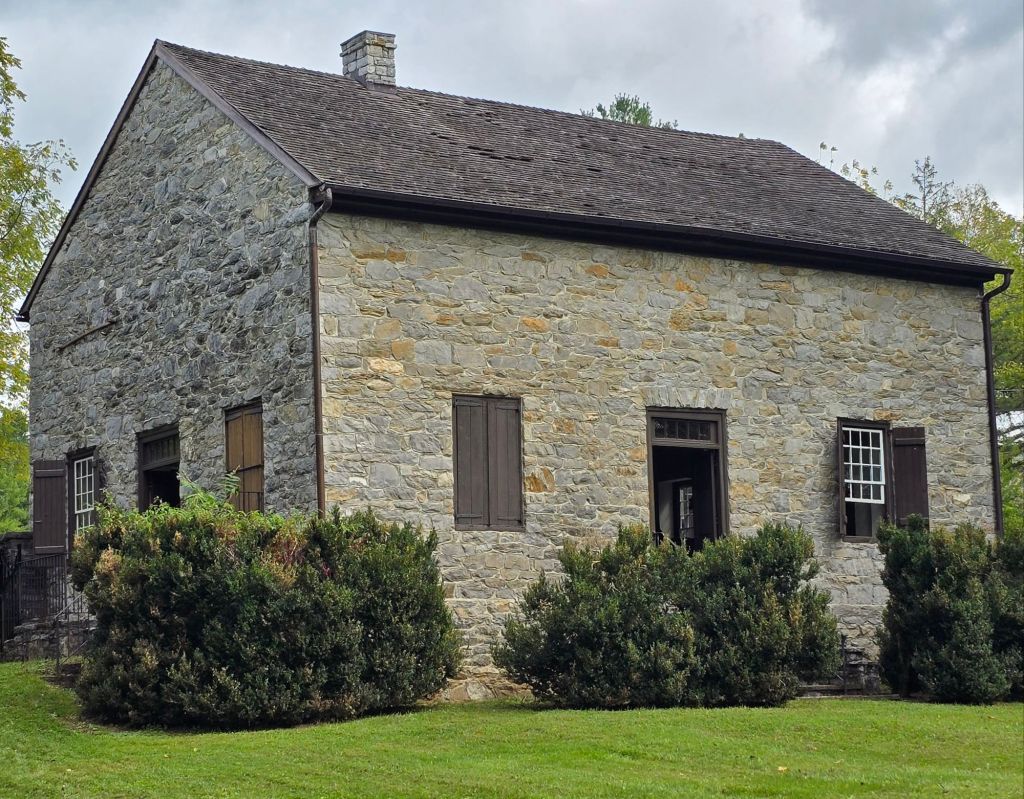
It started to fade. All I had to do was enter the building. I left behind the exterior facade—the rough, irregular fieldstones, gray and ochre, mortared into massive walls beneath a steep roof of weathered wooden shingles. Oneness.
It started to fade. All I had to do was decide where to sit. Dark wooden pews, all stark straightness—high backs, hard edges, rigid parallel lines running wall to wall. Oneness.
It started to fade. All I had to do was look upward. The towering dark-wood pulpit climbed nearly to the ceiling, its massive paneled back crowned by a broad sounding board suspended overhead. Oneness.
It started to fade. All I had to do was listen. The voices—mine, Gary’s beside me, the priest’s and choir’s in front, the congregation all around—rose higher and higher, louder and louder, fell lower and lower, softer and softer, in sweet, sweet harmony. Amazing Grace. We Are Not Alone. A Mighty Fortress. Oneness.
It all started to fade. All I had to do was breathe. The present. All the artifacts of worship surrounding me. It all faded into the moment. The present became the past and the past stood still in the present and ricocheted into the fullness of forever. Oneness.
Oneness ended. Abruptly.
A low mechanical rumble sounded somewhere beyond the open doors, distant at first, then nearer, swelling until the engine suddenly revved—an explosive, throaty roar that flooded through all three doors and filled the chapel.
A motorcycle.
Oneness. Broken.
Suddenly, all the component parts returned. Voices. Pulpit. Priest. Choir. Pews. Congregation. Me. Gary. Stones—the very eighteenth-century stones the farmers dragged to build Old Chapel. Preserved. Keen awareness erased the fade. Oneness shattered into parts.
In that instant, I realized my loss. Oneness was gone through no one’s fault. The motorcyclist was on their own journey. Old Chapel—faithful to its past with no electricity—could not have closed its doors this hot and humid Sunday morn. But I also realized my gain. The insight came without sermon. Whenever we hope to step into moments of cherished Oneness, we need to close fast the doors of our attention to all that might intrude and steal away the prize.
Close fast the door of our attention so that we are completely present with someone we love. Listen to the story we’ve heard before as though it’s being told for the first time. Or better still, as if it’s being told for the last time. Notice the face across the table, as if we’ve never seen it before. Or better still, as if we’ll never see it again. Sit beside someone without needing anything else to happen. Or better still, as if nothing will ever happen again.
Close fast the door of our attention so that we become fully aware that beauty is transient and ever changing. We’ve seen autumn for years immemorial, but we’ve never seen its September glory through today’s eyes. We’ve seen hibiscus blossom, but we’ve never seen its yellow petals flaring from a crimson heart through today’s eyes. We’ve seen sunlight all our lives, but we’ve never seen this shaft of afternoon light spilling across the polished wood of a grand piano through today’s eyes.
Close fast the door of our attention so that we can know ourselves. We’ve known ourselves for a lifetime, but what do we make of the gray in the mirror, the roads already walked? We’re with ourselves today, right now, but what do we make of these hands on the wheel, this breath in this chest? We’ll be with ourselves tomorrow and the day after and the day after that, but what will we make of the road unwalked? The hands unfolded? The breath unbreathed?
Close fast the doors of our attention and let the world within and the world without fade into Oneness.
“The unexamined word is not worth using.” —Brent L. Kendrick (b. 1947). Essayist, educator, and literary scholar, whose work explores the unexpected weight of ordinary life.
“Have you ever heard that expression before?”
I thought it might be a Southern idiom, and since Gary grew up in the Midwest, I wasn’t sure he knew it.
“What expression?”
“The one I just used. Dead as a doornail.”
“I have.”
Fine. It was settled. We both knew what it meant. Finished. Used up. Worthless.
“Well, it strikes me as one of the silliest things I’ve ever heard of. What on earth is a dead doornail?”
“No idea.”
I didn’t either.
How’s them apples? There we sat, two men who appreciate language and use it with careful precision, agreeing that we knew an expression while at the same time confessing that we didn’t understand the phrase that was central to its meaning.
I don’t like feeling as dumb as a stick, so after morning coffee, I made my way to the Oxford English Dictionary (OED) like a bat out of hell so that I could learn about dead doornails.
Oh, boy. I was right. I knew in a flash that I was going to have a Red Letter Day. Lands sake alive. Dead as a doornail goes all the way back to 1350:
“For but ich haue bote of mi bale … I am ded as dore-nail.” (William of Palerne, l. 628)
Don’t worry. I’ll dress it up in some modern rags so that it makes sense:
“For unless I have remedy for my sorrow, I am dead as a doornail.”
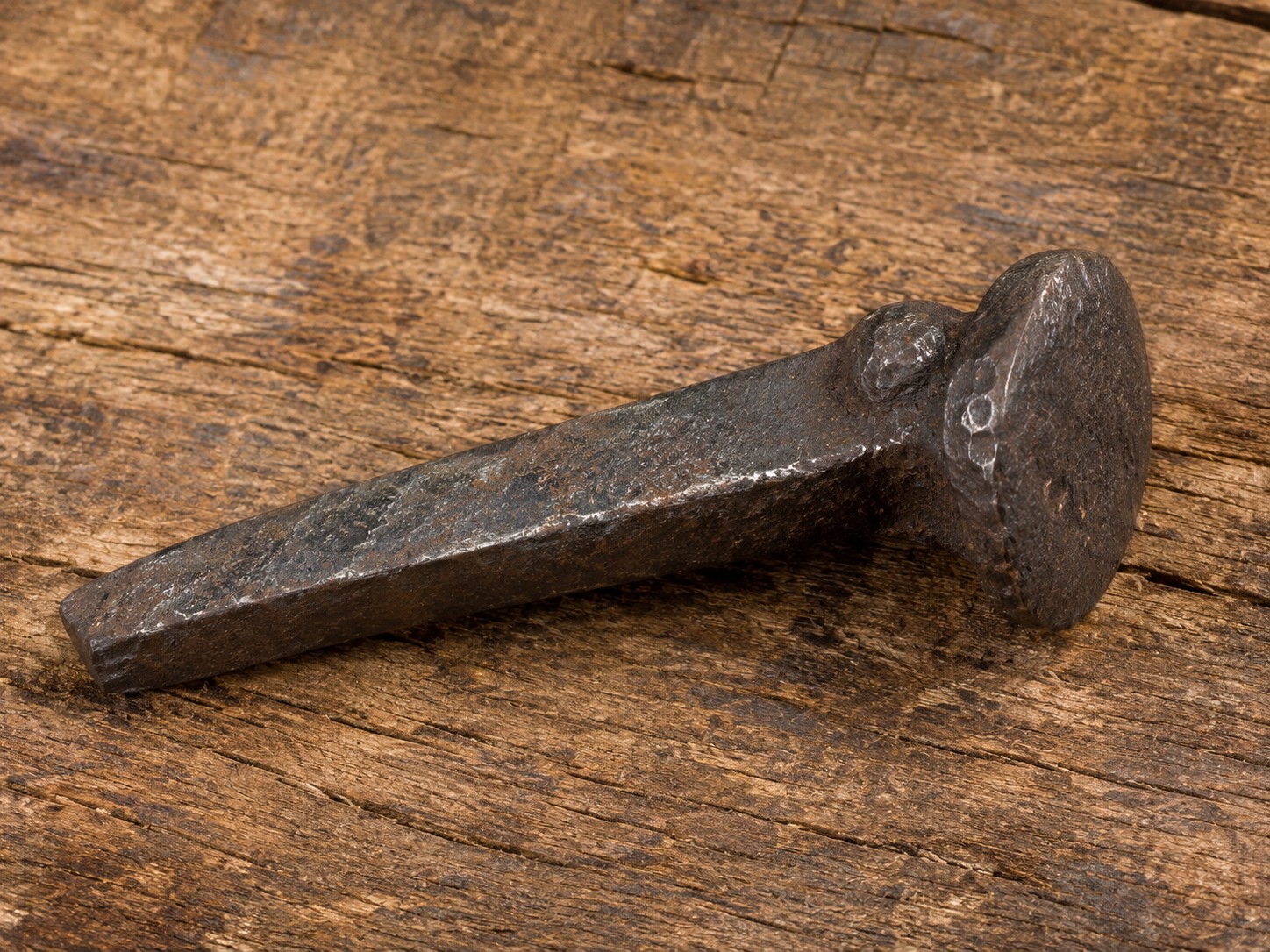
Well, that was fine and dandy, but I still didn’t know what a dead doornail was. I had to dig more. And more, I found. Did you know that in ye olden days doornails were hand-forged, heavy-duty nails, driven through wood and then clenched—the protruding end hammered flat—making them impossible to remove or reuse. Permanently fixed, permanently purposeless, they were, in every practical sense, dead.
And right after unearthing the meaning of dead doornail, I hit paydirt. I came across an entire navigation of other things I could strut around saying. If a doornail can be dead, apparently so can a lot of other things I’d never thought about:
Dead as a stone
Dead as clay
Dead as a herring
Dead as a hammer
English, it seems, has never lacked for dead things.
And then, there’s my favorite one of all. It’s music to my untrained ear:
Dead as the diplodocus
It’s hard to laugh when you’ve got one hand stuck fast to a dead doornail and the other hand being pulled even further back in time by a giant herbivorous sauropod.
I had to laugh. One dead doornail had opened the door to dozens of expressions I use every day without ever stopping to examine what they really ask of me.
The first expression that popped into my head? “Let me know if I can do anything.”I’ve said it more times than I can count.
But what exactly are we saying? At first glance, the meaning seems obvious. Yet the more I think about it, the more I realize that the phrase carries a greater obligation than we usually acknowledge.
After all, those aren’t words of sympathy. They’re words of commitment.
The moment I tell someone to let me know if I can do anything, I’ve volunteered to do something. Maybe it’s as simple as a phone call. Maybe it’s a card. Maybe it’s a casserole. Maybe it’s sitting quietly beside a friend who has just buried a spouse and doesn’t particularly want to talk.
The point is that I’ve offered. Whether the request is large or small, I’ve just volunteered a piece of myself. My words have placed me on the hook.
How often we say those words because they sound appropriate without stopping to consider what we’ve actually promised, without fully examining the obligation hidden inside the offer?
The words are easy enough to say. The casserole takes a little more effort.
Next up was the expression, “I’m so sorry.”
At first glance, it seems simple enough. We say it when someone loses a spouse, receives a frightening diagnosis, buries a parent, or watches a cherished dream collapse.
But what exactly are we saying?
Most of the time, we aren’t apologizing. We didn’t cause the death, the disease, or the disappointment.
Yet the expression carries an obligation all the same.
When I tell someone I’m sorry, I’m not merely acknowledging a fact. I’m entering, however briefly, into another person’s sorrow. I’m saying that your loss matters enough for me to stop, notice, and share a small measure of the burden.
In other words, I’m not simply expressing sympathy.
I’m promising compassion.
That’s a weightier promise than I suspect many of us realize when the words tumble so easily from our lips.
Then came two expressions that sit at opposite ends of the emotional spectrum.
“I hate you.”
Three words.
“I love you.”
Three words.
Yet each carries enough power to alter the course of a relationship, a family, perhaps even a life.
We often treat them as expressions of feeling. But they are more than that. They are declarations. Commitments. Judgments.
To tell someone “I hate you” is not merely to report an emotion. It is to wound, to distance, to diminish, to push another person away.
To tell someone “I love you” is not merely to report an emotion either. It is to assume an obligation—to care, to sacrifice, to forgive, to remain present when remaining present is difficult.
Perhaps that is why both expressions deserve more examination than they usually receive.
They are among the easiest words in the English language to say. And among the hardest to live.
Finally, I came to a phrase that millions of people have spoken for centuries:
“Forgive us our trespasses, as we forgive those who trespass against us.”
I’ve heard it all my life. I’ve spoken it hundreds, perhaps thousands, of times.
But have I examined it? Have I truly considered what I’m asking?
The first part is easy enough. Most of us welcome forgiveness for our failures, shortcomings, and mistakes.
It’s the second part that gives me pause. As we forgive. Not as we intend to forgive. Not as we hope to forgive. Not as we might someday forgive.
As we forgive.
Those words transform a prayer into a promise, a request into an obligation.
And they leave me wondering how many other expressions I use with confidence, familiarity, and conviction without fully considering what they mean—or what they ask of me.
As I reflected on all of these expressions—seemingly light yet laden with responsibility and commitment—I came to a simple conclusion. Going forward, I intend to pay a little more attention to my Ps and Qs.
Not because I suddenly care more about manners. But because I have been reminded that words matter.
They always have.
Whether I am offering help, expressing sorrow, seeking forgiveness, declaring love, or reciting a prayer, I owe those words more than familiarity. I owe them thought.
After all, the unexamined life is not worth living.
Perhaps the same can be said of the unexamined word.
Several years ago, I wrote this reflection on my father. Father’s Day seems an appropriate time to share it once again.
Not long ago, I went searching for a relic that I thought I had stored in the loft. I looked and looked, but I never found whatever it was that sent me on my quest. Instead, I may have found more.
As I rummaged through heaps of possessions—some treasured; some not—I found an elegantly framed photograph that Sister gave me decades ago. (In true Southern fashion—at least in my family—you never call the oldest daughter or the oldest son by their first names. Audrey has always been Sister; John, always Brother.) Sister gave all five siblings copies of the same photograph. Hers is lighted and hangs proudly and prominently on the wall that you see when you walk into her dining room. It’s a photograph of an old man—a very old man, head bowed, forehead leaning on clasped hands, and elbows resting on the dining room table. On the table, a loaf of bread, a bowl with spoon, a knife, and a cross-laden tome. At first glance, the photograph appears to be a copy of “Grace”—Eric Enstrom’s famous 1918 photograph of a Minnesota miner. You may have seen it in a home, a church, or a restaurant. I’ve seen it everywhere.
The photograph on Sister’s dining room wall is identical to Enstrom’s in every detail save two. First, the old man in her photograph has no beard. Second, the old man in her photograph is not the Minnesota miner. He’s a West Virginia coal miner. He’s my father.
I’m rapt by the photograph, and I wonder now—just as I did when Sister gave me my copy—how she ever convinced my father to pose for it. My father knew neither artifice nor airs. More, though, I ponder an overarching question, “Why did Sister have my father sit for such a photograph?”
I had never seen my father’s hands clasped in prayer as they are clasped in Sister’s photograph. My mother was the one who always said grace at our table, with all of us joining hands. It was not until late in life—perhaps just a few years before Sister’s photograph—that my father became a Christian. Certainly he would not have prayed at mealtime before then. By the time he became a Christian, I no longer lived at home. Sister, though, lived next door. Perhaps Sister had seen my father say grace.
I can’t say what Sister saw, but, as for me, I remember my father’s hands differently.
I remember my father’s hands as strong hands. When but a child—no more than four or five, so small that I had to stand on a kitchen chair to watch as he butchered a fresh chicken—I reached out to ask, “What’s that?” just as his cleaver—raised high in air—came thrusting down to sever the chicken breast. The cleaver could not stop. With equal speed, my father’s hand grasped my nearly severed right hand and held it in place until the doctor arrived. Today, the scar that spans my hand authenticates the strength of his: holding on, not letting go.
I remember my father’s hands as a coal miner’s hands—fiercely strong, calloused, rough, knuckle battered, and sooty from coal that could not be scrubbed away. Those hands shoveled coal for fifty years, never missing a day, never suffering injury. Those hands provided.
I remember my father’s hands as a gardener’s hands—perfectly patient, tenacious, self-confident, and unswerving as he pushed the plow, laying rows as straight as the crow flies. “Don’t look down,” he prompted, when the time came for him to teach me how to plow a row. “Stay focused on one thing at the end.” Those hands gardened longer than they mined, never missing a season, never losing a harvest. Those hands fed.
I remember my father’s hands as a carpenter’s hands—steady, certain, and capable as he remodeled our home and helped others remodel theirs, working with wood and wallboard, concrete and plaster. Those hands were untrained hands. “Just a jackleg carpenter,” he’d say of himself. Those hands built.
I remember my father’s hands as a thinker’s hands. His walking carriage, always—whether in coal miner’s “bank clothes” or in white starched shirt and khakis (always his at-home attire)—was with hands behind back, palms out, right resting in left.
Later in life—with our roles reversed: I, the caregiver; my father the one for whom I cared—I saw his hands as gentle hands. As age and illness weakened his body, softened his heart, and calmed his soul, I often held his hands in mine. One day, and I remember it vividly, I had a great curiosity—a compelling curiosity—to compare our hands, his and mine. I asked him to hold his hands out in front of him, and, as he did, I outstretched my hands to his, touching. Our hands were perfect matches—identical—his hands and mine.
And when my father lay in bed dying, I held his hands in mine until we both knew peace as death came with certainty and with finality.
The next day my mother and I made funeral arrangements. We both wanted understated elegance. The brushed, platinum-finished casket with a solid white silk lining—without tufting or design—seemed perfect.
When the evening of my father’s wake arrived, I walked with my mother toward the open casket where my father lay. Even from the far end of the chapel, we could see something on the lining of the raised casket lid—a design.
Drawing closer, we were both taken aback as we looked inside the casket lid. It was not what we had ordered. It was not a solid white silk lining without tufting or design.
Instead we witnessed—together—a pair of praying hands. To the right of the hands, the words, “May God hold you in the palm of His hand until we meet again.”
It was not what my mother and I had planned. It was not what we had ordered. And, yet, the praying hands were there, holding for me—and I believe for me alone—a lasting message.
My Father’s hands.
My father’s hands.
My hands.
Now, as I look back, I see Sister differently. Now, as I look back, I see her photograph of my father differently. Being older than I, Sister knew my father longer—and better. Living closer to my father than I, she had spent more time with him. Being more blessed than I, Sister had more than enough grace to glimpse my father’s hands in ways that I would not see until the end.
The rake lay across the heart, as if it were Cupid’s arrow. Beads of water gathered on the thermos, upright on the nearby stone bench, right beside St. Francis of Assisi. Leather gloves and pruning shears bore witness to a gardener. Gary.
I couldn’t see him, but I knew he couldn’t be far away because his seafoam, floppy hat was not on the bench with his other things.
I knew what he was up to.
The time had come for him to do what I had done down through the years since I built the garden, filling it in with tons of tan pea gravel and surrounding it with a hedge of Little Missy boxwood.
Early on, the labor of weeding was easy. The pea gravel kept unwanted growth under control and beneath the surface. But over time the AngelinaSedum, filling the two circles in the heart’s upper lobes and surrounding the Magnolia in the lower cusp’s circle, died out but not before leaping over the rings that held them. Small chartreuse-yellow clusters softened the heart but lessened its definition.
Gary, my partner—the man who now shares this mountain life me—was doing more than weeding. He had already restored the flagstone pathway leading from heart to home and back again. Now he was planting healing Ajuga that will settle in and stay within the upper rings, eventually sending up purple spikes. Now he was cleaning, making everything as pristine as the day I finished my handiwork. I sat down on the bench, surveyed the slope, and sighed,
“Well done.”
I never had any intention of building the heart garden. My late partner Allen and I had tamed our mountaintop wilderness with so many paradisiacal garden beds that we had declared a moratorium:
“No more.”
But when Allen died and I reflected on where I would scatter his ashes, as mutually agreed upon, I could not for the life of me decide upon the right spot.
We had talked about resting places on our mountaintop, usually settling on the peony garden. Once, even, Allen suggested the Koi Pond would be perfect, but amid laughter, we both exclaimed:
“Oh, no! What happens when the pond filters get cleaned.”
Then, a few months after his death, he came to me in a dream, his voice carrying into my awakening and lingering there:
“Build my heart.”
I knew where. Near the house, at road’s edge—an untamed area we thought about gardening if we ever gave our moratorium a reprieve.
I had no idea how, but I figured a little math and lots of heart would make it happen.
And it did. I marked off an area twenty feet wide and thirty feet deep, sketched a heart with a black water hose, freed the earth of weeds, and blanketed it with pea gravel running deep. For Allen’s celebration of life, I surrounded the heart with SunPatiens, alternating red and white with tears and rain. I bought a wooden Zen rake, perfect for committing Allen’s ashes to the gravel, leaving tracings that mirrored the heart’s design, growing smaller and smaller as the center neared. Later, I planted the boxwood hedge.
Thus, the heart’s beginning.
Time has been kind. But still, the heart needs Gary’s loving care and tenderness. It rests within the landscape, its presence a part of forever.
The morning after Gary finished, we decided to amble down the path, pristinely cleaned and gently curved, with the heart in clear view.
“You go ahead. I’ll be there shortly.”
“No. I’ll wait. For you.”
It was peaceful and inviting.
We talked a little less than usual, as the morning chill quickened us and a Northern Cardinal in the treetops above whistled out its own litany of little questions.
“I want your ashes to be happy here.”
They will.
And when Gary’s time comes, I’ll board the train, his weight on my lap, my hands on the box, making his final journey to Minnesota where his story began.
On this Mother’s Day weekend, I’m thinking not only of mothers, but of everyone who has nurtured, steadied, comforted, protected, and loved—often quietly, often without recognition.
For those celebrating mothers, missing mothers, remembering mothers, or mothering others in their own ways, I wanted to share this post again.
“Mothers hold their children’s hands for a short while, but their hearts forever.” –Unknown
On top of my bedroom chest of drawers is a pair of studio portraits of my father and my mother. They’re hand-colored originals, each measuring 3 inches by 4 inches, taken a year or so after my parents’ 1932 marriage. The portraits are in hinged gold frames. My father is on the left. My mother is on the right. A lamp behind illuminates both.
Right now, as I lie in bed, I’m focusing on my mother. Even though her portrait is five feet or so away, she is as clear to my sight as if she were right beside my bed. I’m glimpsing into a distant past, where memories of her linger like whispers.
She’s seated on a bench, wooden, perhaps. The artistic backdrop transports me outdoors. Trees frame the scene, a tall one behind her, their branches reaching skyward, and shorter ones in the background, on the bank of a calm body of water, perhaps a serene river.
She’s wearing a dark dress with short sleeves and a deep-cut neckline, accentuated by a glistening leaf-shaped brooch.
Her finger-waved hair, parted in the middle, falls softly just below her ears. Her eyes are dark and intense, with a gaze that seems to pierce through the image. They are surrounded by her soft, light skin tone, which provides a striking contrast. Their depth and intensity draw me in and make me wonder. What secrets lie hidden behind them? What stories and dreams do they hold? Are they looking into the depths of the world, seeking answers and understanding? Are they inviting me to join in their quest for knowledge?
Her features captivate and mesmerize me, regardless of how often I look at her portrait. Somehow, though, I seem to see my mother’s hands the most. Their contours are soft and graceful, and the fingers curve delicately, one hand gently clasping the other hand.
I see my mother’s hands the most because I know her hands the best.
My mother’s hands are engaginghands. Her hands held mine when I was but a child, and we scurried down the path behind our home where two boulders stood sentinel on either side as colored snow fell down in green and pink and blue flakes, making me believe in magic. Her hands held mine when I was a few years older, and she led me outdoors when our world was covered in snow and showed me how to lie down in stillness, moving arms and legs left and right to create angel wings, making me believe in flight. Her hands held mine a few years later when our world was green with summer and led me to lie down in warm grass, eyes skyward, discovering cloud figures, pointing out the details to one another so vividly that each could see brand new worlds of our own imaginings, making me believe in sharing visions so that others might see.
My mother’s hands are cooking hands. Her hands could transform pinto beans, onions, cornbread, buttermilk, and sweet potato cobbler into a feast, making me want it weekly. Her hands could turn a 25-pound turkey into a bronzed Thanksgiving dinner that rivaled Norman Rockwell’s iconic oil painting FreedomfromWant, making art come alive in our own coal camp kitchen. Her hands could measure out with perfection all the ingredients for any dish from any cuisine that she had tasted with no need for recipe and with no need for measurements, teaching me to trust my senses.
My mother’s hands are versatile hands. Her hands could make our clothing without pattern, simply by taking our measure with her hands, making me aware that some things are more felt than seen. Her hands could cut my hair using scissors, comb, and the soft stretch of her fingers, reinforcing in my mind the marriage of expertise and craftsmanship. Her hands could take a pastry brush and turn a greased baking sheet or cake pan into a perfect likeness of Christ, making me see Holiness in the everyday.
My mother’s hands are industrious hands. Her hands could transform a grassy field into a kaleidoscope of gladiolas or dahlias, bursting with vibrant hues, teaching me to see potential in the ordinary. Her hands could hold her side of a wooden pole stretched through handles of a galvanized tub, carrying water to the garden, making me realize that many hands can carry heavy loads. Her hands could hang wallpaper with finesse, demonstrating how effort can elevate even the smallest task to art.
My mother’s hands are inclusive hands. Her hands always opened wide the door, welcoming everyone as guests into our home, making me value open-heartedness and acceptance of others, regardless of differences. Her hands always set a place for them at our modest table, making me understand that meager becomes abundance when shared with others. Her hands always held theirs in loving celebration and thanksgiving, making me a witness to the genuine communion of mankind.
My mother’s hands are nurturing hands. Her hands cared for her father and her mother in times when they could not take care of themselves, impressing on me the importance of helping others. Her hands cared for my dad and me and all my siblings, even when our hands might well have lessened the weight that she carried in hers, showing me that strength comes with sacrifice. Her hands took pine rosin to hold tight and heal the gash in my foot, the scar on my sole still a reminder of what she had learned from her mother’s hands, helping me appreciate generational know-how and wisdom.
My mother’s hands are writing hands. Her hands penned sermons when she pastored a church, making me realize that the intellect can lead the heart to be slain by the Holy Spirit. Her hands sent letters out into the world to those she knew well and to those she hardly knew at all, making me see that the power of words reaches beyond the pulpit. Her hands discovered typewriter keys late in life, determined that hand tremors would not tame her self-expression, making me realize the strength of determination.
My mother’s hands are spiritual hands. Her hands joined the hands of other warriors, praying over me as a child with polio, making me–one of the lucky, uncrippled survivors–a believer in the power of prayer. Her hands walked their way through her Bible and her commentary books–from cover to cover–more than thirty times in her lifetime, making me know the richness to be gained through close readings and research. Her hands clapped, sending thunderous applause into the Heavens to show her thankfulness and gratitude, making me know the joy of praise.
My mother’s hands are clasped hands. As she lay in her casket after her funeral, I removed her rings, took her hands and clasped one gently on top of the other, leaned in for a farewell kiss, and, then, closed the lid.
After her burial, my hands–strong from the strength of hers–released from their cage three white doves, flying upward toward the celestial realm, perhaps at that same mysterious moment when my mother found her way back home and celebrated her arrival with outstretched hands.
§ § §
Bertha Pearl Witt Kendrick (May 16, 1912–May 30, 2010)
“It is only with the heart that one can see rightly; what is essential is invisible to the eye.”
— Antoine de Saint-Exupéry (1900–1944). French writer and aviator, best known for The Little Prince, a timeless meditation on seeing, love, and what truly matters.
Two travelers, journeying to the Northern Neck of Virginia, midway between our home in the Shenandoah Valley and our destination, Kilmarnock.
Two travelers with two mid-day choices.
“Horne’s,” Gary read out loud from his phone. “It’s an old-time eatery serving American fare since 1961. It’s a mile or so away.”
He continued with their lunch menu.
“Hmmm. Any other restaurants?”
“Randolph’s on the River.”
About the time he started with their menu, we were approaching Horne’s. Three cars in the parking lot at noon raised some red flags, and the building raised more. It had been something once upon a time, looking back now with one nostalgic backward glance too many.
“Let’s go on to Randolph’s.”
We were there in several minutes. Right on the river with a beautiful view of the bridge.
We drove into the parking lot. One car.
“Maybe they’re closed?”
We both discovered the open door at the same time, looked questionably at one another, entered, and sat by the window on the water’s edge.
We waited and waited and …
“I’ll walk over and get a menu.”
As he did, Gary craned his head toward the open kitchen door.
“It looks really unorganized in there.”
“Maybe we should go back to Horne’s.”
But just as I was on my way to the door, the solo bar customer assured Gary the food was good, as he yelled,
“Hey, Mama. Ya got a customer.”
We returned to our booth.
“Oh, so sorry. I’m the only one here. Nobody else show up yet. Cook. Waitress. Cashier. That’s me. Whatcha want to drink?”
“Water.”
“Same for me.”
In a second, the wizened, chisel-faced Black waitress was back, her hair pulled up tight on top of her head, pulling her taller than her thin frame stood, and 32-ounce plastic glasses of iced water landed gracefully before us.
“What will ya have?”
“Are your oysters local?”
“Oh, yessss. And they big ones.”
“I’ll have the oyster po-boy. You like it?”
“Oh. No. I don’t do oysters, but we sure sell a lot. And it’s on a really big bun.”
“I’ll have one.”
Gary ordered a tuna melt, with French fries and coleslaw.
“What about you?”
“Hmmm. Coleslaw and collards.”
She beamed. “I makes ’em. They so good.”
She spirited around to head back to the kitchen, turning for a sec,
“If ya’ll need anything, just yell out ‘Auntie.'”
We were amused, and maybe smitten by the rawness of her charm, even when she appeared again, grinning.
“Fish truck ain’t got here yet, so we don’t have no tuna. How about a Rock Fish sandwich? Mighty good.”
“Okay.”
“Broiled or fried?”
“Broiled.”
She sprinted away again, as we continued chuckling about our lunch choice and wondering what the food could possibly taste like in a restaurant staffed by a three-in-one.
But nearly as fast as Auntie had sprinted away, she appeared again balancing two plates of food as wide as her beam.
“Ya’ll enjoy.”
“Gary, look at the size of this po-boy! How will I ever eat it all?”
“Well, try one of these fries. I’ve never had fries this good.”
“OMG. They’re awesome. How did she do that?”
By then, I had started to savor the collards.
“Never in my life have I had collards this good. They’re velvety magnificent.”
Just as Gary could not be enticed to savor the collards, neither could I lure him to try my po-boy that I had just dubbed the world’s best ever.
We sat there, enjoying a lunch that we never expected to enjoy, each of us beaming more that Auntie’s beam that competed with the sun glistening on the river.
“What marvelous food!” I quipped. “How did she pull this off?”
She was back soon to see how we were doing.
“How’d you learn to cook collards like that?”
“My grandmother. Just wash ’em up and down several times. Add some onion.”
“Fat back?”
“No. Just bacon. Cook ’em long and slow.”
“They’re the best I’ve ever had.”
She leaned in and whispered as she headed back to the kitchen.
“Gonna bring you a big bowl to take with you.”
We kept eating. Kept enjoying our culinary surprise. Kept nodding in agreement when Gary pronounced:
“Just proves you can’t judge a book by its cover.”
Not judging a book by its cover is a saying we all know. It reminds us not to measure worth by appearances alone. The phrase has been around since 1867 when the Piqua Democrat put it this way:
“Don’t judge a book by its cover; see a man by his cloth, as there is often a good deal of solid worth and superior skill underneath a jacket and yaller pants.”
The idiom’s insight holds.
Once you notice it—really notice it—you start seeing its truth everywhere.
A green thing pushing up through a crack in the sidewalk. Something so small it could be missed entirely if you’re walking fast or looking at your phone. It shouldn’t be there. Concrete says no. Yet there it is, insisting. Alive. You slow down, surprised by how much you want it to win.
A dog at the shelter. The one not pressed eagerly against the gate. The older one. The one whose eyes seem to say, “I’ve already tried being hopeful.” There’s nothing wrong, exactly—just nothing flashy. You move on, almost without thinking, until something tugs. A look. A stillness. Suddenly you’re wondering what kind of life left that quiet patience behind.
A fixer-upper. The peeling paint, the sagging porch, the smell that lingers longer than you’d like. Everyone sees the work. The cost. The trouble. But every now and then you catch a glimpse of something else—a line of light across a floor, a room that wants to breathe again—and you realize the house isn’t finished telling its story.
Then there are people.
People whose jackets are worn. Whose stories arrive with footnotes. People who don’t sparkle on first glance, who hesitate, who carry loss or age or disappointment a little too visibly. People who have been misunderstood long enough that they’ve learned not to rush forward anymore.
People like us. Like you. Like me.
We all know how quickly judgment comes. A glance. A pause. A decision made before the second sentence. We decide what’s worth our time, our care, our patience—and what isn’t.
Sometimes, though, we sit down anyway.
By a river. In a nearly empty restaurant. With a three-in-one waitress who says, “Y’all enjoy” and means it.
If we’re lucky—if we slow down just enough—we leave carrying more than we expected. A full stomach. A warm heart. And the uneasy, beautiful knowledge that the best things in life often arrive wearing the wrong cover.
“It is good to have an end to journey toward; but it is the journey that matters, in the end.” —Ursula K. Le Guin (1929–2018). American novelist and essayist whose work consistently emphasizes process, patience, and the moral meaning of how lives are lived.
Hopefully, talking about December holidays isn’t limited to December alone, because here it is January—and I’m still talking.
“You and Gary must have had MAHvelous celebrations,” someone, somewhere out there, exclaimed.
Actually, we did. We started early, weaving joy into as long a string as possible. And get this—it’s the week after Epiphany, and we’re not finished.
For real. The trees are still up, their lights burning every evening. Lighted garlands trace the banister and the fireplace mantels in both the living room and the kitchen. Outdoors, lighted deer still prance on the deck, a Snoopy tree shimmers in the lower yard, and shrubs outside the kitchen bid a bright welcome.
Is that wonderful or what? Here we are, still enjoying our holiday decorations—largely Gary’s labor of love—which he began the day after Thanksgiving and created day by day thereafter, with no real rush to get anything or everything done.
Don’t worry. Soon enough we’ll box everything up and unplug the trees. We’ll pack it all away. But we won’t be finished. I’ll still be talking about something simple I learned this holiday.
Come to think of it, that’s exactly what I’m doing right now. I want to tell you why this might have been my best Christmas celebration ever.
I think I know.
Christmases past always felt like a frenzied process leading up to a single day. December 25 arrived. Poof. Done. Over.
Time and time again, I found myself humming “Is That All There Is” made famous by Peggy Lee.
The song opens with a childhood fire—flames consuming a house, a father carrying his daughter to safety, the world burning down while she stands shivering in her pajamas. And when it’s all over, the child asks herself:
“Is that all there is to a fire?“
Later comes the circus—spectacle, color, astonishment—followed by a curious sense of absence. Something missing, though nothing is obviously wrong.
“Is that all there is to a circus?“
Then love. Long walks. Gazing into one another’s eyes. And then loss. The beloved leaves. The heart breaks. But still, life goes on.
Even death, waiting at the end, offers no final revelation—only the same unanswered question.
Again and again, the song circles moments that promise transcendence but refuse to deliver a final explanation.
It’s as if the great events of a life—fire, wonder, love, even death—never quite measure up to the meaning we expect them to deliver.
This year, for the first time I can remember, I didn’t find myself humming that song.
I didn’t hear myself asking that question at all.
This year, I didn’t build toward a payoff.
This year, I didn’t measure the season by a single day.
This year, I realized that Christmas lives in the spirit we practice all year long, not in the triumph of a single day.
This year, I learned to take my cue from a slower rhythm—one built day by day, without hurry.
This year, I found pleasure in the making, not the finishing.
This year, the question never came.
Much of that rhythm was Gary’s, and I was wise enough to follow it and learn from it.
It applies to education— not just the diploma, but the nights spent puzzling, reading, failing, beginning again.
It applies to work— not just the promotion or the retirement toast, but the showing up, the learning, the imperfect days that add up to a life.
It applies to friendships— not just the anniversaries and milestones, but the long conversations, the forgiveness, the staying.
It applies to love— not just the moment we fall, but the daily choosing, the adjusting, the patience, the tenderness that deepens over time.
It applies to vacations— not just the photograph-worthy view, but the planning, the anticipation, the getting lost, the laughing along the way.
It applies to accomplishments— books written one page at a time, great rides pedaled one indoor revolution at a time, gardens grown one season at a time.
It applies, I think, to almost everything that matters.
What I was given this Christmas was not a better ending, but a better way of moving through things. A way that lets the journey matter. A way that frees us from asking too much of a single moment, and invites us to live more fully in all the moments that lead up to it.
And so the lights will come down. The boxes will go back into their places. January will move on, as it always does.
But I’ll carry this with me: meaning doesn’t arrive—it accumulates. With that gift, I found a better way to live inside my days.
You took me by surprise again this morning. As always, when I awakened, I checked my Fitbit to see how my heart did overnight. Then I checked WordPress to see how my readers were doing.
And there you were. Another thousand views. A quiet jolt to the chart. Numbers climbing when I wasn’t looking.
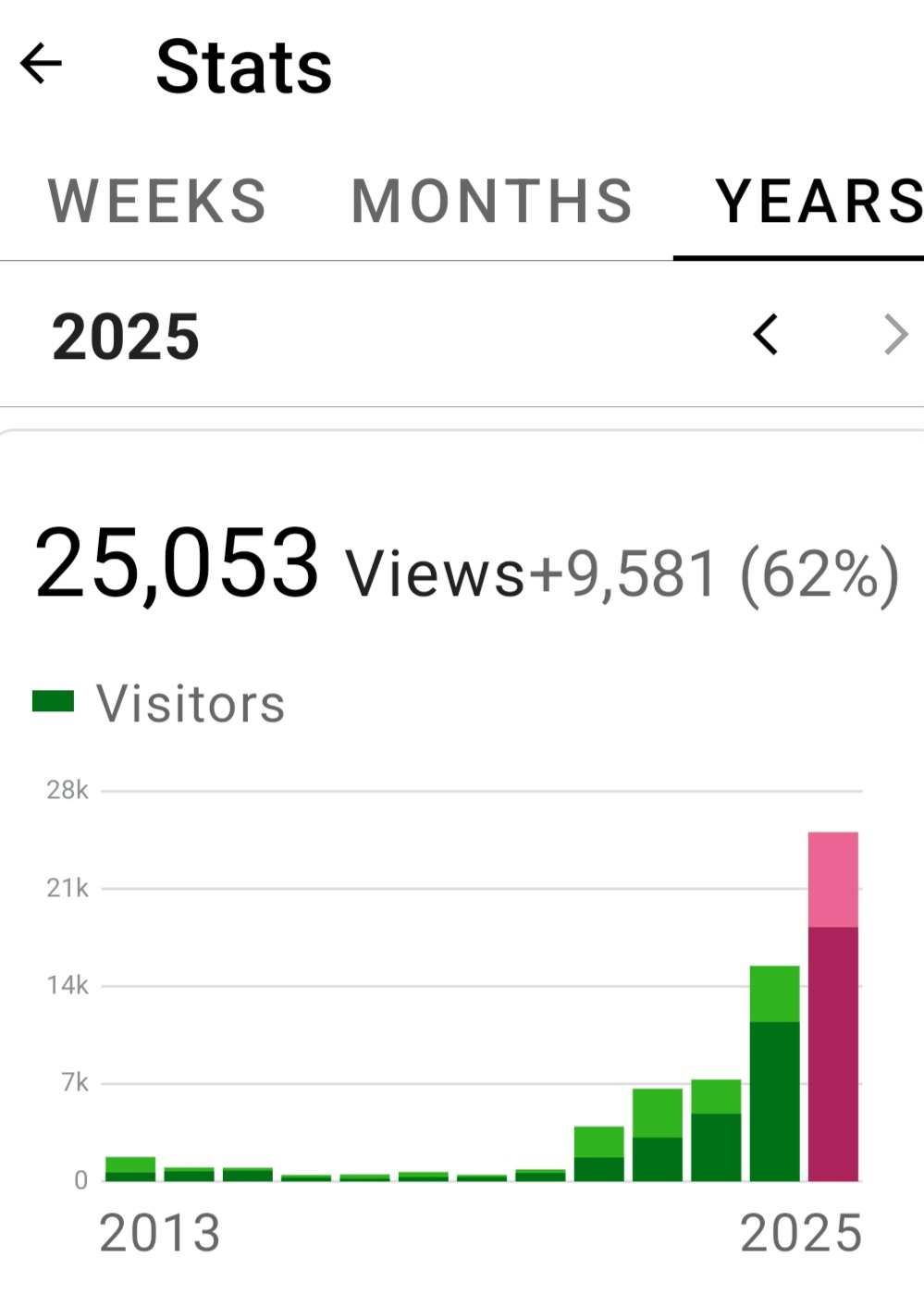
You’ve been dancing higher and higher since October, when I passed 15,000 and figured I’d reached my high-water mark. I even wrote a piece of thanks back then, thinking I’d said all there was to say. But now here we are—December 11th—and this little corner of the internet has gathered 25,053 views.
I’ve done nothing different. I have no flashy headlines. I have no trending hashtags. I just keep following the same rhythm: writing essays born from memory in a home filled with love. I just keep foolin’ around with words and ideas.
So why now, after all these years?
That question hangs gently in the room with me. It’s not demanding an answer. It’s simply inviting a reflection. Maybe something shifted in the writing. Maybe it’s more expansive. Maybe it’s more lived-in. Maybe it’s a voice carrying a steadier warmth now. Maybe it’s grief that’s softened into grace. Maybe it’s love that arrived not with fanfare, but with a quiet hand stretched out in invitation. Maybe it’s all of those things. Maybe. And add to all those maybes one more. Maybe it’s readers sharing with readers.
Gary, of course, doesn’t ask to be written about. But his presence is here, between the lines, in the patience of a paragraph, the steadiness of tone, the way I’ve learned to let silence do some of the talking.
Ruby, on the other hand, insists on being written about, whether she’s nosing me away from my smartphone or curling up in solidarity as I revise for the twenty-fifth time. She is, as always, the keeper of the tempo, the mistress of the move.
So this isn’t an open letter to public stats. It’s a letter to something deeper. It’s a letter to what it means to keep writing when no one’s watching, and then to wake up and find that someone was.
My essays aren’t meant to dazzle. And I know: they don’t. They’re just small acts of holding up the light, one weekly reflection at a time. The fact that they’re being read, now more than ever, tells me something I didn’t expect: quiet honesty still finds its way.
Thank you, Sudden Surge, for reminding me that patience has its own reward, that consistency is a kind of faith, and that somewhere out there, readers are still pausing to linger with a slow essay from the mountain.
I don’t know what this upturn means, or where it leads. But I do know I’ll keep showing up with my smartphone in hand and love at my side.
Benjamin Franklin had Poor Richard. TheWiredResearcher now welcomes a guest contributor: Poor Brentford Lee, who has agreed to sanctify our troubled times with a bold mix of satire and sass.
Approved by ole Ben Franklin. Improved by Poor Brentford Lee
“Forgiveness is divine—but FramilySaid™ is faster and comes in gummable gummies.”
-— Poor Brentford Lee (b. 1947). Unlicensed. Unfiltered. Unapologetically adopted. Known for saying the quiet part loud, he’s back by popular demand (and at least one cease-and-desist letter). Seasoned expert in nothing but experience. Sourdough connoisseur. Self-declared inventor of emotional supplements. Hangs out somewhere between a heavenly blessing and A HOMEMADE biscuit (preferably sourdough).
Years and years ago, in one of my brilliant moments—you know, the kind that arrive somewhere between misplacing your glasses and finding your purpose—I concocted a miracle elixir. An emotional balm. A psychological salve. A chewable sacrament.
And I’m convinced—when it’s finally patented, mass-produced, and widely distributed—it will relieve the world of all its wounds and arrows of outrageous fortune.
Or, at the very least, it will help you forget them for a little while. And really, isn’t that what the world needs most right now? Not advice. Not enlightenment. Not deep therapy.
All you need is Forgetfulness.
Chances are good that if you’re reading this—and have not forgotten—you’re an Oldie-Goldie who still remembers when love was all you needed, and your hips didn’t pop when you bent over.
But friend, times have changed. Now what the world needs isn’t just love—it’s a little bit of blessed, blissful forgetfulness.
So in the spirit of rock legends and gospel truths, I offer you an updated version of the Beatles’ classic. Hum along. Or gum along. Or just pretend you know the tune and clap on the offbeat:
All You Need Is Forgetfulness (Redux) (with apologies to Lennon & McCartney—and gratitude, too)
There’s nothing they can say that can’t be un-heard No shame so deep it can’t be deterred No burn so old it can’t be un-spurred You can let it go
All you need is forgetfulness (Da-da-da-da-da) All you need is forgetfulness (Sing it like you mean it) All you need is forgetfulness, forgetfulness Forgetfulness is all you need
(Slide whistle optional. Biscuit in hand, sourdough preferred.)
Yep. That’s it. All you need is forgetfulness. Not the kind that sneaks up on you in your golden years, when you can’t remember who you bit when you meant to kiss or where you were going with your pants unzipped or where you’ve been with a bowl of popcorn when you went to get strawberries. No—I’m talking about on-demand forgetfulness. Reliable, immediate, with controlled-release options for holidays, family reunions, and any Sunday when your phone rings before you’ve had time to check your Fitbit to make sure you made it through the night.
That, My Dear Readers, is where FramilySaid™ comes in.
They mean well. They always do—those “bless your heart” people. But sometimes, what your framily says can lodge itself right in the soft tissue of your soul, like a splinter from the communion table.
That’s why I made FramilySaid™—not FDA-approved (yet), but clinically proven (by yours truly) to dull the sting of being emotionally ignored by people who should know better. In gummable form, naturally.
A Quick Word about the Name.
FramilySaid™ is exactly what it sounds like. It’s a mountain prof’s fusion of friends, family, and the things they’ve said—bless ’em.
Because sometimes, it’s the people closest to you (by blood—or, in my case, by adoption—history, or shared casserole) whose words linger just a little too long. Who don’t mean to hurt you but somehow do. Who support you privately … but not publicly. Who say “I love you” but never with the clincher: “justtheway you are.”
When they speak and zing you with their petty little barbs? FramilySaid™ can help you. Un-hear it. Un-feel it. Un-bother yourself entirely.
A New Kind of Relief.
I developed this product in a dimly lit, emotionally unstable lab located precisely between my kitchen and a moment of near-epiphany. FramilySaid™ is the first over-the-counter solution specifically designed to help you temporarily forget your people. Not all of them, bless ’em. Just the ones whose “support” lost all its elasticity because you’re doing all the emotional heavy lifting.
Get this. FramilySaid™ is so hip that it comes in gummy form. Flavors include Denial-Drop Cherry and Emotional Support Butterscotch. Easy to chew. Easy to swallow. No dentures? No problem. Just gum it and go.
I just heard a panicked soul (bless their heart) blurt out:
“How can I get me some?”
Well, bless your little heart. It’s so simple. Go online–or use your phone app–and in just a few clicks you’ll be consulting with a doctor named “Jeff” who is definitely certified but not necessarily licensed. Within days or maybe even as soon as yesterday—Poof! A discreet brown package arrives at your door—just like your sex toys arrive, but with more dignity—and fewer batteries.
Anyway, from that point forward, you’ve got protection from friends and family. Take FramilySaid™ when the text message lands wrong. Take it when the smile feels fake. Take it when someone who “loves you no matter what” leaves your partner off the guest list.
Take it. Just take it. Now, that wasn’t so bad, was it.
Now go ahead. Swallow your truth with a buttery sourdough biscuit, included free, one for every FramilySaid™ gummy included in your order. Remember: Cheaper by the Baker’s Dozen.
Now breathe. Breathe again. You’ve got this.
Situations When You Might Need a Gummy.
Situation #1. You call with good news—any kind of news, really—and they respond with:
“Oh, that’s… nice.”
You smile politely. Take a FramilySaid™ gummy. Let the world blur at the edges.
And what would Poor Brentford Lee do? Why, he’d just sigh and say:
“Law me, child…”
And then he’d smile sweetly, fold his napkin with precision, and add demurely:
“Well, bless your little pea-pickin’ heart. Would you pass the sourdough biscuits?”
Situation #2. You share something meaningful—a photo, a milestone, a moment—and get nothing but a thumbs-up emoji.
You chew slowly. Cinnamon apathy floods your tongue.
And what would Poor Brentford Lee do? He’d lean back, fan himself once, and say:
“Why, don’t you worry that pretty little head of yours nary one bit.”
Then, with that same cool smile, he’d add:
“Well, bless your little heart. Would you pass the sourdough biscuits? I need me ‘nuther one”
Situation #3. You confide in someone you thought might be a safe space. Instead, they tilt their head like a golden retriever hearing static and say:
“Well, as long as you’re happy.”
You double your dosage and erase five awkward conversations from memory.
And what would Poor Brentford Lee do? Why, he’d just sigh and say:
“Law me, child… we are officially rationing warmth now.”
And then he’d smile sweetly, fold his napkin precisely, and add demurely:
“Well, bless your little heart. Them sourdough biscuits sure are good. Can I have just one more? Not the whole basket. Thank you kindly.”
Situation #4. Someone finally asks:
“How did you two old geysers meet anyway?”
But get this. Their tone sounds more like a customs agent than a curious soul.
You suddenly feel like a suspect in your own joy. FramilySaid™ softens the interrogation.
And what would Poor Brentford Lee do? He’d lift one eyebrow, cross his silverware, and murmur:
“Law me, child. Love ain’t no interview.”
Then he’d smile–all teeth, all grace–and whisper at his loudest:
“Well, bless your little heart. I think I’ll have another sourdough biscuit—maybe two if you’re feeling generous.”
Situation #5. On one of your hardest days ever in your entire ancient life, you look up at the sky—not metaphorically, but really look—and ask:
“God? Really? After all I’ve done to live with grace, to love deeply, to forgive… and this is still where I land?”
That’s when you reach for the God-level dose. FramilySaid™ won’t answer the prayer. But it will quiet the ache long enough for you to refill your hope.
And what would Poor Brentford Lee do? He’d blink once, breathe deep, and say,
“Law me, child. Even Heaven can ghost you sometimes.”
Then with a reverent nod upward:
“Well, bless your eternal heart. Hand me a biscuit. The everlastin’ kind.”
™ … ™ … ™
Final Notes from the Founder.
Every time you take FramilySaid™, you’ll forget for a spell. You’ll feel better for a spell. Might smile, hum a tune, maybe even whistle while folding your fitted sheets.
But eventually—inevitably—you’ll sit real still. And your heart will tap you on the shoulder and say:
“This ache? It don’t need numbing. It needs naming.”
And you’ll remember:
“It wasn’t the forgetting that healed you. It was remembering the friendship and kinship you truly deserve.“
So go ahead. Declare what you need. Claim your joy. Refill your prescriptions for love, laughter, and a little holy audacity.
And if someone still doesn’t get it?
“Well, bless their little hearts. Just hand ’em one of those perpetual sourdough biscuits and smile like you mean it.”
Coming Soon from the Maker of FramilySaid™.
Because sometimes one generic gummy just isn’t enough, the Maker offers you some specific options:
● SisterStrength™ – For passive-aggression that’s been simmering since the day before forever.
● CousinClear™ – When you can’t remember which cousin sells snake-oils and which one married his ex’s sister brother’s husband.
● UncleMute™ – One dose silences three stories about the Civil Wah he and his kin are still fightin’.
● MatriarchMax™ – For that layered guilt, always served hot, always with a side of pie—and a smile.
● HolidayProlonged Release™ – Kicks in during grace and peaks after the second round of green bean casserole.
A Final, Final Word from the Maker—Yours and Mine—The Big One Who Always Gets the Last Word.
Forgetting isn’t what you need, child. Remembering what you’re worth? Dagnabbit. That’s exactly what you need. That’s the real prescription. (Signed, sealed, and delivered by Poor Brentford Lee, totally unlicensed but highly seasoned.)
While you’re remembering, just reach up and hand me a sourdough biscuit, swallow your pride, go ahead and make up with your low-down, no-good Framily. And then? Move it. Move it. Move it—as fast as a tumbleweed in a windstorm.
And don’t forget Poor Brentford Lee, sitting here, there, and everywhere–all smiles–saying to himself for no one else to hear:
“Law me. Won’t you lay one on me? No, no. Not a biscuit—though they are mighty fine. Just a blessing, child. That’s all I everneeded.”
Poor Brentford Says
“Your worth doesn’t need a witness. Show up for yourself. That’s the real feast.”