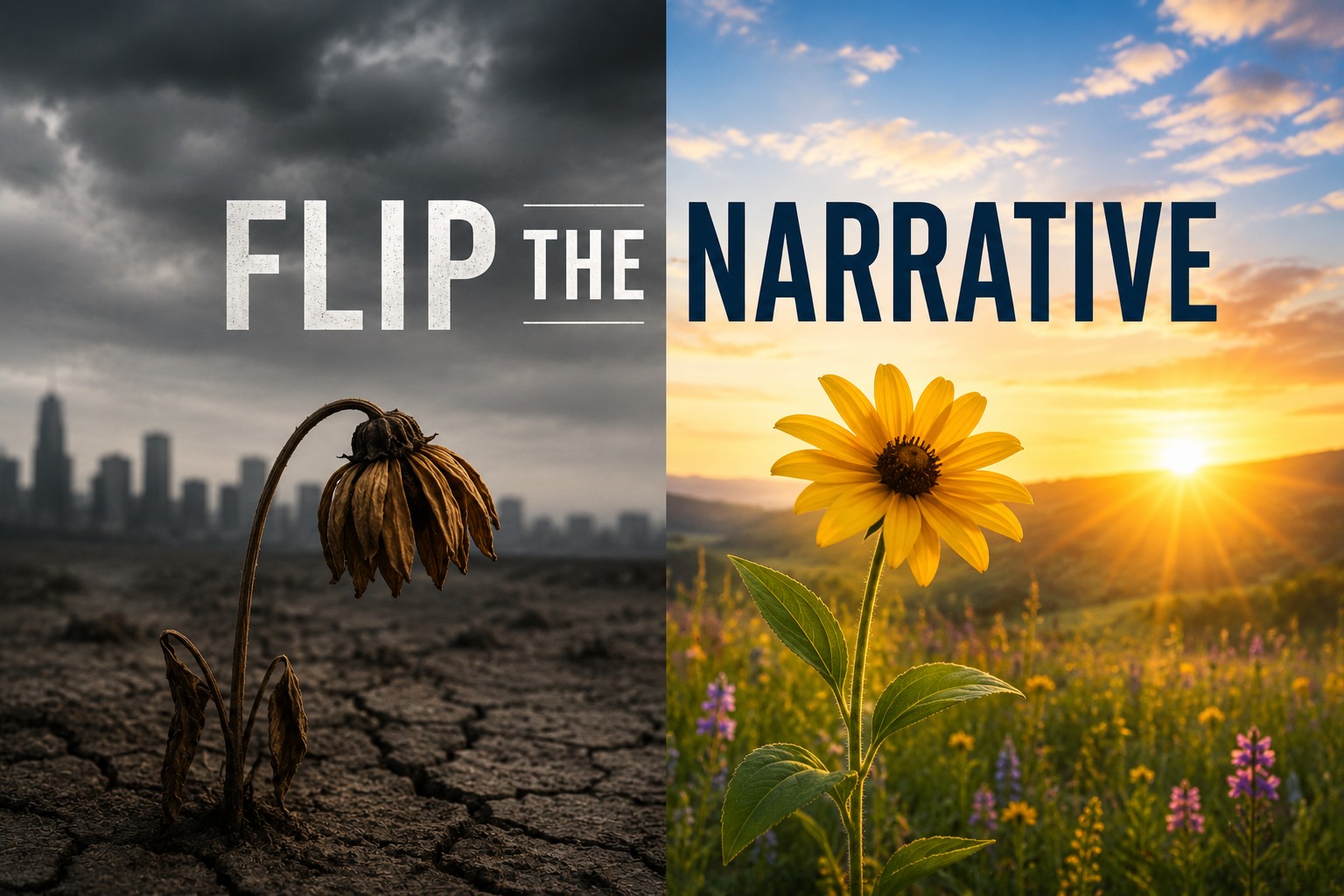
“The facts may remain the same. The narrative doesn’t have to.” —Brent L. Kendrick (b. 1947).
I’ve written it before and I’ll write it again.
Flip the narrative.
You read it right. But I want you to read it again.
Flip the narrative.
When the daily news overwhelms you, flip the narrative.
When technology frightens you, flip the narrative.
When society disappoints you, flip the narrative.
When family and friends let you down, flip the narrative.
When your body reminds you that you’re getting older, flip the narrative.
When life seems to be shrinking, flip the narrative.
When hope begins to flicker, flip the narrative.
And if you think you know what I’m going to say next, I’m making my point.
Flip the narrative.
Flip the narrative because the daily news is not the whole story. Headlines are paid to interrupt your breakfast, not to nourish your soul. They shine spotlights on what is broken, while millions of quiet acts of kindness slip by unnoticed every single day. If all you read is the news, you will eventually believe darkness has won. It hasn’t. Flip the narrative.
Flip the narrative because technology is neither angel nor devil. It is a tool, and tools have no conscience of their own. We lend them ours. Every generation has feared the next invention, certain it would be the one to finally replace the human heart. It never has. The hands change. The fear stays the same. Flip the narrative.
Flip the narrative because society is more than its loudest voices. Every day, strangers hold doors, volunteers serve meals, neighbors check on neighbors, teachers stay late, and someone somewhere chooses grace over anger. Those stories rarely make the evening news, but they make the world worth living in. Flip the narrative.
Flip the narrative because the people who love us are gloriously, frustratingly human. They disappoint us. We disappoint them. If we measure every relationship by its failures, we will eventually stand alone. Better to count forgiveness as often as we count offenses. Better to remember that imperfect love is still love. Flip the narrative.
Flip the narrative because every birthday steals something and gives something back. Your knees may protest. Your memory may hesitate. Your hair may surrender. But wisdom quietly takes a seat beside you. Perspective grows stronger. Small things become precious. You stop trying to impress everyone and start noticing what truly matters. Flip the narrative.
Flip the narrative because a life that seems to be shrinking is often becoming more focused. Doors close. Dreams change. The horizon may draw nearer. Yet, somehow, the heart discovers that depth can be every bit as magnificent as distance. Sometimes life doesn’t become smaller. It becomes richer. Flip the narrative.
Flip the narrative because hope is not pretending everything is fine. Hope looks reality squarely in the eye and refuses to let despair have the final word. Hope has outlived kingdoms, survived wars, buried loved ones, endured heartbreak, and still gets up the next morning expecting light.
“The unexamined word is not worth using.” —Brent L. Kendrick (b. 1947). Essayist, educator, and literary scholar, whose work explores the unexpected weight of ordinary life.
“Have you ever heard that expression before?”
I thought it might be a Southern idiom, and since Gary grew up in the Midwest, I wasn’t sure he knew it.
“What expression?”
“The one I just used. Dead as a doornail.”
“I have.”
Fine. It was settled. We both knew what it meant. Finished. Used up. Worthless.
“Well, it strikes me as one of the silliest things I’ve ever heard of. What on earth is a dead doornail?”
“No idea.”
I didn’t either.
How’s them apples? There we sat, two men who appreciate language and use it with careful precision, agreeing that we knew an expression while at the same time confessing that we didn’t understand the phrase that was central to its meaning.
I don’t like feeling as dumb as a stick, so after morning coffee, I made my way to the Oxford English Dictionary (OED) like a bat out of hell so that I could learn about dead doornails.
Oh, boy. I was right. I knew in a flash that I was going to have a Red Letter Day. Lands sake alive. Dead as a doornail goes all the way back to 1350:
“For but ich haue bote of mi bale … I am ded as dore-nail.” (William of Palerne, l. 628)
Don’t worry. I’ll dress it up in some modern rags so that it makes sense:
“For unless I have remedy for my sorrow, I am dead as a doornail.”
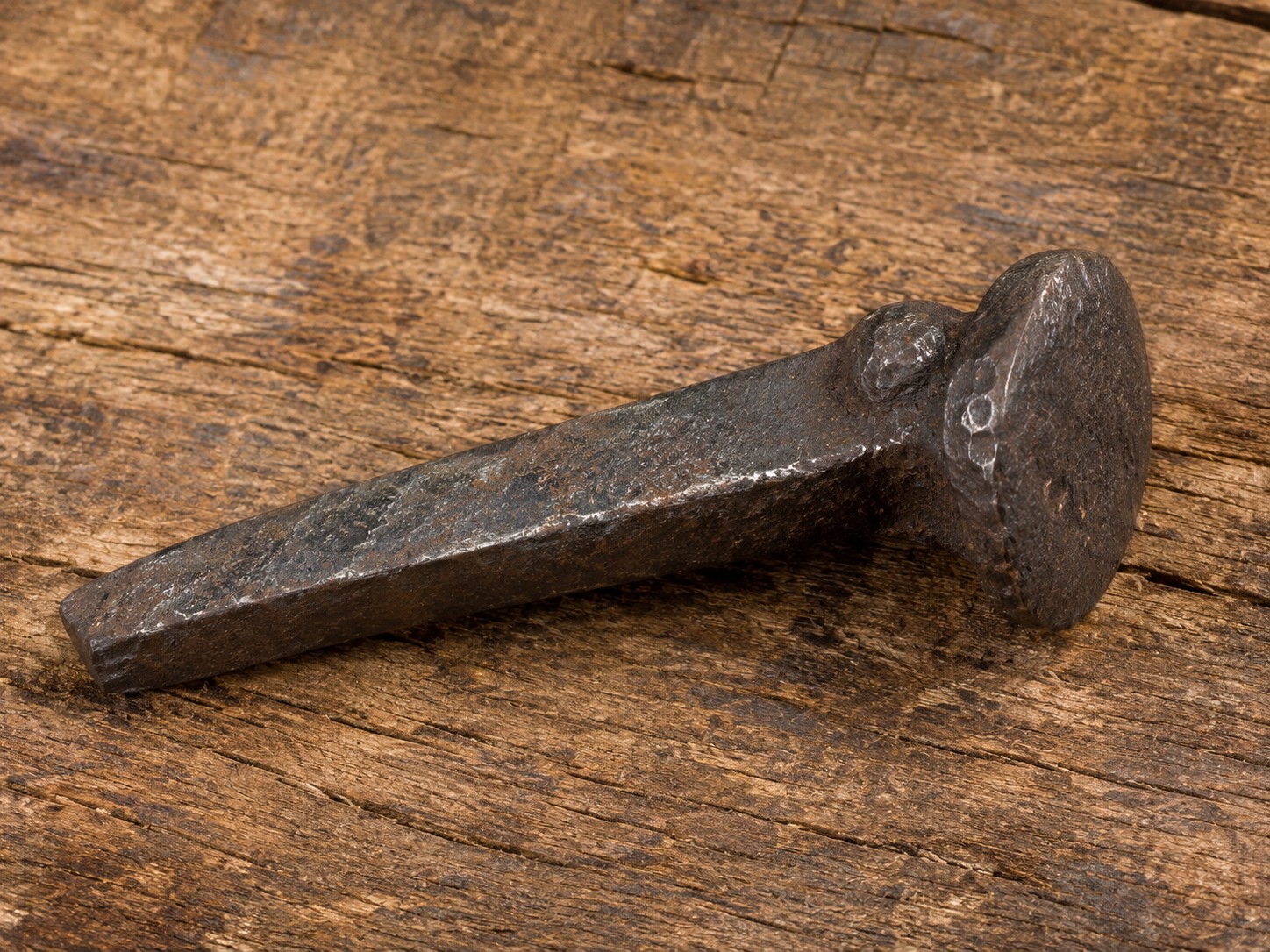
Well, that was fine and dandy, but I still didn’t know what a dead doornail was. I had to dig more. And more, I found. Did you know that in ye olden days doornails were hand-forged, heavy-duty nails, driven through wood and then clenched—the protruding end hammered flat—making them impossible to remove or reuse. Permanently fixed, permanently purposeless, they were, in every practical sense, dead.
And right after unearthing the meaning of dead doornail, I hit paydirt. I came across an entire navigation of other things I could strut around saying. If a doornail can be dead, apparently so can a lot of other things I’d never thought about:
Dead as a stone
Dead as clay
Dead as a herring
Dead as a hammer
English, it seems, has never lacked for dead things.
And then, there’s my favorite one of all. It’s music to my untrained ear:
Dead as the diplodocus
It’s hard to laugh when you’ve got one hand stuck fast to a dead doornail and the other hand being pulled even further back in time by a giant herbivorous sauropod.
I had to laugh. One dead doornail had opened the door to dozens of expressions I use every day without ever stopping to examine what they really ask of me.
The first expression that popped into my head? “Let me know if I can do anything.”I’ve said it more times than I can count.
But what exactly are we saying? At first glance, the meaning seems obvious. Yet the more I think about it, the more I realize that the phrase carries a greater obligation than we usually acknowledge.
After all, those aren’t words of sympathy. They’re words of commitment.
The moment I tell someone to let me know if I can do anything, I’ve volunteered to do something. Maybe it’s as simple as a phone call. Maybe it’s a card. Maybe it’s a casserole. Maybe it’s sitting quietly beside a friend who has just buried a spouse and doesn’t particularly want to talk.
The point is that I’ve offered. Whether the request is large or small, I’ve just volunteered a piece of myself. My words have placed me on the hook.
How often we say those words because they sound appropriate without stopping to consider what we’ve actually promised, without fully examining the obligation hidden inside the offer?
The words are easy enough to say. The casserole takes a little more effort.
Next up was the expression, “I’m so sorry.”
At first glance, it seems simple enough. We say it when someone loses a spouse, receives a frightening diagnosis, buries a parent, or watches a cherished dream collapse.
But what exactly are we saying?
Most of the time, we aren’t apologizing. We didn’t cause the death, the disease, or the disappointment.
Yet the expression carries an obligation all the same.
When I tell someone I’m sorry, I’m not merely acknowledging a fact. I’m entering, however briefly, into another person’s sorrow. I’m saying that your loss matters enough for me to stop, notice, and share a small measure of the burden.
In other words, I’m not simply expressing sympathy.
I’m promising compassion.
That’s a weightier promise than I suspect many of us realize when the words tumble so easily from our lips.
Then came two expressions that sit at opposite ends of the emotional spectrum.
“I hate you.”
Three words.
“I love you.”
Three words.
Yet each carries enough power to alter the course of a relationship, a family, perhaps even a life.
We often treat them as expressions of feeling. But they are more than that. They are declarations. Commitments. Judgments.
To tell someone “I hate you” is not merely to report an emotion. It is to wound, to distance, to diminish, to push another person away.
To tell someone “I love you” is not merely to report an emotion either. It is to assume an obligation—to care, to sacrifice, to forgive, to remain present when remaining present is difficult.
Perhaps that is why both expressions deserve more examination than they usually receive.
They are among the easiest words in the English language to say. And among the hardest to live.
Finally, I came to a phrase that millions of people have spoken for centuries:
“Forgive us our trespasses, as we forgive those who trespass against us.”
I’ve heard it all my life. I’ve spoken it hundreds, perhaps thousands, of times.
But have I examined it? Have I truly considered what I’m asking?
The first part is easy enough. Most of us welcome forgiveness for our failures, shortcomings, and mistakes.
It’s the second part that gives me pause. As we forgive. Not as we intend to forgive. Not as we hope to forgive. Not as we might someday forgive.
As we forgive.
Those words transform a prayer into a promise, a request into an obligation.
And they leave me wondering how many other expressions I use with confidence, familiarity, and conviction without fully considering what they mean—or what they ask of me.
As I reflected on all of these expressions—seemingly light yet laden with responsibility and commitment—I came to a simple conclusion. Going forward, I intend to pay a little more attention to my Ps and Qs.
Not because I suddenly care more about manners. But because I have been reminded that words matter.
They always have.
Whether I am offering help, expressing sorrow, seeking forgiveness, declaring love, or reciting a prayer, I owe those words more than familiarity. I owe them thought.
After all, the unexamined life is not worth living.
Perhaps the same can be said of the unexamined word.
“It is only with the heart that one can see rightly; what is essential is invisible to the eye.”
— Antoine de Saint-Exupéry (1900–1944). French writer and aviator, best known for The Little Prince, a timeless meditation on seeing, love, and what truly matters.
Two travelers, journeying to the Northern Neck of Virginia, midway between our home in the Shenandoah Valley and our destination, Kilmarnock.
Two travelers with two mid-day choices.
“Horne’s,” Gary read out loud from his phone. “It’s an old-time eatery serving American fare since 1961. It’s a mile or so away.”
He continued with their lunch menu.
“Hmmm. Any other restaurants?”
“Randolph’s on the River.”
About the time he started with their menu, we were approaching Horne’s. Three cars in the parking lot at noon raised some red flags, and the building raised more. It had been something once upon a time, looking back now with one nostalgic backward glance too many.
“Let’s go on to Randolph’s.”
We were there in several minutes. Right on the river with a beautiful view of the bridge.
We drove into the parking lot. One car.
“Maybe they’re closed?”
We both discovered the open door at the same time, looked questionably at one another, entered, and sat by the window on the water’s edge.
We waited and waited and …
“I’ll walk over and get a menu.”
As he did, Gary craned his head toward the open kitchen door.
“It looks really unorganized in there.”
“Maybe we should go back to Horne’s.”
But just as I was on my way to the door, the solo bar customer assured Gary the food was good, as he yelled,
“Hey, Mama. Ya got a customer.”
We returned to our booth.
“Oh, so sorry. I’m the only one here. Nobody else show up yet. Cook. Waitress. Cashier. That’s me. Whatcha want to drink?”
“Water.”
“Same for me.”
In a second, the wizened, chisel-faced Black waitress was back, her hair pulled up tight on top of her head, pulling her taller than her thin frame stood, and 32-ounce plastic glasses of iced water landed gracefully before us.
“What will ya have?”
“Are your oysters local?”
“Oh, yessss. And they big ones.”
“I’ll have the oyster po-boy. You like it?”
“Oh. No. I don’t do oysters, but we sure sell a lot. And it’s on a really big bun.”
“I’ll have one.”
Gary ordered a tuna melt, with French fries and coleslaw.
“What about you?”
“Hmmm. Coleslaw and collards.”
She beamed. “I makes ’em. They so good.”
She spirited around to head back to the kitchen, turning for a sec,
“If ya’ll need anything, just yell out ‘Auntie.'”
We were amused, and maybe smitten by the rawness of her charm, even when she appeared again, grinning.
“Fish truck ain’t got here yet, so we don’t have no tuna. How about a Rock Fish sandwich? Mighty good.”
“Okay.”
“Broiled or fried?”
“Broiled.”
She sprinted away again, as we continued chuckling about our lunch choice and wondering what the food could possibly taste like in a restaurant staffed by a three-in-one.
But nearly as fast as Auntie had sprinted away, she appeared again balancing two plates of food as wide as her beam.
“Ya’ll enjoy.”
“Gary, look at the size of this po-boy! How will I ever eat it all?”
“Well, try one of these fries. I’ve never had fries this good.”
“OMG. They’re awesome. How did she do that?”
By then, I had started to savor the collards.
“Never in my life have I had collards this good. They’re velvety magnificent.”
Just as Gary could not be enticed to savor the collards, neither could I lure him to try my po-boy that I had just dubbed the world’s best ever.
We sat there, enjoying a lunch that we never expected to enjoy, each of us beaming more that Auntie’s beam that competed with the sun glistening on the river.
“What marvelous food!” I quipped. “How did she pull this off?”
She was back soon to see how we were doing.
“How’d you learn to cook collards like that?”
“My grandmother. Just wash ’em up and down several times. Add some onion.”
“Fat back?”
“No. Just bacon. Cook ’em long and slow.”
“They’re the best I’ve ever had.”
She leaned in and whispered as she headed back to the kitchen.
“Gonna bring you a big bowl to take with you.”
We kept eating. Kept enjoying our culinary surprise. Kept nodding in agreement when Gary pronounced:
“Just proves you can’t judge a book by its cover.”
Not judging a book by its cover is a saying we all know. It reminds us not to measure worth by appearances alone. The phrase has been around since 1867 when the Piqua Democrat put it this way:
“Don’t judge a book by its cover; see a man by his cloth, as there is often a good deal of solid worth and superior skill underneath a jacket and yaller pants.”
The idiom’s insight holds.
Once you notice it—really notice it—you start seeing its truth everywhere.
A green thing pushing up through a crack in the sidewalk. Something so small it could be missed entirely if you’re walking fast or looking at your phone. It shouldn’t be there. Concrete says no. Yet there it is, insisting. Alive. You slow down, surprised by how much you want it to win.
A dog at the shelter. The one not pressed eagerly against the gate. The older one. The one whose eyes seem to say, “I’ve already tried being hopeful.” There’s nothing wrong, exactly—just nothing flashy. You move on, almost without thinking, until something tugs. A look. A stillness. Suddenly you’re wondering what kind of life left that quiet patience behind.
A fixer-upper. The peeling paint, the sagging porch, the smell that lingers longer than you’d like. Everyone sees the work. The cost. The trouble. But every now and then you catch a glimpse of something else—a line of light across a floor, a room that wants to breathe again—and you realize the house isn’t finished telling its story.
Then there are people.
People whose jackets are worn. Whose stories arrive with footnotes. People who don’t sparkle on first glance, who hesitate, who carry loss or age or disappointment a little too visibly. People who have been misunderstood long enough that they’ve learned not to rush forward anymore.
People like us. Like you. Like me.
We all know how quickly judgment comes. A glance. A pause. A decision made before the second sentence. We decide what’s worth our time, our care, our patience—and what isn’t.
Sometimes, though, we sit down anyway.
By a river. In a nearly empty restaurant. With a three-in-one waitress who says, “Y’all enjoy” and means it.
If we’re lucky—if we slow down just enough—we leave carrying more than we expected. A full stomach. A warm heart. And the uneasy, beautiful knowledge that the best things in life often arrive wearing the wrong cover.
“It’s not how much we give, but how much love we put into giving.”
—Mother Teresa (1910–1997; Roman Catholic nun and missionary known for her selfless work with the poor, sick, and dying; awarded the Nobel Peace Prize in 1979 for her humanitarian efforts.)
The air inside the canvas tent was heavy, thick with summer heat and the smell of fresh-cut pine from the makeshift floorboards. Bare bulbs swayed on frayed wires, throwing jittery shadows over the crowd crammed onto metal chairs and wooden benches. Paper fans—free from the local funeral home—fluttered in tired hands, stirring the humid air as the preacher’s voice climbed, urgent and raw, above the hum of crickets outside. Kids fidgeted, women in cotton dresses leaned forward, and men with rolled-up sleeves nodded, their hats resting in their laps. And then, as always, came the offering plate—a dented tin pan, making its slow, clinking way through the crowd, carried by hands that gave what they could.
In the back of the tent sat a young crippled boy, crutches by his side. When the offering plate was passed to him, he laid his crutches on the plate, saying just above a whisper:
“I don’t have much to give, but what I have, I give.”
As the preacher ended the story, he always added:
“Narry a dry eye was left in the tent that night.”
I wasn’t in the tent that night, but more than once, I heard about what happened from the preacher who was there. The story gave me a gut-punch then, and it still does. It underscores the power of giving our all—even when it seems small or insignificant or inappropriate–and it emphasizes that giving isn’t about the size of the gift. It’s about the spirit behind it.
The message is exactly the same as the one that we discover in the Parable of the Widow’s Mite. Jesus sat watching people bring their offerings to the temple treasury. Wealthy individuals came forward, dropping in large sums, their coins clinking loudly as they gave from their abundance. Then, a poor widow approached quietly and placed in just two small coins—everything she had to live on–all she had. The parable and the tent revival story highlight the value of giving from the heart and the spirit of generosity, not the amount given.
History is punctuated with examples of how, time and time again, people give what they can, and their generous spirit makes an impact that lasts and lasts.
I’m thinking, for example, of how ordinary Americans helped fund the pedestal for the Statue of Liberty. It’s a powerful and inspiring example of collective giving. When France gave the Statue of Liberty to the United States in 1885, the statue itself was completed and shipped, but the U.S. was responsible for building the pedestal—and there wasn’t enough money to finish it.
Wealthy donors weren’t stepping up, and the project was at risk of failure. That’s when Joseph Pulitzer, the newspaper magnate, launched a fundraising campaign through his paper, The New York World. Pulitzer called on everyday Americans to contribute whatever they could and promised to print the names of all donors in the paper, no matter how small the contribution.
The response was overwhelming. Schoolchildren sent in pennies. Workers sent nickels and dimes, often with heartfelt letters explaining that they wanted to be part of something greater. In total, over 120,000 people contributed, many giving less than a dollar. These small donations raised the $100,000 needed (equivalent to millions today) and ensured that the Statue of Liberty would stand as a beacon of hope and freedom.
Fast forward to 1938, the heart of the Great Depression. People were scraping by, yet somehow, when President Franklin D. Roosevelt asked for help to fight polio, Americans found a way. He didn’t ask for much—a dime from every person. Just a dime. And those dimes came pouring in. Schoolchildren sent them wrapped in notebook paper. Factory workers sent them in greasy envelopes. Housewives sent theirs with notes of encouragement. The effort became known as the March of Dimes, and it raised millions to fund research that eventually gave us the polio vaccine.
For me, this story hits close to home—not because the March of Dimes directly helped me, but because I lived the reality of polio. I contracted the disease in 1951, a few years before the vaccine changed everything. As one of the lucky survivors, I’ve always felt a deep connection to the campaign. Every year, I joined in, adding my own dimes and encouraging others to give. The work didn’t stop with polio. By the late 1950s, the March of Dimes expanded its mission to fight birth defects and improve infant health. That little dime became something bigger—a reminder that small gifts, multiplied, can transform lives.
I’m thinking, too, of the mid-1950s, when civil rights activists in Montgomery, Alabama, were facing another uphill battle—segregation on city buses. When Rosa Parks refused to give up her seat, the black community responded with a bus boycott. But boycotting wasn’t free. People still had to get to work, to school, to the grocery store. So, what did they do? They gave.
Nickels and dimes paid for carpools. Families who owned cars gave their time, driving neighbors for free. Churches pooled donations to cover legal fees for arrested protesters. It wasn’t easy—some folks walked miles every day rather than ride those buses—but they gave what they could. Their giving fueled a movement that lasted 381 days and ultimately changed the laws of this country. One ride at a time, one nickel at a time.
These stories, spanning decades, remind me of how I’ve been inspired by and touched by the giving spirit. Like the boy in the tent or the countless dimes sent to fight polio, these moments of generosity have shaped my own journey.
I have lots of examples where people gave from their heart to help me. I’ll share just one. When I graduated from high school in 1965, I was blessed to have scholarships and student loans to pay for my college tuition as well as room and board. Even so, I knew that buying textbooks would be a huge problem. My parents and siblings didn’t have a lot to give, but what they had, they gave. I still needed more, as did other classmates whose families had the same limited finances as mine. To our surprise and great joy, the citizens of my hometown established the Shady Spring Citizens Scholarship fund and awarded each of us college-bound graduates $150, specifically to buy our textbooks. That check meant my future to me.
Down through the years, that generosity has lingered with me, and I have looked for little ways to pay it forward.
For example, when my niece/goddaughter was born, I started saving my pocket change every day. That first year, pennies. The next, pennies and nickels. Then, pennies, nickels, and dimes. Pennies, nickels, dimes, and quarters followed. Finally, all of my pocket change. I saved it regularly—no, faithfully, every day, seven days a week. Seventeen years later, when it came time for Janet to go to college, it was time for me to take all of my coffee cans—chock-full of daily pocket change—to the bank. I was surprised. Actually, I was stunned. As I watched the teller count the coins, I could hardly believe the final total: nearly $10,000. It wasn’t enough for a full year of tuition, but it was more than enough to ease her journey with textbooks, a laptop, and even a $500 savings bond—a future as bright as a shiny new penny.
For me, giving back has always been a way to honor the help I’ve received along the way. One way that I’m doing that this year is by donating all proceeds from my book More Wit and Wisdom: Another Year of Foolin’ Around in Bed to the Student Success Fund at Laurel Ridge Community College where I taught. It’s not a lot, but I know that it might help a student in an emergency—maybe cover the cost of gas for commuting to class, pay for a textbook, or ease the stress of an unexpected expense. Small as it might seem, it’s my way of paying forward the generosity that shaped my own journey.
The truth is simple. Most of us aren’t in a position to make grand gestures, and we don’t have to be. The young boy in the tent didn’t. The widow in the parable didn’t. The countless Americans who gave nickels and dimes to fight polio didn’t. They gave what they could, and in doing so, they made a difference. We can, too.
Tomorrow is GivingTuesday, a day set aside to do good. It started in 2012, and over the years, it’s grown into a global movement, inspiring millions of people around the world to give, collaborate, and celebrate generosity—not just on one day but all year long.
The idea is straightforward: give what you can, whether it’s your time, a donation, or simply lending your voice to support your community. From making someone smile to helping a neighbor or supporting a cause you care about, every act of kindness matters. We all have something to give, and together, those small acts add up to building the better world we all dream of.
As you approach Giving Tuesday, I would urge you to give to whatever cause that speaks to your heart. Whether it’s a few dollars, an hour of your time, or a gesture of kindness, remember that it’s not the size of the gift that matters—it’s the spirit behind it. Together, our small acts of generosity can spark change and lift others in ways we may never fully see but will always profoundly feel.
“In a world where we can be anything, let’s choose to walk the red carpet of life with kindness, grace, and a sprinkle of stardust.”
–Lady Gaga (b. 1986, Stefani Joanne Angelina Germanotta; a Grammy Award-winning singer, songwriter, and actress known for her groundbreaking music, bold fashion choices, and advocacy for social justice issues; one of the most influential and iconic figures in contemporary pop culture, captivating audiences worldwide with her unique blend of creativity and authenticity.)
Hey, y’all. Come here, curl up real close to me, get comfy, and listen while I purr. I need to share something with you that I simply dare not share with the world at large. But since you’re special and know how to keep secrets, I’ll share it with y’all. Okay? So, get close while I whisper my secret in your ear:
“The other day, I was lying on my sofa, all innocent and quiet like, and right out of the blue, I was smitten, right there in my living room, in broad daylight! Can you imagine?”
Well, I couldn’t imagine it either, mainly because it came on so sudden like. I mean. I was just lying there, and then Shazam! I had been smitten! Well, actually, that shouldn’t come as too much of a surprise. I’m smitten easily, and I’m smitten hard. Hopefully, you are, too. Right now, I’m smitten by the gorgeous moss, harbinger of an early spring, greening itself in my Koi Pond Waterfalls. I’m smitten, too, by the online photography course I’m taking so that I can take better photographs with my new Samsung Galaxy S24 Ultra. I continue to be smitten by advances in AI, especially by Aloha, a housekeeping humanoid who can cook and clean. (If you dissed me when I announced my Caden last November, I guess I’m getting the first laugh. Ready to hop on board? There’s room!) And, in case you’re wondering–and I know, I just know that some of you are–I have not been smitten by any of the studmuffins who failed to find their way into Anne Lamott’s life or into mine during our respective flings with online dating apps. (For her account, see “My Year on Match.com”; for mine, which matters far more and is really the only one that matters at all, see “My Year on Unmatched.com.”)
I cannot speak for Lamott, but I remain hopeful. I am doing my best to smite the frog at my kitchen door with regular, passionate kisses so that I can practice my pucker and stay in shape. Who knows? I might just have an opportunity to be smitten by a prince. (Princes like good kissers. Just sayin’.)
No doubt you’re wondering what the hell I’ve been smitten by, aside from my nonsense. Chill. I’m about to tell you.
I’ve been smitten by a red carpet. Mind you, though, it’s not just any ole red carpet. It’s THA red carpet that gets rolled out right in front of you to seduce you into a waltz with destiny, leaving you breathless with anticipation and a sprinkle of stardust in your eyes.
Yep. I’m a smitten kitten. Hear me purr? But here’s the thing. The glamour of rolling out the red carpet goes all the way back to ancient Greece, where it was mentioned in Aeschylus’ play Agamemnon describing the king’s return home after winning a battle. His wife Clytemnestra says to him, “Now my beloved, step down from your chariot, and let not your foot, my lord, touch the Earth. Servants, let there be spread before the house he never expected to see … a crimson path.”
Despite its ancient heritage, it was not until the early 20th century that rolling out the red carpet became associated with celebrities and VIPs, particularly in the entertainment industry. The first known reference to a red carpet being used at the premiere of a movie dates back to 1922, when it was laid out for the opening of the Egyptian Theatre in Hollywood.
Since then, the red carpet has become synonymous with prestige, glamour, and exclusivity, particularly at award shows, movie premieres, and high-profile parties. It’s often used to signify that the individuals walking on it are special guests deserving of special treatment and attention.
That certainly was the case during this year’s Grammy Awards, as the red carpet sizzled with music’s biggest stars like Taylor Swift and SZA. Amidst wardrobe changes and rehearsals, the red carpet set the stage for unforgettable fashion moments.
Beyond Hollywood, the red carpet is used in various other contexts as a symbol of importance, honor, and VIP treatment. I dare say that each of us, at one time or another, has said to ourselves or to someone else “I want to roll out the red carpet” to celebrate someone or to jazz up a special occasion.
You’ve probably had enough of my caterwaul, so I’d better roll out THA red carpet that turned me into a smitten kitten. Meow, meow, meow, purr, purr, purr, meow, meow, purr, purr, meow, purr, MEOW!
Like I said, I was lying on my sofa in broad daylight, amusing myself with some TikTok videos when out of nowhere a video featuring Opatija, a picturesque coastal town in Croatia, popped up on my smartphone. But it wasn’t just any ordinary kind of video. It was a red-carpet tourism video, weaving together a rich tapestry of emotions, triumphs, and shared moments. The taglines alone speak volumes:
● Exploring the vibrant tapestry of choices on the red carpet, where every step unveils a world of possibilities.
● In this beautiful world, imagine if every moment mirrored a red carpet affair—filled with smiles, hugs, and unbridled happiness. Let’s choose to embrace the elegance of joy in every step we take.
● Witness the unexpected on the red carpet—a celebration of diversity, love, and transformation.
● Imagine if every moment mirrored a red-carpet affair—filled with smiles, hugs, and unbridled happiness. Let’s choose to embrace the elegance of joy in every step we take.
Typically, a man appears suddenly and rolls out a red carpet in public places, such as sidewalks or parks, treating unsuspecting strangers as if they were celebrities, complete with photographers, fans, and sometimes even limousines. Without fail, the reactions and interactions with the new celebs are amusing and heartwarming, often catching people off guard with the unexpected VIP treatment. The goal is to capture genuine reactions and create humorous situations, so they often approach anyone who happens to be in the vicinity of where they set up the red carpet. This approach helps keep the content unpredictable and inclusive, as they showcase reactions from a variety of individuals.
Typically, the people who walk the red carpet in the videos seem to be surprised by what is happening. Almost always, they are hesitant to step onto the red carpet after it has been rolled out in front of them, even as the tall young man extends his arm graciously and invitingly. Their movements are cautious, almost as if they’re tiptoeing into unfamiliar territory. Their expressions betray a mixture of uncertainty and curiosity, unsure of what awaits them as they traverse this unexpected path. Each step is tentative, as if testing the ground beneath them for stability.
Yet, as they progress further along the scarlet pathway, something remarkable begins to happen. A subtle shift occurs in their demeanor, a gradual transformation fueled by the energy of the moment. Their apprehension gives way to wonder. Their eyes light up with newfound excitement and anticipation. With each stride, they seem to shed the weight of their doubts, stepping into a realm where anything is possible.
As they walk across the red carpet, a sense of liberation washes over them, freeing them from the constraints of everyday life. In this fleeting moment, they are not defined by their roles or responsibilities but by the sheer exhilaration of the experience. Laughter bubbles forth, spontaneous and unrestrained, as they embrace the joy of the unexpected.
Amidst the vibrant tapestry of emotions, the little dramas of life begin to unfold. Strangers become companions, sharing stories and forging connections that transcend the fleeting encounter. Inhibitions are cast aside, replaced by an unbridled sense of camaraderie and belonging. It’s as if the red carpet has become a stage, and they are the stars of their own impromptu performance.
In the end, as they step off the red carpet, their spirits are buoyed by this enchanting journey. Though they return to the routine of their daily lives, they carry with them the indelible imprint of this extraordinary moment—a reminder that magic can be found in the most unexpected places, if only we dare to take that first step.
“Dare to take thatfirst step. “
We can look at that statement in two ways. The people in these little dramas have to dare to take that first step onto the red carpet. Then, and only then, can these magical transformations take place, even if only for a few moments. But let’s not forget the other individuals who are involved in these little dramas: the Croatian video team, who time and time again, dare to roll out the red carpet for strangers whom they encounter. Without the video team, strangers could not become stars.
I cannot help but wonder what our own little corners of our world would be like if we spent some time thinking about ways that we dare roll out the metaphorical red carpet before strangers whom we encounter in our own lives.
It could be as simple as sincerely complimenting someone on something positive about them. Whether it’s their style, smile, or skill, our words can brighten their day. For instance, we might notice someone’s vibrant scarf and express admiration for how it complements their outfit. Their initial surprise might give way to a smile of appreciation, boosting their confidence and spreading warmth.
It could be as simple as performing small, random acts of kindness without expecting anything in return. It could be as simple as holding the door open for someone, helping carry groceries, or simply offering a friendly smile. Imagine seeing someone struggling with heavy bags and offering assistance without hesitation. Their gratitude and relief could radiate as they realize there are still caring strangers in the world.
It could be as simple as striking up conversations with people we encounter in our daily lives. This could be as straightforward as asking how their day is going or commenting on something happening in the community. Picture starting a conversation with someone standing in line at the grocery store and sharing a laugh over a funny observation. Our genuine interest and friendliness might brighten their day and foster a sense of connection.
As I continue to be smitten by the transformative allure of the Opatija tourism videos, where a mere red carpet, a lens, and the sincere desire to infuse fleeting moments with joy can ignite profound change, I am stirred to contemplate our collective capacity to impact the lives of strangers. Perhaps, in our quest to touch hearts, we need not seek grand gestures. Perhaps all that we need to do is strive to live our lives as radiant beacons of kindness and warmth so that with every interaction, we joyfully roll out the red carpet.