“Never mistake the undone for the unworthy. The desk may be cluttered. The life is not.”
—Poor Brentford Lee (b. 1947. Altar ego—with an alter ego, too, of course. He ministers and he meddles. Life coach without credentials. Available for lectures, upbraidings, and unsolicited reminders of everything you’ve already accomplished.)
Sometimes we’re our own worst enemies. Maybe, all times. I know I am.
It doesn’t matter how much I get done, it’s always the undone that grabs hold of me in my waking hours and throws me into a tiff.
Just the other day—just as dawn was breaking—I sprang up in bed, asking myself:
“Where did it go? Where did it all go?”
Not my life, mind you. That’s still very much in progress.
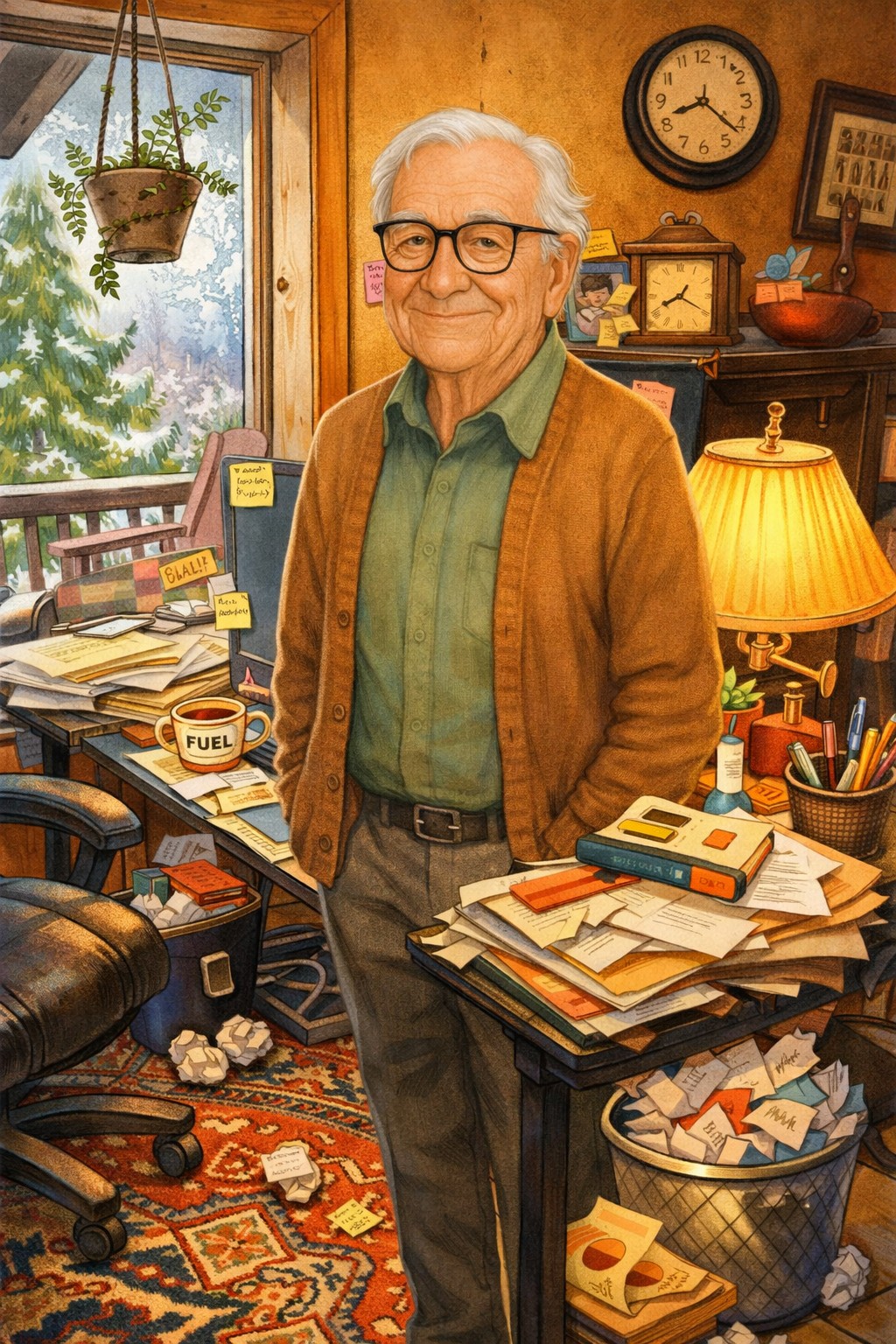
I meant January and February—two months that often keep me snowed in on my mountaintop here in the Shenandoah Valley. And this year—once and for all—they were supposed to be the two perfect months to bring order to chaos. To organize my office.
Boxes. Amazon boxes, to be precise—a small mountain of them, stacked near the woodstove like a cardboard monument to every good intention I’ve ever had. Some are open. Some are not. All of them smile at me. That relentless Amazon smile, curved and cheerful and absolutely unbothered by my shame. I have begun to suspect they are multiplying when I’m not looking.
Desk and worktable. Buried. Buried under manila envelopes, unopened mail, a box of highlighters, a coffee mug that may or may not still contain coffee, and enough paper to reforest a modest hillside. The lamp burns bravely through the chaos like a lighthouse in a nor’easter.
Even the plants have opinions. Two magnificent specimens—sprawling dramatically across their ornate iron stands—have taken matters into their own fronds. One has sent a long, accusatory leaf directly toward my leather chair. As if pointing.
Pointing. Yes, pointing. The same way the ghost of my gray-haired grade school history teacher would point and declare with the wrath of an angry God:
“A cluttered desk is the devil’s workshop.”
And between Mrs. Snyder’s admonitions and my lament—”Where did it go? Where did it all go?”—Poor Brentford appeared as if in a vision rising up from nowhere in particular and everywhere at once.
“Where did it all go, you ask? Where did it all go? I’ll tell you exactly where it went. Pull up a chair if you can find one in that brain of yours, all cluttered now with nonsense.”
I thought I knew for sure where his harangue was headed. But for once he surprised. He did not stoop so low as to rap knuckles with any of the cliches from his repertoire of wisdom.
Not once did I hear,
“Time and tide wait for no one.”
Not once did I hear,
“Make hay while the sun shines.”
I didn’t even hear the one I was certain he would speak with calm certainty,
“Lost time is never found again.”
He didn’t recite any of those things.
Instead, he cleared his throat with great ceremony and delivered his first knuckle rap with the precision of a surgeon and the satisfaction of a man who has been waiting a very long time.
“Only handle it once.”
He let it hang there. Just those four words. Floating in the air above the Amazon boxes and the buried desk and the manila envelopes and the coffee mug of uncertain vintage.
“Your words. Well, Grace Reed’s words, if we’re being precise. Your Copyright Office colleague. The woman whose office was lean, mean, and sparse. The woman whose wisdom you borrowed, researched, published, celebrated, and then—apparently—left to ride around in the Jeep with the junk mail.”
He fixed me with a look that left no room for argument.
“Don’t bemoan where it all went. You know fully well. And you know exactly what to do.”
Then Poor Brentford’s voice softened. Just slightly. Just enough.
“Do you remember what you wrote on January 15th, 2024? You raised your Bunnahabhain to all the tarriers, the delayers, and the occasional shelver. You said, and I quote, ‘Here’s to the to-morrowers, the champions of It can wait until tomorrow, because sometimes tomorrow is just a delay away from today.'”
He smiled. For the first time.
“And do you remember Scarlett?
“She understood something you sometimes forget. Tomorrow is not surrender. Tomorrow is strategy.”
Poor Brentford gestured grandly at the Amazon boxes.
“Your Tara is a little more cardboard than hers. But the principle holds.”
He straightened his jacket.
“The office will get cleaned. One day. Tomorrow, perhaps. Or the day after. Or sometime before the Amazon boxes learn to walk.”
“Scarlett managed. So will you.”
But Poor Brentford wasn’t finished. He stood there, poised to deliver his final and most devastating knuckle rap. Quietly. Almost tenderly.
“Forget the cluttered office for now. I want you to remember something you wrote, something about a young professor who stopped you in a hallway and handed you an offprint with four words inscribed on the front.”
He paused.
“This is life everlasting.”
Another pause. Longer this time.
“You asked whether he was suggesting that we live on forever through what we share with others: ideas immortalized in print. You answered your own question. Here you are, nearly fifty years later, speaking his name. Professor Myerson continues to live.”
He leaned in close.
“And so will you. Through every word you have ever written. Eight books. More than a million words. Scholarship and essays that will outlast every Amazon box in that corner.”
“THAT is your life everlastin’. Now act like it.”
Just when my chair started getting uncomfortable, Poor Brentford had the nerve to tell me to shout out:
“Get behind me, Satan.”
I sprang up at once because in that command I recognized my own mother’s voice. Over and over again I had heard her rebuke the Devil whenever she faced her own pole of proverbial chaos.
Only then did I realize what Poor Brentford had done.
He had serenaded me with snippets of my own advice—counsel I had been publishing right here in this column for years.
I could hardly be offended.
I looked again at the Amazon boxes. The buried desk. The pointing plant.
“Convince me that you have a seed there, and I am prepared to expect wonders.”
—Henry David Thoreau (1817–1862). American essayist, naturalist, and author of Walden, whose writings celebrated attentive living and the quiet wisdom of nature.
Superstitions surrounding Friday the 13th do not concern me. If my middle name weren’t Lee, it would be Lucky. I walk under ladders, ignore black cats, shop, travel and do all the things others won’t do. I will keep right on doing what I’ve always done. But this year, my luck may have run out. Or not.
The day started out on as good a note as possible. I fed my sourdough starter in my usual fashion even though the kitchen was a tad cooler than usual. A slow rise never kept me from planning ahead for scrumptious sourdough pancakes.
After our usual morning routines, Gary and I went out for lunch and returned home. In the afternoon, I preheated the oven to 350° so that it would be ready for whatever it was that I planned to cook for dinner.
Then I went about my affairs as usual. That is until I smelled a wonderful aroma wafting out from the kitchen. Bread? Cake? I was fascinated because I hadn’t started dinner. What could it possibly be?
Just as I walked into the kitchen to see what had lured me there, I exclaimed,
“Oh. No. My sourdough!”
When I turned the oven to preheat after lunch, I forgot that hours earlier I had put my sourdough starter in there on “proof” to get a faster rise.
What I saw when I opened the oven door was not fermentation. It was transformation.
The jar no longer held a living starter. It held evidence of my carelessness. The sides were lacquered in amber and gold, as if the sourdough had tried to climb out and been stopped mid-escape. A caramelized tide line marked how high it had risen before heat overtook it. What had once been soft and elastic was now fixed in place, streaked and hardened like candle wax after a long vigil.
Inside, the starter had transformed into something strangely geological. A pale, spongy dome baked solid at the edges, its surface torn open in small craters where trapped gases had burst and frozen in time. The smell was unmistakable: toasted flour, faint sweetness, a whisper of bread that almost existed.
I stood there looking at a crime scene, fully aware that the culprit and the witness were one and the same.
I had been the one who coaxed these mountain spores into life years ago, watching their first tentative bubbles gather and rise as if they had somewhere important to be. I had fed them, talked about them, and trusted them to do their quiet work while I went about mine.
They had made their way into breads and cakes and cookies and scones and cinnamon rolls, earning praise far beyond my mountaintop kitchen. And yet, on this particular Friday the 13th, I had forgotten them entirely, leaving a small natural wonder behind, unnoticed, to the fate of an oven I had set to preheat.
For a time, I did nothing but stand there, laughing at my stupidity while absorbing the lesson. There seemed little left to do but clean the jar and move on.
But just when I was feeling the depth of loss, I remembered. Flakes. Sourdough flakes.
A year or so ago I had dried some starter and set it aside, more as an experiment than anything else. I never imagined needing them. They sat unnoticed in a small jar, ordinary and still, offering no hint that they might hold anything alive.
I weighed a small portion and put it in a bowl with an equal amount of warm water. I watched as they softened and disappeared into a cloudy mixture. Then I added an equal amount of flour, creating a pasty potential. It felt more like a laboratory ritual than a kitchen rescue. Truthfully, I wasn’t certain anything would happen. But I held on to hope, realizing that those flakes were the only thing left for me to try.
At first, nothing happened.
The mixture sat on the counter looking exactly as one might expect flour and water to look when stirred together: pale, still, and entirely unremarkable. I told myself not to expect too much. After all, these were only dried remnants, fragments of something that had once been alive. Whatever vitality they possessed had long since faded.
But some time later–hours, perhaps less–I noticed a change so small it might easily have been missed. A tiny bubble appeared along the edge of the bowl. Then another. The surface loosened almost imperceptibly, as if taking a slow breath after a long sleep.
By the next morning, there was no denying it. The mixture had awakened. Fine bubbles traced delicate pathways through the paste, and a faint, familiar aroma rose to meet me—not flour, not water, but something living. Something remembering what it had been.
What astonished me most was not simply that the sourdough culture had returned, but how quickly it did so. Years ago, when I first coaxed those mountain spores into existence, I waited days for signs of life, peering into the jar with the anxious patience of a novice. This time, revival came with confidence, as though the culture already knew what it was meant to do.
Up from the flakes it arose.
What had seemed lifeless only hours earlier now stretched upward, gathering strength from invisible work. I found myself watching it the way one watches a garden after rain—not interfering, not hurrying, simply witnessing growth. A living culture once again, carrying within it all the strength and possibility of its ancestral spores.
And standing there, I realized that nothing about it felt accidental. Life, given the smallest chance, had simply resumed its work.
Watching it rise again, I began to understand that what I had witnessed was more than a small kitchen recovery. I had baked the starter, yes. But I had not baked the possibility.
Something essential had been preserved long before the mistake was made. Tucked away almost absentmindedly, those flakes had carried forward what mattered most. Given warmth, patience, and a little attention, the sourdough culture simply resumed its work, as though interruption were only a pause and not an ending.
It struck me then how stubbornly life finds its way back, even after neglect, even after carelessness. What appears lost may only be waiting for the right conditions to begin again.
Perhaps that is the real lesson Friday the 13th had to offer me this year. Not bad luck. Not superstition confirmed. Just a moment of carelessness and a jar of forgotten flakes, both filled with truth. We measure our mistakes with finality, and we assume that one moment of inattention defines the whole story.
“The greatest thing in the world is to know how to belong to oneself.” —Michel de Montaigne (1533-1592). French pioneer of the personal essay.
I tried to blame it on the boots.
I tried to blame it on the coat.
I tried to blame it on the sweater.
I tried to blame it on the scales.
I even tried to blame it on Thanksgiving and Christmas.
But I knew deep down inside that on those occasions I made conscious choices to eat the rich foods that I served up for Gary and me, and sometimes for our guests. Turkey first, of course—sliced generously, then followed by ham, salty and sweet, and later a rack of lamb brought out because it felt like the season called for something a little special. Deep-dish pecan pie, glossy and heavy with syrup. Deep-dish apple pie, still warm, the kind that sinks slightly when the knife goes in. Golden fruitcake—dense, fragrant, unapologetic—cut thin and then, somehow, not so thin. Banana nut bread—the healthy version, of course—on the counter, always ready for just one more slice. Candy dishes everywhere, each one holding something different: chocolates, caramels, peppermints, specialty candies meant for guests but sampled daily. Taffy apple salad. Orange fluff salad. Cranberry sauce—homemade, of course—because it wouldn’t be the holidays without it. Gravy poured generously, more than once. Sourdough dinner rolls torn open while still warm, butter melting into the crumb. And wine—one bottle opened, then another, because it paired well, because it was already there, and because winter evenings stretch long. And it was good. All of it was good.
One or two overindulgences wouldn’t have been so bad. But what started with Thanksgiving rolled into Christmas, kept going through New Year’s, and here I am after a prolonged pig-out snow-in, blaming my weight on scales, sweaters, coats, and boots.
I know better. This is a repeat of last year and the year before, stretching back to the start of memory. All along my satiated journey, I knew what was happening. I sensed it in my body. I felt it in my clothes. I saw it in the mirror. Eventually, my day of reckoning came when I stepped on the scales, gasped, and sighed,
“Enough, Brent. Enough.”
I could veer off into a litany about all the reasons I overindulged. I have no doubt that you’ve heard them all already. Heard them all.
But I’ll plate up a few reasons anyway. Food is how we mark time. Holidays, snow days, long evenings, the stretch between Thanksgiving and New Year’s—meals become punctuation marks. We don’t just eat; we commemorate. One dinner leads to another, then another, until the season itself seems to demand a full plate.
Then there’s winter. The quiet. The staying in. Food keeps us company. It warms the house, fills the hours, shapes the day. A loaf on the counter, something sweet after supper, a little more than usual because there’s nowhere else to go and nothing much else to do.
None of this is shocking. None of this is new. But here’s the thing. Knowing why doesn’t change the outcome. It only explains how easily awareness can lag behind—until one morning, one glance, one number brings it all into focus.
I could dwell on all of that. But chances are you can already relate—whether in your own “appetite” life or in some other corner. You can relate to areas where you’ve lost an awareness—areas that need attention. Maybe it’s your perennial garden beds overtaken by weeds. Maybe it’s your inbox overtaken by junk mail. Maybe it’s your personal and spiritual relationships overtaken by inattention. The list of “maybes” goes on and on.
But here’s the good news. We don’t need to rant and rave. We don’t need to blame our metaphorical sweaters, coats, and scales. And we don’t need to blame ourselves.
Benjamin Franklin had Poor Richard. TheWiredResearcher now welcomes a guest contributor: Poor Brentford Lee, who has agreed to sanctify our troubled times with a bold mix of satire and sass.
Approved by ole Ben Franklin. Improved by Poor Brentford Lee
“Forgiveness is divine—but FramilySaid™ is faster and comes in gummable gummies.”
-— Poor Brentford Lee (b. 1947). Unlicensed. Unfiltered. Unapologetically adopted. Known for saying the quiet part loud, he’s back by popular demand (and at least one cease-and-desist letter). Seasoned expert in nothing but experience. Sourdough connoisseur. Self-declared inventor of emotional supplements. Hangs out somewhere between a heavenly blessing and A HOMEMADE biscuit (preferably sourdough).
Years and years ago, in one of my brilliant moments—you know, the kind that arrive somewhere between misplacing your glasses and finding your purpose—I concocted a miracle elixir. An emotional balm. A psychological salve. A chewable sacrament.
And I’m convinced—when it’s finally patented, mass-produced, and widely distributed—it will relieve the world of all its wounds and arrows of outrageous fortune.
Or, at the very least, it will help you forget them for a little while. And really, isn’t that what the world needs most right now? Not advice. Not enlightenment. Not deep therapy.
All you need is Forgetfulness.
Chances are good that if you’re reading this—and have not forgotten—you’re an Oldie-Goldie who still remembers when love was all you needed, and your hips didn’t pop when you bent over.
But friend, times have changed. Now what the world needs isn’t just love—it’s a little bit of blessed, blissful forgetfulness.
So in the spirit of rock legends and gospel truths, I offer you an updated version of the Beatles’ classic. Hum along. Or gum along. Or just pretend you know the tune and clap on the offbeat:
All You Need Is Forgetfulness (Redux) (with apologies to Lennon & McCartney—and gratitude, too)
There’s nothing they can say that can’t be un-heard No shame so deep it can’t be deterred No burn so old it can’t be un-spurred You can let it go
All you need is forgetfulness (Da-da-da-da-da) All you need is forgetfulness (Sing it like you mean it) All you need is forgetfulness, forgetfulness Forgetfulness is all you need
(Slide whistle optional. Biscuit in hand, sourdough preferred.)
Yep. That’s it. All you need is forgetfulness. Not the kind that sneaks up on you in your golden years, when you can’t remember who you bit when you meant to kiss or where you were going with your pants unzipped or where you’ve been with a bowl of popcorn when you went to get strawberries. No—I’m talking about on-demand forgetfulness. Reliable, immediate, with controlled-release options for holidays, family reunions, and any Sunday when your phone rings before you’ve had time to check your Fitbit to make sure you made it through the night.
That, My Dear Readers, is where FramilySaid™ comes in.
They mean well. They always do—those “bless your heart” people. But sometimes, what your framily says can lodge itself right in the soft tissue of your soul, like a splinter from the communion table.
That’s why I made FramilySaid™—not FDA-approved (yet), but clinically proven (by yours truly) to dull the sting of being emotionally ignored by people who should know better. In gummable form, naturally.
A Quick Word about the Name.
FramilySaid™ is exactly what it sounds like. It’s a mountain prof’s fusion of friends, family, and the things they’ve said—bless ’em.
Because sometimes, it’s the people closest to you (by blood—or, in my case, by adoption—history, or shared casserole) whose words linger just a little too long. Who don’t mean to hurt you but somehow do. Who support you privately … but not publicly. Who say “I love you” but never with the clincher: “justtheway you are.”
When they speak and zing you with their petty little barbs? FramilySaid™ can help you. Un-hear it. Un-feel it. Un-bother yourself entirely.
A New Kind of Relief.
I developed this product in a dimly lit, emotionally unstable lab located precisely between my kitchen and a moment of near-epiphany. FramilySaid™ is the first over-the-counter solution specifically designed to help you temporarily forget your people. Not all of them, bless ’em. Just the ones whose “support” lost all its elasticity because you’re doing all the emotional heavy lifting.
Get this. FramilySaid™ is so hip that it comes in gummy form. Flavors include Denial-Drop Cherry and Emotional Support Butterscotch. Easy to chew. Easy to swallow. No dentures? No problem. Just gum it and go.
I just heard a panicked soul (bless their heart) blurt out:
“How can I get me some?”
Well, bless your little heart. It’s so simple. Go online–or use your phone app–and in just a few clicks you’ll be consulting with a doctor named “Jeff” who is definitely certified but not necessarily licensed. Within days or maybe even as soon as yesterday—Poof! A discreet brown package arrives at your door—just like your sex toys arrive, but with more dignity—and fewer batteries.
Anyway, from that point forward, you’ve got protection from friends and family. Take FramilySaid™ when the text message lands wrong. Take it when the smile feels fake. Take it when someone who “loves you no matter what” leaves your partner off the guest list.
Take it. Just take it. Now, that wasn’t so bad, was it.
Now go ahead. Swallow your truth with a buttery sourdough biscuit, included free, one for every FramilySaid™ gummy included in your order. Remember: Cheaper by the Baker’s Dozen.
Now breathe. Breathe again. You’ve got this.
Situations When You Might Need a Gummy.
Situation #1. You call with good news—any kind of news, really—and they respond with:
“Oh, that’s… nice.”
You smile politely. Take a FramilySaid™ gummy. Let the world blur at the edges.
And what would Poor Brentford Lee do? Why, he’d just sigh and say:
“Law me, child…”
And then he’d smile sweetly, fold his napkin with precision, and add demurely:
“Well, bless your little pea-pickin’ heart. Would you pass the sourdough biscuits?”
Situation #2. You share something meaningful—a photo, a milestone, a moment—and get nothing but a thumbs-up emoji.
You chew slowly. Cinnamon apathy floods your tongue.
And what would Poor Brentford Lee do? He’d lean back, fan himself once, and say:
“Why, don’t you worry that pretty little head of yours nary one bit.”
Then, with that same cool smile, he’d add:
“Well, bless your little heart. Would you pass the sourdough biscuits? I need me ‘nuther one”
Situation #3. You confide in someone you thought might be a safe space. Instead, they tilt their head like a golden retriever hearing static and say:
“Well, as long as you’re happy.”
You double your dosage and erase five awkward conversations from memory.
And what would Poor Brentford Lee do? Why, he’d just sigh and say:
“Law me, child… we are officially rationing warmth now.”
And then he’d smile sweetly, fold his napkin precisely, and add demurely:
“Well, bless your little heart. Them sourdough biscuits sure are good. Can I have just one more? Not the whole basket. Thank you kindly.”
Situation #4. Someone finally asks:
“How did you two old geysers meet anyway?”
But get this. Their tone sounds more like a customs agent than a curious soul.
You suddenly feel like a suspect in your own joy. FramilySaid™ softens the interrogation.
And what would Poor Brentford Lee do? He’d lift one eyebrow, cross his silverware, and murmur:
“Law me, child. Love ain’t no interview.”
Then he’d smile–all teeth, all grace–and whisper at his loudest:
“Well, bless your little heart. I think I’ll have another sourdough biscuit—maybe two if you’re feeling generous.”
Situation #5. On one of your hardest days ever in your entire ancient life, you look up at the sky—not metaphorically, but really look—and ask:
“God? Really? After all I’ve done to live with grace, to love deeply, to forgive… and this is still where I land?”
That’s when you reach for the God-level dose. FramilySaid™ won’t answer the prayer. But it will quiet the ache long enough for you to refill your hope.
And what would Poor Brentford Lee do? He’d blink once, breathe deep, and say,
“Law me, child. Even Heaven can ghost you sometimes.”
Then with a reverent nod upward:
“Well, bless your eternal heart. Hand me a biscuit. The everlastin’ kind.”
™ … ™ … ™
Final Notes from the Founder.
Every time you take FramilySaid™, you’ll forget for a spell. You’ll feel better for a spell. Might smile, hum a tune, maybe even whistle while folding your fitted sheets.
But eventually—inevitably—you’ll sit real still. And your heart will tap you on the shoulder and say:
“This ache? It don’t need numbing. It needs naming.”
And you’ll remember:
“It wasn’t the forgetting that healed you. It was remembering the friendship and kinship you truly deserve.“
So go ahead. Declare what you need. Claim your joy. Refill your prescriptions for love, laughter, and a little holy audacity.
And if someone still doesn’t get it?
“Well, bless their little hearts. Just hand ’em one of those perpetual sourdough biscuits and smile like you mean it.”
Coming Soon from the Maker of FramilySaid™.
Because sometimes one generic gummy just isn’t enough, the Maker offers you some specific options:
● SisterStrength™ – For passive-aggression that’s been simmering since the day before forever.
● CousinClear™ – When you can’t remember which cousin sells snake-oils and which one married his ex’s sister brother’s husband.
● UncleMute™ – One dose silences three stories about the Civil Wah he and his kin are still fightin’.
● MatriarchMax™ – For that layered guilt, always served hot, always with a side of pie—and a smile.
● HolidayProlonged Release™ – Kicks in during grace and peaks after the second round of green bean casserole.
A Final, Final Word from the Maker—Yours and Mine—The Big One Who Always Gets the Last Word.
Forgetting isn’t what you need, child. Remembering what you’re worth? Dagnabbit. That’s exactly what you need. That’s the real prescription. (Signed, sealed, and delivered by Poor Brentford Lee, totally unlicensed but highly seasoned.)
While you’re remembering, just reach up and hand me a sourdough biscuit, swallow your pride, go ahead and make up with your low-down, no-good Framily. And then? Move it. Move it. Move it—as fast as a tumbleweed in a windstorm.
And don’t forget Poor Brentford Lee, sitting here, there, and everywhere–all smiles–saying to himself for no one else to hear:
“Law me. Won’t you lay one on me? No, no. Not a biscuit—though they are mighty fine. Just a blessing, child. That’s all I everneeded.”
Poor Brentford Says
“Your worth doesn’t need a witness. Show up for yourself. That’s the real feast.”
“Talk to yourself like you would to someone you love.”
— Brené Brown (b. 1965), American research professor, author, and speaker on vulnerability, courage, and self-worth.
Go ahead! Run reference if you must. You’ll probably confirm what you already suspect. More than once, I’ve asked you to lean in real close and listen as I shout out for all the world to hear something that I think no one in the world should hear. Private should stay private, right? Not always. Here I am about to pull you in and do it all over again.
But this time it’s different. It’s one of those insights I’ve had before—the kind that first comes as a shadow of knowledge, and then, with a turn, reveals itself fully, clad in nothing more than the simplicity that truth always wears.
That’s exactly what happened to me. I was all by myself. My partner Gary—Remember? My Tennessee Gary?—had gone off to Minnesota for his 60th high school reunion and for a family reunion to boot. So it came to be that I dined alone.
I plated my entree with all the attention that might bespeak the 5-star restaurant that I know my kitchen will never be. Yet, I keep right on striving.
The golden-crusted whiting stretched across the plate like a painter’s confident stroke, its edges crisp, its center promising tender flake with the first touch of a fork. Beside it, a tangle of violet cabbage shimmered as though the skillet had coaxed from it not just flavor but light itself—earthy, sweet, and just slightly wild. A sprig of thyme leaned in, whispering green against the purple, while a single blossom, fuchsia and unapologetic, dared to remind me that even supper alone can flirt with beauty.
Then, an hour or so later, I was ready for dessert. Don’t you dare tell anyone—especially Gary—but since I was alone, I decided that a store-bought dessert would do.
It was tiramisu with all the makings of a showstopper—moist sponge, creamy layers, a hint of coffee and chocolate—but there it sat, in its plastic box, reminding me that sometimes dessert doesn’t need fanfare to be enjoyed.
“Fine. I’ll enjoy it straight from the plastic box.”
Just when I was about to grab a fork (but not a plastic one, mind you), I decided that it needed proper plating, too.
It only took a second for me to turn store-bought into five-star. The tiramisu rose in creamy, coffee-kissed layers, draped with curls of chocolate that caught the light just so. Against the deep black plate, a scarlet bloom blazed like a velvet exclamation point, transforming a humble slice into a scene-stealer. Every bite promised richness, every glance was pure seduction on porcelain.
In no time at all, I had done for myself what I do for us all the time. In no time at all, I had done for myself what I would have done for me and Gary if we had been sharing the table that night. I had lifted something ordinary into something memorable. I had taken the plastic box off the table and replaced it with care, intention, beauty. In that small act—so quick, so simple—I realized that I had given myself the very same attention I so easily give to the life we are building together. And I had done it when it mattered just as much—I was alone.
We forget, don’t we? Especially when we are alone. We fall into the trap of thinking that we have to wait for company, for celebration, for some special someone before we let ourselves live five-star. But that’s not so. We don’t have to wait, nor should we. We should use the special napkins every day, especially when we’re alone. We should have flowers on the table every day, especially when we’re alone. We should bring forth all of life’s little graces, especially when we’re alone.
We should always see ourselves as the guest of honor—especially when we are alone, even when the chair across from us is empty.
We should remind ourselves that this kind of self serve isn’t selfish and it’s not uppity. It’s simply a way that we can say “Yes” to ourselves. It’s pulling the good wine from the rack, even on a Tuesday night. It’s plating coleslaw in a little bowl instead of scooping it from the mixing dish. It’s lighting the fireplace in October simply because the first chill makes you want to. It’s cueing up Black Gospel or Acoustic Chill while kneading bread, letting the room swell with music as much as with sourdough. It’s slipping into my favorite blue linen shirt, even if no one but Ruby will see me in it. These are the gestures that matter most—especially when we are alone.
These “alone” moments count. Every single one of them counts. And if we don’t serve ourselves with dignity, who else will?
So, My Dear Readers, let me raise a glass to the hydrangeas cut and arranged, to the figs sliced and drizzled, to the silver chest opened on an ordinary weeknight. Here’s to the quiet supper for one that still deserves a sprig of thyme, and to the tiramisu that—freed from its plastic coffin—reminds me that even the humblest store-bought sweet can rise to the level of celebration.
Because self serve is never second best. It is the altar we lay with linen and light. It is the chalice filled, the bread broken, the sweetness offered. It is the music of a knife against porcelain, the fragrance of thyme rising like incense, the candle flame trembling like a prayer.
Let the plate gleam. Let the glass catch the last gold of evening. Let the blossom burn bright against the dark. Let the feast of one be as radiant as the feast of many.
Be the guest of honor. Your own. Be the blessing at the table. Your own. Be the flame, the flower, the feast. Your own trinity.
Even when we are alone. Especially when we are alone.
Let’s never–for even a moment–forget: We are enough.
“You may have to fight a battle more than once to win it.”
— Margaret Thatcher (1925–2013) British Prime Minister, nicknamed the “Iron Lady” for her fierce persistence.
Swearing is not my thing. But right now—for once, maybe even on a stack of Bibles (to my Mother’s eternal horror)—I’m going to do it anyway. I swear that my daily demons line themselves up every night when I go to bed, watching as I lie there all peaceful like, orchestrating my next-day goals.
I see them out of the corner of my eye, leaning in, peering, looking carefully as I tap, tap my list on my phone.
And you know what? I swear, they’re waiting for me the next morning.
More often than not, they show up as soon as I start my biking, maybe because that’s how I start my day, right after coffee. I know that if I don’t bike then, I won’t bike at all. The first demon arrives before I even lace my shoes. It whispers:
“Why so early? You’ve got other things you need to do first. You can bike later.”
Nice try. But I’m on to that trick. I know that when it comes to biking, later never comes.
Another one comes at me from a different angle.
“Today? You’ve been doing this every day. You need a break. Take the day off.”
“Get behind me, Satan! I’m biking as usual.”
But get this. By mile three, another demon shows up:
“You’ll never finish.”
I keep pedaling, but the demons keep coming. By mile seven, I’m hearing:
“Yeah. Your butt sure is sore. If you keep going, it’s going to be sore as hell tomorrow.”
I keep on going. And so it goes, on and on through all the miles—10, 15, 20—riding against a whole Satanic chorus, chasing me faster and faster and faster.
Fiercely determined. Fiercely persistent. Fiercely anchored. That’s how I win the biking battle. Usually.
The next demon that hounds me is procrastination. Don’t get me wrong—I know better. I know the wisdom about “breaking things down,” about taking the first step, about Ben Franklin’s truth that “little strokes fell great oaks.” But when I’m staring at the big picture, the demon of procrastination is quick to pounce.
It starts yammering:
“It’s too much. You don’t even know where to start. Better put it off until tomorrow. You’ll see it clearer then, rested and fresh.”
And the sly part is—it sounds almost reasonable. That’s how this demon works. It pretends it’s looking out for me. But I know the truth: once I give in, tomorrow becomes the next day, and the next day, and soon the oak is still standing, unscarred.
So I fight. I start small. One tap of the keys, one page, one email sent. A single stroke against the oak.
Fiercely determined. Fiercely persistent. Fiercely anchored. That’s how I win the procrastination battle. Usually.
I have other demons, of course. But they’re far too personal to divulge for all the world to know. I’m not about to share them.
Like the demon that tells me that my writing will never be good enough to be discovered by a magazine or a newspaper syndicate.
Or the demon that mocks long-range planning at my age, reminding me that there’s far more behind me than there will ever be ahead.
And I’m certainly not going to tell you about the demon that wonders what waits on the other side of the great divide—the same divide every one of us will cross, where all have gone before to face the mysteries of beyond forever.
Like I said, they’re way too personal. So I’ll keep them to myself.
But I’ve gotten to the point in my life that my demons don’t embarrass me anymore because I know that to be human is to battle the demons that strive to undo us.
And besides, we all have our demons. You do, too. Some of them may be the same as mine.
Or maybe you have the demon of worry, who shows up right on schedule, carrying a suitcase that never unpacks. The demon of regret, who loves to remind us of choices we can’t un-choose, words we can’t un-say. The demon of loneliness, who doesn’t bother knocking—just slips in and makes himself at home.
Or the demon of disappointment who lingers when the prize you’ve chased turns out to be a shadow.
Or what about weariness, when the weight of the day presses like red Virginia clay, and every step feels heavier than the last.
And then there’s doubt—the slyest demon of them all—always ready with the same question:
“Are you sure you’re enough?”
These aren’t strangers to you or to me or to any of us. They’re regulars. They know the way in. They don’t need an invitation.
I’m fairly certain that I heard someone somewhere right now screaming in disbelief:
“Get real. Those don’t count as demons at all compared to the ones that I’m battling.”
I hear you. I understand. I’ve been blessed because I’ve never had to deal with the demons of addiction—alcohol, drugs, gambling. Or the demons of abuse—physical, emotional, sexual—the kind that scar the body and the soul.
I’ve never faced the demon of homelessness, not knowing where I’d sleep. Or the demon of hunger, not knowing where my next meal would come from.
I’ve been spared the demon of crushing poverty, the one that never lets you breathe free. And I’ve never lived under the demon of war, with its bombs and sirens and losses that can’t be counted.
But it seems to me—and yes, I know my limited experience might make this sound overly simplistic—whatever demon we face, we have to be fiercely determined. We have to be fiercely persistent. We have to be fiercely anchored. That’s how we win our daily battles with whatever demons come after us.
But let me emphasize here one key word that I emphasized earlier. Usually.
Being fiercely determined, being fiercely persistent, and being fiercely anchored enables us to win our battles daily. Usually.
But as we all know, some days we lose the battle. We all do. And when we lose, it stings. The demons strut, they jeer, they claim the day as theirs. They would have us believe that losing once means losing for good.
But they’re wrong.
Because a lost battle is not a lost war. It’s a stumble, not a surrender. And tomorrow—always tomorrow—the fight begins again.
The demons will be there, lined up and waiting, whispering their same old lies. And we’ll be there, too. Fiercely determined. Fiercely persistent. Fiercely anchored. Ready to face them.
We may not win every day. Sometimes, we do. Sometimes, we don’t. But we show up anyway. Because being human has never been about living without demons. It’s about never letting them have the last word.
And in case you’re wondering, let me assure you. They’ll be back. But guess what? We’ll be back—bruised, stubborn, laughing, and still ready to wrestle.
“Accept—then act. Whatever the present moment contains, accept it as if you had chosen it.”
–Eckhart Tolle (b. 1948). German-born spiritual teacher and author of The Power of Now and A New Earth, whose teachings focus on presence, acceptance, and personal transformation.
A few weeks ago, over cocktails and conversation, my neighbor—an IT guy with a philosophical streak—offered a twist on the old “glass half full or half empty” dilemma. His late wife, Jody, always saw the glass as half-full, but as an engineer, Gary sees it differently:
“Just get a glass that’s the right size for what you’ve got.”
At the time, I nodded politely and filed it under:
“Clever things other people say that may or may not linger in my memory.”
Turns out, I remembered.
A few mornings later—cue ominous music!—my tablet powered up with all the charm of a sulky teenager and promptly informed me that Microsoft had done me the favor of wiping my PowerPoint app into oblivion.
This, mind you, on the eve of speaking to the Mary E. Wilkins Freeman Society—an international gathering of scholars and fellow literary sleuths—about a woman who has occupied both my imagination and my file drawers for over fifty years. The event was titled An Hour with Mary E. Wilkins Freeman and Brent L. Kendrick. The tech test was hours away. I clicked. I reinstalled. I cursed. Nothing. Nada. Zilch.
And then I thought of my neighbor.
“Wrong glass, Brent.”
I hauled my all-in-one PC upstairs to the better WiFi zone, and boom—there it was. Slides intact. Calm restored. Presentation saved.
Turns out, sometimes you don’t need more water. You just need the right-size glass.
Since then, I’ve been thinking more about the right-size-glass concept, and I can think of several other times when I applied it unawares.
There was a time, for example, when I thought my glass had shattered completely. Not cracked—shattered. After Allen died, I wasn’t sure there was any vessel left that could hold what I’d once poured so freely: love, joy, even hope. For a long while, I didn’t try. But healing has its own quiet rhythm, and eventually, I realized I didn’t need the same glass. I just needed one shaped for the life I have now. It took a while, but recently I’ve found one the right size to hold who I’ve become. To hold who I am. Now.
Long before that right-size-glass moment came the time when I first moved to my mountain. I wanted a cabin in the clearing—so I cleared a wide swath of woods to make it so. I cleared far more than I could have imagined, and certainly more than I could realistically manage, especially now at my age. Some days, it feels like my glass is half empty, like I’m falling behind. But the truth is, I just need a different-sized glass. If I choose—as I have chosen—to let some of those cleared areas return to their wild, natural state, I haven’t lost anything. In fact, my glass is now full—full of birdsong and the wisdom of knowing when to stop clearing and simply let things grow.
I think we can apply the “right-size-glass” concept to more than gardening and grief.
Let’s begin with a few low-stakes moments—the ones that test our patience more than our purpose.
● Cooking substitution. Out of buttermilk? Use yogurt and lemon. Different glass. Same outcome.
● Gardening workaround. Tried planting in the wrong spot? Don’t mourn the wilt—move the pot.
● Home décor puzzle. Wardrobe too big for one wall? Move it to a room with a larger wall that showcases all of its Shaker joinery.
Some shifts, though, aren’t minor—they’re wake-up calls. Still, the right-size glass helps.
● Travel plans. Canceled? Money’s tight? Plan a “staycation” with the same sense of purpose.
● Exercise limitations. Can’t run anymore? Try swimming or yoga. Same vitality, different vessel.
● Friendship shift. Someone pulls away? Focus on others who consistently show up.
● Career detours. Passed over for a promotion? Use the freedom to explore a side gig or project with heart.
Or let’s move on up a little higher to some emotional and existential applications.
● Creative droughts. When the writing won’t flow, ask: is it really writer’s block—or just the wrong-shaped glass for the ideas trying to come through?
● Life plan upended. Divorce, retirement, illness—what happens when your “glass” shatters? You pick up what still holds and find a new container for your spirit.
● Shifting beliefs. Formerly held faith, politics, or ideals evolve? Refill your life with what still nourishes—and let go of the brittle framework.
By now, I’m willing to bet you’ve started thinking of your own moments—the ones when you didn’t force what no longer fit, but quietly shifted, adjusted, adapted. Maybe you pivoted. Maybe you paused. Either way, those are the moments that reshape a life.
So, myDear Readers, consider this your open invitation to rethink how you hold disappointment, change, resistance—or anything else that life sets before you. Not by pouring harder into what doesn’t fit, but by choosing a different container altogether.
Here’s to finding the right-size glass—for your spirit, your strength, your joy.
“Tell me, what is it you plan to do with your one wild and precious life?
—Mary Oliver (1935–2019; American poet celebrated for her keen observations of nature, the human spirit, and the connection between the two. Oliver’s poetry encourages readers to engage deeply with the world around them and to embrace life’s moments with curiosity and intention.)
Crunchy fried chicken, its golden-brown crust crackling with every bite. Check. Pimento cheese potato salad, creamy and tangy, with just enough bite to earn nods of approval. Check. Green beans simmered long and slow, tender and rich with the deep, smoky whisper of a ham hock. Check. Sliced tomatoes, their sun-ripened juices glistening under a light sprinkle of salt. Check. Peach pie cooling on the counter, its buttery crust cradling syrupy, sun-warmed fruit, promising the perfect sweet finish. Check.
Dinner was falling into shape, as country as country could be—homey, solid, the kind of meal that settles deep and satisfies. Except I hadn’t made my sourdough biscuits. And it’s those damned biscuits that caused the problem.
Easy peasy. Sourdough discard. Flour. Butter. Milk. Salt. It’s hard to imagine that such a modest assemblage could rise up to become so flaky and tender, hundreds of layers as light and lofty as billowy clouds. But that always happens, in record time.
Get this. I had all the ingredients lined up, waiting for the gentle touch of my deft hands to spring into action. But with my measure mid-air, I stopped in a heated exchange of self-talk:
“I don’t want to bother.”
“Come on. They only take ten minutes.”
“But everything else is done. Why mess up the kitchen now?”
“Biscuits. You always make biscuits.”
“Not tonight.”
“Come on. Just mix the dough.”
“No.”
“You’ll regret it.”
“No. I won’t.”
I set the measuring cup down, exhaled hard, walked away, and floured one up to “I don’t want to bother.”
I’d like to think that ended my self-talk on that topic. It did, for a while. After all, with a meal that was a culinary triumph by anyone’s standards, who needs biscuits?
But here’s the thing. The next day, those biscuits got on my case. In reality, it wasn’t the biscuits. It couldn’t have been since I didn’t make them. It was the underlying reason for not making them that started eating away at me:
“I don’t want to bother.”
I mean, let’s face it. I could have said any number of things:
“I don’t want to.”
“I’m tired. I need a break.”
“With a spread like that, who needs biscuits?”
I didn’t say any of those things because they just weren’t true. My truth was what I had told myself:
“I don’t want to bother.”
Bother. That’s the word that stuck in my craw. Bother—a term that’s been around since at least 1842, when someone first wrote, “We can’t do it at all, we can’t be bothered.” And here I was, almost two centuries later, falling into the same trap.
Realistically, one single utterance should be no cause for alarm. Right? I’m not so certain.
What if it moved from biscuits to other areas of my life?
What about brushing Ruby, my best dog ever? It would be easier to let it slide.
What about publishing my blog posts, week after week after week? It would be a lot easier to skip a week here, there, forever.
What about pushing through with my daily biking routine? It would be a lot easier to bike fewer miles every day or to skip a day now and then.
What about finishing a major research project? It would be a lot easier to put it aside.
Luckily, I haven’t allowed “I don’t want to bother” to prevail. And look at the results.
I have a well-groomed faithful companion, Ruby. I have a blog with a track record for being published every Monday morning before seven just as regularly as clockwork. I bike 15-20 miles every day, seven days a week, knowing that it never gets easier. I just solved one of America’s greatest literary mysteries–Unmasking The Humourist: Alexander Gordon’s Lost Essays of Colonial Charleston, South Carolina. The Humourist’s incisive voice will now be heard once more.
I hope, especially as I age, that I will never let “I don’t want to bother” prevail. Here’s why.
It seems to me that the more we avoid doing things, the smaller our world becomes. What starts as skipping small inconveniences—like making biscuits or brushing the dog—can gradually turn into avoiding new experiences, opportunities, and relationships. The mindset can shift from “I don’t want to bother” to the even more passive “I can’t be bothered.”
It seems to me that the best experiences in life often require an extra push—whether in personal growth, relationships, or creativity. Habitual avoidance means fewer “What if?” moments that lead to breakthroughs or unexpected joys. Sometimes we find ourselves in a rut, not because we lack talent, intelligence, or resources, but simply because we repeatedly choose the path of least resistance.
It seems to me that friendships and family connections need tending. If “I don’t want to bother” becomes the default, relationships slowly fade through neglect. This can lead to isolation, where we wake up one day and realize we haven’t had a meaningful conversation in weeks or months.
It seems to me that small decisions accumulate. If we regularly skip writing, gardening, dating, or learning new things, we might later look back and wonder, “What did I do with all that time?”
It seems to me that the difference between people who feel satisfied with life and those who feel unfulfilled often comes down to these small moments of effort—choosing to bother when it counts.
Believe me. The next time I serve up a meal like that—or any meal, for that matter—I won’t hesitate. I’ll bother.
But Mousie, thou art no thy-lane, In proving foresight may be vain: The best laid schemes o’ Mice an’ Men Gang aft agley, An’ lea’e us nought but grief an’ pain, For promis’d joy!
Robert Burns (1759-1796; considered to be the National Poet of Scotland; from his “To a Mouse”)
Without a doubt, you’re familiar with the poetic lines, “The best laid schemes of mice and men often go astray,” even if you don’t know that Robert Burns penned them.
The lines express a universal truth. Yet, many people have trouble accepting it. Or, maybe, they simply have trouble admitting it when their meticulous plans go awry, sometimes dreadfully so.
Down through the years, it’s happened to me so often that I can accept the poem’s truth readily. More important, I don’t mind admitting it when my best-laid plans flop.
My recent trip to Vermont is a perfect example. I planned it way back in March, just as soon as I knew that my edition of Green Mountain Stories would be launched in Burlington on May 25 and again in Brattleboro on May 30.
I decided that it could also be a much-needed vay-kay for me and my dog Ruby.
But let me ask you this. Have you ever gone on a 10-day road trip with your furry, four-legged best friend, alone with no other person traveling with you?
If so, you know already what I had to learn the hard way: it’s not really your road trip. It’s your dog’s. As I made my careful plans, it became obvious to me that everything was being built around Ruby’s needs:
● How far could she ride in a day?
● Would the hotel mid-way up and mid-way back accept a dog?
● Would the VRBO home rental in Burlington accept a dog? What about a yard so that Ruby could play?
● Would the VRBO home rental in Brattleboro accept a dog? What about a yard so that Ruby could play?
Those were my big concerns. I won’t bother you with the small ones because just a few days before my trip, my best-laid plans fell apart.
It became clear to me, to Ruby, and to our veterinarian that she would be happier staying at a pet spa rather than staying stressed out for such a long trip.
By then, it was too late to change any of my lodging arrangements. The cancellation windows had closed.
● Yeah. It would have been great to stay in swanky downtown hotels and walk to restaurants and nightspots.
● Yeah. It would have been great to fly to Vermont. Or, maybe, drive to DC’s Union Station and journey by Amtrak.
But those options were never part of my Rubyesque best-laid plans. Now it was too late. Fine. I knew that the book launches would go well. As for the rest of the road trip without Ruby, I was determined to make the most of the situation.
At that point, I had no great expectations. None. But that was okay, too. Sometimes life gets better when we expect less. And so it came to be on this trip. My serendipitous encounters took me far greater distances than the distance I would travel. Let me share a few with you.
By the time that I reached Hazelton, PA–three hours or so from my home in Edinburg, VA, driving North on I-81–it was as if I had stepped back into early Spring. The forest canopy was see-through thin, and the leaves were so small, so new, so filled with promise that I immediately started reciting to myself, aloud, for no one else was around to hear, Robert Frost’s “Nothing Gold Can Stay”:
Nature’s first green is gold, Her hardest hue to hold. Her early leaf’s a flower; But only so an hour. Then leaf subsides to leaf. So Eden sank to grief. So dawn goes down to day. Nothing gold can stay.
I love that poem on so many levels, not the least of which is knowing how much effort Frost put into revising it. It didn’t spring into existence as the exquisite 8-line octave that we know. The revision history of the poem–even my sketchy recollection of it–fascinates me because Frost maintained that he did not revise his poems a lot. Here’s how he put it:
A poem may be worked over once it is in being, but may not be worried into being. Its most precious quality will remain its having run itself and having carried the poet with it (“The Figure a Poem Makes,” Collected Poems, 1939).
Frost might disagree, but it seems to me that he worried “Nothing Gold Can Stay” into existence. Let me explain. It started out as three octaves, for a total of 24 lines. More important, the original title was “Nothing Golden Stays.” Well, hello. Duh! Of course, nothing golden stays. Golden is a characteristic. It’s not the real thing.
But after four or five needed revisions, Frost distilled 24 poetic lines into the 8 that we enjoy today, and he changed golden to gold, knowing fully well that if nothing gold can stay we had all damned well better sit up and take notice, especially considering that even Eden sank to grief.
I could go on and on about this poem, but if I do, I’ll not be able to share other parts of my road trip that exceeded expectations. I had better put the pedal to the metal.
Wow! Two asphalt-hours are in my rear-view mirror, I didn’t get a speeding ticket, and I’ve reached my trip’s mid-way destination, headed north: a hotel in Johnson City, NY.
Approaching the city, I was thrilled beyond expectations to see a sign: HOME OF DAVID SEDARIS. Sedaris is one of my favorite writers, yet I had no idea that he was from Johnson City. Imagine that! And here I was sleeping … right in his … home … town. That’s almost downright sultry.
I’ve known Sedaris–not personally but rather as a humorist, comedian, and author–for decades, going all the way back to 1992 when National Public Radio broadcast his essay “Santaland Diaries.” I have always appreciated and enjoyed his self-deprecating humor, his candor about growing up gay in middle-class America in the late Sixties and the early Seventies, and his open-and-oft-written-about commitment to his long-time partner Hugh Hamrick. Hamrick has a few things to say about their relationship, too: “Hugh Hamrick—David Sedaris’ Boyfriend—Finally Tells His Side of Their Story.”
After I got settled in my Johnson City hotel room, I decided that I’d spend the evening in bed with Sedaris. (Re-reading some of his essays on my all-time favorites list.)
It was a “wild night, wild night.“ (Of reading.) I awakened the next morning refreshed and ready to continue my journey.
Not long after leaving Johnson City, I saw signs announcing that I was in New York State’s Southern Tier. I’m not sure why, but I always chuckle when I see those Southern Tier signs. But my laughter subsided as I started seeing birch trees everywhere, as far as I could see. And I immediately thought of Robert Frost’s poem, “Birches,” but since I have written extensively about that poem already in my “A Swinger of Birches,” I will say no more about the poem here except to quote its opening lines:
When I see birches bend to left and right
Across the lines of straighter darker trees,
I like to think some boy’s been swinging them.
An hour or so later, I started seeing signs for Cooperstown, NY. It goes without saying that I fully expected to see a sign: HOME OF JAMES FENIMORE COOPER. I had every right to have that expectation since the town was named after the Cooper family, since Cooper was America’s first novelist to earn his living as a writer, and since Cooperstown and the surrounding frontier served as the backdrop for The Pioneers, the first of five novels in his Leatherstocking Tales.
I did not see the sign that I had expected. Instead, I saw signs announcing Cooperstown as Home of the National Baseball Hall of Fame and Museum. It’s too bad that Cooper’s hometown doesn’t consider him to be a Major League player.
An hour or so later, I approached Saratoga Springs, NY. I was ecstatic. Saratoga Springs. The setting for most of the action in Sherwood Anderson’s famous rite-of-passage short story “I Want to Know Why.”
But about Saratoga. We was there six days and not a soul from home seen us and everything came off just as we wanted it to, fine weather and horses and races and all. We beat our way home and Bildad gave us a basket with fried chicken and bread and other eatables in, and I had eighteen dollars when we got back to Beckersville. Mother jawed and cried but Pop didn’t say much. I told everything we done except one thing. I did and saw that alone. That’s what I’m writing about. It got me upset. I think about it at night. Here it is.
How’s that. The unnamed fifteen-year-old narrator goes back home and tells his parents everything that happened in Saratoga except for the one thing that he “did and saw alone.”
What he doesn’t tell his parents is the passion and love that he feels for Jerry Tilford, a horse trainer. What he doesn’t tell his parents is what he saw Tilford doing in a farmhouse with a “bad woman.” What he doesn’t tell his parents is how he felt about Tilford when he saw what he saw:
Then, all of a sudden, I began to hate that man. I wanted to scream and rush into the room and kill him. I never had such a feeling before. I was mad clean through and I cried and my fists were doubled up so my finger nails cut my hands.
The story ends the next spring with the narrator, nearly sixteen, still wanting to know why Jerry Tilford did what he did. I suspect that the narrator spent his entire life being upset by his feelings and by Jerry’s actions. I suspect that the narrator spent his entire life wondering why things didn’t work out as he hoped they would work out.
It’s one of the most haunting stories about coming-of-age, sexual desire, and rejection that you can ever hope to read. Anderson deals with the topic far more overtly in his story “The Man Who Became a Woman.” After you read that story, you simply must read Anderson’s Winesburg, Ohio (1919). It’s an overlooked classic in American literature.
Two hours or so later, I reached my first book-launch destination: Burlington, VT. I am embarrassed to say that even though I love Ben & Jerry’s Ice-Cream, I had no idea that Burlington has been its home since 1978 when they started dishing it out. Today, it’s still their home, with 282 million pints of deliciousness churned annually.
After Burlington, I headed south to Brattleboro for a second launch of Green Mountain Stories. Obviously, I need not remind you that Mary E. Wilkins Freeman–the author of Green Mountain Stories–launched her career in Brattleboro.
What else can I share about Brattleboro that might exceed your expectations?
Royall Tyler, America’s first playwright whose The Contrast(1787) still enjoys theatrical productions, moved to Brattleboro in 1801 and is buried there in Prospect Hill Cemetery.
Then, of course, we have Rudyard Kipling, English novelist, short-story writer, poet, and journalist, known for being the first English-language writer to receive the Nobel Prize in Literature (1907). What most folks don’t know is that he married Caroline Balestier of Brattleboro in 1892, moved there–initially living in Bliss Cottage where he wrote The Jungle Book(1894)–and then built Naulakha, which is on the Landmark Trust USA. What even fewer people know is that Freeman met Kipling in the Spring of 1892, on one of her return visits to Brattleboro. Later, she wrote to a friend:
The spell of Ruddy’s eyes have faded away, but my heart still clings to the coupe driver. (Letter 111 to Evelyn Sawyer Severance, The Infant Sphinx: Collected Letters of Mary E. Wilkins Freeman, ed. with Biographical/Critical Introductions by Brent L. Kendrick. Scarecrow, 1985.)
And what almost no one knows is that Saul Bellow–acclaimed Canadian-American Nobel Laureate in Literature and author of such noteworthy novels as Dangling Man (1944), The Adventures of Augie March (1953), Seize the Day (1956), and Henderson the Rain King (1959)–lived in Brattleboro for the last 26 years of his life and is buried there in the Shir He Harim Jewish Cemetery section of Morningside Cemetery.
The morning after my Brattleboro book launch, I started the long drive back home. I intended it to be a straight shot on interstates. Somehow–accidentally, I should add–my Gladiator’s Navigation System was programmed to AVOID HIGHWAYS. And I was programmed to DON’T THINK. I just kept right on going down one country back road after another, paying them nary no mind whatsoever. After all, I was getting an up-close-and-personal view of Vermont’s Green Mountains.
The next thing I knew, I was approaching Ulster, NY, with signs announcing HEADLESS HORSEMAN HAYRIDES AND HAUNTED HOUSES. Oh. My. God. How the hell did I end up in the Lower Catskills where folks still scare themselves with Washington Irving’s “The Legend of Sleepy Hollow” (1820).
Suffice it to say, I had given myself my own fright. Immediately, I adjusted my Navigation System, got back on my intended route, settled in to Cruise Control, and clicked my boots together three times, saying “There’s no place like home.”
Before I knew it, I had picked up Ruby from the pet spa. As I drove back up my mountain road, I shared with her brief highlights of my road trip beyond expectations. But as soon as I saw our house, I stopped my storytelling and shouted:
Age is a matter of mind over matter. If you don’t mind, it doesn’t matter.
(Ascribed to the Mark Twain)
Come on now. Tell the truth. Are you aware of your age? Do you feel your age?
I know. I know. You could really nail me on that question. It’s far too vague.
I agree. But, after all, talking about age is always vague, and it’s sometimes downright uncomfortable if not painfully disquieting.
I’m guessing that you immediately thought about your chronological age.
That’s a solid and smart place to begin, but it’s only one type of age.
What about your appearance age?
Or your biological age?
Or your psychological age?
Do you have an awareness of those ages? Are they all in sync? How do you feel about those different ages when you think about yourself?
While you’re processing those thoughts–don’t think too hard or too long, though; spontaneity works as well with that question as it does with maneuvering life itself–let me toss out some other ways that we can look at or avoid our age.
Let’s start with life stages. I like a fast pace, so we’ll skip right over prebirth, birth, infancy, early childhood, middle childhood, and late childhood.
Let’s move right on to subsequent stages, the ones that matter most to me and this post.
You probably know them all already, but in case not, I’ll toss them out with a word associated with each stage.
Adolescence (12-20): passion. Early adulthood (20-35): enterprise. Midlife (35-50): contemplation. Mature adulthood (50-80): benevolence. Late adulthood (80+): wisdom. And death/dying: life.
In case you’re wondering–and I certainly hope that you are–I fall into the “mature adult” stage. It’s great being in a stage with 30 years to fool around with, whether I’m 50 looking toward 80 or 80 looking back at 50. And it’s great knowing that I am benevolent. (I knew that already. But reinforcement always works well.) More important, “mature adult” is far more melodious to my ears than the ageist “Sweetie” or “Dearie” that I and other mature adults suffer far too often by far too many people who should know far better.
With those life stages behind us, let’s have some linguistic fun. Let’s explore some single words for each decade of our lives.
Brace yourself. They’re dreadful words. Just dreadful, especially when they’re all hanging out in the same place together all at the same time. Any one of them makes me scratch my balding pate, trying to figure out who on earth would use such words in regular talking or in regular writing. (Don’t tell anyone, but I just checked. The terms that I just dissed–and am about to diss more fully–are used in the medical field. I might have known it. But, again, don’t tell.)
I’ll start with the one coined most recently. 1991. Supercentenarian–110 years or older.
Then Centenarian–100 or more. I like that one a lot, especially since I completed an Estimated Longevity Test a few days ago. It was free. So why not? I didn’t even have to give an email address. It calculated the results right on the spot. According to the test–which, btw, seemed medically well-grounded and super scientific–I should live to be 105. Imagine that! I’ll take it, especially if it comes with good health, a sharp mind, good spirits, and faithful family and friends lifting me up. (I had to pause here to correct a plethora of typos. Glasses go hand in hand with aging and I’ve had my multi-focal lenses since midlife. OMG. I wonder whether I made typos on the Estimated Longevity Trst and that’s why ut told me that I wuld live to be 501. I’m absolutly sur thet I did knot.)
I’ll combine the next two. Nonagenarian–90s–and Octogenarian–80s. I lump them together because when people ask me my age, I sometimes tell them that I’m 88. At other times, I tell them that I’m 98. It just depends on my mood and how much I need to be pumped up. I love looking at them as they look at me. They smile. They beam. Then they declare, “My goodness, Professor Kendrick! You sure don’t look that old. And to think that you still manage to teach. How on earth do you do it?”
What an ego trip those comments give me, all because of my playful exaggeration. Of course, I still teach. Of course, I don’t look 98 or 88–well, hopefully I don’t–because I’m a Septuagenarian–70s. I exaggerate my age for a very good and highly legitimate reason. When I tell folks that I’m 74, I get puzzled looks or no comments at all. What can I say? I’ve left folks looking puzzled and speechless more than once in my life. Trust me. It never had anything to do whatsoever with my age.
Then we have Sexagenarian–60s–and Quinquagenarian–50s.
Oddly enough, the terms Quadragenarian–40s–and Tricenarian–30s–are not in common usage. Somehow that strikes me as an affront to both groups.
The same can be said of Vicenarian–20s–and Denarians–10 to 19.
All that I can say is this. Perhaps it’s not an affront after all that those terms are not in common usage for those age groups. I should know. When I was someone in those age groups, I wouldn’t have wanted to be called those things either, any more than I would want to be called a Septuagenarian now. I mean, come on. Who wants to be called something that the person doing the calling can’t even pronounce, let alone spell.
I warned you nine paragraphs ago that these terms were dreadful. Candidly, they ended up being more dreadful than I ever dreaded that they would be dreadful.
Nonetheless, I suppose those terms might come in handy from time to time to add an aere distinctionis to what, in reality, are downright insults. And we might just get away with it. Let’s see.
“He’s an old geyser” might morph into “He’s a sexagenarian geyser.” That might even be mistaken for sexy.
“She’s just an old broad” might become “She’s just an octogenarian broad.”
Truthfully, though–and I am all about truth and transparency–I’m not sure that either insult works any better, all garbed and garbled in Latin as they are.
No doubt, you’re still pondering your varying awarenesses of your various ages.
In case you’re wondering what I’m pondering–Please tell me that you are wondering. You are, right?–let me tell you that it’s not my age.
Actually, I’ve never pondered my age because I’ve never had a clear awareness of my age at any age.
I guess you might call me an Age Chameleon. (Go ahead. I’ve been called far worse.) How old I “feel”–regardless of how I slice it and dice it–changes based on those who are around me.
When I was a kid, surrounded by older folks, I felt wise beyond my years.
Now that I’ve grown up to be one of those older folks who surrounded me when I was young, I feel like one of the younger kids who surround me now that I am older. (I know what you’re thinking, and you can just stop it right now. I have not become my own grandpa.)
Let me explain. When I’m teaching traditional, right-out-of-high-school students, I feel exactly like I felt in my late teens. Independent. Not averse to risks. Extraverted. Romantic. Confident that a full lifetime lies ahead. Confident that my full head of hair will always be full. I like feeling like that.
Sometimes–especially since I teach in a community college–I have some students who have been out of high school for a while. With them, I feel exactly like I felt in my twenties: strong bones, strong muscles, ready to run life’s marathons, and ready to make lots of moves– career or otherwise. I like feeling like that, too.
Sometimes, my students are in their thirties, and, around them, I feel just as I felt then: hitting some high notes in my career; thinking about settling down. Or maybe they’re in their forties, making me feel as I felt then: climbing toward career peaks; reaching financial security; discovering the power of progressive lenses.
Hopefully, you’re getting my point. I see myself pretty much the same age as those with whom I interact.
Dare I tell you the truth? Of course, I will. I always do. I interact with me more than I interact with anyone else in the entire world. And in those interactions, I feel just as I felt when I was 27. Unstoppable. I feel that way, that is, until I walk past a mirror. I hate mirrors because they shatter the unreality of my 27-year old self. I do not blush at all to tell you that I have considered removing all the mirrors in my home, but if I did, how on earth would I manage to comb the hair (that I have less and less of) or check to see that all the wispy strands (that I have more and more of) are in place?
But let me bring me and you back to my point before you and I both drift off to parts unknown.
I like the fact that I am an Age Chameleon. I think that it might be a blessing in disguise.
It gives me the best of all the ages. Potential. Hope. Vitality. Playfulness. Imagination. Ingenuity. Passion. Enterprise. Contemplation.
Toss in to that fantabulous mix two more things. Benevolence. Wisdom.
I don’t mind at all that I am not aware of my age and that it doesn’t matter to me.
Here’s the way I see it. As I work at wrapping my head around age, maybe–just maybe–I’ll end up wrapping my head around life.


 The Wired Researcher