Writers may write alone, but essays are completed by readers. Brent L. Kendrick (b. 1947)
Today marks the halfway point of 2026, and I’m delighted to share a milestone.
During the first six months of the year, The Wired Researcher has been viewed more than 17,000 times.
When I embarked on this new chapter inventing myself, I wondered where I would find the conversations that had sustained me for so many years in the classroom. I eventually discovered that they hadn’t ended at all. They had simply moved online, where every Monday morning another essay leaves my desk and finds its way into the world.
Some essays make readers laugh. Others invite reflection. A few stir memories. Every once in a while, one seems to touch something I never anticipated.
What pleases me most isn’t that one essay did well. It’s that readers have embraced essays about humor, language, gardening, relationships, cooking, aging, memory, and the unexpected moments that make ordinary life extraordinary. That tells me you’re returning not just for a topic, but for the journey.
Thank you for reading. Thank you for commenting, sharing, and encouraging me week after week. Writers may write alone, but essays are completed by readers.
Here’s to the essays that have already been shared—and to those still waiting patiently for Monday morning.
To you, My Dear Readers, I am grateful beyond measure.
“There is always one more shot worth believing in.” —Brent L. Kendrick (b. 1947)
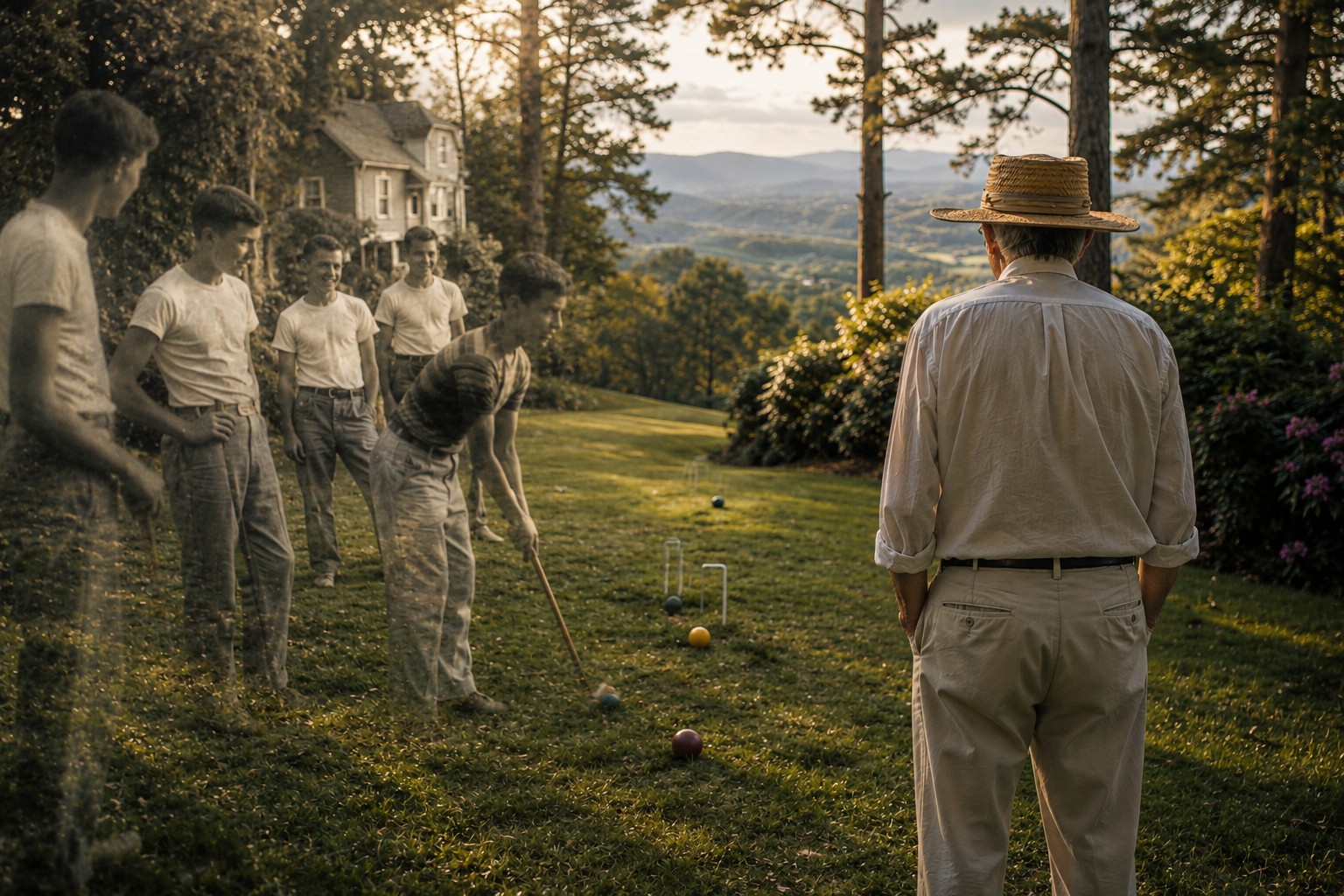
My feet were planted firmly and deliberately on the ground, slightly wider than shoulder width. My body, relaxed and balanced. One hand rested at waist level atop the mallet handle while the other settled lower, wherever comfort and habit had taught it to belong. The mallet hung naturally between my legs, its head poised just behind the ball. I lowered my eyes and followed an invisible line from the center of the ball toward my target. Everything aligned—the ball, the mallet, the distant wicket.
I knew exactly what would come next. With a smooth pendulum swing, I would send the mallet forward, hopefully striking the exact middle of the ball with the center of the mallet head. Just a clean, controlled stroke followed by an easy, unforced follow-through.
Before the mallet could complete its journey, my eyes wandered across the court. It sloped. It dipped. It rose unexpectedly. Grass gave way to patches of dirt. Dirt surrendered to weeds. A ball aimed carefully at a wicket might obey the player—or it might obey the slope. Every shot demanded adjustment. Every turn required patience. Success depended as much on adaptation as skill.
The course occupied a small clearing below the house, tucked among towering trees and surrounded by gardens that had spent decades settling into the mountain. From some spots, the Shenandoah Valley peeked through the foliage below. From others, the trees enclosed the court in a world of their own. Sunlight filtered through the leaves overhead, scattering patches of light and shadow across the grass. No two shots looked quite the same.
A croquet purist would likely find fault with nearly everything about it. The ground wasn’t level. The grass wasn’t uniform. Roots lurked beneath the surface. Gravity inserted itself into nearly every decision. Yet the court possessed a certain stubborn charm. It was not the court one might design from scratch. It was the court the mountain allowed. It was the court that Gary designed, determined to play here on the mountain.
My body remembered this. It had known this posture longer than the mountain had known this court.
To reach that court, I had to climb up a steep flight of concrete steps and walk through a loosely hinged metal gate that opened onto a long expanse of turf, cut close and tight. The starting point was a little way ahead, not far from the double clothesline stretched tight between two iron T’s. It was a narrow yard behind a white, clapboard colonial house across the road where I lived. Looking uphill beyond the fence, I could just barely see the roofline of a small cottage midway up the mountain. Looking to the end of the yard, the grass seemed to end where a fence had once been and where a grove of white pines towered over their needled floor, shading the two-story brick house in their midst.
The court began at the start of the clothesline, continued across the grass, and double-diamonded its way through an expansive and steep pine-needled slope behind the neighboring brick house, where the air turned cool and sharp with the smell of pine. On that court, too, a ball aimed carefully at a wicket might obey the player—or it might obey the slope. Every shot demanded adjustment. Every turn invited improvisation. Success depended as much on imagination as skill.
“You’re taking too long,” Gary called.
The mallet met the ball with a satisfying crack. My burgundy ball started confidently toward the waiting white wicket before surrendering, inch by inch, to the quiet persuasion of gravity.
Gary, shaded beneath his floppy blue sun hat, watched it drift off course and laughed. Beneath the broad brim of my straw hat, I laughed too. There we stood, two old men peering from beneath oversized brims, smelling of sunscreen and freshly cut grass, both convinced that the next shot would surely behave itself.
It didn’t.
Our next shots were even worse. Both balls gathered speed, raced gleefully downhill, crossed the boundary, and disappeared into the weeds. We looked at one another for a moment, then burst into laughter—the kind born of disbelief, optimism, and the certainty that we’d simply climb the hill and try again.
We retrieved our balls, walked back uphill, and tried again.
The older boys—home from college for the summer—were already waiting, mallets in hand. Impossibly slim in their side-tabbed trousers and white T-shirts, bronzed and unworried by the sun, they stood with the easy confidence of boys who belonged to the game. The air around them carried the faint, exotic drift of Jade East. Word traveled fast in a small town. They knew. Before I had even reached the gate, the squabbling began—whose team I would join, whose side would have me. I stepped into my place among them, planted my feet, lowered my eyes to the ball, and looked toward the waiting wicket.
That summer lived inside those arguments over me. I was one of them—not the youngest tag-along, not the kid from across the road, but a player worth having. Damned good, if the squabbling meant anything. The laughter came easily there, too. Cheers rose when a ball slipped cleanly through a wicket. Groans turned into laughter when it didn’t. Before the echoes faded, someone was already settling over the next shot, convinced this one would be different.
The wicket waited.
So did the slope.
So did the laughter.
Hands settled comfortably on well-worn mallets.
Feet found familiar ground.
Eyes followed an invisible line toward a distant wicket.
Everything aligned.
The mallet. The ball. The wicket.
And for one suspended moment, before the swing began, there was only belief that the ball would find its line.
“The truth is, no one of us can be free until everybody is free.” —Maya Angelou(1928–2014). American poet, author, and civil rights activist whose writings explored identity, dignity, freedom, and the shared humanity of all people.
“Write. Just write.”
That’s what I always tell aspiring writers.
“Write as if this will be your last line and your life depends on it. Or maybe your life after death depends on your last line.”
They stare. They roll their eyes. They purse their lips. They start. They write.
And after they’ve written several pages, I interrupt, knowing the gasps that will follow:
“Ignore the first page or two. Writers often discover their real starting point at the top of page two or three.”
“Ignore it? Throw it away?”
“Yeah, usually. Think of those pages as a warm-up exercise. Think of those pages as a way of finding the starting point.”
Ironically, it’s almost always true, even for seasoned writers. Maybe especially for seasoned writers.
I wish it were true for me. This time. This post.
But it’s not.
There’s no way—there’s just no way—that I’m going to start this post with the line I’d have to start it with if I applied my own advice:
“Are you a friend of Dorothy’s?”
Here’s why I wouldn’t.
I’m betting you’d ask:
“Who’s Dorothy?”
That’s what I asked myself yesterday when I stumbled accidentally upon the question. After I found the answer, I kept wishing I had known about it in the 1950s when I was growing up, wondering how on earth I’d ever recognize someone else like me. Queer.
Let’s face it. The eye contact thing—the looking back to see if he was looking back to see—was a hard if not impossible way to identify a kindred soul. How could I be sure? And I wasn’t about to come out and ask:
“Are you, you know—like me.”
But if I had known about Dorothy, I would have let it slip casually into the conversation:
“And are you a friend of Dorothy’s?”
“Yes” would have moved the conversation far, far away from small talk.
But I didn’t know then that the question was a coded phrase used by the LGBTQ+ community—particularly gay men—throughout the mid-20th century to discreetly identify one another.
Safe. Veiled. No risk. No exposure. No hostility. No legal trouble.
I’m surprised that it took me seventy-eight years to learn about the question and its answer. But I’m not surprised that I did so during Pride Month.
I had been paying close attention to the June headlines.
Some were celebratory. Governor Hochul proclaimed June 2026 LGBTQ+ Pride Month in New York. Orange County recognized Pride Month for the first time. Richmond listed eleven events to check out this June.
Others were not. Indiana’s governor declared Pride Month “Nuclear Family Month.” Republican governors across the country rebranded it with conservative alternatives. Tennessee followed Indiana’s lead. In Pinellas, Pride met “Faith and Family” pushback.
Then came a headline closer to home. It hit hard. Someone I knew shamed their former employer on FB for celebrating Pride Month and used a classic but outlandish propaganda technique: mix a few kernels of truth with a few outdated statistics, several disputed claims, some outright falsehoods, and then present everything under the banner:
“No Pride in Gay Life: THE FACTS.”
It only took me a minute or so to read the FB post. But it took me far longer to process my emotions. Anger. Sadness. Disappointment. Exhaustion. Surprise that it came from—someone I knew.
It took me even longer as I questioned what exactly we’re celebrating in June. Being gay, lesbian, bisexual, transgender, or queer? Hard-won advances that allow millions of people to live more openly than they could a generation ago? Battles that remain to be fought?
They’re not the same things. One is identity: human beings with shared blood pulsing in our veins and with shared hopes living in our hearts. The second is history: yesterday. The third is hope: today and tomorrow.
Suddenly, I realized that when we celebrate Pride Month, June ends and LGBTQ+ people remain marginalized.
Suddenly, I realized that when we celebrate Black History Month, February ends and Black Americans remain marginalized.
Suddenly, I realized that when we celebrate Women’s History Month, March ends and women remain marginalized.
Suddenly, I realized that when we celebrate Native American History Month, November ends and Native Americans remain marginalized.
Suddenly, I realized that we’ve gotten very good at celebrating people we’re still marginalizing.
We can do better.
We can be better.
We must.
I hope I live to see the day when Pride Month never ends.
I hope I live to see the day when Black History month never ends.
I hope I live to see the day when Women’s History Month never ends.
I hope I live to see the day when Native American Month never ends.
I hope I live to see the day when special months never end because we no longer need a special time to remind us that we are special humans every moment of every day of every month—all the time.
A day when dignity is not reserved for June or February or March or November.
A day when respect does not depend upon race, religion, gender, orientation, age, birthplace, wealth, education, politics, or any of the countless labels we use to divide ourselves into tribes.
A day when we stop asking who belongs and start assuming that everyone does.
Come fast the day when we see the person before we see the category.
Come fast the day when our differences invite our curiosity rather than our suspicion.
Come fast the day when no child grows up wondering whether there is anyone else in the world like them.
Come fast the day when we won’t need to ask, “Are you a friend of Dorothy’s?”
Several years ago, I wrote this reflection on my father. Father’s Day seems an appropriate time to share it once again.
Not long ago, I went searching for a relic that I thought I had stored in the loft. I looked and looked, but I never found whatever it was that sent me on my quest. Instead, I may have found more.
As I rummaged through heaps of possessions—some treasured; some not—I found an elegantly framed photograph that Sister gave me decades ago. (In true Southern fashion—at least in my family—you never call the oldest daughter or the oldest son by their first names. Audrey has always been Sister; John, always Brother.) Sister gave all five siblings copies of the same photograph. Hers is lighted and hangs proudly and prominently on the wall that you see when you walk into her dining room. It’s a photograph of an old man—a very old man, head bowed, forehead leaning on clasped hands, and elbows resting on the dining room table. On the table, a loaf of bread, a bowl with spoon, a knife, and a cross-laden tome. At first glance, the photograph appears to be a copy of “Grace”—Eric Enstrom’s famous 1918 photograph of a Minnesota miner. You may have seen it in a home, a church, or a restaurant. I’ve seen it everywhere.
The photograph on Sister’s dining room wall is identical to Enstrom’s in every detail save two. First, the old man in her photograph has no beard. Second, the old man in her photograph is not the Minnesota miner. He’s a West Virginia coal miner. He’s my father.
I’m rapt by the photograph, and I wonder now—just as I did when Sister gave me my copy—how she ever convinced my father to pose for it. My father knew neither artifice nor airs. More, though, I ponder an overarching question, “Why did Sister have my father sit for such a photograph?”
I had never seen my father’s hands clasped in prayer as they are clasped in Sister’s photograph. My mother was the one who always said grace at our table, with all of us joining hands. It was not until late in life—perhaps just a few years before Sister’s photograph—that my father became a Christian. Certainly he would not have prayed at mealtime before then. By the time he became a Christian, I no longer lived at home. Sister, though, lived next door. Perhaps Sister had seen my father say grace.
I can’t say what Sister saw, but, as for me, I remember my father’s hands differently.
I remember my father’s hands as strong hands. When but a child—no more than four or five, so small that I had to stand on a kitchen chair to watch as he butchered a fresh chicken—I reached out to ask, “What’s that?” just as his cleaver—raised high in air—came thrusting down to sever the chicken breast. The cleaver could not stop. With equal speed, my father’s hand grasped my nearly severed right hand and held it in place until the doctor arrived. Today, the scar that spans my hand authenticates the strength of his: holding on, not letting go.
I remember my father’s hands as a coal miner’s hands—fiercely strong, calloused, rough, knuckle battered, and sooty from coal that could not be scrubbed away. Those hands shoveled coal for fifty years, never missing a day, never suffering injury. Those hands provided.
I remember my father’s hands as a gardener’s hands—perfectly patient, tenacious, self-confident, and unswerving as he pushed the plow, laying rows as straight as the crow flies. “Don’t look down,” he prompted, when the time came for him to teach me how to plow a row. “Stay focused on one thing at the end.” Those hands gardened longer than they mined, never missing a season, never losing a harvest. Those hands fed.
I remember my father’s hands as a carpenter’s hands—steady, certain, and capable as he remodeled our home and helped others remodel theirs, working with wood and wallboard, concrete and plaster. Those hands were untrained hands. “Just a jackleg carpenter,” he’d say of himself. Those hands built.
I remember my father’s hands as a thinker’s hands. His walking carriage, always—whether in coal miner’s “bank clothes” or in white starched shirt and khakis (always his at-home attire)—was with hands behind back, palms out, right resting in left.
Later in life—with our roles reversed: I, the caregiver; my father the one for whom I cared—I saw his hands as gentle hands. As age and illness weakened his body, softened his heart, and calmed his soul, I often held his hands in mine. One day, and I remember it vividly, I had a great curiosity—a compelling curiosity—to compare our hands, his and mine. I asked him to hold his hands out in front of him, and, as he did, I outstretched my hands to his, touching. Our hands were perfect matches—identical—his hands and mine.
And when my father lay in bed dying, I held his hands in mine until we both knew peace as death came with certainty and with finality.
The next day my mother and I made funeral arrangements. We both wanted understated elegance. The brushed, platinum-finished casket with a solid white silk lining—without tufting or design—seemed perfect.
When the evening of my father’s wake arrived, I walked with my mother toward the open casket where my father lay. Even from the far end of the chapel, we could see something on the lining of the raised casket lid—a design.
Drawing closer, we were both taken aback as we looked inside the casket lid. It was not what we had ordered. It was not a solid white silk lining without tufting or design.
Instead we witnessed—together—a pair of praying hands. To the right of the hands, the words, “May God hold you in the palm of His hand until we meet again.”
It was not what my mother and I had planned. It was not what we had ordered. And, yet, the praying hands were there, holding for me—and I believe for me alone—a lasting message.
My Father’s hands.
My father’s hands.
My hands.
Now, as I look back, I see Sister differently. Now, as I look back, I see her photograph of my father differently. Being older than I, Sister knew my father longer—and better. Living closer to my father than I, she had spent more time with him. Being more blessed than I, Sister had more than enough grace to glimpse my father’s hands in ways that I would not see until the end.
“There is no pillow so soft as a clear conscience.” —French proverb
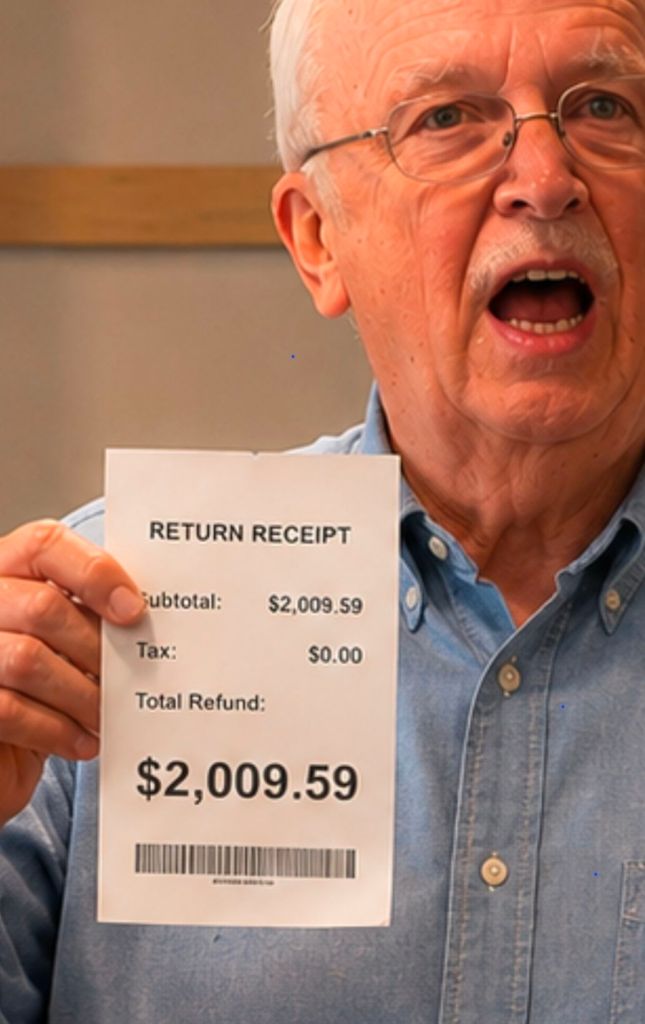
$2,009.59.
I stared in disbelief. I swallowed deep.
I had to word the amount to myself silently so that my brain could comprehend the bottom line on the receipt.
Two thousand nine dollars and fifty-nine cents.
It didn’t add up.
“Excuse me. I think you made a mistake.”
“Let me see.”
The sales associate reviewed the return receipt, looked at me, and smiled,
“No. It’s correct. That amount will be credited to your account.”
I looked at the receipt again, just to confirm what I knew already.
“Don’t I wish. But the refund amount is way too much. Look. Let me show you what happened.”
I circled $868.00 on the receipt.
“See. You refunded the full amount for 8 boxes of Detroit 4×12 tile. I only returned 1 box.”
Then I circled $823.77.
“And see right here. You refunded the full amount for 9 boxes of Classico Bardiglio Hexagon tiles. I only returned 2 boxes.”
I proceeded to circle and explain other areas involving incorrect refunds.
The associate followed along attentively.
“I can’t do anything about it. The refund is already in the system”
“But you have to fix the mistake. That’s not my money.”
After hearing once more that the refund had been processed already, I paused, took a deep breath, and laughed.
“I’ve never worked so hard at returning something that’s not mine. Can I talk to a manager?”
By the time the manager arrived, I was as amused as annoyed.
“So do you want your $2,009.59 back or what?”
I explained everything all over again.
“I don’t think I can fix it.”
“You mean you can’t override the transaction.”
“Nope. Maybe headquarters will know how.”
They did. Add the full purchases back to my account, minus the boxes of tiles I had returned. That would offset the incorrect refund.
It struck me as convoluted, but I had just lost two hours of my morning already.
A card swipe, a new refund receipt, and a handshake later, I was on my way home.
Less than a mile from the store, my phone rang. By the time I reached a nearby farmers market and listened to the voicemail, I knew my morning wasn’t over.
“Mr. Kendrick, in reviewing what we just did, I realize that I only fixed the problem for one of the tile returns. You need to come back to the store so I can do the other adjustment.”
I returned, weighing all the while the price of honesty.
The manager laughed, apologized, and proceeded to fix the second error on the return.
“I have to tell you that I just had a bathroom remodeled. This return was the worst part of it all.”
“I understand. I’ve added a $70 discount for your trouble. You deserve it.”
Ironically, I didn’t deserve it. Honesty is its own reward.
The rake lay across the heart, as if it were Cupid’s arrow. Beads of water gathered on the thermos, upright on the nearby stone bench, right beside St. Francis of Assisi. Leather gloves and pruning shears bore witness to a gardener. Gary.
I couldn’t see him, but I knew he couldn’t be far away because his seafoam, floppy hat was not on the bench with his other things.
I knew what he was up to.
The time had come for him to do what I had done down through the years since I built the garden, filling it in with tons of tan pea gravel and surrounding it with a hedge of Little Missy boxwood.
Early on, the labor of weeding was easy. The pea gravel kept unwanted growth under control and beneath the surface. But over time the AngelinaSedum, filling the two circles in the heart’s upper lobes and surrounding the Magnolia in the lower cusp’s circle, died out but not before leaping over the rings that held them. Small chartreuse-yellow clusters softened the heart but lessened its definition.
Gary, my partner—the man who now shares this mountain life me—was doing more than weeding. He had already restored the flagstone pathway leading from heart to home and back again. Now he was planting healing Ajuga that will settle in and stay within the upper rings, eventually sending up purple spikes. Now he was cleaning, making everything as pristine as the day I finished my handiwork. I sat down on the bench, surveyed the slope, and sighed,
“Well done.”
I never had any intention of building the heart garden. My late partner Allen and I had tamed our mountaintop wilderness with so many paradisiacal garden beds that we had declared a moratorium:
“No more.”
But when Allen died and I reflected on where I would scatter his ashes, as mutually agreed upon, I could not for the life of me decide upon the right spot.
We had talked about resting places on our mountaintop, usually settling on the peony garden. Once, even, Allen suggested the Koi Pond would be perfect, but amid laughter, we both exclaimed:
“Oh, no! What happens when the pond filters get cleaned.”
Then, a few months after his death, he came to me in a dream, his voice carrying into my awakening and lingering there:
“Build my heart.”
I knew where. Near the house, at road’s edge—an untamed area we thought about gardening if we ever gave our moratorium a reprieve.
I had no idea how, but I figured a little math and lots of heart would make it happen.
And it did. I marked off an area twenty feet wide and thirty feet deep, sketched a heart with a black water hose, freed the earth of weeds, and blanketed it with pea gravel running deep. For Allen’s celebration of life, I surrounded the heart with SunPatiens, alternating red and white with tears and rain. I bought a wooden Zen rake, perfect for committing Allen’s ashes to the gravel, leaving tracings that mirrored the heart’s design, growing smaller and smaller as the center neared. Later, I planted the boxwood hedge.
Thus, the heart’s beginning.
Time has been kind. But still, the heart needs Gary’s loving care and tenderness. It rests within the landscape, its presence a part of forever.
The morning after Gary finished, we decided to amble down the path, pristinely cleaned and gently curved, with the heart in clear view.
“You go ahead. I’ll be there shortly.”
“No. I’ll wait. For you.”
It was peaceful and inviting.
We talked a little less than usual, as the morning chill quickened us and a Northern Cardinal in the treetops above whistled out its own litany of little questions.
“I want your ashes to be happy here.”
They will.
And when Gary’s time comes, I’ll board the train, his weight on my lap, my hands on the box, making his final journey to Minnesota where his story began.
“Like an old friend waiting on the porch, Poor Brentford appears at the entrance to each section, tips his hat, shares a thought, and invites readers to come a little farther along.”
Drumroll, please!
The moment absolutely no one has been waiting for has arrived!
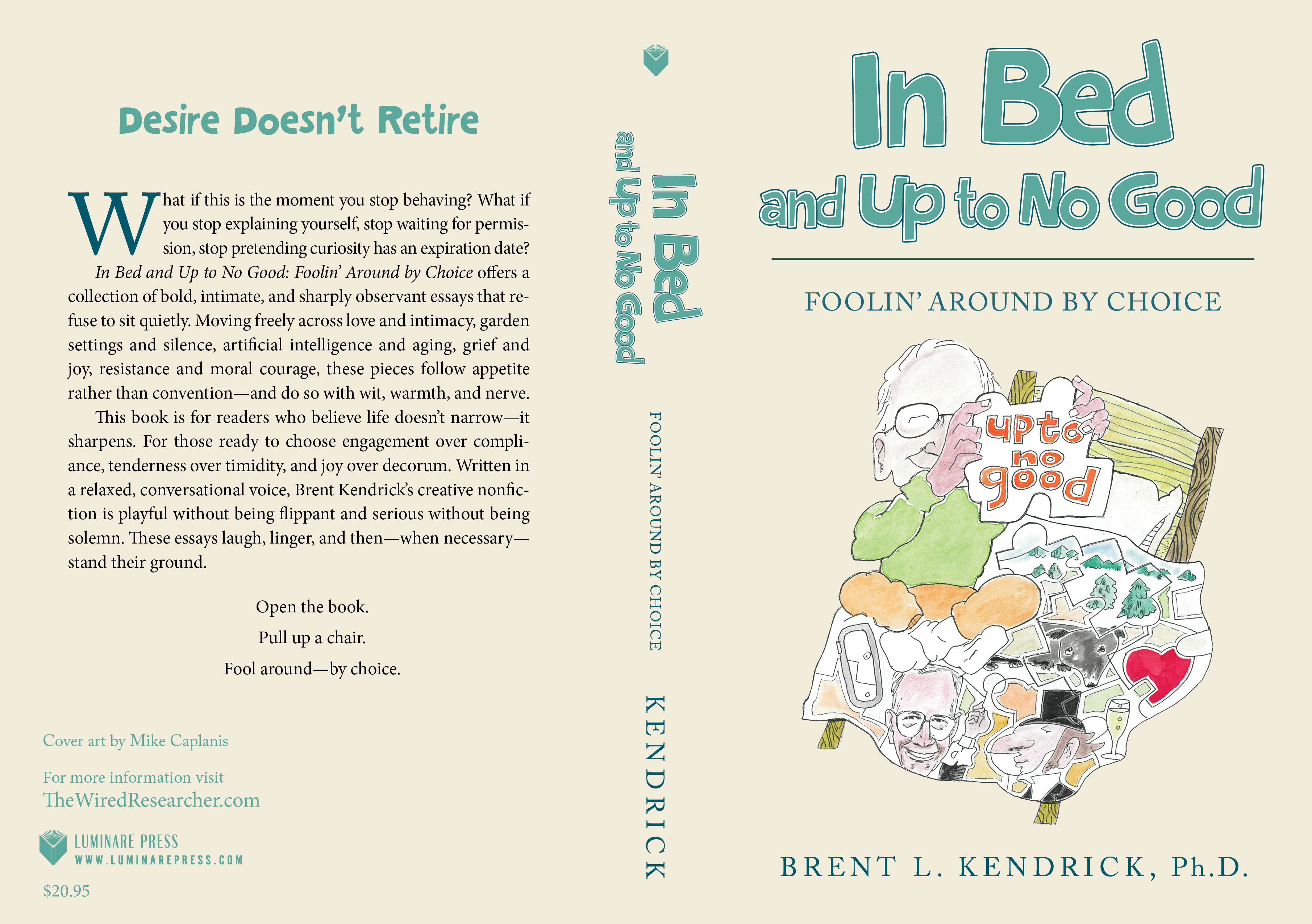
I’m pleased to announce that Up to No Good, the fifth book in TheWired ResearcherSeries and my fourth InBed book, is now available.
But before I tell you where to find it, let me tell you why it’s different.
For the past several years, I’ve been foolin’ around in bed. Stop right there! Don’t you dare call the authorities. I’m talking about writing.
The first volume appeared in 2023. Two more followed. Each gathered together a year’s worth of essays from The Wired Researcher, preserving them much as they originally appeared—one after another, week after week, moving steadily forward through time.
There was something honest about that approach. Readers experienced the essays in much the same order that I lived them.
But while assembling this fourth volume, I discovered something that surprised me.
A collection gathers.
A book shapes.
The distinction may sound small, but it changed everything.
For the first time, I stopped thinking primarily about chronology and started thinking about conversation.
● What happens when essays written months apart find themselves side by side?
● What emerges when humor sits next to heartbreak?
● What new meaning appears when an essay about gardening quietly speaks to one about grief, love, aging, democracy, memory, or biscuits?
The more I explored those questions, the more I realized that this volume wanted to become something different.
Not merely a collection.
A book.
A reading experience.
In the introduction, I explain that these essays are grouped “by the questions they worry, the moments they linger over, the emotional weather they share.”
That simple shift transformed the project.
Essays began speaking to one another.
Patterns emerged.
Themes surfaced that I hadn’t fully recognized when writing the individual pieces.
Then something else happened.
Poor Brentford Lee got involved.
Those of you who have followed my blog know Poor Brentford—the mountain philosopher, accidental theologian, occasional dispenser of homespun wisdom, and longtime observer of life’s oddities and wonders.
In earlier volumes, Poor Brentford mostly wandered in and out of individual essays.
This time, he grabbed hold of the entire book.
As the sections took shape, Poor Brentford somehow appointed himself official greeter, introducing each one with a bit of homespun wisdom uniquely his own.
“Most of what saves us wasn’t planned. It just kept growing anyway.”
“Everybody’s handed something they didn’t order. The rest is choice.”
“We were just boxwoods until someone believed we could be part of something beautiful.”
Frankly, I’m not sure I had much say in the matter.
Poor Brentford can be bodacious that way.
The result is that he now wanders throughout the book, standing at the entrance to every section, tipping his hat, offering a thought, and inviting readers to come a little farther along.
In many ways, Poor Brentford became the connective thread that helped transform a collection of essays into a unified reading experience.
Instead of moving week by week through a calendar year, readers move through twelve thematic landscapes:
What Grows, Teaches explores gardens, reinvention, second chances, patience, and grace.
What We Do with What We’re Given examines mishearings, limitations, temptations, acceptance, and the choices that shape a life.
Chosen Ground asks what it means to belong—to a place, to a memory, and ultimately to ourselves.
Those We Carry reflects on the people who continue to live within us long after they are gone.
Plagiarism À La Carte celebrates borrowing, influence, recipes, wit, and the occasional joyful act of making something unmistakably your own.
What We Lean On explores the quiet structures that steady us through uncertainty, solitude, and change.
On Our Own Terms examines aging, authenticity, self-authorship, and the liberating realization that we no longer need permission to be ourselves.
Giving Forward honors educators, mentors, benefactors, and all those who quietly build bridges for others.
Together, One ventures into fascinating territory where human curiosity meets artificial intelligence and asks what happens when we learn alongside the tools we create.
Literary Wanderings follows books, writers, forgotten voices, and the ideas that continue to shape us.
Choosing Love Again explores something I never expected to experience at this stage of life: the extraordinary privilege of falling in love once more.
And finally, When Democracy Falters gathers essays written from the conviction that citizenship is not a spectator sport and that silence carries consequences of its own.
Looking back, I realize that what changed wasn’t merely the arrangement of the essays.
What changed was the way I saw them.
Teaching literature for decades trained me to look beneath the surface, to ask how individual parts contribute to larger meanings. Somewhere along the way, I began applying that same close reading to my own writing.
The result is this book.
Some readers will recognize essays they first encountered on the blog. I hope they do. But I also hope they’ll discover something new in the conversations those essays now have with one another.
Others will be encountering many of these pieces for the first time.
Either way, my hope is that readers will find themselves lingering.
Laughing.
Remembering.
Questioning.
Growing.
Perhaps even falling a little more deeply in love with life itself.
After all, that’s what these essays have been teaching me all along.
In Bed and Up to No Good: Foolin’ Around by Choice is now available through Amazon and Barnes & Noble.
If you’d like to see what happens when a collection becomes a book—and when Poor Brentford appoints himself tour guide—I’d be honored to have you join me for the journey.
And as always, thank you for reading. Without readers, essays are merely conversations waiting to happen.
“It’s not what you look at that matters, it’s what you see.” — Henry David Thoreau (1817–1862). American essayist, naturalist, and philosopher whose Walden remains one of literature’s most enduring calls to deliberate, examined living.
I linger long, and I look hard at most things. I used to call it a “close reading” of a text. These days I see it more as a close reading of life. Lately, I’m lingering longer and looking harder, especially at headlines.
The other day, I was startled by the proliferation of headlines announcing Pope Leo XIV’s first encyclical:
● “Pope Leo XIV’s New Warning: He Now Calls for ‘Disarming Artificial Intelligence'”
● “Pope Leo Issues Biblical Warning about the Rise of AI”
● “Pope Leo’s Unsettling Vision of the AI Future”
● “Pope Leo Warns of AI Fueling Warfare”
● “Pope Leo Quotes Gandalf as He Issues Dire Warning about Rise of AI”
I could quote more, but those headlines send out their message clearly.
I was shocked and disappointed to see His Holiness taking a seemingly negative position about an advancement that holds such high hope for helping humanity in ways beyond our ability to help ourselves.
I couldn’t help but wonder what impact the encyclical would have on the world’s 1.4 billion baptized members of the Catholic Church, especially considering the controversial nature of AI.
I paused, hesitant to accept the headlines in front of me. After all, I’m aware that many headlines are generated with the assistance of artificial intelligence. They’re crafted for speed, clicks, and emotional impact. But I also know that a human being still approved those words, still chose the emphasis, and still decided what readers would see first. AI may help write the headline, but humans shape the message.
Also, the Pope’s view of AI—suggested by the headlines—seemed too skewed across a variety of sources.
I kept looking. I landed on different ones with different perspectives:
● “AI Must Serve Humanity”
● “Pope Leo Calls for Ethical Limits on AI”
● “Pope Leo’s ‘Magnifica humanitas’: AI Must Serve Humanity Not Concentrate Power”
I liked these headlines better.
But liking has nothing to do with finding truth.
I knew exactly what I had to do. Go to the source. Read the encyclical for myself.
I did. I read Magnifica humanitas—all of it, roughly 42,000 words.
I could tell you that the overall thrust of the encyclical is that humanity must not surrender its moral, spiritual, political, or relational responsibilities to systems of power—whether technological, economic, or ideological—but must remain deeply committed to human dignity, truth, community, and the common good.
I could tell you that the Pope is ultimately asking not whether technology is advancing, but whether humanity itself is advancing along with it.
I could tell you what I consider to be the encyclical’s top five points:
1. Human dignity must remain at the center of society.
2. Truth matters and must be pursued carefully.
3. Solidarity and the common good require shared responsibility.
4. Technology is powerful but must be guided ethically and politically.
5. Human flourishing depends upon relationships, care, and community.
But since I’m not going to tell you any of those things, I’m not about to tell you that although he didn’t mention Gandalf by name, he quotes one of his famous lines:
“It is not our part to master all the tides of the world, but to do what is in us for the succour of those years wherein we are set, uprooting the evil in the fields that we know, so that those who live after may have clean earth to till.”
The Pope even cites Beethoven’s Ninth as an example of art preserving and expressing humanity’s longing for unity, dignity, and transcendence.
But you didn’t hear it from me. And there’s no way–there’s just no way–that I’m going to tell you that the Pope’s recurring question is not whether AI will shape the future—it clearly will—but whether human beings will remain wise, engaged, compassionate, and morally awake enough to shape it in return. Again and again, the encyclical insists that we must not surrender our responsibilities to systems of efficiency, profit, control, or technological inevitability. Human beings must remain active participants in deciding how these tools are designed, governed, regulated, and used.
And since I’m not telling you those things, I won’t tell you that the encyclical is far less a rejection of technology than a call for moral vigilance and human stewardship. The Pope repeatedly acknowledges the remarkable promise of technological innovation, including AI, while warning that power without ethical formation can easily become dehumanizing. The central challenge, as His Holiness sees it, is not merely building smarter systems, but ensuring that humanity itself continues to grow in wisdom, justice, truthfulness, compassion, and care for one another while using them.
In case you’re wondering why I’m not going to tell you any of those things, it’s simple. If you really want to know what the Pope has to say about AI, ignore the headlines. Ignore them all. Instead, go to the encyclical itself and read it. Give it a close reading. Find truth.
Once you’ve done that, sit back and reflect on all the other headlines grabbing your attention. Forget whether you like the headlines. Instead, focus on finding truth.
Maybe that’s the larger lesson here.
If we truly want to understand what someone believes—whether it’s a pope, a politician, a journalist, a neighbor, or even someone we love—we cannot depend entirely upon summaries, snippets, reactions, headlines, algorithms, or the emotional momentum of the crowd. We have to slow down. We have to return to the source. We have to read more carefully than modern life—and perhaps especially modern technology—often encourages us to read.
The older I get, the more convinced I become that close reading is not simply something we practice in English classes. It may be one of the most important skills we have left in an age increasingly shaped by artificial intelligence, instant information, and manufactured urgency.
A close reading of the news. A close reading of what people actually say. A close reading of our assumptions. A close reading of the stories we tell ourselves. A close reading of our own hearts.
Maybe that’s one way we resist becoming careless in a world moving faster than human reflection was ever meant to move.