Ounce of Prevention. Pound of Cure.


“Never mistake the season for the signal.”

—Poor Brentford Lee (b. 1947.) He reads the signs, trusts the seasons, studies the soil—and is not above reminding others when they’ve mistaken one for the other.


“Absolutely not!”

“You must! Please, help.”

“This time, young man, you’ve gotten yourself in so deep that I can’t help.”

“Yes, you can. I know you can. You know everything.”

I was certain my pitiful entreaties would soften Poor Brentford’s heart and move him to help.

But no. He would not be moved.

“You got yourself into this mess all by yourself.”

“And just how did I do that? Come on, Brentford Lee. Help me.”

“I can’t. Why on earth did you think you could read Mother Nature—in April, no less? Don’t you know that’s the cruelest month of all, especially in the Shenandoah Valley?”

I knew that, of course. It’s the time of year when the world seems to be coming alive again—only to have Mother Nature step in and kill that vibrant new growth with a harsh, chilling frost.

That’s why Valley folks rarely plant tender crops until mid-May, after the danger of frost has passed.

So. There. I do know those precautions.

But last year, we found ourselves in a new gardening zone. Our old Zone 6 became Zone 7, with the danger of frost ending around mid-April.

I was cautiously thrilled—but I still waited until early May, when the ground was warm and the forest fully leafed.

This year, though, my mountaintop felt different. The soil warmed sooner. The forest leafed sooner. Sooner, it turned out, was early April.

“Wait and see,” I kept telling Gary. “When the mountaintop turns green, we’re past the danger of frost.”

“Are you sure?”

“Of course, I am. Mother Nature knows what she’s doing. She’s telling us Spring has overtaken Winter.”

And so it was. I had convinced myself. I managed to convince Gary. Together, we planted—and rejoiced in the head start.

Just as we beamed our widest smiles, we checked the weather.

Mother Nature was pulling a switcheroo.

Frost. April 22. 2:00 a.m. to 10:00 a.m.

27°? 30°?

The forecasts varied, but we knew: our plants were doomed unless we intervened—and maybe even then.

Poor Brentford was no help whatsoever. He had the nerve to smirk:

“An ounce of prevention is worth a pound of cure.”

I know. I know. We should not have planted.

But we did.

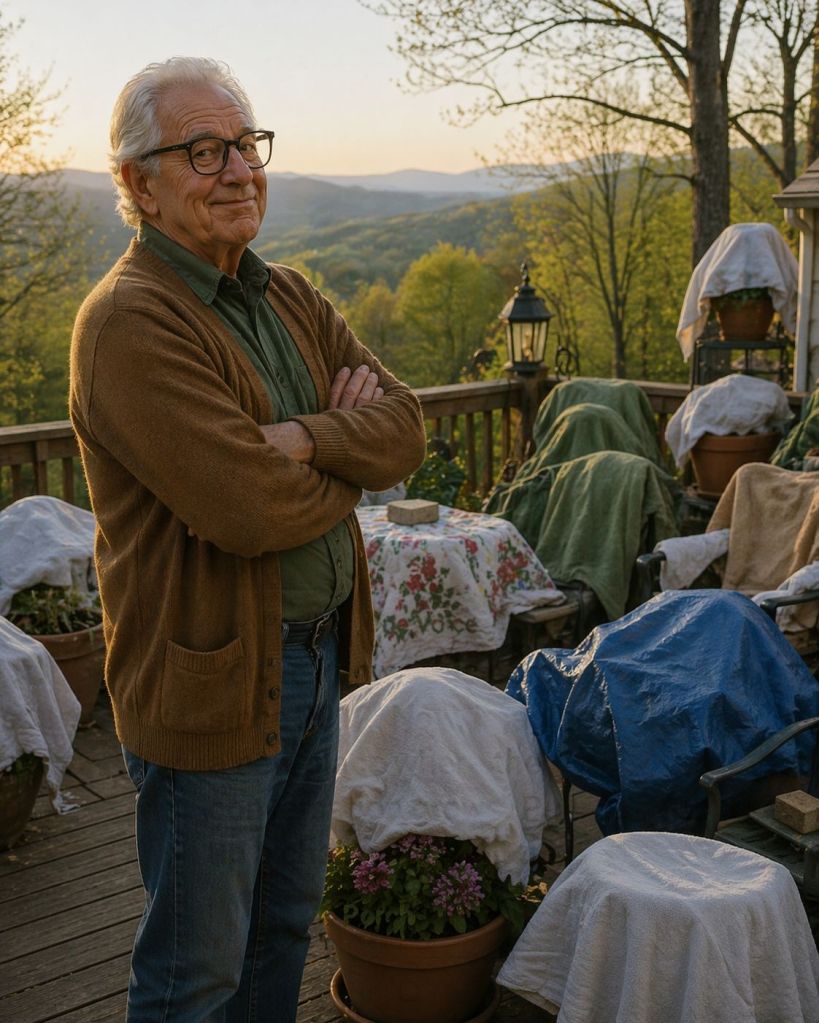
And there we were, scrambling to invent a pound of cure for our poor, tender, pitiful plants—deck, patio, yard—everywhere. Pots filled with blooms that had no business showing off this early.

What followed was less a plan than an emergency deployment.

Tarps emerged from the basement. Towels defected from bathrooms. A festive tablecloth—clearly never intended for agricultural duty—was reassigned to frost prevention. Gary moved with operational urgency.

Clay pots became heat traps. Chairs became scaffolding. We hurried bewildered begonias to safer quarters. We draped. We pinned. We tucked. We hoped.

By dusk, the deck resembled an archaeological dig disguised as a linen sale. Shapes rose under fabric—domes, humps, improbable ridgelines of cotton and optimism. Each tender plant huddled beneath its improvised shelter, awaiting judgment from a sky that had seemed so kind only hours before.

Poor Brentford Surveys the Scene.

Judgment came in the early morning hours.

Harsher than expected.
Colder than predicted.
Twenty-four degrees.

Poor Brentford surveyed the scene.

“Your pound of cure was heroic,” he observed. “But was it enough?”

I looked out at the mountains and smiled. The trees, in all their green fullness, had been spared.

We began uncovering our plants.

One by one.

Here a bloom lifted.
There a stem held.
Elsewhere, leaves—cold, but alive.

We kept going.

More life.
More holding on.
More quiet insistence.

In the end, we lost only one.

And that one? To be honest, I had not been covered it very well at all.

I stood there a moment longer than necessary.

I had been prepared to blame the frost.

This time, I didn’t.

And I let that be enough.

To Mend or Not to Mend, that Is the Question | Poor Brentford Has His Notions


“Some things serve us best by finishing well.”
— Poor Brentford Lee (b. 1947. Advisor on matters requiring both thread and judgment. Maintains that things well used are best released with gratitude.)


Poor thing. It was just hanging there in the closet.

My favorite purple linen shirt. It was freshly ironed, as it always is, because Gary cares and continues faithfully to press it into presentability even though we both know the collar has grown thin, the threads worn nearly bare, the fabric softened beyond persuasion by years of loyal service at the neckline.

It hangs. Right beside the better ones, right beside the best ones. It still looks handsome at a distance. The color holds its dignity. The linen remembers its authority.

But up close, the collar tells the truth.

There I stood, looking at it, wondering whether I might wear it out in public one more time.

“Dare I?”

I suspected not.

Still, the idea would not entirely leave me. Gary has shown more than once that he knows his way around a needle. I have seen evidence of his skill. A careful stitch here, a thoughtful repair there. Nothing dramatic. Simply competent and reliable.

I couldn’t help but wonder:

“Could Gary save my collar? Could he perform one more act of restoration that would allow me to parade around in public in my old faithful shirt?”

I stood there longer than any sensible person should reasonably devote to a worn piece of linen, quietly debating whether dignity required retirement or reinforcement.

And that was when Poor Brentford arrived.

He did not offer advice immediately. Poor Brentford rarely rushes. He prefers to ask me questions that seem innocent until I attempt to answer them.

“Are you quite certain,” he asked mildly, “that this is a path you wish to explore?”

I did not answer because I knew what direction he was about to take.

Poor Brentford’s memory is longer than I care to admit, even when it comes to fabric.

“Don’t you recall other occasions,” he continued, “when well-intended mending produced unintended outcomes?”

He did not need to specify.

I knew. But I chose to give him that blank stare that always works for me when I feign innocence.

“Remember your sister’s dress?”

Of course, I did. Judy needed something special for an important high school occasion. She had a lovely white dress–a hand-me-down from an older sister. Elegant, well made, perfectly respectable. But what teenage lady wants to wear a dress that has made its public debut already?

“Surely you remember the persuasive talk your resourceful mother gave her?”

“‘Judy,’ she whimpered with soft confidence, “I can transform that dress into something so stunning it will look brand new. A packet of Rit dye is all I need. Pink will be breathtaking on you.'”

Poor Brentford need not have refreshed my memory further. I remembered all.

My mother prepared the dye, immersed the dress, and waited the appointed time.

Judy and I walked out into the back yard with my mother as she hung the dress on the clothesline.

“Oh, Judy. It’s stunning!”

Judy looked, not terribly convinced, even less so when she walked around to inspect the back of the dress.

“Mama! Look! The back doesn’t match. It’s a much deeper pink.”

She was right. The front embraced a gentle pink, while the back pursued a darker vision of the same dream.

Judy was crying. I was laughing. And Poor Brentford? He had the nerve to offer encouragement.

“Listen here, girl. Two shades of pink simply mean twice the fashion. People admire originality.”

They did not. But Poor Brentford was not to be undone. To this day I can still hear him applauding my mother’s sincerity all the while admitting that a new dress was what the day—and Judy’s event—needed.

“Stop pining away over your purple shirt,” he ordered as I continued to stand and stare. “Sometimes, some things are best left alone. Have you forgotten Audrey’s sewing machine?”

How could I not remember. My sister had talked about it often.

As a newlywed, she was proud of her sewing skills but lacked the mechanical companion she believed her talents deserved. Rather than come right out and ask for a sewing machine, she mentioned casually that if she had one, she could mend his tattered garments while frugally extending their wearability.

Poor Brentford understood her plight and reminded her:

“A sewing machine is never an extravagance. It is an investment in continuity.”

And so it was. Repairs followed. Patches appeared. Shirts and trousers acquired energetic embellishments that coworkers described—not entirely unfairly—as reminiscent of a coat of many colors.

But the decisive test came when a funeral required that Audrey shorten Bobby’s dress pants. She took careful measurements and made her sewing machine sing. She was certain that she had completed the alteration with seamstress precision. When her husband tried on the trousers, one side was several inches shorter than the other.

Poor Brentford, never inclined toward alarm, regarded the matter calmly.

“Length,” he observed, “is sometimes a matter of perspective.”

Audrey made every effort to restore balance. She even added fabric at the bottom, but she could not hide the seam that was required to extend the length. Her husband never made it to the funeral, but he never forgot the trousers that he never wore.

By resurrecting these two historical family moments, I knew what Poor Brentford was doing. He was reminding me of the disappointment I would face if I insisted on saving what time had already altered.

“Well-intended mending,” he whispered gently, “does not always restore what we hope it will restore.”

We stood there together, looking at the collar Gary had pressed with such quiet care.

“Surely you’re not thinking that the collar could be reversed?”

It was as if he had read my mind.

“Don’t even go there,” he continued. “Allow the shirt to go down dignified.”

Poor Brentford has always understood something I am still learning. Mending is not always accomplished with needle and thread. The dress was altered beyond harmony. The trousers were improved beyond wearability. The collar had been laundered into truth, its edge now softened to the point of surrender.

“Some things serve us best by finishing well.”

Poor Brentford said nothing more. He did not need to. He has always known that mending takes many forms.

We mend by stitching.
We mend by adapting.
We mend by honoring.
We mend by remembering.

But, sometimes, we mend best by releasing.

And How Shall I Begin? A Moral Compass in an Age of Headlines.


“I felt my standpoint shaken
In the universal crisis.
But with one step backward taken
I saved myself from going.
A world torn loose went by me.
Then the rain stopped and the blowing,
And the sun came out to dry me.”

— Robert Frost (1874–1963). Four-time Pulitzer Prize winner and one of the most influential American poets of the 20th century. The quote is from his “One Step Backward Taken.”)


I’m not a genius. But I’m smart enough.

I’m not ancient. But I’ve lived long enough.

I’m focused on silver linings. But I’m realistic enough.

And yet, these days, I find myself asking:

“And how shall I begin?”

I’m mouthing that lament every day as I process the news, trying to understand what’s true. And what isn’t.

Don’t be alarmed. I haven’t fallen for the “Fake News” malady that plagues the House that should be the Whitest and most transparent in the land. But isn’t.

I’m simply responding to the struggle of grappling day after day with headlines that cause major whiplash.

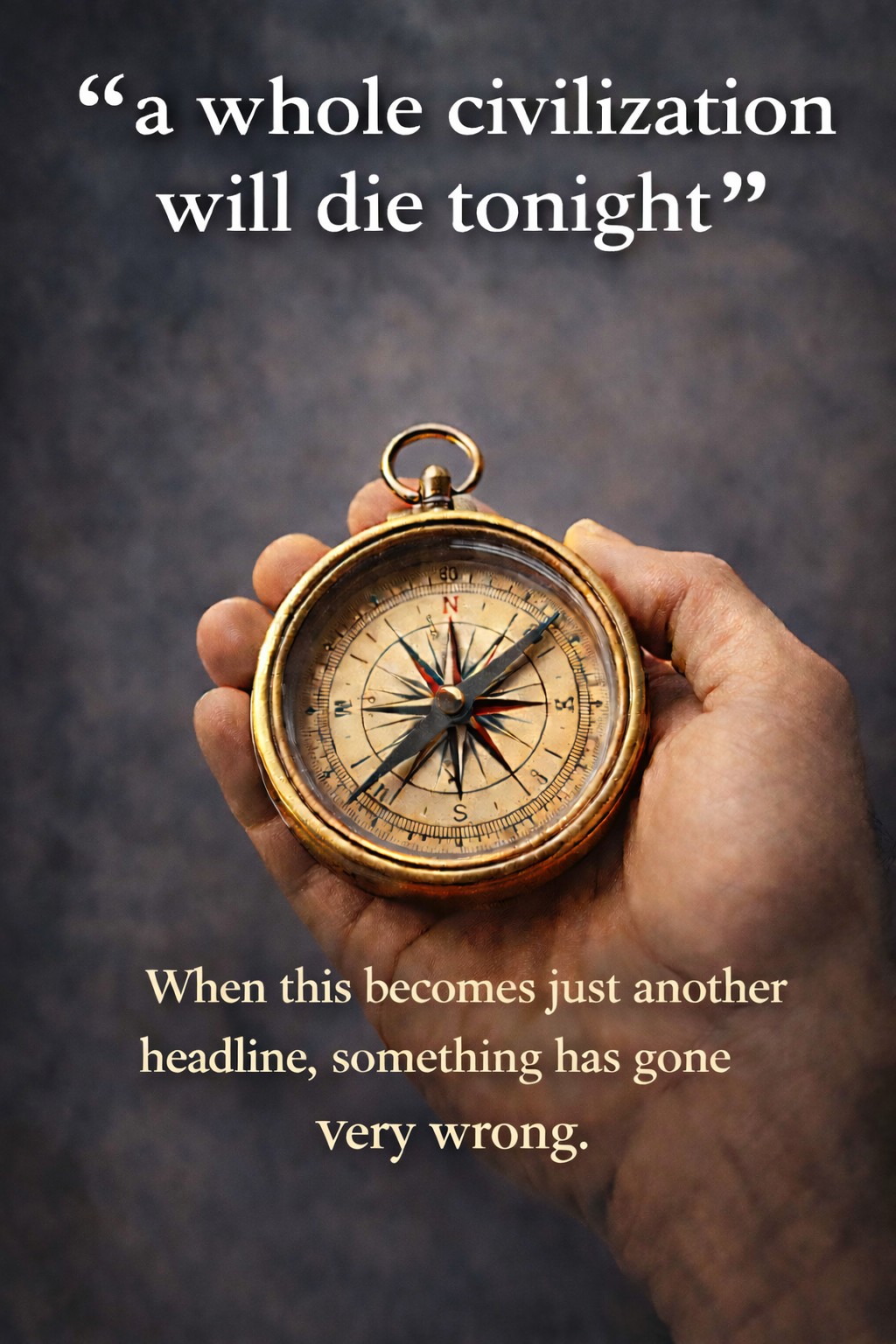
My pain was most severe on April 8, 2026, the morning after the President of the United States had threatened to annihilate an entire civilization—an outcome forestalled, for now, by a tenuous two-week ceasefire agreement with Iran.

I awakened. I inhaled. I sighed.

Then news processing began. The headlines seemed to argue with one another.

Trump Warns Iran ‘Whole Civilization Will Die’

Trump Threatens ‘Power Plant Day’ and ‘Bridge Day’ for Iran

Trump Sets 8 p.m. Deadline for Tehran

Ceasefire Reached After Two Weeks of Escalating Threats

Hegseth Declares ‘Decisive’ Victory Over Iran as Ceasefire Holds

Each headline carried its own emotional voltage. Each belonged to a different reality. Each demanded interpretation before the mind had time to absorb the implications of the last.

I moved back and forth between them, as though scanning the horizon for bearings that refused to hold still.

What I am experiencing is not ignorance but overload. The difficulty lies in the troubling acceleration of interpretation in a profession once defined by the discipline of waiting long enough to get things right.

Consider libraries. At their best, they do not merely gather books. They impose order. They create sequence. They distinguish catalog from commentary, reference from rumor, scholarship from speculation. They allow ideas to ripen because they provide intellectual space in which ripening can occur.

Headlines, by contrast, now arrive like weather systems colliding over open water—pressure against pressure, temperature against temperature, narrative against narrative–producing turbulence before the mind has even had time to locate north.

I am not longing for a simpler past. The past was never as simple as memory sometimes pretends. Newspapers got things wrong. Governments obscured truth. Voices were excluded. Perspectives were limited. The so-called consensus often reflected who had access to presses, pulpits, and broadcast towers.

But there was, nonetheless, a sense that information moved in a sequence that allowed thought to follow. Now information and interpretation appear simultaneously, each insisting on priority. The result is not merely disagreement. Disagreement can be healthy. Disagreement sharpens thought.

The result, instead, is compression. Compression of time. Compression of context. Compression of reflection. We’re asked to conclude before understanding has had the opportunity to unfold.

And then we have the words themselves. Not paraphrased. Not filtered. Not softened by summary.

Right now, words published by a sitting President of the United States appeared in the public stream as casually as any other post competing for attention:

“A whole civilization will die tonight, never to be brought back again. I don’t want that to happen, but it probably will…”

Those words burn on my brain.

And what about his words a few days earlier on Easter morn:

“Tuesday will be Power Plant Day, and Bridge Day, all wrapped up in one, in Iran. There will be nothing like it!!! Open the Fuckin’ Strait, you crazy bastards, or you’ll be living in Hell — JUST WATCH! Praise be to Allah.”

Those words burn, too.

What startled me was not only the language itself, but also the velocity with which language of this magnitude seemed to be absorbed into the ordinary churn of the news cycle.

A threat invoking the destruction of a civilization. A deadline—8 p.m. Eastern Standard Time—as though annihilation could be scheduled between dinner and the evening weather. Profanity directed at a sovereign nation. Religious language pressed into rhetorical service. Exclamation points doing the work once reserved for deliberation.

Then the headlines moved on. Analysis fractured into familiar alignments. Interpretations multiplied. The moment was processed, categorized, debated, defended, reframed, condemned, contextualized, and gradually folded into the ongoing river of competing urgencies.

But I could not quite fold it away. Some language does not dissipate simply because the news cycle advances. Some language lingers. Some language tests the boundaries of what we are willing to normalize simply because normalization has become the adaptive response to informational overload.

What’s gnawing at me right now is this. More and more, I find myself falling back on something older than any alert that lights up my phone.

My moral compass.

I’m landing there not because I distrust journalism. Not because I imagine that complex geopolitical realities can be reduced to tidy conclusions. Not because I believe that every headline must conform to my preferences.

I’m landing there simply because, even in a world of incomplete information, some things remain legible.

I know that truth matters.

I know that language matters.

I know that threats—especially those uttered from positions of immense power—matter.

I know that rhetoric capable of conjuring the annihilation of entire peoples is not merely strategic vocabulary to be shrugged off between weather reports and stock updates.

I know this not because a headline tells me so, but because a lifetime of reading, thinking, teaching, and living has taught me that words shape worlds.

Facts help us understand events. Conscience helps us understand consequences. Evidence tells us what is unfolding. Moral proportion tells us what should give us pause.

My moral compass is not a substitute for evidence. But neither is evidence meaningful without some internal measure capable of recognizing when rhetoric crosses thresholds that once would have prompted gasps of disbelief around the world, followed by sustained collective stillness.

I know that complex geopolitical realities rarely yield simple judgments.

I know that leaders sometimes speak forcefully for strategic reasons.

I know that journalists, working in real time, must report language even when its implications remain uncertain.

But I also know this. The casual invocation of civilizational destruction should not feel ordinary. The language of annihilation should not feel routine. Deadlines for devastation should not feel like programming notes in the daily schedule of global life.

Even in a fractured informational environment, some lines remain visible. Even in a world of interpretive disagreement, some language retains moral weight independent of partisan affiliation. Even in an age of competing narratives, conscience still recognizes disproportion.

The compass may tremble, but it need not spin.

And so I return again to the question with which I began:

How shall I begin?

Perhaps I’ll begin:

● By trusting that the habits of mind formed over decades—habits shaped in libraries, classrooms, conversations, and careful reading—remain capable of distinguishing urgency from alarmism, disagreement from distortion, complexity from confusion.

● By trusting that patience remains a form of intelligence.

● By trusting that moral proportion is not an antiquated instrument, but a necessary one.

I am not a genius. But I am smart enough to know that understanding rarely arrives prepackaged in a headline.

I am not ancient. But I have lived long enough to know that normalization can occur gradually enough that we scarcely notice the shift until the boundary has already moved.

I am focused on silver linings. But I am realistic enough to know that clarity sometimes requires effort equal to the confusion that obscures it.

I will continue. Reading. Comparing. Pausing. Listening for what rings true beneath what merely rings loud.

I will begin again each morning with the quiet but stubborn conviction that truth and responsibility do not cease to exist simply because their presentation has grown more chaotic or their interpretation more divided.

The world may move quickly, but the compass, if we are willing to hold it steady, still points True North.

Keeping Up with the Evidence


“Language is fossil poetry.”
— Ralph Waldo Emerson (1803–1882). American essayist and philosopher, leading voice of the Transcendentalist movement.


Savannahians have long dubbed their city the Hostess of the South. Many also claim that Jones Street is the most beautiful street in the city. Maybe so. Brick by brick, it unfurls like a quiet benediction: a ribbon of warm red paving stones softened by time, shaded by live oaks whose arms stretch overhead, heavy with Spanish moss filtering the light into a perpetual late-afternoon glow. Federal and Greek Revival townhouses stand shoulder to shoulder, dignified but never aloof, their brick façades punctuated by deep green shutters, wrought-iron balconies, and stoops that rise just enough to suggest ceremony without pretension. Lantern-lit doors—some painted a daring lacquered red—open onto iron urns spilling over with ferns and flowering vines, blurring the line between garden and street. Even the street’s history seems layered into the view, so that walking Jones Street feels less like moving through space than through time, where elegance lingers and beauty is not announced but assumed.

Some Savannahians even maintain that the expression “keeping up with the Joneses” began because of the luxurious homes built along Jones Street. I had never heard that claim until friends visited Savannah and later shared it—along with a stream of photographs—on Facebook. I knew the expression, of course, but I had never heard it tethered to a specific place, much less to a famous street down South.

The claim fueled the researcher in me, leading me to the Oxford English Dictionary (OED). If the phrase is anchored to Jones Street in Savannah, the OED editors are unaware of it. They credit the expression instead to Arthur Ragland “Pop” Momand, who in 1913 launched his New York Globe comic strip, Keeping Up with the Joneses. The strip drew on Momand’s experiences in Nassau County, New York, rather than on any known connection to Savannah’s storied street.

I could have let the matter rest there. OED consulted. Myth gently dispelled. Case closed. But curiosity and further digging—beyond the OED and into archival material, historical accounts, and even the occasionally useful corridors of YouTube—clarified the matter. Since Momand’s comic strip emerged from New York, the Joneses in question were almost certainly New York Joneses. And in the late nineteenth century, that name carried weight. The Livingstons, the Schermerhorns, the Masons, and the Jones family were counted among New York’s old-money elite. Mason and Jones controlled what was then the third-largest bank in the country—Chemical Bank—and their combined wealth ranked among the most formidable in New York’s financial world.

Within that circle, Elizabeth Schermerhorn Jones stood at the center of social gravity. She did not merely inhabit high society; she defined it. Her standards of dress, decorum, and domestic display shaped the expectations of an entire class. Others did not simply admire—they imitated. To be fashionable was to approximate her taste. To be modern was to anticipate it. Her Newport summer residence, constructed in 1853, became a symbol of that authority—an architectural declaration of wealth and refinement that drew attention and, inevitably, comparison.

After her death in 1886, the house passed through multiple owners, declined, and was eventually sold at foreclosure in 1934. Today only the reinforced shell remains, its walls braced in a quiet act of preservation—as if even the structure itself were still attempting, in some small way, to keep up the Joneses.

English is full of such borrowed names, reminders that language often preserves the reputations—and sometimes the accidents—of the people who once carried them.

A few examples may surprise you. Others will feel as familiar as the words themselves.

Did you know that the Earl of Sandwich, pressed by appetite and convenience at the gaming table, is said to have solved his dilemma by placing meat between slices of bread, allowing him to eat without interrupting play. Whether the story is embroidered or not, the word sandwich endured. What began as a practical solution became a culinary staple, and the man himself receded into the background, leaving behind a word now spoken far more often than his title ever was.

Then we have Captain Charles Boycott, an English land agent in nineteenth-century Ireland, who found himself the target of organized social and economic resistance from protesting tenants. Rather than confront him directly, the community withdrew—refusing to work his land, speak his name, or acknowledge his presence. The strategy proved so effective that his surname—boycott—entered the language as a verb, now used globally to describe collective refusal. The man was resisted; the name persisted.

Or what about Étienne de Silhouette? An eighteenth-century French finance minister known for his austerity measures lent his name—somewhat unfairly—to a form of portraiture defined by its simplicity. The inexpensive shadow profiles that became fashionable during his tenure were mockingly associated with his economic policies. Over time, the satire softened, and the word silhouette came to describe not frugality but form itself: an outline, a presence reduced to its essential shape.

The word dunce offers an even stranger reversal. It derives from the medieval philosopher John Duns Scotus, whose followers were once regarded as careful and rigorous thinkers. They wore distinctive pointed caps as a mark of their intellectual tradition. Yet in time, critics of scholasticism turned the name into an insult. The scholar became a fool, and the cap a symbol of ignorance—a reminder that language does not always preserve reputation so much as it repurposes it.

Then we have Amelia Bloomer. She did not invent the garment that bears her name, but she did something perhaps more enduring: she advocated for its adoption. A nineteenth-century reformer, she promoted a style of dress that allowed women greater freedom of movement—looser trousers gathered at the ankle, worn beneath a shortened skirt. The look was practical, even liberating, but it was also controversial. Her name became attached to the style, and with it, to the broader idea that clothing could signal change. What was once a subject of ridicule now reads as an early gesture toward autonomy.

And let’s not forget James Brudenell, the 7th Earl of Cardigan, who is remembered for leading the ill-fated Charge of the Light Brigade during the Crimean War. Less dramatically, though perhaps more enduringly, his name came to be associated with the knitted wool jacket worn by British officers under their uniforms. The cardigan, as it is now known, has long since shed its military associations. It remains, instead, as a quiet example of how even the most turbulent histories can soften into something familiar, worn close, and almost entirely detached from their origins.

So the more I explore borrowed names that have crept into our language, perhaps Savannah can keep its story. Jones Street may not have given us the phrase “keeping up with the Joneses,” but it hardly needs the credit to justify the legend.

Language often works this way. A person’s name slips quietly into common speech, the individual gradually fading while the word remains, carrying only the echo of its origin. And when a story is told often enough—beautifully enough, and in just the right light—its beginning can begin to matter less than its appeal. In the end, what we are really keeping up with may not be the Joneses at all, but the enduring human habit of turning beauty, memory, and rumor into something that feels like truth—and is repeated as if it were true.