“The first porch is where you find your voice. The second porch is where your voice finds others.” —Poor Brentford Lee (b. 1947. Keeper of two porches, one mountain, one dog, and an inexhaustible supply of things worth saying—none of which he has to say alone anymore, thanks to his partner, Gary.)
Dear Faithful Readers,
You’ve been here with me on the porch since—well, some of you since the very beginning, back when I built it as nothing more than a place where you could pull up a chair and talk with me about the joys, challenges, and discoveries of research. We kept right on doing that from 2012 to 2021 when I decided to make the porch a little more fun by bringing you weekly creative nonfiction essays.
I’m still at it. Nearly 750,000 words later. Yes, you read it right. Foolin’ around in bed every night with ideas and words adds up. I’m spurred on by you, my Dear Readers, whose numbers keep increasing annually! Last year, we shared more than 35,000 views right here on the porch.
But I’ve built a brand-new porch, and I want you to be the first to know about it.
Don’t worry, though. I’m not leaving The Wired Researcher porch. It will remain open virtually forever. Same Monday mornings. Same voice–mine, with Poor Brentford’s voice chiming in from time to time. We’ll both be there, waiting for you.
I just heard someone shout out:
“So, why are you building a new porch? What’s that all about?”
Well, for starters, it has better lighting, and it might just bring in more neighbors for all of us to visit and exchange ideas.
I’m counting on you to check it out. I’ve named the second porch The Kendrick Chronicles.
“Where on earth is this new porch of yours?”
Gracious me! You know that I like to take my time–slow and easy like. In a sec, I’ll give you the link so that you can check it out for yourself. And when you do, go ahead and Subscribe! From that point forward, my essays–ever goldern new one that hits the world, every Monday morning like a neighbor who always brings something worth reading and never overstays his welcome–will find their way directly to your Inbox.
You can find this new porch of mine in Substack. Here’s the link:
“What will I find when I get to this new porch of yours?”
Why, gracious me! You’ll find a comfy chair with your name on it and a handful of your favorite essays with my name on ’em:
● Redbuds of Remembrance
● Learning to Love in New Ways
● I Am Afraid
● Poor Brentford Cleans the Wax Out of His Ears
● Two, Together
● Glimpses of My Mother’s Hands
● The Ghost of Palmyra Church Road
● Truths Half-Told. Letters Half-Burned. A Legacy Waiting to Be Fully Heard.
● Carrying the Bags of Colonial America’s Humourist
And get this. If you subscribe, next week you’ll get an essay about a kitchen disaster beyond belief: “Oh, No! No Sourdough!” And the week after that, “What We Know. What We Believe.” It may be the most complete thing I’ve ever written about who I am and what I believe about what comes next.
So go on now. Pull up a chair. Same voice. Wider porch.
I am honored to be featured on Barney Smith’s Vermont Artists and Authors podcast, StoryComic, Episode 361.
I had a delightful time talking with Barney about Vermont’s most famous writer, Mary E. Wilkins Freeman, and my book Green Mountain Stories, a collection of 28 stories by Mary E. Wilkins Freeman. Originally published in 1887 under the title A Humble Romance and Other Stories, it’s now in print 136 years later under what appears to have been the title that Freeman and her editor, Mary Louise Booth, had agreed upon: Green Mountain Stories.
You can hear more about Freeman and the book’s backstory in Barney’s interview. I emphasize the fact that Freeman is a Vermont writer, and that Green Mountain Stories is made in Vermont.
■ I hope that Green Mountain Storiesbringsgreat inspiration to readers across Vermont.
■ I hope that each of the 262,852 households in Vermont buys a copy.
■ I hope that each of the 185 public libraries in Vermont buys at least one copy.
■ And I hope that each of the 250 public schools in Vermont figures out a way to incorporate at least one Mary E. Wilkins Freeman short story into their curriculum. They will find many suitable ones in Green Mountain Stories–stories on par with the best in American Literature, right up there with Nathaniel Hawthorne, Edgar Allan Poe, Sarah Orne Jewett, Mark Twain, Stephen Crane, Sherwood Anderson, and William Faulkner.
—Bret Lott (b. 1958; American author and memoirist whose themes focus on family, faith, and the complexities of human relationships.)
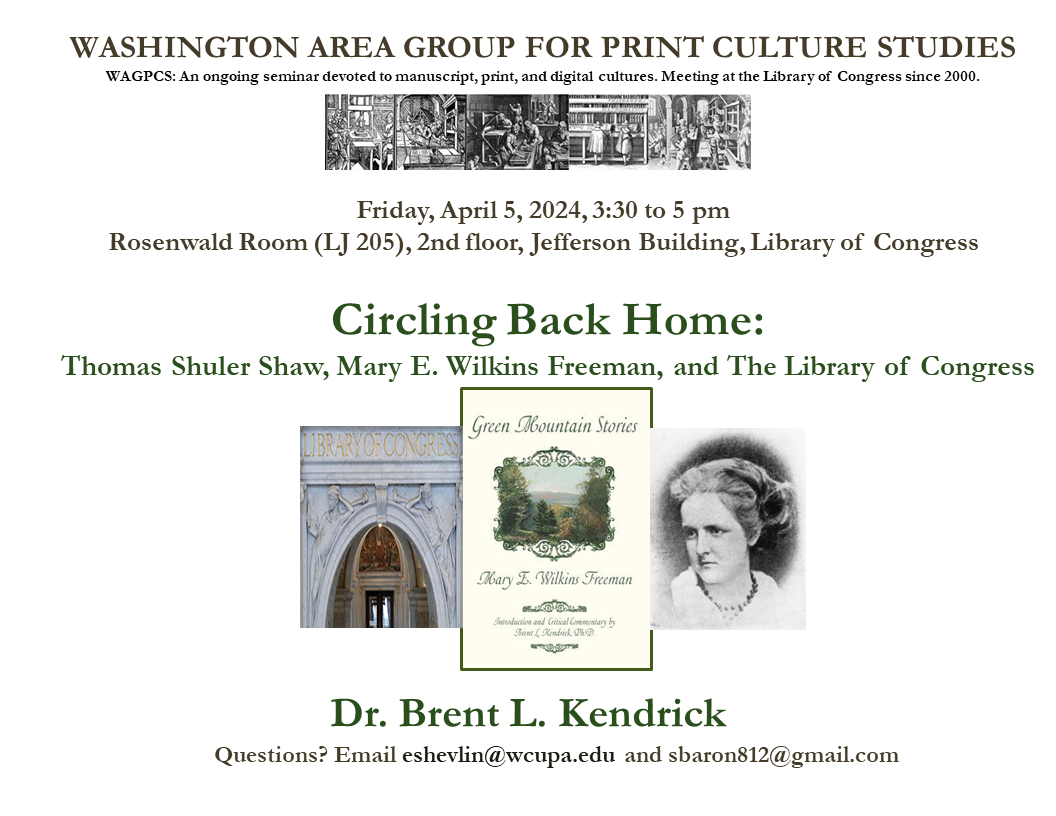
Next week I’ll be circling back home to the Library of Congress (LOC) where I enjoyed a glorious career spanning twenty-five years. I won’t be going home alone. Joining me will be the woman I’ve had an affair with for the last fifty years or so. I’m speaking, of course, of none other than my lady, Mary E. Wilkins Freeman. As part of my ongoing work on my two-volume Dolly: Life and Letters of Mary E. Wilkins Freeman, I’m circling back to LOC’s Rare Book and Special Collections to revisit some important Freeman materials. The beautiful part, however, is that the Washington Area Group for Print Culture Studies (WAGPCS) has invited me to talk about my research. I am thrilled beyond thrilled to be circling back home and to have the opportunity to share my ongoing and exciting work on Freeman.
Below is the abstract of my talk followed by a WAGPCS promotional for the event!
ABSTRACT
On March 15, 1930, the acclaimed American short story writer, Mary E. Wilkins Freeman, passed away. Her legacy, however, continues to resonate. At the turn of the twentieth century, Freeman and Mark Twain stood as America’s most beloved writers. She blazed a trail for women in literature, becoming the first recipient of the William Dean Howells Gold Medal for Distinguished Work in Fiction (awarded by the American Academy of Arts and Letters in 1925). She achieved the distinction of being among the first women elected to membership in the National Institute of Arts and Letters in 1926. Additionally, the bronze doors at the American Academy of Arts and Letters in New York (West 155 Street Administration Building) bear the inscription, “Dedicated to the Memory of Mary E. Wilkins Freeman and the Women Writers of America.”
Enter Thomas Shuler Shaw, a librarian at the Library of Congress, who embarked on an ambitious project in December 1931: writing what would have been the first biography of Mary E. Wilkins Freeman. His goal was to illuminate the life and literary contributions of this remarkable author.
However, fate had other plans. Shaw’s biography, titled A Nineteenth Century Puritan, faced rejection from prominent publishers such as Harper & Brothers, Ladies’ Home Journal, and The Saturday Evening Post. Despite setbacks, Shaw persevered. His meticulously curated scrapbooks and the typescript of his unpublished biography found a home in the Rare Book & Special Collections Division. These artifacts, along with Freeman’s books donated by Shaw to the Library of Congress, provide a rich tapestry of insights into her life and work. Notably, some of these materials reside in the Rare Book/Special Collections, while others find their place in the General Collections.
Fast-forward to 1985. Dr. Brent L. Kendrick, then serving as the Training Coordinator for United States Copyright at the Library of Congress, unveiled a literary treasure: The Infant Sphinx: Collected Letters of Mary E. Wilkins Freeman. Kendrick’s work, enriched by Shaw’s scrapbooks and unpublished biography, delves into Freeman’s correspondence. Through these letters, we glimpse the inner world of a prolific writer who defied conventions and left an indelible mark on American literature.
Fast forward again to May 2023. Kendrick continues his scholarly immersion into Freeman’s world and edits a new edition of her first collection of short stories for adults. Originally published as A Humble Romance and Other Stories in 1887, the book was meant to bear the title Green Mountain Stories. Now, 136 years later, it finally emerges under its intended name: Green Mountain Stories. Kendrick’s edition includes extensive critical commentary, unraveling the intriguing backstory behind this literary transformation.
But Kendrick’s scholarly pursuits don’t end there. Armed with fresh discoveries—significant letters previously absent from his earlier work, The Infant Sphinx—he embarks on a new two-volume project: Dolly: Life and Letters of Mary E. Wilkins Freeman. Vol. I: The New England Years (1852-1901). Vol. II: The New Jersey Years (1902-1930).
With these ongoing scholarly endeavors in mind, Dr. Kendrick returns full circle to the Library of Congress, a place where both he and Shaw once contributed their efforts. Here, he plans to delve once more into Shaw’s meticulously curated scrapbooks and unpublished biography, reexamining their contents to discern fresh insights that could enrich his comprehensive exploration of Freeman’s life and correspondence. This return to the archives not only honors the legacy of Shaw’s dedication but also underscores the enduring significance of the Library of Congress as a nexus for scholarly inquiry into the lives and works of American literary figures.
“I love the winter landscapes, Oh how wonderfully beautiful it was in Brattleboro. I used to walk to the head of High Street, and stand and look at the mountain in winter. The beauty in Brattleboro made a great difference in my life.”
Mary E. Wilkins Freeman, 1852-1930 (Letter 509 to Allie Morse. The Infant Sphinx: Collected Letters of Mary E. Wilkins Freeman. Edited with Biographical/Critical Introductions and Annotations by Brent L. Kendrick. Scarecrow, 1985.)
I don’t know about you, but when I hear “Made in Vermont,” many things come to my mind.
The first thing that always defies gravity by flowing upwards to the top of my list is Maple Syrup. Vermont and maple syrup are synonymous in my mind. Imagine a stack of sourdough pancakes, topped with melting butter, all amber-glazed with hot maple syrup. (Well, I’ve got the starter, and I’ve got the maple syrup. I can feel breakfast coming on. Actually, once when I was in Vermont, my hosts insisted that we have pancakes and maple syrup for dinner, with dill pickle spears on the side. Scrumptious!) Maple syrup must taste good to lots and lots and lots of people: on average, Vermont produces 2.55 million gallons of maple syrupannually. Is that sweet or what?
The second thing on my Made-in-Vermont list–since I’m a baker–would have to be King Arthur Flour. Is there any other? Of course, other brands of flour exist. But when it comes to my own baking–biscuits, cakes, cobblers, muffins, pancakes, pie crust, puff pastry, and scones–I always use King Arthur Flour. (No. I am not being paid by advertising affiliates. Hmmm. That is a thought.) I even use it to start my sourdough starter and to replenish it. Located in Norwich, Vermont, King Arthur Flour produces 100 million pounds annually. Can you imagine?
Cheese, of course, is on my list, too. Vermont produces 147 million pounds of cheese annually. Its artisanal cheeses are some of the best in the world. I’m thinking of Cabot’s Clothbound Cheddar, Jasper Hill’s Bayley Hazen Blue, Lazy Lady Farm Goat Cheese, and Vermont Creamery’s Bonnie Bouche. Those are some of my favorites. They seem to be everyone’s favorites when served alongside some fresh fruit and a warm loaf of my fresh sourdough bread made, of course, with King Arthur Flour.
And since I have a sweet tooth, you won’t be surprised to know that Ben & Jerry’s Ice Cream (out of Burlington, Vermont) makes my list and lots of others’, too, confirmed by 282 million pints churned annually. Best-selling? Half Baked, followed by Cherry Garcia. I’ll take a triple-scoop, waffle cone of each, one for each hand. Yum! Thank you for the extra napkins. I’ll need them.
To that list, a new Made-in-Vermont item can be added as of May 23. Surprisingly, it’s not food related. On further thought, however, it really is food related. It’s food for the soul. That’s the best kind. It’s a book of short stories, many of them as timeless and as universal as you can ever hope to find, in Vermont or anywhere else in the world.
My regular followers know, of course, that I am referring to my recently published edition of Green Mountain Stories, a collection of 28 stories by Mary E. Wilkins Freeman. Originally published in 1887 under the title A Humble Romance and Other Stories, it’s now in print–136 years later–under what appears to have been the title that Freeman and her editor, Mary Louise Booth, had agreed upon: Green Mountain Stories. You can read all about the book’s backstory in the “Introduction” and the “Critical Commentary” that I wrote for the publication.
I won’t go into the details here. If I do, you will have no incentive to buy Green Mountain Stories. And if you don’t buy the book, how will I–a former community college professor–be able to afford reinventing myself, a process that I started in January 2023. I can’t stop now, sung to the tune of Tom Petty and the Heartbreakers’ “I Won’t Back Down.” Lord only knows what might become of me if I did. I must finish whatever it is that I have started in this new chapter of my life. Trust me: I’ll stand my ground, won’t be turned around.
But let me get back to Green Mountain Stories. I was in Burlington, Vermont, for a launch on May 25, and then, on May 30, I was in Brattleboro, Vermont, for another launch. At both launches, I emphasized a few of Freeman’s major literary accomplishments:
■ In 1925, she was the first recipient of the William Dean Howells Gold Medal for Distinguished Work in Fiction. The award is given every five years. Some subsequent winners include Pearl Buck, Eudora Welty, William Faulkner, Thomas Pynchon, John Updike, Don DeLillo, and, most recently, Richard Powers.
■ In 1926, she was one of the first women elected to membership in the American Institute of Arts and Letters. It “marked the letting down of the bars to women.”
■ In 1938, the American Academy and Institute of Arts and Letters dedicated its bronze doors to “The Memory of Mary E. Wilkins Freeman and the Women Writers of America.”
At both launches, I also noted something truly extraordinary about the publication of Green Mountain Stories.
From the time that I came up with my plan for the book, I decided that the publisher of Green Mountain Stories would have to be a Vermont publisher. I would not settle for less.
Now, Vermonters can take great pride in knowing that Green Mountain Stories is Made in Vermont.
■ The book’s designer—Jenny Lyons— lives in Vermont.
■ The book’s launches took place in Vermont, initially in Burlington–sponsored by Onion River Press and Vermont bookseller Phoenix Books–and then in Brattleboro–sponsored by three Vermont organizations: Brattleboro Literary Festival, Brooks Memorial Library, and the Words Trail.
■ And, most important of all, the author of Green Mountain Stories–Mary E. Wilkins Freeman– launched her acclaimed literary career in Brattleboro, Vermont.
Green Mountain Stories is Made inVermont.
■ I hope that Green Mountain Storiesbringsgreat inspiration to readers across Vermont.
■ I hope that each of the 262,852 households in Vermont buys a copy.
■ I hope that each of the 185 public libraries in Vermont buys at least one copy.
■ And I hope that each of the 250 public schools in Vermont figures out a way to incorporate at least one Mary E. Wilkins Freeman short story into their curriculum. They will find many suitable ones in Green Mountain Stories–stories on par with the best in American Literature, right up there with Nathaniel Hawthorne, Edgar Allan Poe, Sarah Orne Jewett, Mark Twain, Stephen Crane, Sherwood Anderson, and William Faulkner.
Those are my hopes. I know. They are high hopes. I do not hold those hopes with the expectation of selling lots of copies of Green Mountain Stories, though bringing home a little green wouldn’t be a bad thing. Instead, I hope that Vermont and Vermonters will welcome home with welcome arms its most famous literary daughter, Mary E. Wilkins Freeman: Made in Vermont.
When I started my research on acclaimed American short story writer Mary E. Wilkins Freeman, in the mid-1970s, I made many research trips to the towns where she lived. Randolph, Massachusetts, where she was born in 1852. Brattleboro, Vermont, where she moved with her family in 1867, where she launched her distinguished literary career, and where she remained until the death of her mother (1880) and her father (1883). A year or so later, she returned to Randolph. Metuchen, New Jersey, where she moved after her marriage to Charles Manning Freeman in 1902 and where she remained until her death in 1930.
Without fail, during those research trips, I would stop people on the street:
“Hi, I’m doing research on Mary E. Wilkins Freeman and …”
“Mary WHO?“
Since those early days of my research, several major contributions to Freeman studies have been published, including my The Infant Sphinx: Collected Letters of Mary of Wilkins Freeman (Scarecrow, 1985), praised by The Journal of Modern Literature as “the most complete record to date of Freeman’s life as writer and woman.” More recent is the noteworthy collection of scholarly essays New Perspectives on Mary E. Wilkins Freeman: Reading with and against the Grain. Eds. Stephanie Palmer, Myrto Drizou, and Cécile Roudeau (Edinburgh University Press, 2023).
Since those early days of my research, Freeman has regained her status as a significant nineteenth century writer, especially among lovers of the American short story tradition. More and more people understand why she was the first recipient of the William Dean Howells Gold Medal for Distinguished Work in Fiction:
Freeman Receiving from Hamlin Garland the First William Dean Howells Gold Medal for Distinguished Work in Fiction (The Infant Sphinx: Collected Letters of Mary E. Wilkins Freeman. Ed. with Biographical/Critical Introductions and Annotations by Brent L. Kendrick, Scarecrow, 1985, Special Insert, Plate O).
Also, more and more people understand why the American Academy and Institute of Arts and Letters dedicated its bronze doors to “The Memory of Mary E. Wilkins Freeman and the Women Writers of America”:
Bronze Doors, American Academy and Institute of Arts and Letters, New York (The Infant Sphinx: Collected Letters of Mary E. Wilkins Freeman. Ed. with Biographical/Critical Introductions and Annotations by Brent L. Kendrick, Scarecrow, 1985, Special Insert, Plate P).
Even so, Freeman is still not the household name that she was at the turn of the 20th century when she and Mark Twain were America’s most beloved writers.
But that’s about to change, especially in Vermont.
On May 23, a book will be released that will anchor her to Vermont, now and forever.
I’m the author, and I’ll be headed to Burlington, Vermont, for the official May 25 book launch, hosted by Onion River Press and Phoenix Books.
The book is a short story collection by Mary E. Wilkins Freeman. It was originally published under the title A Humble Romance and Other Stories (1887). But it was supposed to be published as Green Mountain Stories. Now, 136 years later, the collection is being published under its intended title, Green Mountain Stories, with an extensive critical commentary providing the intriguing backstory. This publication anchors Freeman solidly, unequivocally, and forever to Vermont—The Green Mountain State—where she launched her acclaimed literary career. Vermont can now claim Freeman as its own, just as exclusively as Freeman claimed Vermont as her own, from the start of her career until the end. The publication marks the beginning of Freeman’s long journey back home to Vermont.
I hope that you can join me at the book launch–especially if you are a Vermonter–so that you can hear all about it in person!
You can preorder your copy of the book now, using the link below:



 The Wired Researcher