“A rope will not stop a snake. It will, however, give a frightened man something to hold on to.” –Poor Brentford (b. 1947). Acclaimed folklorist and voice of reason in the Wilderness.
Something was afoot, and I knew it. I had just finished making my rounds upstairs shining my Eveready along every wall and under every piece of furniture in every room. In that moment, I heard Poor Brentford downstairs.
He wasn’t talking.
He wasn’t praying.
He was chanting.
Now mind you, this wasn’t some halfhearted mumbling under his breath. No. This was a serious incantation. I looked downstairs and there he stood in broad daylight. With all the solemnity of a monk, he began:
“May the highly renowned Sage Astika, born to Jaratkaru and steadfast in truth, protect me from all serpents.”
He had hardly finished that one when he drew a deep breath and released a long, resonant “Ommmmmmmm.”
Without missing a beat, he launched into another invocation, this one delivered in a decidedly Appalachian twang:
“May all the Nagas be pleased with me, the ones who inhabit on the earth’s surface … residing in the rays of sunlight …”
I listened for a moment. His invocation droned on and on as he wandered through the earth, the heavens, rivers, ponds, and places I had never heard of. When he reached the River Saraswati, I quietly cleared my throat.
“Brentford. what on earth is going on down there?”
“Going on? Have you lost your mind. There’s a blacksnake in the house.”
“I know. So?”
“So? We have to get it out of here.”
Poor Brentford was visibly shaken: “Ommmmmmmm.”
“I get it,” I replied. “You think you’re some kind of mountaintop St. Patrick chasing snakes down into the Shenandoah River.”
“Well, at least that’s a far cry better than the blanket, broom, and bucket you plopped down on the floor down here.”
“Cute, Brentford. Real cute. Unlike you, I’m being sensible. I don’t have a doubt in the world that the snake will coil up on the towel. Then I’ll coax it into the bucket with a broom and carry him safely back outdoors.”
“Safely?”
“Of course. Safely. I don’t want to hurt it.”
“Hmpfff. I’m here to tell you exactly what that snake’s gonna do. It’s gonna slither up your leg, kwile itself around your waist, and squeeze every last bit of air out of you.”
“Whatever. Have it your way. I have work to do.”
Poor Brentford did too with his fierce determination to rid the house of the snake before dark set in. He started singing something that hardly had a tune. He had unmercifully cobbled together all the snake lore of all the ages into the most pitiful lyrics imaginable.
“Hang the garlic, spread the clove, Sweep the lemon where you rove. Splash the vinegar, bless the floor, You don’t live here anymore.
“Cinnamon upon the sill, Take your leave beyond the hill. May your journey safe now be, Just… don’t spend the night with me.”
And so it was. Poor Brentford carried on his shenanigans all afternoon.
Throughout it all, the blacksnake remained mysteriously hidden, no doubt frightened by the quiet that was no more.
Gary seemed unfazed by it all. Yet when it was time for dinner, he thought it best that I should go downstairs and select our bottle of wine.
I was glad to do so, but I swear. I am certain–well, I think I am–that I caught a glimpse of a black tail beneath wine cooler pulling itself out of sight. All right. Fine. I did. I scooted the cooler back a little, real gentle like, and sure enough, there was the blacksnake, all three feet or so, stretched out along the wall. By the time I got back with my bucket, he was long gone.
I decided that it might be a good thing to leave all the lights on down there. After all, he was a stranger in a strange place and dark was coming on.
As I made my way back upstairs, I kept reminding myself of something I read somewhere–I think I did–that each of us is connected to a powerful spirit animal, guardians believed to watch over us, based on when we were born. And get this. I’m Scorpio, so the snake is my protective spirit.
Gary and I decided to watch TV in the loft instead of downstairs the way we usually do. I don’t think we’ve ever watched it in the loft before. But I enjoyed it immensely, because it gave a fresh perspective on things, and Poor Brentford left us alone for a while at least.
Poor Brentford, the rope, the bed, and Ruby, awaiting her own circle. The blacksnake was unavailable for comment.
But by the time we came down for bed, he was right there, as agitated as ever.
He was just inside our bedroom, holding two pieces of rope–one much longer than the other.
“Ropes in the bedroom?” Gary raised an eyebrow, looking quizzically at me and then the bed.
Poor Brentford looked at Gary as though the answer should have been obvious.
“Well, duh. You have to put a rope in a circle around the bed, and once Ruby hops up, put a circle around her, too.”
He started laying the rope on the floor, encircling the bed.
“Trust me. A snake will not crawl over a piece of rope”
Enough was enough.
“Get out, Brentford Lee, right now. And close the door behind you.”
I read somewhere that a snake will not crawl under a closed door. I think I did. I’m almost certain I did. Somewhere. National Geographic?
Writers may write alone, but essays are completed by readers. Brent L. Kendrick (b. 1947)
Today marks the halfway point of 2026, and I’m delighted to share a milestone.
During the first six months of the year, The Wired Researcher has been viewed more than 17,000 times.
When I embarked on this new chapter inventing myself, I wondered where I would find the conversations that had sustained me for so many years in the classroom. I eventually discovered that they hadn’t ended at all. They had simply moved online, where every Monday morning another essay leaves my desk and finds its way into the world.
Some essays make readers laugh. Others invite reflection. A few stir memories. Every once in a while, one seems to touch something I never anticipated.
What pleases me most isn’t that one essay did well. It’s that readers have embraced essays about humor, language, gardening, relationships, cooking, aging, memory, and the unexpected moments that make ordinary life extraordinary. That tells me you’re returning not just for a topic, but for the journey.
Thank you for reading. Thank you for commenting, sharing, and encouraging me week after week. Writers may write alone, but essays are completed by readers.
Here’s to the essays that have already been shared—and to those still waiting patiently for Monday morning.
To you, My Dear Readers, I am grateful beyond measure.
The rake lay across the heart, as if it were Cupid’s arrow. Beads of water gathered on the thermos, upright on the nearby stone bench, right beside St. Francis of Assisi. Leather gloves and pruning shears bore witness to a gardener. Gary.
I couldn’t see him, but I knew he couldn’t be far away because his seafoam, floppy hat was not on the bench with his other things.
I knew what he was up to.
The time had come for him to do what I had done down through the years since I built the garden, filling it in with tons of tan pea gravel and surrounding it with a hedge of Little Missy boxwood.
Early on, the labor of weeding was easy. The pea gravel kept unwanted growth under control and beneath the surface. But over time the AngelinaSedum, filling the two circles in the heart’s upper lobes and surrounding the Magnolia in the lower cusp’s circle, died out but not before leaping over the rings that held them. Small chartreuse-yellow clusters softened the heart but lessened its definition.
Gary, my partner—the man who now shares this mountain life me—was doing more than weeding. He had already restored the flagstone pathway leading from heart to home and back again. Now he was planting healing Ajuga that will settle in and stay within the upper rings, eventually sending up purple spikes. Now he was cleaning, making everything as pristine as the day I finished my handiwork. I sat down on the bench, surveyed the slope, and sighed,
“Well done.”
I never had any intention of building the heart garden. My late partner Allen and I had tamed our mountaintop wilderness with so many paradisiacal garden beds that we had declared a moratorium:
“No more.”
But when Allen died and I reflected on where I would scatter his ashes, as mutually agreed upon, I could not for the life of me decide upon the right spot.
We had talked about resting places on our mountaintop, usually settling on the peony garden. Once, even, Allen suggested the Koi Pond would be perfect, but amid laughter, we both exclaimed:
“Oh, no! What happens when the pond filters get cleaned.”
Then, a few months after his death, he came to me in a dream, his voice carrying into my awakening and lingering there:
“Build my heart.”
I knew where. Near the house, at road’s edge—an untamed area we thought about gardening if we ever gave our moratorium a reprieve.
I had no idea how, but I figured a little math and lots of heart would make it happen.
And it did. I marked off an area twenty feet wide and thirty feet deep, sketched a heart with a black water hose, freed the earth of weeds, and blanketed it with pea gravel running deep. For Allen’s celebration of life, I surrounded the heart with SunPatiens, alternating red and white with tears and rain. I bought a wooden Zen rake, perfect for committing Allen’s ashes to the gravel, leaving tracings that mirrored the heart’s design, growing smaller and smaller as the center neared. Later, I planted the boxwood hedge.
Thus, the heart’s beginning.
Time has been kind. But still, the heart needs Gary’s loving care and tenderness. It rests within the landscape, its presence a part of forever.
The morning after Gary finished, we decided to amble down the path, pristinely cleaned and gently curved, with the heart in clear view.
“You go ahead. I’ll be there shortly.”
“No. I’ll wait. For you.”
It was peaceful and inviting.
We talked a little less than usual, as the morning chill quickened us and a Northern Cardinal in the treetops above whistled out its own litany of little questions.
“I want your ashes to be happy here.”
They will.
And when Gary’s time comes, I’ll board the train, his weight on my lap, my hands on the box, making his final journey to Minnesota where his story began.
“Like an old friend waiting on the porch, Poor Brentford appears at the entrance to each section, tips his hat, shares a thought, and invites readers to come a little farther along.”
Drumroll, please!
The moment absolutely no one has been waiting for has arrived!
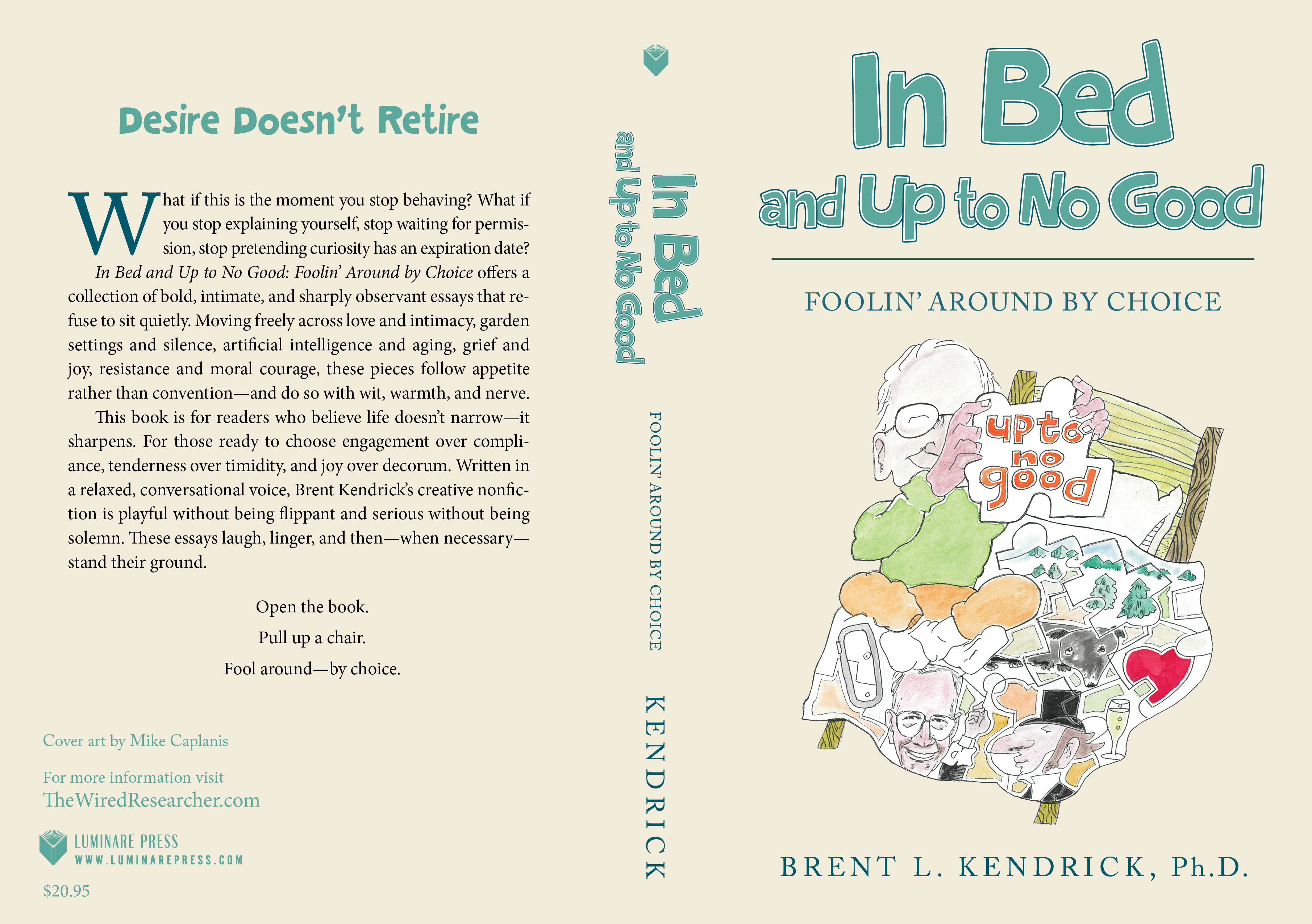
I’m pleased to announce that Up to No Good, the fifth book in TheWired ResearcherSeries and my fourth InBed book, is now available.
But before I tell you where to find it, let me tell you why it’s different.
For the past several years, I’ve been foolin’ around in bed. Stop right there! Don’t you dare call the authorities. I’m talking about writing.
The first volume appeared in 2023. Two more followed. Each gathered together a year’s worth of essays from The Wired Researcher, preserving them much as they originally appeared—one after another, week after week, moving steadily forward through time.
There was something honest about that approach. Readers experienced the essays in much the same order that I lived them.
But while assembling this fourth volume, I discovered something that surprised me.
A collection gathers.
A book shapes.
The distinction may sound small, but it changed everything.
For the first time, I stopped thinking primarily about chronology and started thinking about conversation.
● What happens when essays written months apart find themselves side by side?
● What emerges when humor sits next to heartbreak?
● What new meaning appears when an essay about gardening quietly speaks to one about grief, love, aging, democracy, memory, or biscuits?
The more I explored those questions, the more I realized that this volume wanted to become something different.
Not merely a collection.
A book.
A reading experience.
In the introduction, I explain that these essays are grouped “by the questions they worry, the moments they linger over, the emotional weather they share.”
That simple shift transformed the project.
Essays began speaking to one another.
Patterns emerged.
Themes surfaced that I hadn’t fully recognized when writing the individual pieces.
Then something else happened.
Poor Brentford Lee got involved.
Those of you who have followed my blog know Poor Brentford—the mountain philosopher, accidental theologian, occasional dispenser of homespun wisdom, and longtime observer of life’s oddities and wonders.
In earlier volumes, Poor Brentford mostly wandered in and out of individual essays.
This time, he grabbed hold of the entire book.
As the sections took shape, Poor Brentford somehow appointed himself official greeter, introducing each one with a bit of homespun wisdom uniquely his own.
“Most of what saves us wasn’t planned. It just kept growing anyway.”
“Everybody’s handed something they didn’t order. The rest is choice.”
“We were just boxwoods until someone believed we could be part of something beautiful.”
Frankly, I’m not sure I had much say in the matter.
Poor Brentford can be bodacious that way.
The result is that he now wanders throughout the book, standing at the entrance to every section, tipping his hat, offering a thought, and inviting readers to come a little farther along.
In many ways, Poor Brentford became the connective thread that helped transform a collection of essays into a unified reading experience.
Instead of moving week by week through a calendar year, readers move through twelve thematic landscapes:
What Grows, Teaches explores gardens, reinvention, second chances, patience, and grace.
What We Do with What We’re Given examines mishearings, limitations, temptations, acceptance, and the choices that shape a life.
Chosen Ground asks what it means to belong—to a place, to a memory, and ultimately to ourselves.
Those We Carry reflects on the people who continue to live within us long after they are gone.
Plagiarism À La Carte celebrates borrowing, influence, recipes, wit, and the occasional joyful act of making something unmistakably your own.
What We Lean On explores the quiet structures that steady us through uncertainty, solitude, and change.
On Our Own Terms examines aging, authenticity, self-authorship, and the liberating realization that we no longer need permission to be ourselves.
Giving Forward honors educators, mentors, benefactors, and all those who quietly build bridges for others.
Together, One ventures into fascinating territory where human curiosity meets artificial intelligence and asks what happens when we learn alongside the tools we create.
Literary Wanderings follows books, writers, forgotten voices, and the ideas that continue to shape us.
Choosing Love Again explores something I never expected to experience at this stage of life: the extraordinary privilege of falling in love once more.
And finally, When Democracy Falters gathers essays written from the conviction that citizenship is not a spectator sport and that silence carries consequences of its own.
Looking back, I realize that what changed wasn’t merely the arrangement of the essays.
What changed was the way I saw them.
Teaching literature for decades trained me to look beneath the surface, to ask how individual parts contribute to larger meanings. Somewhere along the way, I began applying that same close reading to my own writing.
The result is this book.
Some readers will recognize essays they first encountered on the blog. I hope they do. But I also hope they’ll discover something new in the conversations those essays now have with one another.
Others will be encountering many of these pieces for the first time.
Either way, my hope is that readers will find themselves lingering.
Laughing.
Remembering.
Questioning.
Growing.
Perhaps even falling a little more deeply in love with life itself.
After all, that’s what these essays have been teaching me all along.
In Bed and Up to No Good: Foolin’ Around by Choice is now available through Amazon and Barnes & Noble.
If you’d like to see what happens when a collection becomes a book—and when Poor Brentford appoints himself tour guide—I’d be honored to have you join me for the journey.
And as always, thank you for reading. Without readers, essays are merely conversations waiting to happen.
“Language is fossil poetry.” — Ralph Waldo Emerson (1803–1882). American essayist and philosopher, leading voice of the Transcendentalist movement.
Savannahians have long dubbed their city the Hostess of the South. Many also claim that Jones Street is the most beautiful street in the city. Maybe so. Brick by brick, it unfurls like a quiet benediction: a ribbon of warm red paving stones softened by time, shaded by live oaks whose arms stretch overhead, heavy with Spanish moss filtering the light into a perpetual late-afternoon glow. Federal and Greek Revival townhouses stand shoulder to shoulder, dignified but never aloof, their brick façades punctuated by deep green shutters, wrought-iron balconies, and stoops that rise just enough to suggest ceremony without pretension. Lantern-lit doors—some painted a daring lacquered red—open onto iron urns spilling over with ferns and flowering vines, blurring the line between garden and street. Even the street’s history seems layered into the view, so that walking Jones Street feels less like moving through space than through time, where elegance lingers and beauty is not announced but assumed.
Some Savannahians even maintain that the expression “keeping up with the Joneses” began because of the luxurious homes built along Jones Street. I had never heard that claim until friends visited Savannah and later shared it—along with a stream of photographs—on Facebook. I knew the expression, of course, but I had never heard it tethered to a specific place, much less to a famous street down South.
The claim fueled the researcher in me, leading me to the Oxford English Dictionary (OED). If the phrase is anchored to Jones Street in Savannah, the OED editors are unaware of it. They credit the expression instead to Arthur Ragland “Pop” Momand, who in 1913 launched his New York Globe comic strip, Keeping Up with the Joneses. The strip drew on Momand’s experiences in Nassau County, New York, rather than on any known connection to Savannah’s storied street.
I could have let the matter rest there. OED consulted. Myth gently dispelled. Case closed. But curiosity and further digging—beyond the OED and into archival material, historical accounts, and even the occasionally useful corridors of YouTube—clarified the matter. Since Momand’s comic strip emerged from New York, the Joneses in question were almost certainly New York Joneses. And in the late nineteenth century, that name carried weight. The Livingstons, the Schermerhorns, the Masons, and the Jones family were counted among New York’s old-money elite. Mason and Jones controlled what was then the third-largest bank in the country—Chemical Bank—and their combined wealth ranked among the most formidable in New York’s financial world.
Within that circle, Elizabeth Schermerhorn Jones stood at the center of social gravity. She did not merely inhabit high society; she defined it. Her standards of dress, decorum, and domestic display shaped the expectations of an entire class. Others did not simply admire—they imitated. To be fashionable was to approximate her taste. To be modern was to anticipate it. Her Newport summer residence, constructed in 1853, became a symbol of that authority—an architectural declaration of wealth and refinement that drew attention and, inevitably, comparison.
After her death in 1886, the house passed through multiple owners, declined, and was eventually sold at foreclosure in 1934. Today only the reinforced shell remains, its walls braced in a quiet act of preservation—as if even the structure itself were still attempting, in some small way, to keep up the Joneses.
English is full of such borrowed names, reminders that language often preserves the reputations—and sometimes the accidents—of the people who once carried them.
A few examples may surprise you. Others will feel as familiar as the words themselves.
Did you know that the Earl of Sandwich, pressed by appetite and convenience at the gaming table, is said to have solved his dilemma by placing meat between slices of bread, allowing him to eat without interrupting play. Whether the story is embroidered or not, the word sandwich endured. What began as a practical solution became a culinary staple, and the man himself receded into the background, leaving behind a word now spoken far more often than his title ever was.
Then we have Captain Charles Boycott, an English land agent in nineteenth-century Ireland, who found himself the target of organized social and economic resistance from protesting tenants. Rather than confront him directly, the community withdrew—refusing to work his land, speak his name, or acknowledge his presence. The strategy proved so effective that his surname—boycott—entered the language as a verb, now used globally to describe collective refusal. The man was resisted; the name persisted.
Or what about Étienne de Silhouette? An eighteenth-century French finance minister known for his austerity measures lent his name—somewhat unfairly—to a form of portraiture defined by its simplicity. The inexpensive shadow profiles that became fashionable during his tenure were mockingly associated with his economic policies. Over time, the satire softened, and the word silhouette came to describe not frugality but form itself: an outline, a presence reduced to its essential shape.
The word dunce offers an even stranger reversal. It derives from the medieval philosopher John Duns Scotus, whose followers were once regarded as careful and rigorous thinkers. They wore distinctive pointed caps as a mark of their intellectual tradition. Yet in time, critics of scholasticism turned the name into an insult. The scholar became a fool, and the cap a symbol of ignorance—a reminder that language does not always preserve reputation so much as it repurposes it.
Then we have Amelia Bloomer. She did not invent the garment that bears her name, but she did something perhaps more enduring: she advocated for its adoption. A nineteenth-century reformer, she promoted a style of dress that allowed women greater freedom of movement—looser trousers gathered at the ankle, worn beneath a shortened skirt. The look was practical, even liberating, but it was also controversial. Her name became attached to the style, and with it, to the broader idea that clothing could signal change. What was once a subject of ridicule now reads as an early gesture toward autonomy.
And let’s not forget James Brudenell, the 7th Earl of Cardigan, who is remembered for leading the ill-fated Charge of the Light Brigade during the Crimean War. Less dramatically, though perhaps more enduringly, his name came to be associated with the knitted wool jacket worn by British officers under their uniforms. The cardigan, as it is now known, has long since shed its military associations. It remains, instead, as a quiet example of how even the most turbulent histories can soften into something familiar, worn close, and almost entirely detached from their origins.
So the more I explore borrowed names that have crept into our language, perhaps Savannah can keep its story. Jones Street may not have given us the phrase “keeping up with the Joneses,” but it hardly needs the credit to justify the legend.
Language often works this way. A person’s name slips quietly into common speech, the individual gradually fading while the word remains, carrying only the echo of its origin. And when a story is told often enough—beautifully enough, and in just the right light—its beginning can begin to matter less than its appeal. In the end, what we are really keeping up with may not be the Joneses at all, but the enduring human habit of turning beauty, memory, and rumor into something that feels like truth—and is repeated as if it were true.
“The first porch is where you find your voice. The second porch is where your voice finds others.” —Poor Brentford Lee (b. 1947. Keeper of two porches, one mountain, one dog, and an inexhaustible supply of things worth saying—none of which he has to say alone anymore, thanks to his partner, Gary.)
Dear Faithful Readers,
You’ve been here with me on the porch since—well, some of you since the very beginning, back when I built it as nothing more than a place where you could pull up a chair and talk with me about the joys, challenges, and discoveries of research. We kept right on doing that from 2012 to 2021 when I decided to make the porch a little more fun by bringing you weekly creative nonfiction essays.
I’m still at it. Nearly 750,000 words later. Yes, you read it right. Foolin’ around in bed every night with ideas and words adds up. I’m spurred on by you, my Dear Readers, whose numbers keep increasing annually! Last year, we shared more than 35,000 views right here on the porch.
But I’ve built a brand-new porch, and I want you to be the first to know about it.
Don’t worry, though. I’m not leaving The Wired Researcher porch. It will remain open virtually forever. Same Monday mornings. Same voice–mine, with Poor Brentford’s voice chiming in from time to time. We’ll both be there, waiting for you.
I just heard someone shout out:
“So, why are you building a new porch? What’s that all about?”
Well, for starters, it has better lighting, and it might just bring in more neighbors for all of us to visit and exchange ideas.
I’m counting on you to check it out. I’ve named the second porch The Kendrick Chronicles.
“Where on earth is this new porch of yours?”
Gracious me! You know that I like to take my time–slow and easy like. In a sec, I’ll give you the link so that you can check it out for yourself. And when you do, go ahead and Subscribe! From that point forward, my essays–ever goldern new one that hits the world, every Monday morning like a neighbor who always brings something worth reading and never overstays his welcome–will find their way directly to your Inbox.
You can find this new porch of mine in Substack. Here’s the link:
“What will I find when I get to this new porch of yours?”
Why, gracious me! You’ll find a comfy chair with your name on it and a handful of your favorite essays with my name on ’em:
● Redbuds of Remembrance
● Learning to Love in New Ways
● I Am Afraid
● Poor Brentford Cleans the Wax Out of His Ears
● Two, Together
● Glimpses of My Mother’s Hands
● The Ghost of Palmyra Church Road
● Truths Half-Told. Letters Half-Burned. A Legacy Waiting to Be Fully Heard.
● Carrying the Bags of Colonial America’s Humourist
And get this. If you subscribe, next week you’ll get an essay about a kitchen disaster beyond belief: “Oh, No! No Sourdough!” And the week after that, “What We Know. What We Believe.” It may be the most complete thing I’ve ever written about who I am and what I believe about what comes next.
So go on now. Pull up a chair. Same voice. Wider porch.
—Terry Tempest Williams (b. 1955. American writer and environmental activist whose lyrical essays explore the intersections of personal narrative, place, and ecological stewardship.)
Something snuck up on me yesterday.
I was talking on the phone with my 90-year-old sister when I glanced down at my smartphone, saw my WordPress dashboard—and nearly did a spit take.
Over 15,188 views this year already!
That’s already more than all of 2024, and we still have October, November, and December to go. Apparently, my little mountain corner has gone global again—and I couldn’t be more grateful.
To every one of you, My Dear Readers, who reads, comments, shares, or quietly lingers over a sentence or two: thank you. You’ve turned this space into a community of curiosity, compassion, and laughter. Every click, every view, every thoughtful message reminds me that words still matter—and that connection runs deeper than algorithms.
Your Top 10 Favorites of 2025 (So Far)
Every year tells its own story through what readers choose. This year’s list made me smile. It’s a mix of reflection, resilience, and rediscovery—with a dash of irreverence (because, well, it’s me or Poor Brentford Lee or maybe both).
● “I Am Afraid” — A wake-up call for our country—and a reminder of who we still can be.
●“The Place: Charleston” — The launch of my Unmasking The Humourist: Alexander Gordon’s Lost Essays of Colonial Charleston, South Carolina.
There’s still more to come before year’s end—new essays, reflections, maybe even a few surprises that have been sitting in my drafts waiting for the right moment. Perhaps even one or two guest posts by our famed and acclaimed Poor Brentford Lee.
I can’t promise I’ll always be profound, but I can promise I’ll keep showing up with authenticity, honesty, humor, and heart.
Thank you, My Dear Readers, for being here, for reading, and for reminding me—every day—that a single voice can still find an echo.
“The act of writing is the act of discovering what you believe.”
— David Hare (b. 1947.) British playwright and screenwriter, whose works probe truth, belief, and the human condition.
Sometimes in the hush of evening, when the lamp spills its amber light and the world grows gentle, I watch. His head tilts slightly, caught by the glow, and suddenly, the years loosen their grip. The lines that life has written across his face soften; the jaw loosens, light as breath; the mouth, so often set in quiet thought, curves with the ease of youth. His eyes, clear and steady, seem to brighten from within, carrying a spark that belonged first to a boy and then to a young man. Slowly, the present thins. I see him slipping into his past. Fifty. Thirty. Twenty. And then, for the briefest moment, the man beside me becomes the eighteen-year-old he once was—time erasing each layer, revealing what was always there: the young man, quietly returning.
As I glance elsewhere in the room, I see an artifact from his past—one that has crossed time and threshold to find its place in ours: the grand piano. Massive and unyielding, it took four men to wrestle it off the truck and ease it through the doorway. Yet here it rests, polished wood catching the lamplight, waiting.
At this moment, I still hear the sound as his hands moved across the piano earlier in the day—measured, assured, easy. And I heard “For All We Know” rise into the room, each note carrying a hush that reached backward in time. The melody was not just music; it was memory, and it wrapped itself around him, around me, around the room itself. Ruby retreated to the bed, but not fully at rest. She leaned forward, her body stretched long, her head angled as far as she dared—as though even she knew the swell of sound carried us into places layered and deep. She held herself at the edge, cautious not to tumble into the wandering past, into the chasms of memory, beckoning us toward knowing and truth.
Elsewhere in the room, near the piano, another layer from the past peels back. Hanging on the wall is a sepia-toned etching—Salena Gazebo, number 8 of only 200, signed by the artist Carl Johnson. The lines are delicate, deliberate: the curving path, the quiet trees, the pavilion standing open like an invitation. It feels less like a structure than a memory, as if the paper itself breathed it into being. When I look at it, I sense not just the gazebo, but the moments once lived beneath it—the warmth of gatherings, the hush of twilight, the whispered vows of past lovers who lingered there. Dream and truth blur, as though the etching had captured not a place at all but a pulse of longing and a flicker of knowledge, carrying us softly toward knowing and truth.
In another room, on top of the chest of drawers, rest family photographs. Portraits, a chorus of faces gathered through years, smiling, standing, caught in stillness. They look out across the room with a quiet weight, less about who they are than the collective feel they give: belonging, continuity, the insistence that life moves forward even as it circles back. They do not need names to speak; their presence alone is enough.
Nearby, on a table, sits something smaller, more ordinary yet no less enduring: an iron toast holder. His grandmother’s. On his mother’s side? Or, maybe, his father’s? The lineage matters less than the fact that he kept it, carried it through moves and years, never discarding, never forgetting. The metal holds more than memories of bread he may never have seen toasted. It holds a thread of persistence, a reason to keep even the smallest objects close.
In the dining room, on a side table, another artifact gleams in silver relief: The Last Supper, framed, gifted to his maternal grandparents on their fiftieth wedding anniversary. Sacred and commemorative at once, it shimmers with devotion, not only to faith but also to family. The silver has traveled down through generations, carried into his keeping, held as though letting go would diminish more than memory. It is a marker of continuity, of reverence, of love that lasted long enough to be honored.
And then there is the little boy riding a dog—a keepsake that belonged first to his father when his father was a child, before his life was cut tragically short. A small porcelain figure, a child astride a loyal companion, frozen in time. Yet in that figure is more than innocence; it is a bridge across absence, a way of knowing a father he never met. It survived when the man did not, passed on to him as both wound and inheritance, loss and gift. That little boy on the dog rides still through the years, carrying ache and legacy.
Through these artifacts, I glimpse the man I already know and love, his story unfolding in fragments that matter. In the little boy riding the dog, I see both wound and inheritance, a bridge across absence. In the Last Supper, I see reverence, devotion, love honored and passed along. In the iron toast holder, I see endurance, the instinct to keep and carry even what is small. In the family photographs, I see continuity, lives pressed together across generations. In the drawing of the gazebo, I see invitation and hush—the twilight blur where dreams fade into memory and truth. And in the grand piano, I hear the melody that threads them all together—still rising, still echoing, ever playing in the quiet of his soul.
These artifacts matter to him and, now, to me. I could point to others. But I won’t. Yet one more remains, quiet and insistent, the truest of them all—not carved in silver or pressed into porcelain, but carried in ink and idea. His 1965 high-school graduation essay. He was co-valedictorian. He was eighteen.
It rests inside his high-school yearbook, the Bluejay, its cover deep blue and gilt, its pages a mosaic of faces, cheers, and world events already turning into history. And there, slipped carefully between those pages, lies his speech—typed, carried through six decades of moves and seasons. The paper holds its shape, and the words stand sure, preserved as though waiting for their moment to be read again. In its keeping, I see more than memory; I see devotion—the instinct to preserve not only what he did but who he was becoming. It is an artifact, yes, but it is also a testament, held safe in the place that marked his youth and carried forward into the man he is now.
I smiled and whispered:
“Show me what you wrote.”
He lifted the page, holding it in his hands, just as he held it onstage sixty years ago. Soft at first, his voice grew firmer as he returned to the beliefs that had steadied him even then: that learning gives life its shape, that responsibility gives it weight, that hope gives it breath, and that perseverance gives it endurance. Sixty years have passed, yet as he read, I heard not only the boy addressing his classmates but the man beside me—the same convictions intact, the same spirit enduring.
In those moments, as his voice stretched back and returned to me across the decades, I realized that of all his artifacts, this was the richest. My partner, Gary T. Knutson, wrote those words in youth. They carried him into a future he could not yet imagine. And they anchor him still—steadying him in the present, guiding him toward tomorrow. The piano may sing, the photographs may remember, the silver may gleam, the porcelain boy may still ride—but they can only point, only hint. His own words, fragile on paper yet alive in spirit, opened the door wider. They revealed not just what he kept but who he was becoming, and who he still is.
That is the power of words—not just Gary’s words, but all our words. They outlast objects, outshine heirlooms, outlive even memory. In them can be found who we are when all else has been stripped away—values, beliefs, longings, the essence of self, laid bare. And more than that, words do not simply keep; they move. They persuade and console, ignite and endure. They reveal who we were, and they shape who we might yet become. That is their gift, and their power—becoming, in a way, stronger than stone.
Show me what you wrote, and I’ll see who you are—then, now, and still becoming. For words outlast memory and outshine the heirlooms we keep. They carry the essence. They carry the longing. And they proclaim the truths we’ve always held.
“The reader is the final arbiter of a text. Without the reader, the words are silent.”
—Margaret Atwood (b. 1939). Canadian poet, novelist, essayist, and critic, one of the most influential literary voices of our time.
My Dear Readers, I blinked yesterday, and suddenly my little corner of the internet tallied 12,000 views for 2025—with three months still to go!
That’s not just a number. It’s 12,000 moments of connection. 12,000 times someone out there paused long enough to read my words, nod, chuckle, roll an eye, or maybe even find a flicker of themselves in my essays.
And here’s the part that stuns me: with this pace, we’re on track to sail past last year’s phenomenal 15,000 peak—a record I once thought unrepeatable. But here we are, repeating (and then some).
The 10 You Loved the Loudest
Every essay I publish is a seed tossed into the world. Some sprout quietly. Some bloom bold and bright. Here are the ten that you watered most generously this year:
Whether you’ve been here since my first blog post nearly 13 years ago or you just stumbled across my latest musings, you’ve made this milestone possible. I don’t take your presence lightly.
So, here’s to you—my companions in this ongoing experiment of storytelling, memory-making, and meaning-finding. Let’s see how far we can climb before 2025 closes the books.
After all, the numbers matter—but the connections matter more.
“I do not at all understand the mystery of grace—only that it meets us where we are but does not leave us where it found us.”
—Annie Dillard (b. 1945). American essayist whose work reflects the natural world as a mirror for awe and meaning, most memorably in her Pulitzer Prize–winning Pilgrim at Tinker Creek.
What on earth am I doing writing about motherhood in the dog days of summer—the hottest, most humid stretch, when snakes go blind until their molting skin slips over their eyes—especially when I’m celebrating a mother, not my own?
I keep saying to myself:
“This would be perfect for a Mother’s Day post in May.”
But you, my Dear Reader, know that I rarely write to match the calendar—and this post won’t match it, either. That’s not to say I’ve never done it—only that I’ve never done it by design. It’s simply that from time to time an idea collides with an occasion—Mother’s Day or Father’s Day or Thanksgiving or … Hmmmm. Maybe I’ve done it more than I realize.
Anyway, if you browse through my posts, you’ll see the pattern of how I write. When something grabs hold of me and won’t let go, I know I’ve been called to share it—maybe for the greater good, even if it’s just one person who feels the same tug while reading that I felt while writing.
That’s exactly what happened with this post. Memories washed over me from long ago and far away. They had surfaced before, but only as ghostly apparitions drifting in a paused wave. This time, though, I was nearly pulled under by the current.
It began when I uncovered a hand-painted pillow I hadn’t used in years. Bold crimson flowers and curling green leaves still popped against a soft beige background. The piping had faded, and the stuffing had settled into the easy comfort of something well-loved. It was a little worn, and it was a little wistful, but it was still a bright relic from when I was just beginning to find my way.
As soon as I saw the pillow, I started remembering my neighbor who made it. She was an older woman, maybe a few years older than my Mother, but not many. She dressed neatly, always in small-print floral dresses, and, when at home, she always topped her dresses with matching aprons. Ringlets of white hair framed a face that seemed stern at first, but softened the moment she spoke. She had the bearing of someone who kept things in order—herself, her home, her garden, and her place in the community. No one ever doubted that she would follow through on whatever she took on.
Her name was Nell. Nell Barker Harris, but I never called her by her first name. My Mother taught me better. She was always Mrs. Harris to me, though I swear I had the hardest time making Mrs. sound like MIZ-iz. It always rolled off my tongue as MIZ.
My memories of her stretch back to 1958, when my parents bought our home in the subdivision that bore her last name. I had just turned eleven, and I loved exploring the uncharted woods surrounding our home and beyond.
Mrs. Harris and my Mother were good friends, sharing interests in church, cooking and canning, and working the polls on election days.
My Mother thought the world of her, and, looking back, most of what I came to know about her came from my Mother:
“MIZ Harris this …” and “MIZ Harris that …” was a constant refrain, especially during summer and fall harvests.
Many were the days my Mother sent me to the Harrises—Nell and her husband Worthy—with fresh vegetables from our garden, or to fetch canning jars—the old timey blue ones with zinc lids—or to swap a recipe.
The Harrises lived close, but their house lay just out of sight from ours. All I had to do was cut across the garden, slip past the barbed-wire fence, run down a slope, and dash up a knoll to reach their faux-stone cottage. It was one of the finer ones in our small town, with more than a hint of upper-middle-class comfort. I’d climb the steps straight to the door, where Mrs. Harris usually met me, fulfilling the errand right there on the stoop.
From those errands and my Mother’s comments, I came to know Mrs. Harris well enough that one December, I went boldly to her house on my own. My sister Judy and I had decided to put up a Christmas tree while our Mother was shopping. I had long had my eyes set on a beautiful white pine—not for Christmas, but for love—growing in the Harris’s woods where I roamed. Off I went to ask if we could cut it down. She agreed, and though the tree seemed to shrink with every drag homeward, Judy and I had it lighted and decorated by the time our Mother returned. She knew exactly how to celebrate the surprise as a tribute to childhood ingenuity.
Another time, my parents sent me over with an idea that I’d dreamt up—again involving white pines. A dead-end dirt road ran between our home and the Harris’s land that we gardened, and we thought it would be beautiful to line its 200-foot stretch with pines. I asked Mrs. Harris if we could dig saplings from her woods. She agreed, though she thought fall would be a wiser planting time.
My parents insisted amongst ourselves that proper planting and deep watering would see them through. They were hardly more than spindly stems with a few scraggly needles, more like Charlie Brown’s Christmas tree than the giants we imagined. Pitiful as they were, they survived the July heat and, in time, grew straight and tall, rising with quiet majesty, as if they had always belonged there.
Later—June 1972, a few years out of college and working at the Library of Congress—I wanted more than the skyward-pointing pines. I wanted the land itself. I found myself in Mrs. Harris’s home, asking if she would sell me the very garden lots my parents and I had tended from pre-teen through early manhood.
I still remember sitting in their parlor that day—dress pants, crisp shirt, and a tie, as if I’d been summoned to defend my undergraduate honor’s thesis. I sat in an overstuffed chair in the corner, its armrests rising up to hold me accountable. The room itself seemed to echo their seriousness and my intent. Mahogany gleamed in the soft light. A large china cabinet dominated one wall, its shelves lined with Blue Willow dishes like the ones my oldest sister Audrey collected. Everything about the space spoke of order and permanence—qualities my Mother had always extolled in Mrs. Harris herself.
Across from me sat Nell and Worthy Harris, steady and composed, firing their questions in quick succession:
Why do you want the land?
Do you plan to build a house there one day?
How will you pay for it?
A bank loan? Do you understand that you’ll need a co-signer?
They had far more questions than I had answers. But a few days later, I rode with the Harrises in their blue-and-white Chevrolet to Raleigh County National Bank, a solemn drive dressed up in chrome and vinyl. I had made the appointment myself, though the banker’s name and face have faded. What remains is the setting: a huge walnut desk topped with thick glass, its surface spread with legal documents that seemed to weigh more than the paper they were printed on.
I signed, and Mrs. Harris co-signed—the literal and the metaphorical deed, both done and dated June 9. She was, after all, the owner of the land. The gleam on my face that day couldn’t have equaled hers, steady and satisfied, as though she had not only sold me a parcel of ground but had also planted me there, rooting me firmly to the very soil where those skyward pines had begun.
But the pillow dragged up one last memory of Mrs. Harris—a dim and shifting one, like an undertow I didn’t see coming.
One year—1965, just a month before graduating from high school—I nominated Mrs. Harris for “Mother of the Year.” She certainly was worthy of the recognition, although she never seemed like my Mother, not even like a mother figure, really. And now, looking back, I wonder whether it was my Mother herself who suggested the nomination. Or maybe it was my oldest sister Audrey. Both of them admired her immensely as one of the pillars of our community and the church that the three of them attended.
Whatever the springboard, I picture myself typing the letter—hunting and pecking as solemnly as if drafting a constitution—and then, with all the earnestness of seventeen, listing her many accomplishments.
I don’t remember a single sentence I wrote in that nomination, only that it won her the recognition we all thought she deserved. What I do remember is the aftermath: her picture in the newspaper, and maybe even a spot on a live radio interview, sharing her reaction:
“I’m just flabbergasted.”
Down through the years, I often found myself wondering how my Mother felt about my nominating Mrs. Harris instead of her. If she carried even a flicker of disappointment, she never showed it. And why would she? For all I know, she may have planted the idea in my head in the first place, speaking of Mrs. Harris with admiration the way she always did.
Years later, my parents came to live with me in DC after my dad suffered a stroke and needed more care than my Mother could manage alone. Audrey and I worked out a plan: summers in their own home, with her nearby to help; winters with me in DC. It was during those ten years that I found myself with a chance to do what I hadn’t done back in high school–nominate my own Mother for recognition as the remarkable woman she was.
The details of my Mother’s nomination are as vague in my memory as Mrs. Harris’s. I am fairly certain it was 1982—the year my parents celebrated their 50th wedding anniversary—and that DC’s “beautiful music station,” WGAY (99.5), sponsored the “Mother-of-the-Month” recognition. I nominated her by focusing on her long marriage to my dad, their six children, and the challenges she faced as an aging woman caring for her invalid husband, ten years her senior. Even though they lived with me, she was the caregiver during the day, and she carried the worry with her to bed at night. That, I believed, made her worthy of being honored.
I had been notified the day before that she had won, and that the radio host would call her live between 7:15 and 7:30 the next morning. I delayed leaving for work until the call came, turning on the radio to listen. The host told her about the award, and she responded in her plain, honest way:
“I am just flabbergasted.”
And here I am, decades later, unsettled by the blur of my memories of the honors given my Mother and Mrs. Harris. I wanted the details to come alive again here, to loom as large now as they did then. So, I went looking for the scoops that might have been reported in the newspapers.
I looked and looked again, but I found no newspaper coverage of my Mother being honored as “Mother of the Month.” That’s fine. My Mother doesn’t need to live in print—she lives on in me. Besides, I know the details by heart. I listened as she heard the radio broadcaster announce her status for all the listening world to hear. The radio station hosted a dinner for her. I pinned their orchid corsage to her dress, drove the two of us to the restaurant, and sat across the table from her.
We dined at The Monocle, seated at one of its linen-draped tables where the Capitol dome seemed near enough to touch. The restaurant buzzed with the voices of staffers and senators, but none of that mattered to me. What mattered was not the food or the setting, but the way she sat taller than usual, radiant with the glow of being truly seen.
I don’t remember the menu. I don’t remember what we ate or drank. What I do remember is my Mother spotlighted there, savoring a moment that was hers alone. She wasn’t the caregiver or the dutiful wife and mother that night. She was the honored radio station guest, my celebrated Mother, and I was lucky enough to be her escort.
I fared better in my search for Mrs. Harris’s recognition. I landed on the newspaper article itself, published in the Beckley Post-Herald on April 15, 1965. I was mistaken about nominating her for Mother of the Year, yet the headline showed I wasn’t far off:
“Shady Spring Woman Is ‘Mrs. Homemaker’”
“Mrs. Homemaker of 1964 and 1965 is the title which was bestowed on Mrs. Worthy Harris of Shady Spring on Saturday afternoon at the annual Home and Sport Show sponsored by Beckley Jaycees.”
It’s a long, long article, taking up nearly a quarter of a page and featuring a full-length photograph of Mrs. Harris holding a silver platter, one of her many gifts, along with a litany of her many talents that left me nodding in remembrance:
“An active member of White Oak Baptist Church, Mrs. Harris teaches crafts such as quilting, copper and leather tooling, refinishing furniture, cooking, canning, silk screening, lamp making, teaches home demonstration club classes, judges community fairs, and does upholstering as a hobby.”
As I continued reading, I realized that I was wrong about something else, too, so wrong that I was beyond flabbergasted:
“In her letter Mrs. [Audrey] Bateman stated, ‘Variety is the spice of life, and truly Mrs. Harris can attribute her zest to living to her many activities which center around her home and community. Her most admirable quality is that she always has time for God, her family, and friends.’”
I read the paragraph three times. Even then, I could only mutter to myself:
“Impossible!”
Surely, I was the one who wrote the nomination—I’d always been the family wordsmith, and the memory still lingers.
It was then that I called Audrey. Surely, she would know. She recalled Mrs. Harris’ recognition, but she was adamant that she had not written that letter, echoing the same sentiment that I had worried about down through the years:
“I wouldn’t dare have written that letter and slighted my own mother.”
Who knows. Maybe I wrote it for her to sign.
The truth lies somewhere in the mix—me, Audrey, and my Mother. All the careful lines blur, all the edges soften, until what’s left is simply presence—fluid, unguarded, and enough.
But now, sixty years after Mrs. Harris’s well-deserved recognition, I suspect it was my Mother herself who lined things up. I’m sure she never dreamt that one day I’d be celebrating her grace—while also celebrating a mother, not my own.