
“Never mistake the season for the signal.”
—Poor Brentford Lee (b. 1947.) He reads the signs, trusts the seasons, studies the soil—and is not above reminding others when they’ve mistaken one for the other.
“Absolutely not!”
“You must! Please, help.”
“This time, young man, you’ve gotten yourself in so deep that I can’t help.”
“Yes, you can. I know you can. You know everything.”
I was certain my pitiful entreaties would soften Poor Brentford’s heart and move him to help.
But no. He would not be moved.
“You got yourself into this mess all by yourself.”
“And just how did I do that? Come on, Brentford Lee. Help me.”
“I can’t. Why on earth did you think you could read Mother Nature—in April, no less? Don’t you know that’s the cruelest month of all, especially in the Shenandoah Valley?”
I knew that, of course. It’s the time of year when the world seems to be coming alive again—only to have Mother Nature step in and kill that vibrant new growth with a harsh, chilling frost.
That’s why Valley folks rarely plant tender crops until mid-May, after the danger of frost has passed.
So. There. I do know those precautions.
But last year, we found ourselves in a new gardening zone. Our old Zone 6 became Zone 7, with the danger of frost ending around mid-April.
I was cautiously thrilled—but I still waited until early May, when the ground was warm and the forest fully leafed.
This year, though, my mountaintop felt different. The soil warmed sooner. The forest leafed sooner. Sooner, it turned out, was early April.
“Wait and see,” I kept telling Gary. “When the mountaintop turns green, we’re past the danger of frost.”
“Are you sure?”
“Of course, I am. Mother Nature knows what she’s doing. She’s telling us Spring has overtaken Winter.”
And so it was. I had convinced myself. I managed to convince Gary. Together, we planted—and rejoiced in the head start.
Just as we beamed our widest smiles, we checked the weather.
Mother Nature was pulling a switcheroo.
Frost. April 22. 2:00 a.m. to 10:00 a.m.
27°? 30°?
The forecasts varied, but we knew: our plants were doomed unless we intervened—and maybe even then.
Poor Brentford was no help whatsoever. He had the nerve to smirk:
“An ounce of prevention is worth a pound of cure.”
I know. I know. We should not have planted.
But we did.
And there we were, scrambling to invent a pound of cure for our poor, tender, pitiful plants—deck, patio, yard—everywhere. Pots filled with blooms that had no business showing off this early.
What followed was less a plan than an emergency deployment.
Tarps emerged from the basement. Towels defected from bathrooms. A festive tablecloth—clearly never intended for agricultural duty—was reassigned to frost prevention. Gary moved with operational urgency.
Clay pots became heat traps. Chairs became scaffolding. We hurried bewildered begonias to safer quarters. We draped. We pinned. We tucked. We hoped.
By dusk, the deck resembled an archaeological dig disguised as a linen sale. Shapes rose under fabric—domes, humps, improbable ridgelines of cotton and optimism. Each tender plant huddled beneath its improvised shelter, awaiting judgment from a sky that had seemed so kind only hours before.
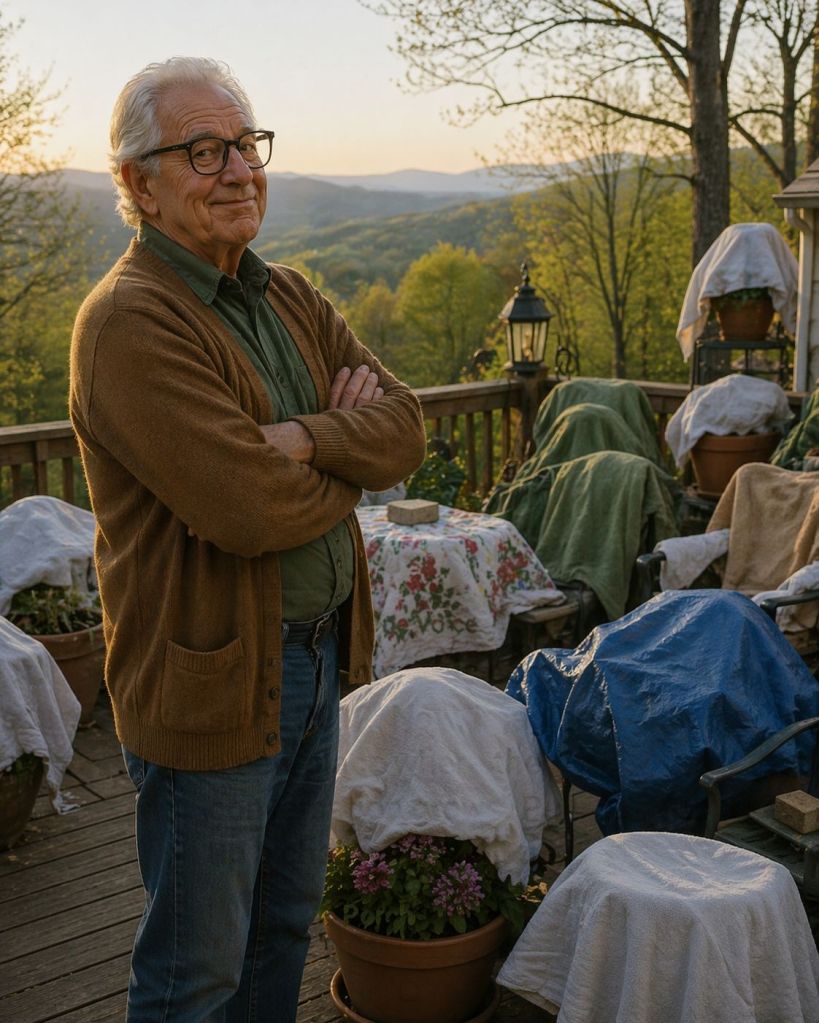
Judgment came in the early morning hours.
Harsher than expected.
Colder than predicted.
Twenty-four degrees.
Poor Brentford surveyed the scene.
“Your pound of cure was heroic,” he observed. “But was it enough?”
I looked out at the mountains and smiled. The trees, in all their green fullness, had been spared.
We began uncovering our plants.
One by one.
Here a bloom lifted.
There a stem held.
Elsewhere, leaves—cold, but alive.
We kept going.
More life.
More holding on.
More quiet insistence.
In the end, we lost only one.
And that one? To be honest, I had not been covered it very well at all.
I stood there a moment longer than necessary.
I had been prepared to blame the frost.
This time, I didn’t.
And I let that be enough.

