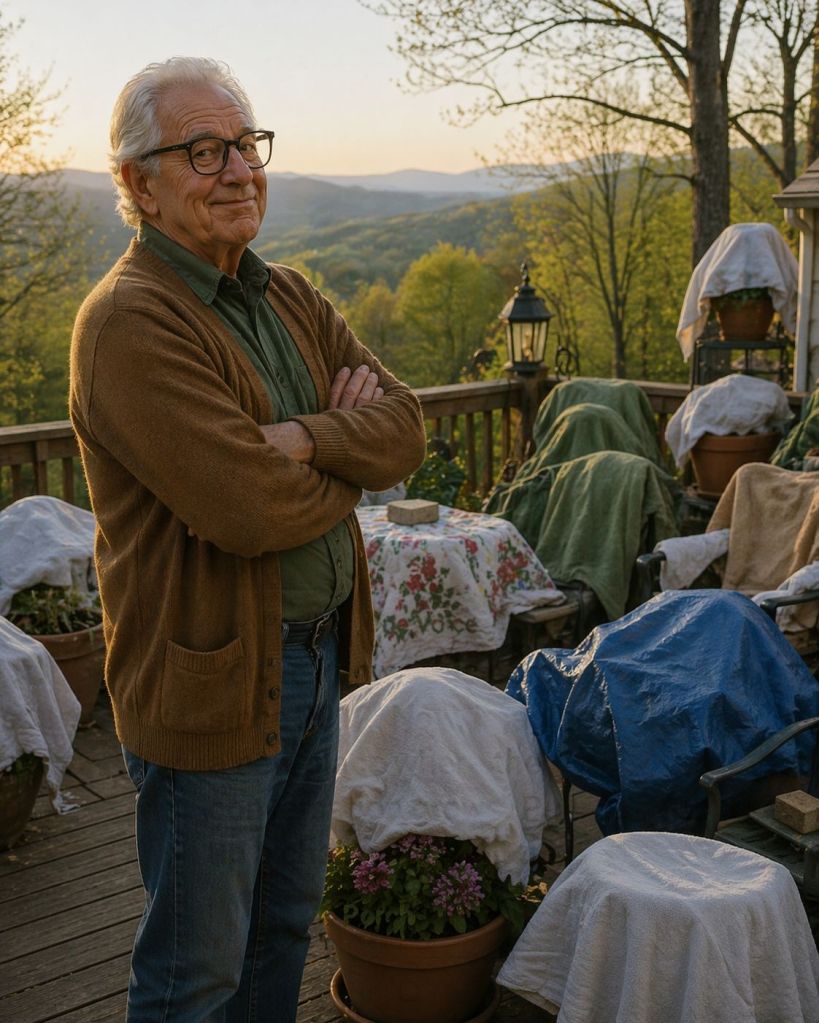
—Poor Brentford Lee (b. 1947.) He reads the signs, trusts the seasons, studies the soil—and is not above reminding others when they’ve mistaken one for the other.
“Absolutely not!”
“You must! Please, help.”
“This time, young man, you’ve gotten yourself in so deep that I can’t help.”
“Yes, you can. I know you can. You know everything.”
I was certain my pitiful entreaties would soften Poor Brentford’s heart and move him to help.
But no. He would not be moved.
“You got yourself into this mess all by yourself.”
“And just how did I do that? Come on, Brentford Lee. Help me.”
“I can’t. Why on earth did you think you could read Mother Nature—in April, no less? Don’t you know that’s the cruelest month of all, especially in the Shenandoah Valley?”
I knew that, of course. It’s the time of year when the world seems to be coming alive again—only to have Mother Nature step in and kill that vibrant new growth with a harsh, chilling frost.
That’s why Valley folks rarely plant tender crops until mid-May, after the danger of frost has passed.
So. There. I do know those precautions.
But last year, we found ourselves in a new gardening zone. Our old Zone 6 became Zone 7, with the danger of frost ending around mid-April.
I was cautiously thrilled—but I still waited until early May, when the ground was warm and the forest fully leafed.
This year, though, my mountaintop felt different. The soil warmed sooner. The forest leafed sooner. Sooner, it turned out, was early April.
“Wait and see,” I kept telling Gary. “When the mountaintop turns green, we’re past the danger of frost.”
“Are you sure?”
“Of course, I am. Mother Nature knows what she’s doing. She’s telling us Spring has overtaken Winter.”
And so it was. I had convinced myself. I managed to convince Gary. Together, we planted—and rejoiced in the head start.
Just as we beamed our widest smiles, we checked the weather.
Mother Nature was pulling a switcheroo.
Frost. April 22. 2:00 a.m. to 10:00 a.m.
27°? 30°?
The forecasts varied, but we knew: our plants were doomed unless we intervened—and maybe even then.
Poor Brentford was no help whatsoever. He had the nerve to smirk:
“An ounce of prevention is worth a pound of cure.”
I know. I know. We should not have planted.
But we did.
And there we were, scrambling to invent a pound of cure for our poor, tender, pitiful plants—deck, patio, yard—everywhere. Pots filled with blooms that had no business showing off this early.
What followed was less a plan than an emergency deployment.
Tarps emerged from the basement. Towels defected from bathrooms. A festive tablecloth—clearly never intended for agricultural duty—was reassigned to frost prevention. Gary moved with operational urgency.
Clay pots became heat traps. Chairs became scaffolding. We hurried bewildered begonias to safer quarters. We draped. We pinned. We tucked. We hoped.
By dusk, the deck resembled an archaeological dig disguised as a linen sale. Shapes rose under fabric—domes, humps, improbable ridgelines of cotton and optimism. Each tender plant huddled beneath its improvised shelter, awaiting judgment from a sky that had seemed so kind only hours before.
Poor Brentford Surveys the Scene.
Judgment came in the early morning hours.
Harsher than expected. Colder than predicted. Twenty-four degrees.
Poor Brentford surveyed the scene.
“Your pound of cure was heroic,” he observed. “But was it enough?”
I looked out at the mountains and smiled. The trees, in all their green fullness, had been spared.
We began uncovering our plants.
One by one.
Here a bloom lifted. There a stem held. Elsewhere, leaves—cold, but alive.
We kept going.
More life. More holding on. More quiet insistence.
In the end, we lost only one.
And that one? To be honest, I had not been covered it very well at all.
“A man should never be ashamed to own he has been in the wrong, which is but saying, in other words, that he is wiser today than he was yesterday.”
–Alexander Pope (1688–1744; English poet and satirist, one of the most influential poets of the 18th century, whose wit and keen moral reflections in works like “The Rape of the Lock” and “An Essay on Man” secured his literary legacy.)
Eating crow is never easy. In fact, it’s downright tough, so much so that it takes a lot of willpower and gumption.
Oh, I’m not talking about eating crow as in the genus Corvus, those glossy black birds found in most parts of the world. I’ve never eaten one of them.
I’m talking about eating the kind of crow that we sometimes have to eat when we discover that we’re wrong. That’s a hard discovery to make. Let’s face it: it’s hard to fess up when we’re wrong. But let’s own up to it—sometimes the best thing to do is just eat crow and be done with it.
Take the stubborn husband who swore up and down he could fix the plumbing himself, despite his wife’s warnings. A few YouTube tutorials, a flooded bathroom, and an emergency call to the plumber later, he’s standing there, soaking wet, eating a big plate of crow.
Or the manager who brushed off an employee’s suggestion, only to watch the competition roll out the same idea—successfully. There’s no easy way to walk that one back, but let’s hope the manager at least had the sense to admit, “I should’ve listened.”
Then there’s the friend who mocked TikTok, Wordle, or Air Fryers, scoffing at the hype—until they tried it. And now? They’re sending out their Wordle scores every morning, scrolling TikTok before bed, and raving about how crispy their Brussels sprouts get. Yep. Crow. Served hot and fresh.
People have been “eating crow” since the dawn of human interaction so the list could go on and on, ranging from professional to personal and from funny to frustrating, but I don’t need to continue. Every item in the list captures the same universal realization: Oops … I was wrong. Ididn’tunderstand.
Even though we’ve been eating crow for a long, long time, the phrase itself is surprisingly modern. It first appeared in 1885 in the MagazineofAmericanHistory:
“‘To eat crow’ means to recant, or to humiliate oneself.”
By 1930, the phrase had taken on a more serious tone:
“I should merely be making an ass of myself if I accused someone and then had to eat crow” (E. Queen, French Powder Mystery).
By 1970, “eating crow” was used in a way that is close to what we all hope for when we use the phrase today:
“I was going to apologize, eat crow, offer to kiss and make up” (New Yorker)
Yep! Sometimes, eating crow comes with extra benefits.
These days, eating crow is firmly on the menu for anyone caught in the wrong. Actually, it was on my menu last week. Two servings of crow. That’s right. Two servings. Mind you, I haven’t been caught in the wrong because I haven’t done anything wrong other than having had some lingering thoughts down through the years about two Mary E. Wilkins Freeman scholars. I’ve now come to realize that I was wrong, or, more accurately, I’ve come to realize that I didn’t understand.
And since I’ve always believed that eating crow is most beneficial if done in public, let me lift the cloche and reveal my double portion.
My first portion is because of thoughts that I’ve had about Thomas Shuler Shaw, a librarian at the Library of Congress, who embarked on an ambitious project to write what would have been the first biography of Mary E. Wilkins Freeman. His goal was to illuminate the life and literary contributions of this remarkable author who had died in 1930.
However, fate had other plans. Shaw’s 1931 biography, A Nineteenth Century Puritan, faced rejection from prominent publishers such as Harper & Brothers, Ladies’ Home Journal, and The Saturday Evening Post. I’ve always credited Shaw for persevering, at least enough to find a home for his meticulously curated scrapbooks and the typescript of his unpublished biography in the Rare Book & Special Collections Division at the Library of Congress. Those artifacts provide a rich tapestry of insights into Freeman’s life and work, and they certainly helped me with my edition of The Infant Sphinx: Collected Letters of Mary E. Wilkins Freeman (Scarecrow, 1985).
Nonetheless, I wondered then as I do now: why didn’t Shaw continue his efforts to find a publisher? His book would have distinguished itself as the first Freeman biography. What impact might it have had on her literary reputation if the details of her life had been accessible to readers of the 1930s and 1940s?
My second portion of crow relates to another scholar working on a Freeman biography around the same time. Edward Foster wrote his Mary E. Wilkins Freeman: A Biographical and Critical Study in 1934 as his thesis when he was a candidate for the Doctor of Philosophy degree at Harvard University. The university accepted his thesis, but Foster didn’t complete his Harvard degree. He put aside his Freeman work until 1956 when he revised and published it as Mary E. Wilkins Freeman (Hendricks House).
Foster was direct when he explained the delay:
My thesis was accepted […] also for subsidized publication by Harvard Press. Lacking funds for subsidy and failing to get trade publication, I forgot the thing for nearly twenty years. MWF is only a small part of my career. (Foster to Brent L. Kendrick, ALS, October 24, 1973)
Nonetheless, I wondered then as I do now: why didn’t Foster try to find a publisher sooner than he did? What impact might it have had on her literary reputation if Foster’s details of her life had been accessible to readers of the 1930s and 1940s.
There. I’ve done it. I’ve eaten my two portions of crow. However, I have to do one more thing to help you understand the art of eating crow. To turn eating crow into an art requires divulging what prompted, in my case, not just one portion of crow but two in a single serving. That’s the source of the catharsis. That’s the confession, without which eating crow can never be an art.
Here’s mine.
Yesterday, I uploaded the manuscript of my forthcoming book Unmasking The Humourist: Alexander Gordon’s Lost Essays of Colonial Charleston, South Carolina. My book definitively establishes Gordon (c. 1692–1754)—antiquarian, Egyptologist, scholar, singer, and later Clerk of His Majesty’s Council of South Carolina—as the author of The Humourist essays, restoring his rightful place in literary history.
I hesitate to say this, but the book is a significant scholarly work. It’s meticulously researched, not only unearthing a forgotten literary voice but also redefining our understanding of colonial American literature. While it’s structured with rigor, it remains highly engaging, making complex historical and literary analysis accessible without oversimplification. It’s not just a literary recovery; it’s a reframing of Charleston’s intellectual life, the role of satire in the colonies, and the transatlantic literary tradition. That’s no small feat.
To say that I am ecstatic is an understatement. I am.
But get this. I’ve been working on this book since 1973, when Professor Calhoun Winton of the University of South Carolina suggested that I try to solve this literary mystery. Published in the South-Carolina Gazette, the essays had been largely forgotten, and the identity of their author remained unknown.
At the time, I recognized their brilliance and used them as the foundation for a graduate paper. Then I put the project aside where it remained in my mental storehouse of “one-day, some-day” ideas, waiting for the right time.
Decades later, the Virginia Community College System (VCCS) gave me an extraordinary opportunity to return to that project, to bring these essays into the light, and to finally answer the question that had remained unanswered for centuries: Who wrote them?
As a VCCS Chancellor’s Professor (2012-2014), I answered that question and shared the essays and my ongoing findings with my blog readers right here. Actually, that’s when TheWiredResearcher had its beginning.
Ironically, I delayed publishing my watershed UnmaskingTheHumourist until now.
You may be wondering about my delays, just as I wondered about Foster’s delays and Shaw’s delays.
I’ve been wondering about my delays, too, and that’s why I’m eating crow.
I could toss out many reasons:
● TheHumourist essays seemed too short for a book and too long for a scholarly article.
● I wanted to make certain that my evidence for claiming Alexander Gordon as the author was as compelling as my discussion.
● I wanted to do further research so that my headnotes and endnotes for the essays were comprehensive.
All of those reasons are true.
I won’t toss into that mix other scholarly pursuits that came my way.
I won’t toss into that mix my early career advances as a federal employee or my second career advances as an educator.
I won’t toss into that mix caring for aging parents.
Actually, I won’t toss into that mix anything else because what became obvious to me when I uploaded Unmasking The Humourist: Alexander Gordon’s Lost Essays of Colonial Charleston, South Carolina was something seriously simple. We all lead complex, complicated, and convoluted lives.
● I know that truth firsthand.
● You likely do as well.
● So, too, did Edward Foster.
● So, too, did Thomas Shuler Shaw.
Wondering about their delays caused no harm, but I now see there was no need to wonder at all. I might simply have acknowledged what I’ve come to recognize in my own self-talk about The Humourist:
Life is rich, robust, and mysterious, and it rarely marches forward on a straight path.
As I move forward on my path, I’ll keep that truth in mind as I interact with others—and with myself. And with that heightened awareness, perhaps I really will have mastered the art of eating crow.