And How Shall I Begin? A Moral Compass in an Age of Headlines.


“I felt my standpoint shaken
In the universal crisis.
But with one step backward taken
I saved myself from going.
A world torn loose went by me.
Then the rain stopped and the blowing,
And the sun came out to dry me.”

— Robert Frost (1874–1963). Four-time Pulitzer Prize winner and one of the most influential American poets of the 20th century. The quote is from his “One Step Backward Taken.”)


I’m not a genius. But I’m smart enough.

I’m not ancient. But I’ve lived long enough.

I’m focused on silver linings. But I’m realistic enough.

And yet, these days, I find myself asking:

“And how shall I begin?”

I’m mouthing that lament every day as I process the news, trying to understand what’s true. And what isn’t.

Don’t be alarmed. I haven’t fallen for the “Fake News” malady that plagues the House that should be the Whitest and most transparent in the land. But isn’t.

I’m simply responding to the struggle of grappling day after day with headlines that cause major whiplash.

My pain was most severe on April 8, 2026, the morning after the President of the United States had threatened to annihilate an entire civilization—an outcome forestalled, for now, by a tenuous two-week ceasefire agreement with Iran.

I awakened. I inhaled. I sighed.

Then news processing began. The headlines seemed to argue with one another.

Trump Warns Iran ‘Whole Civilization Will Die’

Trump Threatens ‘Power Plant Day’ and ‘Bridge Day’ for Iran

Trump Sets 8 p.m. Deadline for Tehran

Ceasefire Reached After Two Weeks of Escalating Threats

Hegseth Declares ‘Decisive’ Victory Over Iran as Ceasefire Holds

Each headline carried its own emotional voltage. Each belonged to a different reality. Each demanded interpretation before the mind had time to absorb the implications of the last.

I moved back and forth between them, as though scanning the horizon for bearings that refused to hold still.

What I am experiencing is not ignorance but overload. The difficulty lies in the troubling acceleration of interpretation in a profession once defined by the discipline of waiting long enough to get things right.

Consider libraries. At their best, they do not merely gather books. They impose order. They create sequence. They distinguish catalog from commentary, reference from rumor, scholarship from speculation. They allow ideas to ripen because they provide intellectual space in which ripening can occur.

Headlines, by contrast, now arrive like weather systems colliding over open water—pressure against pressure, temperature against temperature, narrative against narrative–producing turbulence before the mind has even had time to locate north.

I am not longing for a simpler past. The past was never as simple as memory sometimes pretends. Newspapers got things wrong. Governments obscured truth. Voices were excluded. Perspectives were limited. The so-called consensus often reflected who had access to presses, pulpits, and broadcast towers.

But there was, nonetheless, a sense that information moved in a sequence that allowed thought to follow. Now information and interpretation appear simultaneously, each insisting on priority. The result is not merely disagreement. Disagreement can be healthy. Disagreement sharpens thought.

The result, instead, is compression. Compression of time. Compression of context. Compression of reflection. We’re asked to conclude before understanding has had the opportunity to unfold.

And then we have the words themselves. Not paraphrased. Not filtered. Not softened by summary.

Right now, words published by a sitting President of the United States appeared in the public stream as casually as any other post competing for attention:

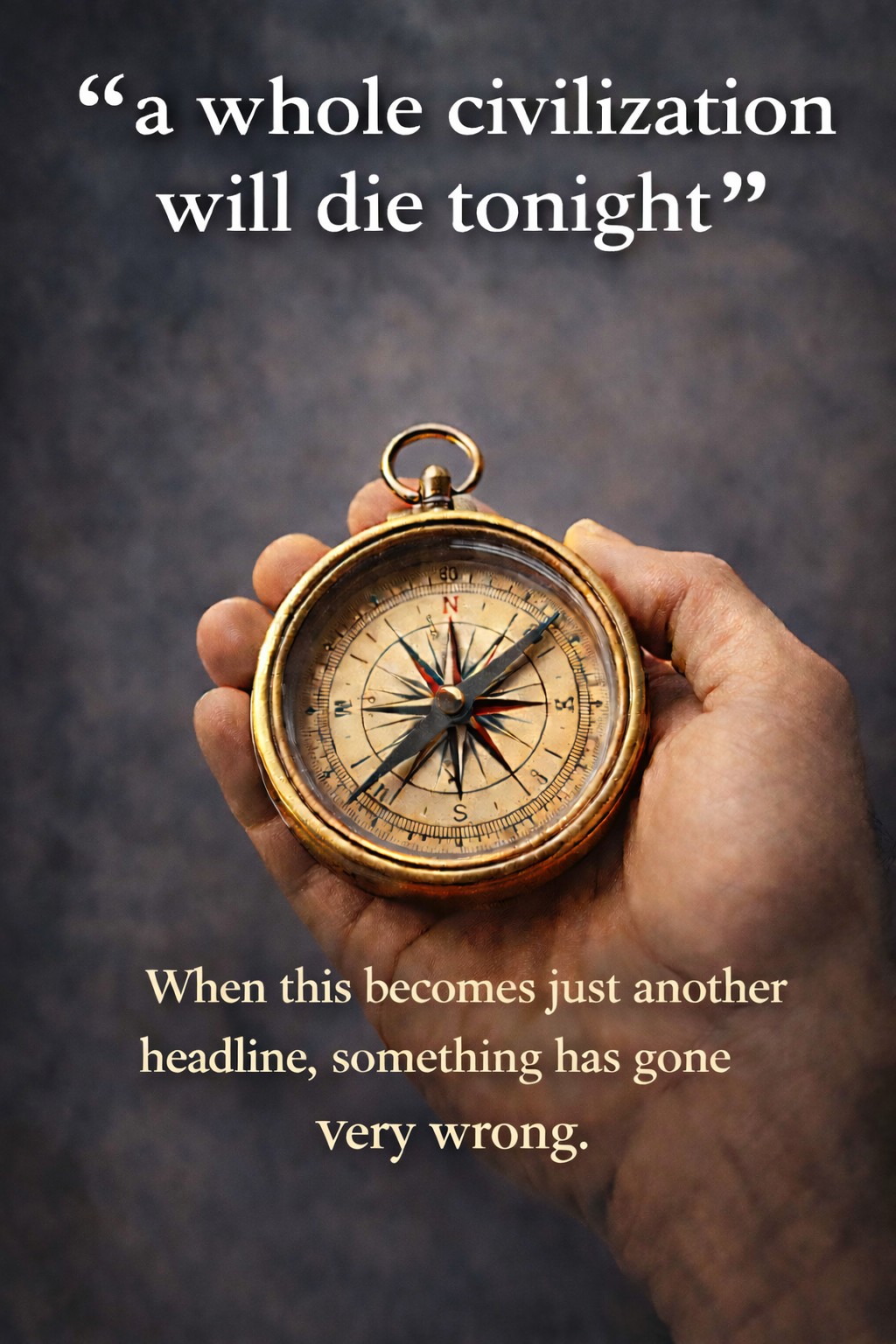
“A whole civilization will die tonight, never to be brought back again. I don’t want that to happen, but it probably will…”

Those words burn on my brain.
And what about his words a few days earlier on Easter morn:

“Tuesday will be Power Plant Day, and Bridge Day, all wrapped up in one, in Iran. There will be nothing like it!!! Open the Fuckin’ Strait, you crazy bastards, or you’ll be living in Hell — JUST WATCH! Praise be to Allah.”

Those words burn, too.

What startled me was not only the language itself, but also the velocity with which language of this magnitude seemed to be absorbed into the ordinary churn of the news cycle.

A threat invoking the destruction of a civilization. A deadline—8 p.m. Eastern Standard Time—as though annihilation could be scheduled between dinner and the evening weather. Profanity directed at a sovereign nation. Religious language pressed into rhetorical service. Exclamation points doing the work once reserved for deliberation.

Then the headlines moved on. Analysis fractured into familiar alignments. Interpretations multiplied. The moment was processed, categorized, debated, defended, reframed, condemned, contextualized, and gradually folded into the ongoing river of competing urgencies.

But I could not quite fold it away. Some language does not dissipate simply because the news cycle advances. Some language lingers. Some language tests the boundaries of what we are willing to normalize simply because normalization has become the adaptive response to informational overload.

What’s gnawing at me right now is this. More and more, I find myself falling back on something older than any alert that lights up my phone.

My moral compass.

I’m landing there not because I distrust journalism. Not because I imagine that complex geopolitical realities can be reduced to tidy conclusions. Not because I believe that every headline must conform to my preferences.

I’m landing there simply because, even in a world of incomplete information, some things remain legible.

I know that truth matters.

I know that language matters.

I know that threats—especially those uttered from positions of immense power—matter.

I know that rhetoric capable of conjuring the annihilation of entire peoples is not merely strategic vocabulary to be shrugged off between weather reports and stock updates.

I know this not because a headline tells me so, but because a lifetime of reading, thinking, teaching, and living has taught me that words shape worlds.

Facts help us understand events. Conscience helps us understand consequences. Evidence tells us what is unfolding. Moral proportion tells us what should give us pause.

My moral compass is not a substitute for evidence. But neither is evidence meaningful without some internal measure capable of recognizing when rhetoric crosses thresholds that once would have prompted gasps of disbelief around the world, followed by sustained collective stillness.

I know that complex geopolitical realities rarely yield simple judgments.

I know that leaders sometimes speak forcefully for strategic reasons.

I know that journalists, working in real time, must report language even when its implications remain uncertain.

But I also know this. The casual invocation of civilizational destruction should not feel ordinary. The language of annihilation should not feel routine. Deadlines for devastation should not feel like programming notes in the daily schedule of global life.

Even in a fractured informational environment, some lines remain visible. Even in a world of interpretive disagreement, some language retains moral weight independent of partisan affiliation. Even in an age of competing narratives, conscience still recognizes disproportion.

The compass may tremble, but it need not spin.

And so I return again to the question with which I began:

How shall I begin?

Perhaps I’ll begin:

● By trusting that the habits of mind formed over decades—habits shaped in libraries, classrooms, conversations, and careful reading—remain capable of distinguishing urgency from alarmism, disagreement from distortion, complexity from confusion.

● By trusting that patience remains a form of intelligence.

● By trusting that moral proportion is not an antiquated instrument, but a necessary one.

I am not a genius. But I am smart enough to know that understanding rarely arrives prepackaged in a headline.

I am not ancient. But I have lived long enough to know that normalization can occur gradually enough that we scarcely notice the shift until the boundary has already moved.

I am focused on silver linings. But I am realistic enough to know that clarity sometimes requires effort equal to the confusion that obscures it.

I will continue. Reading. Comparing. Pausing. Listening for what rings true beneath what merely rings loud.

I will begin again each morning with the quiet but stubborn conviction that truth and responsibility do not cease to exist simply because their presentation has grown more chaotic or their interpretation more divided.

The world may move quickly, but the compass, if we are willing to hold it steady, still points True North.

We Are Such Stuff as Dreams Are Made On

“Our revels now are ended. These our actors,
As I foretold you, were all spirits and
Are melted into air, into thin air:
And, like the baseless fabric of this vision,
The cloud-capp’d towers, the gorgeous palaces,
The solemn temples, the great globe itself,
Yea, all which it inherit, shall dissolve
And, like this insubstantial pageant faded,
Leave not a rack behind. We are such stuff
As dreams are made on, and our little life
Is rounded with a sleep.”

William Shakespeare (1564–1616; an English playwright, poet, and actor, widely regarded as one of the greatest writers in the English language. The quote is Prospero reflecting on the fleeting nature of life, The Tempest, Act 4, Scene 1.)

Raindrops had been falling steadily all day, but I was determined to get a better glimpse. I pulled safely off the road and parked in a grassy area, hoping to turn my drive-by impressions into something more tangible.

Right across from me stood the nearly remodeled house at the corner of Gateway Lane. Its fresh gray siding gleamed against the misty afternoon, and the neat white trim on the roofline and windows gave it a crisp, modern edge. This clean contrast seemed to soften against the backdrop of the old, towering trees surrounding it. A small front porch, still under construction, wrapped around to the side, its bare framework waiting to cradle the entryway that would soon welcome visitors. The simplicity of the single-story structure was anchored by the earthy lawn and the gentle curve of the road, reflecting a quiet transformation. Even the steady rain couldn’t dampen the renewal unfolding before me.

But this remodeling was more than just a surface change. It had been going on for over a year, maybe longer. The house wasn’t just getting a facelift; it was being rebuilt from its very foundation. This wasn’t simply a matter of adding a porch or changing the siding from white to gray. The work was deep and structural, and that’s what had taken so long.

I remember when it all started. The house was suddenly surrounded by the relentless growl of a backhoe, its sharp metal teeth tearing into the earth around the foundation. Day by day, the trench grew deeper and wider, as if the house itself were being uprooted, its very stability pulled into question. Dirt piled high, and the house seemed to brace itself for the transformation ahead.

Then came the cinderblocks, stacked in neat, heavy rows, patiently waiting to reshape and fortify the foundation. The windows—the house’s eyes to the outside world—were ripped out, leaving dark, hollow spaces. They were hastily covered in sheets of plastic, which flapped and snapped against the wind on gusty days, as if the house were drawing deep, ragged breaths during its lengthy transformation.

Through it all, the house endured quietly, as if preparing for a rebirth beneath the dust and debris. The process dragged on, perhaps because the crew was never more than one or two people at a time. Sometimes, I wondered: Why not tear it down and build anew? Other times, I thought: Were the owners tied to the house by more than just bricks and mortar? Were they new buyers, envisioning profit from this modest fixer-upper?

Now, on this misty afternoon, as I admired the nearly completed house from my Jeep, I knew that soon—perhaps by Thanksgiving or maybe before the joy-filled month of December—someone would move into their new home. Someone had a dream, and now it was realized, born not just from superficial changes, but from all that’s required to make dreams come true.

As I became transfixed by the modest transformation in front of me, my mind’s eye gradually faded into a sharp focus of me, myself, chasing my own lifetime of dreams.

My dreams have been few in number but big in size. They’ve been big because I see dreams as different from the gazillion goals that I’ve set for myself down through the years, the things that I knew I could achieve in a day, a week, a month, a year, or even longer.

For me, dreams go far beyond goals. They overarch all else. They serve as a life-compass. They keep me oriented and aligned with my true North, my own authentic self.

From as early as five years old, I started dreaming on clouds, and my first cloud dream was bigger than my home, bigger than my coal camp, bigger than West Virginia, bigger than anything that I knew or could comprehend. I knew then something about myself that would shape my entire life: I was drawn to men, though I didn’t fully understand the depth of that attraction. Growing up in the late 1940s, 1950s, and 1960s in the Bible Belt South, with a fundamentalist minister for a mother, I quickly recognized that this truth about myself would be a challenge to navigate. In a world where the church preached that men like me were sinful, and where societal norms pressed in from every side, my dream was simple: to move forward, to stay true to who I was as a person, and one day, to live an openly gay life, free from ridicule and condemnation.

Back then, the idea of living openly wasn’t even something I could articulate fully. Yet the desire to live authentically, without having to hide a core part of who I was, remained my compass. I was too young to understand the full scope of what it meant to be gay, but I already knew that the road ahead wouldn’t be easy. All around me was the conflict of sin and salvation. Even as a child, I had a hope, a dream, that someday, the world, however big it might be, might allow me to live openly as myself, without fear.

That was my first big dream. One day, it came true. One day, though it was decades in coming, I was able to live openly as a gay man. One day, when I met my late partner, I discovered the power that two people experience when they surrender fully to true love. One day, Allen and I said our vows, exchanged our rings, and went on living our lives together, openly, as all people should be allowed to do. Through it all, my dream empowered me to maintain my authenticity.

My second cloud dream wasn’t as big as the first, but it was bigger than my home and bigger than my family. Influenced by my mother, the minister, I fell in love with language as a preschooler. Her sermons were magical, and I came to believe that her words held great power. Her Biblical research also fascinated me, as I watched her thumb through multiple Biblical commentaries, especially her treasured Matthew Henry Commentary on the Whole Bible, originally written in 1706. Her quiet, unseen research brought informed clarity to her interpretations, helping her with her sermons and helping her help others navigate their own spiritual journeys through the Bible. Without knowing it, her unpretentious research revealed to me the joy of discovery and exploring comparative meanings in a text. By the time I reached third grade, I had a dream not only that I would become an English professor but also that I would earn my Ph.D., become a published scholar, and make learning my lifelong companion.

Today, that’s not an unusual dream, but for me, the son of a coal miner and the first in his family to go to college, it was extraordinary. Even so, extraordinary dreams come true. One day, I earned my Ph.D. One day, I became a college professor. One day, I became a published author, not only of scholarly works but also of creative nonfiction essays. Who would have dreamt that my dream would have allowed me to fulfill all of those things and, in addition, have a distinguished career at the Library of Congress? But it did. For a kid who grew up in a home with just a handful of books and in a town with no library, it was beyond imaginable that I would spend a quarter of a century working in an institution with “all the books” and giving human resources advice to two Librarians of Congress. Who would have dreamt that nearing eighty, my dream would still be propelling me toward learning? But it does. I’m as turned on now by learning as I was turned on by words when I was a child, but these days I’m hyped by Artificial Intelligence (AI) and my belief that we can harness its power to make us better than we are. Who would have dreamt that my dream would have allowed me to taste “the good life” without ever making it a priority? But it did. The material comforts, joyful and meaningful career engagements, loving relationships, physical and spiritual well-being, and belonging to rich and diverse communities fell into place.

My third dream was bigger and billowier than the first two. Although I never made a conscious effort to live “the good life,” I did resolve from childhood that I would live “a good life.” I’ve always taken the moral high ground, based on justice and goodness rather than personal gain or self-interest. I’ve always stood up for the underdog, knowing that I’m standing up for everyone because somewhere along our journeys, we’re all underdogs. I’ve always shared my plenty with those whose want brings pain and suffering not only to them but also to me. I’ve always accepted people for who they are and where they are, believing that their blood pulses through my veins and mine through theirs. I’ve always been grateful for what I have, celebrating that my meager mite, regardless of its manifestation, is my lot. I’ve always tried to make amends by the end of the day for words harsh-spoken and feelings ill-harbored, knowing the wisdom of my mother’s teaching:

“Never let the sun go down on your wrath.”

I’ve always seen every day as a brand-new day, giving me one more chance to “get it right,” whatever the “it” might be. I’ve always tried to live every day so that at the end of each day, even if it should be the end of my life, I am at peace with myself and with my soul, being able to slip into slumber, sighing the words of that great gospel song:

“It is well with my soul.”

As I reflect on the three dreams that shaped my life, I know now what I never knew as a youngster starting out on my journey. It’s clear to me that without even knowing what I was doing, my dreams aligned with key stages of Maslow’s Hierarchy of Needs, illustrating how my pursuit of a fulfilled and meaningful life followed a path of human development that is universal. We all pursue our physiological needs of food and water. We all pursue our need for safety of person, employment, family, and resources. We all pursue our need for love, belonging, and sexual intimacy. We all pursue our need for self-esteem gained through achievements as well as through respecting others and being respected by others. We all pursue the most important pursuit of all, our need for self-actualization, of discovering, developing, and celebrating our own authentic self.

And you? What about you and the life dreams that you are chasing? Whatever they might be and wherever you might be in seeing them through to fulfillment, let me offer a few words of encouragement based on where I’ve been and what I’ve experienced on my journey.

● Above all else, dream. Dream big, bigger than the bounds of your imagination, and perhaps even bigger than what you think possible. The greater the strive, the more likely the achievement.

● Wake up every day to your dream, letting its brightness surround you and lead you throughout your day. The more beaming the vision, the closer the reality.

● Work tirelessly and endlessly toward achieving your dream. The greater your grit, the more triumphant your victory.

● Expect setbacks, reminding yourself that life often leads us two steps forward only to thrust us one step back. Turn every setback into a comeback.

● Keep an eye open for naysayers, realizing that you yourself may be the chiefest among them. Transform traitors of dooming doubt into warriors of powerful prayer.

● Surround yourself with supporters, those who believe in you and your dream. The stronger your circle, the more robust your resolve.

● Validate yourself, but never forget to validate others, knowing that each of us is enough. The more you uplift others, the more we rise together.

In the end, what matters most is not the size of our dreams, but the dreams themselves and the heart and grit that we pour into them. In the end, we need to be ever mindful that we are all such stuff as dreams are made on, constantly rebuilding our foundations, striving toward fulfillment, and learning that the journey itself is the real victory. Dreams are not just distant destinations; they are the roadmaps guiding us toward our authentic selves. Whether we stumble or soar, each step along the way is a testament to our perseverance and our determination to not let go of what we hold most dear.

Whatever dream you are chasing, know that it is not the finish line that defines you—it is the striving, the growing, and the becoming that shape who you are. Keep dreaming. Keep reaching. Keep believing that every effort, every setback, and every triumph will bring you one step closer to your truest and most authentic self.