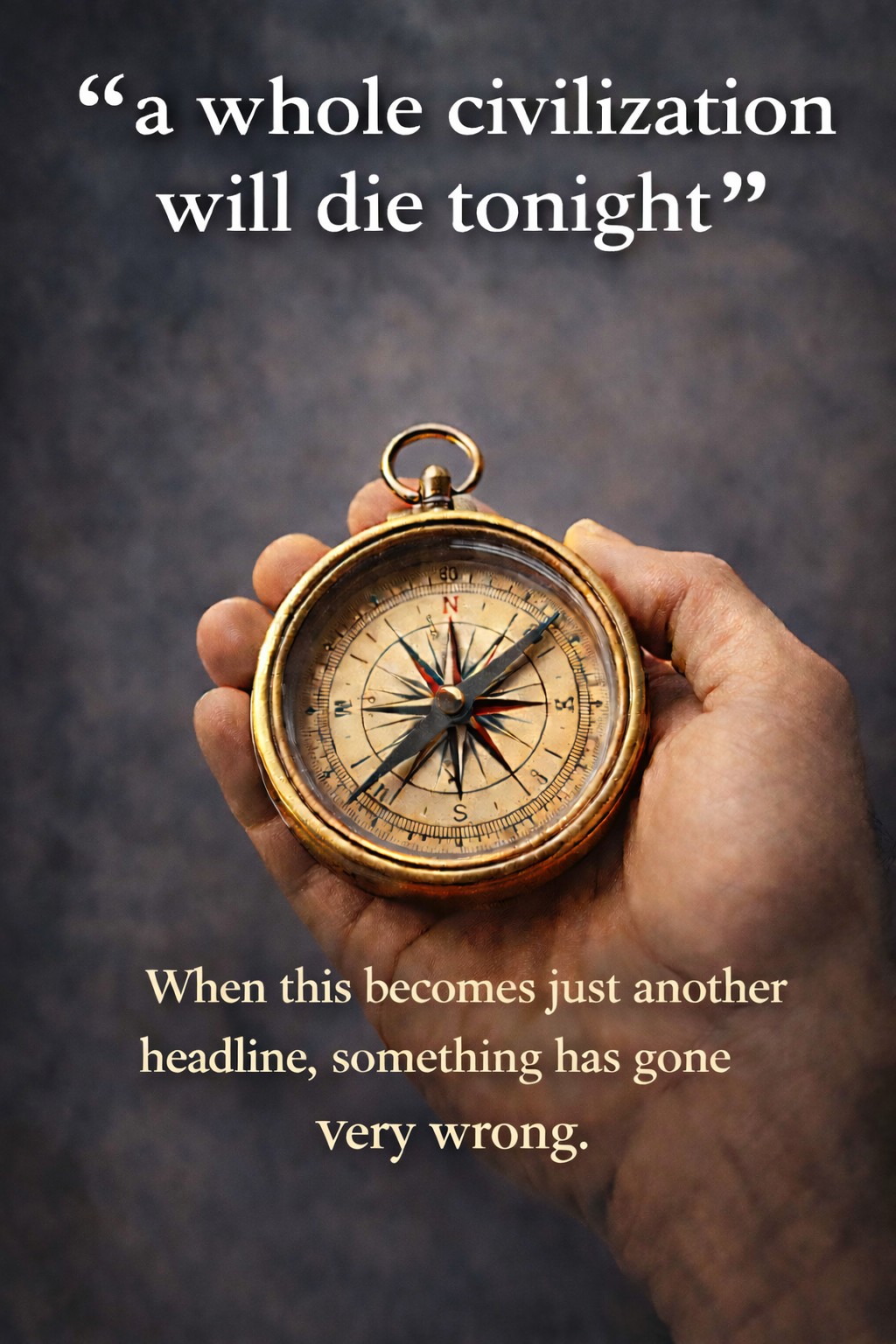
“The care of human life and happiness, and not their destruction, is the first and only legitimate object of good government.” —Thomas Jefferson (1743–1826). Principal author of the Declaration of Independence and third President of the United States.
At the far end of the deck, beyond the flowers and conversation, the flag flew. The mountain breeze caught it softly, lifting and releasing it against the deep green of the forest. There was something almost reverential about its solitude.

Time was it would have had company. A flag flying on the opposite end. Two in the middle. And spanning the entire 70-foot deck, bunting—the classic pleated red, white, and blue fanned ones that unfurl patriotism, national unity, and civic belonging.
After all, this time was different. It was special. It was unlike any Fourth of July that has come before. We were not simply marking another birthday. We were celebrating the 250th anniversary of the signing of the Declaration of Independence. Two hundred and fifty years. It is an astonishing span of time, and I suspect most Americans, if they paused to think about it at all, felt at least a quiet sense of gratitude for having lived to witness such an anniversary.
I did.
Ordinarily, I would have looked for something even bolder than bunting and traditional flags to mark the occasion. After all, I enjoy celebrations of almost every kind. Give me the first tomato from the garden, a birthday, an anniversary, a hummingbird’s return, a friend’s good fortune, or even a pie that slices perfectly, and I can usually find a reason to raise a glass or gather people around the table. Celebration comes naturally to me.
This year, however, I couldn’t muster up more than one solitary flag flying in the northeast corner of our deck. Somehow that seemed enough.
If you are tempted to think that I’m less than patriotic, you would be mistaken. I love this country deeply. My family has lived on this soil for generations. Some of my ancestors fought in the American Revolution. Others answered their country’s call in wars that followed. Their sacrifices are woven into my family’s story, just as surely as they are woven into the story of our nation.
Perhaps that’s why I found myself standing on the deck, looking toward the flag, wondering why my heart felt quieter than usual.
The answer, I think, had been unfolding for days.
It had not been building toward any single event. Iran and the United States had exchanged military strikes, then edged toward a ceasefire. Venezuela’s government and Washington were trading threats over what might come next. Russia’s war in Ukraine ground on into another season, no closer to resolution than it had been the season before. And closer to home, even Greenland—a name I never expected to hear in a conversation about American power—had become a subject of dispute over sovereignty and strategic interest. Not all of these were wars in the traditional sense. But each was a test of what a nation is willing to risk, and what it is willing to say out loud that it wants.
What surprised me was not the speed of events.
It was the speed with which many of us seemed to move on.
I searched and listened for conversations at stores and among friends. I expected arguments. I expected anxiety. I expected outrage or relief—something to suggest that Americans were wrestling with the gravity of what had happened and were asking the tough questions.
Had military action become the only option? Were the stated objectives achieved? What might the long-term consequences be—for everyone involved?
Why weren’t more of us asking those questions?
Instead, I encountered what felt like an extraordinary calm.
Life simply continued. People packed restaurants. Families headed to the beach. Neighbors mowed their lawns. Social media filled with photographs of backyard cookouts, grandchildren chasing sparklers, fresh peaches, birthday cakes, and sunsets.
I smiled at many of those photographs. Some of them were my own, on Facebook.
Gary and I watered flowers. Ruby ran around the yard. We welcomed Gary’s daughter and her family into our home.
We did all those things and more. Life, after all, does not suspend itself because the world has become uncertain.
Yet a question continued to follow me from room to room.
When did war become something we simply live around?
I found myself looking for the national conversation I remembered from years ago. Not agreement. We have never agreed about war. During the Cold War, neighbors disagreed about nuclear weapons and foreign policy. During Vietnam, families argued around dinner tables. After September 11, Americans wrestled with difficult questions about security and liberty. The conversations were often messy, sometimes angry, but they happened.
But here’s why I’m uneasy now.
I grew up in a world where war mattered, not because I fought in one. I didn’t. But because nearly everyone around me had been touched by one.
As a boy growing up in the coal camps of southern West Virginia, I knew men whose lives had been interrupted by World War II. Others had served in Korea. They did not often tell long stories, but they didn’t have to. Sometimes a single sentence carried the weight of an entire lifetime. Sometimes it was a photograph on the mantel. Sometimes a missing friend whose name was spoken only once each Memorial Day.
War was never merely an item in the newspaper. It lived among us. We didn’t live around it. There is a difference.
We are, after all, a nation born in revolution. Our earliest history is inseparable from war—not because Americans glorified it, but because they believed certain principles were worth extraordinary sacrifice. Life. Liberty. The pursuit of happiness. Those words were never meant to make war ordinary. If anything, they remind us that the decision to wage war should never become ordinary.
Human beings were never designed to carry the weight of every tragedy occurring on every continent every hour of every day. We still have gardens to tend, meals to prepare, dogs to walk, children to raise, aging parents to love, and neighbors who need us.
Even after the wars I’ve known had ended, the possibility of another one lingered in the background of everyday life. My generation practiced air-raid drills in school. We learned unfamiliar words like “fallout” and “radiation” before we fully understood them. During the Cuban Missile Crisis, adults spoke in quieter voices, and children sensed enough to know that the world itself seemed less certain than it had the week before.
I suppose every generation grows accustomed to the anxieties of its own time.
Perhaps ours has simply grown accustomed to too many.
Pandemics.
Political divisions.
Economic uncertainties.
Iran. Venezuela. Ukraine. Greenland. Names that, a few years ago, would each have commanded a nation’s full attention for weeks. Now they arrive almost in the same breath, take their turn in the headlines, and give way to whatever comes next.
The headlines arrive with urgency, remain for a few days, and then quietly slide aside to make room for the next emergency waiting in line.
That is not entirely our fault. Life insists upon being lived.
And yet…
Conflict—and especially the prospect of war—ought to interrupt us.
It ought to remind us that somewhere a young American is standing watch far from home. Somewhere parents are waiting for a telephone call they hope never comes. Somewhere families in Iran, or Kyiv, or towns whose names we’re only now learning, are wondering whether tomorrow will resemble yesterday or whether everything familiar will disappear before morning.
Distance may explain why we do not feel their fear. However, it should not excuse forgetting it.
I have no grand solutions to offer. I cannot tell diplomats how to negotiate or generals how to wage war. I have lived long enough to distrust simple answers to complicated questions.
What I do know is this.
A nation that celebrates its freedom should never grow so accustomed to conflict, wherever it appears and whatever name it goes by, that it no longer pauses to consider what such conflict asks of everyone it touches.
On the morning of the Fourth of July, I stepped onto our deck and looked toward the flag flying quietly in the northeast corner. It moved gently in the mountain breeze, exactly as it had moved the day before and the day before that.
I realized then that I hadn’t celebrated less because I loved my country less. I simply chose to celebrate more quietly because I found myself loving my country differently.
Two hundred and fifty years ago, Americans pledged “our Lives, our Fortunes, and our sacred Honor.” That pledge was never only a declaration of independence. It was an invitation to keep asking, generation after generation, what independence should cost us and what it should demand of us.
That solitary flag in the corner of the deck was never a sign that I loved my country less.
It was a reminder that some anniversaries call not only for celebration, but for an honest reckoning with who we are, what we stand for, and what kind of nation we hope to become.