“Holding a book in your hands is like holding another human being.“
—Leah Price (b. 1970. Literary scholar and historian of the book, known for her work on how and why we read across time and format.)
Well, this was unexpected—in the best possible way.
The paperback edition of The Third Time’s the Charm: Still Foolin’ Around in Bed just became available—much earlier than planned! I was already celebrating the Kindle release today, and now, here comes the paperback joining the party.
So whether you’re a digital reader who likes to swipe beneath the covers, or someone who prefers the feel of a real book in hand, you now have options. The hardcover (with its fabulous dust jacket) is still on the way—but today, I’m just enjoying this double dose of charm.
This collection gathers 440 pages of essays written, as always, In Bed—thoughtful, humorous, grounded, and a little mischievous. If you decide to dive in, I hope it keeps you company, makes you smile, and maybe even nudges a memory or two of your own.
P.S. If you enjoy it, I’d be grateful if you’d leave a review. A few kind words go a long way in helping others discover this little book of big heart.
“Lovers of print are simply confusing the plate for the food.”
—Douglas Adams (1952–2001; British author and satirist best known for his cult-classic sci-fi series The Hitchhiker’s Guide to the Galaxy. he embraced e-books long before they were mainstream.)
Well, friends… it’s official.
The Third Time’s the Charm: Still Foolin’ Around in Bedis now available on Kindle!
This is the first of three editions rolling out over the next couple of weeks. Today, I’m delighted to share the digital version for all of you who like to read with the lights off, your glasses on, and your e-reader tucked beneath the covers.
This collection gathers 440 pages of my most personal essays—stories that stretch from Appalachian coal camps to online dating, from gardening joys to philosophical musings, all written (as always) In Bed. There’s humor, heart, and a fair amount of reflection. If you’ve followed The Wired Researcher blog, you’ll recognize the voice. If you’re new, welcome to my little “postage stamp of native soil.”
Coming soon: the paperback edition, followed by the hardcover—with its delightfully mischievous dust jacket. I’ll be sharing more when each one arrives.
Until then, if you’re eager to start reading, the Kindle version is ready to crawl under the covers with you. I’d love to hear what resonates—and what surprises you.
P.S. If you enjoy it, a quick review on Amazon would mean the world. It helps other readers discover what you’ve found—and it gives my word messengers a better chance of finding their destination.
“To be remembered, to have one’s name spoken—these are the most powerful things anyone can hope for.“
–Paul Monette (1945–1995; award-winning gay author, poet, and activist. His 1988 Borrowed Time: An AIDS Memoir was one of the first memoirs to document the AIDS crisis from a personal, unflinching perspective.)
Cercis canadensis—or Redbud, as we call it here in the Shenandoah Valley of Virginia—is blooming now, as April unfurls, splashing the forest with an unmistakable purple that defies subtlety. Not pink. Not lavender. But a wild, jubilant purple that dares the bare trees around it to remember what life feels like. Its blossoms don’t wait for leaves, and they don’t hide behind foliage. They burst straight from the bark, bold and tender all at once—like a memory that insists on being remembered.
They seem more magnificent this year, tugging at my heart more fiercely than ever before, making David’s words ring out above his gentle whisper:
“When the Redbuds bloom, remember me.”
David and I knew one another decades ago at the Library of Congress where we both worked in the United States Copyright Office. When we first met, David was a Cataloger, and I was a Technical Support Specialist and then Copyright Training Coordinator. We were hello-in-passing colleagues.
Later, a close and unexpected bond developed between us. I became the Library of Congress Intern Director, coordinating a 9-month program that brought together a dozen or so highly talented librarians from within the Library and across the nation, providing them with an in-depth understanding of the library’s collections, its services, and its management infrastructure.
Sitting in my office about two weeks before the program’s start, I looked up and saw David standing there. After I congratulated him on being selected for that year’s Intern class, he gave me a troubled look:
“Thanks. Can we talk?”
“Of course. Come on in.”
He closed the door as he entered. He sat down, sighed, and shot me another look that to this day remains in my memory as one of existential angst:
“I have AIDS.”
My reply hung in the air, like eternity:
“I’m so sorry.”
What else could I have said? It was 1985. Even though AIDS (Acquired ImmunoDeficiency Syndrome) was generally known to most Americans, as it spread within the gay community, it started making its way to sensational articles in national newspapers, leaving all of us–especially in the gay community–terror stricken.
● 37% in Poll Say AIDS Altered Their Attitude to Homosexuals
● Saliva Discounted as an AIDS Threat
● More and More AIDS Cases Found Among Drug Users
● Panel Disagrees Over AIDS Risk for Public
● Grim New Ravage of AIDS: Brain Damage
● Rock Hudson, Screen Idol, Dies at 59
I had read those articles and more, but they had not prepared me for this moment.
Sitting across the desk from me was not Rock Hudson. Not a brain-ravaged AIDS person. Not a drug user. Not any of the things that I had read about.
Sitting across the desk from me was my friend David. David, poised at a high point in his career. David, diagnosed with AIDS. David. Death.
Before my three words had reached David’s ears, I walked around to where he sat. As I stretched out my arms, David stood to receive my embrace. Each knowing that friends stand for friends. Each knowing that friends stand with friends.
“I don’t know what to do?”
“About what?”
“About starting the Intern program.”
I knew the answer that I was about to give David was true. It had nothing to do with being gay. Nothing to do with AIDS. It had everything to do with being. Everything to do with living.
“I don’t have a magic ball, David, but it seems to me that as you face unknown health issues, a structured program like this might just be the anchor that you need.”
“But what about my fellow interns?”
David was well aware that for the next nine months, we would all share a small classroom–with top library officials appearing and making presentations throughout the day. It was close quarters. It was rigorous. It was intense.
He was also well aware of the public reaction to AIDS. Fear was thick in the air—fear of infection, fear of proximity, even fear within the gay community itself. At one point, some wondered whether poppers had caused the epidemic.
“I don’t know how your fellow Interns will react, but I’d urge you to stick with the program. I’ll be with you every day, and I’ll have your back.”
David left my office, leaving each of us with lots to think about.
For David, thinking about whether to continue with the program or let a disease with an unknown trajectory–other than eventual death–take charge of his life and spirit.
For me, thinking about navigating the months ahead while remembering that I was directing the most prestigious Library Intern program in the nation.
Two weeks passed. No word from David. Hopeful, I went ahead and made his name tent, stacking it with the others. As I stood at the door, greeting each of the Interns, I saw David walking my way:
“Let’s do it!”
And do it, we did, for a succession of days strung together like a strand of survival pearls. Then, one day, just before we were breaking for lunch, David asked whether he could share something with his classmates.
I knew what was coming. I knew, too, that anyone with something to share knows better than anyone else not only when to share but also how to share.
David shared his news with them as bluntly as he had shared it with me, but his existential angst had softened, perhaps in the hope that a burden shared would become a burden lessened.
I watched each face in the room. I listened to every word. To every breath between the words. One by one, each Intern summoned courage to offer consolation, support, hope, and help. When the last among them had offered all they had to give, one spoke again, laying one thing more upon love’s altar:
“Let’s have lunch brought in so we can all stay here together. Today. With David.”
We did.
The spirit that shone around the room that day continued to shine upon us day after day, month after month, all the way through a triumphant Intern graduation with David as one of our speakers.
David and his fellow Interns proved themselves to be a class beyond measure.
Where many people spoke of separation, the Interns spoke of inclusion.
Where many people chose to remain socially ignorant, the Interns chose to embrace information as power.
Where many people practiced discrimination, the Interns practiced acceptance.
I like to think that all of us rose to the occasion. We did. At the same time, I know that it was David who helped us rise higher than we ever imagined simply because we were not trying to rise. We were just trying to be … ourselves. We were just trying to let him be … himself.
InDavid, we did not see the face of AIDS.
InDavid, we saw the face of humanity.
InDavid, we saw the face of ourselves.
InDavid, we saw the depth of our empathy.
InDavid, we saw the things that each of us valued most.
InDavid, we saw opportunities to be more present, to say “I love you” more, and to recalibrate the course of our own lives.
InDavid, we saw the face of our own mortality, our fears of not having lived fully, of leaving things unsaid, and of being forgotten.
ThroughDavidand with David, we grappled with all of those grave issues–spoken and unspoken–confident of being fellow travelers on a shared journey.
ThroughDavid, with the arrival of every new spring since–now numbering forty–I am wrapt by redbuds of remembrance.
“We were just boxwoods until someone believed we could be part of something beautiful.”
–— Anonymous. Possibly the shy one in the corner.
Ten pots of BuxusMicrophylla, or, as I prefer saying in plain English, Little Missy boxwoods—five per row, glossy green and neatly packed—sit patiently in the open bed of an Army Green Jeep Gladiator. It’s the last Saturday in March, early morning, overcast, but already brushing up against seventy degrees. The air hums with quiet possibility. The gravel drive crunches underfoot, the hills beyond still bare-limbed and watching. The day is waiting, hopeful. So are the boxwoods—waiting, hopeful, wondering—ready to take root in the earth but not yet knowing where.
One other player in this little drama unfolding before us is waiting–hopeful and wondering, too. That would be me. It’s been two weeks since I bought the boxwoods and asked Woodstock Gardens to hold them for me. I had been eyeing the weather forecast, and when I saw that Saturday’s temp would soar to 83°, I knew that the time had arrived for me and the Little Missy boxwoods to perform.
I knew where I wanted to plant them: along a stepped, stone pathway with a wide expanse of gardening space reaching out to the rock wall above that defines the walkway to my kitchen. Down through the years, lots of perennials have flourished there, mainly hardy bananas and lilies. But this past winter, I decided that small, evergreen patches would soften the stones and brighten the landscape year-round.
I expected putting in the Little Missy boxwoods to be straightforward. Position in place. Dig the holes. Tease the tangled root balls. Cover with topsoil. Water. Mulch. Those expectations defined my day, making me confident that I would move on to reclaiming the peony bed in the lower yard by early afternoon.
And so it would have been, I suspect, had I not decided to adjust a rock here and there with an eye toward little more than leveling them as they once were. I knew from the start that leveling one rock would lead to three to five and on and on. But what I didn’t expect was that the rocks would become my focus—not as a distraction from planting, but as a quiet joy, inviting me to sit and let them show me where they wanted to be. As I moved the rocks, the soil spoke to a past that I had created down through the years, with a fierce determination to turn mountain clay into fertile loam.
And there I sat with nowhere that I had to go and with nothing that I had to do other than sit right there, centered in nothing yet in everything.
I glanced at my Fitbit and realized that I would be a 1pm peony-bed no-show. But that didn’t matter. I had spaced my boxwoods exactly where I wanted them to begin with, but now they were framed by rocks whose voice I had heeded. I knew in that moment that this is the way to plant boxwoods.
I could brush this aside just as readily as I cradled the soil carefully around each boxwood.
But I won’t—because this wasn’t just a moment in the garden. It was a quiet revelation.
The stillness of that moment—just me, the rocks, the soil, and the Little Missy boxwoods—stirred something I hadn’t expected. It reminded me of another time I resisted the urge to rush. A time when I could have taken the more efficient path, but chose instead the one that felt truer, even if slower.
Years ago, colleagues and friends encouraged me to publish a selected edition of letters by Mary E. Wilkins Freeman. “It’ll be faster,” they said. “Get it out there. Choose the best, the most representative.” But I couldn’t. I didn’t want to curate a highlight reel. I wanted to listen to her whole voice—every quiet, overlooked, handwritten and typed syllable of it. “If not me, who? If not now, when?”–I mused.
And so, I kept going. Year after year. Archives and attics. Libraries and ledgers. It took a decade, but in the end, The Infant Sphinx: Collected Letters of Mary E. Wilkins Freeman bore an honest title and held honest content. Collected. 585 letters. All. No stone unturned.
What mattered as much as the scholarship was the joy of the journey. The small discoveries. The forgotten details. The moments when her voice, long quiet, seemed to rise again from the page, breathing life into a history nearly lost. Just like those rocks, just like that soil—I had to be still, to listen, to let her show me where she wanted to be.
Years later, my students came along. In my online classes, I interacted with each class as a whole, and with each student as they turned in their work. But I always made it a point to reach out to students who didn’t submit an assignment or who seemed to be slipping away. My messages weren’t elaborate—just a quick, casual “checking in with you.” I never knew where those simple interventions might lead.
More than once, a student replied to say they were struggling—juggling work, family, illness, or grief—and that my short note had stopped them from dropping the course altogether. From giving up.
Those became some of my most memorable teaching moments. I hadn’t said anything profound. I had simply shown up. And somehow, I had rolled away a small stone of darkness and doubt so that a student could glimpse light—and maybe even hope.
In each of these moments, I was doing what didn’t have to be done. No one would have faulted me for skipping a few rocks, publishing a selection of letters, or letting a silent student drift away. But something in me paused. Listened. Chose the slower path. Not because I had to—but because I could. If not me, who? If not now, when?
Maybe that’s the deeper truth. Not every action we take has to change the world. But every time we pause and ask If not me, who?If not now, when?—when we do the thing that doesn’t have to be done—we create the conditions where light can get in. Where roots can reach deeper. Where someone, or something, can grow.
It could be something as simple as picking up the phone to call someone who’s been on your mind. Or checking in on a neighbor whose curtains haven’t opened in days. It might be stopping to thank the cashier who’s clearly having a rough shift. Or finally taking the time to write that note of encouragement, apology, or love.
It could mean speaking up when a voice needs backing. Or standing back to let someone else shine. It might be mentoring a colleague, even when your plate is full. Or walking away from a quick fix to do something the right way, even if no one will notice.
It could be choosing kindness when sarcasm’s easier. Planting hope where cynicism wants to take root. Offering presence when no solution is in sight.
These aren’t dramatic acts. They’re just pauses. Moments when we choose to show up with care. To ask ourselves, If not me, who? If not now, when? And then to listen for the answer.
It’s not about doing more. It’s about doing what matters. Trusting that presence—not perfection—is what carries us forward. And knowing that when we show up, even quietly, the outcome will almost always be better, more beautiful, and far more rewarding.
–Elizabeth Gilbert (b. 1969. American author best known for her memoir Eat, Pray, Love, which became a global bestseller and cultural phenomenon. Her work blends introspection, humor, and an embrace of life’s messiness—much like the spirit behind my modest The Third Time’s the Charm.)
Guess what arrived in the mail today?
(Hint: it isn’t another gardening catalog—though those are always welcome at my house.)
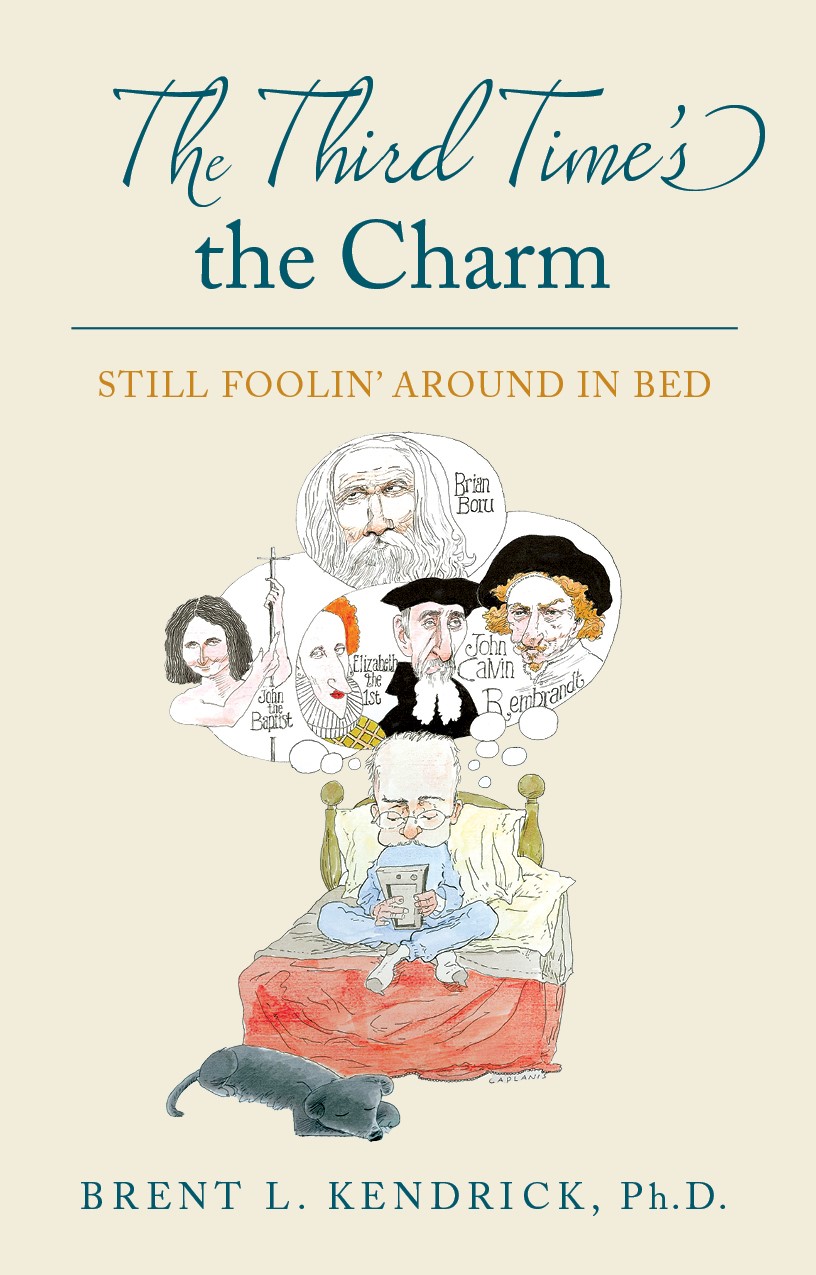
It’s the printed proof of my next book, The Third Time’s the Charm. At 440 pages, it’s a whopper! This brand-new collection of personal essays is drawn from my The Wired Researcher Series. Today, I’m delighted to share the cover art with you. Once again, the art is by acclaimed caricaturist Mike Caplanis. Although he was inspired by the essay “What If I’m Not Who You Think I Am?”, the book’s cover captures the spirit of this collection perfectly—thoughtful, mischievous, and comfortably tucked between the sheets.
This book is close to my heart. It’s a gathering of essays written—yes, literally, as you know already—in bed, where I do my most creative thinking and, often, my most honest writing. I hope these pieces reflect a voice that’s warm, a little witty, deeply rooted in everyday life, and shaped by the rhythms of memory, nature, and reflection.
William Faulkner once referred to his childhood landscape as “a postage stamp of native soil,” and in this collection, I’ve claimed one of my own. These essays rise from the soil that grounds me—Appalachian roots, coal camp memories, gardening, grief, and joy—and reach toward readers everywhere. I hope these pieces help you discover something true in your own story, too.
The book will be available very soon—just a few weeks away. For now, consider this a soft unveiling and a warm invitation. I’ll share more details soon, including where and how to get your copy. Until then, feel free to admire the cover, fluff your pillows, and prepare to join me—in spirit and in story—In Bed.
P.S. If you’d like to be among the first to know when the book is available, keep an eye here—or better yet, follow me if you’re not doing so already.
“Tell me, what is it you plan to do with your one wild and precious life?
—Mary Oliver (1935–2019; American poet celebrated for her keen observations of nature, the human spirit, and the connection between the two. Oliver’s poetry encourages readers to engage deeply with the world around them and to embrace life’s moments with curiosity and intention.)
Crunchy fried chicken, its golden-brown crust crackling with every bite. Check. Pimento cheese potato salad, creamy and tangy, with just enough bite to earn nods of approval. Check. Green beans simmered long and slow, tender and rich with the deep, smoky whisper of a ham hock. Check. Sliced tomatoes, their sun-ripened juices glistening under a light sprinkle of salt. Check. Peach pie cooling on the counter, its buttery crust cradling syrupy, sun-warmed fruit, promising the perfect sweet finish. Check.
Dinner was falling into shape, as country as country could be—homey, solid, the kind of meal that settles deep and satisfies. Except I hadn’t made my sourdough biscuits. And it’s those damned biscuits that caused the problem.
Easy peasy. Sourdough discard. Flour. Butter. Milk. Salt. It’s hard to imagine that such a modest assemblage could rise up to become so flaky and tender, hundreds of layers as light and lofty as billowy clouds. But that always happens, in record time.
Get this. I had all the ingredients lined up, waiting for the gentle touch of my deft hands to spring into action. But with my measure mid-air, I stopped in a heated exchange of self-talk:
“I don’t want to bother.”
“Come on. They only take ten minutes.”
“But everything else is done. Why mess up the kitchen now?”
“Biscuits. You always make biscuits.”
“Not tonight.”
“Come on. Just mix the dough.”
“No.”
“You’ll regret it.”
“No. I won’t.”
I set the measuring cup down, exhaled hard, walked away, and floured one up to “I don’t want to bother.”
I’d like to think that ended my self-talk on that topic. It did, for a while. After all, with a meal that was a culinary triumph by anyone’s standards, who needs biscuits?
But here’s the thing. The next day, those biscuits got on my case. In reality, it wasn’t the biscuits. It couldn’t have been since I didn’t make them. It was the underlying reason for not making them that started eating away at me:
“I don’t want to bother.”
I mean, let’s face it. I could have said any number of things:
“I don’t want to.”
“I’m tired. I need a break.”
“With a spread like that, who needs biscuits?”
I didn’t say any of those things because they just weren’t true. My truth was what I had told myself:
“I don’t want to bother.”
Bother. That’s the word that stuck in my craw. Bother—a term that’s been around since at least 1842, when someone first wrote, “We can’t do it at all, we can’t be bothered.” And here I was, almost two centuries later, falling into the same trap.
Realistically, one single utterance should be no cause for alarm. Right? I’m not so certain.
What if it moved from biscuits to other areas of my life?
What about brushing Ruby, my best dog ever? It would be easier to let it slide.
What about publishing my blog posts, week after week after week? It would be a lot easier to skip a week here, there, forever.
What about pushing through with my daily biking routine? It would be a lot easier to bike fewer miles every day or to skip a day now and then.
What about finishing a major research project? It would be a lot easier to put it aside.
Luckily, I haven’t allowed “I don’t want to bother” to prevail. And look at the results.
I have a well-groomed faithful companion, Ruby. I have a blog with a track record for being published every Monday morning before seven just as regularly as clockwork. I bike 15-20 miles every day, seven days a week, knowing that it never gets easier. I just solved one of America’s greatest literary mysteries–Unmasking The Humourist: Alexander Gordon’s Lost Essays of Colonial Charleston, South Carolina. The Humourist’s incisive voice will now be heard once more.
I hope, especially as I age, that I will never let “I don’t want to bother” prevail. Here’s why.
It seems to me that the more we avoid doing things, the smaller our world becomes. What starts as skipping small inconveniences—like making biscuits or brushing the dog—can gradually turn into avoiding new experiences, opportunities, and relationships. The mindset can shift from “I don’t want to bother” to the even more passive “I can’t be bothered.”
It seems to me that the best experiences in life often require an extra push—whether in personal growth, relationships, or creativity. Habitual avoidance means fewer “What if?” moments that lead to breakthroughs or unexpected joys. Sometimes we find ourselves in a rut, not because we lack talent, intelligence, or resources, but simply because we repeatedly choose the path of least resistance.
It seems to me that friendships and family connections need tending. If “I don’t want to bother” becomes the default, relationships slowly fade through neglect. This can lead to isolation, where we wake up one day and realize we haven’t had a meaningful conversation in weeks or months.
It seems to me that small decisions accumulate. If we regularly skip writing, gardening, dating, or learning new things, we might later look back and wonder, “What did I do with all that time?”
It seems to me that the difference between people who feel satisfied with life and those who feel unfulfilled often comes down to these small moments of effort—choosing to bother when it counts.
Believe me. The next time I serve up a meal like that—or any meal, for that matter—I won’t hesitate. I’ll bother.
“A man should never be ashamed to own he has been in the wrong, which is but saying, in other words, that he is wiser today than he was yesterday.”
–Alexander Pope (1688–1744; English poet and satirist, one of the most influential poets of the 18th century, whose wit and keen moral reflections in works like “The Rape of the Lock” and “An Essay on Man” secured his literary legacy.)
Eating crow is never easy. In fact, it’s downright tough, so much so that it takes a lot of willpower and gumption.
Oh, I’m not talking about eating crow as in the genus Corvus, those glossy black birds found in most parts of the world. I’ve never eaten one of them.
I’m talking about eating the kind of crow that we sometimes have to eat when we discover that we’re wrong. That’s a hard discovery to make. Let’s face it: it’s hard to fess up when we’re wrong. But let’s own up to it—sometimes the best thing to do is just eat crow and be done with it.
Take the stubborn husband who swore up and down he could fix the plumbing himself, despite his wife’s warnings. A few YouTube tutorials, a flooded bathroom, and an emergency call to the plumber later, he’s standing there, soaking wet, eating a big plate of crow.
Or the manager who brushed off an employee’s suggestion, only to watch the competition roll out the same idea—successfully. There’s no easy way to walk that one back, but let’s hope the manager at least had the sense to admit, “I should’ve listened.”
Then there’s the friend who mocked TikTok, Wordle, or Air Fryers, scoffing at the hype—until they tried it. And now? They’re sending out their Wordle scores every morning, scrolling TikTok before bed, and raving about how crispy their Brussels sprouts get. Yep. Crow. Served hot and fresh.
People have been “eating crow” since the dawn of human interaction so the list could go on and on, ranging from professional to personal and from funny to frustrating, but I don’t need to continue. Every item in the list captures the same universal realization: Oops … I was wrong. Ididn’tunderstand.
Even though we’ve been eating crow for a long, long time, the phrase itself is surprisingly modern. It first appeared in 1885 in the MagazineofAmericanHistory:
“‘To eat crow’ means to recant, or to humiliate oneself.”
By 1930, the phrase had taken on a more serious tone:
“I should merely be making an ass of myself if I accused someone and then had to eat crow” (E. Queen, French Powder Mystery).
By 1970, “eating crow” was used in a way that is close to what we all hope for when we use the phrase today:
“I was going to apologize, eat crow, offer to kiss and make up” (New Yorker)
Yep! Sometimes, eating crow comes with extra benefits.
These days, eating crow is firmly on the menu for anyone caught in the wrong. Actually, it was on my menu last week. Two servings of crow. That’s right. Two servings. Mind you, I haven’t been caught in the wrong because I haven’t done anything wrong other than having had some lingering thoughts down through the years about two Mary E. Wilkins Freeman scholars. I’ve now come to realize that I was wrong, or, more accurately, I’ve come to realize that I didn’t understand.
And since I’ve always believed that eating crow is most beneficial if done in public, let me lift the cloche and reveal my double portion.
My first portion is because of thoughts that I’ve had about Thomas Shuler Shaw, a librarian at the Library of Congress, who embarked on an ambitious project to write what would have been the first biography of Mary E. Wilkins Freeman. His goal was to illuminate the life and literary contributions of this remarkable author who had died in 1930.
However, fate had other plans. Shaw’s 1931 biography, A Nineteenth Century Puritan, faced rejection from prominent publishers such as Harper & Brothers, Ladies’ Home Journal, and The Saturday Evening Post. I’ve always credited Shaw for persevering, at least enough to find a home for his meticulously curated scrapbooks and the typescript of his unpublished biography in the Rare Book & Special Collections Division at the Library of Congress. Those artifacts provide a rich tapestry of insights into Freeman’s life and work, and they certainly helped me with my edition of The Infant Sphinx: Collected Letters of Mary E. Wilkins Freeman (Scarecrow, 1985).
Nonetheless, I wondered then as I do now: why didn’t Shaw continue his efforts to find a publisher? His book would have distinguished itself as the first Freeman biography. What impact might it have had on her literary reputation if the details of her life had been accessible to readers of the 1930s and 1940s?
My second portion of crow relates to another scholar working on a Freeman biography around the same time. Edward Foster wrote his Mary E. Wilkins Freeman: A Biographical and Critical Study in 1934 as his thesis when he was a candidate for the Doctor of Philosophy degree at Harvard University. The university accepted his thesis, but Foster didn’t complete his Harvard degree. He put aside his Freeman work until 1956 when he revised and published it as Mary E. Wilkins Freeman (Hendricks House).
Foster was direct when he explained the delay:
My thesis was accepted […] also for subsidized publication by Harvard Press. Lacking funds for subsidy and failing to get trade publication, I forgot the thing for nearly twenty years. MWF is only a small part of my career. (Foster to Brent L. Kendrick, ALS, October 24, 1973)
Nonetheless, I wondered then as I do now: why didn’t Foster try to find a publisher sooner than he did? What impact might it have had on her literary reputation if Foster’s details of her life had been accessible to readers of the 1930s and 1940s.
There. I’ve done it. I’ve eaten my two portions of crow. However, I have to do one more thing to help you understand the art of eating crow. To turn eating crow into an art requires divulging what prompted, in my case, not just one portion of crow but two in a single serving. That’s the source of the catharsis. That’s the confession, without which eating crow can never be an art.
Here’s mine.
Yesterday, I uploaded the manuscript of my forthcoming book Unmasking The Humourist: Alexander Gordon’s Lost Essays of Colonial Charleston, South Carolina. My book definitively establishes Gordon (c. 1692–1754)—antiquarian, Egyptologist, scholar, singer, and later Clerk of His Majesty’s Council of South Carolina—as the author of The Humourist essays, restoring his rightful place in literary history.
I hesitate to say this, but the book is a significant scholarly work. It’s meticulously researched, not only unearthing a forgotten literary voice but also redefining our understanding of colonial American literature. While it’s structured with rigor, it remains highly engaging, making complex historical and literary analysis accessible without oversimplification. It’s not just a literary recovery; it’s a reframing of Charleston’s intellectual life, the role of satire in the colonies, and the transatlantic literary tradition. That’s no small feat.
To say that I am ecstatic is an understatement. I am.
But get this. I’ve been working on this book since 1973, when Professor Calhoun Winton of the University of South Carolina suggested that I try to solve this literary mystery. Published in the South-Carolina Gazette, the essays had been largely forgotten, and the identity of their author remained unknown.
At the time, I recognized their brilliance and used them as the foundation for a graduate paper. Then I put the project aside where it remained in my mental storehouse of “one-day, some-day” ideas, waiting for the right time.
Decades later, the Virginia Community College System (VCCS) gave me an extraordinary opportunity to return to that project, to bring these essays into the light, and to finally answer the question that had remained unanswered for centuries: Who wrote them?
As a VCCS Chancellor’s Professor (2012-2014), I answered that question and shared the essays and my ongoing findings with my blog readers right here. Actually, that’s when TheWiredResearcher had its beginning.
Ironically, I delayed publishing my watershed UnmaskingTheHumourist until now.
You may be wondering about my delays, just as I wondered about Foster’s delays and Shaw’s delays.
I’ve been wondering about my delays, too, and that’s why I’m eating crow.
I could toss out many reasons:
● TheHumourist essays seemed too short for a book and too long for a scholarly article.
● I wanted to make certain that my evidence for claiming Alexander Gordon as the author was as compelling as my discussion.
● I wanted to do further research so that my headnotes and endnotes for the essays were comprehensive.
All of those reasons are true.
I won’t toss into that mix other scholarly pursuits that came my way.
I won’t toss into that mix my early career advances as a federal employee or my second career advances as an educator.
I won’t toss into that mix caring for aging parents.
Actually, I won’t toss into that mix anything else because what became obvious to me when I uploaded Unmasking The Humourist: Alexander Gordon’s Lost Essays of Colonial Charleston, South Carolina was something seriously simple. We all lead complex, complicated, and convoluted lives.
● I know that truth firsthand.
● You likely do as well.
● So, too, did Edward Foster.
● So, too, did Thomas Shuler Shaw.
Wondering about their delays caused no harm, but I now see there was no need to wonder at all. I might simply have acknowledged what I’ve come to recognize in my own self-talk about The Humourist:
Life is rich, robust, and mysterious, and it rarely marches forward on a straight path.
As I move forward on my path, I’ll keep that truth in mind as I interact with others—and with myself. And with that heightened awareness, perhaps I really will have mastered the art of eating crow.
“A rock pile ceases to be a rock pile the moment a single man contemplates it, bearing within him the image of a cathedral.”
—Antoine de Saint-Exupéry (1900–1944; French writer, aviator, and philosopher, best known for The Little Prince. His works explore themes of human connection, imagination, and the search for meaning.)
Knife raised in the air, just a few inches or so above the kitchen counter, I stood there nearly motionless. I’d like to say that it was one of my better knives, maybe my Shun or my Wüsthof. But it wasn’t. I’d like to say that it was about to land on one of my better cutting boards, maybe my Boos or my Ironwood. But it wasn’t. And I’d like to say that I was about to execute some fancy-schmancy cut, maybe Chiffonade or Julienne. But I wasn’t.
I was just standing there with ordinary carrots, celery, and onions arranged on an ordinary cutting board as I minced them with my ordinary paring knife for an ordinary pasta sauce.
But as I stood there, something extraordinary happened in that ordinary moment.
Just as my knife was coming down, Billy Collins’ “I Chop Some Parsley While Listening to Art Blakey’s Version of ‘Three Blind Mice'” seemed to shimmer across the blade. Maybe that was to be expected. I love Billy Collins’ poetry, and, after all, there I stood chopping, and in Collins’ poem, there he stands chopping parsley and dicing onions.
But get this. As he wields his knife, he’s not at all concerned about how or why, in the nursery rhyme—the supposed thrust of his bluesy poetic mirepoix—the mice managed to be in the direct path of the farmer’s wife’s blade. Of course, he’s not. We all know how that story ends. But at that moment, standing in my own kitchen, I had no idea how mine would.
But Collins does something I’ve never seen anyone else do. Instead of focusing on how the mice lost their tails, which we know already, he sets up his own minor tragedy filled with blues and tears by raising questions about their blindness:
Was it congenital?
Was it a common accident?
Did each come to blindness separately,
How did they manage to find one another?
After posing those weighty questions–ones that I dare say most of us have never even vaguely contemplated–Collins gets emotional as he thinks about the mice without eyes and without tails running through moist grass or slipping around a baseboard corner.
Actually, he’s brought to tears, but don’t worry. He has two good covers:
By now I am on to dicing an onion which might account for wet stinging, in my own eyes, though Freddie Hubbard’s mournful trumpet on “Blue Moon,” which happens to be the next cut, cannot be said to be making matters any better.
There you have it. Just as the end of Collins’ poem trailed across the blade, my knife landed once more on the veggies, and I remembered what I had been thinking before Billy Collins had the nerve to drag the farmer’s wife’s mice and Art Blakey’s music into my kitchen uninvited.
I was recalling Mary E. Wilkins Freeman, best known for her AHumbleRomanceandOtherStories as well as ANew EnglandNunandOtherStories. At the start of her acclaimed literary career that spanned nearly a half century, she commented:
I wonder if there is such a thing as working a vein so long that the gold ceases to be gold. There is no use in worrying, for another vein might open.
Despite her concerns, her literary canon powerfully demonstrates that more than one gold vein opened for her. She went on to write 3 plays, 14 novels, 3 volumes of poetry, 22 volumes of short stories, over 50 uncollected short stories and prose essays, and 1 motion picture play.
Freeman’s literary output never ceases to amaze me. As soon as her fears and successes bubbled up in my mind, it seemed that every time I lifted my knife to continue chopping, I thought of other writers and their fears about running out of ideas.
As a writer myself, and especially as a former Creative Writing professor, I’ve always paid attention to the ways writers wrestle with their fears. I always managed to sprinkle writers’ fears and their successes throughout my classes, and these days, I try sprinkling the same reminders throughout my own days of doubt.
What about Stephen King, one of the most prolific and celebrated writers of our time, who has openly feared creative depletion? He once admitted:
“Sometimes I wonder if I’ve already written my best book. And if I have, I’m all done.”
But King’s fears didn’t stop him. He continued to write, producing novels across multiple decades, from Misery to The Green Mile, 11/22/63, and Billy Summers, proving that the well of creativity runs deeper than we sometimes believe.
What about Margaret Atwood, best known for The Handmaid’s Tale, who has openly acknowledged her anxiety about running out of ideas? She once said:
“I live in fear of running out of ideas. I tell my subconscious to keep the pipeline full.”
But Atwood’s fears didn’t stop her. She has continued to produce groundbreaking fiction, essays, and poetry well into her later years, including The Testaments, which won the Booker Prize decades after her first major successes.
What about Isaac Asimov, the visionary mind behind Foundation and I, Robot, who, despite his prolific output, still feared creative emptiness? He once asked:
“What if suddenly I can’t think of anything? What if the words stop coming?”
But Asimov’s fears didn’t stop him. He went on to publish over 500 books across multiple genres—science fiction, history, and even chemistry—proving that creativity is not finite but ever-expanding.
What about Louisa May Alcott, best known for Little Women, who felt the pressure of creative exhaustion, particularly because she wrote at a relentless pace to support her family? She once confessed in her journal:
“I can only wander and wait, wishing I could rush into a new book with the old eagerness.”
But Alcott’s fears didn’t stop her. Despite her anxieties, she went on to write Little Men and Jo’s Boys, along with numerous other novels, short stories, and essays that secured her place in literary history.
What about Neil Gaiman, the imaginative force behind American Gods and Coraline, who has openly admitted that the idea of creative depletion haunts him? He once said:
“People ask me where I get my ideas from, and I feel like they should be asking, ‘How do you keep from running out of ideas?’ Because that’s what terrifies me.”
But Gaiman’s fears didn’t stop him. He has continued crafting captivating stories across novels, graphic novels, and television, proving that creativity is a muscle that strengthens with use, not one that simply wears out.
What about Maya Angelou, the legendary poet and memoirist, who feared that one day her words might simply stop? She once admitted:
“I have written eleven books, but each time I think, ‘Uh oh, they’re going to find out now. I’ve run a game on everybody, and they’re going to find me out.’”
But Angelou’s fears didn’t stop her. She continued to write, speak, and inspire, producing Even the Stars Look Lonesome, Letter to My Daughter, and numerous volumes of poetry that touched lives around the world.
And what about Christopher Isherwood, best known for The Berlin Stories (which inspired Cabaret), who worried about creative stagnation, especially as he aged. He once wrote:
“I kept asking myself: What am I really doing? Do I have anything left to say?”
But Isherwood’s fears didn’t stop him. He went on to write A Single Man, one of the most important gay novels of the 20th century, as well as an acclaimed series of autobiographical works well into his later years.
My reveries into literary fears and successes could have lasted forever. But just as I finished with Isherwood, I looked down at my ordinary carrots, celery, and onions arranged on an ordinary cutting board, and I realized that I had finished mincing them with my ordinary paring knife.
In that moment, I remembered that my reverie had not started with Mary E. Wilkins Freeman and Billy Collins at all. It had commenced with me standing there, wondering: What would I do if I ran out of ideas? What would I do if I worked my literary vein so much that whatever little gold it might have ceased to be gold?
But I can’t worry about that right now. I have a few book titles to my own credit, with two more to be added this year. For now, I’ll continue to contemplate the ordinary truths that surround me in my ordinary world.
Who knows. Maybe one day, history will add my name to the list of writers who feared running out of ideas—but never actually did.
“To sin by silence when they should protest makes cowards...”
–Ella Wheeler Wilcox (1850–1919; American poet known for her uplifting and socially conscious writing. Her work championed justice, personal responsibility, and the power of speaking out.)
Whether everyone owns up to it or not, America is in the throes of a Constitutional, social, and moral crisis—unlike anything in our Nation’s history. It doesn’t take a genius to see what’s happening. We only need to look around.
It’s unfolding in real time, shaping and shaking the very foundation of our democracy. Since his second inauguration, Donald J. Trump has tested the limits of executive power, issuing sweeping orders that centralize authority, gut independent oversight, and sideline checks and balances. The rapid dismantling of diversity, equity, and inclusion (DEI) programs, the mass pardoning of January 6 rioters, and the rollback of environmental protections—all justified under the banner of “restoring order”—are not isolated actions. They are a pattern, a deliberate reshaping of the country to fit a singular vision.
Already many people—immigrants, federal workers, and LGBTQ+ individuals—feel the pain through deportations, firings, and the rollback of protections. Many other people—seniors, low-income families, and those reliant on federal programs—will feel the pain yet to come through health care cuts, the cancellation of USAID programs, the discontinuation of flu vaccine updates, and threats to Medicaid and Social Security. And now, in a shocking display of authoritarian bravado, Trump humiliated Ukrainian President Volodymyr Zelensky in the Oval Office—publicly berating a wartime ally fighting for survival against Russian aggression. His attack was not just a personal insult; it was a signal to the world that American leadership, once defined by its commitments, is now dictated by impulsive cruelty.
Now is not the time for silence. Now is the time to speak up.
Now is not the time for complacency. Now is the time to act up.
Now is not the time to be broken by divisiveness. Now is the time to come together and walk together.
Why? This crisis threatens the very essence of who we are as Americans.
Why? This crisis is unparalleled in our Nation’s history.
Why? This crisis threatens our today, our tomorrow, and our future.
I am heavy-hearted, but I find hope in looking back on those who stood up when hope seemed lost. Time and again, ordinary people have overturned what once seemed inevitable. We can learn from those ordinary Americans who took extraordinary actions. We can be extraordinary, too.
History tells us time and time again that moments like these define not just leaders but entire movements. The moral high road isn’t a scenic detour—it’s often the hardest path, requiring both conviction and courage.
Taking a Stand Means Taking Action
When faced with injustices like the unprecedented ones we’re up against now, neutrality isn’t a shield—it’s a choice. And history has been shaped by those who refused to sit back and let injustice run its course. They took a stand. They acted. I’m thinking about:
● Thomas Paine – A political writer who stoked the flames of revolution with “Common Sense” and “The American Crisis.”
● Frederick Douglass – A former slave who demanded that America reckon with its hypocrisy, forcing the nation to see itself as it was.
● Henry David Thoreau – Who refused to pay a tax that supported slavery and war, writing “Civil Disobedience” to argue that individuals must resist unjust laws.
● Susan B. Anthony – Who cast an illegal vote in 1872, knowing she’d be arrested but refusing to accept a system that denied women their rights.
● Martin Luther King Jr – Who rejected patience and appeasement, writing Letter from Birmingham Jail as a rebuke to those who claimed to be allies but urged him to wait.
● Daniel Ellsberg – Who leaked the Pentagon Papers at great personal risk, exposing government deceit about Vietnam.
These people didn’t just take the moral high ground—they fought for it, walked it, and held their ground when it mattered most.
Silence Enables Tyranny: The Lesson of Nazi Germany
If history teaches us anything, it’s that silence enables oppression. In Nazi Germany, countless people looked the other way, convincing themselves that they had no choice, that someone else would act. Their silence helped pave the way for one of the greatest atrocities in human history.
German pastor Martin Niemöller, once complicit himself, later warned against the dangers of staying quiet:
“First they came for the socialists, and I did not speak out—because I was not a socialist.
“Then they came for the trade unionists, and I did not speak out—because I was not a trade unionist.
“Then they came for the Jews, and I did not speak out—because I was not a Jew.
“Then they came for me—and there was no one left to speak for me.”
People Are Taking a Stand
From city halls to concert halls, from boardrooms to town squares, Americans are refusing to be silent. People are taking a stand, and the movement taking shape in powerful ways.
Our crisis started when Trump and J. D. Vance were sworn into office on January 20. The next day, the movement started as people were brave enough and bold enough to stand up to the crisis that threatens our Nation and our Democracy.
At the inaugural prayer service at the Washington National Cathedral, Bishop Mariann Edgar Budde, the Episcopal Bishop of Washington, took a stand and directly addressed the President, urging him to show compassion and mercy toward vulnerable communities. She implored, “In the name of our God, I ask you to have mercy on the people in our country who are scared now.” Her courageous plea highlighted the fears of LGBTQ+ individuals, immigrants, and refugees, calling for leadership grounded in empathy and justice.
The next month at the February 21 Governors’ Conference, the president threatened to strip Maine of its federal funding if it refused to comply with his executive order, banning transgender women from competing in women’s sports. In a tense exchange, Maine’s Democratic Governor Janet Mills took a stand and did not waver. Her response to the president? A simple: “See you in court.”
This wasn’t just a sharp retort. It was a moment of moral clarity, an assertion that principles matter more than political pressure.
Two days later, on February 23, Jane Fonda received the Lifetime Achievement Award at the SAG ceremony in Los Angeles. In her speech, she urged her fellow actors to channel the courage of those who resisted McCarthyism, reminding them of past social movements like Apartheid, Civil Rights, and Stonewall.
“Have you ever watched a documentary and wondered if you’d have been brave enough to walk the bridge or face the hoses and batons?
“We don’t have to wonder anymore—we are in our documentary moment. … And even if they’re of a different political persuasion, we need to call upon our empathy and not judge, but listen from our hearts and welcome them into our tent, because we are going to need a big tent to resist successfully what’s coming at us.”
It’s not just celebrities and politicians taking action; ordinary citizens are making their voices heard, sometimes at great personal cost. We all witnessed the legislative town hall meeting in northern Idaho descend into chaos after three plainclothes security workers forcibly removed Teresa Borrenpohl, who was heckling the speakers.
Others are taking a stand, too, against actions that threaten our nation’s core values. Their courage serves as a beacon, reminding us of the power of collective action.
I’m thinking of the recent upheaval at the John F. Kennedy Center for the Performing Arts and the resistance performers are showing as they take a stand. Issa Rae canceled her sold-out show, Renée Fleming stepped down as artistic advisor, Shonda Rhimes resigned as treasurer, and Ben Folds relinquished his role as artistic advisor to the National Symphony Orchestra. These actions underscore the artists’ commitment to preserving the integrity of our cultural institutions.
I’m thinking of Labor Organizations and grassroots movements that are also mobilizing to voice their dissent. The People’s Union USA, founded by John Schwarz, organized a national “economic blackout” on February 28, urging Americans to halt all consumer spending for 24 hours. The boycott was a warning shot—a demonstration that ordinary citizens can disrupt the economic status quo when corporations and policymakers ignore their voices. Early reports suggest widespread participation—major retailers and businesses have already reported noticeable dips in sales. And this is just the beginning. More boycotts are planned in the coming months, targeting corporations that fuel inequality, suppress wages, or remain complicit in policies that threaten democracy. This movement is a reminder that collective economic action has long been a tool for social change, from the Montgomery Bus Boycott to the anti-Apartheid divestments. If history is any guide, the pressure will only build.
I’m thinking of the citizens of Mad River Valley, Vermont who protested Vance’s ski trip just this past weekend. One poster said it all:
“Vermonters don’t bend the knee to wannabe KINGS.”
These contemporary examples of moral leadership echo history, where individuals refused to remain neutral in the face of injustice.
History doesn’t look kindly on those who stand on the sidelines. And we don’t get to tell ourselves we would have acted differently then, if we refuse to act now.
Every Act of Resistance Matters
For the first time in my life, I’m feeling powerless. I imagine that you are, too. At the same time, so did many of the people we now call heroes—before they took action.
● Thomas Paine was just a pamphleteer.
● Susan B. Anthony was just one woman with a ballot.
● Martin Luther King Jr. was just a preacher.
● Daniel Ellsberg was just a government analyst.
● Bishop Mariann Edgar Buddewas just a faith leader.
● Jane Fonda was just an actress.
● Governor Janet Millswas just a politician.
They weren’t waiting for permission to do the right thing. They just did it. And because they did it in the past, our country changed. And because people are standing up and acting now, our country can “course correct” again.
Will You Stand When It Counts?
Taking a stand doesn’t require grand gestures. It can be as simple as:
● Participating in economic boycotts as a way of doing something.
● Calling out injustice, rather than letting it slide.
● Supporting those fighting for equality, rather than assuming someone else will.
● Refusing to comply with policies that erode human rights.
● Voting for leaders who put principles above politics.
The moral high road isn’t for the comfortable. It’s for the brave—for those who refuse to look away, for those who understand that silence is complicity.
This is one of those moments. It’s a moment that history won’t forget.
What will you do? Will you take a stand? History is watching.
“What is research but a blind date with knowledge?” — Will Harvey (b. 1963; computer scientist and entrepreneur known for his contribution to the field of interactive entertainment.)
“The greatest part of a writer’s time is spent in reading, in order to write; a man will turn over half a library to make one book.” — Samuel Johnson (1709-1784; poet, essayist, moralist, and lexicographer, best known for compiling A Dictionary of the English Language, 1755.)
Years ago, I solved one of the greatest literary mysteries in early American history. The Humourist—a sharp-witted, enigmatic essayist whose work graced the front page of The South-Carolina Gazette in 1753 and 1754—had been lost to time, his identity obscured by history.
Through meticulous research—poring over newspapers, historical records, forgotten manuscripts, and overlooked clues—I solved the mystery, uncovering the man behind the words—his identity, his world, and the forces that led to his disappearance.
I shared my discovery with the world through my copyrighted blog, laying bare the identity of The Humourist. But there was more to be done. Solving the mystery was only the beginning.
Now, after years of refining my research, the book I’ve long envisioned is finally becoming a reality. UnmaskingTheHumourist: Alexander Gordon’sLostEssaysofColonialCharleston, SouthCarolina, will be a available in September. It’s a definitive edition that not only reveals The Humourist’s true identity but also presents his essays in full, with critical commentary, historical context, and meticulous annotations. This is not just a rediscovery; it is a restoration of one of the most significant but overlooked literary voices of Colonial America.
Why This Book Matters
This is more than just the story of an anonymous writer. It’s about:
● Colonial America’s literary landscape and its connections to the great essay traditions of England.
● The power of satire in shaping public discourse—even in a bustling port city like Charleston.
● The intersection of literature, politics, and history, as seen through the eyes of a writer who was both an observer and an insider.
For the first time, The Humourist’s essays will step out of the yellowed pages of The South Carolina Gazette and into the full light of historical and literary analysis.
The Book Will Arrive This Fall
This carefully curated edition will include: ● All of The Humourist’s essays, fully annotated. ● A critical introduction that explores his identity, influences, and legacy. ● A deep dive into the historical and literary significance of his work. ● A call for further scholarly research into this long-forgotten but pivotal writer.
Stay Tuned!
Over the coming months, I’ll be sharing exclusive glimpses into the book’s publication journey, including its official launch. Follow my blog for exclusive updates—you won’t want to miss what’s next!
I solved the mystery years ago. Now—earlythis fall—the book that brings #The Humourist back to life will be available not only on Amazon but also in a bookstore near you!

 The Wired Researcher