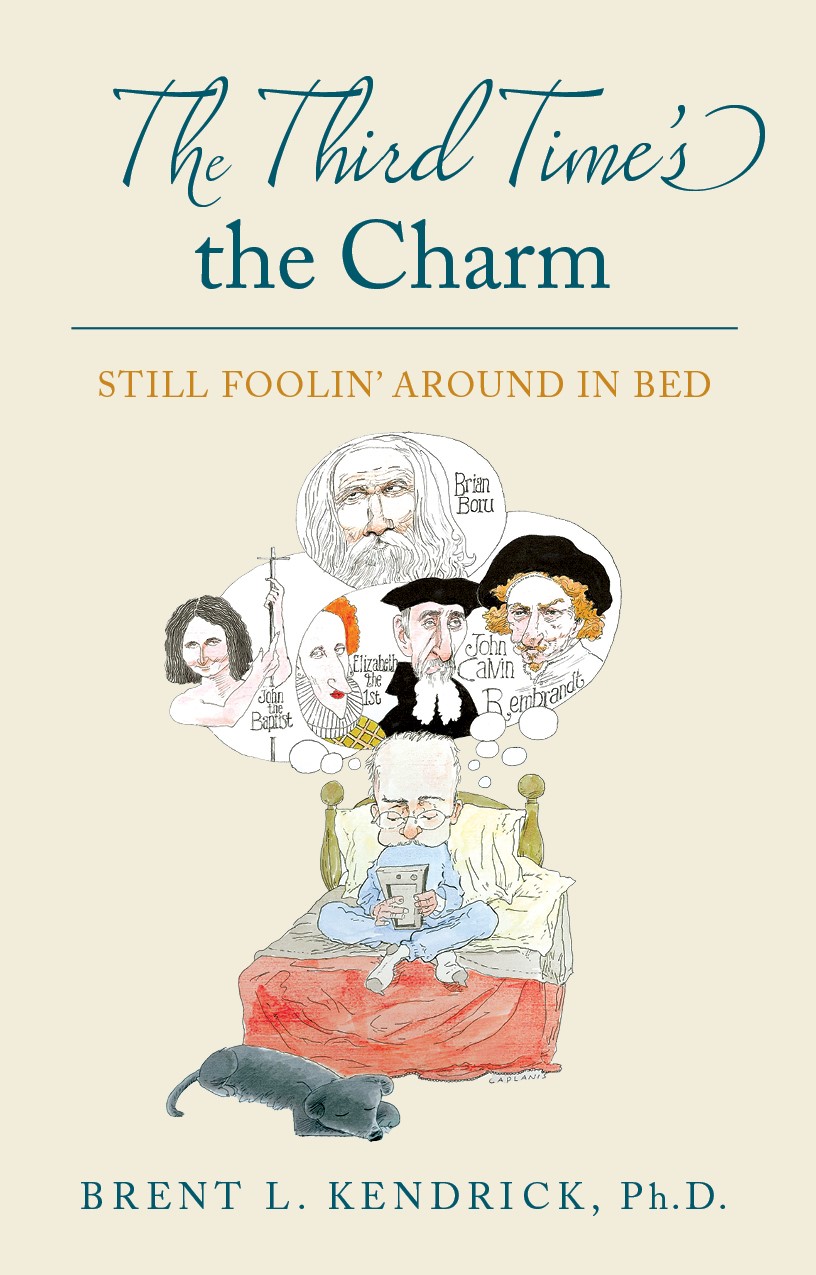
The Third Time’s the Charm: Still Foolin’ Around in Bed is now available in hardcover — alongside paperback and Kindle editions.
Whether you’re reading in bed, on your favorite chair, or anywhere your journey takes you, The Third Time’s the Charm promises to entertain, uplift, and inspire. Settle in and let the journey begin.
In this third volume of delightfully thought-provoking essays, I invite you into the most intimate spaces—both literal and metaphorical—of a life lived fully and authentically. From Appalachian coal camps to deep connections with family, friends, and a loyal canine companion, these essays explore joy and loss, solitude and connection, memory and reinvention—with warmth, wit, and unflinching honesty.
You’ll find stories of dust bunnies and online dating, gardening and global warming, grief and the wonder of AI. Each essay offers a window into the universal truths that shape our lives, reminding us that every “postage stamp” of existence is rich, rooted, and uniquely ours.
Thank you for being part of this journey. Let’s keep turning pages together!
P.S.The hardcover version makes a pretty terrific gift — especially for anyone who loves life’s twists, turns, and unexpected laughter.
“Holding a book in your hands is like holding another human being.“
—Leah Price (b. 1970. Literary scholar and historian of the book, known for her work on how and why we read across time and format.)
Well, this was unexpected—in the best possible way.
The paperback edition of The Third Time’s the Charm: Still Foolin’ Around in Bed just became available—much earlier than planned! I was already celebrating the Kindle release today, and now, here comes the paperback joining the party.
So whether you’re a digital reader who likes to swipe beneath the covers, or someone who prefers the feel of a real book in hand, you now have options. The hardcover (with its fabulous dust jacket) is still on the way—but today, I’m just enjoying this double dose of charm.
This collection gathers 440 pages of essays written, as always, In Bed—thoughtful, humorous, grounded, and a little mischievous. If you decide to dive in, I hope it keeps you company, makes you smile, and maybe even nudges a memory or two of your own.
P.S. If you enjoy it, I’d be grateful if you’d leave a review. A few kind words go a long way in helping others discover this little book of big heart.
“Lovers of print are simply confusing the plate for the food.”
—Douglas Adams (1952–2001; British author and satirist best known for his cult-classic sci-fi series The Hitchhiker’s Guide to the Galaxy. he embraced e-books long before they were mainstream.)
Well, friends… it’s official.
The Third Time’s the Charm: Still Foolin’ Around in Bedis now available on Kindle!
This is the first of three editions rolling out over the next couple of weeks. Today, I’m delighted to share the digital version for all of you who like to read with the lights off, your glasses on, and your e-reader tucked beneath the covers.
This collection gathers 440 pages of my most personal essays—stories that stretch from Appalachian coal camps to online dating, from gardening joys to philosophical musings, all written (as always) In Bed. There’s humor, heart, and a fair amount of reflection. If you’ve followed The Wired Researcher blog, you’ll recognize the voice. If you’re new, welcome to my little “postage stamp of native soil.”
Coming soon: the paperback edition, followed by the hardcover—with its delightfully mischievous dust jacket. I’ll be sharing more when each one arrives.
Until then, if you’re eager to start reading, the Kindle version is ready to crawl under the covers with you. I’d love to hear what resonates—and what surprises you.
P.S. If you enjoy it, a quick review on Amazon would mean the world. It helps other readers discover what you’ve found—and it gives my word messengers a better chance of finding their destination.
“To be remembered, to have one’s name spoken—these are the most powerful things anyone can hope for.“
–Paul Monette (1945–1995; award-winning gay author, poet, and activist. His 1988 Borrowed Time: An AIDS Memoir was one of the first memoirs to document the AIDS crisis from a personal, unflinching perspective.)
Cercis canadensis—or Redbud, as we call it here in the Shenandoah Valley of Virginia—is blooming now, as April unfurls, splashing the forest with an unmistakable purple that defies subtlety. Not pink. Not lavender. But a wild, jubilant purple that dares the bare trees around it to remember what life feels like. Its blossoms don’t wait for leaves, and they don’t hide behind foliage. They burst straight from the bark, bold and tender all at once—like a memory that insists on being remembered.
They seem more magnificent this year, tugging at my heart more fiercely than ever before, making David’s words ring out above his gentle whisper:
“When the Redbuds bloom, remember me.”
David and I knew one another decades ago at the Library of Congress where we both worked in the United States Copyright Office. When we first met, David was a Cataloger, and I was a Technical Support Specialist and then Copyright Training Coordinator. We were hello-in-passing colleagues.
Later, a close and unexpected bond developed between us. I became the Library of Congress Intern Director, coordinating a 9-month program that brought together a dozen or so highly talented librarians from within the Library and across the nation, providing them with an in-depth understanding of the library’s collections, its services, and its management infrastructure.
Sitting in my office about two weeks before the program’s start, I looked up and saw David standing there. After I congratulated him on being selected for that year’s Intern class, he gave me a troubled look:
“Thanks. Can we talk?”
“Of course. Come on in.”
He closed the door as he entered. He sat down, sighed, and shot me another look that to this day remains in my memory as one of existential angst:
“I have AIDS.”
My reply hung in the air, like eternity:
“I’m so sorry.”
What else could I have said? It was 1985. Even though AIDS (Acquired ImmunoDeficiency Syndrome) was generally known to most Americans, as it spread within the gay community, it started making its way to sensational articles in national newspapers, leaving all of us–especially in the gay community–terror stricken.
● 37% in Poll Say AIDS Altered Their Attitude to Homosexuals
● Saliva Discounted as an AIDS Threat
● More and More AIDS Cases Found Among Drug Users
● Panel Disagrees Over AIDS Risk for Public
● Grim New Ravage of AIDS: Brain Damage
● Rock Hudson, Screen Idol, Dies at 59
I had read those articles and more, but they had not prepared me for this moment.
Sitting across the desk from me was not Rock Hudson. Not a brain-ravaged AIDS person. Not a drug user. Not any of the things that I had read about.
Sitting across the desk from me was my friend David. David, poised at a high point in his career. David, diagnosed with AIDS. David. Death.
Before my three words had reached David’s ears, I walked around to where he sat. As I stretched out my arms, David stood to receive my embrace. Each knowing that friends stand for friends. Each knowing that friends stand with friends.
“I don’t know what to do?”
“About what?”
“About starting the Intern program.”
I knew the answer that I was about to give David was true. It had nothing to do with being gay. Nothing to do with AIDS. It had everything to do with being. Everything to do with living.
“I don’t have a magic ball, David, but it seems to me that as you face unknown health issues, a structured program like this might just be the anchor that you need.”
“But what about my fellow interns?”
David was well aware that for the next nine months, we would all share a small classroom–with top library officials appearing and making presentations throughout the day. It was close quarters. It was rigorous. It was intense.
He was also well aware of the public reaction to AIDS. Fear was thick in the air—fear of infection, fear of proximity, even fear within the gay community itself. At one point, some wondered whether poppers had caused the epidemic.
“I don’t know how your fellow Interns will react, but I’d urge you to stick with the program. I’ll be with you every day, and I’ll have your back.”
David left my office, leaving each of us with lots to think about.
For David, thinking about whether to continue with the program or let a disease with an unknown trajectory–other than eventual death–take charge of his life and spirit.
For me, thinking about navigating the months ahead while remembering that I was directing the most prestigious Library Intern program in the nation.
Two weeks passed. No word from David. Hopeful, I went ahead and made his name tent, stacking it with the others. As I stood at the door, greeting each of the Interns, I saw David walking my way:
“Let’s do it!”
And do it, we did, for a succession of days strung together like a strand of survival pearls. Then, one day, just before we were breaking for lunch, David asked whether he could share something with his classmates.
I knew what was coming. I knew, too, that anyone with something to share knows better than anyone else not only when to share but also how to share.
David shared his news with them as bluntly as he had shared it with me, but his existential angst had softened, perhaps in the hope that a burden shared would become a burden lessened.
I watched each face in the room. I listened to every word. To every breath between the words. One by one, each Intern summoned courage to offer consolation, support, hope, and help. When the last among them had offered all they had to give, one spoke again, laying one thing more upon love’s altar:
“Let’s have lunch brought in so we can all stay here together. Today. With David.”
We did.
The spirit that shone around the room that day continued to shine upon us day after day, month after month, all the way through a triumphant Intern graduation with David as one of our speakers.
David and his fellow Interns proved themselves to be a class beyond measure.
Where many people spoke of separation, the Interns spoke of inclusion.
Where many people chose to remain socially ignorant, the Interns chose to embrace information as power.
Where many people practiced discrimination, the Interns practiced acceptance.
I like to think that all of us rose to the occasion. We did. At the same time, I know that it was David who helped us rise higher than we ever imagined simply because we were not trying to rise. We were just trying to be … ourselves. We were just trying to let him be … himself.
InDavid, we did not see the face of AIDS.
InDavid, we saw the face of humanity.
InDavid, we saw the face of ourselves.
InDavid, we saw the depth of our empathy.
InDavid, we saw the things that each of us valued most.
InDavid, we saw opportunities to be more present, to say “I love you” more, and to recalibrate the course of our own lives.
InDavid, we saw the face of our own mortality, our fears of not having lived fully, of leaving things unsaid, and of being forgotten.
ThroughDavidand with David, we grappled with all of those grave issues–spoken and unspoken–confident of being fellow travelers on a shared journey.
ThroughDavid, with the arrival of every new spring since–now numbering forty–I am wrapt by redbuds of remembrance.
–Elizabeth Gilbert (b. 1969. American author best known for her memoir Eat, Pray, Love, which became a global bestseller and cultural phenomenon. Her work blends introspection, humor, and an embrace of life’s messiness—much like the spirit behind my modest The Third Time’s the Charm.)
Guess what arrived in the mail today?
(Hint: it isn’t another gardening catalog—though those are always welcome at my house.)
It’s the printed proof of my next book, The Third Time’s the Charm. At 440 pages, it’s a whopper! This brand-new collection of personal essays is drawn from my The Wired Researcher Series. Today, I’m delighted to share the cover art with you. Once again, the art is by acclaimed caricaturist Mike Caplanis. Although he was inspired by the essay “What If I’m Not Who You Think I Am?”, the book’s cover captures the spirit of this collection perfectly—thoughtful, mischievous, and comfortably tucked between the sheets.
This book is close to my heart. It’s a gathering of essays written—yes, literally, as you know already—in bed, where I do my most creative thinking and, often, my most honest writing. I hope these pieces reflect a voice that’s warm, a little witty, deeply rooted in everyday life, and shaped by the rhythms of memory, nature, and reflection.
William Faulkner once referred to his childhood landscape as “a postage stamp of native soil,” and in this collection, I’ve claimed one of my own. These essays rise from the soil that grounds me—Appalachian roots, coal camp memories, gardening, grief, and joy—and reach toward readers everywhere. I hope these pieces help you discover something true in your own story, too.
The book will be available very soon—just a few weeks away. For now, consider this a soft unveiling and a warm invitation. I’ll share more details soon, including where and how to get your copy. Until then, feel free to admire the cover, fluff your pillows, and prepare to join me—in spirit and in story—In Bed.
P.S. If you’d like to be among the first to know when the book is available, keep an eye here—or better yet, follow me if you’re not doing so already.
“The universal does not attract us until housed in an individual.”
—Ralph Waldo Emerson (1803–1882; American essayist, lecturer, philosopher, and poet who led the Transcendentalist movement of the mid-19th century. Known for his influential essays including Self-Reliance and The Over-Soul.)
Memoirists writers are shamelessly self-centered, and I ought to know. I’m one of ’em. And of course, I know that you really want to know why I used ’em instead of them.
You do want to know, don’t you? You don’t?
Well, this is where things start to get dicey, because I’m going to tell you anyway.
I chose ’em instead of them because the former seemed more casual and playful and, in my mind, it makes me feel comfortable bashing the hell out of ’em since I’m bashing the hell out of myself at the same time. Now you know.
Aren’t you glad that I told you? You’re not?
No problem. Like I said. We’re shamelessly self-centered.
Now that I’ve cleared the air about that one teensy-weensy word choice–it was a choice, of course, though I’m not sure ’em should count as a word–let me tell you how the title of today’s post bullied its way to the top.
You do want to know, don’t you? You don’t?
Well, I’m betting that you know exactly what’s coming next. You’re right. I’m going to tell you anyway. Like I said. We’re shamelessly self-centered.
Originally, today’s post was titled “An Apologia for Memoirists.” Clever, no? I thought so, too, despite the way the word apologia looks. It may look like an apology, but it is not an apology at all. Aucontraire. It is a staunch defense of something.
Let me give you an example of an old and famous apologia. I’m thinking of Plato’s Apologia Socratis, the legal self-defense that Socrates spoke at his own trial for impiety and corruption. He was defending himself against the charges of corrupting the youth and of not believing in acknowledged and accepted gods.
After thinking about that example, I decided that apologia was a poor word choice for inclusion in the title of today’s post. As I have just demonstrated, its meaning is easily misconstrued. Beyond that, its pronunciation is not easy either.
Is it “a–puh-low-jee–uh?”
or
Is it “a–puh–low-jee-uh?”
Damned if I know. And if I don’t know how to pronounce a word, I’ll be damned if I’m going to use it.
So, in a touch or two on my Smartphone, I struck right through AnApologia and replaced it with two words that are easily pronounced and readily understood: InDefense.
There. I’ve straightened out Apologia. Now, let me explain why I scrapped Memoirists. I suppose any reader who knows what a memoir is would know–or quickly deduce– that a memoirist is “a person who writes memoirs.” Don’t you detest circular definitions like that? I do. But you can’t blame me for it! Blame dictionary.com. That’s where the definition came from, and that’s why I put it in quotes. I may go ’round in circles, but I would never give you a circular definition. I’d spit it out exactly as it is. A memoirist is someone like me who takes the raw material of their life—its triumphs, trials, quirks, and quiet moments—and shapes it into a narrative that not only reflects their truth but connects with the truths of others.
That definition is mine, and I like it. However, I scrapped Memoirists for an entirely different reason. If you think pronouncing Memoir is an exercise in tongue-mouth calisthenics, try pronouncing Memoirists:
● mem-wahr-ists
or
● mem-wawr-ists
Well, maybe it rolls off your tongue just fine, but it gets stuck to the roof of my mouth. And, I don’t know about you, but when something sticks to the roof of my mouth, I get rid of it as quickly as possible.
That’s just what I did with Memoirists. I got rid of it. Quickly. In just a touch or two on my Smartphone, I struck right through part of Memoiristsand replaced it with Memoir Writers. I know. Two words instead of one. Fine. What I lost in word count, I gained in mouth feel.
It took a while, but now you know–even if you had no desire in knowing–everything you never wanted to know about the origin of the title In Defense of Memoir Writers. Like I said. We’re shamelessly self-centered.
Now, I’m certain that you want to know why I feel the need to defend myself and other memoir writers. You do want to know, don’t you? You don’t?
Well, I’m betting that you know exactly what’s coming …
Like I said. We’re shamelessly self-centered. Right? I mean, after all, we share all of the intimate details of our lives with the entire world as if they give a rat’s ass about our world. But we do it anyway. Is that self-centered or what?
Take me, for example. I may have one-upped Anne Sexton who commented, “I tell so much truth in my poetry that I’m a fool if I say more.” I don’t know how many words are in her canon–she does have a canon, you know, though I shudder at the thought–but since 2021 when my blog shifted focus from research to memoir, I’ve spewed out nearly 300,000 words. My God. I’m taken aback. How is it possible that I have shared so much about me, especially when I tell writers that there’s no me in memoir. If they looked closely, they would see for themselves that there is a me in the word, and, like I’ve said all along, memoir writers like me are shamelessly self-centered. This post proves it. After all that I’ve written who would think that I could write more, but here I am, dragging you along to somewhere I think you might want to be for a few minutes–perhaps leading you to somewhere you might even want to stay a while to rest, perhaps to heal.
I shudder at the things that I have shared with you. I do. You know as much about me as I know about myself, and if you don’t know it off the top of your head–and that’s how certain I am that I matter to you–you can find it by foolin’ around in my blog. Let me zing you with a few things, and as I do, I wonder–I just wonder–whether you would put yourself out there for all the world to know.
You know that I’m so full of myself that I fully believe that I helped my Mother give me birth so that I could start charting new territories in my brand-new world.
You know that as my mother preached I wiped away the tears that fell from women’s eyes, some of them slain in the Spirit and hopping from the back of one pew to the next, all the way up to the front of the church and then all the way back again, never missing a jump and never suffering a fall.
You know that when I hold out my right hand to you, you’re grasping the hand that my Father held tight after he nearly cut it off accidentally while butchering a chicken.
You know the challenges that I faced as a gay guy born in the Bible-Belt in the late 1940s, growing up there in the 1950s and 1960s, trying my best to stay true to my authentic self.
You know that I chase dreams and never let go, even if it takes me 50 years as it took me to become an English professor.
You know that the praying hands my Mother and I witnessed in the lid of my Father’s coffin took us both by surprise with the words, “May God hold you in the palm of His hand until we meet again,” holding for me, and me alone, a lasting message.
You know that after my Mother’s burial, I took my hands–strong from the strength of hers–and released from their cage three white doves, flying upward, perhaps at that same mysterious moment when my mother found her way back home and celebrated her arrival with outstretched hands.
You know that when I wrote my late partner’s obituary, it was as if angel wings brushed across the page, just as magically as Allen brushed across and touched our life together.
Equally important, you know that I sometimes ignore dust bunnies and cobwebs; that I get ideas for writing everywhere, even when biking or weeding; that I notice smells like dill and black snakes; and that when I’m not having real guests, I’m conjuring up imaginary ones.
You know all these things and so much more about me because of one thing that I keep on doing right here in my blog post. Week after week after week, I take my bony index finger, hook the side of my metaphorical homespun curtains, and pull them back gently so that you can see through the fragile glass pane and catch glimpses of my world–past, present, and future. Creation. Faith. Survival. Authenticity. Perseverance. Grace. Transcendence. Love. Imagination.
From that perspective, it occurs to me that maybe memoir writers like me aren’t shamelessly selfish after all. Maybe we take our triumphs, trials, quirks, and quiet moments and try to shape them into a narrative that not only reflects our truths as we know them but also connects with your own truths as you glimpse into your world–past, present, and future.
Maybe memoir writers like me aren’t shamelessly selfish at all. Instead, maybe, just maybe, we’re shamelessly selfless—willing to sacrifice our private selves so that something universal can emerge from the personal. Even if the greater good is one solitary soul, needing an oar to stay afloat, it’s in the act of revealing our individual stories that we reflect something far larger than ourselves.
Maybe that’s our truest calling—not selfishness, but selflessness. And perhaps that’s the best defense I can offer for memoir writers like me.
“When you come to the edge of all that you know, you must believe in one of two things: there will be ground to stand on, or you will be given wings to fly.”
–Patrick Overton (b. 1948; American poet, author, and educator whose work explores faith, creativity, and the resilience of the human spirit.)
It wasn’t by chance that I found myself in a booth at a local diner one morning, sipping a modestly strong cup of coffee. A group of farmers crowded the table next to me, boots dusty from the fields, their voices low but carrying the kind of weight that makes you lean in without meaning to.
One of them, a man whose face looked like it had been sculpted by weather and years, paused, letting the heft of his story fill the air.
“Biggest snappin’ turdle I ever seed,” he declared, his voice carrying the awe of the moment.
“She was stuck in a pond, thick and still with mud, scorchin’ sun beatin’ down. Musta come up from the Shenandoaher to lay her eggs, but thar she was. Stuck. No way out.”
He stopped, shaking his head as if the memory had hold of him.
“Took me a 2×4, went in slow, pried her loose, gentle as I could. Watched her crawl off on her way back home.”
Then, with a solemnity that could rival any preacher’s, he took off his cap, held it tight, and looked at the others. His voice rose just enough to mark the words:
“It warn’t no accident I was thar when I wuz. Nope. Warn’t no accident.”
And in that moment, you’d have sworn the diner itself leaned in to listen.
I’d been leaning in all along, drawn by his words. How well I could relate. I started thinking about various times in my life when something seemed to magically reach out, take hold of me, and point me in the direction of home.
My mind slid back to 1965 when I was a senior in high school, beginning my college search. I applied to the University of Richmond and Marshall University, my first choices, but then Tom Bee from Alderson-Broaddus College (A-B) visited my school, and everything changed. He encouraged me to apply, I did, and the college offered me a scholarship package too attractive to resist, though I tried my best to do so. As if to convince myself that I would not pursue my education at my third choice, I decided to prove the point to myself by making a college visit.
I will always remember that summer day when we drove on campus. I’d arrived determined that A-B wasn’t the place for me. But then I saw it—Old Main, its stately presence rising over the hilltop plateau.
I stood there, framed by two Civil War-era cannons, gazing down at the winding Tygart River, its covered bridge linking the campus to the little town of Philippi. The scene was simple but breathtaking, and for a moment, the world seemed to hold its breath.
Beneath the expansive sky, surrounded by the campus’s serene beauty, a profound peace washed over me. In that timeless moment, as the sun cast a warm glow on the college, something deep within whispered: home.
It warn’t no accident.
That same sense of being guided resurfaced when my career path took an unexpected turn, thanks to a serendipitous nudge from someone who believed in me.
During my final summer as an A-B undergraduate, I interned in Washington, DC, at the Department of Health, Education, and Welfare’s Division of Two-Year Colleges. My supervisor, Dr. Roger Norden, was so impressed with my conscientious and dedicated work ethic that he initiated paperwork to appoint me to a full-time position. I extended my apartment lease, bought some new clothes, and basked in how well my education was paying off. A few days before my appointment was to become official, Dr. Norden called me into his office to share the sad news that I would not be appointed to the position after all because a hiring freeze was in effect.
His news hit me hard—I’d planned my future around that job. But seeing my disappointment, Dr. Norden offered a lifeline:
“Take your résumé up to the Library of Congress. It might be just the place for you. It’s a Legislative Branch agency, not impacted by the hiring freeze. With your degree in English, it might be the perfect place for you to work as an editor.”
That nudge led to a 25-year career at the Library of Congress, where I served in roles as an editor, training coordinator, and advisor to two Librarians of Congress. Each position deepened my connection to the Library’s mission and allowed me to contribute in ways I never imagined.
Looking back, I realize that moment in Dr. Norden’s office wasn’t just serendipity—it was part of a larger pattern of guidance, shaping the path I was meant to walk.
It warn’t no accident.
Looking back, each step seemed to prepare me for the next, even when I didn’t realize it at the time. When I turned fifty, I took an early retirement from the Library of Congress and relocated to my weekend home in the Shenandoah Valley. One dream, though, had lingered since childhood—the dream of becoming a college professor. That dream began to take shape one day as I was driving back from a consulting gig in DC.
I saw a sign that I had no doubt seen many times before, but this time, as the “Lord Fairfax Community College” exit drew near, I decided to stop and see whether I could talk with the head of the English Department about a teaching position.
To my surprise, the Dean of Humanities, Dr. Sissy Crowther, was free to meet with me. Impressed by my Ph.D. in American Literature and my editorial experience at the Library of Congress, she offered me the opportunity to teach Technical Writing and American Literature.
That meeting opened the door to a series of opportunities I could never have imagined. I became a full professor, fulfilling my childhood dream, and was challenged to teach in ways I never thought possible—dynamic Friday and Saturday classes, Virtual Learning, and even free Open Educational Resources I designed and curated myself. I co-advised an honor society, co-authored the college’s accreditation report, and worked alongside brilliant colleagues from throughout the commonwealth to redesign developmental English education across the Virginia Community College System.
Each of these opportunities built on the last, guided by mentors and colleagues who believed in me.
It warn’t no accident.
Looking back, I see how every step led me exactly where I was meant to be, and not just in my career. Sometimes life’s most unexpected gifts come when we least expect them.
I certainly never expected this gift. I was traveling and decided to stop for a bite at the only restaurant in town. Suddenly, across the parking lot, my eyes met his. In that moment, time stood still. There was a spark, an inexplicable connection that swept me off my feet and left me breathless.
That’s precisely what happened when my late partner and I met at Applebee’s. Our eyes locked, and in that instant, the world around us faded. There were no words, no explanations needed—just a clarity that this was it. Allen and I knew, without question, that our lives were meant to be shared.
Our twenty-year love story began with that electrifying connection, the kind that transcends logic and reason. Some might call it serendipity, others destiny, but I know this much:
It warn’t no accident.
The love Allen and I shared was a guiding light in my life, an anchor that grounded me and a compass that pointed me toward home. Even now, I can look back and see how every twist and turn in my journey brought me closer to him.
That sense of guidance has stayed with me, extending beyond love and career, to moments of quiet reflection in the natural world.
My mind is drifting back to one of my hiking adventures right here in Shenandoah County. As an experienced hiker, I knew all about the thoughtful process of placing trail markers to guide hikers without detracting from the natural beauty of the wilderness. Trail blazes are there to ensure hikers stay on course, marking key points such as the beginning and end of a trail, turns, and intersections along the way.
I had decided to hike Big Schloss, a popular trail in George Washington National Forest, where orange blazes guide hikers along the Mill Mountain Trail from the Wolf Gap Campground to stunning views at the summit. The trail begins steep, then narrows along the ridge, leading to a wooden walkway and the iconic rock outcrop—a perfect spot to pause and reflect.
As I hiked, I realized that I hadn’t been paying attention to the blazes, completely swept away by the terrain, the breathtaking views, and my own reveries. Just as a flicker of panic about being lost began to rise, I spotted a blaze not far ahead, quietly assuring me that I was still on the right path to my destination.
It warn’t no accident.
Looking back on these moments—some planned, others entirely unexpected—I see a pattern too intricate to be coincidence. Each twist and turn, each nudge and connection, feels like a deliberate part of a greater design, one I didn’t always see in the moment but have come to trust over time.
Some might call it luck, others fate, or even divine intervention. For me, it’s an Unseen Hand, guiding, steadying, and pointing the way forward.
Whether it was choosing a college, finding a career, falling in love, or hiking a winding trail, that presence has been there—quiet but constant, assuring me that I’m on the right path, even when I’ve felt lost.
“Blessed is the season which engages the whole world in a conspiracy of love.”
–Hamilton Wright Mabie (1846–1916; American essayist and editor known for his inspirational writing on literature, culture, and the transformative power of kindness.)
December is a month brimming with light, meaning, and connection. Across cultures, we celebrate hope and renewal: the candles of Hanukkah commemorating resilience; Christmas, reflecting faith and generosity; and the Winter Solstice marking the return of light. Each tradition reminds us that even in darkness, there is light to be found.
Although I embrace the diversity and the richness of those cultural and religious celebrations–and others–I am most familiar with the traditions surrounding Christmas, a holiday that 90% of Americans will celebrate regardless of their beliefs. That statistic strikes me as ironic since I’ve been hearing a rather noncelebratory chorus wafting through the air to a not-so-happy but more-and-more popular tune:
“I’ll be glad when Christmas is over.”
While I can relate, I find those words strange—and here’s why.
Growing up in the coalfields of Southern West Virginia, everyone in my home and throughout our coal camp longed for Christmas to arrive. The celebrations were never labored. Instead, they were simple, mirroring our modest means since my dad was a coal miner. I can still see our windows decorated with wreaths made of scarlet-red celluloid with overlapping holly leaves, their edges curling delicately, with a deep green bow on top. Their translucent sheen captivated me year after year.
Our Christmas tree was always a cedar. My mother would have no other kind, probably because she knew that it was the one kind that my dad could always manage to find, hatchet down, and tote home for her to decorate. How well I recall the metal bird ornaments, brightly painted and glittering with long, glowing spun-glass tails that shimmered like ethereal feathers. Even more vivid in my memory are the bubble lights–especially the bird-shaped ones with vibrant, detailed feathers– that came alive with gentle bubbles when warmed, adding a magical flicker to the tree.
When evening came, I was mesmerized by the glow-in-the-darkicicles, translucent plastic mimicking dripping ice. They absorbed light during the day and emitted a soft, magical bluish glow in the dark, adding an ethereal wintery charm. The tree topper was a star with sharp, radiant points made of the same plastic that emitted a soft, magical glow at night. More than once, one or more icicles within my reach bedded me down in fantasies.
Those decorations seemed to hold more than just a festive glow—they captured the hope and light that Christmas brought to our coal camp. Even in the darkest days of winter, the light of our cedar tree radiated a promise of something brighter and better.
The rest of our celebration took place on Christmas day. A gift for each child, along with a brown paper bag containing an orange, a few English walnuts and Brazil nuts (both in the shell), some chocolate drops, a coconut bonbon or two, and some hard Christmas candy. Dinner was traditional with turkey and all the fixings. A more modest and less stressful day of celebration cannot be imagined.
However, as I grew older and my family’s finances improved, I noticed that the more we had, the more complicated Christmas seemed to become. Somehow, the simplicity and the authenticity of those earlier days got swept away in the whirlwind of excess. It became fraught with expectations around gift-giving, family gatherings, and hosting. Those pressures made the holiday feel more like an obligation than a celebration.
I’m not suggesting that we return to the “good old days,” but I am offering a gentle reminder. Let’s not lose sight of the light, hope, and connection that our December holidays are meant to bring.
Whether we celebrate Christmas, Hanukkah, Kwanzaa, or the Winter Solstice, December holds a truth that transcends any one tradition. At its heart, this season is not about perfection or excess—it’s about finding light in the darkness, connection in a fragmented world, and hope for the days ahead.
Maybe what we need most in December is not more doing, but more being. The rush to create the perfect holiday often drowns out the simple joys that make this season special. Perhaps it’s in the quiet moments—the glow of a candle, the laughter of loved ones, or even the stillness of a winter night—that we can rediscover what these traditions are truly about.
Whether it’s the menorah’s light that burned for eight miraculous days, the warmth of a cedar tree glowing with bubble lights, or the turning of the solstice that promises brighter days, these celebrations remind us that even in the darkest times, there is always light to be found. They urge us to pause, to reflect, and to carry that light forward.
In a world that often feels too fast, too busy, and too disconnected, December offers us a chance to recalibrate. It’s an invitation to let go of the stress, to step back from the hustle, and to reclaim the simple joys that make life meaningful. That’s the real gift of this season—not the presents we give or receive, but the presence we bring to one another.
This December, let’s carry forward the light—whether from a candle, a cedar tree, or the stars themselves. Let’s pause, step away from the hustle, and embrace the hope that lights our way.
“Somewhere, something incredible is waiting to be known.”
–Carl Sagan (1934–1996; astronomer and science communicator who inspired millions through his work on Cosmos and popular science writing.)
Tell me to do something, and I probably won’t do it. It smacks too much of being ordered around. No, thank you. Most of the time–though not always–I prefer to do the bossing.
On the other hand, suggest that I do something–maybe even challenge me to do something–and I’ll probably do it. Yes, thank you. I thrive on encouragement.
That’s exactly how today’s post began. One of my followers–my Linden Correspondent (LC)–suggested that the world at large might be revved and ready to know how my wired blog began! I thought LC’s suggestion was splendid, especially since my blog just celebrated its 12th anniversary. What better time than now to share the electrifying backstory.
With a growing readership of 13,782 (and counting!), I like to think my blog has found its niche. My readers value my blog for what it is today: a succession of riveting and captivating creative nonfiction essays that appear magically every Monday morning just in time for that first cup of coffee–that is for early risers who get their brew going early. That’s why I make a point of posting before 7am. While I sip on my coffee and savor what I wrote, I like to think that the entire world is doing the same thing.
Every Monday morning, you’ll find me in my reading chair with Ruby—my 60-pound lapdog—perusing my post while she peruses me. Sometimes, I smile and say aloud for her amusement:
“Wow, Kendrick! That’s a remarkable sentence. If you keep cranking out little gems like that, maybe one day you’ll end up somewhere as someone’s endnote.”
Yep. An endnote. Ironically, I guess that’s where we all end up: Someone’s endnote.
That’s not such a bad thing, you know. An endnote here. An endnote there. It seems to me that achieving a memorable, perhaps quotable phrase here and there is probably far wiser than having the entire canon of my work ricocheting around the world.
Stop and think about it for a minute or three. Look, for example, at what Benjamin Franklin achieved as a writer. Let’s focus on his Poor Richard’s Almanack, published annually from 1732 to 1758—nearly a quarter of a century of wit and wisdom.
Most people today can recall only a handful of Franklin’s most famous sayings, like:
● “Early to bed and early to rise makes a man healthy, wealthy, and wise.” ● “A penny saved is a penny earned.” ● “No gains without pains.”
Please tell me, Dear Reader, that you know those sayings, for if you don’t, you surely won’t know these:
● “Well done is better than well said.” ● “Three may keep a secret, if two of them are dead.” ● “If you would not be forgotten, as soon as you are dead and rotten, either write things worth reading, or do things worth writing.”
Indeed, Franklin managed to do both: he wrote things worth reading and did things worth writing. And, as I like to say:
“Endnoted.”
But let me take you back to where I began: the beginning of this blog.
I am so sorely tempted to say:
“It was a dark and stormy night …”
And that’s exactly what I would say, but if I said that I would have to note that Edward Bulwer-Lytton opened his 1830 novel, Paul Clifford with those words. As much as I hate to say it, because I am a stickler on documentation, I have grown weary of all the endnoting that I keep noting. Let us then move on to something that requires no noting.
Whew! I don’t know about you, but I feel notably relieved already.
LC must be relieved, too, to see that, at last, I’m getting around to sharing with the world the story behind the birth of my blog. But, as they say, every blog has its story, and mine is no exception.
Here’s what’s fascinating. Today, I am known around the world for my weekly memoir blog posts talking about anything from Aging to Zippers and about everything in between.
But when the idea for my blog came to me in 2012, I had a sharp, narrow, scholarly focus. I was working on my application for the VCCS Chancellor’s Commonwealth Professorship Program. At the heart of my application was the scholarly research that I wanted to do with a remarkable collection of Colonial American essays, songs, poems, and advertisements published pseudonymously under the name of “The Humourist” in the South Carolina Gazette during 1753-1754. The unique essays had never been reprinted, so they remained “hidden” and “undiscovered,” so to speak, in that newspaper. Further, no one knew who wrote the essays. Well, I was 99% certain that I knew, but I needed to do additional research and analysis to confirm my suspicions. In that sense, my project was a literary “whodunit” involving three things.
First, I planned to prepare a critical, annotated edition of the essays.
Second, I planned to develop a convincing case for authorial attribution based on a preponderance of internal evidence as well as on stylometrics.
Third, throughout the process of preparing the critical, annotated edition and developing a case for authorial attribution, I planned to give the essays a “close reading.” I was reminded of a quote by Robert Frost:
“We go to college to be given one more chance to learn to read in case we haven’t learned in high school. Once we have learned to read, the rest can be trusted to add itself unto us.”
I always shared that wisdom with my students. Learning to read—really read—gets to the heart of what we want our students to do, not just in English classes but across the board. When students slow down and give a text a close reading, critical thinking and intellectual discovery follow.
As Frost knew so well, that is what “learning to read” is all about. Further, when students learn how to really read, they can construct their own intellectual inquiries: “the rest can be trusted to add itself unto us.”
I always shared that belief—and approach—with my students without fail. I showed them how to learn to read, class after class, reading assignment after reading assignment, as I gave whatever literary selection we were reading my own close reading and as I made my own discoveries about a text. They were intrigued not only by my process but also by the discoveries that I made simply because of my dogged determination to give a text—any text—a close reading.
In my application, that’s precisely what I proposed to do with “The Humourist” essays. I wanted the opportunity to give the essays such a close reading that I would be able not only to establish a scholarly, annotated edition but also to identify the author.
I was really happy with that part of my application, but I knew that I needed something more. I needed a way to share my scholarly work on a regular basis with my colleagues and my students so that they could benefit, too.
I needed an idea. As I sat there on that January 8th evening, well into the third or fourth or maybe even fifth revision of my application, I started thinking about Daniel Boorstin (1975-1987), twelfth Librarian of Congress. A champion of accessibility, he worked to open the library to the public in symbolic and practical ways. He placed picnic tables and benches on Neptune Plaza, transforming it into a space for community gatherings. He initiated mid-day concerts and famously removed the chains from the majestic bronze doors at the first-floor west entrance leading to the Great Hall of the Jefferson Building. When told it would create a draft, he replied, “Great—that’s just what we need.” In a bold move, he even stopped the practice of searching visitors.
At that time, I worked at the Library of Congress as an editor of the National Union Catalog, Pre-1956 Imprints, and I well remember the occasion when the bronze doors were opened. If I am not mistaken, it was on this occasion that I heard Dr. Boorstin say:
“You never know when an idea is about to be born.“
His comment lingered, and since hearing it, I made a point to keep track of when my own ideas were born.
So it came to be. While thinking about Boorstin, ideas, and my project, I exclaimed to myself:
“Blog it!”
I knew that a blog would allow me to share with the entire world my challenges, discoveries, and joys of research.
I knew that a blog would allow me to share with others this remarkable collection of Colonial American essays, songs, poems, and advertisements. The Encyclopedia of the Essay (ed. Tracy Chevalier, 1997) placed “The Humourist” essays in the tradition of Samuel Johnson’s Rambler essays and observed that they are the only “full-fledged literary” works to have appeared in the South Carolina Gazette. Years earlier, J. A. Leo Lemay (du Pont Winterthur Professor of English at the University of Delaware) had noted in A Bibliographical Guide to the Study of Southern Literature (1969) that the essays should be edited, published, and the author identified.
This was hot! I knew that I could make “stuffy” literary research come alive in a blog. Colleagues and students and scholars and the world at large would love it. I knew they would because who wouldn’t love essays on par with Benjamin Franklin’s “Silence Dogood Letters”? Get this, too. Franklin had direct ties to the South Carolina Gazette and possibly to the author of “The Humourist” essays.
I knew, too, that aside from being in the essay tradition itself, a blog would allow me to share my project with faculty and students throughout the Virginia Community College System (VCCS), from the beginning of my work and every step of the way through completion. I realized that a blog would allow me to capture my personal experiences on a regular and ongoing basis: my work, my methods, my discoveries, my challenges and frustrations, and my joys.
I knew that a blog would allow me to do in the virtual world—using a heretofore unstudied literary work—exactly what I did in my classroom with literary works that appear in our textbooks: turn my blog followers on to the beauty of giving a text a close reading and turn them my on to “learning how to read,” showing them that once they learned how to read all else would be given to them.
That same evening, I came up with a working title: TheWiredResearcher. I Googled it and was delighted to discoverthatnosuchblog existed.
As I often do, I emailed a former student—a lover of language and words and ideas—to get her take on my blog idea.
She responded immediately:
The word “wired” will catch the attention of …The Young. They’ll think you are “hip.”
You’ll need a logo. You’ll need T-shirts with the logo on them. You need pens that say, “The Wired Researcher.” “Sold in libraries everywhere.” “Guaranteed to make study more exciting.” Oh, boy, I see tie-ins!
Clearly my former student was as wired as I was—perhaps that’s why I valued her opinions as highly as I did—but her email response gave affirmation to the title of the blog that had been born.
Here’s where the birth of the blog starts to get really sweet. I was awarded the Chancellor’s Commonwealth Professorship (2012-2014).
My first announcement appeared on October 19, 2012. It was short!
“Welcome to The Wired Researcher! Blog posts will begin on November 26, 2012.”
True to my promise, on November 26, I published “Opportunity Knocks Twice in the Virginia Community College System.” That post included the first of the historical essays that served as the nucleus for my project: “The Humourist” (November 26, 1753). Yep. Choosing to launch my blog on November 26, the same day that the Humourist launched his essays, was deliberate, and if I must say so myself, I think it was a stroke of genius!
And so, The Wired Researcher was born—not just as a blog, but as a way for me to share my love of research with a world eager to learn about my discoveries.
Now you have the inside scoop. If you want to know more, simply go back to the beginning and read all the posts from the start. But whatever you do, please make certain that you read “Colonial Charleston’s Biggest Literary Mystery Is Solved!” Yep. I solved the literary whodunit that captured me in the first place. Then you have to read “Three Special Shout-Outs!” because behind every success story are lots of people who deserve praise and thanks!
Wait! Wait! Don’t go yet. I have one or two more things to share.
When my blog started, I had around 1,750 views a year, representing 33 countries. So far this year, it has soared to an impressive 13,782 views from 152 countries! I must be writing something right!
To each and every one of you, My Dear Readers–then, now, and all along the way–a special shout-out!
To my Linden Correspondent (LC), who tossed out the idea that I share the story behind the blog, I extend asupercalifragilisticexpialidociousthank-you! (As Mary Poppins would say, nothing else captures the exuberance quite right!)
I look forward to a future of Mondays, inspired by the joy of discovery and by the connections that I’m making with all of you.
–Marian Wright Edelman (b. 1939; pioneering civil rights leader and founder of the Children’s Defense Fund, advocating tirelessly for children’s rights and social justice.)
Gobsmacked is what I am. Absolutely gobsmacked. You would be too if you were looking at the recipe that has captured my fancy. You might want to sit down before I share some details with you. Descended from Great Cakes, this cake is anything but a lightweight! Take a look at the ingredients—they’re enough to feed an army and keep their spirits high!
● 30 quarts of flour ● 10 pounds of butter ● 14 pounds of sugar ● 12 pounds of raisins ● 36 eggs ● 1 pint of wine ● 1 quart of brandy ● Spices beyond belief
OMG. With all of that booze, I’m ready to start singing “Happy Days Are Here Again.” I don’t know about you, but I sure could use a Triple Sec of cheer and joy to see me through today, tomorrow’s election, and the four years ahead.
But for today, “Don’t Worry. Be Happy.”At the same time, I’m not about to bake that cake! There’s just no way that I’m going to bake that cake. It would never fit into my ovens, not even both of them. I don’t feel too bad, though, because it wouldn’t have fit into a regular Colonial American oven either. Back then, it had to be baked in a communal oven.
“Communal oven!” someone just screamed.
Absolutely! A communal oven. It’s a reminder of how this country, in all its diversity, has always come together for one purpose—just as we’ll be doing tomorrow at the voting booth.
Someone else queried, “Is the Good Professor half baked?“
“He’s beyond half-baked,” someone else retorted. “He’s mixing this up. It’s more of his preposterous dough-hook nonsense.”
Excuse me! I am not half-baked, and I am not making this up. Those are the ingredients for an Election Day Cake recipe published by Amelia Simmons, “An American Orphan,” in her 47-page American Cookery (1796), America’s first cookbook. And get this. The Library of Congress has designated it as one of the “88 Books that Shaped America.” So there! Get off my bake!
Election Day in Colonial America was a holiday, and even though women couldn’t vote, their involvement in the voting process brought a unique flavor to the honor and privilege of voting. The Election Day Cake, hearty and full of energy, kept weary voters going—many of whom had traveled great distances just to make their voices heard. The bustling crowds and the special refreshments turned Election Day into a lively, festive event.
Fortunately, times have changed, allowing everyone, regardless of background, a place in our democracy to help bake a future for all Americans. Now women are welcome at the polls, and men are welcome in the kitchen. And that’s exactly where you would have found me yesterday, but I wasn’t baking that cake, only because it’s way too big. But since tomorrow is our opportunity to vote for a future that never mattered more in the history of our country than now, I made a scaled-back version of that Election Day Cake. I soaked the dried fruits in Cointreau for a week, and you can take it from me: the fruits and the Cointreau tasted exceptionally fine! To make this cake even more special, I pulled out my own sourdough, spawned right here on my mountain. After all, Colonial cooks would have used sourdough, too. (Remember, commercial yeast didn’t rise up until the 19th century.)
My bake is a celebration of our right to vote, gifted from past generations who fought to make it possible.
My bake binds me to community and civic pride, and its rich and layered flavors will remind me of how voting unites diverse voices into a single, shared event.
My bake speaks our collective voices, our collective choices, and our collective hopes for a future that embodies the best of America, for all Americans.
My bake is a melting pot of democracy, assuring me that every vote connects us to a shared history steeped in the sense of being part of something bigger. Each ingredient, like each vote, contributes to the rich, diverse flavor of our nation—just as every voice shapes a stronger, more inclusive democracy.
Tomorrow, when I vote, my bake will remind me that I’m fulfilling my civic duty.
Tomorrow, when I vote, my choice will be conscious and deliberate, cast for a future where our country grows stronger, becomes more unified, and remains true to the ideals we’ve fought to protect.
Tomorrow, when I vote, my ballot will be my celebration of democracy’s sweet fruits, honoring the values that make me proud to be an American.
Tomorrow, when I vote, I’ll be reminded that each of us has a critically important, once-in-a-lifetime, now-or-never obligation to fulfill as we come together united as one nation to “bake the vote” and to chart a new way forward.

 The Wired Researcher