A Reckoning

“Some of us think holding on makes us strong, but sometimes it is letting go.”

Hermann Hesse (1877–1962), German-Swiss novelist and Nobel Prize laureate, best known for Siddhartha, Steppenwolf, and The Glass Bead Game.

Believe it or not, a week or so ago, the past rose up and slapped me across the face. No, it didn’t leave a bruise, but it left behind something I’m still thinking about.

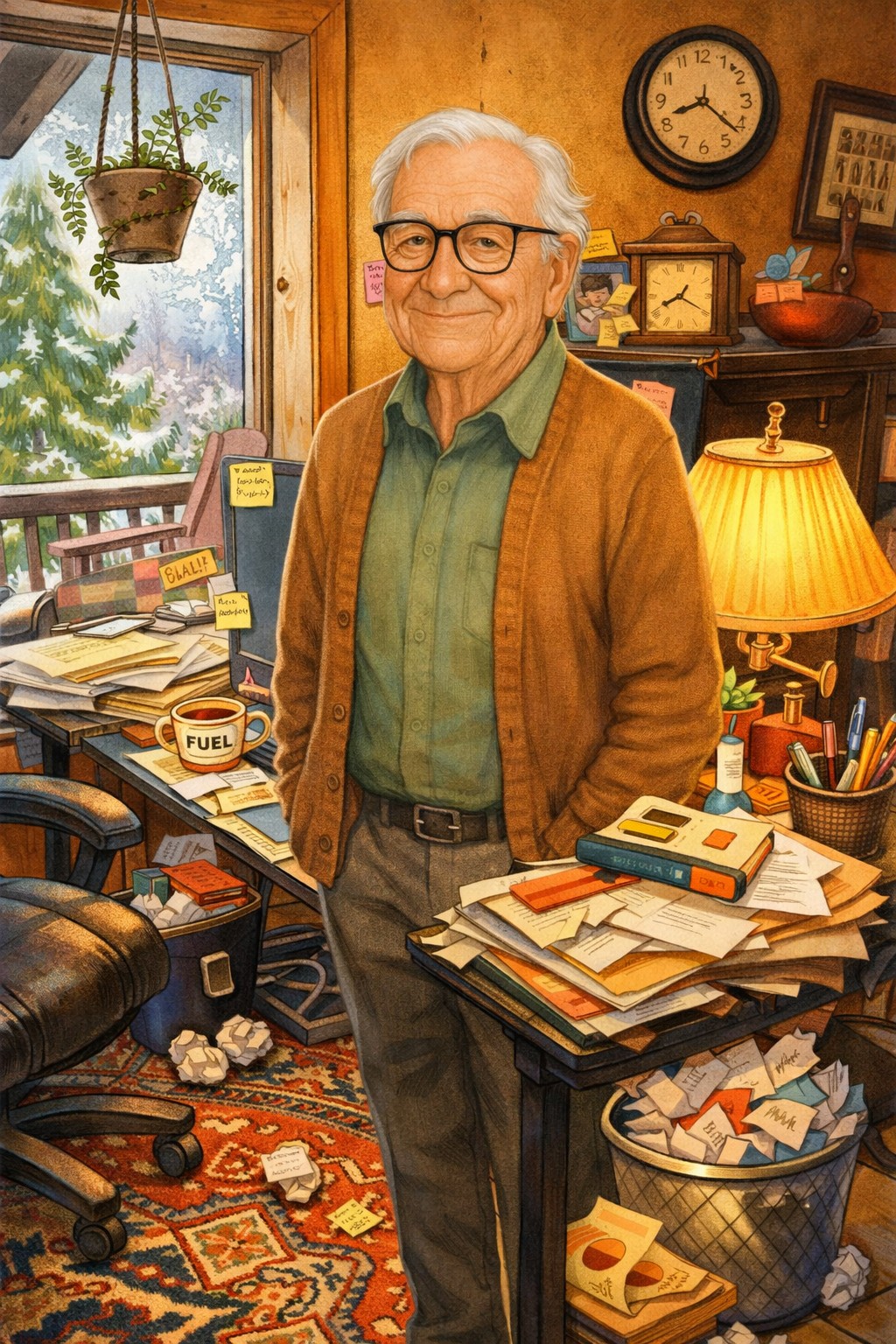
The slap started when I walked into my office. At first glance, it looks impressive. The lamp casts a golden pool across my glass-top computer desk, giving the whole space a glow that almost convinces me I’ve got things under control. The Oriental rug circles wide and bold underfoot, all rich blues and reds that make the room feel grounded, important, and maybe even a little too proud of itself. Books and papers rise in uneven towers, but in that first glance, they seem less like clutter and more like credentials—proof that I’ve been busy living, working, collecting. Even the cows in the painting on the wall keep a calm eye on the scene, as if to say,

“Carry on, Mtn Prof. You’ve got this.”

But as I walk through the door, the illusion collapses. What looked like a tidy study becomes a landscape of leaning towers and stubborn archives. Books crowd tables in uneven stacks, some open, some shut tight, all demanding to be dealt with. Boxes huddle together on the floor, their labels promising order—but their bulging edges betray the lie. Folders spill their contents, paper curling like leaves that refuse to fall from the tree. A shirt slouches over the back of a chair, a plaid witness to resolve slipping into resignation.

Everywhere I turn, something insists on being noticed. Woven baskets perch on top of files, as if even the containers need containers. The desk is less a surface than a staging ground for half-made decisions. Another painting on the back wall gazes out of its pasture, unblinking, as though it’s been watching me circle this mess for years. It has. It’s not chaos exactly—it’s accumulation. Layer upon layer, a sediment of living, each piece waiting for me to finally decide whether it still belongs.

It isn’t permanent chaos. The boxes say as much, their sharp edges and taped seams hinting at better days ahead—days when decisions will be made, order restored, and space reclaimed. For now, it’s not just an office; it’s a staging area where the past collides with the present, where choices will shape the future. Every pile, every stack, every half-forgotten guidebook, and every dog-eared folder is here because I pulled it out of hiding and chose to face it. In that sense, the clutter is not failure but progress. It’s the visible proof that I’m reckoning with the past, one piece at a time.

I’ll continue to reckon, and I’ll keep on making progress. I know I will. But I know, too, that I can’t rid myself of a lifetime of artifacts in one day. Take the CDs, for instance. Three rows deep. Wedged into the lowest shelf of the floor-to-ceiling bookcase at the far end of the office. They’ve been squirreled away there for years. Waiting. Ralph Stanley leans against Sting, Nina Simone keeps company with Mahalia Jackson, and Susan Boyle dreams her dream right next to the Chuck Wagon Gang. It’s less a collection than a timeline—decades of moods, memories, and seasons pressed into plastic cases. But here’s the thing. I don’t have the heart to get rid of them in one fell swoop. And besides, maybe I don’t want to get rid of them all. Maybe I don’t need to get rid of them all. But I can’t hang on just to hang on. Each one becomes a decision. Which will serenade me today? Into the future? Which has already sung its last song?

Other choices are easier. Travel guides, for instance. Like Fodor’s Greece and Frommer’s Greece on $35 a Day. Both hopelessly outdated, their covers promising adventures I never took. They carry missed possibilities but not regret. Into the discard pile they go. Or the box of Library of Congress business cards, embossed with the proud gold seal of my past career. They once carried weight, proof of my role in the world’s premier library. Now? Nothing more than relics of a past identity. They go into the discard pile, too. The work, the years, the meaning, and the memories? They stay.

Other choices are so easy they’re no brainers. My Frost shelf, for instance: concordances, centennial essays, letters, the familiar black-and-green spines that have followed me across decades. They stay. The same goes for my Mary E. Wilkins Freeman books, lined up in their muted blues and browns. They’re not just books; they’re part of my scholarly DNA. No question, no hesitation. They stay.

Then there are some things whose fate I know as soon as my touch awakens forgottenness. My college copy of Hemingway’s The Old Man and the Sea, margins crammed with the notes of an eighteen-year-old who thought he already knew something about struggle. It stays. My copy of Gibran’s The Prophet, inscribed by a fraternity brother—a book I’ve carried long past the days of Greek letters and youthful certainties. It stays.

A three-by-five oil painting of the covered bridge in Philippi, West Virginia? It’s no masterpiece, but it hardly needs to be. I crossed those boards more times than I remember during my years at Alderson-Broaddus College, each passage a kind of bridge between my coal camp past and the life I was building in the present. The brushstrokes may be clumsy, the colors a bit too bright, but none of that matters. It stays.

A small stack of cassettes holds my mother’s voice on magnetic ribbon. One, dated 11/12/81, is labeled I Take a Stroll and Cause Worry among the Worry Warts. The cassettes may be obsolete, but her voice? Never. Alongside them rests the Bible she gave me when I left for college, her handwriting in the front marking it as mine, though I’ve always known it was hers first.

And the kettle bottom resting heavy on my desk—a flat, round stone that once fell from mine roofs where my father worked fifty years. In those seams, a kettle bottom was a miner’s dread, dropping without warning, too often killing the man beneath it. This one didn’t. My father walked away again and again, spared by chance or grace. These pieces stay—not for their weight, but for his, for hers, and for mine.

Tucked nearly into oblivion is a small 4-H patch from fourth grade, meant to be sewn onto a jacket I didn’t have. But I never needed the jacket to know the four H’s—head, heart, hands, health embroidered in me long before I understood mottos or mission statements. They shaped how I worked, how I cared, and how I learned to give myself to something larger. That patch will never leave me. Some things you don’t outgrow; they simply grow with you.

The things in my office are only the visible part of the past. The rest doesn’t sit on shelves—it lives in memory, in relationships, in faith, in regret, in longing. Those pieces weigh just as much, sometimes more. They, too, must be faced, not in sweeping generalizations, but one by one, moment by moment, decision by decision.

Because that’s how the past works. Even though we can’t erase it, we can’t carry all of it forward either. We have to make hard choices, keeping only what steadies us and letting go of the rest. That’s the only way we’ll have room for life to keep unfolding. Room for the present to breathe. Room for the future to arrive. Room to move forward without being smothered by what came before.

I’m glad the past slapped me across the face. It taught me what we all eventually learn: the only way to live fully in the present, and prepare for the future, is to reckon with the past—seen and unseen, tangible and intangible—piece by piece, choice by choice. The past, the present, and the future are never separate. They are one continuum of time. One long sorting. One steady choosing. One true becoming.

Spaces and Habits of Famous (and Not-So-Famous) Writers

I started working on something, and it was really bad. It was crummy. But I was really so happy just to be working on a little crummy thing. I would get home, and I would think, “It’s waiting for me. My crummy thing.”

Louise Glück (American poet and winner of the 2020 Nobel Prize in Literature), “The Poet’s View” (2014).

Writers’ lives have always fascinated me. Their writing spaces and their writing habits have fascinated me perhaps even more.

Some writers’ spaces make me feel right at home. I’m thinking of Albert Camus, Arthur Miller, Dylan Thomas, Jack London, Ray Bradbury, Wallace Stegner, William F. Buckley, Jr., and Carl Sandburg. Their writing spaces are filled with stacks of papers and books just like one part of my office. They seem to thrive on chaos as much as I do.

In stark contrast are the well-organized and sparsely furnished writing spaces of E. B. White, Edith Wharton, Edward Albee, F. Scott Fitzgerald, George Bernard Shaw, H. L. Mencken, and Hunter S. Thompson. Their writing spaces are aesthetically beautiful, with everything positioned perfectly, but those spaces would be far too still–far too quiet–for me.

Interestingly enough, Maya Angelou doesn’t have her own writing space. She rents a hotel room in the towns where she lives. She goes there to write every day.

Angelou’s method would not work for me either. I couldn’t afford that kind of luxury.

Aside from writing spaces, writers have preferences about how they’re poised when they write. It might surprise you to know that not all writers write while sitting down.

Some stand. Ernest Hemingway, Thomas Wolfe, and Philip Roth are a few examples.

Some lie down on their beds, notably Maya Angelou, Truman Capote, and Edith Wharton.

At least one writer dons his gravity boots and hangs from an exercise frame to think things out: Dan Brown.

What time of day do famous writers work?

Some are early birds. Toni Morrison (4am), Benjamin Franklin (5am), and Ernest Hemingway (6am).

Others, night owls: Franz Kafka and Charles Bukowski.

And what about daily writing quotas?

James Joyce prided himself on a well-written sentence. A good writing day for him? Three sentences.

Ernest Hemingway, 500 words. John Steinbeck, 1 page. Stephen King, 6-10 pages.

Ray Bradbury, a lot. One short story a week.

Henry Miller worked on one thing at a time until it was finished.

Mary E. Wilkins Freeman worked on three stories at a time, on three different typewriters.

You’ve guessed it already. Famous writers are downright quirky.

But what about writers who are not famous? Are they quirky?

I can only answer for myself. I’m definitely not famous, but I definitely have one or four quirks.

Let me share a few of mine. I am doing so only because I casually shared one of my quirks in an email to a friend. Here’s what she wrote in response:

“I was interested in your note the other night about how you are now writing in bed! I have lots of questions! None of my business!  But I’m still interested!  

“On a laptop? Cup of tea by your side? Wine? Cocktail?  Pencil and paper? Do you rewrite as you go along or wait until the end?

“How do you label your docs?”

Before tossing my reply out into the world for all to read, let me put things into context.

My home is on a mountain top. My office is downstairs where I have sweeping views of the valley below and the mountain range beyond. Nearest the expansive window looking out onto my stone patio and my gardens below is my sparse desk with an HP All-in-One Computer and a lamp. This is where I do my professorial academic work.

To the back of my office is an old Shenandoah Valley farm table (bookcases on the side walls) with an HP EliteBook and a lamp. That’s the research end of my office where I’m currently working on a two-volume book tentatively titled Dolly: Life and Letters of Mary E. Wilkins Freeman. That part of my office is cluttered chaos, but I know what’s where.

Obviously, I need one dedicated space for my academics and another one for my research.

What I had not realized, however, until my friend asked about my blog-writing habits, is that I need a third area for working on my blog!

Here’s where and how I work on my blog. It’s what I shared first with my friend and now with you, my readers.

“What I am about to share will shatter your image!

“I am literally in bed, usually around 7:45pm, and I try to write until 9:30pm or so. This new routine–started just before Christmas–seems to give me a better night’s sleep, though I am now sleeping in until 5:30am.

“Yes, I have a cocktail: a Bunnahabhain Scotch, neat, waiting for me on the night table. No laptop. I’m doing the thinking, writing, revising, and editing right on my smartphone, while lying all comfy in bed. 

“No docs. I’m doing it all as drafts in WordPress.

“I find that having four or five different posts going at once lets me focus on what my mood requires.

“I’ve never written in this manner before, but I like it a lot. Actually, I love it. It makes me feel very much like a writer must feel. When I write now, I am done with the busyness of the day.  It’s quiet, and my mind just settles in peacefully on ideas and fooling around with words!

“So there! You heard it first right here! And what you’re reading here might well find its way into a future post. I just had an idea!”

Indeed, “the idea that I just had” is exactly what you’re reading now: a blog post sharing glimpses of the spaces and habits of famous writers and one not-so-famous writer: me.

What I didn’t share with my friend is this. The multiple posts that I work on–each in various draft stages–start out as little more than ideas, sometimes bad ones. To paraphrase Louise Glück, I say to myself as each day winds down and I get ready for bed: “They’re there. My crummy draft posts are waiting for me.”

Who on earth would have dreamt that writing could become such a comforting, lay-me-down-to-sleep bedfellow?