Home Alone, Together


“We’re all just walking each other home.”
Ram Dass (1931–2019). American spiritual teacher and author of Be Here Now. His work emphasizes compassion, presence, and our shared human journey.
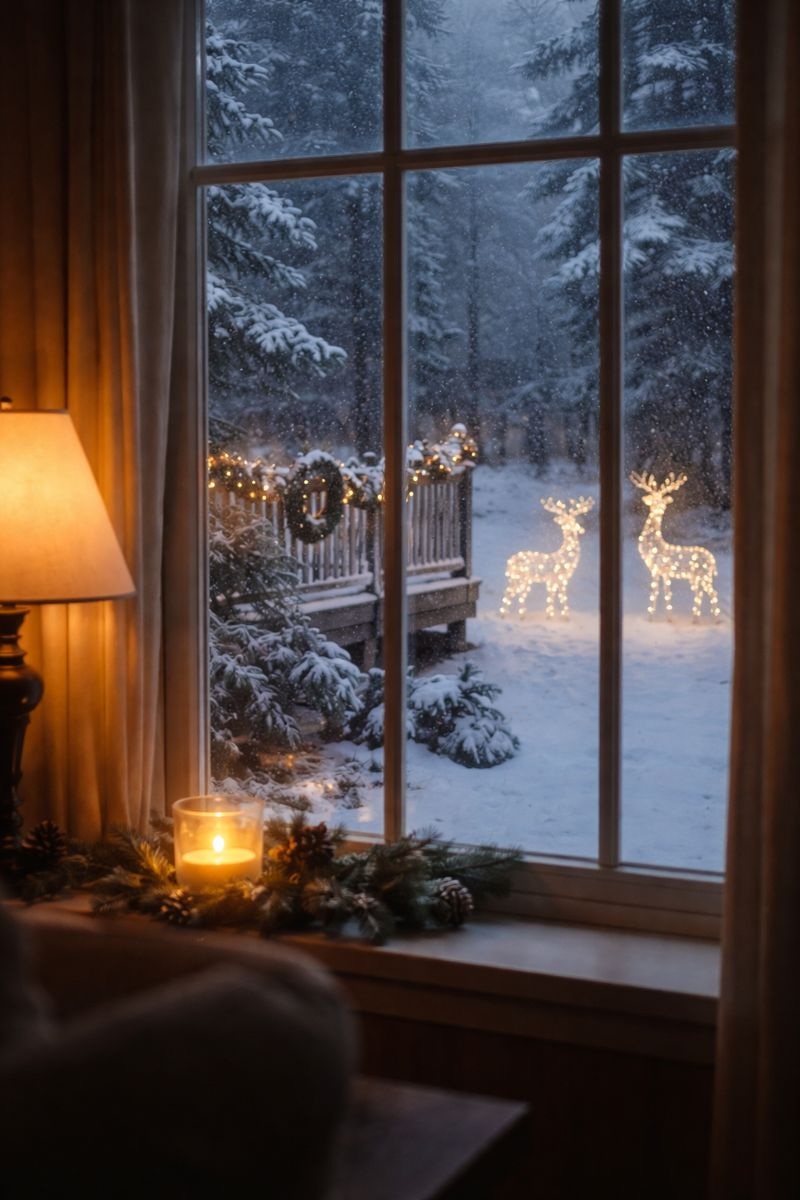

Early morning. Early breakfast. Just the two of us—three, counting Ruby, who has claimed her customary spot under the kitchen table, waiting for the last crumbs of food or wisdom, whichever falls first. Gary and I are sitting across from one another, easing into our day as we always do.

He’s looking out through the French doors toward the deck, where the lighted reindeer we put up together stand frozen in their stately poses of the first snow. I’m facing the working end of the kitchen: stainless steel appliances catching the last of yesterday’s shine, boxwood wreaths hanging in the window, the whole room trimmed and tucked as though company is coming.

Between us is the long view into the living room—garlands draped over the loft railing, trees (plural—cheerfully, unapologetically plural) gleaming in their corners, lamps warming the walls, decorations perched on every surface that would hold still long enough. It looks, frankly, as though Christmas got carried away and stayed for dessert.

Out of nowhere, I say, “She’ll be alone this weekend.”

Gary turns. “Who?”

“My sister. Arlene.” I take a sip of coffee. “I’ve gotten this ridiculous notion in my head that she’s going to round up all the nearby senior citizens and stage their own version of Home Alone.

We both chuckle, but the idea has already taken hold of me, and the cameras start rolling.

I can see it clearly. The walkers revved up like getaway cars, hearing aids squealing like high-tech booby traps, and the whole troop plotting slapstick with the seriousness of jewel thieves. It’s claptrap nonsense, of course. They’d never really do it. Would they? I doubt it. But how would I know? I don’t know any of them except my sister.

But in my mind, the first scene is already framed and from there the full movie unfolds.

The massive wooden door closes with that soft, familiar thump, and for a moment I can hear the whole house settling around it, almost the way a person exhales after company leaves. Snow blankets the yard like a quilt pulled up by a generous hand. In reality, there is no snow there in North Carolina, except in the photograph from last winter that I’m looking at, the one insisting that I let the house and yard wear a snowfall, too.

It’s a small town, one state away. But it could just as easily be your town or mine or anyone’s. Places like this multiply across the country, each one familiar enough that you can walk through the front door in your imagination without fumbling for the light switch.

Inside stands my sister. She’s eighty-five and determined, leaning into the walker that has become her steady companion. Mind you, she wasn’t left home alone accidentally to fend for herself like Kevin McCallister in Home Alone. She’s simply stepping into a quiet weekend while her daughter and son-in-law are away. She has love, support, and everything she needs.

It’s a beautiful house to behold and to be alone inside. Christmas trees are scattered through the rooms like warm invitations. The largest stands in the front room, glowing with the kind of soft light that makes winter feel kinder. Miss Kitty, the household’s silent monarch, purrs beneath it as if she has been appointed guardian of the glittering tree skirt. If mischief were to break out, she would be responsible, not my sister. My sister is more likely navigating the kitchen with caution, pouring coffee, warming dinner, and keeping an eye on keeping steady.

Still, my mind keeps drifting toward the movie. The parallels surface whether invited or not. A child unexpectedly alone. A golden-ager temporarily on her own. Two people at opposite ends of life who have to face the same truth: they’re the only human heartbeat in the house. His version of that truth was noisy and slapstick. Hers, quiet and measured. Yet both had to answer the same unnerving question:

What now?

And that’s where I started to realize that the nonsense of the movie points toward an important truth, one buried deep down inside each of us. The boy did not simply defend his house. He defended himself against the old, universal fear of being alone. He did it in the only way an eight-year-old could: with a heap of claptrap and a wild imagination. He tied paint cans to bannisters. He smeared tar on the steps. He turned cardboard cutouts into party guests. He rigged a toy train so it looked like Michael Jordan was circling the living room. The entire operation was absurd, but it worked. It gave him something to do with his fear, and in doing so, it transformed the fear itself.

I think we all do something similar, no matter our age. We gather what we have at hand and fashion a small defense against the fear of being alone. Children build their courage with noise and make-believe. Adults use busyness, familiar routines, and the jokes that soften the dark edges of a room. Elders rely on rituals, morning light through the same window, and the quiet companionship of animals who seem to understand more than they let on. Whatever the tools, the intention is the same. We are all trying to steady ourselves against the quiet and find a little joy in the process.

This wasn’t theoretical for my sister. She is capable, yet I imagine she felt afraid. She’d never say so, of course. She’s too strong. But, really, who wouldn’t be? When the door closed, when the house settled, when she realized she was the only heartbeat inside, fear must have visited her the way it visits all of us. Human. Ancient. Asking its familiar question:

Can I do this? Alone?

Yet even in her fear, I can imagine her shaping the hours with the practical, stubborn spark that has carried her through a lifetime. If she had been the star of her own senior-citizen remake of Home Alone, she wouldn’t have rigged paint cans or tarred the steps, but I can picture her angling her walker like a modest barricade, checking the locks with practiced determination, setting her ears and senses to “alert mode,” and deputizing Miss Kitty as Head of Household Security. She would have done nothing reckless. She would have done nothing theatrical. She would have done the small, knowing gestures that help an old fear settle down and behave.

It’s right here at this quiet, ordinary threshold that I started to be stirred by an even deeper truth. What my sister faced in that moment isn’t unique to someone alone for a weekend. It is the condition every human being inherits the moment we arrive in this world. Being “home alone” is human. I don’t mean in the cute, holiday-movie sense, but in the older, deeper, existential one. From the beginning, every one of us has lived within the small boundaries of our own minds, our private fears, private hopes, and our private rooms. Aloneness is the quiet fact beneath every era, every culture, every age. An eight-year-old with a slingshot in a Chicago suburb. An eighty-five-year-old with a walker in North Carolina. A shepherd in ancient Israel. A monk in a Himalayan monastery. A woman weaving baskets in West Africa. A man tapping away on his smartphone in the Shenandoah Valley. Put them on the same long timeline and the same truth surfaces: each one faces the same inner room, the same echoing questions, and the same silence that asks to be met.

This is meaning-making, and it begins the moment we face our aloneness, not when we avoid it, not when we panic in it. It begins when we turn toward it and say:

“Well, here I am. Now what? What can I shape from this?”

Philosophers have been wrestling with that same question since the dawn of thought. From the Buddha to Kierkegaard, from Lao Tzu to Camus, from the psalmists to the Stoics, every tradition has circled the same enduring question:

● How does a human being rise inside the solitude of their own existence?

● How do we take the raw material of being alone and coax something illuminated out of it?

World religions, in all their variety and beauty, have offered the same response in their own accents. They do not deny the dark. They answer it with light. Literally, symbolically, ritually. Light as remembrance. Light as resistance. Light as meaning. Light as shared humanity. Advent candles. Hanukkah flames. Diwali lamps. Temple lanterns. The kinara burning through the seven days of Kwanzaa. All of them whisper the same ancient encouragement: keep something bright near you. Keep something burning for the ones who come after. If you must face the dark—and everyone must—then face it with a flame.

As I kept circling back to look at the whole scene, I realized that, at some point, each one of us is “home alone.” But it isn’t a tragedy. And it isn’t a failure. It is simply the place where the human spirit begins to show its strength. When we face the aloneness—not outrun it, not dramatize it, but turn toward it—we start gathering whatever light we can find. A lamp switched on at dusk. A familiar chair pulled close to the tree. A loving voice warming the room. A cat curling into our lap with quiet reassurance. These gestures are anything but small. They are how we turn fear into presence, and presence into possibility.

What astonishes me is not that we are afraid, but that we keep meeting our fear with resourcefulness, humor, memory, and hope. We keep rising. We keep lighting dark corners. We keep finding ways to move through our aloneness with a surprising and stubborn grace.

We don’t pretend aloneness away—we meet it together. That is the miracle.

Day by day, weekend by weekend, life by life, we find enough light to find one another and to walk one another home—alone, together.

I Am Afraid

We can be fearless in proclaiming that we are afraidafraid of what is happening, afraid of what might come, afraid of becoming numb to it all.

It could be any morning up here on the mountain. Any season. The light spills over the valley like it’s been rehearsing for centuries, finding its way to the deck that I sanded and painted myself. Ruby’s already made her first round of the yard, nose to the wind, tail announcing that all is well in our little dominion—hers and mine and Gary’s.

From the outside, it might look like the middle of nowhere. But to us, it’s home. It’s our mountaintop oasis. It speaks peace. It speaks love. It knows both.

And yet—I am afraid.

I’m not afraid of dying.

I’m not afraid of the questions at my annual doctor’s visit—how’s the sleep, how’s the balance, any falls lately? I know the drill, know the tone. It’s the small talk we make with time itself.

I am afraid of more than that. Much more.

I am afraid of living.

I am afraid when I watch our nation take one step, then another, back and back and back toward what too many call the “Good Ole Days.” Days that weren’t always that good in reality—at least not for everyone. I’ve seen real progress during my seventy-seven years, hard-won and deeply felt. But now I know what it feels like to watch it slip away.

I am afraid when I see the National Guard deployed to American cities—unbidden, uninvited—storming in under the cloak of “security,” while local leaders protest and courts rule against the deployment as unconstitutional.

I am afraid when I see streams of homeless men, women, and children forcibly cleared from our Nation’s capital—not relocated, but shamed off the sidewalks, invisible again to the people who run the city.

I am afraid when masked men wearing ICE uniforms sweep through neighborhoods in unmarked vans—when people are grabbed at early hours, dragged from their routines, as children watch from windows.

I am afraid when I see our public health agencies bend—when the CDC overturns or ignores scientific consensus, issuing guidelines that feel political more than medical, eroding trust in what should be shields, not targets.

I am afraid when I see older Americans treated as burdens instead of blessings—when Social Security and food programs are cut under the banner of “efficiency,” when Medicare oversight is weakened and the sickest lose coverage, when senior housing programs vanish from federal budgets as if aging were a mistake. When growing old becomes a liability instead of an honor, a nation has lost its sense of inheritance.

I am afraid when I see poor and working families once again blamed for their poverty—when SNAP and WIC are gutted, when rent assistance dries up, when wages shrink while profits soar. Poverty is being rebranded as personal failure again, as though the system itself weren’t tilting the table.

I am afraid when I see classrooms and libraries turned into battlegrounds—when teachers are monitored, words are banned, and curiosity is treated as defiance. When education becomes indoctrination, the light that should guide us turns inward and burns.

I am afraid when I see our museums stripped of independence—when curators are told which histories to showcase and which to hide, when funding depends on keeping donors and politicians comfortable instead of keeping the record honest. When museums are told what stories to tell, history itself becomes propaganda.

I am afraid when I see the earth itself crying out—when wildfires, floods, and droughts speak the truth our leaders refuse to hear. When those in power in Washington call climate change a hoax, mock science, and dismantle what fragile protections remain—treating the planet not as inheritance but as inventory. The soil, the rivers, the air—they are not ours to own. They are the breath of every living thing that will come after us.

I am afraid when I see our history books rewritten—when the ugliness of our past is softened or omitted altogether, as if truth were a stain to be scrubbed away. I am afraid when textbooks trade context for comfort, when children are taught pride without responsibility. That’s not education. That’s amnesia dressed as virtue.

I am afraid when I see books banned from shelves—works of art, witness, and imagination stripped from students’ hands because someone decided fear should be the curriculum. A nation that fears its own words is a nation already forgetting how to think.

I am afraid when I see faith itself being rewritten—when those who hold the Bible high forget the heart of its message: love thy neighbor as thyself. When “the least of these” are ignored or condemned, when compassion is replaced with control, when the name of Christ is used not to comfort but to conquer.

I am afraid when I see the Department of Defense renamed the War Department—as if we’ve abandoned even the language of restraint, as if the goal were not defense but dominance. Words matter. Change the name, and you change the story. Change the story, and you change what we become.

I’ve lived long enough to see this nation inch closer to its promise, step by hard-won step. I watched the Civil Rights Movement force open doors that had been locked for centuries. I watched women claim the rights and respect they were long denied. I watched same-sex marriage move from silence to law, from whispers to weddings. I watched a Black man take the oath of office as President of the United States and felt, for the first time in my life, that maybe—just maybe—we were learning what equality really means.

And yet, I’m watching so much of that progress being undone in plain sight—rolled back by men who smile as they sign the papers. That’s what eats at me. We came so far. We proved we could change. And now I fear we’re proving how quickly we can forget.

I have one more fear—one that hits closer to home for me than any of the others, and yet it reaches out and encompasses them all.

I am afraid when I see LGBTQ freedoms stripped away in bill after state bill—protections withdrawn, rights revoked, marriages questioned, school policies reversed—while the rhetoric whispers “return to order,” but the victims are many.

It hits me hard, like a gut punch, because I know what it feels like to live quietly on the margins of acceptance. I had a place at the table—as long as I behaved. As long as I laughed at the right jokes. As long as I didn’t speak the truth of who I was. I was welcome, yes—but only in disguise. That was the unspoken bargain: conformity in exchange for belonging. A seat, but not a voice. Presence without personhood.

It took me years to understand that silence isn’t peace—it’s erasure wrapped in politeness. And acceptance that depends on pretending is not acceptance at all. So when I see hard-won freedoms for LGBTQ people being stripped away, I don’t see politics. I see people—people like me—being pushed back into the shadows we worked so long to escape.

I am afraid, too, of the silence that wears love’s disguise. Of families who say they accept us—so long as it’s private. Who love their gay brother or their trans child quietly, behind closed doors, but never speak that love out loud. Because public love takes courage, and private love costs nothing.

I am afraid that if the reckoning comes—and it may—some of us will look around and find that the people who said they loved us privately will deny us publicly.

And I am afraid that the ground is shifting for all of us—that what’s being erased is not just rights, but recognition of value.

I am afraid that we are being bombarded deliberately with so much chaos and confusion that we are forgetting what lies at the core of who we are—as Americans, yes, but more deeply, as human beings: the value of the individual.

The gay and the straight.
The trans and the cis.
The believer and the atheist.
The refugee and the citizen.
The imprisoned and the free.
The Black and the white.
The immigrant and the native-born.
The woman and the man.
The poor and the privileged.
The child and the elder.
The body that moves easily, and the one that cannot.
The mind that remembers, and the mind that forgets.
The one who speaks, and the one who has no voice.
The one who is seen, and the one who is invisible.

Each carries the same sacred value.
Each bears the image of us all.
Leave one behind, and the whole is diminished.
Forget one, and the soul of the people forgets itself.

I am afraid that this forgetting has already begun. It’s not just in Washington, though Washington leads the charge. It seeps into pulpits, classrooms, living rooms—into the quiet corners of our own decency. It’s in the news we scroll past, the cruelty we explain away, the silence we call “staying out of it.”

I am afraid because I see what happens when the faceless stay faceless—when the homeless become numbers, when the refugee becomes a threat, when the trans child becomes a talking point. I am afraid because I know what happens when we stop seeing each other as sacred.

And I am afraid because I’m not sure what I can do.

But I know I have to do something. We all do.

We can vote. We can write. We can reach out to those in power and to those who believe they hold it. But maybe more than any of those things, we can be fearless in proclaiming that we are afraid—afraid of what is happening, afraid of what might come, afraid of becoming numb to it all.

We can name it.
We can put a face to it.
We can be the moral engine of one—
each of us reaching further than comfort,
further than tribe or label—
to hold on to what makes us human,
to reclaim it before it slips away.

One human being girding up another.
One hand extended.
One voice saying, I see you.
That’s where resistance begins.

We can show, by the way we live, that each person matters—every single one. The forgotten, the dismissed, the weary, the silenced. Because the measure of a democracy—like the measure of a soul—is not how it treats the powerful, but how it protects the powerless.

So yes, I am afraid.
But fear, spoken aloud, can become light.
And light, once shared, can become strength.

Maybe that’s where our healing begins:
in the courage to care out loud,
to stand with the one beside us and say,
You are not forgotten.

Because the next person erased could be someone we love.
Or it could be us. You. Me.
But if we stand together—if we keep standing—
it will not be all of us.

⸻ ✦ ⸻ ⸻ ✦ ⸻ ⸻ ✦ ⸻

If this essay speaks to your heart, please like it. Please share it.
Let it travel further than fear—and bring us closer to hope.

The Demons We All Wrestle

“You may have to fight a battle more than once to win it.”

— Margaret Thatcher (1925–2013)
British Prime Minister, nicknamed the “Iron Lady” for her fierce persistence.

Swearing is not my thing. But right now—for once, maybe even on a stack of Bibles (to my Mother’s eternal horror)—I’m going to do it anyway. I swear that my daily demons line themselves up every night when I go to bed, watching as I lie there all peaceful like, orchestrating my next-day goals.

I see them out of the corner of my eye, leaning in, peering, looking carefully as I tap, tap my list on my phone.

And you know what? I swear, they’re waiting for me the next morning.

More often than not, they show up as soon as I start my biking, maybe because that’s how I start my day, right after coffee. I know that if I don’t bike then, I won’t bike at all. The first demon arrives before I even lace my shoes. It whispers:

“Why so early? You’ve got other things you need to do first. You can bike later.”

Nice try. But I’m on to that trick. I know that when it comes to biking, later never comes.

Another one comes at me from a different angle.

“Today? You’ve been doing this every day. You need a break. Take the day off.”

“Get behind me, Satan! I’m biking as usual.”

But get this. By mile three, another demon shows up:

“You’ll never finish.”

I keep pedaling, but the demons keep coming. By mile seven, I’m hearing:

“Yeah. Your butt sure is sore. If you keep going, it’s going to be sore as hell tomorrow.”

I keep on going. And so it goes, on and on through all the miles—10, 15, 20—riding against a whole Satanic chorus, chasing me faster and faster and faster.

Fiercely determined. Fiercely persistent. Fiercely anchored. That’s how I win the biking battle. Usually.

The next demon that hounds me is procrastination. Don’t get me wrong—I know better. I know the wisdom about “breaking things down,” about taking the first step, about Ben Franklin’s truth that “little strokes fell great oaks.” But when I’m staring at the big picture, the demon of procrastination is quick to pounce.

It starts yammering:

“It’s too much. You don’t even know where to start. Better put it off until tomorrow. You’ll see it clearer then, rested and fresh.”

And the sly part is—it sounds almost reasonable. That’s how this demon works. It pretends it’s looking out for me. But I know the truth: once I give in, tomorrow becomes the next day, and the next day, and soon the oak is still standing, unscarred.

So I fight. I start small. One tap of the keys, one page, one email sent. A single stroke against the oak.

Fiercely determined. Fiercely persistent. Fiercely anchored. That’s how I win the procrastination battle. Usually.

I have other demons, of course. But they’re far too personal to divulge for all the world to know. I’m not about to share them.

Like the demon that tells me that my writing will never be good enough to be discovered by a magazine or a newspaper syndicate.

Or the demon that mocks long-range planning at my age, reminding me that there’s far more behind me than there will ever be ahead.

And I’m certainly not going to tell you about the demon that wonders what waits on the other side of the great divide—the same divide every one of us will cross, where all have gone before to face the mysteries of beyond forever.

Like I said, they’re way too personal. So I’ll keep them to myself.

But I’ve gotten to the point in my life that my demons don’t embarrass me anymore because I know that to be human is to battle the demons that strive to undo us.

And besides, we all have our demons. You do, too. Some of them may be the same as mine.

Or maybe you have the demon of worry, who shows up right on schedule, carrying a suitcase that never unpacks. The demon of regret, who loves to remind us of choices we can’t un-choose, words we can’t un-say. The demon of loneliness, who doesn’t bother knocking—just slips in and makes himself at home.

Or the demon of disappointment who lingers when the prize you’ve chased turns out to be a shadow.

Or what about weariness, when the weight of the day presses like red Virginia clay, and every step feels heavier than the last.

And then there’s doubt—the slyest demon of them all—always ready with the same question:

“Are you sure you’re enough?”

These aren’t strangers to you or to me or to any of us. They’re regulars. They know the way in. They don’t need an invitation.

I’m fairly certain that I heard someone somewhere right now screaming in disbelief:

“Get real. Those don’t count as demons at all compared to the ones that I’m battling.”

I hear you. I understand. I’ve been blessed because I’ve never had to deal with the demons of addiction—alcohol, drugs, gambling. Or the demons of abuse—physical, emotional, sexual—the kind that scar the body and the soul.

I’ve never faced the demon of homelessness, not knowing where I’d sleep. Or the demon of hunger, not knowing where my next meal would come from.

I’ve been spared the demon of crushing poverty, the one that never lets you breathe free. And I’ve never lived under the demon of war, with its bombs and sirens and losses that can’t be counted.

But it seems to me—and yes, I know my limited experience might make this sound overly simplistic—whatever demon we face, we have to be fiercely determined. We have to be fiercely persistent. We have to be fiercely anchored. That’s how we win our daily battles with whatever demons come after us.

But let me emphasize here one key word that I emphasized earlier. Usually.

Being fiercely determined, being fiercely persistent, and being fiercely anchored enables us to win our battles daily. Usually.

But as we all know, some days we lose the battle. We all do. And when we lose, it stings. The demons strut, they jeer, they claim the day as theirs. They would have us believe that losing once means losing for good.

But they’re wrong.

Because a lost battle is not a lost war. It’s a stumble, not a surrender. And tomorrow—always tomorrow—the fight begins again.

The demons will be there, lined up and waiting, whispering their same old lies. And we’ll be there, too. Fiercely determined. Fiercely persistent. Fiercely anchored. Ready to face them.

We may not win every day. Sometimes, we do. Sometimes, we don’t. But we show up anyway. Because being human has never been about living without demons. It’s about never letting them have the last word.

And in case you’re wondering, let me assure you. They’ll be back. But guess what? We’ll be back—bruised, stubborn, laughing, and still ready to wrestle.

Tell Them Who I Am

“Who do you say that I am?”

Jesus, Matthew 16:15

The knock at the door was as gentle as any I had ever heard before, yet it frightened me with its persistence. After all, it was the middle of the night, and I rarely have visitors here on my mountain, and when I do, I anticipate their arrival and meet them in the walkway.

After a while, my curiosity overcame my fear. I went to the kitchen door and opened it. There, not on all fours, but standing as upright and erect as any human I had ever seen was my dog Hazel.

Lit by the spill of the floodlights—like some mythic creature caught mid-transformation—Hazel looked less like a pet and more like a story I hadn’t yet written: fifty-nine pounds of sinewy poise, all confidence and oversized paws planted with purpose. Her coat shimmered with its reddish golden shades of ember and mischief—Husky in spirit, Shepherd in legacy, and wholly herself.

Her tail curled tight; her head slightly tilted—alert, noble, a whisper of the wild. Her ears twitched once as if tuning in to something I would never hear. And her eyes? They saw, as if piercing through the darkness that found me standing there.

She wasn’t waiting. She was watching. And in that moment, so was I—awed by her stillness, her strength, and a quiet reminder of something I had yet to remember.

And, as naturally as anything you would never expect a dog to say, she looked at me:

“I’m just a monkey. I’m a howler.”

Then I awakened. Amused. Grinning. Lying there in bed. Musing. Hazel. Fifteen years of fierce love, muddy pawprints, and conversations that needed no translation, except in dreams.

As I lay there, I realized the dream’s significance. In a way, it was the oldest kind of magic: a name spoken often comes true.

For years and years and years, Hazel’s bark reminded me of a monkey. Not just any monkey—a howler. One of those wild-voiced beings that belt their souls into the sky from treetop pulpits at dawn. Her bark had that same deep, echoing wildness—less a request than a proclamation.

Some dogs bark. Hazel declared.

And so it came to be. I would say to her over and over again:

“You’re just a monkey! You’re a howler.”

She didn’t seem offended. If anything, I think she took it as a compliment. Obviously, Hazel was not a monkey, nor could she become one. Except in my dream.

But here’s the thing:

She became what I had named her.

And that truth deserves repeating:

She became what I had named her.

That dream set me to thinking long and hard about what it means to name.

To Name.

I started wondering when the phrase was first used and in what context. And if you know me as I know you do, you know that I headed off to the Oxford English Dictionary (OED) where I discovered that it was first used in Old English:

“[Hælend] gefregn hine huætd ðe tonoma is? & cuæð to him here tonoma me is, forðon monig we sindon” (Lindisfarne Gospels Mark v. 9).

Right! That doesn’t look like English to you either, does it? Let’s look at the translation.

“[The Savior] asked him, ‘What is your name?’ And he said to him, ‘My name is Legion, for we are many.'”

It’s a well-known moment in the Gospels—Jesus (the Hælend) encountering a man possessed by demons. The phrase “My name is Legion, for we are many” comes from Mark 5:9 (and Luke 8:30), rendered above in Old English.

This is an incredible example of what happens when we name something. The name Legion does far more than identify. It reveals nature, condition, and moral alignment. When Jesus asks for a name, he isn’t just asking for a label—he’s uncloaking the essence of what possesses the man.

Did you catch that? A name reveals essence.

And I ask you–right here, right now, as I am about to do–to start thinking about names swirling around in your head. Maybe the names associated with you: the names that others call you.

As you reflect, let me share with you the significance of the names swirling around in my head.

The Names that Others Called Me.

The first that I remember was not my given name—Brentford Lee. Rather, it was Little Mister Sunshine. My mother gave me that name because—as she loved to tell others, including me–I was born smiling and radiating happiness. Now, 77 years later? Others say that I’m still smiling. Still radiating happiness.

Clearly, my mother saw the essence of who I am and named it.

Or how’s this? My siblings, for as far back as I can remember, had another way of naming me. They always called me different.

“You don’t look like us.

“You don’t talk like us.

“You don’t walk like us.

“You’re different.

Truth be told, I was different, and I knew it. Ironically and for my own well-being, when they called me different, I leaned into it as compliment rather than condemnation.

It didn’t take me long, however, until I came to feel and understand the word they weren’t naming, the word that others, later, named. Queer. Either way–and even though I continued to see myself as special, a way of looking at myself that would stay with me for a lifetime, even now–it was a label of not quite, a soft-spoken exile and an unspoken ache.

Clearly, my siblings and others saw my essence—and named it.

And I ask you—right here, right now, as I am about to do—to think about the names you’ve claimed for yourself. Not the ones others gave you. The ones you whispered into being.
The ones that changed how you stood in the world.

As you reflect, let me share with you the significance of the names swirling around in my head.

The Names that I Called Myself.

The first that I remember was when I was in the third grade. Professor. Can you imagine anything more outlandish than that coming from a coal-camp kid in a town with not one professor? I have no idea where I had heard the word or came to know it. But I knew that in order to be a professor–in order to teach in a college or university—I would have to earn the highest degree conferred in my field. I picked English because I believed—no, I knew—that words mattered. Yes, words could wound. I had learned firsthand how they could cut to the soul. But I also knew something else. Words could heal. Words could save. Words could give wings.

I earned my Ph.D. in literature. I became a college professor—”full” no less. And when students called me Dr. Kendrick at the institutions where I taught–the University of South Carolina, the Library of Congress, and Laurel Ridge Community College–in deference to my degree, I always suggested Professor in deference to the earliest name I called myself–the name that captured my essence.

More recently, I call myself Reinventor. I came up with that name at the start of 2023–after my 23-year career at Laurel Ridge. Most folks retire. Not me. I’ve never liked the word—because right there in the middle of retired is tired. Trust me. I ain’t no ways tired. I have more books to write–far more than the five I’ve already published since 2023. I have more life to live than the one I’ve lived. I have more love to give than the love I’ve given. My colleagues and friends may call themselves retired—and that’s fine. But me? I’ll keep saying I’m a reinventor. It’s not just who I am now. It’s who I’m still becoming.

These days, I call myself Writer. I’ve always been one—researching, digging, unraveling stories. But since reinventing myself, being a writer has taken on a new, truer shape. I write in bed every night, publish my blog posts every Monday morning, and every year, I bring forth a new book of creative nonfiction essays, stories that bear my name and my soul.

I’ve branched out, too—seeing through to publication my Unmasking The Humourist: Alexander Gordon’s Lost Essays of Colonial Charleston, South Carolina and immersing myself a two-volume biography of Mary E. Wilkins Freeman, a labor of love and legacy.

Yes, right now, the name I call myself is Writer. It captures the essence of who I am—
what I do, what I am becoming, and who I cannot stop being.

As we continue reflecting on the power of names, I ask you—right here, right now, as I am about to do—to think about names that wound others, perhaps forever or perhaps giving them a transformative moment to heal.

The Names that Wound or Heal.

The first that comes to mind is a word in Countee Cullen’s “Incident.” It’s painful—inflicted on an innocent child, standing at the edge of razzle-dazzle wonder.

Once riding in old Baltimore,
Heart-filled, head-filled with glee,
I saw a Baltimorean
Keep looking straight at me.

Now I was eight and very small,
And he was no whit bigger,
And so I smiled, but he poked out
His tongue and called me, “Nigger.”

I saw the whole of Baltimore
From May until December:
Of all the things that happened there
That’s all that I remember.

What the speaker in the poem remembers being called Nigger. One word. It shattered an eight-year-old’s heart—and likely left a lifetime crack.

It’s haunting—how a single word, spoken with cruelty, can eclipse everything else.

I’ve known that kind of eclipse, too. Different. Queer. Faggot. Fag. Words I never asked for—words that crawled in and clung, no matter how often I repeated what my mother had taught me:

“Sticks and stones may break my bones, but words can never hurt me.”

Of course, they hurt, but I rose above the pain, smoothing over my soul like a balm the names that lifted me—Little Mister Sunshine, and the one I whispered in those early, tender years—Professor. But here’s the strange and saving truth: I didn’t start to heal until I explicitly named the sexual dimension of myself. Ironically, I had to declare it publicly before I could begin to claim the healing I didn’t yet realize I needed. I had to say gay—not in a whisper, not in code, but openly. Aloud. Loud. In front of the world.

Gay.

Only then could I begin to gather all the pieces I’d hidden away. The softness. The brilliance. The full shape of who I was—who I had always been. One word. My word. Spoken not with shame, but with quiet certainty. And for the first time, I didn’t flinch. I stood. Proud. With that naming, I finally gave myself permission to shine—fully and fiercely, without apology.

I have one more request–one more “ask” of you–as we grapple with what might just be the most powerful part of naming. I ask you—right here, right now, as I am about to do—what are the names we whisper when we reach for meaning? The names we murmur in awe, in need, in love? The names we give the force that calls us?

The Names We Call the Force that Calls.

Whenever I think that thought–and the older I get, the more often I think it–I recall Bill Gaither’s interview with acclaimed Gospel singer Jessy Dixon–one of my favorites. Gaither was bold and direct as the interview neared its end:

“When your time comes—as it will surely come for each of us—what do you want people to remember about you?”

After a soft pause, the answer came with quiet certainty:

“Tell them I am redeemed.”

In those five words, Jessy Dixon named–and claimed–the essence of his destiny.

Redeemed.

I can’t help but wonder: what name rises up in you when you reach for meaning? God? Creator? Oversoul? Spirit? Light? Love? Source? Mystery?

And in my wonder, I’m mindful that names like those are what we call the ungraspable—the presence that nudges us forward, the light that finds us when we didn’t even know we were lost. We reach for names when we reach for meaning. And whatever we call it—it calls us, too.

Whatever name you use, My Dear Reader
whoever you are, wherever you are:

Say it loud and clear.

Speak it like it matters—
because it does.

Speak it like it carries
the full weight of your becoming—
because it does.

Let the world see
the essence of who you are.

Name it—
knowing that names have power.

Remember: you are enough—
not despite all the names you carry,
but because of them.

You are every name you’ve claimed
and every name you have yet to whisper into being.

And when the time comes—
I hope you’ll speak your name
as boldly as I speak mine.

Let others know:
their names can never hurt you.

But your name?
It roots you deep
in everything that matters—
your truth, your becoming, your essence.

Tell them, one and all, once and for all:

“This is who I am.”

Redbuds of Remembrance

To be remembered, to have one’s name spoken—these are the most powerful things anyone can hope for.

–Paul Monette (1945–1995; award-winning gay author, poet, and activist. His 1988 Borrowed Time: An AIDS Memoir was one of the first memoirs to document the AIDS crisis from a personal, unflinching perspective.)

Cercis canadensisor Redbud, as we call it here in the Shenandoah Valley of Virginia—is blooming now, as April unfurls, splashing the forest with an unmistakable purple that defies subtlety. Not pink. Not lavender. But a wild, jubilant purple that dares the bare trees around it to remember what life feels like. Its blossoms don’t wait for leaves, and they don’t hide behind foliage. They burst straight from the bark, bold and tender all at once—like a memory that insists on being remembered.

They seem more magnificent this year, tugging at my heart more fiercely than ever before, making David’s words ring out above his gentle whisper:

“When the Redbuds bloom, remember me.”

David and I knew one another decades ago at the Library of Congress where we both worked in the United States Copyright Office. When we first met, David was a Cataloger, and I was a Technical Support Specialist and then Copyright Training Coordinator. We were hello-in-passing colleagues.

Later, a close and unexpected bond developed between us. I became the Library of Congress Intern Director, coordinating a 9-month program that brought together a dozen or so highly talented librarians from within the Library and across the nation, providing them with an in-depth understanding of the library’s collections, its services, and its management infrastructure.

Sitting in my office about two weeks before the program’s start, I looked up and saw David standing there. After I congratulated him on being selected for that year’s Intern class, he gave me a troubled look:

“Thanks. Can we talk?”

“Of course. Come on in.”

He closed the door as he entered. He sat down, sighed, and shot me another look that to this day remains in my memory as one of existential angst:

“I have AIDS.”

My reply hung in the air, like eternity:

“I’m so sorry.”

What else could I have said? It was 1985. Even though AIDS (Acquired ImmunoDeficiency Syndrome) was generally known to most Americans, as it spread within the gay community, it started making its way to sensational articles in national newspapers, leaving all of us–especially in the gay community–terror stricken.

● 37% in Poll Say AIDS Altered Their Attitude to Homosexuals

● Saliva Discounted as an AIDS Threat

● More and More AIDS Cases Found Among Drug Users

● Panel Disagrees Over AIDS Risk for Public

● Grim New Ravage of AIDS: Brain Damage

● Rock Hudson, Screen Idol, Dies at 59

I had read those articles and more, but they had not prepared me for this moment.

Sitting across the desk from me was not Rock Hudson. Not a brain-ravaged AIDS person. Not a drug user. Not any of the things that I had read about.

Sitting across the desk from me was my friend David. David, poised at a high point in his career. David, diagnosed with AIDS. David. Death.

Before my three words had reached David’s ears, I walked around to where he sat. As I stretched out my arms, David stood to receive my embrace. Each knowing that friends stand for friends. Each knowing that friends stand with friends.

“I don’t know what to do?”

“About what?”

“About starting the Intern program.”

I knew the answer that I was about to give David was true. It had nothing to do with being gay. Nothing to do with AIDS. It had everything to do with being. Everything to do with living.

“I don’t have a magic ball, David, but it seems to me that as you face unknown health issues, a structured program like this might just be the anchor that you need.”

“But what about my fellow interns?”

David was well aware that for the next nine months, we would all share a small classroom–with top library officials appearing and making presentations throughout the day. It was close quarters. It was rigorous. It was intense.

He was also well aware of the public reaction to AIDS. Fear was thick in the air—fear of infection, fear of proximity, even fear within the gay community itself. At one point, some wondered whether poppers had caused the epidemic.

“I don’t know how your fellow Interns will react, but I’d urge you to stick with the program. I’ll be with you every day, and I’ll have your back.”

David left my office, leaving each of us with lots to think about.

For David, thinking about whether to continue with the program or let a disease with an unknown trajectory–other than eventual death–take charge of his life and spirit.

For me, thinking about navigating the months ahead while remembering that I was directing the most prestigious Library Intern program in the nation.

Two weeks passed. No word from David. Hopeful, I went ahead and made his name tent, stacking it with the others. As I stood at the door, greeting each of the Interns, I saw David walking my way:

“Let’s do it!”

And do it, we did, for a succession of days strung together like a strand of survival pearls. Then, one day, just before we were breaking for lunch, David asked whether he could share something with his classmates.

I knew what was coming. I knew, too, that anyone with something to share knows better than anyone else not only when to share but also how to share.

David shared his news with them as bluntly as he had shared it with me, but his existential angst had softened, perhaps in the hope that a burden shared would become a burden lessened.

I watched each face in the room. I listened to every word. To every breath between the words. One by one, each Intern summoned courage to offer consolation, support, hope, and help. When the last among them had offered all they had to give, one spoke again, laying one thing more upon love’s altar:

“Let’s have lunch brought in so we can all stay here together. Today. With David.”

We did.

The spirit that shone around the room that day continued to shine upon us day after day, month after month, all the way through a triumphant Intern graduation with David as one of our speakers.

David and his fellow Interns proved themselves to be a class beyond measure.

Where many people spoke of separation, the Interns spoke of inclusion.

Where many people chose to remain socially ignorant, the Interns chose to embrace information as power.

Where many people practiced discrimination, the Interns practiced acceptance.

I like to think that all of us rose to the occasion. We did. At the same time, I know that it was David who helped us rise higher than we ever imagined simply because we were not trying to rise. We were just trying to be … ourselves. We were just trying to let him be … himself.

In David, we did not see the face of AIDS.

In David, we saw the face of humanity.

In David, we saw the face of ourselves.

In David, we saw the depth of our empathy.

In David, we saw the things that each of us valued most.

In David, we saw opportunities to be more present, to say “I love you” more, and to recalibrate the course of our own lives.

In David, we saw the face of our own mortality, our fears of not having lived fully, of leaving things unsaid, and of being forgotten.

Through David and with David, we grappled with all of those grave issues–spoken and unspoken–confident of being fellow travelers on a shared journey.

Through David, with the arrival of every new spring since–now numbering forty–I am wrapt by redbuds of remembrance.

Listening to the Unsaid

“Not to speak is to speak, not to act is to act.”

Dietrich Bonhoeffer (1906-1945; German theologian, pastor, and anti-Nazi activist; Symbol of moral courage and a powerful voice for justice and human rights.

Years ago, a colleague and close friend told me something that I would never forget:

“Always pay attention to what people say …”

And as he continued his advice, his voice became more measured and emphatic:

“but pay more attention to what they don’t say.”

I knew immediately what he meant. When interacting with others, it’s crucial to notice not only their words but also their silences, whether in face-to-face conversations, emails, or text messages. For example, a friend who shares their day enthusiastically but glosses over a specific event might be experiencing discomfort or distress. At work, a colleague who avoids discussing a particular project might be facing hidden challenges or dissatisfaction. In emails, if someone consistently skips over certain questions or topics, it might be a cue that they’re uncomfortable or unwilling to address those issues. Similarly, in text messages, when someone constantly shifts the subject away from certain topics, it might suggest they’re shielding their true feelings. A total failure to mention something significant, like a major life change or a recent accomplishment, might be just as telling. This omission might reveal underlying issues, such as feelings of inadequacy or a desire to avoid judgment. Equally important is when someone fails to respond to something that you’ve shared. It might indicate disinterest or a reluctance to engage with the topic.

These unspoken cues–what I call the unsaid–often reveal more than words ever could, offering deeper insights into the thoughts and emotions that people might not openly express. For example, I’m thinking of President Biden’s July 21 announcement that he was withdrawing from the 2024 presidential race and his subsequent address to the Nation. My siblings have said nothing to me about it, and most of my friends have said little more. It’s as if the President never made the announcement. It’s as if the President never delivered the address. It’s as if those news items were overshadowed by other national and international news.

Right now, you might be thinking:

“Well, I don’t talk politics either.”

I hear you. I get it. You’re probably doing the wise thing. As a rule, I don’t talk politics either with my family and many of my friends because I know that they don’t want to listen to my views. But not even mentioning the President’s decision is different. Although I would not expect to have a discussion, I would expect to hear a brief mention.

The silence that has surrounded me, by and large, since the President’s announcement has caused me to spend more than a little time reflecting on the power of silence and what the unsaid can reveal.

Why People Remain Silent.

Reflecting on why people choose silence reveals a complex mix of motivations. Fear of conflict and judgment often play significant roles, as many worry that speaking up will lead to disagreements or criticism. A lack of confidence in their communication skills or the validity of their thoughts can also hold people back.

Additionally, some prefer to protect others’ feelings, avoiding potentially hurtful conversations. Cultural and social norms can discourage sharing certain thoughts or emotions. Uncertainty about timing or approach further contributes to silence, as does the desire to avoid confronting uncomfortable truths or difficult situations. Others might simply consider their concerns too trivial to mention.

Aside from exploring possible reasons why people choose silence, what about the consequences of this silence. By understanding the dangers of silence, we can better appreciate the importance of speaking up and listening to the unsaid.

The Dangers of Silence.

As I reflected on the whys and wherefores, the dangers of inherent silences popped up in my mind as well. Those dangers can infiltrate our lives and sneak up on us unawares. We need to be aware of them, lest we fall prey to the unintended consequences of our silence. Acknowledging these risks allows us to create a more open, honest, and empathetic environment in our personal and collective lives.

I’m thinking of a number of areas, and I’ve already mentioned two of them. Political Silence. Not discussing President Biden’s decision, for example, can lead to misinformation, apathy, and a lack of preparedness for future developments. Family and Friend Dynamics. Not exploring political issues within families and amongst friends can lead to misunderstandings, resentment, and long-term damage to relationships, potentially causing irreparable harm and estrangement.

Or what about Social Issues? Remaining silent on social justice issues at home and abroad can perpetuate inequality and hinder progress. Silence on systemic racism, gender inequality, and human rights abuses can allow discriminatory practices to continue unchecked, disproportionately affecting marginalized communities and amplifying their suffering.

Environmental Issues loom large, too. Silence on climate change, pollution, and conservation can accelerate ecological damage and irreparable harm, leading to catastrophic climate events and irreversible ecosystem damage. By not speaking out, we’re creating a planet in peril.

Let’s not forget about Workplace Environment. Silence can enable toxic behavior, low morale, and decreased productivity. It can also stifle innovation, perpetuate systemic issues, and harm employee mental health. By speaking up, we can foster a culture of psychological safety, promote positive change, and create a more inclusive work environment.

In the area of Mental Health, silence can exacerbate mental health struggles, allowing stigma, shame, and suffering to persist. By not speaking out, we prevent others from seeking help and hinder our own healing, but by sharing our experiences, we can reduce stigma and increase support.

Spirituality is another area that we need to consider. Silence can disconnect us from our deepest beliefs and values, leaving us feeling unfulfilled and without purpose. By exploring our spirituality, we can discover new sources of comfort, meaning, and resilience.

Obviously, too, we need to be mindful of Aging and Dying. Silence often surrounds the end of life, leaving us unprepared and unsupported. By not discussing our mortality, we miss chances for closure, healing, and cherished moments with loved ones and fail to make informed decisions about end-of-life care and legacy.

These are just a few examples that illustrate the far-reaching impact of silence across different spheres of our lives. Silence affects other areas of our lives, too, such as Education, Media and Journalism, Personal Relationships, and Community and Social Movements. By acknowledging the impact of silence in these spheres, we can work towards creating a more open, honest, and empathetic society, where our voices are heard and valued.

Transforming the Silence.

It seems to me that, at a minimum, we need to have these conversations–even the hard ones–with ourselves so that we know where we stand and what we stand for. Ideally, we need to have those conversations–even the hard ones–with our families, our friends, our neighbors, our colleagues, and our world at large. If we choose silence, we need to remember its inherent dangers. Equally important, if others choose silence, we need to remember to listen to the unsaid. The silences we hear can offer powerful and empowering insights.

As we navigate the complexities of silence, may we find the courage to speak up, listen deeply, and create a world where every voice is valued and feels safe being heard. Not to speak is to speak, and by finding the courage to speak up, we can break free from the constraints of silence and foster a culture of openness, empathy, and understanding. Breaking the silence is crucial not only for our personal growth and relationships but also for our collective well-being.

Let’s resolve to raise our voices and transform the silence.

A Cautionary Tale

“I learned that courage was not the absence of fear, but the triumph over it. The brave man is not he who does not feel afraid, but he who conquers that fear.”

–Nelson Mandela (1918-2013; a towering figure in the fight against apartheid in South Africa and a symbol of resilience, reconciliation, and forgiveness worldwide.)

Have you ever found yourself sitting in front of your computer, fingers poised over the keyboard, eyes locked on the blank screen? The cursor blinks, mocking your indecision. The room holds its breath, waiting for your next move. 

Of course you have. We all have. I have, too.

Actually, I had that happen not long ago. I was sitting in front of my computer, enveloped in a curious trance as I looked at my PowerPoint options. Each was a digital beacon of possibilities, beckoning me into a realm where creativity and innovation might dance hand in hand.

My seasoned fingers, once adept at coaxing brilliance from the keys, hovered hesitantly over the mouse, betraying the uncertainty that clouded my thoughts. The screen gazed back at me with patient anticipation, as if urging me to breathe life into the blankness into which I stared.

But as I peered into the depths of the display, my mind became a whirlwind of memories. How many lectures had I crafted with this very tool? How many minds had I ignited with the flicker of a well-placed slide or the resonance of a perfectly timed transition?

And yet, despite my seasoned expertise, I found myself transfixed, caught in the labyrinth of my own imagination. The cursor blinked mockingly, a silent reminder of the silence that echoed through my mind.

I sat there, staring, waiting, realizing that in the digital world of ones and zeros, the true magic lies not in the tools we wield, but in the stories we choose to tell.

Indeed, I had a story to tell. Gina Byrd, Executive Director of the Friends of Handley Library System, had invited me for an “Author Talk” at Bowman Library (Stephens City, VA). My topic? “Reinventing Yourself: Writing Your Next Chapter.”

Several weeks before my talk, Gina and I met at the library so that we could go over logistics.

“Will you be using PowerPoint?”

“No, I don’t think so. I like to walk around the room while I talk.”

It was settled. No PowerPoint.

But when I got back home, the notion swept over me that perhaps I should use PowerPoint. I hesitated for a moment before deciding to reach out to Gina. After all, I had initially dismissed the idea, preferring the freedom of movement without slides. But as I mulled it over, I realized that visual aids could enhance the audience’s understanding of my topic. With a sense of uncertainty If I can keep from it, I fired off an email to Gina:

It occurs to me that I might want to use PowerPoint after all, especially if you all have a remote clicker that I could use as I walk around.

Gina’s prompt reply reassured me:

That’s fine! We have the Clear Touch Panel (it’s basically a huge iPad) and a clicker you can use. If you can bring your presentation on a thumb drive, that would be easiest.

The next day, I talked myself into tackling the PowerPoint presentation.

“Piece of cake. You’re an expert on reinvention. After all, you’ve been reinventing yourself for a lifetime. You’ve got this.”

Sure. Right. Self-talk works most of the time. However, this seemed to be one of those times when it wasn’t working. There I sat, once again, staring at my blank computer screen while PowerPoint stared back at me. Even though I had more than a week to complete the PowerPoint, my mantra was immediate:

“Go on. Just do it. Get it out of the way.”

The glow of the PowerPoint screen beckoned, but I found myself lured instead into chasing the indoor tasks awaiting my attention. The dust bunnies, like mischievous gremlins, taunted me from their hiding places, my laundry begged to be folded and sorted, and my houseplants drooped in silent protest against neglect. As I tackled each chore, a siren call steered me further away from the digital abyss.

The next day, I faced the blank screen once more. It was then that my fear looked back at me. I realized that I had not developed a PowerPoint presentation in more than two years. I realized that I was fearful simply because I was no longer familiar with a task that, in reality, was simple and straightforward.

That settled it. I sat down in front of my computer, determined to develop the presentation, slide by slide. I had no expectation that I would finish it that day, but I resolved to complete a draft. I knew that I had to get past my fear.

The next thing I knew, I found myself ensnared by the choices at my fingertips. Each transition, a delicate balance between subtlety and spectacle, whispered promises of visual delight. Each animation added movement and meaning to static slides. Each carefully selected photograph added depth and resonance to my narrative. The bullets, like soldiers marching in formation, stood ready to deliver their payload of information with precision and clarity. Every click held power, and I was in charge.

I finished my PowerPoint presentation the next day, and I was delighted with it. Actually, I was ecstatic because I had as much fun developing it as I had ever enjoyed in the past.

When I gave my talk at Bowman Library, I realized that my decision to use PowerPoint was a wise one. It helped me navigate my talk smoothly, and, more importantly, it kept everyone engaged. Afterward, several people commented on its effectiveness, with special praise for the transitions, which they felt reinforced the content.

As I drove back home, I started thinking about the PowerPoint battle that I had fought and nearly lost. It would have been so easy for me to have aborted my plan. After all, I hadn’t planned to use PowerPoint initially. But I had changed my mind. What a pity it would have been for me to have lost the battle to the dis-ease that I was experiencing simply because I had not used PowerPoint in more than two years.

Don’t get me wrong. If I were rating the level of my fear, I’d probably give it a 4 on a scale of 10, with 10 being the greatest fear. Actually, that’s not that bad at all, yet it was bad enough to lure me away from the task, not once, not twice, but multiple times.

Without a doubt, I’ve experienced far greater fears in my life. How well I recall getting back on a bicycle after several decades of not riding a bike. There I stood, at the trailhead to the Virginia Creeper Trail, nostalgia tugging at my muscles. The trail stretched downhill before me. I glanced at the path, comforted that Allen–my late partner, who also hadn’t ridden a bike in several decades–was facing the challenge with me. But as I considered the downhill descent, I could neither hide nor disguise my fear. With trembling legs, I pushed off, the wind carrying whispers of both fear and exhilaration. The trail unfolded. I pedaled. I kept on pedaling until I made it to Damascus, 34 miles later, safely past my fear.

More recently, I had a more frightening encounter with a chainsaw. I was finishing a day’s work of taking down some small trees behind my home. I decided to end the job by cutting a sapling. There I stood—a weekend warrior in faded jeans and work boots. The sapling seemed to know exactly how to make the saw bounce back, cut through denim, and rip through flesh, all the way down to but not through my patella—the hinge of leg movement, the guardian of joints. It took twelve stitches and nearly as many weeks to heal my knee.

It took me far longer to bounce back from the deep-seated fear that the chainsaw had instilled. Months passed. Every trip to my basement found me staring at the saw, wondering whether I would ever have the courage to use it again. Determined to conquer the fear, I ordered protective chainsaw chaps. When they arrived, I put them on hesitantly, started the Stihl, and cautiously but triumphantly took down a small tree. I tossed the wood and my fear into the stack for winter fires.

Experiencing fear, especially in certain situations or after a prolonged period of inactivity or after an accident, is a common and normal human response. Fear is a natural part of the human experience.

As a seasoned educator and as a man in his seventies, I’ve seen fear kick ass over and over again as people faced:

Technology
Change
Failure
Medical Procedures
Public Speaking
Rejection
Regret
Success
Letting Go
Driving
Aging

The list is endless. But here’s the caution that we all need to hear regardless of who we are or where we are in life. As we navigate life, fear can often stand as a formidable barrier between us and our aspirations. Yet, as I’ve learned through my own experiences, it’s in confronting these fears head-on that we find the true essence of courage and resilience.

I urge you to take a moment to reflect on the fears that may be holding you back—whether it’s the fear of trying something new, the fear of failure, or the fear of the unknown. Embrace these fears not as obstacles but as opportunities for growth and self-discovery.

Just as I conquered my hesitation with PowerPoint, rode a bike after decades, and faced down a chainsaw, you too can overcome the fears that threaten to immobilize you. Step by step, challenge by challenge, you have the power to rewrite your story and embark on a journey of transformation.

I encourage you to take that first step today. Identify one fear that’s lingering in the shadows of your mind and make a commitment to confront it. Whether it’s signing up for that class you’ve been eyeing, reaching out to mend a broken relationship, or simply daring to dream a little bigger—embrace the discomfort, for it’s in pushing past our boundaries that we discover our true potential.

Remember: you are capable of far more than you know. Let’s rise above our fears, embrace the adventure of life, and write the next chapter of our story with courage, resilience, and unwavering determination. The blank page of possibility awaits. Let’s fill it with the triumphs of our bravery.