“The real voyage of discovery consists not in seeking new landscapes, but in having new eyes.”
—Marcel Proust (1871–1922). from his The Captive (1923), the fifth volume of his seven-part masterpiece In Search of Lost Time. Proust’s exploration of memory and perception reshaped modern literature.
Somewhere I saw it. Everywhere, maybe. Nowhere? Wherever—it grabbed hold of me and wouldn’t let go.
It was the gripping question:
“What would you tell your 18-year-old self?”
It lingered—since forever. Or yesterday? Either way, one morning not long ago, I tried to get rid of it by tossing it out to others—as if the orphaned question might leave me alone once it found a new home.
The replies were as varied as I expected, and as humorous and matter-of-fact, too:
“Buy stock in Apple and Amazon.”
“Be good at life; cultivate a well-rounded lifestyle.”
“Be patient; trust in God.”
“Serve God better.”
“Stay young; don’t age.”
“Be friends with your mom. Spend more time with family. Don’t let important things slide.”
“Don’t worry about impressing anyone other than yourself.”
Almost always, their offerings included a request to hear what I would have told my 18-year-old self. As a result, the question dug itself more deeply into my being, as I stalled by answering:
“I’m still thinking.”
It was true. But I knew I had to answer the question, too, not for them, but for me.
Several possibilities surfaced.
The first was rather light-hearted:
“You don’t have to have it all figured out. Just stay curious, kind, and honest. Don’t waste your energy chasing approval. Learn to cook, listen more than you talk, and remember: dogs and good people can tell when your heart’s true. Oh, and wear sunscreen.”
I dissed it immediately (though it carried some truths). Then I came up with:
“Don’t rush. The world will still be there when you’re ready to meet it. Pay attention to seemingingly insignificant things. They’re where meaning hides. Keep your humor close and your integrity closer. Fall in love, but don’t lose yourself in the process. And when life hands you a fork in the road, check which one smells like supper.”
I didn’t like that any better, though it, too, spoke truth. I was certain I could nail it with a third attempt:
“You think you know who you are right now, but you’re only meeting the opening act. Be kind. Be curious. And don’t confuse noise for meaning. The world rewards loudness, but grace whispers. Listen to that whisper. It’s you, becoming.”
Then six words sauntered past, not so much tinged with regret as with remembrance. Six words. Six.
“Be a citizen of the world.”
Those words had crossed my path before. In fact, I remember exactly when—not the actual date but instead the general timeframe and the location.
It would have been in the early 1980s, when I was working at the Library of Congress. I was standing in the Main Reading Room of the Jefferson Building, as captivated by its grandeur as I had been when I first started working there in 1969.
Above me, light spilled through the dome like revelation. Gold, marble, and fresco conspired to make the air itself feel sacred, as if thought had taken on architecture. Beyond those arches, knowledge waited in silence, breathing through pages and time.
Even now, I can close my eyes and see it: the way the dome seemed to rise into forever—an invitation, a reminder—that the world was larger than any one life, and I was already standing in the heart of it.
As an editor of the National Union Catalog, Pre-1956 Imprints—the “bibliographic wonder of the world”—I knew every alcove, every corridor, every one of its 532 miles of bookshelves, holding more than 110 million items in nearly every language and format. I had walked those miles over and over again doing my editorial research. I had come to learn that knowledge knows no barrier. I had come to learn that it transcends time and place.
At the same time, I decided that I could transcend place, too. With my experience and credentials, I began to imagine working in the world’s great libraries—first the Library of Congress, then The British Library, then the Bibliothèque Nationale de France, then the Biblioteca Nazionale Centrale di Roma.
I didn’t know where the journey would end, but it gave me a dream, a dream of being a citizen of the world of learning.
More than that, it was a dream untainted by pretense—never by the notion of being uppity. Instead, it was a simple dream. I figured that if I had made it from the coal camps of West Virginia to the hallowed halls of our nation’s library, I could pack up whatever it was that had brought me that far and go throughout the world, savoring knowledge and learning—and perhaps, over time, gaining a smidgen of wisdom.
But here’s the catch. If transcending geography is the measure of my dream’s fulfillment—the wanderlust, the scholar’s yearning for marble floors, old paper, and the hum of languages not my own—then, at first glance, I failed. I never made it to any of the world’s great libraries except the Library of Congress.
However, as I look back through my life-lens of 78 years come November 20, I realize that maybe I went beyond the geographic destinations that I set for myself.
I went from the mountains of West Virginia to the monuments of D.C., from there to the marshlands of South Carolina where I earned my Ph.D., from there back home to the monuments, and, from there, at last, to the Shenandoah Valley and college teaching that took me internationally via Zoom and tapped into Open Educational Resources that did away with the restrictive border of printed books.
In a sense, then, although I didn’t cross country borders, I crossed the borders of ideas, with my voice carrying me farther than my feet ever needed to.
I’ve managed to live generously, teach across generations, write with empathy, research with joy, garden with gratitude, cook with curiosity, and love with intentionality. In all of that, I have been that citizen of the world—not by passport stamps, but by curiosity. By compassion. By connection.
Maybe that’s the truth I’d offer my 18-year-old self:
“You don’t have to travel the world to belong to it. You only have to live with your eyes open.”
“To be remembered, to have one’s name spoken—these are the most powerful things anyone can hope for.“
–Paul Monette (1945–1995; award-winning gay author, poet, and activist. His 1988 Borrowed Time: An AIDS Memoir was one of the first memoirs to document the AIDS crisis from a personal, unflinching perspective.)
Cercis canadensis—or Redbud, as we call it here in the Shenandoah Valley of Virginia—is blooming now, as April unfurls, splashing the forest with an unmistakable purple that defies subtlety. Not pink. Not lavender. But a wild, jubilant purple that dares the bare trees around it to remember what life feels like. Its blossoms don’t wait for leaves, and they don’t hide behind foliage. They burst straight from the bark, bold and tender all at once—like a memory that insists on being remembered.
They seem more magnificent this year, tugging at my heart more fiercely than ever before, making David’s words ring out above his gentle whisper:
“When the Redbuds bloom, remember me.”
David and I knew one another decades ago at the Library of Congress where we both worked in the United States Copyright Office. When we first met, David was a Cataloger, and I was a Technical Support Specialist and then Copyright Training Coordinator. We were hello-in-passing colleagues.
Later, a close and unexpected bond developed between us. I became the Library of Congress Intern Director, coordinating a 9-month program that brought together a dozen or so highly talented librarians from within the Library and across the nation, providing them with an in-depth understanding of the library’s collections, its services, and its management infrastructure.
Sitting in my office about two weeks before the program’s start, I looked up and saw David standing there. After I congratulated him on being selected for that year’s Intern class, he gave me a troubled look:
“Thanks. Can we talk?”
“Of course. Come on in.”
He closed the door as he entered. He sat down, sighed, and shot me another look that to this day remains in my memory as one of existential angst:
“I have AIDS.”
My reply hung in the air, like eternity:
“I’m so sorry.”
What else could I have said? It was 1985. Even though AIDS (Acquired ImmunoDeficiency Syndrome) was generally known to most Americans, as it spread within the gay community, it started making its way to sensational articles in national newspapers, leaving all of us–especially in the gay community–terror stricken.
● 37% in Poll Say AIDS Altered Their Attitude to Homosexuals
● Saliva Discounted as an AIDS Threat
● More and More AIDS Cases Found Among Drug Users
● Panel Disagrees Over AIDS Risk for Public
● Grim New Ravage of AIDS: Brain Damage
● Rock Hudson, Screen Idol, Dies at 59
I had read those articles and more, but they had not prepared me for this moment.
Sitting across the desk from me was not Rock Hudson. Not a brain-ravaged AIDS person. Not a drug user. Not any of the things that I had read about.
Sitting across the desk from me was my friend David. David, poised at a high point in his career. David, diagnosed with AIDS. David. Death.
Before my three words had reached David’s ears, I walked around to where he sat. As I stretched out my arms, David stood to receive my embrace. Each knowing that friends stand for friends. Each knowing that friends stand with friends.
“I don’t know what to do?”
“About what?”
“About starting the Intern program.”
I knew the answer that I was about to give David was true. It had nothing to do with being gay. Nothing to do with AIDS. It had everything to do with being. Everything to do with living.
“I don’t have a magic ball, David, but it seems to me that as you face unknown health issues, a structured program like this might just be the anchor that you need.”
“But what about my fellow interns?”
David was well aware that for the next nine months, we would all share a small classroom–with top library officials appearing and making presentations throughout the day. It was close quarters. It was rigorous. It was intense.
He was also well aware of the public reaction to AIDS. Fear was thick in the air—fear of infection, fear of proximity, even fear within the gay community itself. At one point, some wondered whether poppers had caused the epidemic.
“I don’t know how your fellow Interns will react, but I’d urge you to stick with the program. I’ll be with you every day, and I’ll have your back.”
David left my office, leaving each of us with lots to think about.
For David, thinking about whether to continue with the program or let a disease with an unknown trajectory–other than eventual death–take charge of his life and spirit.
For me, thinking about navigating the months ahead while remembering that I was directing the most prestigious Library Intern program in the nation.
Two weeks passed. No word from David. Hopeful, I went ahead and made his name tent, stacking it with the others. As I stood at the door, greeting each of the Interns, I saw David walking my way:
“Let’s do it!”
And do it, we did, for a succession of days strung together like a strand of survival pearls. Then, one day, just before we were breaking for lunch, David asked whether he could share something with his classmates.
I knew what was coming. I knew, too, that anyone with something to share knows better than anyone else not only when to share but also how to share.
David shared his news with them as bluntly as he had shared it with me, but his existential angst had softened, perhaps in the hope that a burden shared would become a burden lessened.
I watched each face in the room. I listened to every word. To every breath between the words. One by one, each Intern summoned courage to offer consolation, support, hope, and help. When the last among them had offered all they had to give, one spoke again, laying one thing more upon love’s altar:
“Let’s have lunch brought in so we can all stay here together. Today. With David.”
We did.
The spirit that shone around the room that day continued to shine upon us day after day, month after month, all the way through a triumphant Intern graduation with David as one of our speakers.
David and his fellow Interns proved themselves to be a class beyond measure.
Where many people spoke of separation, the Interns spoke of inclusion.
Where many people chose to remain socially ignorant, the Interns chose to embrace information as power.
Where many people practiced discrimination, the Interns practiced acceptance.
I like to think that all of us rose to the occasion. We did. At the same time, I know that it was David who helped us rise higher than we ever imagined simply because we were not trying to rise. We were just trying to be … ourselves. We were just trying to let him be … himself.
InDavid, we did not see the face of AIDS.
InDavid, we saw the face of humanity.
InDavid, we saw the face of ourselves.
InDavid, we saw the depth of our empathy.
InDavid, we saw the things that each of us valued most.
InDavid, we saw opportunities to be more present, to say “I love you” more, and to recalibrate the course of our own lives.
InDavid, we saw the face of our own mortality, our fears of not having lived fully, of leaving things unsaid, and of being forgotten.
ThroughDavidand with David, we grappled with all of those grave issues–spoken and unspoken–confident of being fellow travelers on a shared journey.
ThroughDavid, with the arrival of every new spring since–now numbering forty–I am wrapt by redbuds of remembrance.
“When you come to the edge of all that you know, you must believe in one of two things: there will be ground to stand on, or you will be given wings to fly.”
–Patrick Overton (b. 1948; American poet, author, and educator whose work explores faith, creativity, and the resilience of the human spirit.)
It wasn’t by chance that I found myself in a booth at a local diner one morning, sipping a modestly strong cup of coffee. A group of farmers crowded the table next to me, boots dusty from the fields, their voices low but carrying the kind of weight that makes you lean in without meaning to.
One of them, a man whose face looked like it had been sculpted by weather and years, paused, letting the heft of his story fill the air.
“Biggest snappin’ turdle I ever seed,” he declared, his voice carrying the awe of the moment.
“She was stuck in a pond, thick and still with mud, scorchin’ sun beatin’ down. Musta come up from the Shenandoaher to lay her eggs, but thar she was. Stuck. No way out.”
He stopped, shaking his head as if the memory had hold of him.
“Took me a 2×4, went in slow, pried her loose, gentle as I could. Watched her crawl off on her way back home.”
Then, with a solemnity that could rival any preacher’s, he took off his cap, held it tight, and looked at the others. His voice rose just enough to mark the words:
“It warn’t no accident I was thar when I wuz. Nope. Warn’t no accident.”
And in that moment, you’d have sworn the diner itself leaned in to listen.
I’d been leaning in all along, drawn by his words. How well I could relate. I started thinking about various times in my life when something seemed to magically reach out, take hold of me, and point me in the direction of home.
My mind slid back to 1965 when I was a senior in high school, beginning my college search. I applied to the University of Richmond and Marshall University, my first choices, but then Tom Bee from Alderson-Broaddus College (A-B) visited my school, and everything changed. He encouraged me to apply, I did, and the college offered me a scholarship package too attractive to resist, though I tried my best to do so. As if to convince myself that I would not pursue my education at my third choice, I decided to prove the point to myself by making a college visit.
I will always remember that summer day when we drove on campus. I’d arrived determined that A-B wasn’t the place for me. But then I saw it—Old Main, its stately presence rising over the hilltop plateau.
I stood there, framed by two Civil War-era cannons, gazing down at the winding Tygart River, its covered bridge linking the campus to the little town of Philippi. The scene was simple but breathtaking, and for a moment, the world seemed to hold its breath.
Beneath the expansive sky, surrounded by the campus’s serene beauty, a profound peace washed over me. In that timeless moment, as the sun cast a warm glow on the college, something deep within whispered: home.
It warn’t no accident.
That same sense of being guided resurfaced when my career path took an unexpected turn, thanks to a serendipitous nudge from someone who believed in me.
During my final summer as an A-B undergraduate, I interned in Washington, DC, at the Department of Health, Education, and Welfare’s Division of Two-Year Colleges. My supervisor, Dr. Roger Norden, was so impressed with my conscientious and dedicated work ethic that he initiated paperwork to appoint me to a full-time position. I extended my apartment lease, bought some new clothes, and basked in how well my education was paying off. A few days before my appointment was to become official, Dr. Norden called me into his office to share the sad news that I would not be appointed to the position after all because a hiring freeze was in effect.
His news hit me hard—I’d planned my future around that job. But seeing my disappointment, Dr. Norden offered a lifeline:
“Take your résumé up to the Library of Congress. It might be just the place for you. It’s a Legislative Branch agency, not impacted by the hiring freeze. With your degree in English, it might be the perfect place for you to work as an editor.”
That nudge led to a 25-year career at the Library of Congress, where I served in roles as an editor, training coordinator, and advisor to two Librarians of Congress. Each position deepened my connection to the Library’s mission and allowed me to contribute in ways I never imagined.
Looking back, I realize that moment in Dr. Norden’s office wasn’t just serendipity—it was part of a larger pattern of guidance, shaping the path I was meant to walk.
It warn’t no accident.
Looking back, each step seemed to prepare me for the next, even when I didn’t realize it at the time. When I turned fifty, I took an early retirement from the Library of Congress and relocated to my weekend home in the Shenandoah Valley. One dream, though, had lingered since childhood—the dream of becoming a college professor. That dream began to take shape one day as I was driving back from a consulting gig in DC.
I saw a sign that I had no doubt seen many times before, but this time, as the “Lord Fairfax Community College” exit drew near, I decided to stop and see whether I could talk with the head of the English Department about a teaching position.
To my surprise, the Dean of Humanities, Dr. Sissy Crowther, was free to meet with me. Impressed by my Ph.D. in American Literature and my editorial experience at the Library of Congress, she offered me the opportunity to teach Technical Writing and American Literature.
That meeting opened the door to a series of opportunities I could never have imagined. I became a full professor, fulfilling my childhood dream, and was challenged to teach in ways I never thought possible—dynamic Friday and Saturday classes, Virtual Learning, and even free Open Educational Resources I designed and curated myself. I co-advised an honor society, co-authored the college’s accreditation report, and worked alongside brilliant colleagues from throughout the commonwealth to redesign developmental English education across the Virginia Community College System.
Each of these opportunities built on the last, guided by mentors and colleagues who believed in me.
It warn’t no accident.
Looking back, I see how every step led me exactly where I was meant to be, and not just in my career. Sometimes life’s most unexpected gifts come when we least expect them.
I certainly never expected this gift. I was traveling and decided to stop for a bite at the only restaurant in town. Suddenly, across the parking lot, my eyes met his. In that moment, time stood still. There was a spark, an inexplicable connection that swept me off my feet and left me breathless.
That’s precisely what happened when my late partner and I met at Applebee’s. Our eyes locked, and in that instant, the world around us faded. There were no words, no explanations needed—just a clarity that this was it. Allen and I knew, without question, that our lives were meant to be shared.
Our twenty-year love story began with that electrifying connection, the kind that transcends logic and reason. Some might call it serendipity, others destiny, but I know this much:
It warn’t no accident.
The love Allen and I shared was a guiding light in my life, an anchor that grounded me and a compass that pointed me toward home. Even now, I can look back and see how every twist and turn in my journey brought me closer to him.
That sense of guidance has stayed with me, extending beyond love and career, to moments of quiet reflection in the natural world.
My mind is drifting back to one of my hiking adventures right here in Shenandoah County. As an experienced hiker, I knew all about the thoughtful process of placing trail markers to guide hikers without detracting from the natural beauty of the wilderness. Trail blazes are there to ensure hikers stay on course, marking key points such as the beginning and end of a trail, turns, and intersections along the way.
I had decided to hike Big Schloss, a popular trail in George Washington National Forest, where orange blazes guide hikers along the Mill Mountain Trail from the Wolf Gap Campground to stunning views at the summit. The trail begins steep, then narrows along the ridge, leading to a wooden walkway and the iconic rock outcrop—a perfect spot to pause and reflect.
As I hiked, I realized that I hadn’t been paying attention to the blazes, completely swept away by the terrain, the breathtaking views, and my own reveries. Just as a flicker of panic about being lost began to rise, I spotted a blaze not far ahead, quietly assuring me that I was still on the right path to my destination.
It warn’t no accident.
Looking back on these moments—some planned, others entirely unexpected—I see a pattern too intricate to be coincidence. Each twist and turn, each nudge and connection, feels like a deliberate part of a greater design, one I didn’t always see in the moment but have come to trust over time.
Some might call it luck, others fate, or even divine intervention. For me, it’s an Unseen Hand, guiding, steadying, and pointing the way forward.
Whether it was choosing a college, finding a career, falling in love, or hiking a winding trail, that presence has been there—quiet but constant, assuring me that I’m on the right path, even when I’ve felt lost.
“The past is a source of knowledge, and the future is a source of hope. Love of the past implies faith in the future.”
–Stephen Ambrose (1936-2002; American historian and biographer. The quote is from his Undaunted Courage: Meriwether Lewis, Thomas Jefferson, and the Opening of the American West, 1996).
No doubt you’ve heard me own up to the sad reality that I am a packrat. I keep everything. Letters and all other forms of personal correspondenceincludingholidaycards. (Scattered here and there; some loose, some bundled). Canceled checks. Remember ye olden days? (Scattered here and there; some loose, some bundled–the canceled checks, silly, not ye olden days, though they’re certainly scattered and shattered to smithereens, sometimes for the better.) Emails going back to forever. (Scattered on flash drives by and large; some printed; both courtesy of my good friend of longest standing with whom I have exchanged more than 23,000 emails since we first met. She’s hoping that if our virtual world disappears after our real world does, someone might be guilted into keeping the printed emails as proof that once upon a time we were.) Taxreturns. (Organized by year, as I recall, in two filing cabinets–one in my office; the other, in a teeny-tiny space, with slanting ceiling parallel to the slant of the descending stairs above.)
I have held on to all of these treasures in the full belief that by now I’d be unrich and unfamous and that the tax returns, emails, canceled checks, and letters/correspondence/cards would be helpful to the unbiographer who isn’t with me working on the unbiography that they’re not writing.
Now, however, I confess that more than once, I’ve been tempted to toss it all into the fire as of no worth, but I dare not do so until I review it all carefully. Since I keep everything, who knows what other valuables I might have tossed into a folder knowing that the best way to hide anything is in plain sight, but over time, I forgot what I put where.
However, with Federal Tax Day upon us, what better time than now to scrutinize all of my tax returns going all the way back to 1969. My God! I must be deranged to have kept all those tax records, especially since the IRS has no such requirement. I don’t think it does, at any rate. Let me check. BRB. Okay. Here’s what the IRS says:
“1. Keep records for 3 years if situations (4), (5), and (6) below do not apply to you. “2. Keep records for 3 years from the date you filed your original return or 2 years from the date you paid the tax, whichever is later, if you file a claim for credit or refund after you file your return. “3. Keep records for 7 years if you file a claim for a loss from worthless securities or bad debt deduction. “4. Keep records for 6 years if you do not report income that you should report, and it is more than 25% of the gross income shown on your return. “5. Keep records indefinitely if you do not file a return. “6. Keep records indefinitely if you file a fraudulent return.” [Emphasis supplied. Leave it to the IRS to take us from the ridiculous to the sublime. Let me make it perfectly clear right here, right now: I kept all of my returns and not one–no, not one–is fraudulent. Wouldn’t that be stupid. I mean to file a fraudulent return and keep a copy of it on file. “Excuse me, your honor. Right here in Exhibit A is proof that my tax return for 19– is fraudulent. I’m so glad that I kept a copy so that I could have my day in court and prove my point, your Honor. A fine plus five years? But, your Honor, I kept all of my records. Don’t they count for anything?] “7. Keep employment tax records for at least 4 years after the date that the tax becomes due or is paid, whichever is later.”
OMG! I have no idea what any of the preceding means. Maybe I never did. Maybe that’s why I kept all these damned documents all these years.All I know is this. Right now, I’m so dizzy that I’m about to faint. Excuse me for a sec while I chant. You’re dizzy, too? I understand. Let’s do it together:
● Let’s close our eyes. ● Now, let’s take a handful of deep, calming breaths. ● Let each exhalation be a “letting go” of any tension or worry. ● Let’s take a slow, deep breath. ● On the out-breath, let’s chant the single word: “Ohhhhhhhmmmmmmm.” ● Let’s repeat again and again and again until we can no longer say IRS.
Ahhhh. I’m feeling much better now, and I’m enjoying my desired Ohhhhhhhhhhmmmmm outcome. In fact, my tongue is tingling so much that I couldn’t say IRS if all of my unfraudulent tax returns depended on it.
Thank you so much for chanting with me. To reward you, I’m going to give you a rare treat, probably never heard of before in all the annals of blogging. I’m going to review all of my tax records and treat this post exactly as a producer would treat a reality TV show. You know, where ordinary people do extraordinary things, like argue over who forgot to buy the milk or dramatically flip a pancake for the camera. My words will be my mic and my camera, and what you read will be me, live, unscripted, minute by minute, as I open tax folders that have not been opened in decades, and it all unfolds right here on my Mountain top in Virginia’s Shenandoah Valley: ordinary me going through my ordinary, real-life tax files, hoping for your sake and mine that I find something extraordinarily extraordinary, but whatever I find you’re going to get it: the good, the bad, and the whatever. (But not all. Some things must be left to the imagination. Just sayin’.)
Hotdayumm! Is this exciting or what? Shall we start? Are you ready? Yes? Me, too! Let us go then. You and I. A lifetime of tax returns awaits us.
OMG! I can’t believe it! I opened the file cabinet drawer in the closet beneath the stairs, and the folders are arranged in perfect alphabetical order, just as I knew they would be. I see a folder with a typed label: INCOMETAXES. I am surprised, doubly. First, this folder is thick, about an inch or so. Second, unlike the other tax folders, the label on this one does not specify a year. I am intrigued. I have no idea–absolutely no idea–what’s inside this generic, non-date-specific folder.
Good God! I know that I’m a packrat, but I didn’t know that I’m apparently a moron, too. It’s no wonder this folder is so thick. I kept not only my tax returns but also the instruction booklets. But hold on here just a minute. Maybe I’m not a moron after all. I wonder, DearReader, whether you have an original IRS instructional booklet from the 1960s? Do you? Be honest! I bet you don’t. I’ll bet the IRS doesn’t. I’ll bet that even the Library of Congress doesn’t. I just did a quick review of all of my tax folders. It appears that I have the original instruction booklet for each year since I first filed taxes. I have an entire “run.” I’m betting that these booklets are worth a fortune. I see a golden future ahead of me. Soon and very soon, I’ll be featured on Antiques Road Show.
Now, I’m really wired, but I can’t continue. For now, I must cease and desist. I have some shopping to do. It’s clear to me that these moronic tax folders of mine deserve the White Glove treatment.
I’m back from shopping. But here’s the thing. In reality, sometimes we don’t get what we think we deserve, and sometimes, historically significant tax folders don’t get what I’d like to think that they deserve, either. I couldn’t find any white cotton gloves that would fit me, and I’m not about to slip on latex.
So here I am, perusing these tax folders with my bare hands. Actually, I love being able to feel the texture of the paper. Papers do differ, you know. The instructional booklet paper is thin, lightweight, and porous. The tax return paper, on the other hand, is a little thicker, heavier, and smoother, intended to be kept, perhaps indefinitely for anyone who might have filed a fraudulent tax return.
At this point, I’m so glad that you’re readingme rather than watchingme on reality TV. I don’t think crimson is quite my color, and yet my blush right now is even deeper. This is so embarrassing, but since I promised to reveal all, I shall. Bear with me.
Down through the years, and even at the start of this post, I’ve told anyone and everyone–even rank strangers–that I had kept all of my tax returns going back to 1969. Looking back, I wonder why I thought those files started then. Undoubtedly, it’s because 1969 was when I began my 25-year career at the Library of Congress. But what I discovered in the one-inch folder that I’m exploring now is that I actually filed my first return in 1967, two years earlier than I remembered.
Guess what else I discovered? Apparently, I didn’t keep a copy of my 1967 tax return. I have to confess the same for my 1968, 1969, and 1970 returns. Goodness. This is far more embarrassing than I ever dreamt that it would be!
Oh. Don’t worry. I have copies of those returns that I had forgotten about! Here’s why and how I got them. For tax year 1971, I used the Five-Year Income Average method. However, since I hadn’t kept the prior four years, I had to write the IRS and request copies! I have a copy of my original request. It’s a handwritten, carbon copy on onion skin paper. A few months later, I sent the IRS a follow-up request. It’s a typed carbon copy, again on onion skin. I guess I thought that a typed letter might result in the requested action that my handwritten request had not achieved. It did. My copies arrived, I filed my return, and here I am, looking at them nearly six decades later.
No doubt, you’re wondering about my taxable income for those years. I promised bare reality, so here goes:
I have to say that as I looked at my tax records, I wasn’t focusing at all on income. Instead, I was focusing on the memories that washed over me as I looked.
Take, for example, my 1967 return. By today’s standard, $1,604 isn’t much, but it was a small fortune for me as a sophomore at Alderson-Broaddus University. The income, though, is totally eclipsed by the work experience that gave me my earning opportunity. As an undergraduate, I was required to have two off-campus experiences. I could have opted for the university’s educational programs in Switzerland or Mexico. Instead, for my first one, I decided to orchestrate my own internship experience that would let me live for a few months in our Nation’s Capital. Looking back, I’m not certain how that notion found its way into my head. Further, I’m not certain how I ever came up with the idea of an internship with Senator Robert Byrd (D-WV).
But I did both, and of this, I am certain. With unwavering determination, once I had lined up my internship with Senator Byrd, I knew that I’d be moving to DC and that I had to have somewhere to live. Looking back, I am surprised by my ingenuity and my boldness. Equipped only with DC Yellow Pages and a rotary telephone and undaunted by the challenge, I found myself an apartment at McClean Gardens in northwest DC, right off of Wisconsin Avenue and just a few blocks from the Washington Cathedral, St. Albans School for Boys, Sidwell Friends School, and the Washington Ballet. In my mind, an apartment near those landmarks meant one thing: I’d be discovering city life while living in a safe neighborhood. Then, armed with courage, I further surprised myself when I packed up my bags, got a one-way Greyhound ticket from Philippi (WV) to DC. When I arrived late at night, I took a metro bus from downtown out to my McClean Gardens apartment. For three glorious spring months, amidst the bloom of new beginnings, I enjoyed living in the shadow of the Washington Cathedral and working in the hallowed halls of Senate Office Buildings, House Office Buildings, and the U.S. Capitol.
Or what about my 1969 return. Again, the taxable income of $2,932 is anything but impressive. But I will always remember that summer, that fall, and the opportunities that allowed me to earn that income.
The summer months found me immersed in my second internship in DC, at the former Department of Health, Education, and Welfare, Division of the Two-Year College. It was an extraordinary transformative opportunity that shaped my perspective on education and the world, but amidst the whirlwind of learning, one moment stands out above all others: the historic July 20 Moon Landing. I vividly recall the anticipation and excitement as my fraternity brother and I, sharing a modest apartment in Capitol Heights, MD–just across the DC line–resolved to witness this monumental event. Strapped for cash and lacking a television, Tim and I scrounged together enough change to afford a single beer each at a local bar on nearby Marlboro Pike, nursing it patiently through the evening until American astronauts Neil Armstrong and Edwin “Buzz” Aldrin made history by setting foot on the lunar surface. Armstrong’s immortal words, “That’s one small step for man, one giant leap for mankind,” reverberated through the air, etching themselves into the annals of human achievement and forever echoing in my mind.
The fall months, starting in September, found me beaming with pride when I was my appointed to a position at the Library of Congress as a MARC Editor. (Yes. I was appointed, not hired. Yes. It was a position, not a job.) I gave up my apartment in Capitol Heights, I sold my Chevrolet Bel Air, and I moved into an apartment at 200 C Street, SE–now Capitol Hill Hotel–a block away from the Library of Congress. Days found me as an Editor in the John Adams Building, at that time known as the Library Annex. Evenings found me as a Reader/Researcher in the Library’s Main Reading Room of the Thomas Jefferson Building, where the grandeur of its architecture served as a backdrop to my dreams. As I immersed myself in the serene ambiance of the Main Reading Room, I couldn’t help but be captivated by the intricate architectural details. The soaring ceiling, adorned with elaborate frescoes and intricate carvings, seemed to reach towards the heavens, instilling within me a sense of awe and wonder. As I wandered through the upper-level alcoves, tracing my fingers along the spines of ancient tomes, I found solace in timeless beauty.
I could continue looking at my 1971 Five-Year Income Average tax return, and I could share with you other memories from those early years. Then, I could keep right on going with all of the subsequent tax returns that I have held on to down through the years, along with their counterparts: the emails, the canceled checks, and the various forms of personal correspondence.
However, just by examining one small section of one thick tax folder, I’ve unearthed a treasure trove of significance. These tax files, meticulously kept over my lifetime, hold a value far beyond what I initially anticipated. They serve as far more than just financial records; they are windows into the chapters of my life. Each line item, each deduction, anchors me to specific moments and places, serving as poignant reminders of my journey—where I’ve been, who I’ve become, and the person I continue to evolve into.
As I reflect on the journey through my tax records, I realize that these seemingly mundane documents hold far more than financial data. Through the haze of numbers and figures, I glimpse moments of triumph, of uncertainty, and of growth. In these records, I unearth not just financial transactions but the very essence of my existence, woven into the fabric of time itself.
In preserving these records, I’ve safeguarded not just financial history, but personal narratives. They serve as markers of my evolution, from the eager college student navigating the halls of power in Washington, D.C., to the budding professional finding my footing in the corridors of the Library of Congress.
Each tax year returns a story, not just of income earned or taxes paid, but of experiences, challenges, and aspirations that shaped me. They are reminders of the resilience and resourcefulness that carried me through moments of courage, doubt, and uncertainty.
Taxing though we may be, let’s give a shoutout to the packrats, the keepers of memories, the custodians of personal history. May we never underestimate the value of our archives, for within them lies the essence of who we are, where we’ve been, and the dreams that propel us forward.
As I close these tax folders–Just for now, mind you; I will open them again moving forward–I do so with a newfound appreciation for the richness they contain. In the end, it’s not just about the numbers, but the stories they tell, and the legacy they leave behind. I’ve discovered treasures far beyond what I ever imagined. I am grateful for the journey they’ve allowed me to relive and the memories they’ve helped me preserve and hold tight.
DearReader–whoever you are and wherever you are–may your own archives be a source of inspiration and reflection to you, too, reminding you of the moments that define you and the dreams that fuel your journey. May your own journey through personal records echo the profound discovery and appreciation that mine has evoked, reminding you of the richness of your own narrative.
—Bret Lott (b. 1958; American author and memoirist whose themes focus on family, faith, and the complexities of human relationships.)
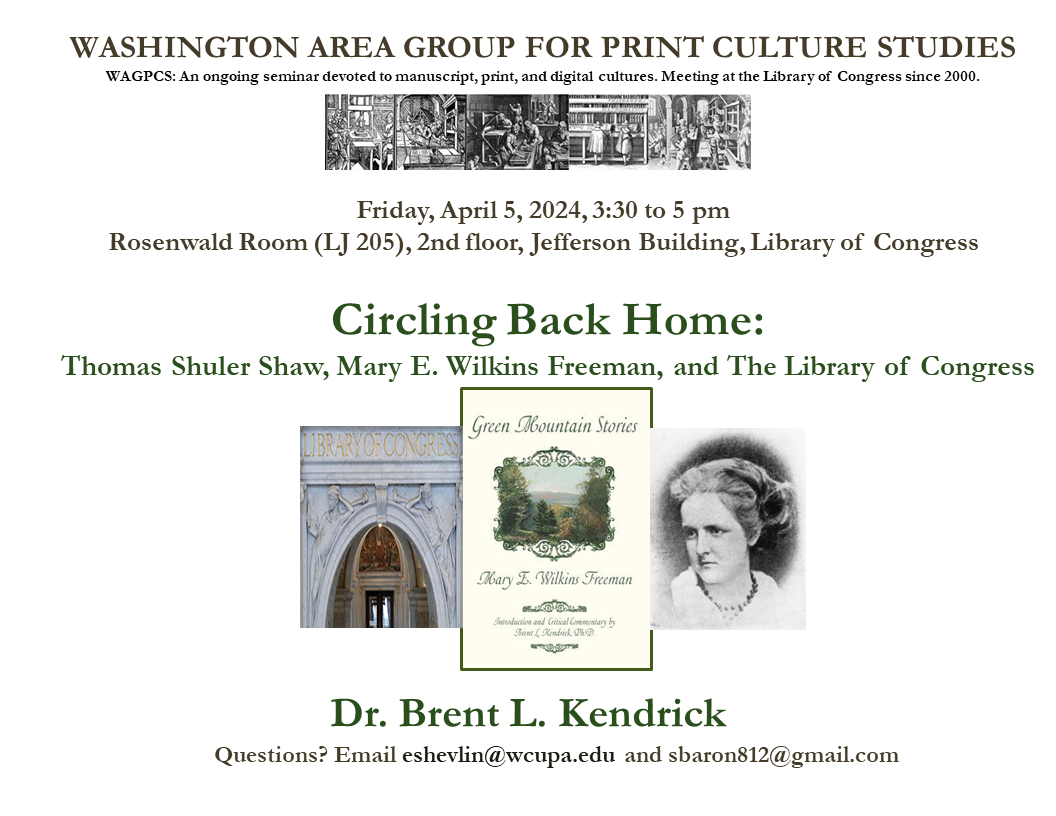
Next week I’ll be circling back home to the Library of Congress (LOC) where I enjoyed a glorious career spanning twenty-five years. I won’t be going home alone. Joining me will be the woman I’ve had an affair with for the last fifty years or so. I’m speaking, of course, of none other than my lady, Mary E. Wilkins Freeman. As part of my ongoing work on my two-volume Dolly: Life and Letters of Mary E. Wilkins Freeman, I’m circling back to LOC’s Rare Book and Special Collections to revisit some important Freeman materials. The beautiful part, however, is that the Washington Area Group for Print Culture Studies (WAGPCS) has invited me to talk about my research. I am thrilled beyond thrilled to be circling back home and to have the opportunity to share my ongoing and exciting work on Freeman.
Below is the abstract of my talk followed by a WAGPCS promotional for the event!
ABSTRACT
On March 15, 1930, the acclaimed American short story writer, Mary E. Wilkins Freeman, passed away. Her legacy, however, continues to resonate. At the turn of the twentieth century, Freeman and Mark Twain stood as America’s most beloved writers. She blazed a trail for women in literature, becoming the first recipient of the William Dean Howells Gold Medal for Distinguished Work in Fiction (awarded by the American Academy of Arts and Letters in 1925). She achieved the distinction of being among the first women elected to membership in the National Institute of Arts and Letters in 1926. Additionally, the bronze doors at the American Academy of Arts and Letters in New York (West 155 Street Administration Building) bear the inscription, “Dedicated to the Memory of Mary E. Wilkins Freeman and the Women Writers of America.”
Enter Thomas Shuler Shaw, a librarian at the Library of Congress, who embarked on an ambitious project in December 1931: writing what would have been the first biography of Mary E. Wilkins Freeman. His goal was to illuminate the life and literary contributions of this remarkable author.
However, fate had other plans. Shaw’s biography, titled A Nineteenth Century Puritan, faced rejection from prominent publishers such as Harper & Brothers, Ladies’ Home Journal, and The Saturday Evening Post. Despite setbacks, Shaw persevered. His meticulously curated scrapbooks and the typescript of his unpublished biography found a home in the Rare Book & Special Collections Division. These artifacts, along with Freeman’s books donated by Shaw to the Library of Congress, provide a rich tapestry of insights into her life and work. Notably, some of these materials reside in the Rare Book/Special Collections, while others find their place in the General Collections.
Fast-forward to 1985. Dr. Brent L. Kendrick, then serving as the Training Coordinator for United States Copyright at the Library of Congress, unveiled a literary treasure: The Infant Sphinx: Collected Letters of Mary E. Wilkins Freeman. Kendrick’s work, enriched by Shaw’s scrapbooks and unpublished biography, delves into Freeman’s correspondence. Through these letters, we glimpse the inner world of a prolific writer who defied conventions and left an indelible mark on American literature.
Fast forward again to May 2023. Kendrick continues his scholarly immersion into Freeman’s world and edits a new edition of her first collection of short stories for adults. Originally published as A Humble Romance and Other Stories in 1887, the book was meant to bear the title Green Mountain Stories. Now, 136 years later, it finally emerges under its intended name: Green Mountain Stories. Kendrick’s edition includes extensive critical commentary, unraveling the intriguing backstory behind this literary transformation.
But Kendrick’s scholarly pursuits don’t end there. Armed with fresh discoveries—significant letters previously absent from his earlier work, The Infant Sphinx—he embarks on a new two-volume project: Dolly: Life and Letters of Mary E. Wilkins Freeman. Vol. I: The New England Years (1852-1901). Vol. II: The New Jersey Years (1902-1930).
With these ongoing scholarly endeavors in mind, Dr. Kendrick returns full circle to the Library of Congress, a place where both he and Shaw once contributed their efforts. Here, he plans to delve once more into Shaw’s meticulously curated scrapbooks and unpublished biography, reexamining their contents to discern fresh insights that could enrich his comprehensive exploration of Freeman’s life and correspondence. This return to the archives not only honors the legacy of Shaw’s dedication but also underscores the enduring significance of the Library of Congress as a nexus for scholarly inquiry into the lives and works of American literary figures.
When I let go of what I am, I become what I might be.
Lao Tzu (Ancient Chinese philosopher and writer; founder of Taoism.)
The idea for today’s post exploded magically in my head one Friday morning last spring as I drove to campus for a Creative Writing class. I started thinking about the fact that Fall 2022 would be my last semester as a full-time Professor of English at Laurel Ridge Community College. In the midst of my reverie, I had an insight. I’ve been blessed with the luxury of growing up more than once.
Now I’m writing about that epiphany of many months ago. Candidly, until I started working on this post, I hadn’t given a lot of thought to the meanings that the expression “growing up” can have.
The most common, of course, relates to the challenges that we all face as we progress from childhood through puberty into early adulthood.
That meaning goes all the way back to the Coverdale Bible of 1535:
“The childe Samuel wente and grewe up, & was accepted of the Lorde & of men” (1 Samuel ii. 26).
Sometimes, however, the expression can be used to criticize someone who is being silly or unreasonable. I’m thinking of that memorable line in J. D. Salinger’s 1951 novel, Catcher in the Rye:
“For Chrissake, grow up.”
I’m not certain that anyone has ever told me to “grow up.” When I was young, people told me that I was old for my age. Now that I am older, people tell me that I am young for my age.
Be that as it may, I’ve never considered “growing up” as a once-in-a-lifetime rite of passage where we make it to adulthood. One day, we arrive. One day, we’ve grown up. Voila!
For me, “growing up” has been an ongoing journey from Point A to Point B, where Point B is never the end. Instead, it becomes the starting point of another journey.
Let me explain.
Many people might assume that since I was born in the coal fields of Southern West Virginia my Point A of “growing up” was related directly to “getting out.” Even today, West Virginia is the fifth poorest state in the nation. Without doubt, I remember vividly and well the hardships of poverty–the challenges of living from paycheck to paycheck.
What I remember far more are the values and hard work ethic that my dad (a coal miner) and my mother (a fundamentalist minister) instilled in me. What I remember far more is that they taught me to appreciate, value, and celebrate diversity. What I remember far more is that they taught me to embrace and accept everyone.
What I remember far more are the educators who knew the subjects that they taught and who taught those subjects with passion. What I remember far more are the educators who loved their students and took personal interest in us. They were living witnesses to everyone in the coal camp: we could transform our lives through education just as education had transformed their lives.
For me, my first “growing up” had nothing to do with “getting out.” It had everything to do with getting educated. It had everything to do with going to college.
By the third grade, I was telling everyone that I was going to be an English Professor. Looking back, I wonder what planted that idea in my head. I had never met a professor. None lived in my coal camp or in the slightly larger town where we moved when I started the third grade. I had no idea whatsoever what an English Professor did. I had no idea what I would have to do to become one. But I minced no words about it. I was going to become an English Professor. Yet, how could that ever happen? I would have to go to college and that would cost big bucks that my parents didn’t have. Where would the money come from? My teachers and my parents had answers for me. “Work hard. Do your best. Get good grades.” After a few years of seeing my commitment to academic success, they expanded their answer: “Keep it up. You’ll get scholarships. You’ll see.”
And that’s exactly what I did. I went forward with faith, and, as a rising high-school senior, I started the college-application process. Acceptance letters came one by one but without any scholarship offers. I felt good–really good–about being accepted. Sure. Feeling good would pay tuition. Sure. Feeling good would pay for textbooks. Sure. Feeling good would pay for room and board. Yep. I felt good.
Doors were opening for me to get educated, but, ironically, I couldn’t pay to cross the threshold.
Then, just a month or two before graduating third in my class, I received a letter from Alderson-Broaddus University that changed my life forever. I had been accepted with a comprehensive financial aid package–scholarships, Work Study, and student loans–that covered all expenses.
Can you imagine. Me. A hard-working, coal-camp kid with a dream, going off to college. Me. The first in my family to go to college. I pinched myself, and off I went to college.
As part of my studies at Alderson-Broaddus, I had two academic internships in Washington, D.C. One was with Senator Robert Byrd, doing administrative tasks in his office and delivering mail to United States Senators. The second was with the former Department of Health, Education, and Welfare–Division of Two-Year Colleges.
When I graduated cum laude from Alderson-Broaddus in 1969 with a Bachelor’s Degree in the Humanities, I landed a position at the Library of Congress, as an editor in its MARC Project. After a year, I moved up and became an editor in the National Union Catalog, Pre-1956 Imprints, hailed as the bibliographic wonder of the world.
Can you imagine? Me. The hard-working, coal-camp kid with a dream and three books in his early childhood home–the King James Bible; Webster’s Dictionary; and Sears Roebuck Catalog–working as an editor in the world’s largest library, the place with all the books.
I pinched myself over and over again. I was living in my own apartment in the shadow of the Nation’s Capitol. I was working in the world’s premier library. I was a federal employee with a handsome salary and first-rate benefits.
I had grown up. Or so I thought.
Three years into my federal career, I got hooked on research. The yearning for more learning descended upon me, and I realized that I needed to grow up again.
Off I went to the University of South Carolina where I earned my Ph.D. in American Literature, where I became a Mary E. Wilkins Freeman scholar, and where I experienced, for the first time, the joy of teaching.
I was armed with credentials, but I had only one college professorship offer, with a salary so low that I could not afford to accept the position.
I went back home to the Library of Congress where I remained for a total of twenty-five years. I continued my Freeman research and published my The Infant Sphinx: The Collected Letters of Mary E. Wilkins Freeman (Scarecrow Press, 1985). I worked with the best professionals in the federal sector. I continued my earlier work as an editor in the NUCPP-Pre-1955 Imprints. I became the Training Coordinator for the United States Copyright Office and then Director of the Library’s Internship Program and after that Special Assistant for Human Resources, giving HR advice to department heads as well as to two Librarians of Congress.
I spent a total of twenty-five years as a federal employee, as a researcher, and as a scholar.
Surely, I had grown up. Or so I thought.
But when I turned fifty, I started feeling antsy about that childhood dream of becoming a Professor of English. I started feeling antsy about that childhood dream of long, long ago. I started fussing with myself every day and throughout the days:
“If not now, when.”
On a leap of faith that I would find a college home, I took advantage of a 1998 early retirement from the Library of Congress. I sold my Capitol Hill home, bought myself a Jeep, and relocated to my weekend home in Virginia’s Shenandoah Valley.
In August 1999, Lord Fairfax Community College (now Laurel Ridge Community College), opened its doors to me, first as an Adjunct Professor of English and then as a full-time Professor of English.
Some might say that my childhood dream was deferred for a long, long time.
Others might say that I had to grow up twice before I was ready to grow into the professor that I would become.
I tend to agree with the latter group. My education, my research, my scholarship, and my federal service positioned me to move into academe at the perfect moment. I was prepared for my teaching journey. I was ready for my teaching journey.
Now I have come full circle to where this post began. After twenty-three years, this semester was my last one as a full-time professor at Laurel Ridge Community College. On Friday, December 9, I taught my last class there as a full-time professor.
What an incredible journey it has been! I am so grateful to my Laurel Ridge family who have journeyed with me. And I’m even more grateful to more than 7,000 students, who believe —no, more than 7,000 students who know—that an education will transform their lives just as my life was transformed by education. I am pleased beyond measure that they let me be their learning coach. Every day, they gave me one more chance to do it better. Every day, they gave me one more chance to get it right. Every day, they let me be, me. Every day, they let me be a part of the magic.
Surely, I am grown up now.
I daresay that you have guessed it already. I’m not. In fact, I just heard someone say:
“The good professor is going to grow up again.”
Yes. That’s exactly what I’m going to do, for the fourth time in my life. I just did some quick and dirty math. It seems to me that each time I grow up takes nearly twenty-five years. With a little luck, the next growing up will take about the same number of years and will be filled with lots of scholarly research, writing and publishing; lots of teaching; and lots of service. Who knows. Only time will tell.
But here’s how I see things right now. By the time I reach 100, I might have grown up. And, if I haven’t, I’ll keep right on with the important work of becoming what I might be.
Never to forget where we came from and always praise the bridges that carried us over.
Fannie Lou Hammer (1917-1977; Civil Rights Crusader)
My life has been filled with people who have helped me succeed. People who have helped carry me over. I like to think of them–collectively–as my bridge builders.
BRIDGE BUILDERS–MY PARENTS AND MY SIBLINGS.
My parents, of course, started building the bridge upon which I still trod. They gave me life and empowered me to live mine to the fullest. They provided forever-tools–always to use, never to lose, ever. As a coal miner, my dad lived the life that he worked, and he preached it. As a preacher, my mother lived the life that she preached, and she worked it. They taught me to work hard at and see to the finish anything and everything that I started, fully believing that all work has dignity. They taught me the difference between working for a living and working for love. They taught me to appreciate, value, and celebrate diversity. They taught me to embrace and accept everyone along my way. And, yes, they taught me that with an education I could be whatever I wanted to be and go wherever I wanted to go.
My five brothers and sisters played critical roles, too, in constructing the bridge that has served me so well. Since they were older, I didn’t always understand the full dimensions of their lives: restaurateur; sales person and caregiver extraordinaire; medical technologist; mechanic; and post mistress. Yet, whatever they were doing always impressed me and sent me chasing my own dreams.
BRIDGE BUILDERS–MY EDUCATORS AND MY BENEFACTORS.
Growing up in the coal fields of Southern West Virginia, I was blessed to have some of the best educators in the world. They knew the subjects that they taught, and they taught those subjects with passion. Perhaps more important, they loved their students and took personal interest in us. They were living witnesses: we could transform our lives through education just as education had transformed their lives.
My third grade teacher at Shady Spring Elementary School stretched my bridge by introducing me to Robert Frost’s poetry. I fell in love–and remain in love–with poetry, and Frost remains my favorite poet. Bridge work continued as other teachers pulled me toward Scripps National Spelling Bee Competitions and Voice of Democracy Competitions. And I will always remember the teacher who got me hooked on the parts of speech and sentence diagramming. She knew that she had unleashed a wild child in love with the power of language.
My teachers at Shady Spring High School lengthened and strengthened the bridge still more. One showed me that powerful writing and hefty revision go hand in hand. Another helped me realize that typing and bookkeeping were solid backup skills that could open other career paths if my dream of going to college had to be deferred. And what a critical expansion my high school biology teacher provided by welcoming me and several other students to crash his desk every day at lunch, day after day, week after week, semester after semester, from our sophomore year all the way through graduation. Those lunch-time conversations were far more important than any lunch before or since. He gave us his time. He gave us himself.
As high school graduation approached and going to college became a reality, benefactors stepped up to help build my bridge. My parents and siblings didn’t have a lot to give, but what they had, they gave. Similarly, the citizens of my hometown set up a scholarship fund to help college-bound students buy freshman-year textbooks. I was one of the first recipients. That $150 check meant my future to me.
My professors at Alderson-Broaddus University added wonderfully rich dimensions to the bridge. Most of them lived on campus–on faculty row–and our classes were so small that we were often their dinner guests. They helped me see the human side of the presumed academic ivory tower that years later I would strive to model. My advisor, though in her fifties, finished her doctoral degree while I studied under her and served as her Work Study. She gave me an appreciation of lifelong learning. Fortunately, too, benefactors made it possible for my life bridge to continue growing. Their endowed scholarships helped me fulfill my dream of becoming a college English professor.
As a graduate student at the University of South Carolina, phenomenal educators continued to enrich my life and build my bridge. I’m thinking of my advisor who turned me on to textual bibliography. Another professor introduced me to Mary E. Wilkins Freeman–the ongoing focal point of my scholarly research from then until now. I’m recalling the professor who lectured, literary work in hand and not a lecture note in sight, with fiery passion and exultant joy. He allowed himself to be slain in the intellectual moment just as my mother always allowed herself to be slain in the spiritual moment. Through his teaching, I saw the best of both worlds–his and my mother’s. I had a vision of the educator that I would strive to be.
BRIDGE BUILDERS–MY COLLEAGUES AND MY FRIENDS.
Just as I was blessed to have bridge builders throughout my educational life, so too have I been blessed to have them in my professional and personal life.
I would not be where I am today had it not been for my supervisor at the former Department of Health, Education, and Welfare. When I was a summer intern in his Division of Two-Year Colleges, he was the one who suggested that the Library of Congress might be the perfect place for me as an editor. He was the one who nudged me to Capitol Hill to submit an employment application.
Without his influence, I would never have had a twenty-five year career at the world’s premier research library.
During that career, I worked with the best professionals in the federal sector. They were awesome bridge builders for me and countless others. One–a pioneer in library automation, at a time when computers were still called machines–helped me move up from being an editor in the MARC Project to being an editor in the NUCPP-Pre-1955 Imprints, the bibliographic wonder of the world. Another made me believe that information is never lost: painstaking and dogged research can always lead to its discovery. Another made me believe that I had it in me to be the Training Coordinator for the United States Copyright Office. Then he led me from there to being the Director of the Library’s Internship Program and from there to being Special Assistant for Human Resources, giving HR advice to department heads throughout the Library as well as to two Librarians of Congress.
After I crossed the bridge from the library side to the academic side at Lord Fairfax Community College, I was blessed to have still more bridge builders in my life. The biggest, perhaps, was the selection committee that recommended hiring me as a professor of English, thereby making my third-grade dream come true. Later, another bridge builder challenged me to teach dynamic 8-hour classes on Fridays and Saturdays. Another graciously asked me to co-advise the Alpha Beta Omega Chapter of Phi Theta Kappa–the International Honor Society of the Two-Year College. Other bridge builders challenged me to teach without walls: Virtual Learning. Still another, without books: free Open Educational Resources personally curated and designed by me. Then there was the seminal opportunity to co-author and edit the college’s report for LFCC’s Reaffirmation of Accreditation, Southern Association of Colleges and Schools (SACS). Add to that team teaching Leadership Honors Seminars and English Honors Seminars and co-presenting at conferences with mathematicians, artists, and psychologists. And I will always remember the growth opportunity afforded by co-chairing the Developmental English Curriculum Team charged with redesigning Developmental English across the Virginia Community College System. Other bridge builders–colleagues, deans, vice-presidents, and presidents–championed me so successfully that, from time to time, I was in the limelight at the college, state, and national levels.
Fortunately, close friends have been there with me throughout my crossing–giving the support that only friends can provide. The “You can do this” pep talks! The “You did it” celebrations. The listening. The sharing. The “Here’s a tissue” followed by “Better now?” The emailing. “What? You kept them all? Guinness Book of World Records? No way!” The texting. The calling. The nothingness. The silliness. The everything-ness. All the things that nurturing friends do…just because that’s what friends do.
BRIDGE BUILDER–MY SOULMATE.
Words cannot describe one of the most important bridge builders in my life: my soulmate, my late partner. Allen journeyed with me across a large expanse of my bridge, quietly adding key components along the way. Gourmet cooking. Gardening. Hiking. Biking. Together we made the journey from who I was before, to who I am now. Together we witnessed the power and depth of love through surrender. Together our hands clasped tightly one another’s, one last time, as he crossed his own bridge into eternity.
BRIDGE BUILDERS–MY GOLDEN YEARS AND BEYOND.
Today, I am in awe. I am standing on the bridge that others built for me, still strong after seven decades. I am standing on the bridge that others will continue to build for me, including my executors who will pay my bridge forward by strengthening the endowed scholarships that Allen and I envisioned and established.
Looking back, the distance from where I started–the coal fields of Southern West Virginia–to where I am today–the Shenandoah Valley of Virginia–is not that far: fewer than 300 miles. But the joys and triumphs that I have experienced while journeying across the bridge exceed by far the wildest dreams of my wild imagination.
Looking ahead toward my Golden Years–whatever they are; whatever they bring–I step forth confidently. My bridge is strong. My bridge is sturdy. My bridge will endure. Those who built my bridge made it according to the best specs.
Looking ahead further still to that time when I will cross from my earthly bridge into the Great Beyond–whatever it is; whatever it brings–I hope that all of my bridge builders will be there to welcome me. My Soulmate/Partner. My Colleagues. My Friends. My Educators. My Siblings. My Parents.
What a great gettin’ up morning that will be as I rejoice in singing the praises of my bridge builders, the ones who carried me over.

 The Wired Researcher