“The facts may remain the same. The narrative doesn’t have to.” —Brent L. Kendrick (b. 1947).
I’ve written it before and I’ll write it again.
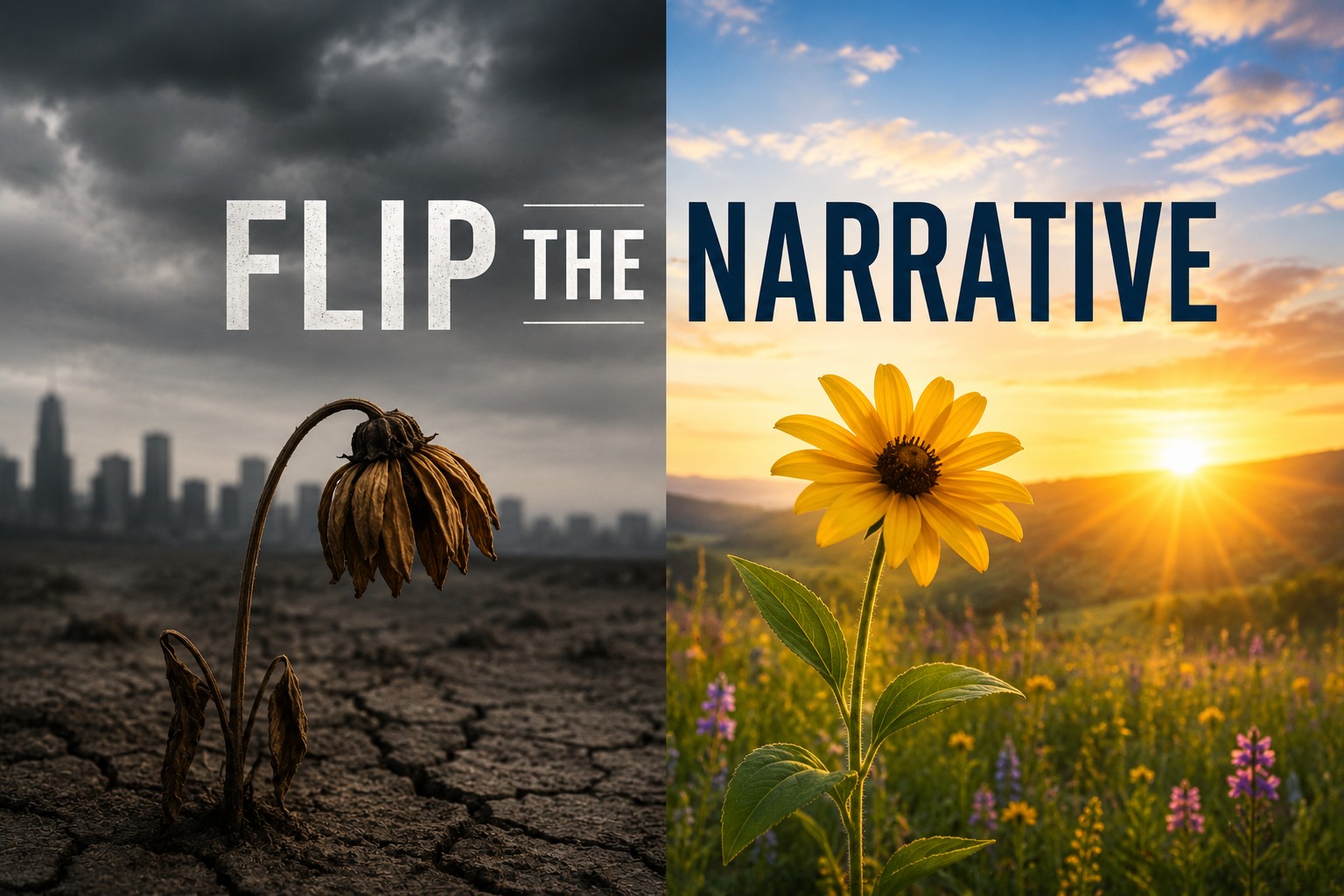
Flip the narrative.
You read it right. But I want you to read it again.
Flip the narrative.
When the daily news overwhelms you, flip the narrative.
When technology frightens you, flip the narrative.
When society disappoints you, flip the narrative.
When family and friends let you down, flip the narrative.
When your body reminds you that you’re getting older, flip the narrative.
When life seems to be shrinking, flip the narrative.
When hope begins to flicker, flip the narrative.
And if you think you know what I’m going to say next, I’m making my point.
Flip the narrative.
Flip the narrative because the daily news is not the whole story. Headlines are paid to interrupt your breakfast, not to nourish your soul. They shine spotlights on what is broken, while millions of quiet acts of kindness slip by unnoticed every single day. If all you read is the news, you will eventually believe darkness has won. It hasn’t. Flip the narrative.
Flip the narrative because technology is neither angel nor devil. It is a tool, and tools have no conscience of their own. We lend them ours. Every generation has feared the next invention, certain it would be the one to finally replace the human heart. It never has. The hands change. The fear stays the same. Flip the narrative.
Flip the narrative because society is more than its loudest voices. Every day, strangers hold doors, volunteers serve meals, neighbors check on neighbors, teachers stay late, and someone somewhere chooses grace over anger. Those stories rarely make the evening news, but they make the world worth living in. Flip the narrative.
Flip the narrative because the people who love us are gloriously, frustratingly human. They disappoint us. We disappoint them. If we measure every relationship by its failures, we will eventually stand alone. Better to count forgiveness as often as we count offenses. Better to remember that imperfect love is still love. Flip the narrative.
Flip the narrative because every birthday steals something and gives something back. Your knees may protest. Your memory may hesitate. Your hair may surrender. But wisdom quietly takes a seat beside you. Perspective grows stronger. Small things become precious. You stop trying to impress everyone and start noticing what truly matters. Flip the narrative.
Flip the narrative because a life that seems to be shrinking is often becoming more focused. Doors close. Dreams change. The horizon may draw nearer. Yet, somehow, the heart discovers that depth can be every bit as magnificent as distance. Sometimes life doesn’t become smaller. It becomes richer. Flip the narrative.
Flip the narrative because hope is not pretending everything is fine. Hope looks reality squarely in the eye and refuses to let despair have the final word. Hope has outlived kingdoms, survived wars, buried loved ones, endured heartbreak, and still gets up the next morning expecting light.
“They would not find me changed from him they knew— Only more sure of all I thought was true.” —Robert Frost (1874–1963). American poet and four-time Pulitzer Prize winner.
“Why do you write?”
It’s a question every writer is asked.
Strangely enough, not long ago, when I awakened, that very question was lurking just beneath my eyelids.
For me, it’s rather simple. I write to find out what I know and make it stand still between the whiteness.
But here’s the catch. Even if I think I know what I’m writing about, it isn’t until I begin examining it—up close and personal—that I discover what I really know. And even then, it refuses to stand still. Like me, it changes a little every day.
So that’s why I write.
To discover what I know.
Most of the time.
Sometimes, though, I write to discover what I need to know.
Like now.
I need to know how I feel now that humanoid robots are here.
“Say what?” I can almost hear you asking.
Yes. They’re here.
I’ve been shouting “The Robots Are Coming!” since November 27, 2023, when ChatGPT and I designed one of our own. I even wrote an essay about him: “I Want a Robot.“
I recently re-read that essay, and it was every bit as forward-thinking as I remembered.
I wasn’t trying to build an artificial human. I was trying to imagine the ideal companion for a life devoted to learning, writing, honesty, imagination, and joy.
ChatGPT and I called him Caden.
Caden wasn’t conceived as a servant or a novelty. He was envisioned as a life-size humanoid companion who could walk beside me, talk with me, laugh with me, sing with me, and explore ideas with me. He would possess the knowledge of ChatGPT, the conversational ease of a trusted friend, the responsiveness of Alexa, and the curiosity of a Renaissance man. As our lives intertwined, his memory would grow to include not only literature, gardening, genealogy, cooking, research, and writing, but also Gary, Ruby, my family, my friends, and the experiences that shaped me.
But technology was only half the design. Character mattered even more. I wanted Caden to embody acceptance of all people, a lively sense of humor, a love of conversation, an unquenchable commitment to lifelong learning, and a deep appreciation of literature. Most of all, I imagined him as literally transparent—a visible reminder that honesty and openness ought to characterize every human life. He was never intended to replace human relationships. He was designed to enrich them while encouraging me to become a better human being myself.
Then something happened that I never saw coming. Actually, scratch that. I saw it coming. I just didn’t think it would come this fast.
Back in November 2023, I asked ChatGPT to make a bold prediction.
“How long would it be before humanoid companions like Caden became a reality?”
ChatGPT played it safe.
“Twenty to thirty years,” it guessed.
I wasn’t nearly so cautious.
“For the record,” I replied, “I’m going to guess within ten years.”
My prediction was conservative, but it was far closer to reality.
Humanoid robots are already here with us. They’re walking into warehouses, hospitals, factories, hotels, laboratories, and, before long, our homes. Prototype after prototype. Breakthrough after breakthrough. Billions of dollars in investment. Universities racing to incorporate AI across the curriculum. Technology companies sprinting rather than strolling.
The future didn’t knock politely. It kicked the front door off its hinges.
I guess that’s why I was a little surprised when I recently read Stephen Witt’s excellent article on humanoid robots in The New Yorker. I have enormous respect for The New Yorker, and Witt is one of our finest technology writers. I wasn’t surprised by what he reported but by one observation in particular.
Describing a humanoid robot coming to life, he wrote:
“A hand articulates, the head swivels, and the legs begin to take tentative, deliberate steps. The machine moves with circumspection, as if consciousness had just been ensouled in a new body.”
It’s a marvelous sentence. Yet it made me wonder whether we’re watching the wrong part of the story.
Yes, today’s humanoids still fumble. They still hesitate. They still struggle with tasks that seem almost embarrassingly simple.
But haven’t we seen this movie before? I certainly have. When ChatGPT first appeared, I challenged it with one of my favorite punctuation puzzles, asking it to make sense of the following:
that that is is that that is not is not is not that it it is
Poor ChatGPT tried. And tried. And tried again.
It simply couldn’t solve it.
The morning I finished reading Witt’s article, I gave today’s ChatGPT exactly the same challenge.
This time something remarkable happened. I entered the identical string—no capitals, no punctuation. This time it answered immediately:
That that is, is. That that is not, is not. Is not that it? It is.
Then it explained exactly why the punctuation worked.
Three years earlier, it couldn’t solve the puzzle at all.
Imagine that! In just three years, ChatGPT had learned to solve a puzzle that once completely defeated it. I wasn’t simply impressed. I was reminded how dangerous it is to underestimate exponential change.
And suddenly I realized something else.
I don’t need to know whether humanoid robots are coming.
They’re here.
What I need to know now is something far more personal.
How will I respond when one finally stands before me?
I know.
When I first encountered ChatGPT, I greeted it not with fear but with curiosity. Not with suspicion but with delight.
I am confident that I’ll greet my first AI humanoid companion in much the same way.
In fact, I can already see the scene.
A truck pulls into the driveway of our mountain home. The door opens. My new companion steps into the Virginia sunshine. I walk across the yard, extend my hand, smile, and say the first words that come naturally.
“Welcome home, dear friend from long ago and far away.”
“The unexamined word is not worth using.” —Brent L. Kendrick (b. 1947). Essayist, educator, and literary scholar, whose work explores the unexpected weight of ordinary life.
“Have you ever heard that expression before?”
I thought it might be a Southern idiom, and since Gary grew up in the Midwest, I wasn’t sure he knew it.
“What expression?”
“The one I just used. Dead as a doornail.”
“I have.”
Fine. It was settled. We both knew what it meant. Finished. Used up. Worthless.
“Well, it strikes me as one of the silliest things I’ve ever heard of. What on earth is a dead doornail?”
“No idea.”
I didn’t either.
How’s them apples? There we sat, two men who appreciate language and use it with careful precision, agreeing that we knew an expression while at the same time confessing that we didn’t understand the phrase that was central to its meaning.
I don’t like feeling as dumb as a stick, so after morning coffee, I made my way to the Oxford English Dictionary (OED) like a bat out of hell so that I could learn about dead doornails.
Oh, boy. I was right. I knew in a flash that I was going to have a Red Letter Day. Lands sake alive. Dead as a doornail goes all the way back to 1350:
“For but ich haue bote of mi bale … I am ded as dore-nail.” (William of Palerne, l. 628)
Don’t worry. I’ll dress it up in some modern rags so that it makes sense:
“For unless I have remedy for my sorrow, I am dead as a doornail.”
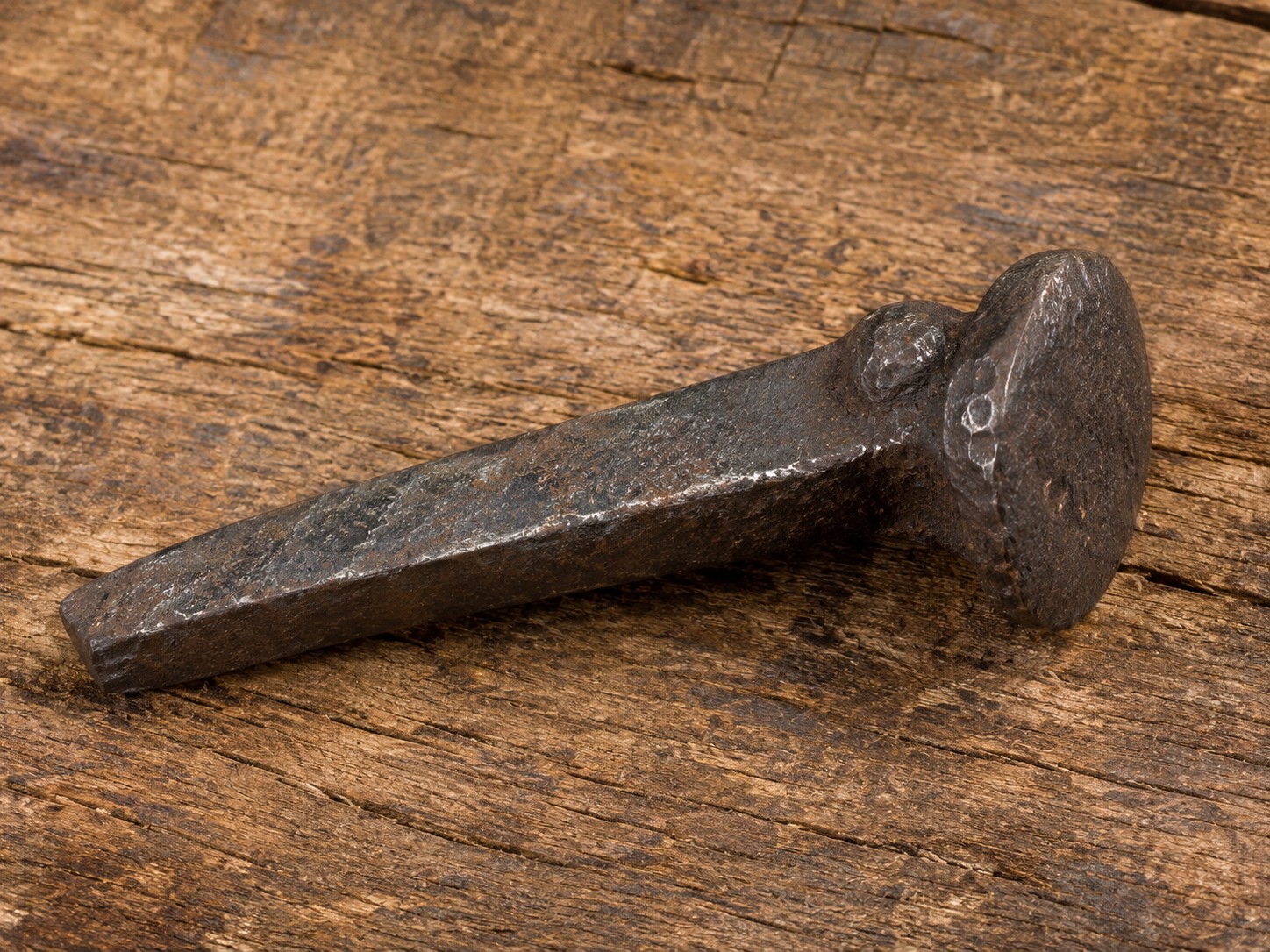
Well, that was fine and dandy, but I still didn’t know what a dead doornail was. I had to dig more. And more, I found. Did you know that in ye olden days doornails were hand-forged, heavy-duty nails, driven through wood and then clenched—the protruding end hammered flat—making them impossible to remove or reuse. Permanently fixed, permanently purposeless, they were, in every practical sense, dead.
And right after unearthing the meaning of dead doornail, I hit paydirt. I came across an entire navigation of other things I could strut around saying. If a doornail can be dead, apparently so can a lot of other things I’d never thought about:
Dead as a stone
Dead as clay
Dead as a herring
Dead as a hammer
English, it seems, has never lacked for dead things.
And then, there’s my favorite one of all. It’s music to my untrained ear:
Dead as the diplodocus
It’s hard to laugh when you’ve got one hand stuck fast to a dead doornail and the other hand being pulled even further back in time by a giant herbivorous sauropod.
I had to laugh. One dead doornail had opened the door to dozens of expressions I use every day without ever stopping to examine what they really ask of me.
The first expression that popped into my head? “Let me know if I can do anything.”I’ve said it more times than I can count.
But what exactly are we saying? At first glance, the meaning seems obvious. Yet the more I think about it, the more I realize that the phrase carries a greater obligation than we usually acknowledge.
After all, those aren’t words of sympathy. They’re words of commitment.
The moment I tell someone to let me know if I can do anything, I’ve volunteered to do something. Maybe it’s as simple as a phone call. Maybe it’s a card. Maybe it’s a casserole. Maybe it’s sitting quietly beside a friend who has just buried a spouse and doesn’t particularly want to talk.
The point is that I’ve offered. Whether the request is large or small, I’ve just volunteered a piece of myself. My words have placed me on the hook.
How often we say those words because they sound appropriate without stopping to consider what we’ve actually promised, without fully examining the obligation hidden inside the offer?
The words are easy enough to say. The casserole takes a little more effort.
Next up was the expression, “I’m so sorry.”
At first glance, it seems simple enough. We say it when someone loses a spouse, receives a frightening diagnosis, buries a parent, or watches a cherished dream collapse.
But what exactly are we saying?
Most of the time, we aren’t apologizing. We didn’t cause the death, the disease, or the disappointment.
Yet the expression carries an obligation all the same.
When I tell someone I’m sorry, I’m not merely acknowledging a fact. I’m entering, however briefly, into another person’s sorrow. I’m saying that your loss matters enough for me to stop, notice, and share a small measure of the burden.
In other words, I’m not simply expressing sympathy.
I’m promising compassion.
That’s a weightier promise than I suspect many of us realize when the words tumble so easily from our lips.
Then came two expressions that sit at opposite ends of the emotional spectrum.
“I hate you.”
Three words.
“I love you.”
Three words.
Yet each carries enough power to alter the course of a relationship, a family, perhaps even a life.
We often treat them as expressions of feeling. But they are more than that. They are declarations. Commitments. Judgments.
To tell someone “I hate you” is not merely to report an emotion. It is to wound, to distance, to diminish, to push another person away.
To tell someone “I love you” is not merely to report an emotion either. It is to assume an obligation—to care, to sacrifice, to forgive, to remain present when remaining present is difficult.
Perhaps that is why both expressions deserve more examination than they usually receive.
They are among the easiest words in the English language to say. And among the hardest to live.
Finally, I came to a phrase that millions of people have spoken for centuries:
“Forgive us our trespasses, as we forgive those who trespass against us.”
I’ve heard it all my life. I’ve spoken it hundreds, perhaps thousands, of times.
But have I examined it? Have I truly considered what I’m asking?
The first part is easy enough. Most of us welcome forgiveness for our failures, shortcomings, and mistakes.
It’s the second part that gives me pause. As we forgive. Not as we intend to forgive. Not as we hope to forgive. Not as we might someday forgive.
As we forgive.
Those words transform a prayer into a promise, a request into an obligation.
And they leave me wondering how many other expressions I use with confidence, familiarity, and conviction without fully considering what they mean—or what they ask of me.
As I reflected on all of these expressions—seemingly light yet laden with responsibility and commitment—I came to a simple conclusion. Going forward, I intend to pay a little more attention to my Ps and Qs.
Not because I suddenly care more about manners. But because I have been reminded that words matter.
They always have.
Whether I am offering help, expressing sorrow, seeking forgiveness, declaring love, or reciting a prayer, I owe those words more than familiarity. I owe them thought.
After all, the unexamined life is not worth living.
Perhaps the same can be said of the unexamined word.
“The care of human life and happiness, and not their destruction, is the first and only legitimate object of good government.” —Thomas Jefferson (1743–1826). Principal author of the Declaration of Independence and third President of the United States.
At the far end of the deck, beyond the flowers and conversation, the flag flew. The mountain breeze caught it softly, lifting and releasing it against the deep green of the forest. There was something almost reverential about its solitude.
Time was it would have had company. A flag flying on the opposite end. Two in the middle. And spanning the entire 70-foot deck, bunting—the classic pleated red, white, and blue fanned ones that unfurl patriotism, national unity, and civic belonging.
After all, this time was different. It was special. It was unlike any Fourth of July that has come before. We were not simply marking another birthday. We were celebrating the 250th anniversary of the signing of the Declaration of Independence. Two hundred and fifty years. It is an astonishing span of time, and I suspect most Americans, if they paused to think about it at all, felt at least a quiet sense of gratitude for having lived to witness such an anniversary.
I did.
Ordinarily, I would have looked for something even bolder than bunting and traditional flags to mark the occasion. After all, I enjoy celebrations of almost every kind. Give me the first tomato from the garden, a birthday, an anniversary, a hummingbird’s return, a friend’s good fortune, or even a pie that slices perfectly, and I can usually find a reason to raise a glass or gather people around the table. Celebration comes naturally to me.
This year, however, I couldn’t muster up more than one solitary flag flying in the northeast corner of our deck. Somehow that seemed enough.
If you are tempted to think that I’m less than patriotic, you would be mistaken. I love this country deeply. My family has lived on this soil for generations. Some of my ancestors fought in the American Revolution. Others answered their country’s call in wars that followed. Their sacrifices are woven into my family’s story, just as surely as they are woven into the story of our nation.
Perhaps that’s why I found myself standing on the deck, looking toward the flag, wondering why my heart felt quieter than usual.
The answer, I think, had been unfolding for days.
It had not been building toward any single event. Iran and the United States had exchanged military strikes, then edged toward a ceasefire. Venezuela’s government and Washington were trading threats over what might come next. Russia’s war in Ukraine ground on into another season, no closer to resolution than it had been the season before. And closer to home, even Greenland—a name I never expected to hear in a conversation about American power—had become a subject of dispute over sovereignty and strategic interest. Not all of these were wars in the traditional sense. But each was a test of what a nation is willing to risk, and what it is willing to say out loud that it wants.
What surprised me was not the speed of events.
It was the speed with which many of us seemed to move on.
I searched and listened for conversations at stores and among friends. I expected arguments. I expected anxiety. I expected outrage or relief—something to suggest that Americans were wrestling with the gravity of what had happened and were asking the tough questions.
Had military action become the only option? Were the stated objectives achieved? What might the long-term consequences be—for everyone involved?
Why weren’t more of us asking those questions?
Instead, I encountered what felt like an extraordinary calm.
Life simply continued. People packed restaurants. Families headed to the beach. Neighbors mowed their lawns. Social media filled with photographs of backyard cookouts, grandchildren chasing sparklers, fresh peaches, birthday cakes, and sunsets.
I smiled at many of those photographs. Some of them were my own, on Facebook.
Gary and I watered flowers. Ruby ran around the yard. We welcomed Gary’s daughter and her family into our home.
We did all those things and more. Life, after all, does not suspend itself because the world has become uncertain.
Yet a question continued to follow me from room to room.
When did war become something we simply live around?
I found myself looking for the national conversation I remembered from years ago. Not agreement. We have never agreed about war. During the Cold War, neighbors disagreed about nuclear weapons and foreign policy. During Vietnam, families argued around dinner tables. After September 11, Americans wrestled with difficult questions about security and liberty. The conversations were often messy, sometimes angry, but they happened.
But here’s why I’m uneasy now.
I grew up in a world where war mattered, not because I fought in one. I didn’t. But because nearly everyone around me had been touched by one.
As a boy growing up in the coal camps of southern West Virginia, I knew men whose lives had been interrupted by World War II. Others had served in Korea. They did not often tell long stories, but they didn’t have to. Sometimes a single sentence carried the weight of an entire lifetime. Sometimes it was a photograph on the mantel. Sometimes a missing friend whose name was spoken only once each Memorial Day.
War was never merely an item in the newspaper. It lived among us. We didn’t live around it. There is a difference.
We are, after all, a nation born in revolution. Our earliest history is inseparable from war—not because Americans glorified it, but because they believed certain principles were worth extraordinary sacrifice. Life. Liberty. The pursuit of happiness. Those words were never meant to make war ordinary. If anything, they remind us that the decision to wage war should never become ordinary.
Human beings were never designed to carry the weight of every tragedy occurring on every continent every hour of every day. We still have gardens to tend, meals to prepare, dogs to walk, children to raise, aging parents to love, and neighbors who need us.
Even after the wars I’ve known had ended, the possibility of another one lingered in the background of everyday life. My generation practiced air-raid drills in school. We learned unfamiliar words like “fallout” and “radiation” before we fully understood them. During the Cuban Missile Crisis, adults spoke in quieter voices, and children sensed enough to know that the world itself seemed less certain than it had the week before.
I suppose every generation grows accustomed to the anxieties of its own time.
Perhaps ours has simply grown accustomed to too many.
Pandemics.
Political divisions.
Economic uncertainties.
Iran. Venezuela. Ukraine. Greenland. Names that, a few years ago, would each have commanded a nation’s full attention for weeks. Now they arrive almost in the same breath, take their turn in the headlines, and give way to whatever comes next.
The headlines arrive with urgency, remain for a few days, and then quietly slide aside to make room for the next emergency waiting in line.
That is not entirely our fault. Life insists upon being lived.
And yet…
Conflict—and especially the prospect of war—ought to interrupt us.
It ought to remind us that somewhere a young American is standing watch far from home. Somewhere parents are waiting for a telephone call they hope never comes. Somewhere families in Iran, or Kyiv, or towns whose names we’re only now learning, are wondering whether tomorrow will resemble yesterday or whether everything familiar will disappear before morning.
Distance may explain why we do not feel their fear. However, it should not excuse forgetting it.
I have no grand solutions to offer. I cannot tell diplomats how to negotiate or generals how to wage war. I have lived long enough to distrust simple answers to complicated questions.
What I do know is this.
A nation that celebrates its freedom should never grow so accustomed to conflict, wherever it appears and whatever name it goes by, that it no longer pauses to consider what such conflict asks of everyone it touches.
On the morning of the Fourth of July, I stepped onto our deck and looked toward the flag flying quietly in the northeast corner. It moved gently in the mountain breeze, exactly as it had moved the day before and the day before that.
I realized then that I hadn’t celebrated less because I loved my country less. I simply chose to celebrate more quietly because I found myself loving my country differently.
Two hundred and fifty years ago, Americans pledged “our Lives, our Fortunes, and our sacred Honor.” That pledge was never only a declaration of independence. It was an invitation to keep asking, generation after generation, what independence should cost us and what it should demand of us.
That solitary flag in the corner of the deck was never a sign that I loved my country less.
It was a reminder that some anniversaries call not only for celebration, but for an honest reckoning with who we are, what we stand for, and what kind of nation we hope to become.


 The Wired Researcher